World War II
MAST High School
US History – Period 4
Ms. Richardson
United States: World War I Statistics
• # of causalities:
– approximately 323,018
• Cost of war:
– Approximately $32 billion
The wars end bought widespread disillusionment in the
early 1930s and the belief that the United States had
been drawn into the war through loans and trade with
the Allies. The media blamed bankers & munitions
(weapons) companies for the war.
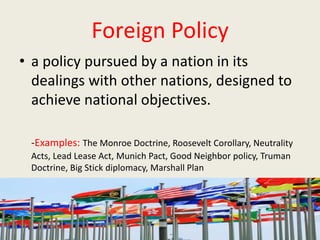
Foreign Policy
• a policy pursued by a nation in its
dealings with other nations, designed to
achieve national objectives.
-Examples: The Monroe Doctrine, Roosevelt Corollary, Neutrality
Acts, Lead Lease Act, Munich Pact, Good Neighbor policy, Truman
Doctrine, Big Stick diplomacy, Marshall Plan
Isolationism
a policy of
remaining apart
from the political
affairs and
interest of other
countries.
Internationalism
a political
principle which
supports a greater
political or
economic
cooperation
among nations
and peoples.
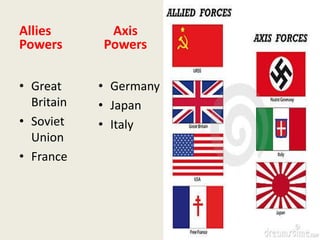
Allies
Powers
• Great
Britain
• Soviet
Union
• France
Axis
Powers
• Germany
• Japan
• Italy
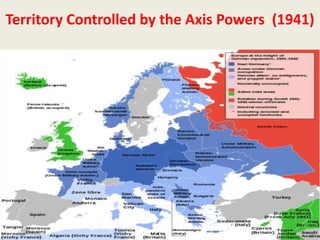
Territory Controlled by the Axis Powers (1941)
Neutrality Acts
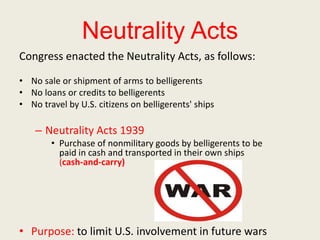
Congress enacted the Neutrality Acts, as follows:
• No sale or shipment of arms to belligerents
• No loans or credits to belligerents
• No travel by U.S. citizens on belligerents' ships
– Neutrality Acts 1939
• Purchase of nonmilitary goods by belligerents to be
paid in cash and transported in their own ships
(cash-and-carry)
• Purpose: to limit U.S. involvement in future wars
Lend-Lease Act 1941
• Ended U.S. neutrality!
• The U.S. committed huge
economic resources to
fighting [against]
Germany.
–Becomes “arsenal of
democracy”

WWII: Neutrality & Lend Lease

  • 1.
    World War II MASTHigh School US History – Period 4 Ms. Richardson
  • 2.
    United States: WorldWar I Statistics • # of causalities: – approximately 323,018 • Cost of war: – Approximately $32 billion The wars end bought widespread disillusionment in the early 1930s and the belief that the United States had been drawn into the war through loans and trade with the Allies. The media blamed bankers & munitions (weapons) companies for the war.
  • 3.
    Foreign Policy • apolicy pursued by a nation in its dealings with other nations, designed to achieve national objectives. -Examples: The Monroe Doctrine, Roosevelt Corollary, Neutrality Acts, Lead Lease Act, Munich Pact, Good Neighbor policy, Truman Doctrine, Big Stick diplomacy, Marshall Plan
  • 4.
    Isolationism a policy of remainingapart from the political affairs and interest of other countries. Internationalism a political principle which supports a greater political or economic cooperation among nations and peoples.
  • 5.
    Allies Powers • Great Britain • Soviet Union •France Axis Powers • Germany • Japan • Italy
  • 6.
    Territory Controlled bythe Axis Powers (1941)
  • 7.
    Neutrality Acts Congress enactedthe Neutrality Acts, as follows: • No sale or shipment of arms to belligerents • No loans or credits to belligerents • No travel by U.S. citizens on belligerents' ships – Neutrality Acts 1939 • Purchase of nonmilitary goods by belligerents to be paid in cash and transported in their own ships (cash-and-carry) • Purpose: to limit U.S. involvement in future wars
  • 8.
    Lend-Lease Act 1941 •Ended U.S. neutrality! • The U.S. committed huge economic resources to fighting [against] Germany. –Becomes “arsenal of democracy”

Editor's Notes

  • #2 What takes America out of the great depression? World War II
  • #9 The three types of economic resources are commonly known as human resources, natural resources and capital resources. Economists often refer to these three resources as the factors of production.