Chapter 26
FRANKLIN D. ROOSEVELT
AND THE NEW DEAL
America Past and Present
Eighth Edition
Divine  Breen  Fredrickson  Williams  Gross  Brand
Copyright 2007, Pearson Education, Inc., publishing as Longman
The Great Depression
• 1920s optimism drove increase in
expectations of continual improvement
• Stock market collapsed, factories
closed, unemployment went up,
optimism shattered
The Great Crash
• 1928: Soaring stock prices attracted
individual, corporate investment
• 1929: Stock market crashed
– Directly affected 3 million
– Credit crunch stifled business
• Businesses laid off workers
• Demand for consumer goods declined
The Great Crash
• New 1920s economy failed to distribute
wealth broadly enough
• Money used for profits, dividends, and
stock speculation should have been
used for wage increases
• Productivity increased 43%, wages only
by 11%
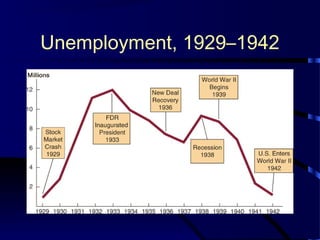
Unemployment, 1929–1942
Effects of the Depression
• Hardship affected all classes
• The middle class lost belief in ever-
increasing prosperity
• Thousands of young homeless, jobless
Fighting the Depression
• Republican attempts to overcome
catastrophe floundered
• Depression gave Democrats
opportunity to regain power
Hoover and Voluntarism
• Hoover initially sought solution through
voluntary action, private charity
• Eventually aided farmers with Farm Board
to buy surpluses and bankers with loans
through Reconstruction Finance
Corporation
• Bonus Army & General MacArthur
• Resisted Democratic efforts to give direct
aid to the unemployed
– Perceived as indifferent to human suffering
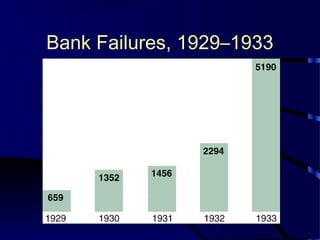
Bank Failures, 1929–1933
The Emergence of Roosevelt
• Franklin Roosevelt
– Born to wealth and privilege
– 1921: Crippled by polio
– 1928: Elected governor of New York
– Talented and persuasive politician
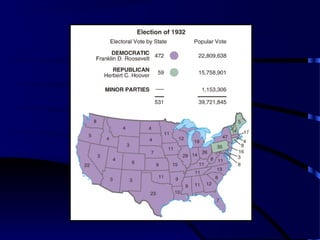
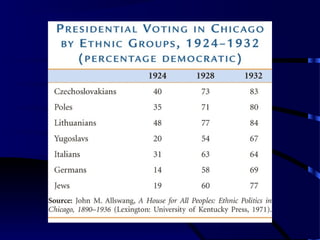
• 1932: Defeated Hoover with farmer-
worker-immigrant-Catholic coalition
The Hundred Days
• FDR inaugural inspired with the term
“nothing to fear, but fear itself”
• Banking system saved from collapse
• Fifteen major laws provided relief
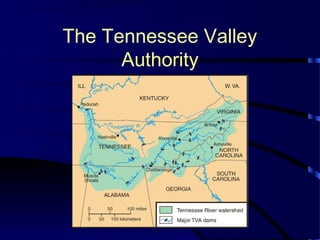
• Tennessee Valley Authority was the
most ambitious one
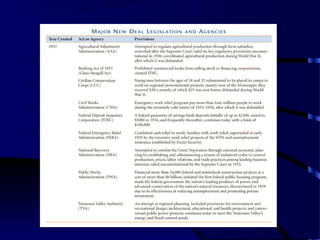
• New Deal aimed to reform and restore,
not nationalize, the economy
The Tennessee Valley
Authority
Roosevelt and Recovery
• National Recovery Administration
– Industries formulated codes to eliminate cut-throat
competition, ensure labor peace
– codes favored big business, unenforceable
– 1935: NRA ruled unconstitutional
• Agricultural Adjustment Act of 1933
– farmers paid to take land out of cultivation
– prices increased, mainly because of government
payments, but Dust Bowl helped by cutting supply
– sharecroppers, tenant farmers dispossessed
Roosevelt and Relief
• 1933: Harry Hopkins placed in charge
of RFC to direct aid to unemployed
• 1933: Civilian Conservation Corps
provided employment to young people
• 1935: Works Progress Administration
placed unemployed on federal payroll
• Programs never sufficiently funded
Roosevelt and Reform
• 1933–1934: Focus on immediate
problems
• 1935: Shift to permanent economic
reform, “broker state”
Challenges to FDR
• Father Charles Coughlin advocated
nationalizing banks, anti-Semitism
• Francis Townsend called for $200 per
month pensions to all those over 60 if
they spent it within the month
• Huey Long and the Share the Wealth
Clubs called for redistribution of wealth
by seizing private fortunes
Social Security
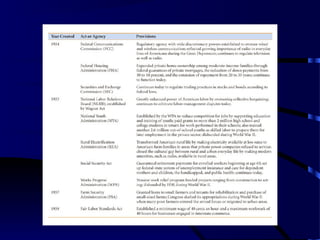
• 1935: Social Security Act passed
• Criticisms
– Too few people would collect pensions
– Unemployment package inadequate
• Established pattern of government aid
to poor, aged, handicapped
Labor Legislation
• 1935: Wagner Act
– Allowed unions to organize
– Outlawed unfair labor practices
• 1938: Fair Labor Standard Act
– Maximum hour
– Minimum wage
– Rural Electrification Administration brought
electricity to 90% of farmers who did not
have it in 1930
Impact of the New Deal
• Had a broad influence on the quality of
life in the U.S. in the 1930s
• Helped labor unions most
• Helped women, minorities least
Rise of Organized Labor
• 1932: National Recovery Act spurred
union organizers
• Congress of Industrial Organization
(CIO) formed by John L. Lewis
• CIO unionized steel, auto industries
• 1940: CIO membership hit 5 million,
28% of labor force unionized
The New Deal Record on Help
to Minorities
• Crop reduction program allowed whites
to fire or evict blacks, Hispanics
• Public works programs helped by
providing employment
• New Deal figures convinced minorities
that the government was on their side
• 1934: Indian Reorganization Act gave
American Indians greater control
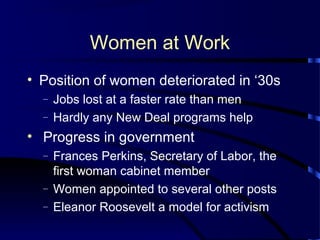
Women at Work
• Position of women deteriorated in ‘30s
– Jobs lost at a faster rate than men
– Hardly any New Deal programs help
• Progress in government
– Frances Perkins, Secretary of Labor, the
first woman cabinet member
– Women appointed to several other posts
– Eleanor Roosevelt a model for activism
End of the New Deal
• 1936: New Deal peaked with
Roosevelt’s reelection
• Congress resisted programs after 1936
The Election of 1936
• FDR’s campaign
– Attacked the rich
– Promised further reforms
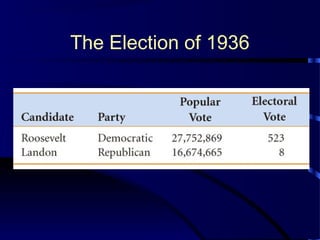
– Defeated Republican Alf Landon
• Democrats won lopsided majorities in
both houses of Congress
• FDR coalition: South, cities, labor,
ethnic groups, African Americans, poor
The Election of 1936
The Supreme Court Fight
• Supreme Court blocked several of
FDR’s first-term programs
• 1937: FDR sought right to "pack" Court
• Congressional protest forced retreat
• FDR’s opponents emboldened
The New Deal in Decline
• 1936: Cutbacks for relief agencies
• 1937: Severe slump hit economy
• Roosevelt blamed, resorted to huge
government spending
• 1938: Republican party revived
The New Deal and American Life
• New Deal’s limitations
– Depression not ended
– Economic system not fundamentally
altered
– Little done for those without political clout
• Achievements
– Social Security, the Wagner Act
– Political realignment of the 1930s

Ap 2 chapter 26 ppt notes MARTIN APUSH

  • 1.
    Chapter 26 FRANKLIN D.ROOSEVELT AND THE NEW DEAL America Past and Present Eighth Edition Divine  Breen  Fredrickson  Williams  Gross  Brand Copyright 2007, Pearson Education, Inc., publishing as Longman
  • 2.
    The Great Depression •1920s optimism drove increase in expectations of continual improvement • Stock market collapsed, factories closed, unemployment went up, optimism shattered
  • 3.
    The Great Crash •1928: Soaring stock prices attracted individual, corporate investment • 1929: Stock market crashed – Directly affected 3 million – Credit crunch stifled business • Businesses laid off workers • Demand for consumer goods declined
  • 4.
    The Great Crash •New 1920s economy failed to distribute wealth broadly enough • Money used for profits, dividends, and stock speculation should have been used for wage increases • Productivity increased 43%, wages only by 11%
  • 5.
  • 6.
    Effects of theDepression • Hardship affected all classes • The middle class lost belief in ever- increasing prosperity • Thousands of young homeless, jobless
  • 7.
    Fighting the Depression •Republican attempts to overcome catastrophe floundered • Depression gave Democrats opportunity to regain power
  • 8.
    Hoover and Voluntarism •Hoover initially sought solution through voluntary action, private charity • Eventually aided farmers with Farm Board to buy surpluses and bankers with loans through Reconstruction Finance Corporation • Bonus Army & General MacArthur • Resisted Democratic efforts to give direct aid to the unemployed – Perceived as indifferent to human suffering
  • 9.
  • 10.
    The Emergence ofRoosevelt • Franklin Roosevelt – Born to wealth and privilege – 1921: Crippled by polio – 1928: Elected governor of New York – Talented and persuasive politician • 1932: Defeated Hoover with farmer- worker-immigrant-Catholic coalition
  • 13.
    The Hundred Days •FDR inaugural inspired with the term “nothing to fear, but fear itself” • Banking system saved from collapse • Fifteen major laws provided relief • Tennessee Valley Authority was the most ambitious one • New Deal aimed to reform and restore, not nationalize, the economy
  • 14.
  • 15.
    Roosevelt and Recovery •National Recovery Administration – Industries formulated codes to eliminate cut-throat competition, ensure labor peace – codes favored big business, unenforceable – 1935: NRA ruled unconstitutional • Agricultural Adjustment Act of 1933 – farmers paid to take land out of cultivation – prices increased, mainly because of government payments, but Dust Bowl helped by cutting supply – sharecroppers, tenant farmers dispossessed
  • 16.
    Roosevelt and Relief •1933: Harry Hopkins placed in charge of RFC to direct aid to unemployed • 1933: Civilian Conservation Corps provided employment to young people • 1935: Works Progress Administration placed unemployed on federal payroll • Programs never sufficiently funded
  • 17.
    Roosevelt and Reform •1933–1934: Focus on immediate problems • 1935: Shift to permanent economic reform, “broker state”
  • 18.
    Challenges to FDR •Father Charles Coughlin advocated nationalizing banks, anti-Semitism • Francis Townsend called for $200 per month pensions to all those over 60 if they spent it within the month • Huey Long and the Share the Wealth Clubs called for redistribution of wealth by seizing private fortunes
  • 19.
    Social Security • 1935:Social Security Act passed • Criticisms – Too few people would collect pensions – Unemployment package inadequate • Established pattern of government aid to poor, aged, handicapped
  • 20.
    Labor Legislation • 1935:Wagner Act – Allowed unions to organize – Outlawed unfair labor practices • 1938: Fair Labor Standard Act – Maximum hour – Minimum wage – Rural Electrification Administration brought electricity to 90% of farmers who did not have it in 1930
  • 21.
    Impact of theNew Deal • Had a broad influence on the quality of life in the U.S. in the 1930s • Helped labor unions most • Helped women, minorities least
  • 22.
    Rise of OrganizedLabor • 1932: National Recovery Act spurred union organizers • Congress of Industrial Organization (CIO) formed by John L. Lewis • CIO unionized steel, auto industries • 1940: CIO membership hit 5 million, 28% of labor force unionized
  • 23.
    The New DealRecord on Help to Minorities • Crop reduction program allowed whites to fire or evict blacks, Hispanics • Public works programs helped by providing employment • New Deal figures convinced minorities that the government was on their side • 1934: Indian Reorganization Act gave American Indians greater control
  • 24.
    Women at Work •Position of women deteriorated in ‘30s – Jobs lost at a faster rate than men – Hardly any New Deal programs help • Progress in government – Frances Perkins, Secretary of Labor, the first woman cabinet member – Women appointed to several other posts – Eleanor Roosevelt a model for activism
  • 25.
    End of theNew Deal • 1936: New Deal peaked with Roosevelt’s reelection • Congress resisted programs after 1936
  • 26.
    The Election of1936 • FDR’s campaign – Attacked the rich – Promised further reforms – Defeated Republican Alf Landon • Democrats won lopsided majorities in both houses of Congress • FDR coalition: South, cities, labor, ethnic groups, African Americans, poor
  • 27.
  • 28.
    The Supreme CourtFight • Supreme Court blocked several of FDR’s first-term programs • 1937: FDR sought right to "pack" Court • Congressional protest forced retreat • FDR’s opponents emboldened
  • 31.
    The New Dealin Decline • 1936: Cutbacks for relief agencies • 1937: Severe slump hit economy • Roosevelt blamed, resorted to huge government spending • 1938: Republican party revived
  • 32.
    The New Dealand American Life • New Deal’s limitations – Depression not ended – Economic system not fundamentally altered – Little done for those without political clout • Achievements – Social Security, the Wagner Act – Political realignment of the 1930s