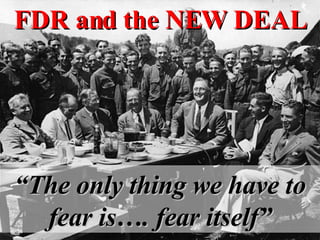
FDR and the NEW DEAL “ The only thing we have to fear is…. fear itself”
 
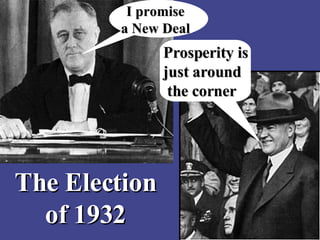
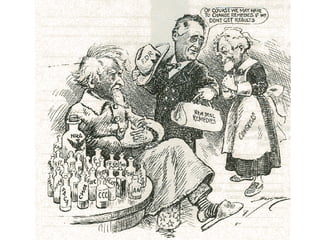
The Election of 1932 Prosperity is just around the corner I promise a New Deal !
INTRO to FDR Americans ready for a change 2. Elected with 23 million votes (57% of voting population) 3.  More of a quarterback…willing to experiment                             
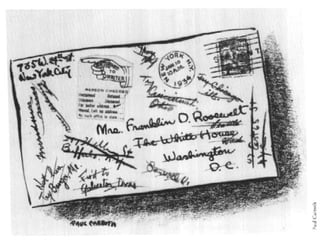
The New Deal Complete Web: “Impact…” Categorize federal programs: Relief Recovery or Reform Read: WPA article and two letters (the last two letters in the “Letters to Eleanor packet” - Describe the impact of job programs individuals  Slide show:Complete Chart Video: Develop an understanding of the AAA Laser Disc: Gather and check info on New Deal programs
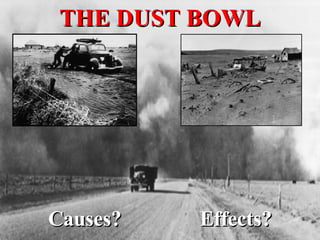
THE DUST BOWL Causes?  Effects?
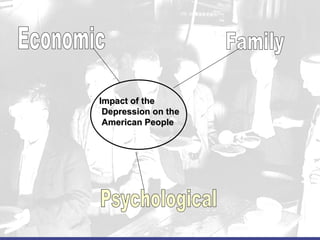
Impact of the  Depression on the  American People Family Economic Psychological


LEGISLATIVE LEADERSHIP 1. THE FIRST 100 DAYS 2. PRESIDENT AND ADVISORS WRITE MAJOR NEW DEAL LAWS 3. CHECKS AND BALANCES 4. INCREASED POWERS OF PRES .                             
 
 
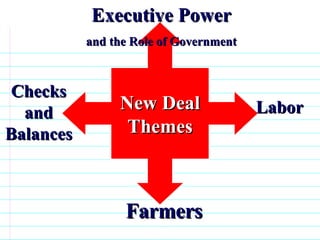
New Deal Themes Farmers Checks and Balances Executive Power and the Role of Government Labor                             
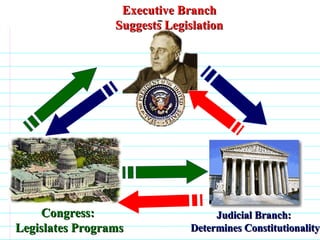
Congress:  Legislates Programs Judicial Branch:  Determines Constitutionality Executive Branch Suggests Legislation                             
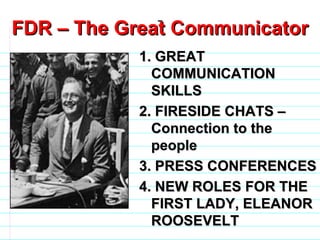
FDR – The Great Communicator 1. GREAT COMMUNICATION SKILLS 2. FIRESIDE CHATS – Connection to the people 3. PRESS CONFERENCES 4. NEW ROLES FOR THE FIRST LADY, ELEANOR ROOSEVELT                             
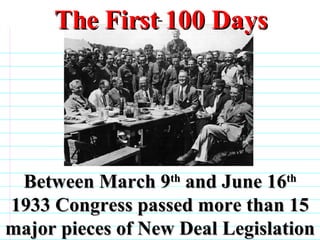
Between March 9 th  and June 16 th  1933 Congress passed more than 15 major pieces of New Deal Legislation The First 100 Days                             
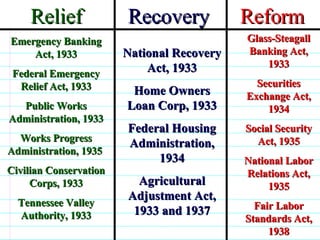
Relief Recovery Reform National Recovery Act, 1933 Home Owners Loan Corp, 1933 Federal Housing Administration, 1934 Agricultural Adjustment Act, 1933 and 1937 Emergency Banking Act, 1933 Federal Emergency Relief Act, 1933 Public Works Administration, 1933 Works Progress Administration, 1935  Civilian Conservation Corps, 1933 Tennessee Valley Authority, 1933 Glass-Steagall Banking Act, 1933 Securities Exchange Act, 1934 Social Security Act, 1935 National Labor Relations Act, 1935 Fair Labor Standards Act, 1938                             
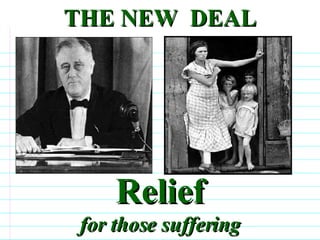
THE NEW  DEAL Relief for those suffering                             
                            
Closed the nation’s banks  (Bank Holiday) Bank examiners check banks Sound Banks Reopen Emergency Banking Act                             
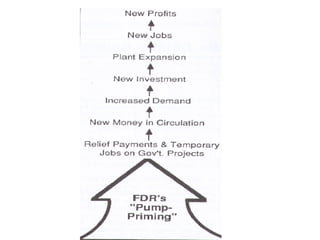
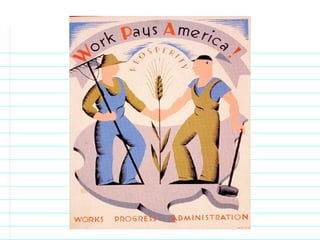
Civil Works Administration (CWA) Public Works Administration (PWA) Created 3 million work relief jobs repairing roads, parks and public buildings; replaced with Works Progress Administration (WPA) Created jobs on government projects that increased worker buying power and stimulated the economy                             
Civilian Conservation Corps (CCC) 1. Provide employment for young men between ages of 18-25 conserving natural resources 2. $2.5 million men participated during programs history Federal  Emergency Relief Administration Distributed $500,000 to states and cities for direct relief and work projects for the homeless and unemployed                             
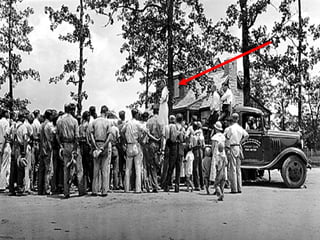
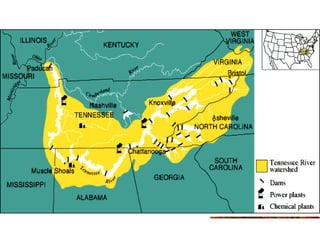
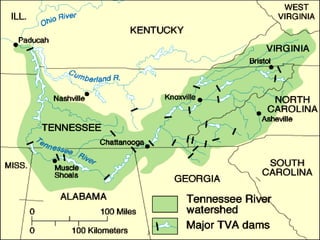
Tennessee Valley Authority (TVA) 1. Regional Development Project In Southeast 2. Intended to provide jobs, cheap electricity, flood control through construction of dams 3. Dams and power plants government owned                             
 
 
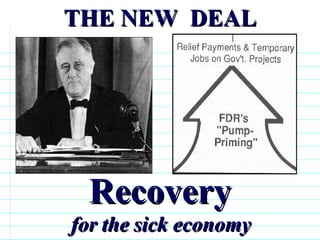
THE NEW  DEAL Recovery for the sick economy                             
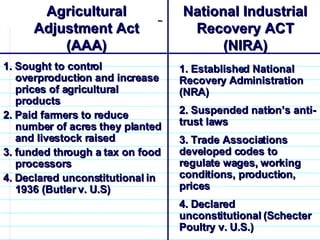
National Industrial  Recovery ACT (NIRA) Agricultural Adjustment Act (AAA) 1. Sought to control overproduction and increase prices of agricultural products 2. Paid farmers to reduce number of acres they planted and livestock raised 3. funded through a tax on food processors 4. Declared unconstitutional in 1936 (Butler v. U.S) 1. Established National Recovery Administration (NRA) 2. Suspended nation’s anti-trust laws 3. Trade Associations developed codes to regulate wages, working conditions, production, prices 4. Declared unconstitutional (Schecter Poultry v. U.S.)                             
Home Owners Loan Corp Refinanced mortgages of middle income home owners                             
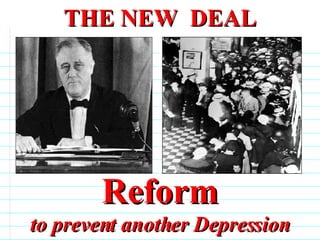
THE NEW  DEAL Reform to prevent another Depression                             
Glass-Steagall Banking Act 1. Established Federal Deposit Insurance Corp. (FDIC) 2. Insured Bank Accounts up to $5,000 Social Security  Act Provided old age insurance, unemployment  insurance Gave assistance to dependent children and the elderly, ill and handicapped                             
Securities  Exchange Act 1 . Required full disclosure of stock offered for sale 2. Established Securities and Exchange Commission (SEC) to regulate stock market 3. Gave Federal Reserve Board power to regulate purchase of stock on margin                             
National Labor Relations Act (Wagner Act) 1.Guaranteed Labor Right To Organize 2. Guaranteed Right to collective bargaining 3. Outlawed unfair labor practices like blacklisting 4. Created National Labor Relations Board                             
CRITICISMS OF  THE NEW DEAL : 1. OPPOSE INCREASED GOV’T ROLE IN ECONOMY (CREEPING SOCIALISM) 2. OPPOSE INCREASED TAXATION 3. OPPOSE DEFICIT SPENDING 4. OPPOSE WELFARE PROGRAMS                             
CRITICISMS OF THE NEW DEAL:  COURT PACKING 1.  BUTLER V. U.S.  &  SCHECHTER V. U.S. 2. FDR PROPOSES INCREASING SIZE OF SUPREME COURT FROM 9 TO 15 3. PROPOSAL RAISES SERIOUS CONSITUTIONAL ISSUES 4. CONGRESS REJECTS PLAN (Checks and Balances)                             
NEW DEAL: COURT CASES The United States vs.  Schechter Poultry Corporation (1935) The Supreme Court rules the the NRA gave Congress the power to regulate intrastate commerce and violated sep of powers The United States vs. Butler (1936) The Supreme Court declares the AAA is unconstitutional on the grounds that agriculture is a local, not an interstate matter                             
SCHECTHER (1935) BACKGROUND : Schecther Poultry Company bought, slaughtered, and sold chickens only in NYS and was charged with failing to observe minimum wage and hour provisions. ISSUE : Does the NIRA (and the President) have the power to regulate certain aspects of commerce during the Depression? OPINION : Congress, not the President has the power to regulate commerce                             
BUTLER (1936) BACKGROUND : The 1933 AAA implemented a tax on the processing of agricultural commodities. ISSUE : Does the U.S. Congress exceed its power to tax and spend in order to provide  for the general welfare of the US? OPINION : The AAA is unconstitutional because it attempted to regulate and control agricultural production, an areareserved to the states                             

The New Deal

  • 1.
    FDR and theNEW DEAL “ The only thing we have to fear is…. fear itself”
  • 2.
  • 3.
    The Election of1932 Prosperity is just around the corner I promise a New Deal !
  • 4.
    INTRO to FDRAmericans ready for a change 2. Elected with 23 million votes (57% of voting population) 3. More of a quarterback…willing to experiment                             
  • 5.
    The New DealComplete Web: “Impact…” Categorize federal programs: Relief Recovery or Reform Read: WPA article and two letters (the last two letters in the “Letters to Eleanor packet” - Describe the impact of job programs individuals Slide show:Complete Chart Video: Develop an understanding of the AAA Laser Disc: Gather and check info on New Deal programs
  • 6.
    THE DUST BOWLCauses? Effects?
  • 7.
    Impact of the Depression on the American People Family Economic Psychological
  • 8.
  • 9.
  • 10.
  • 11.
    LEGISLATIVE LEADERSHIP 1.THE FIRST 100 DAYS 2. PRESIDENT AND ADVISORS WRITE MAJOR NEW DEAL LAWS 3. CHECKS AND BALANCES 4. INCREASED POWERS OF PRES .                             
  • 12.
  • 13.
  • 14.
    New Deal ThemesFarmers Checks and Balances Executive Power and the Role of Government Labor                             
  • 15.
    Congress: LegislatesPrograms Judicial Branch: Determines Constitutionality Executive Branch Suggests Legislation                             
  • 16.
    FDR – TheGreat Communicator 1. GREAT COMMUNICATION SKILLS 2. FIRESIDE CHATS – Connection to the people 3. PRESS CONFERENCES 4. NEW ROLES FOR THE FIRST LADY, ELEANOR ROOSEVELT                             
  • 17.
    Between March 9th and June 16 th 1933 Congress passed more than 15 major pieces of New Deal Legislation The First 100 Days                             
  • 18.
    Relief Recovery ReformNational Recovery Act, 1933 Home Owners Loan Corp, 1933 Federal Housing Administration, 1934 Agricultural Adjustment Act, 1933 and 1937 Emergency Banking Act, 1933 Federal Emergency Relief Act, 1933 Public Works Administration, 1933 Works Progress Administration, 1935 Civilian Conservation Corps, 1933 Tennessee Valley Authority, 1933 Glass-Steagall Banking Act, 1933 Securities Exchange Act, 1934 Social Security Act, 1935 National Labor Relations Act, 1935 Fair Labor Standards Act, 1938                             
  • 19.
    THE NEW DEAL Relief for those suffering                             
  • 20.
  • 21.
    Closed the nation’sbanks (Bank Holiday) Bank examiners check banks Sound Banks Reopen Emergency Banking Act                             
  • 22.
    Civil Works Administration(CWA) Public Works Administration (PWA) Created 3 million work relief jobs repairing roads, parks and public buildings; replaced with Works Progress Administration (WPA) Created jobs on government projects that increased worker buying power and stimulated the economy                             
  • 23.
    Civilian Conservation Corps(CCC) 1. Provide employment for young men between ages of 18-25 conserving natural resources 2. $2.5 million men participated during programs history Federal Emergency Relief Administration Distributed $500,000 to states and cities for direct relief and work projects for the homeless and unemployed                             
  • 24.
    Tennessee Valley Authority(TVA) 1. Regional Development Project In Southeast 2. Intended to provide jobs, cheap electricity, flood control through construction of dams 3. Dams and power plants government owned                             
  • 25.
  • 26.
  • 27.
    THE NEW DEAL Recovery for the sick economy                             
  • 28.
    National Industrial Recovery ACT (NIRA) Agricultural Adjustment Act (AAA) 1. Sought to control overproduction and increase prices of agricultural products 2. Paid farmers to reduce number of acres they planted and livestock raised 3. funded through a tax on food processors 4. Declared unconstitutional in 1936 (Butler v. U.S) 1. Established National Recovery Administration (NRA) 2. Suspended nation’s anti-trust laws 3. Trade Associations developed codes to regulate wages, working conditions, production, prices 4. Declared unconstitutional (Schecter Poultry v. U.S.)                             
  • 29.
    Home Owners LoanCorp Refinanced mortgages of middle income home owners                             
  • 30.
    THE NEW DEAL Reform to prevent another Depression                             
  • 31.
    Glass-Steagall Banking Act1. Established Federal Deposit Insurance Corp. (FDIC) 2. Insured Bank Accounts up to $5,000 Social Security Act Provided old age insurance, unemployment insurance Gave assistance to dependent children and the elderly, ill and handicapped                             
  • 32.
    Securities ExchangeAct 1 . Required full disclosure of stock offered for sale 2. Established Securities and Exchange Commission (SEC) to regulate stock market 3. Gave Federal Reserve Board power to regulate purchase of stock on margin                             
  • 33.
    National Labor RelationsAct (Wagner Act) 1.Guaranteed Labor Right To Organize 2. Guaranteed Right to collective bargaining 3. Outlawed unfair labor practices like blacklisting 4. Created National Labor Relations Board                             
  • 34.
    CRITICISMS OF THE NEW DEAL : 1. OPPOSE INCREASED GOV’T ROLE IN ECONOMY (CREEPING SOCIALISM) 2. OPPOSE INCREASED TAXATION 3. OPPOSE DEFICIT SPENDING 4. OPPOSE WELFARE PROGRAMS                             
  • 35.
    CRITICISMS OF THENEW DEAL: COURT PACKING 1. BUTLER V. U.S. & SCHECHTER V. U.S. 2. FDR PROPOSES INCREASING SIZE OF SUPREME COURT FROM 9 TO 15 3. PROPOSAL RAISES SERIOUS CONSITUTIONAL ISSUES 4. CONGRESS REJECTS PLAN (Checks and Balances)                             
  • 36.
    NEW DEAL: COURTCASES The United States vs. Schechter Poultry Corporation (1935) The Supreme Court rules the the NRA gave Congress the power to regulate intrastate commerce and violated sep of powers The United States vs. Butler (1936) The Supreme Court declares the AAA is unconstitutional on the grounds that agriculture is a local, not an interstate matter                             
  • 37.
    SCHECTHER (1935) BACKGROUND: Schecther Poultry Company bought, slaughtered, and sold chickens only in NYS and was charged with failing to observe minimum wage and hour provisions. ISSUE : Does the NIRA (and the President) have the power to regulate certain aspects of commerce during the Depression? OPINION : Congress, not the President has the power to regulate commerce                             
  • 38.
    BUTLER (1936) BACKGROUND: The 1933 AAA implemented a tax on the processing of agricultural commodities. ISSUE : Does the U.S. Congress exceed its power to tax and spend in order to provide for the general welfare of the US? OPINION : The AAA is unconstitutional because it attempted to regulate and control agricultural production, an areareserved to the states