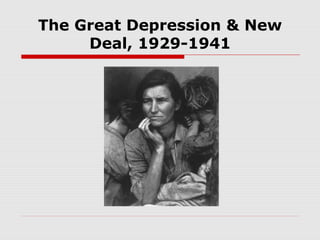
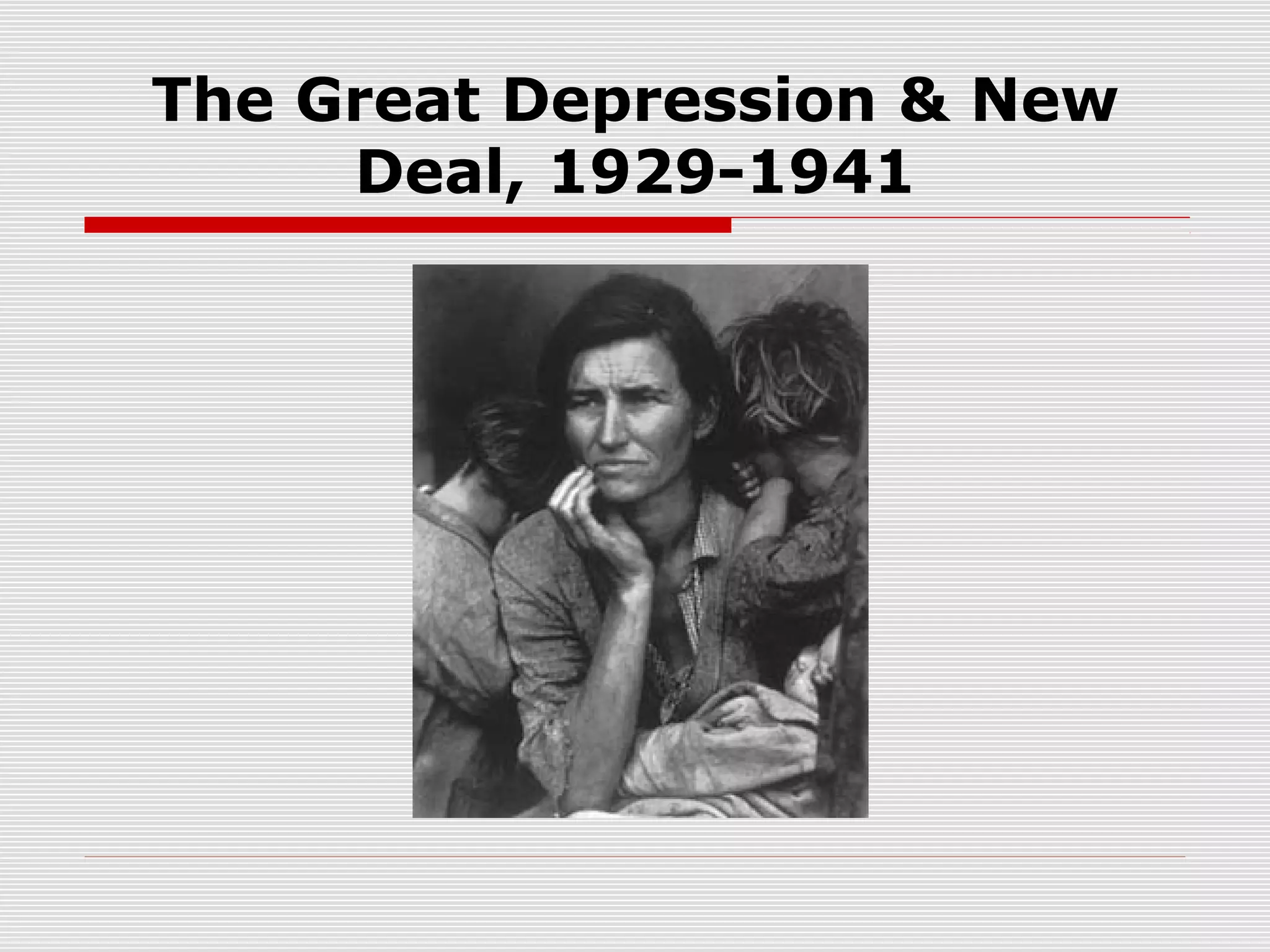
The Great Depression & New
Deal, 1929-1941
Origins and Causes
Extreme wealth inequalities
Ballooning stock market
Over reliance on unprotected loans
Too much speculation & borrowing
Overproduction and uneven distribution capabilities
Stock Market crash was a symptom
Banks lacked money, people lost savings, debts were
called in, no cash
 Production stopped, workers fired, no $,
consumption declined, no profits, more workers fired







President Hoover







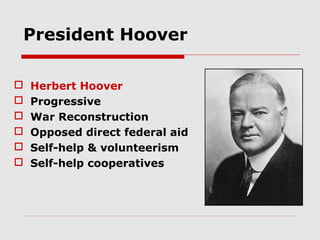
Herbert Hoover
Progressive
War Reconstruction
Opposed direct federal aid
Self-help & volunteerism
Self-help cooperatives
“Hoover’s America”
 Anti-tax views & opposition to gov’t
support deepened depression
 Texas legislature vetoed a bond measure
for relief
 Oklahoma governor William Murray called
out the national guard to enforce
segregation in OK City
 Colorado Senator Ed Costigan wanted
federal government to help states in relief
efforts
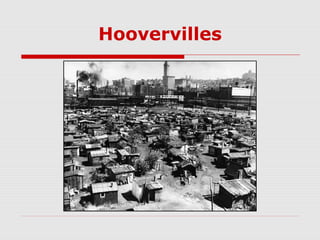
Hoovervilles
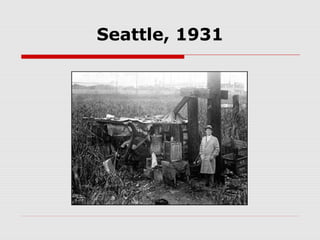
Seattle, 1931
The Bonus Army/March










World War One veterans
Gov’t denied their pensions
Marched on Washington, 1932
Congregated around White House
Gen. Douglas MacArthur
Military evicted them from D.C.
Deep anger at gov’t
Deep class divisions
http://www.youtube.com/watch?v=xqevdBZC
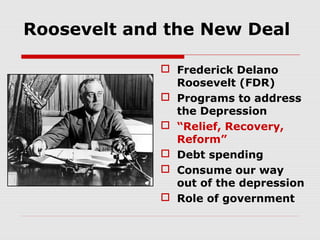
Roosevelt and the New Deal
 Frederick Delano
Roosevelt (FDR)
 Programs to address
the Depression
 “Relief, Recovery,
Reform”
 Debt spending
 Consume our way
out of the depression
 Role of government
Immediate Responses, 1933
 Federal Emergency Relief Act
 Federal funds for relief

 National Industrial Recovery Act
 Fair work and competition codes
 Administration to enforce codes
 Guaranteed labor’s right to organize
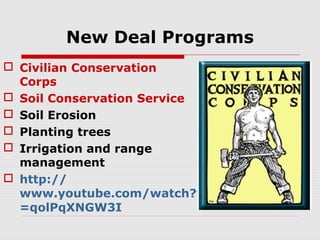
New Deal Programs
 Civilian Conservation
Corps
 Soil Conservation Service
 Soil Erosion
 Planting trees
 Irrigation and range
management
 http://
www.youtube.com/watch?v
=qolPqXNGW3I
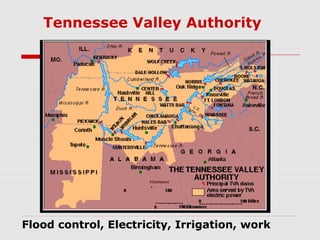
Tennessee Valley Authority

Flood control, Electricity, Irrigation, work
Works Progress Administration
WPA
 Biggest agency
 1935 employed 8 million and
$2 billion fund
 Bridges, reservoirs, irrigation, sewage,
schools, playgrounds, education, training

 Work Programs paid minimum wages,
pulled them off charity and soup lines
 “We Work Again”
 http://www.youtube.com/watch?v
=Gk0SpTOi9Aw
1935 Social Security Act
Safety net for all Americans
Percentage of paycheck
Based on shorter life-span
Intended to supplement (not
replace) income
 Less inclined to “retire”




Financial System
 Federal Deposit Insurance
Corporation (FDIC)
 Insured individual bank deposits

 Securities and Exchange
Commission (SEC)
 Regulated trading practices in stocks
and bonds
Problems with New Deal
 Relief based on race: Tucson
scaled payments based on race
 Favored large industries and
business
 Hurt some small farmers
 Local agencies administered relief
and ran programs
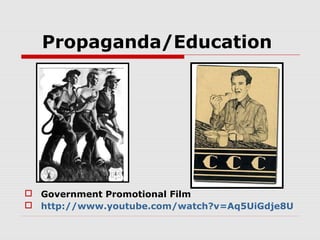
Propaganda/Education

 Government Promotional Film
 http://www.youtube.com/watch?v=Aq5UiGdje8U
Water and the West
 Bureau of Reclamation
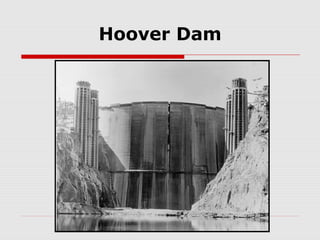
 Hoover Dam
 Water for L.A., Imperial Valley, Phoenix,
and power for region

 Central Valley Project harnessed the
Sacramento River
 Water storage, irrigation, hydro-electricity
 Federal-corporate alliance
 $2.5 billion by 1935
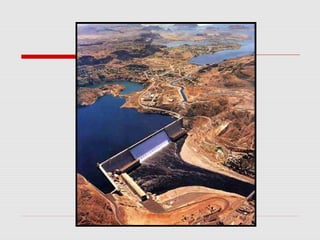
Hoover Dam
Grand Coulee Dam
 Columbia River, 1941
 Largest concrete structure in the
world
 Created a 150 mile lake
 Too much power
 Bonneville Power Administration
 Powered 70% of Northwest
The Dust Bowl
 Economic and environmental disaster
 Overproduction, monocrops
 Plowed up grasses for farms to meet the
needs of a booming wheat market
 Soil exhaustion, soil erosion
 Drought and winds
 1935: Blew winds from CO and NE,
blackened the sky across the plains, into
the East and Atlantic Ocean
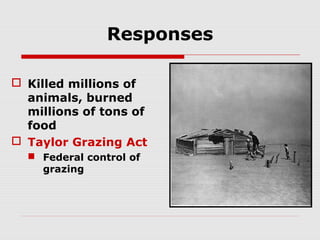
Responses
 Killed millions of
animals, burned
millions of tons of
food
 Taylor Grazing Act
 Federal control of
grazing
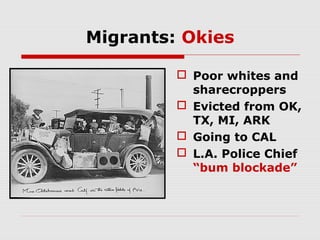
Migrants: Okies
 Poor whites and
sharecroppers
 Evicted from OK,
TX, MI, ARK
 Going to CAL
 L.A. Police Chief
“bum blockade”
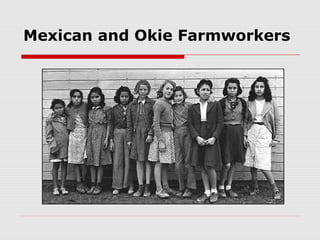
Mexican and Okie Farmworkers
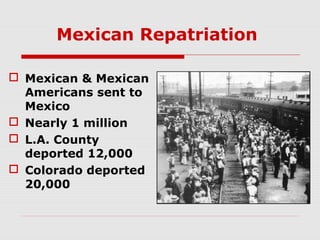
Mexican Repatriation
 Mexican & Mexican
Americans sent to
Mexico
 Nearly 1 million
 L.A. County
deported 12,000
 Colorado deported
20,000
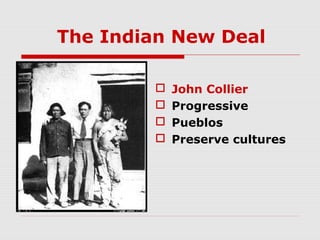
The Indian New Deal





John Collier
Progressive
Pueblos
Preserve cultures
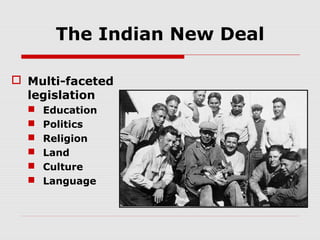
The Indian New Deal
 Multi-faceted
legislation







Education
Politics
Religion
Land
Culture
Language
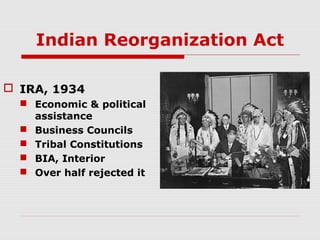
Indian Reorganization Act
 IRA, 1934
 Economic & political
assistance
 Business Councils
 Tribal Constitutions
 BIA, Interior
 Over half rejected it
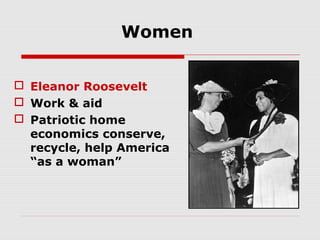
Women
 Eleanor Roosevelt
 Work & aid
 Patriotic home
economics conserve,
recycle, help America
“as a woman”
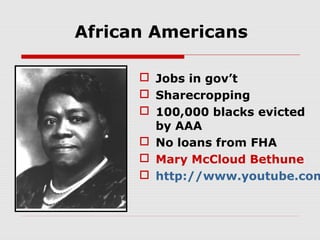
African Americans

 Jobs in gov’t
 Sharecropping
 100,000 blacks evicted
by AAA
 No loans from FHA
 Mary McCloud Bethune
 http://www.youtube.com
“Share the Wealth”







Huey Long
Populist Gov. in LA
Use of radio and sensational claims
Rhetoric of poverty / class tensions
Senator
Share the Wealth

 Social Justice


http://www.youtube.com/watch?v=mdzAbxsjPRA&NR=1
Public Art and Culture
 Federal Writers Project
 Theater
 Oral histories of slavery, folk lore, Indian
stories, Mexican Revolution, cowboys,
frontier life, etc
 National cultural resources and heritage
 Federal Arts Program
 http://www.youtube.com/watch?v
=PKsm3SmBBKU&feature=related
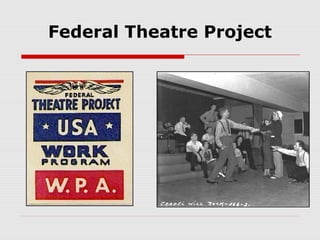
Federal Theatre Project
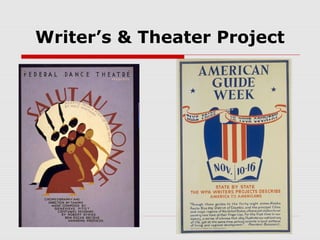
Writer’s & Theater Project
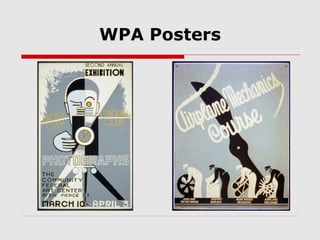
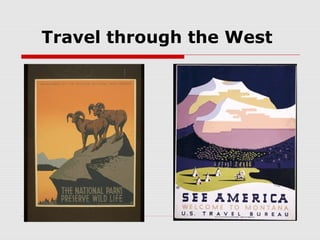
WPA Posters
Travel through the West
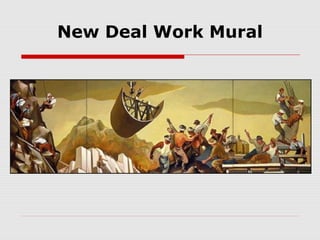
New Deal Work Mural
End of the Depression
 Federal spending on an unprecedented
level failed to stop it
 The largest entrance of the federal
government into the American economy
 Made the federal government into a
“broker state” between labor and capital
 Social programs and “safety net”
 Brought fed gov’t into the lives of nearly
all Westerners
 WWII ended the Depression
Comparisons with the Present?
Wealth inequalities
Deregulation
Bad Home mortgages
Massive individual debt
Inflated costs & uncontrolled speculative
investments in commodities
 Collapse of investment-debt-loan system
 A Vicious Cycle:






 Retraction of loans, increase in job losses, fall in
investments, layoffs, decline in consumption,
reduced production, layoffs, no consumption…

Greatdepression and New Deal

  • 1.
    The Great Depression& New Deal, 1929-1941
  • 2.
    Origins and Causes Extremewealth inequalities Ballooning stock market Over reliance on unprotected loans Too much speculation & borrowing Overproduction and uneven distribution capabilities Stock Market crash was a symptom Banks lacked money, people lost savings, debts were called in, no cash  Production stopped, workers fired, no $, consumption declined, no profits, more workers fired       
  • 3.
    President Hoover       Herbert Hoover Progressive WarReconstruction Opposed direct federal aid Self-help & volunteerism Self-help cooperatives
  • 4.
    “Hoover’s America”  Anti-taxviews & opposition to gov’t support deepened depression  Texas legislature vetoed a bond measure for relief  Oklahoma governor William Murray called out the national guard to enforce segregation in OK City  Colorado Senator Ed Costigan wanted federal government to help states in relief efforts
  • 5.
  • 6.
  • 7.
    The Bonus Army/March          WorldWar One veterans Gov’t denied their pensions Marched on Washington, 1932 Congregated around White House Gen. Douglas MacArthur Military evicted them from D.C. Deep anger at gov’t Deep class divisions http://www.youtube.com/watch?v=xqevdBZC
  • 8.
    Roosevelt and theNew Deal  Frederick Delano Roosevelt (FDR)  Programs to address the Depression  “Relief, Recovery, Reform”  Debt spending  Consume our way out of the depression  Role of government
  • 9.
    Immediate Responses, 1933 Federal Emergency Relief Act  Federal funds for relief  National Industrial Recovery Act  Fair work and competition codes  Administration to enforce codes  Guaranteed labor’s right to organize
  • 10.
    New Deal Programs Civilian Conservation Corps  Soil Conservation Service  Soil Erosion  Planting trees  Irrigation and range management  http:// www.youtube.com/watch?v =qolPqXNGW3I
  • 11.
    Tennessee Valley Authority Floodcontrol, Electricity, Irrigation, work
  • 12.
    Works Progress Administration WPA Biggest agency  1935 employed 8 million and $2 billion fund  Bridges, reservoirs, irrigation, sewage, schools, playgrounds, education, training  Work Programs paid minimum wages, pulled them off charity and soup lines  “We Work Again”  http://www.youtube.com/watch?v =Gk0SpTOi9Aw
  • 13.
    1935 Social SecurityAct Safety net for all Americans Percentage of paycheck Based on shorter life-span Intended to supplement (not replace) income  Less inclined to “retire”    
  • 14.
    Financial System  FederalDeposit Insurance Corporation (FDIC)  Insured individual bank deposits  Securities and Exchange Commission (SEC)  Regulated trading practices in stocks and bonds
  • 15.
    Problems with NewDeal  Relief based on race: Tucson scaled payments based on race  Favored large industries and business  Hurt some small farmers  Local agencies administered relief and ran programs
  • 16.
    Propaganda/Education  Government PromotionalFilm  http://www.youtube.com/watch?v=Aq5UiGdje8U
  • 17.
    Water and theWest  Bureau of Reclamation  Hoover Dam  Water for L.A., Imperial Valley, Phoenix, and power for region  Central Valley Project harnessed the Sacramento River  Water storage, irrigation, hydro-electricity  Federal-corporate alliance  $2.5 billion by 1935
  • 18.
  • 19.
    Grand Coulee Dam Columbia River, 1941  Largest concrete structure in the world  Created a 150 mile lake  Too much power  Bonneville Power Administration  Powered 70% of Northwest
  • 21.
    The Dust Bowl Economic and environmental disaster  Overproduction, monocrops  Plowed up grasses for farms to meet the needs of a booming wheat market  Soil exhaustion, soil erosion  Drought and winds  1935: Blew winds from CO and NE, blackened the sky across the plains, into the East and Atlantic Ocean
  • 22.
    Responses  Killed millionsof animals, burned millions of tons of food  Taylor Grazing Act  Federal control of grazing
  • 23.
    Migrants: Okies  Poorwhites and sharecroppers  Evicted from OK, TX, MI, ARK  Going to CAL  L.A. Police Chief “bum blockade”
  • 24.
    Mexican and OkieFarmworkers
  • 25.
    Mexican Repatriation  Mexican& Mexican Americans sent to Mexico  Nearly 1 million  L.A. County deported 12,000  Colorado deported 20,000
  • 26.
    The Indian NewDeal     John Collier Progressive Pueblos Preserve cultures
  • 27.
    The Indian NewDeal  Multi-faceted legislation       Education Politics Religion Land Culture Language
  • 28.
    Indian Reorganization Act IRA, 1934  Economic & political assistance  Business Councils  Tribal Constitutions  BIA, Interior  Over half rejected it
  • 29.
    Women  Eleanor Roosevelt Work & aid  Patriotic home economics conserve, recycle, help America “as a woman”
  • 30.
    African Americans  Jobsin gov’t  Sharecropping  100,000 blacks evicted by AAA  No loans from FHA  Mary McCloud Bethune  http://www.youtube.com
  • 31.
    “Share the Wealth”       HueyLong Populist Gov. in LA Use of radio and sensational claims Rhetoric of poverty / class tensions Senator Share the Wealth  Social Justice  http://www.youtube.com/watch?v=mdzAbxsjPRA&NR=1
  • 32.
    Public Art andCulture  Federal Writers Project  Theater  Oral histories of slavery, folk lore, Indian stories, Mexican Revolution, cowboys, frontier life, etc  National cultural resources and heritage  Federal Arts Program  http://www.youtube.com/watch?v =PKsm3SmBBKU&feature=related
  • 33.
  • 34.
  • 35.
  • 36.
  • 37.
  • 38.
    End of theDepression  Federal spending on an unprecedented level failed to stop it  The largest entrance of the federal government into the American economy  Made the federal government into a “broker state” between labor and capital  Social programs and “safety net”  Brought fed gov’t into the lives of nearly all Westerners  WWII ended the Depression
  • 39.
    Comparisons with thePresent? Wealth inequalities Deregulation Bad Home mortgages Massive individual debt Inflated costs & uncontrolled speculative investments in commodities  Collapse of investment-debt-loan system  A Vicious Cycle:       Retraction of loans, increase in job losses, fall in investments, layoffs, decline in consumption, reduced production, layoffs, no consumption…