THE MUSICAL BRAIN
NEUROLOGICAL CURIOSITIES OF
MUSICIANS, MUSIC AND THE REST OF US
Randy M. Rosenberg MD FAAN FACP
Assistant Professor of Neurology
Temple School of Medicine
Former Chief, Division of Neurology
Aria Healthcare
Principle Flutist of the Warminster Symphony
LONG TERM BENEFITS OF
MUSIC EDUCATION
• Preschoolers who had keyboard training did better at math
reasoning than another group that had computer training instead.
• College students who had received musical training before age 12
remembered significantly more words from a list than other
students.
• Infants can distinguish differences in pitch, melody and rhythm
from very early on. In fact, they even seem to recognize music they
were exposed to repeatedly in the womb.
• Students who received daily music training for seven months had
higher reading scores at the end than did a control group. A year
later, their scores were still higher than the control groups.
• Preschoolers were able to learn body parts better in a lesson that
used music and dance as opposed to conventional lessons, or
even one including movement but no music.
SO WHAT DO YOU HEAR….?
OR WHAT MAKES SOMETHING
MUSICAL?
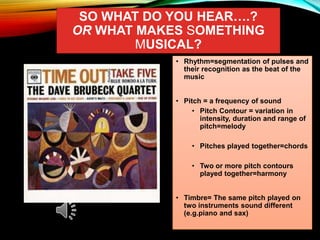
• Rhythm=segmentation of pulses and
their recognition as the beat of the
music
• Pitch = a frequency of sound
• Pitch Contour = variation in
intensity, duration and range of
pitch=melody
• Pitches played together=chords
• Two or more pitch contours
played together=harmony
• Timbre= The same pitch played on
two instruments sound different
(e.g.piano and sax)
”I LIKE THE BEAT, AND YOU CAN DANCE TO IT.
I GIVE IT A 85”
Rock-a-bye Baby
¾
Segments of 3 beats to a
measure
You’re a Grand Old
Flag
2/4
Segments of 2 beats to a
measure
ASMR: AUTONOMOUS SENSORY
MERIDIAN RESPONSE
• A distinct, pleasurable tingling
sensation in the head, scalp,
back, or peripheral regions of
the body in response to visual,
auditory, tactile, olfactory, or
cognitive stimuli
• Whispering is the most
frequently cited stimulus
• So SOUND ALONE CAN
INDUCE PLEASURE WITHOUT
BEING MUSICAL! (FOR
EXAMPLE…)
MUSICAL FRISSON
MESOLIBIC DOPAMINERGIC SYSTEM OR
HOW TO GET “HIGH” (MUSICALLY SPEAKING)
Pleasure stimulates the
release of dopamine
particularly in the nucleus
accumbens
Sex, eating, gambling,
addition and <drum roll!>
MUSIC!
DECIBEL (LOUDNESS) COMPARISON
CHART
DAMAGING
SOUND
EXPOSURE
WHETHER
MUSIC OR
NOISE
For every 3dBs over 85,
permissable exposure time is
cut in half
80/90 rule for MP3 players
IPOD AND DAMAGE TO
HEARING
The Fligor Rule (2006)
Maximum settings to obtain 50% maximum dosage…
iPod volume at 60% for 120 minutes
Depends on earphone used
Some earphones “isolate” the ear.
Some earphones have different electro-acoustic characteristics.
In quiet environment, most people have iPod volumes at
50% but in noisy environments the volume is often 80%.
Use isolating headphones!
HEARING LOSS IN
MUSICIANS
• 170,000 professional musicians
• 60 million+ amateur musicians
• Percentage with hearing loss
• Adult musicians age 27-66 years 61%
• Youth musicians age 18-22 years 22%
• Child Musicians age 8-12 years 16%
Hearing thresholds are generally better in women
Progression is slower in women and in men
THIS IS WHY THE PROBLEMS OF MUSICIANS ARE SO
IMPORTANT! (IT’S THE NUMBERS STUPID!)
FIVE FACTORS AFFECTING HEARING
LOSS IN MUSICIANS
• Intensity
• Maximum limits for symphony orchestras are achieved at anywhere
between 10 and 25 hours per week of playing.
• Levels in excess of 85 dBA were measured even during a relatively quiet
etude at Canada’s National Ballet with a peak level of 126 dBA.
• Duration
• “Liking the music”
• Stapedial reflex
• (Individual factors)
AN ORCHESTRA CAN BE A DANGEROUS PLACE TO
WORK!
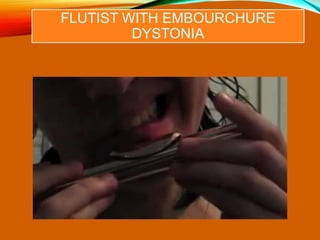
MUSICIAN’S DYSTONIA
• Loss of voluntary control in the hands or embouchure (oral
musculature) when playing an instrument.
• Originate in the brain
• Symptoms generally do not manifest during other activities.
• The disorder may progress over a period of time and then
stabilize.
• Focal dystonia never resolves spontaneously
MUSICIAN’S DYSTONIA:
CHARACTERISTICS
• Occurs in up to 1% off all professional musicians and can
end a career eg Liona Boyd, Glenn Gould, Robert
Schumann
• Usually affects part of body most involved with rapid
repetitive actions
• Pianists right > left hand
• Flutist embouchure (lips)
• Violinists left hand
• Guitarists right hand
• Painless and may be bilateral
• Usually affects 4th and 5th fingers
• Worsens with continued activity
• Sensory tricks are common
GUITARIST WITH
MUSICIAN’S DYSTONIA
FLUTIST WITH EMBOURCHURE
DYSTONIA
PATTERNS OF
MUSICIAN’S DYSTONIA
PRIMARY BOW TREMOR
MUSCULOSKELETAL AND NEUROPATHIC INJURY IN
MUSICIANS
MUSCULOSKELETAL AND NEUROPATHIC
INJURY IN MUSICIANS
• Carpal Tunnel Syndrome
• Especially in guitar, violin and viola players
• Sustained 12th and 13th position on violin
• Cubital Tunnel Syndrome (Ulnar neuropathy)
• Left hand of violin, viola and guitar players
• Thoracic Outlet
• Bilateral in flutists
• Left sided in violinists
• Radial Tunnel Syndrome v lateral epicondylitis
GADGETS TO REDUCE MUSCULOSKELETAL INJURY
MUSICAL
HALLUCINATIONS 1
• Charles Ives, Robert Schumann, Shostakovich
• Interfere with perception or conversation in a manner that
never occurs with normal musical imagery
• Usually are a reference from the patient’s history of musical
exposure or training
• Characteristics changes over time
• Increasingly loud
• More intrusive
• Expanded repertoire with shorter duration
• Patient has limited options for control
MUSICAL
HALLUCINATIONS 2
• Can be a manifestation of partial seizures usually of right temporal
origin
• Drug induced
• Anticonvulsants
• Antidepressants
• Anesthetics
• Opiates
• Amandatine
• Most common among hearing impaired suspected as a cortical release
phenomenon.
• Female > male
• Advanced age
• NOT earworms
• Treatment
• Gabapentin, quintiapine cochlear implant
MUSICOGENIC EPILEPSY
• Reflex epilepsy in response to the psychoacoustic aspects of
music
• Strong correlation to the temporal lobe and a right-sided
preponderance
• Patients often have multiple seizure types
• Absence and secondary generalization are often influenced by
duration of music
• Dejavu and other affective seizures are associated with music
that evokes strong memories and preference
WILLIAMS SYNDROME
• Characteristic facial
morphotype
• Severe cognitive
dysfunction
• Cardiovascular disease
accounts for most cases of
early mortality
• Interest and enthusiasm for
music is almost universal
along with extreme
sociability and
loquaciousness
AMUSIA
Talking about music is like dancing
about architecture
"I know only 2 tunes: one of them is
'Yankee Doodle', and the other one isn't." -
Ulysses S. Grant
AMUSIA I
• Inability to recognize musical tones or rhythms or to
reproduce them.
• Congenital Amusia
• Occurs in 5% of population and is life long
• Likely some genetic element
• Inability to recognize or reproduce familiar tunes
• Impaired ability to judge pitch
• Variable severity (some individual find music unpleasant e.g.
banging and will avoid whenever possible)
• Generally does not affect prosody or the ability to recognize
familiar sounds
IF YOU ARE AMUSIC…….
• You report having the condition for as long as you can remember
• Unaware when music, including your own singing, is off-key
• Difficulty discriminating or recognizing melodies without lyrics
• Disliking of musical sounds and avoidance of public places and situations
where music occurs.
• Unlikely to “use” music in everyday life or experience reactions such as chills,
relaxation or mood enhancement
(Ayotte et al, 2002; Peretz et al, 2003; McDonald & Stewart, 2008)
AMUSIA II
• Acquired Amusia
• Often Coexists with Aphasia
• Can have isolated deficits in melody and rhythm
• Expressive
• Impaired singing
• Impaired ability to play an instrument
• Deficit for writing musical notation
• Receptive
• Inability to read musical notation
• Inability to interpret melody
• Mixed
GEORGE GERSHWIN
• George Gershwin, renowned composer
and pianist, well known for his popular
works, died on the 11th July 1937 due to a
malignant brain tumor.
• His neurological symptoms first appeared
on that same year, in February, with a
simple olfactory partial seizure,
characterized by an unpleasant smell of
burnt rubber (uncinated seizure).
• He later had a quick clinical descend, with
severe headache that occurred in bouts,
dizziness, coordination compromise and
olfactory seizures, eventually lapsing into
a coma on the 9th July 1937. Despite the
surgical intervention, Gershwin died soon
after the procedure without recovering his
consciousness.
MAURICE RAVEL
• Ravel's suffered a progressive
dementia with loss of fluent
speech or write music but
could still listen critically. “My
mind is full of ideas,” he wrote,
“but when I want to write them
down, they vanish.”
• Died in 1937 (5 months after
Gershwin) likely from
complications of neurosurgical
intervention. No tumor found.
(possible Fronto-temporal
dementia or late effects of
trauma)
Thank you for your
attention and may all
of your days be
tuneful ones.

The musical brain

  • 1.
    THE MUSICAL BRAIN NEUROLOGICALCURIOSITIES OF MUSICIANS, MUSIC AND THE REST OF US Randy M. Rosenberg MD FAAN FACP Assistant Professor of Neurology Temple School of Medicine Former Chief, Division of Neurology Aria Healthcare Principle Flutist of the Warminster Symphony
  • 3.
    LONG TERM BENEFITSOF MUSIC EDUCATION • Preschoolers who had keyboard training did better at math reasoning than another group that had computer training instead. • College students who had received musical training before age 12 remembered significantly more words from a list than other students. • Infants can distinguish differences in pitch, melody and rhythm from very early on. In fact, they even seem to recognize music they were exposed to repeatedly in the womb. • Students who received daily music training for seven months had higher reading scores at the end than did a control group. A year later, their scores were still higher than the control groups. • Preschoolers were able to learn body parts better in a lesson that used music and dance as opposed to conventional lessons, or even one including movement but no music.
  • 4.
    SO WHAT DOYOU HEAR….? OR WHAT MAKES SOMETHING MUSICAL? • Rhythm=segmentation of pulses and their recognition as the beat of the music • Pitch = a frequency of sound • Pitch Contour = variation in intensity, duration and range of pitch=melody • Pitches played together=chords • Two or more pitch contours played together=harmony • Timbre= The same pitch played on two instruments sound different (e.g.piano and sax)
  • 5.
    ”I LIKE THEBEAT, AND YOU CAN DANCE TO IT. I GIVE IT A 85” Rock-a-bye Baby ¾ Segments of 3 beats to a measure You’re a Grand Old Flag 2/4 Segments of 2 beats to a measure
  • 6.
    ASMR: AUTONOMOUS SENSORY MERIDIANRESPONSE • A distinct, pleasurable tingling sensation in the head, scalp, back, or peripheral regions of the body in response to visual, auditory, tactile, olfactory, or cognitive stimuli • Whispering is the most frequently cited stimulus • So SOUND ALONE CAN INDUCE PLEASURE WITHOUT BEING MUSICAL! (FOR EXAMPLE…)
  • 7.
  • 8.
    MESOLIBIC DOPAMINERGIC SYSTEMOR HOW TO GET “HIGH” (MUSICALLY SPEAKING) Pleasure stimulates the release of dopamine particularly in the nucleus accumbens Sex, eating, gambling, addition and <drum roll!> MUSIC!
  • 10.
  • 11.
    DAMAGING SOUND EXPOSURE WHETHER MUSIC OR NOISE For every3dBs over 85, permissable exposure time is cut in half 80/90 rule for MP3 players
  • 12.
    IPOD AND DAMAGETO HEARING The Fligor Rule (2006) Maximum settings to obtain 50% maximum dosage… iPod volume at 60% for 120 minutes Depends on earphone used Some earphones “isolate” the ear. Some earphones have different electro-acoustic characteristics. In quiet environment, most people have iPod volumes at 50% but in noisy environments the volume is often 80%. Use isolating headphones!
  • 13.
    HEARING LOSS IN MUSICIANS •170,000 professional musicians • 60 million+ amateur musicians • Percentage with hearing loss • Adult musicians age 27-66 years 61% • Youth musicians age 18-22 years 22% • Child Musicians age 8-12 years 16% Hearing thresholds are generally better in women Progression is slower in women and in men THIS IS WHY THE PROBLEMS OF MUSICIANS ARE SO IMPORTANT! (IT’S THE NUMBERS STUPID!)
  • 14.
    FIVE FACTORS AFFECTINGHEARING LOSS IN MUSICIANS • Intensity • Maximum limits for symphony orchestras are achieved at anywhere between 10 and 25 hours per week of playing. • Levels in excess of 85 dBA were measured even during a relatively quiet etude at Canada’s National Ballet with a peak level of 126 dBA. • Duration • “Liking the music” • Stapedial reflex • (Individual factors)
  • 16.
    AN ORCHESTRA CANBE A DANGEROUS PLACE TO WORK!
  • 17.
    MUSICIAN’S DYSTONIA • Lossof voluntary control in the hands or embouchure (oral musculature) when playing an instrument. • Originate in the brain • Symptoms generally do not manifest during other activities. • The disorder may progress over a period of time and then stabilize. • Focal dystonia never resolves spontaneously
  • 18.
    MUSICIAN’S DYSTONIA: CHARACTERISTICS • Occursin up to 1% off all professional musicians and can end a career eg Liona Boyd, Glenn Gould, Robert Schumann • Usually affects part of body most involved with rapid repetitive actions • Pianists right > left hand • Flutist embouchure (lips) • Violinists left hand • Guitarists right hand • Painless and may be bilateral • Usually affects 4th and 5th fingers • Worsens with continued activity • Sensory tricks are common
  • 19.
  • 20.
  • 21.
  • 22.
  • 23.
  • 24.
    MUSCULOSKELETAL AND NEUROPATHIC INJURYIN MUSICIANS • Carpal Tunnel Syndrome • Especially in guitar, violin and viola players • Sustained 12th and 13th position on violin • Cubital Tunnel Syndrome (Ulnar neuropathy) • Left hand of violin, viola and guitar players • Thoracic Outlet • Bilateral in flutists • Left sided in violinists • Radial Tunnel Syndrome v lateral epicondylitis
  • 25.
    GADGETS TO REDUCEMUSCULOSKELETAL INJURY
  • 26.
    MUSICAL HALLUCINATIONS 1 • CharlesIves, Robert Schumann, Shostakovich • Interfere with perception or conversation in a manner that never occurs with normal musical imagery • Usually are a reference from the patient’s history of musical exposure or training • Characteristics changes over time • Increasingly loud • More intrusive • Expanded repertoire with shorter duration • Patient has limited options for control
  • 27.
    MUSICAL HALLUCINATIONS 2 • Canbe a manifestation of partial seizures usually of right temporal origin • Drug induced • Anticonvulsants • Antidepressants • Anesthetics • Opiates • Amandatine • Most common among hearing impaired suspected as a cortical release phenomenon. • Female > male • Advanced age • NOT earworms • Treatment • Gabapentin, quintiapine cochlear implant
  • 28.
    MUSICOGENIC EPILEPSY • Reflexepilepsy in response to the psychoacoustic aspects of music • Strong correlation to the temporal lobe and a right-sided preponderance • Patients often have multiple seizure types • Absence and secondary generalization are often influenced by duration of music • Dejavu and other affective seizures are associated with music that evokes strong memories and preference
  • 29.
    WILLIAMS SYNDROME • Characteristicfacial morphotype • Severe cognitive dysfunction • Cardiovascular disease accounts for most cases of early mortality • Interest and enthusiasm for music is almost universal along with extreme sociability and loquaciousness
  • 30.
    AMUSIA Talking about musicis like dancing about architecture "I know only 2 tunes: one of them is 'Yankee Doodle', and the other one isn't." - Ulysses S. Grant
  • 31.
    AMUSIA I • Inabilityto recognize musical tones or rhythms or to reproduce them. • Congenital Amusia • Occurs in 5% of population and is life long • Likely some genetic element • Inability to recognize or reproduce familiar tunes • Impaired ability to judge pitch • Variable severity (some individual find music unpleasant e.g. banging and will avoid whenever possible) • Generally does not affect prosody or the ability to recognize familiar sounds
  • 32.
    IF YOU AREAMUSIC……. • You report having the condition for as long as you can remember • Unaware when music, including your own singing, is off-key • Difficulty discriminating or recognizing melodies without lyrics • Disliking of musical sounds and avoidance of public places and situations where music occurs. • Unlikely to “use” music in everyday life or experience reactions such as chills, relaxation or mood enhancement (Ayotte et al, 2002; Peretz et al, 2003; McDonald & Stewart, 2008)
  • 33.
    AMUSIA II • AcquiredAmusia • Often Coexists with Aphasia • Can have isolated deficits in melody and rhythm • Expressive • Impaired singing • Impaired ability to play an instrument • Deficit for writing musical notation • Receptive • Inability to read musical notation • Inability to interpret melody • Mixed
  • 34.
    GEORGE GERSHWIN • GeorgeGershwin, renowned composer and pianist, well known for his popular works, died on the 11th July 1937 due to a malignant brain tumor. • His neurological symptoms first appeared on that same year, in February, with a simple olfactory partial seizure, characterized by an unpleasant smell of burnt rubber (uncinated seizure). • He later had a quick clinical descend, with severe headache that occurred in bouts, dizziness, coordination compromise and olfactory seizures, eventually lapsing into a coma on the 9th July 1937. Despite the surgical intervention, Gershwin died soon after the procedure without recovering his consciousness.
  • 35.
    MAURICE RAVEL • Ravel'ssuffered a progressive dementia with loss of fluent speech or write music but could still listen critically. “My mind is full of ideas,” he wrote, “but when I want to write them down, they vanish.” • Died in 1937 (5 months after Gershwin) likely from complications of neurosurgical intervention. No tumor found. (possible Fronto-temporal dementia or late effects of trauma)
  • 36.
    Thank you foryour attention and may all of your days be tuneful ones.