Is Music a Language?Jenna DiFrancescoTasha Wells
Music as a Universal LanguageMusic is available to people around the worldPeople, no matter what culture, can read the same piece of music Influences from various cultures can be seen all around the worldWe can see linguistic trends in both music that musicians read and people listen to everyday on the radio
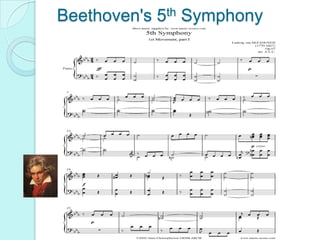
Beethoven's 5th Symphony
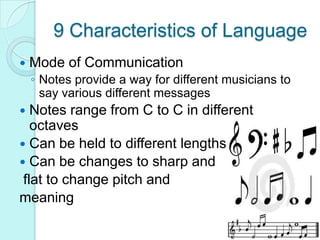
9 Characteristics of LanguageMode of CommunicationNotes provide a way for different musicians to say various different messages Notes range from C to C in different octavesCan be held to different lengths Can be changes to sharp and flat to change pitch and meaning
9 Characteristics of LanguageSemanticSongs have a distinctive ability to reach a variety of people on many different levelsPragmaticEffective in both transmitting a meaningful message and sending and receiving a messageInterchangeabilitySends and receives a message to people by the words in the song and the emotions in the music
9 Characteristics of LanguageCultural TransmissionEach country has their own form of music from religious to popAlso, countries borrow music from one another
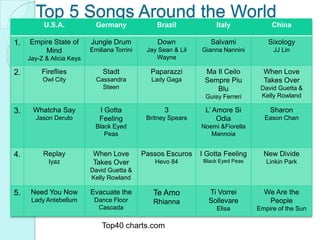
Top 5 Songs Around the WorldTop40 charts.com
Music has 9 Characteristics to be a LanguageArbitrarinessThe notes do not directly stand for the direct sound they makeDiscreetnessMusical songs or phrases are built of notesDisplacement Clearly affected by place in time and spaces between notesProductivity Has the ability to create infinite series of  musical  phrases in any type of combination
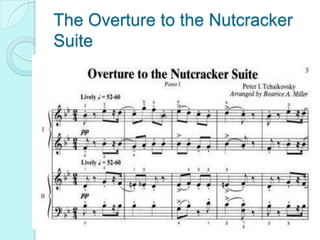
The Overture to the Nutcracker Suite
A Few Musical TermsTempoHow fast or slow the song goesKey SignatureChanges whether a specific note is flat or sharp for the duration of the piece AccidentalChanges the note to flat or sharp for that measure of musicMeasureOne specific bar of musicOctaveA series of 8 notes that start and end with the same note all in ascending or descending orderDynamicsHow loud or soft to play a section of the piece
LANGUAGE AND MUSICLANGUAGE-a system of signs,symbols,gestures,or rules in communicating (dictionary.com) IS MUSIC A LANGUAGE?Yes!Especially when you think of it in its written form,without the addition of lyricsSMN-Standard Musical Notation is comprised of staves,time signatures,key signatures,clefs,dynamics,and more....(www.cliffnotes.com)Its a way to share information that many people(musicians) across the world can understandNot only does musical notation have the nine characteristics of communication, but it can also be classified into the categories of linguistic analysis( phonology, phonetic unit, phoneme)and has lexical categories
Categories of Linguistic AnalysisPhonology-study of the sound system of language(music e.g. Notes/bars)Phonetic Unit/Segment/Phone-actual musical notes produced by an instrument & perceived as a unique sound(symphonies)Phoneme-perceieved sound that signals a difference in meaning when contrasted with another phoneme(cut,but) (d',d")
Lexical CategoriesMajor categories into which words(not morphemes)can be divided- noun, pronoun, adjective, verb, determinerIn musical notation...A piece is composed of bars/measures.Each measure has a certain amount of beats indicated at the  beginning of the piece in fractional notation.The notes can be classfied into three universal categories   -flats,sharps,naturalsThere are a host of other notations in a bar that indicates to the musician the way the music is to be played
Exploring FurtherSome argue that the sounds created by music are not a part of language & are purely artistic & abstractTaking music in its entirety and not just notational form, also gives meaning to music being a language because it shows relationships among varying cultures and in societyMusic can evoke feelings, emotions,& thoughts.Although maybe not universal reactions; it does show that music communicates to all one way or another"Do you know anyone who doesn't like music"?It can form stronger relationships in the home(parent: child)It sends messages around the world & we in turn respond by buying more to concerts, downloading songs,& connecting to more people
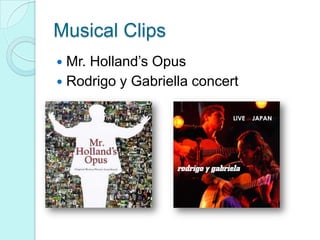
Musical ClipsMr. Holland’s OpusRodrigo y Gabriella concert
Mr. Holland’s Opus
Whorf's ResearchLinguistic relativity-whether & to what extent structures of specific languages have an impact on the thought of those who speak themUsing music we can say...Whether & to what extent music variations of a specific song have an impact on the thought of those who hear itVygotsky: Language socialization across culture (1986) Socio-cultural information is conveyed in and along with languageHigher order functions develop out of social interaction(think ABC's song)We must examine the external world in which the individual life has developed in through participation in activities that require cognitive & communicative functions(www.unm.edu/../sociocult.html)
Finally Jakobson (1956)Schematic of a Verbal InteractionAddresser - emotional mental state of the speaker(musician/composer)Addressee- cognitive (listener)Context- referential, about the circumstances of the utterance (every song has a story)Code- metalingual, speech (denotational code in music)Message-poetic, the form of the message(sounds or lyrics)Contact- phatic (if the focus is on the communication, the channels stay open) SIGNIFICANCE-this is a model of musical interaction-context is important-allows for multiple functions of an interaction-functions are distinguishable
The End!Any Questions?Thank you!

Is music a language

  • 1.
    Is Music aLanguage?Jenna DiFrancescoTasha Wells
  • 2.
    Music as aUniversal LanguageMusic is available to people around the worldPeople, no matter what culture, can read the same piece of music Influences from various cultures can be seen all around the worldWe can see linguistic trends in both music that musicians read and people listen to everyday on the radio
  • 3.
  • 4.
    9 Characteristics ofLanguageMode of CommunicationNotes provide a way for different musicians to say various different messages Notes range from C to C in different octavesCan be held to different lengths Can be changes to sharp and flat to change pitch and meaning
  • 5.
    9 Characteristics ofLanguageSemanticSongs have a distinctive ability to reach a variety of people on many different levelsPragmaticEffective in both transmitting a meaningful message and sending and receiving a messageInterchangeabilitySends and receives a message to people by the words in the song and the emotions in the music
  • 6.
    9 Characteristics ofLanguageCultural TransmissionEach country has their own form of music from religious to popAlso, countries borrow music from one another
  • 7.
    Top 5 SongsAround the WorldTop40 charts.com
  • 8.
    Music has 9Characteristics to be a LanguageArbitrarinessThe notes do not directly stand for the direct sound they makeDiscreetnessMusical songs or phrases are built of notesDisplacement Clearly affected by place in time and spaces between notesProductivity Has the ability to create infinite series of musical phrases in any type of combination
  • 9.
    The Overture tothe Nutcracker Suite
  • 10.
    A Few MusicalTermsTempoHow fast or slow the song goesKey SignatureChanges whether a specific note is flat or sharp for the duration of the piece AccidentalChanges the note to flat or sharp for that measure of musicMeasureOne specific bar of musicOctaveA series of 8 notes that start and end with the same note all in ascending or descending orderDynamicsHow loud or soft to play a section of the piece
  • 11.
    LANGUAGE AND MUSICLANGUAGE-asystem of signs,symbols,gestures,or rules in communicating (dictionary.com) IS MUSIC A LANGUAGE?Yes!Especially when you think of it in its written form,without the addition of lyricsSMN-Standard Musical Notation is comprised of staves,time signatures,key signatures,clefs,dynamics,and more....(www.cliffnotes.com)Its a way to share information that many people(musicians) across the world can understandNot only does musical notation have the nine characteristics of communication, but it can also be classified into the categories of linguistic analysis( phonology, phonetic unit, phoneme)and has lexical categories
  • 12.
    Categories of LinguisticAnalysisPhonology-study of the sound system of language(music e.g. Notes/bars)Phonetic Unit/Segment/Phone-actual musical notes produced by an instrument & perceived as a unique sound(symphonies)Phoneme-perceieved sound that signals a difference in meaning when contrasted with another phoneme(cut,but) (d',d")
  • 13.
    Lexical CategoriesMajor categoriesinto which words(not morphemes)can be divided- noun, pronoun, adjective, verb, determinerIn musical notation...A piece is composed of bars/measures.Each measure has a certain amount of beats indicated at the beginning of the piece in fractional notation.The notes can be classfied into three universal categories -flats,sharps,naturalsThere are a host of other notations in a bar that indicates to the musician the way the music is to be played
  • 14.
    Exploring FurtherSome arguethat the sounds created by music are not a part of language & are purely artistic & abstractTaking music in its entirety and not just notational form, also gives meaning to music being a language because it shows relationships among varying cultures and in societyMusic can evoke feelings, emotions,& thoughts.Although maybe not universal reactions; it does show that music communicates to all one way or another"Do you know anyone who doesn't like music"?It can form stronger relationships in the home(parent: child)It sends messages around the world & we in turn respond by buying more to concerts, downloading songs,& connecting to more people
  • 15.
    Musical ClipsMr. Holland’sOpusRodrigo y Gabriella concert
  • 16.
  • 17.
    Whorf's ResearchLinguistic relativity-whether& to what extent structures of specific languages have an impact on the thought of those who speak themUsing music we can say...Whether & to what extent music variations of a specific song have an impact on the thought of those who hear itVygotsky: Language socialization across culture (1986) Socio-cultural information is conveyed in and along with languageHigher order functions develop out of social interaction(think ABC's song)We must examine the external world in which the individual life has developed in through participation in activities that require cognitive & communicative functions(www.unm.edu/../sociocult.html)
  • 18.
    Finally Jakobson (1956)Schematicof a Verbal InteractionAddresser - emotional mental state of the speaker(musician/composer)Addressee- cognitive (listener)Context- referential, about the circumstances of the utterance (every song has a story)Code- metalingual, speech (denotational code in music)Message-poetic, the form of the message(sounds or lyrics)Contact- phatic (if the focus is on the communication, the channels stay open) SIGNIFICANCE-this is a model of musical interaction-context is important-allows for multiple functions of an interaction-functions are distinguishable
  • 19.