
AUDITORY
HALLLUCINATIONS,
ILLUSIONS AND
DELUSIONS
Randy M Rosenberg MD FAAN FACP
Assistant Clinical Professor of Neurology
Lewis Katz School of Medicine atTemple University
Tinnitus
■ Auditory percept without an external source (mostly)
■ Aberrant activity originating in the auditory system
■ 10-15% prevalence in adults
■ 3% Interferes with Work, Sleep, Concentration, and Social
Interactions
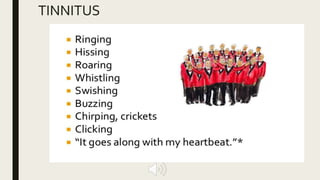
TINNITUS
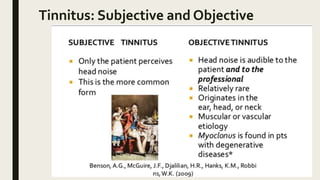
Tinnitus: Subjective and Objective
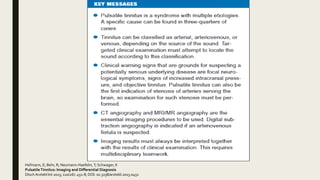
Hofmann, E; Behr, R; Neumann-Haefelin,T; Schwager, K
PulsatileTinnitus: Imaging and Differential Diagnosis
DtschArztebl Int 2013; 110(26): 451-8; DOI: 10.3238/arztebl.2013.0451
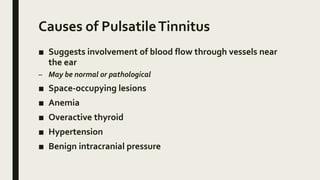
Causes of PulsatileTinnitus
■ Suggests involvement of blood flow through vessels near
the ear
– May be normal or pathological
■ Space-occupying lesions
■ Anemia
■ Overactive thyroid
■ Hypertension
■ Benign intracranial pressure
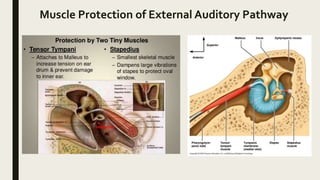
Muscle Protection of External Auditory Pathway
Otic Myoclonus
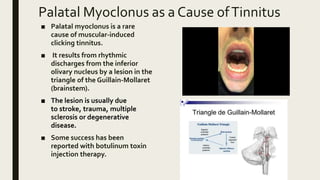
Palatal Myoclonus as a Cause ofTinnitus
■ Palatal myoclonus is a rare
cause of muscular-induced
clicking tinnitus.
■ It results from rhythmic
discharges from the inferior
olivary nucleus by a lesion in the
triangle of the Guillain-Mollaret
(brainstem).
■ The lesion is usually due
to stroke, trauma, multiple
sclerosis or degenerative
disease.
■ Some success has been
reported with botulinum toxin
injection therapy.
Red Flags inTinnitus
■ Sudden onset…with or without hearing loss
■ Unilateral tinnitus
■ Pulsatile tinnitus
■ Sudden tinnitus with stroke like symptoms
Pathophysiology of SubjectiveTinnitus
■ Although the pathological origin of tinnitus may be peripheral
(cochlear, 8th nerve), the perception is central
■ Neuroplasticity, the adaption of cortical and subcortical to
deprivation or distortion of sensory input from the damaged
cochlea==midbrain==auditory cortex
■ The auditory cortex that no longer receives stimulation due to
cochlear injury is called the lesion projection zone (LPZ)
■ Following cochlear injury, neurons in the LPZ change in two ways
– Increase in spontaneous firing rate
– Neurons that are adjacent to the LPZ represent a larger frequency
range
■ THE KEY UNDERSTANDING INTINNITUS RESEARCH ISTHAT
ALTHOUGHTINNITUS PRESENTS INTHE EAR, IT IS A
NEUROLOGICAL PHENOMENON
Role of the Basal Ganglion inTreatment
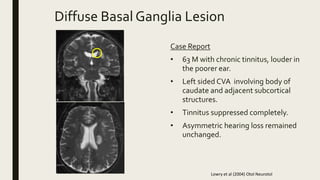
Diffuse Basal Ganglia Lesion
Case Report
• 63 M with chronic tinnitus, louder in
the poorer ear.
• Left sided CVA involving body of
caudate and adjacent subcortical
structures.
• Tinnitus suppressed completely.
• Asymmetric hearing loss remained
unchanged.
Lowry et al (2004) Otol Neurotol
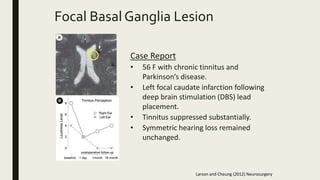
Larson and Cheung (2012) Neurosurgery
Focal Basal Ganglia Lesion
Case Report
• 56 F with chronic tinnitus and
Parkinson’s disease.
• Left focal caudate infarction following
deep brain stimulation (DBS) lead
placement.
• Tinnitus suppressed substantially.
• Symmetric hearing loss remained
unchanged.
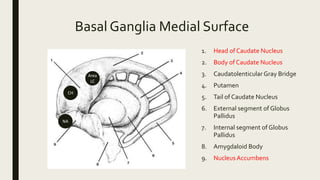
Basal Ganglia Medial Surface
1. Head of Caudate Nucleus
2. Body of Caudate Nucleus
3. Caudatolenticular Gray Bridge
4. Putamen
5. Tail of Caudate Nucleus
6. External segment of Globus
Pallidus
7. Internal segment of Globus
Pallidus
8. Amygdaloid Body
9. Nucleus Accumbens
Area
LC
CH
NA
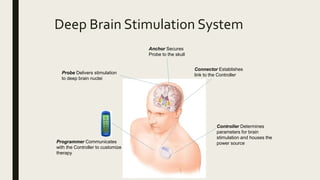
Probe Delivers stimulation
to deep brain nuclei
Anchor Secures
Probe to the skull
Connector Establishes
link to the Controller
Programmer Communicates
with the Controller to customize
therapy
Controller Determines
parameters for brain
stimulation and houses the
power source
Deep Brain Stimulation System
MUSICAL HALLUCINATIONS
■ Affects 2% of patients with hearing loss
■ Purely nonpsychiatric
■ People highly dependent on their cell phones may
hallucinate their ringtones
■ The sounds are typically heard as short fragments of
simple melodies
– often from music heard regularly and familiar from youth
and especially from hymns and carols.
■ Hallucinations are pure and not contaminated or distorted
by the degree of current hearing loss
– This is similar to Charles Bonnet Syndrome
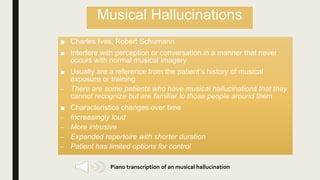
Musical Hallucinations
■ Charles Ives, Robert Schumann
■ Interfere with perception or conversation in a manner that never
occurs with normal musical imagery
■ Usually are a reference from the patient’s history of musical
exposure or training
– There are some patients who have musical hallucinations that they
cannot recognize but are familiar to those people around them
■ Characteristics changes over time
– Increasingly loud
– More intrusive
– Expanded repertoire with shorter duration
– Patient has limited options for control
Piano transcription of an musical hallucination
Musical Hallucinations
■ Can be a manifestation of partial seizures usually of right temporal origin
■ Drug induced
– Anticonvulsants
– Antidepressants
– Anesthetics
– Opiates
– Amandatine
■ Most common among hearing impaired suspected as a cortical release
phenomenon.
– Female > male
– Advanced age
■ NOT earworms
Earworms/Brainworms
■ Generally considered to be a
constant loop of fifteen to twenty
seconds of music lodged in your
head for at least a few hours, if not
days—or, in severe cases, months.
■ A particular hallmark of earworms
is the presence of passages with
closely spaced musical intervals
and long notes.
– In other words, a sequence in which
the notes are close to each other on
the music scale—such as C, C-sharp,
and D—and each note is held for a
moment before moving on to the
next.
■ Sing out loud!
ASMR: Autonomous Sensory
Meridian Response
■ A distinct, pleasurable tingling
sensation in the head, scalp, back, or
peripheral regions of the body in
response to visual, auditory, tactile,
olfactory, or cognitive stimuli
■ Whispering is the most frequently
cited stimulus
■ So SOUNDALONECAN INDUCE
PLEASUREWITHOUT BEING
MUSICAL! (FOR EXAMPLE…)
Symptoms of Schizophrenia
■ Positive
– Hallucinations (usually auditory)
– 70% of patient of which 40% are partially or fully refractory to drug therapy
– Delusions (fixed false beliefs)
– Disorganized speech and behavior
■ Negative
– Decreased emotional range
– Poverty of speech
– Loss of interests and drives
■ Cognitive deficits
■ Mood symptoms
Psychotic Auditory Hallucinations
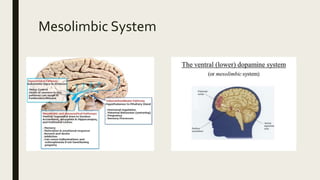
Mesolimbic System
What Creates Positive Symptoms
Schizophrenia?
■ Abnormalities in the dopaminergic systems
– Drugs that diminish firing rates of mesolimbic dopamine D2 neurons are
antipsychotic
■ Hypodopaminergic activity in the mesocartical system lead to negative symptoms
■ Hyperdopaminergic activity in the mesolimbic systems leads to positive symptoms
■ Auditory/Verbal hallucinations may have an anatomical correlate with
hyperactivity in Wernicke’s area.
– rTMS (repetitive transcranial magnetic stimulation) at low frequencies (1Hzt)
targeting the superior temporal gyrus appear to improve symptoms
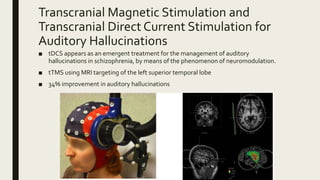
Transcranial Magnetic Stimulation and
Transcranial Direct Current Stimulation for
Auditory Hallucinations
■ tDCS appears as an emergent treatment for the management of auditory
hallucinations in schizophrenia, by means of the phenomenon of neuromodulation.
■ tTMS using MRI targeting of the left superior temporal lobe
■ 34% improvement in auditory hallucinations
Episodic Cranial Sensory Shock
(“Exploding Head Syndrome)
■ Benign condition in which a person hears loud "imagined" noises (such as a bomb
exploding, a gunshot, or a cymbal crash) or experiences an explosive feelingwhen
falling asleep or waking up.[
■ The most prevalent theory on the cause of EHS is dysfunction of the reticular
formation in the brainstem responsible for transition between waking and
sleeping.[2]
■ Paroxysmal sensory parasomnia not associated with significant pain.
■ Consider hypnagogic hallucinations and sleep paralysis as other parasomnias that
occur at the onset of sleep and before awakening
■ Treatment has included Anafanil, carbamazepine, methyphenidate. Reassurance
may be best approach.
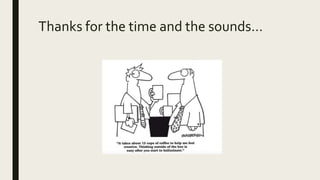
Thanks for the time and the sounds…

Auditory Hallucinations

  • 1.
    AUDITORY HALLLUCINATIONS, ILLUSIONS AND DELUSIONS Randy MRosenberg MD FAAN FACP Assistant Clinical Professor of Neurology Lewis Katz School of Medicine atTemple University
  • 2.
    Tinnitus ■ Auditory perceptwithout an external source (mostly) ■ Aberrant activity originating in the auditory system ■ 10-15% prevalence in adults ■ 3% Interferes with Work, Sleep, Concentration, and Social Interactions
  • 3.
  • 4.
  • 5.
    Hofmann, E; Behr,R; Neumann-Haefelin,T; Schwager, K PulsatileTinnitus: Imaging and Differential Diagnosis DtschArztebl Int 2013; 110(26): 451-8; DOI: 10.3238/arztebl.2013.0451
  • 6.
    Causes of PulsatileTinnitus ■Suggests involvement of blood flow through vessels near the ear – May be normal or pathological ■ Space-occupying lesions ■ Anemia ■ Overactive thyroid ■ Hypertension ■ Benign intracranial pressure
  • 7.
    Muscle Protection ofExternal Auditory Pathway
  • 8.
  • 9.
    Palatal Myoclonus asa Cause ofTinnitus ■ Palatal myoclonus is a rare cause of muscular-induced clicking tinnitus. ■ It results from rhythmic discharges from the inferior olivary nucleus by a lesion in the triangle of the Guillain-Mollaret (brainstem). ■ The lesion is usually due to stroke, trauma, multiple sclerosis or degenerative disease. ■ Some success has been reported with botulinum toxin injection therapy.
  • 10.
    Red Flags inTinnitus ■Sudden onset…with or without hearing loss ■ Unilateral tinnitus ■ Pulsatile tinnitus ■ Sudden tinnitus with stroke like symptoms
  • 11.
    Pathophysiology of SubjectiveTinnitus ■Although the pathological origin of tinnitus may be peripheral (cochlear, 8th nerve), the perception is central ■ Neuroplasticity, the adaption of cortical and subcortical to deprivation or distortion of sensory input from the damaged cochlea==midbrain==auditory cortex ■ The auditory cortex that no longer receives stimulation due to cochlear injury is called the lesion projection zone (LPZ) ■ Following cochlear injury, neurons in the LPZ change in two ways – Increase in spontaneous firing rate – Neurons that are adjacent to the LPZ represent a larger frequency range ■ THE KEY UNDERSTANDING INTINNITUS RESEARCH ISTHAT ALTHOUGHTINNITUS PRESENTS INTHE EAR, IT IS A NEUROLOGICAL PHENOMENON
  • 12.
    Role of theBasal Ganglion inTreatment
  • 13.
    Diffuse Basal GangliaLesion Case Report • 63 M with chronic tinnitus, louder in the poorer ear. • Left sided CVA involving body of caudate and adjacent subcortical structures. • Tinnitus suppressed completely. • Asymmetric hearing loss remained unchanged. Lowry et al (2004) Otol Neurotol
  • 14.
    Larson and Cheung(2012) Neurosurgery Focal Basal Ganglia Lesion Case Report • 56 F with chronic tinnitus and Parkinson’s disease. • Left focal caudate infarction following deep brain stimulation (DBS) lead placement. • Tinnitus suppressed substantially. • Symmetric hearing loss remained unchanged.
  • 15.
    Basal Ganglia MedialSurface 1. Head of Caudate Nucleus 2. Body of Caudate Nucleus 3. Caudatolenticular Gray Bridge 4. Putamen 5. Tail of Caudate Nucleus 6. External segment of Globus Pallidus 7. Internal segment of Globus Pallidus 8. Amygdaloid Body 9. Nucleus Accumbens Area LC CH NA
  • 16.
    Probe Delivers stimulation todeep brain nuclei Anchor Secures Probe to the skull Connector Establishes link to the Controller Programmer Communicates with the Controller to customize therapy Controller Determines parameters for brain stimulation and houses the power source Deep Brain Stimulation System
  • 17.
    MUSICAL HALLUCINATIONS ■ Affects2% of patients with hearing loss ■ Purely nonpsychiatric ■ People highly dependent on their cell phones may hallucinate their ringtones ■ The sounds are typically heard as short fragments of simple melodies – often from music heard regularly and familiar from youth and especially from hymns and carols. ■ Hallucinations are pure and not contaminated or distorted by the degree of current hearing loss – This is similar to Charles Bonnet Syndrome
  • 18.
    Musical Hallucinations ■ CharlesIves, Robert Schumann ■ Interfere with perception or conversation in a manner that never occurs with normal musical imagery ■ Usually are a reference from the patient’s history of musical exposure or training – There are some patients who have musical hallucinations that they cannot recognize but are familiar to those people around them ■ Characteristics changes over time – Increasingly loud – More intrusive – Expanded repertoire with shorter duration – Patient has limited options for control Piano transcription of an musical hallucination
  • 19.
    Musical Hallucinations ■ Canbe a manifestation of partial seizures usually of right temporal origin ■ Drug induced – Anticonvulsants – Antidepressants – Anesthetics – Opiates – Amandatine ■ Most common among hearing impaired suspected as a cortical release phenomenon. – Female > male – Advanced age ■ NOT earworms
  • 20.
    Earworms/Brainworms ■ Generally consideredto be a constant loop of fifteen to twenty seconds of music lodged in your head for at least a few hours, if not days—or, in severe cases, months. ■ A particular hallmark of earworms is the presence of passages with closely spaced musical intervals and long notes. – In other words, a sequence in which the notes are close to each other on the music scale—such as C, C-sharp, and D—and each note is held for a moment before moving on to the next. ■ Sing out loud!
  • 21.
    ASMR: Autonomous Sensory MeridianResponse ■ A distinct, pleasurable tingling sensation in the head, scalp, back, or peripheral regions of the body in response to visual, auditory, tactile, olfactory, or cognitive stimuli ■ Whispering is the most frequently cited stimulus ■ So SOUNDALONECAN INDUCE PLEASUREWITHOUT BEING MUSICAL! (FOR EXAMPLE…)
  • 22.
    Symptoms of Schizophrenia ■Positive – Hallucinations (usually auditory) – 70% of patient of which 40% are partially or fully refractory to drug therapy – Delusions (fixed false beliefs) – Disorganized speech and behavior ■ Negative – Decreased emotional range – Poverty of speech – Loss of interests and drives ■ Cognitive deficits ■ Mood symptoms
  • 23.
  • 24.
  • 25.
    What Creates PositiveSymptoms Schizophrenia? ■ Abnormalities in the dopaminergic systems – Drugs that diminish firing rates of mesolimbic dopamine D2 neurons are antipsychotic ■ Hypodopaminergic activity in the mesocartical system lead to negative symptoms ■ Hyperdopaminergic activity in the mesolimbic systems leads to positive symptoms ■ Auditory/Verbal hallucinations may have an anatomical correlate with hyperactivity in Wernicke’s area. – rTMS (repetitive transcranial magnetic stimulation) at low frequencies (1Hzt) targeting the superior temporal gyrus appear to improve symptoms
  • 26.
    Transcranial Magnetic Stimulationand Transcranial Direct Current Stimulation for Auditory Hallucinations ■ tDCS appears as an emergent treatment for the management of auditory hallucinations in schizophrenia, by means of the phenomenon of neuromodulation. ■ tTMS using MRI targeting of the left superior temporal lobe ■ 34% improvement in auditory hallucinations
  • 27.
    Episodic Cranial SensoryShock (“Exploding Head Syndrome) ■ Benign condition in which a person hears loud "imagined" noises (such as a bomb exploding, a gunshot, or a cymbal crash) or experiences an explosive feelingwhen falling asleep or waking up.[ ■ The most prevalent theory on the cause of EHS is dysfunction of the reticular formation in the brainstem responsible for transition between waking and sleeping.[2] ■ Paroxysmal sensory parasomnia not associated with significant pain. ■ Consider hypnagogic hallucinations and sleep paralysis as other parasomnias that occur at the onset of sleep and before awakening ■ Treatment has included Anafanil, carbamazepine, methyphenidate. Reassurance may be best approach.
  • 28.
    Thanks for thetime and the sounds…