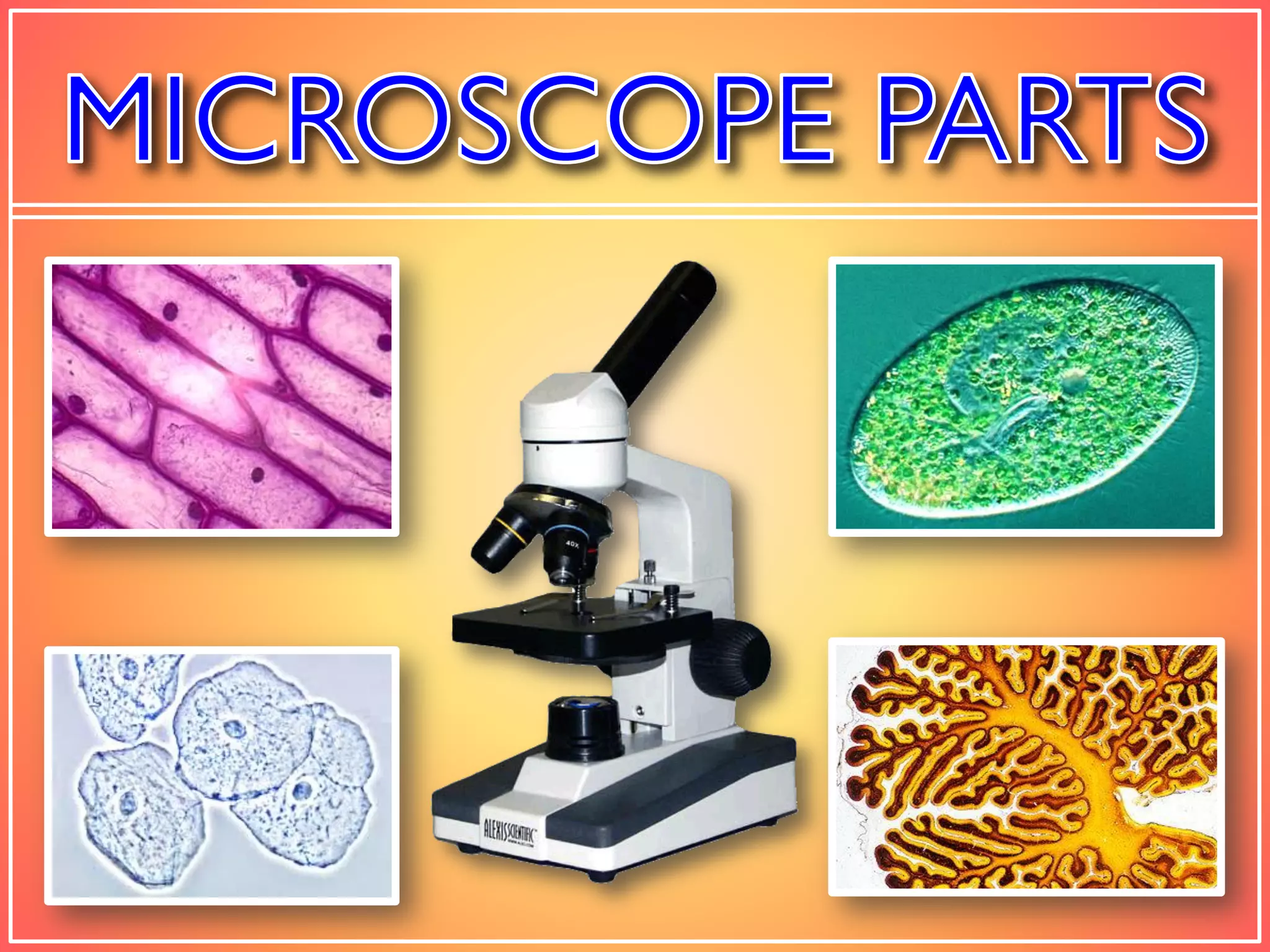
Introduction of Microscopes
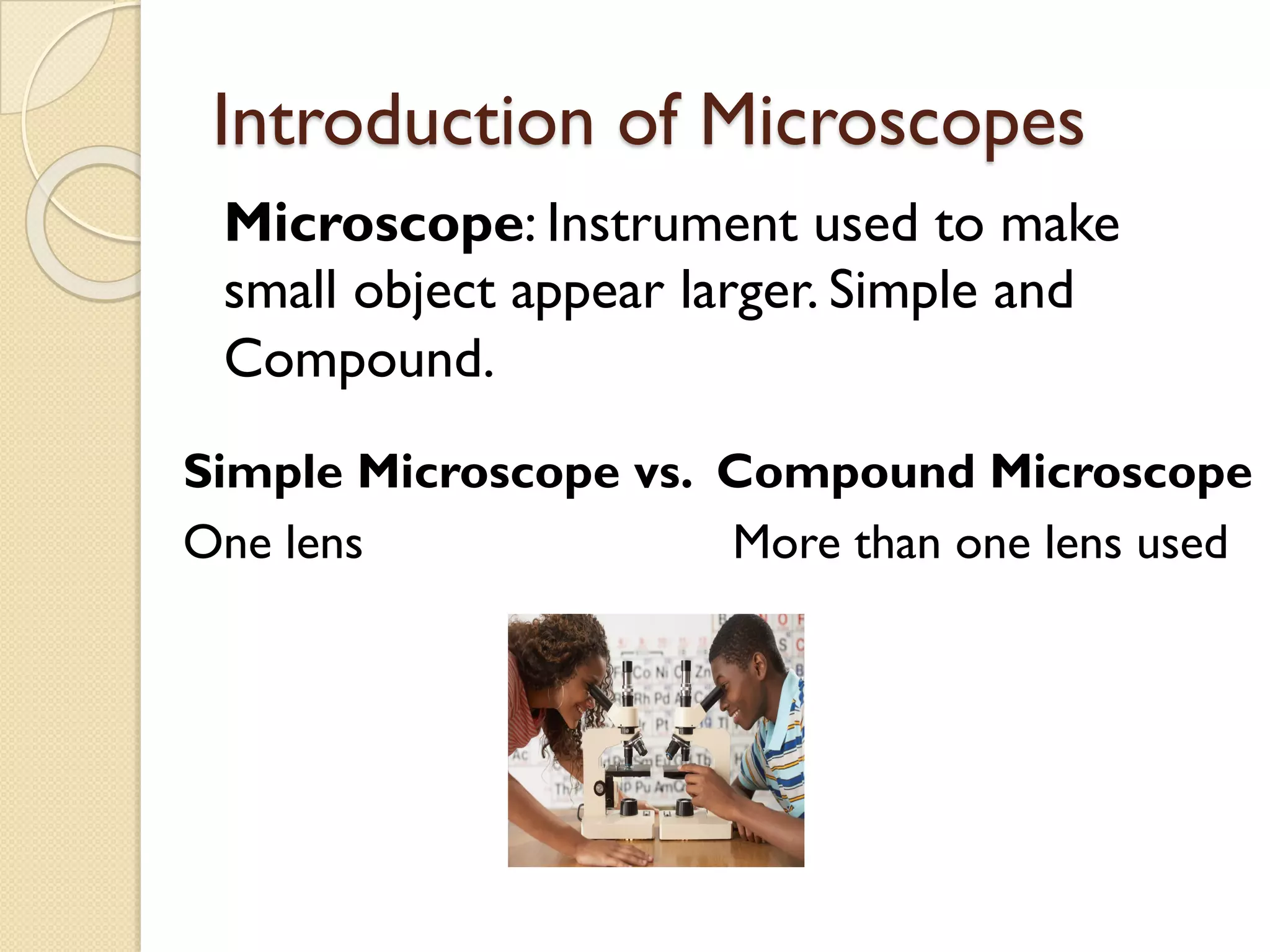
Microscope: Instrument used to make
small object appear larger. Simple and
Compound.
Simple Microscope vs. Compound Microscope
One lens More than one lens used
Microscopes
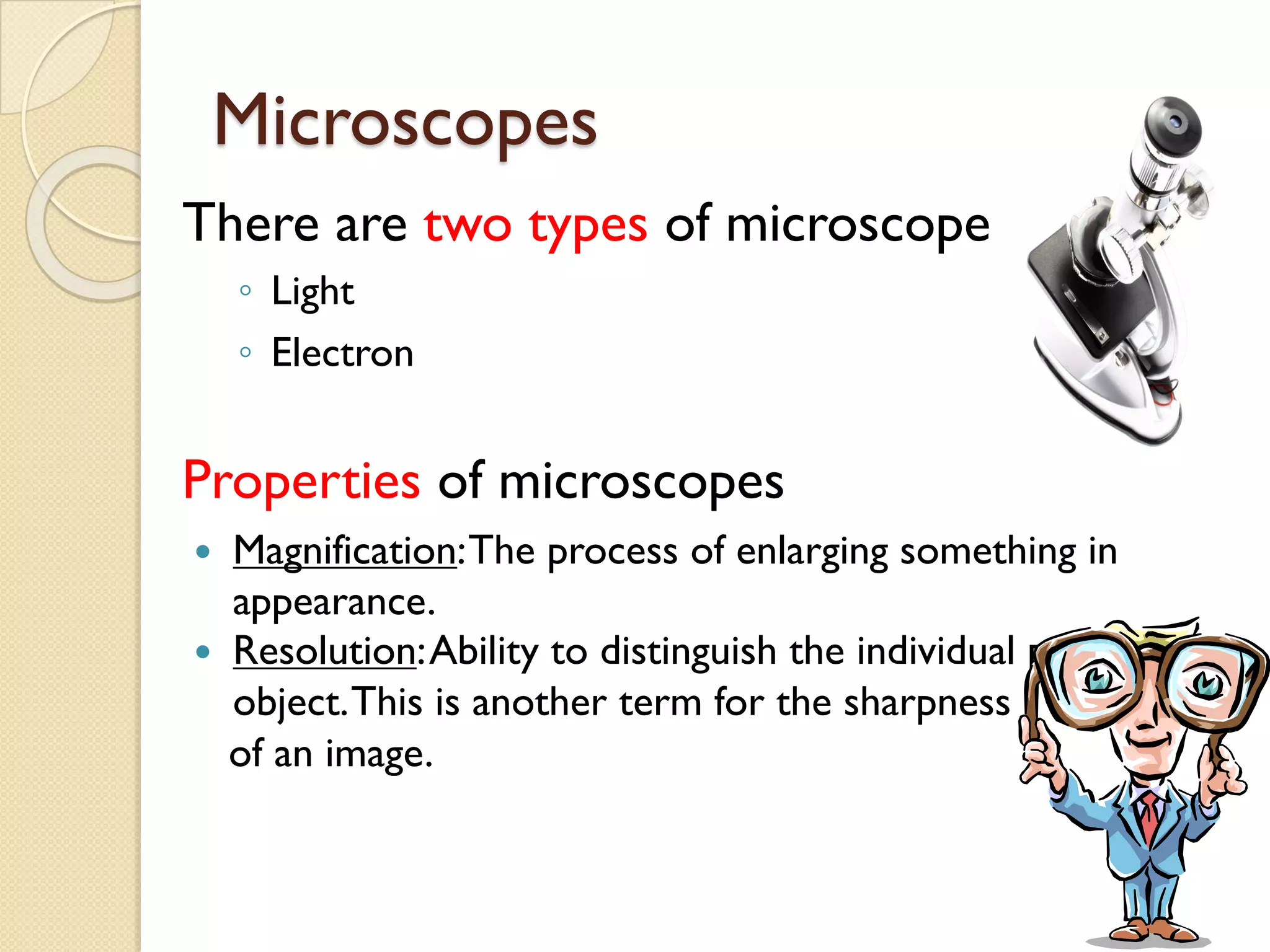
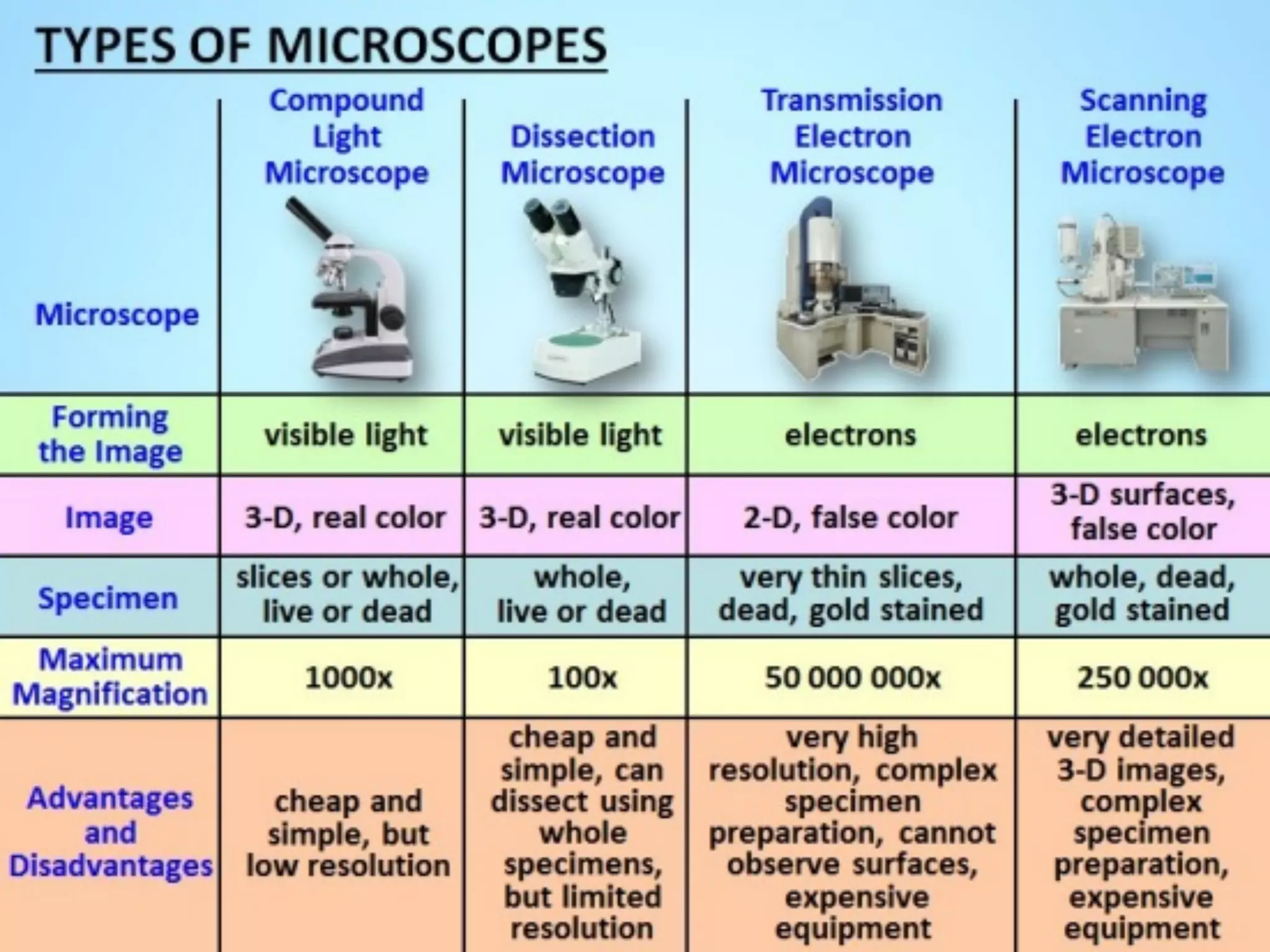
There are two types of microscope
◦ Light
◦ Electron
Properties of microscopes
— Magnification:The process of enlarging something in
appearance.
— Resolution:Ability to distinguish the individual parts of a
object.This is another term for the sharpness
of an image.
Microscopes
Magnification and Lenses
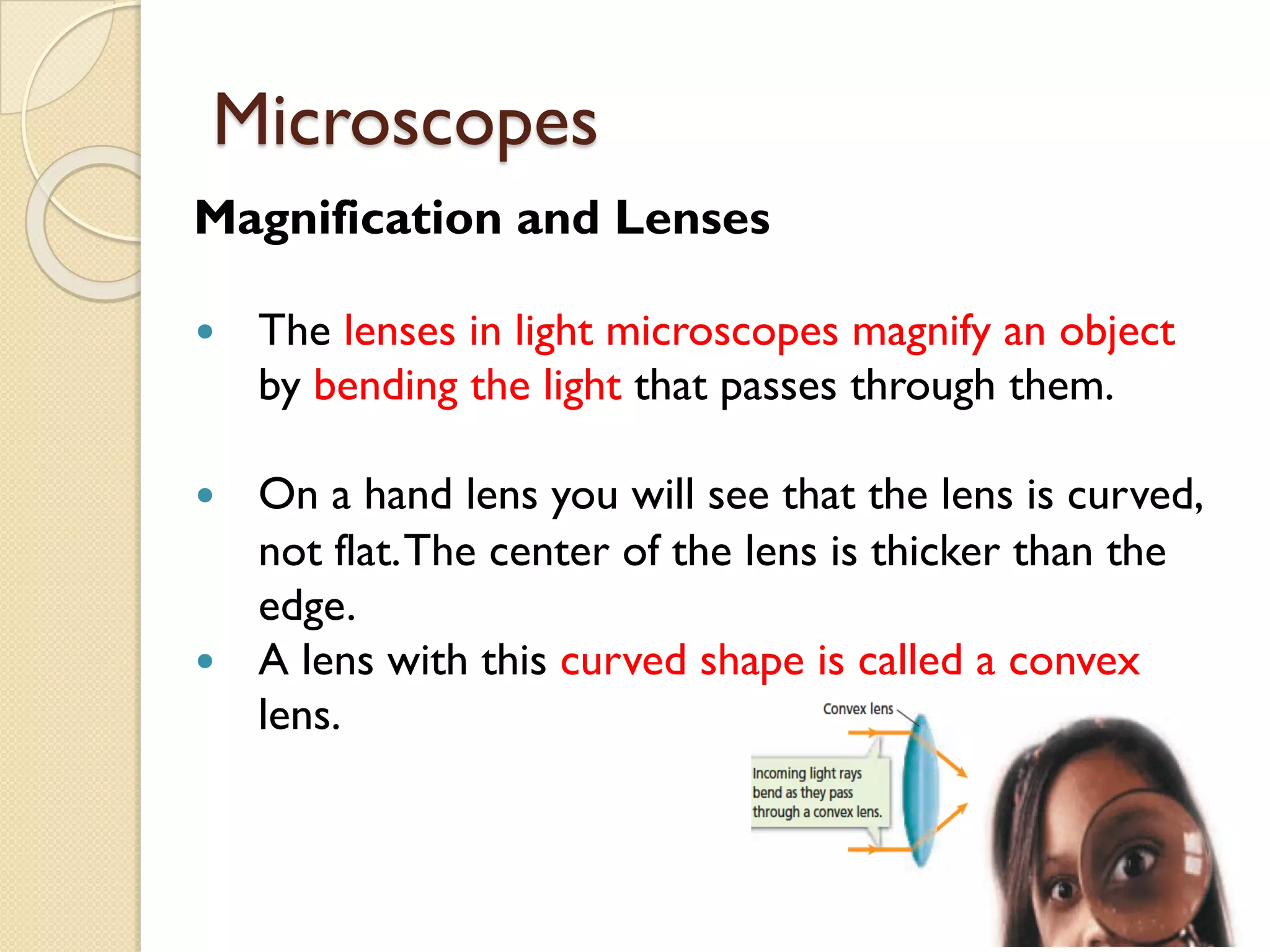
— The lenses in light microscopes magnify an object
by bending the light that passes through them.
— On a hand lens you will see that the lens is curved,
not flat.The center of the lens is thicker than the
edge.
— A lens with this curved shape is called a convex
lens.
Microscopes
Magnification and Lenses
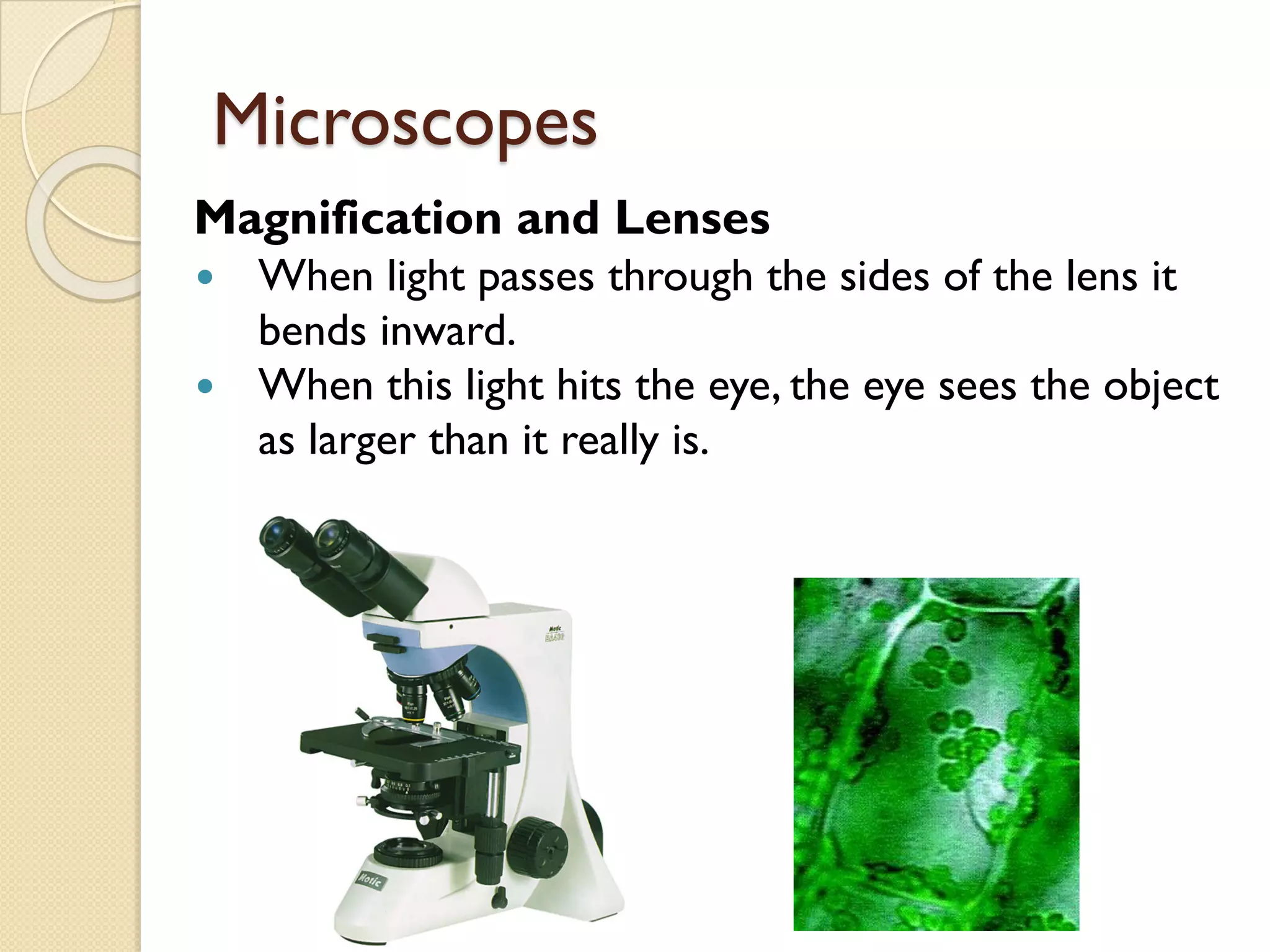
— When light passes through the sides of the lens it
bends inward.
— When this light hits the eye, the eye sees the object
as larger than it really is.
Microscopes
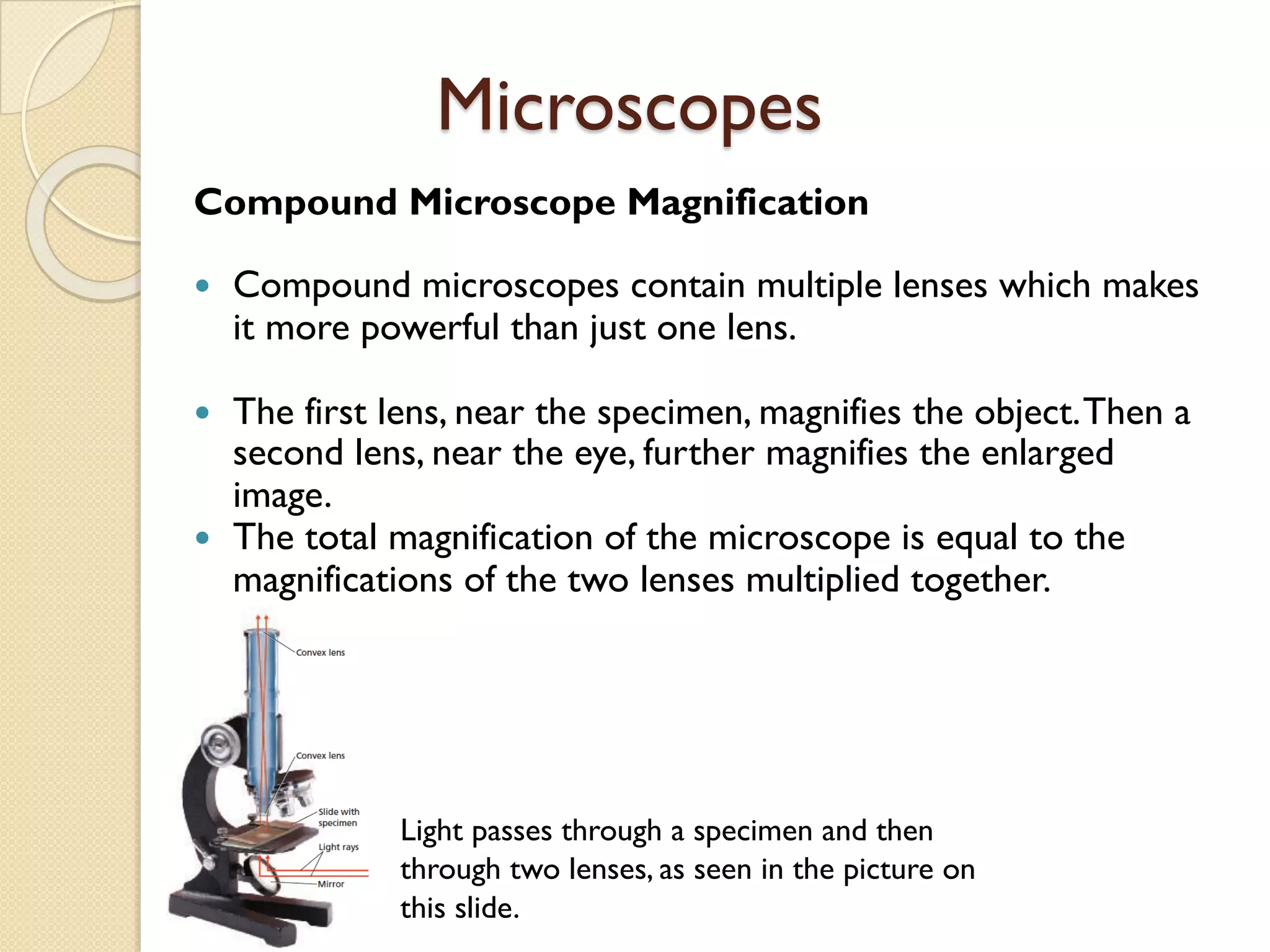
Compound Microscope Magnification
— Compound microscopes contain multiple lenses which makes
it more powerful than just one lens.
— The first lens, near the specimen, magnifies the object.Then a
second lens, near the eye, further magnifies the enlarged
image.
— The total magnification of the microscope is equal to the
magnifications of the two lenses multiplied together.
Light passes through a specimen and then
through two lenses, as seen in the picture on
this slide.
Microscopes
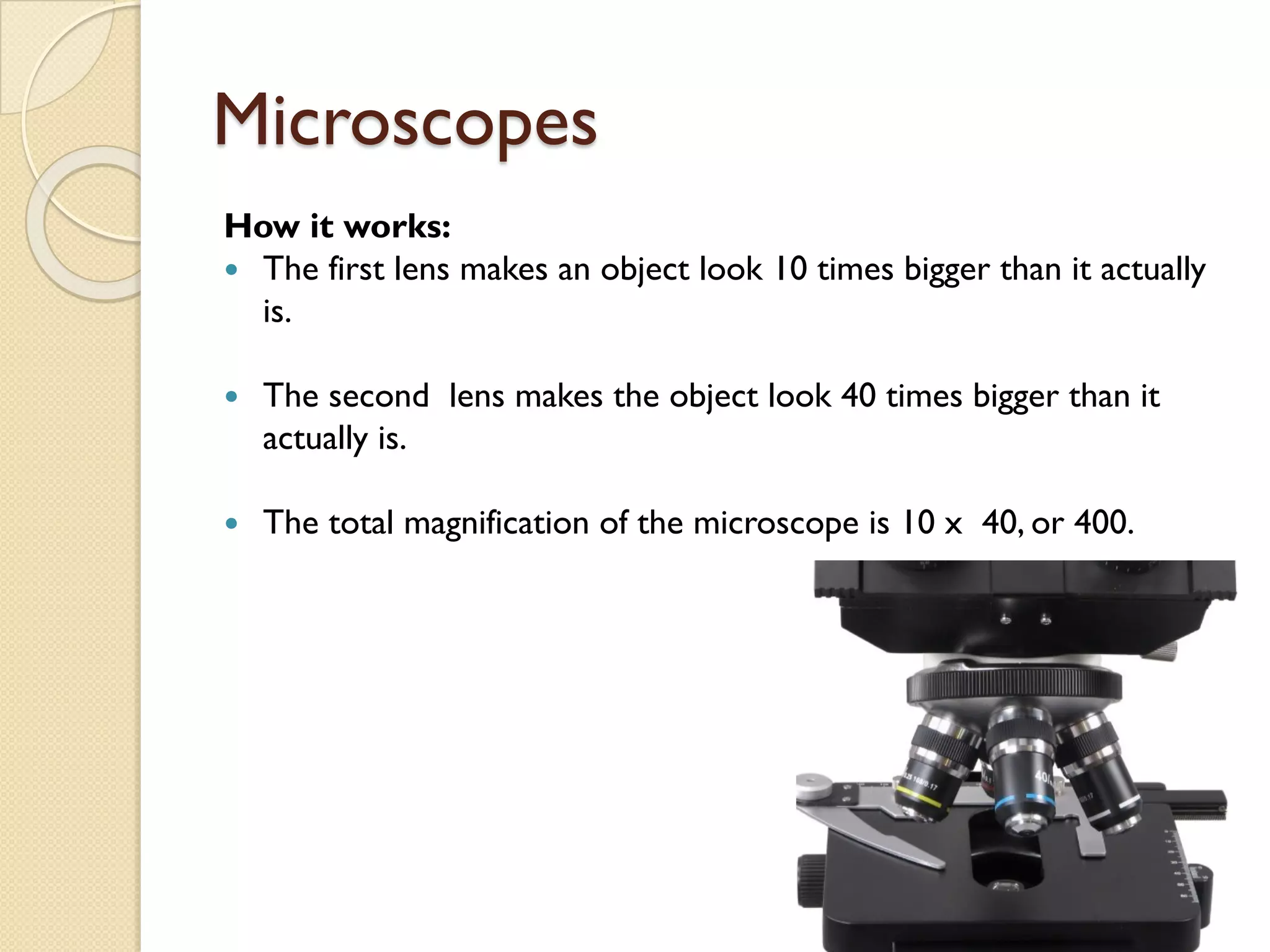
How it works:
— The first lens makes an object look 10 times bigger than it actually
is.
— The second lens makes the object look 40 times bigger than it
actually is.
— The total magnification of the microscope is 10 x 40, or 400.
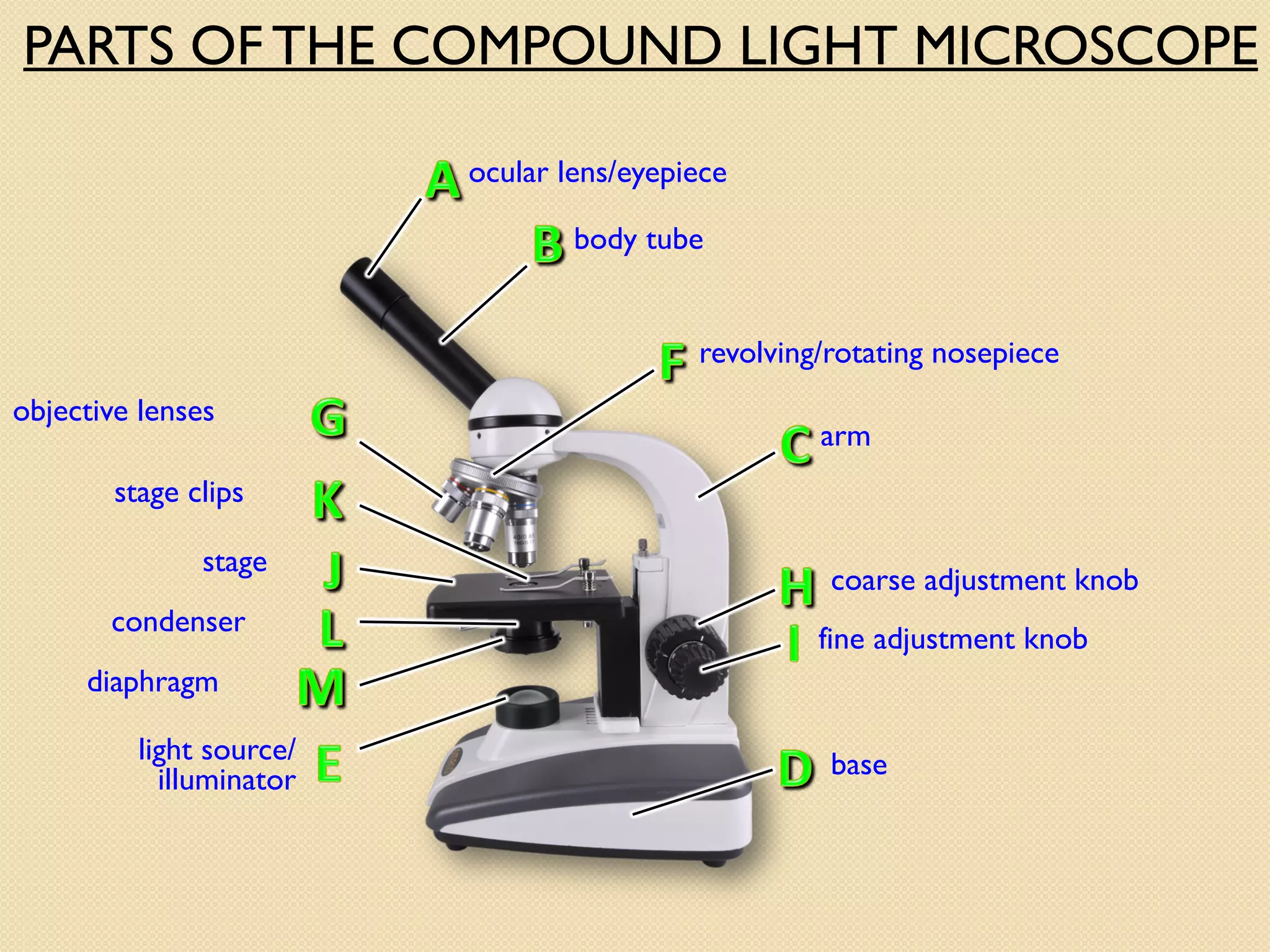
ocular lens/eyepiece
objective lenses
body tube
base
coarse adjustment knob
fine adjustment knob
stage
stage clips
diaphragm
arm
revolving/rotating nosepiece
light source/
illuminator
condenser
PARTS OF THE COMPOUND LIGHT MICROSCOPE
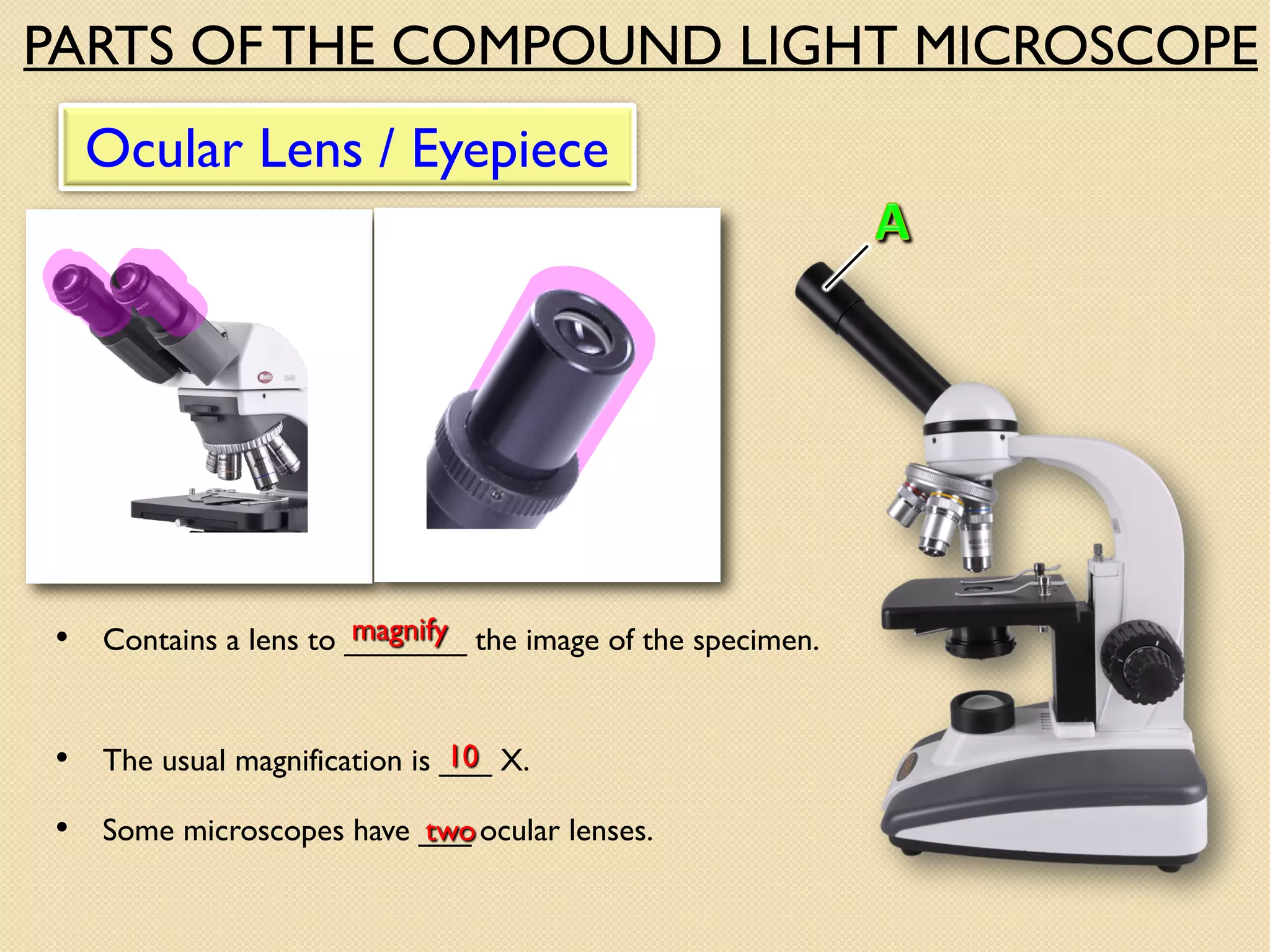
Ocular Lens / Eyepiece
• Contains a lens to _______ the image of the specimen.
• The usual magnification is ___ X.
• Some microscopes have ___ ocular lenses.
magnify
10
two
PARTS OF THE COMPOUND LIGHT MICROSCOPE
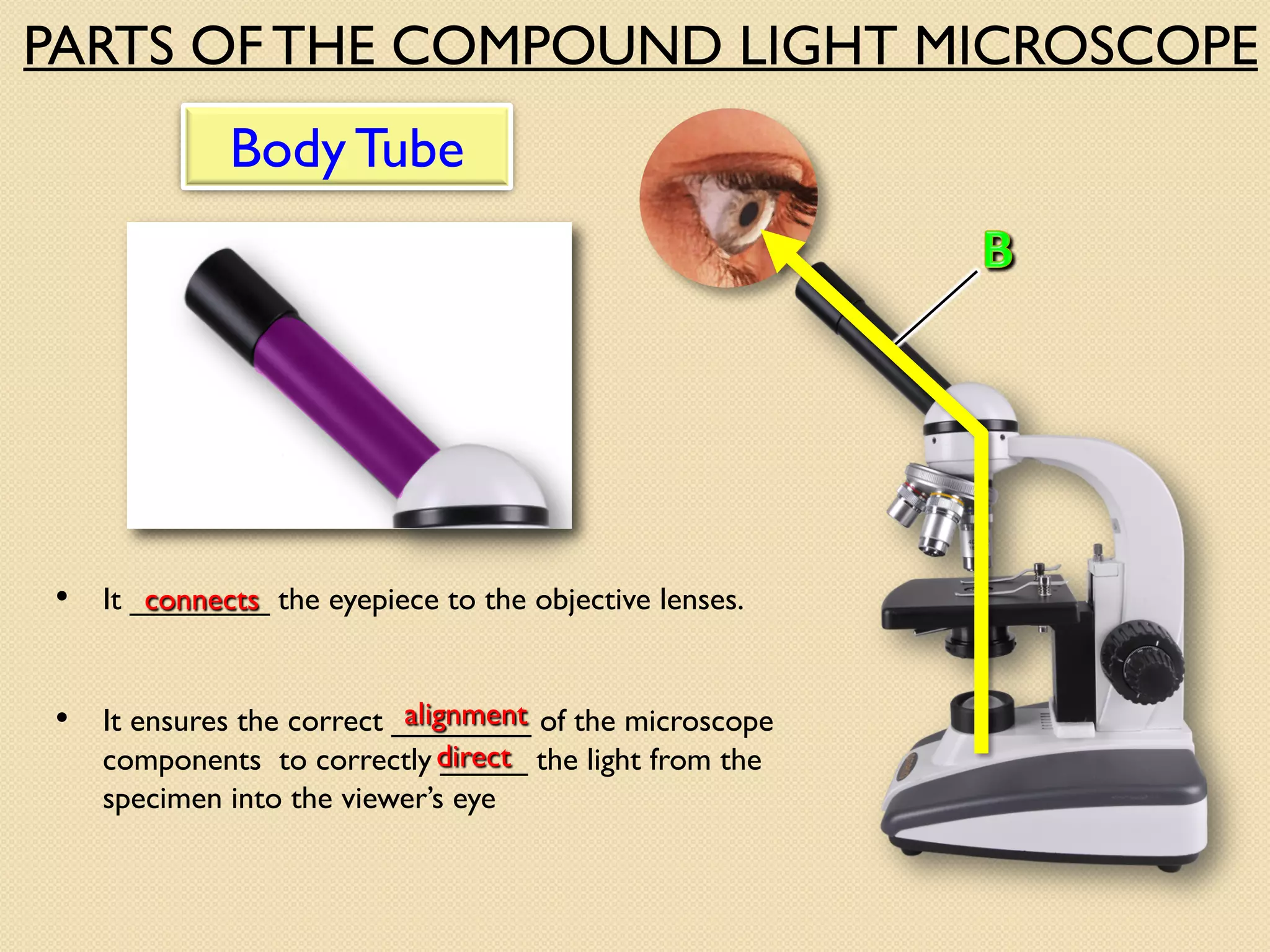
Body Tube
• It ________ the eyepiece to the objective lenses.
connects
• It ensures the correct ________ of the microscope
components to correctly _____ the light from the
specimen into the viewer’s eye
alignment
direct
PARTS OF THE COMPOUND LIGHT MICROSCOPE
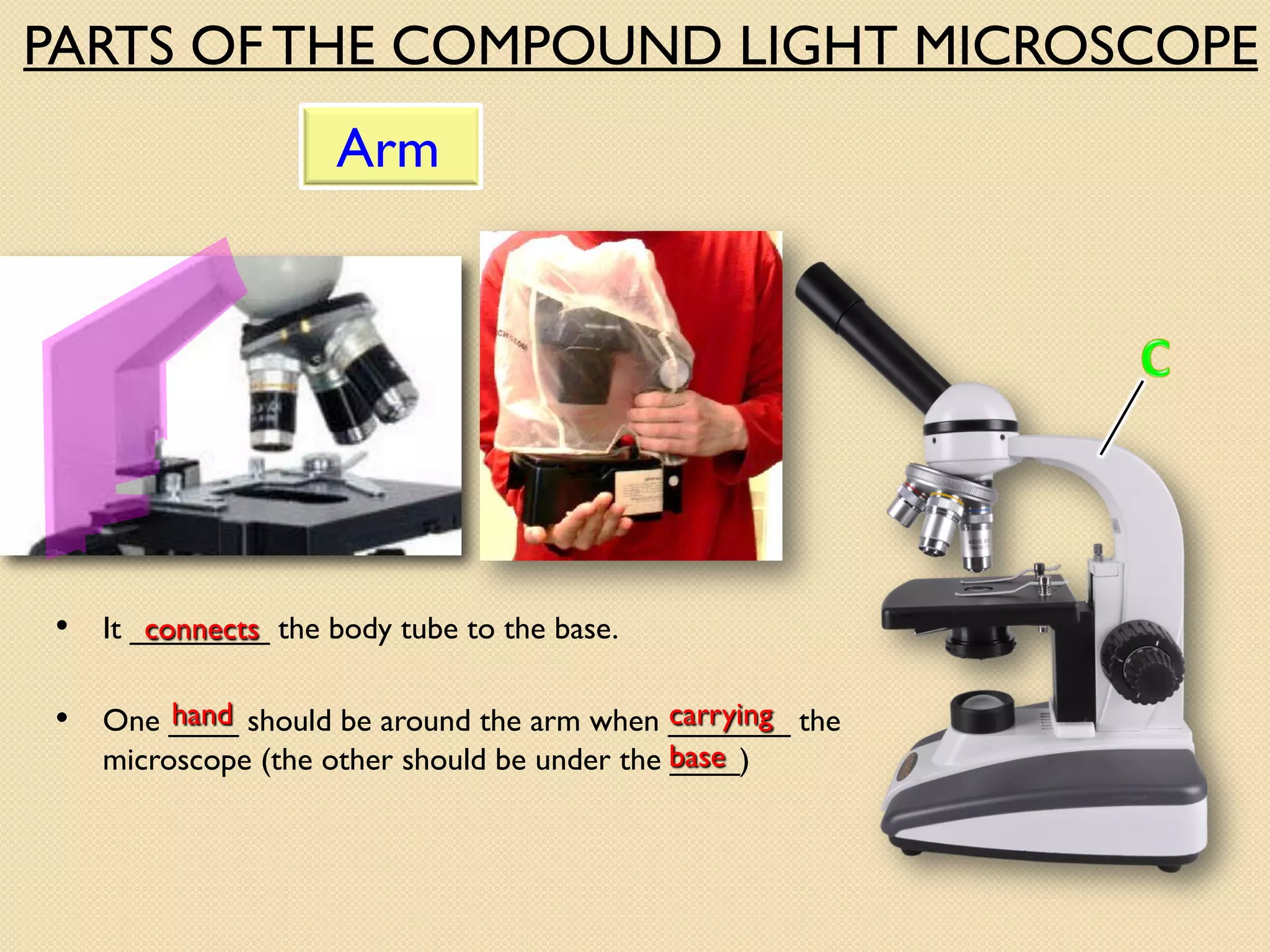
• One ____ should be around the arm when _______ the
microscope (the other should be under the ____)
Arm
• It ________ the body tube to the base.
connects
hand carrying
base
PARTS OF THE COMPOUND LIGHT MICROSCOPE
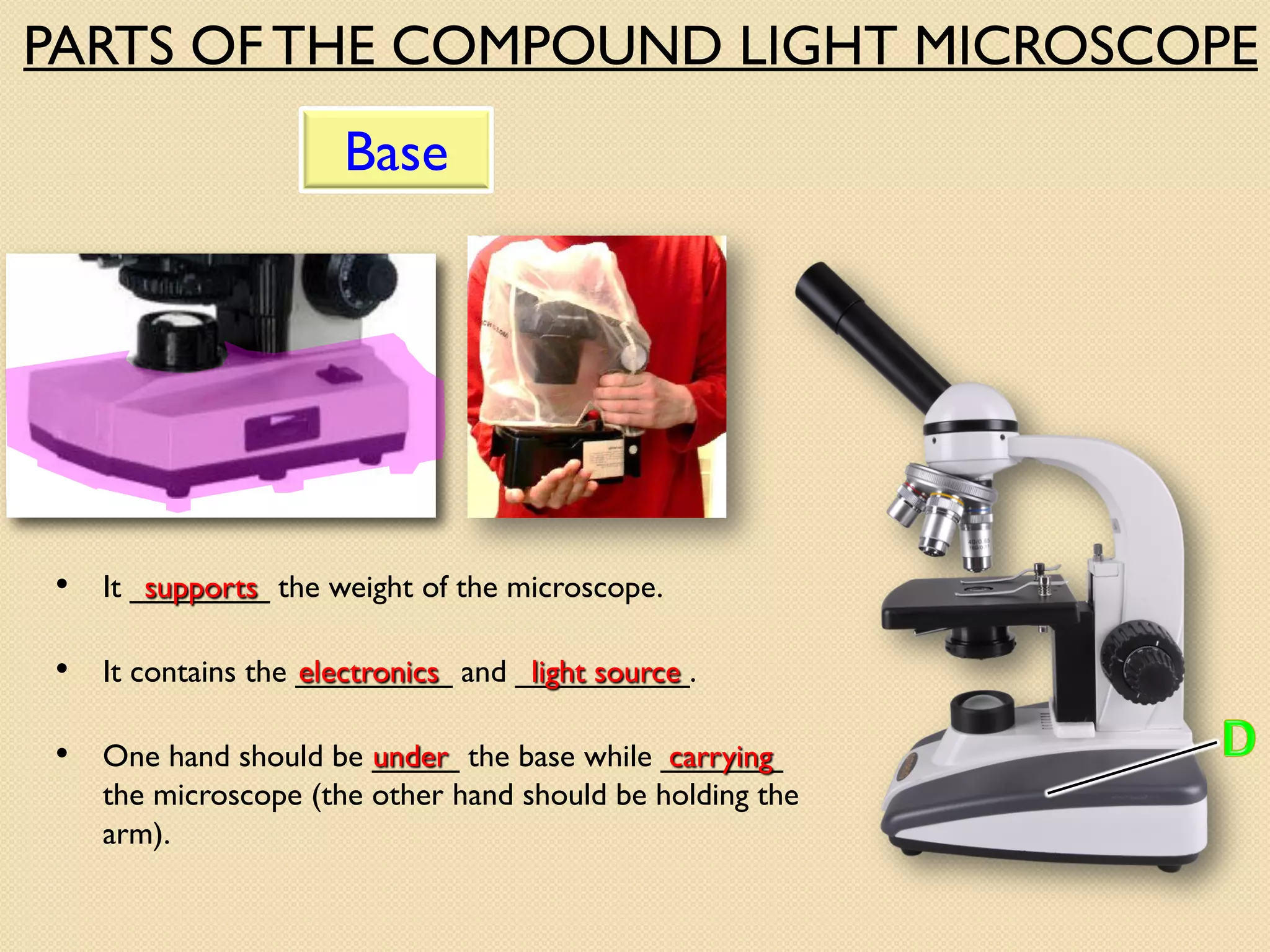
• It contains the _________ and __________.
• It ________ the weight of the microscope.
• One hand should be _____ the base while _______
the microscope (the other hand should be holding the
arm).
Base
supports
electronics
carrying
light source
under
PARTS OF THE COMPOUND LIGHT MICROSCOPE
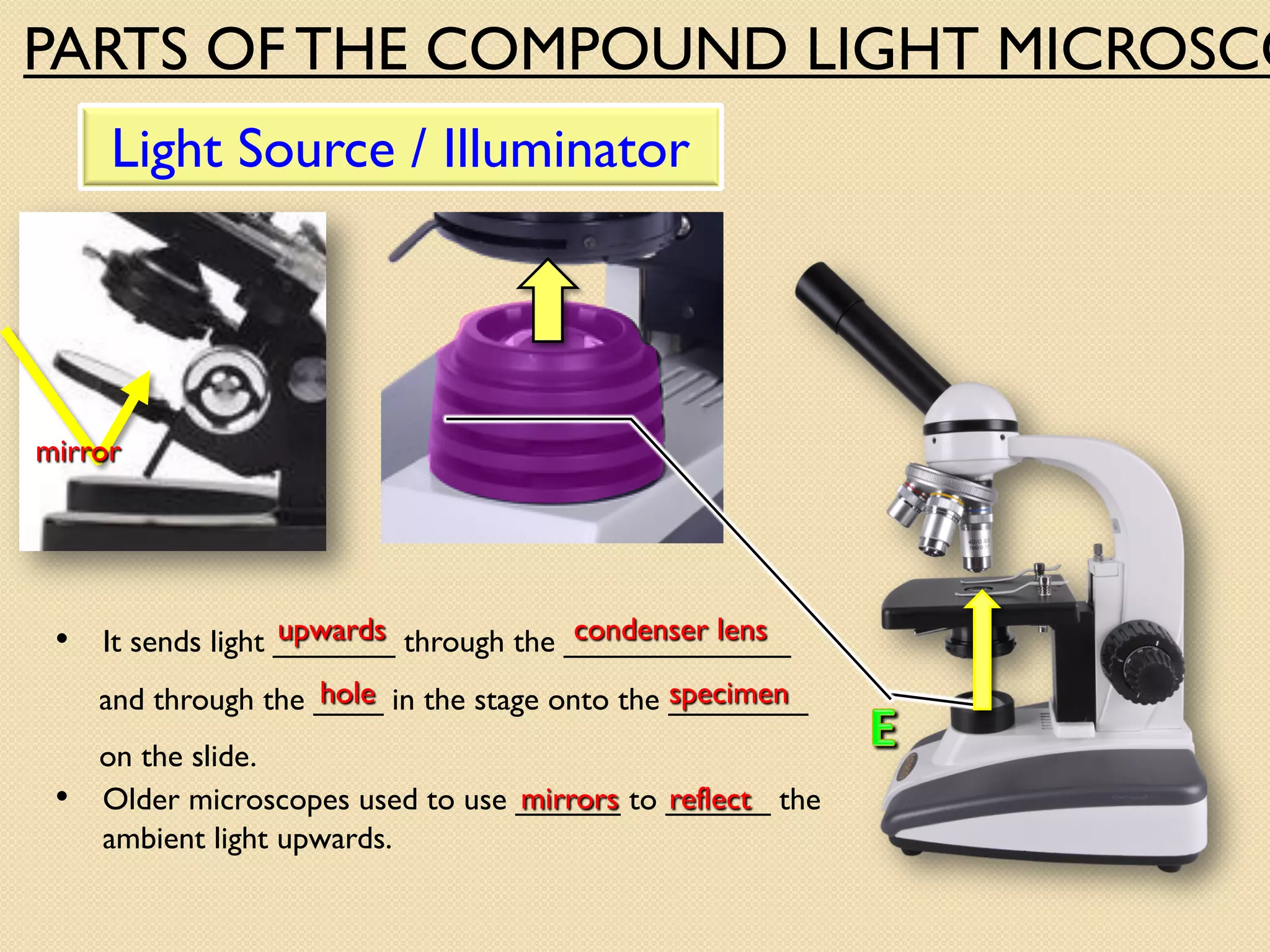
Light Source / Illuminator
• It sends light _______ through the _____________
and through the ____ in the stage onto the ________
on the slide.
hole specimen
condenser lens
upwards
PARTS OF THE COMPOUND LIGHT MICROSCO
mirror
• Older microscopes used to use ______ to ______ the
ambient light upwards.
mirrors reflect
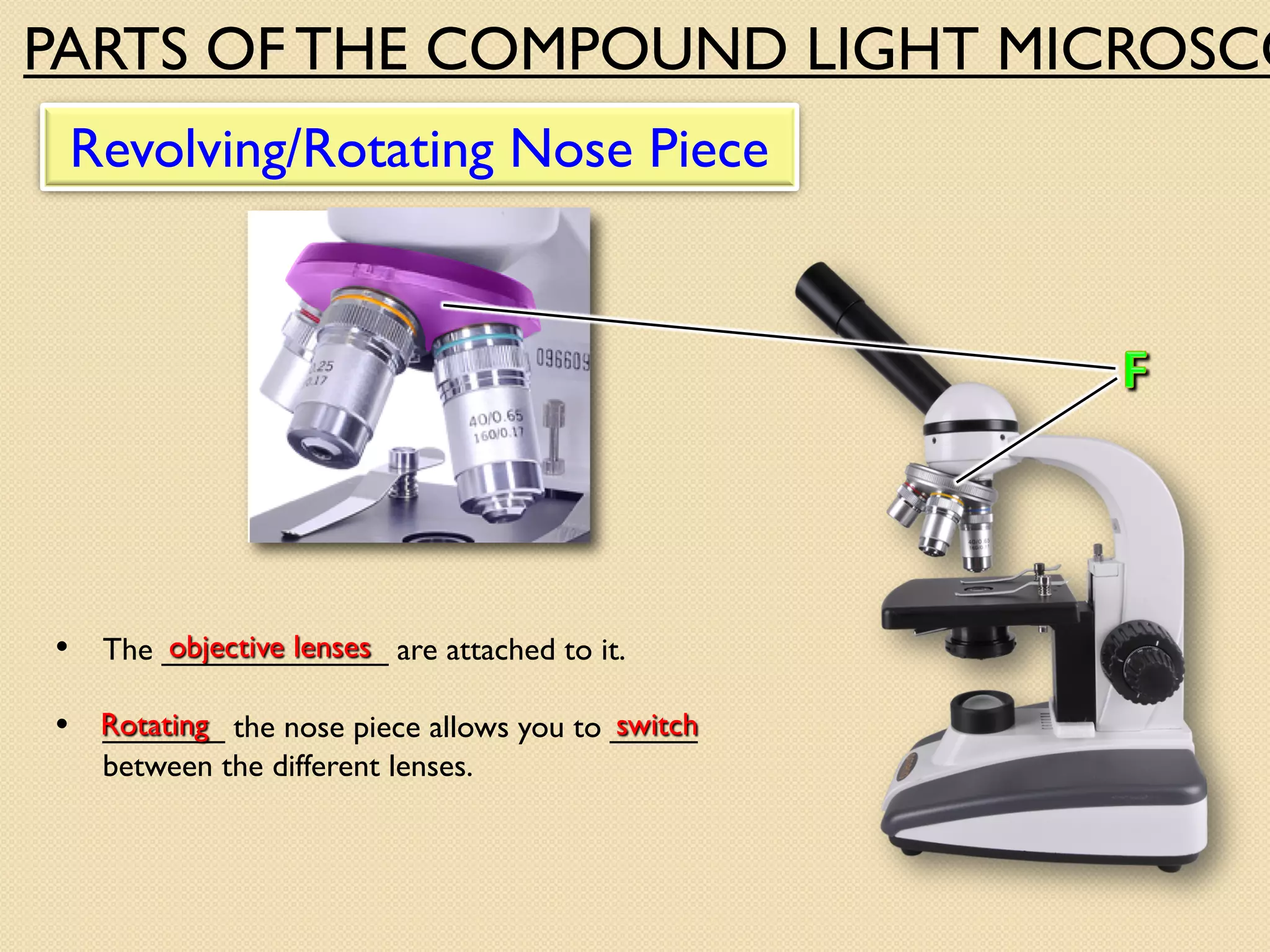
Revolving/Rotating Nose Piece
• The _____________ are attached to it.
• _______ the nose piece allows you to _____
between the different lenses.
objective lenses
Rotating switch
PARTS OF THE COMPOUND LIGHT MICROSCO
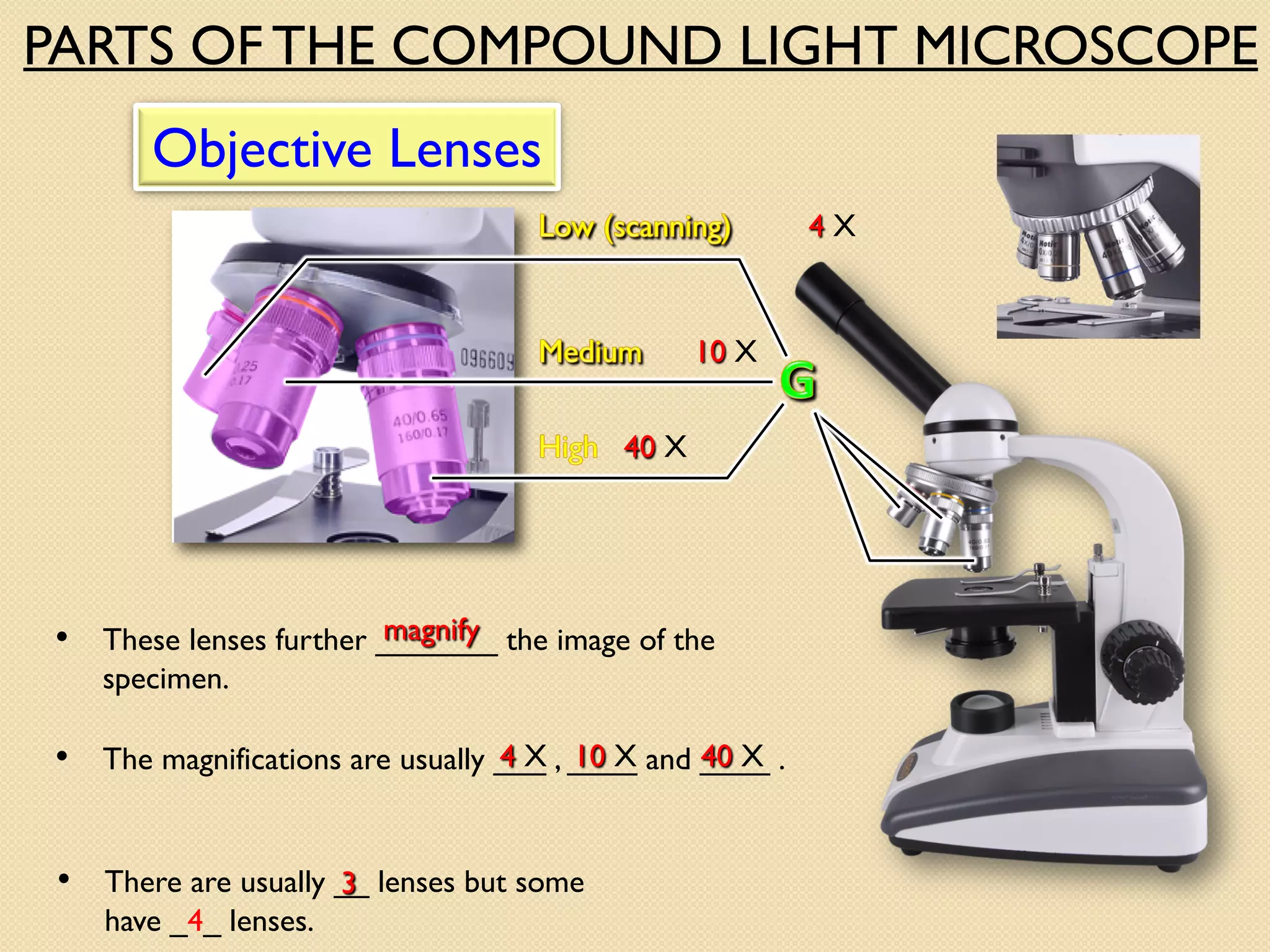
Objective Lenses
• These lenses further _______ the image of the
specimen.
magnify
• The magnifications are usually ___ , ____ and ____ .
4 X 10 X 40 X
4 X
10 X
40 X
• There are usually __ lenses but some
have _4_ lenses.
3
PARTS OF THE COMPOUND LIGHT MICROSCOPE
Objective Lenses
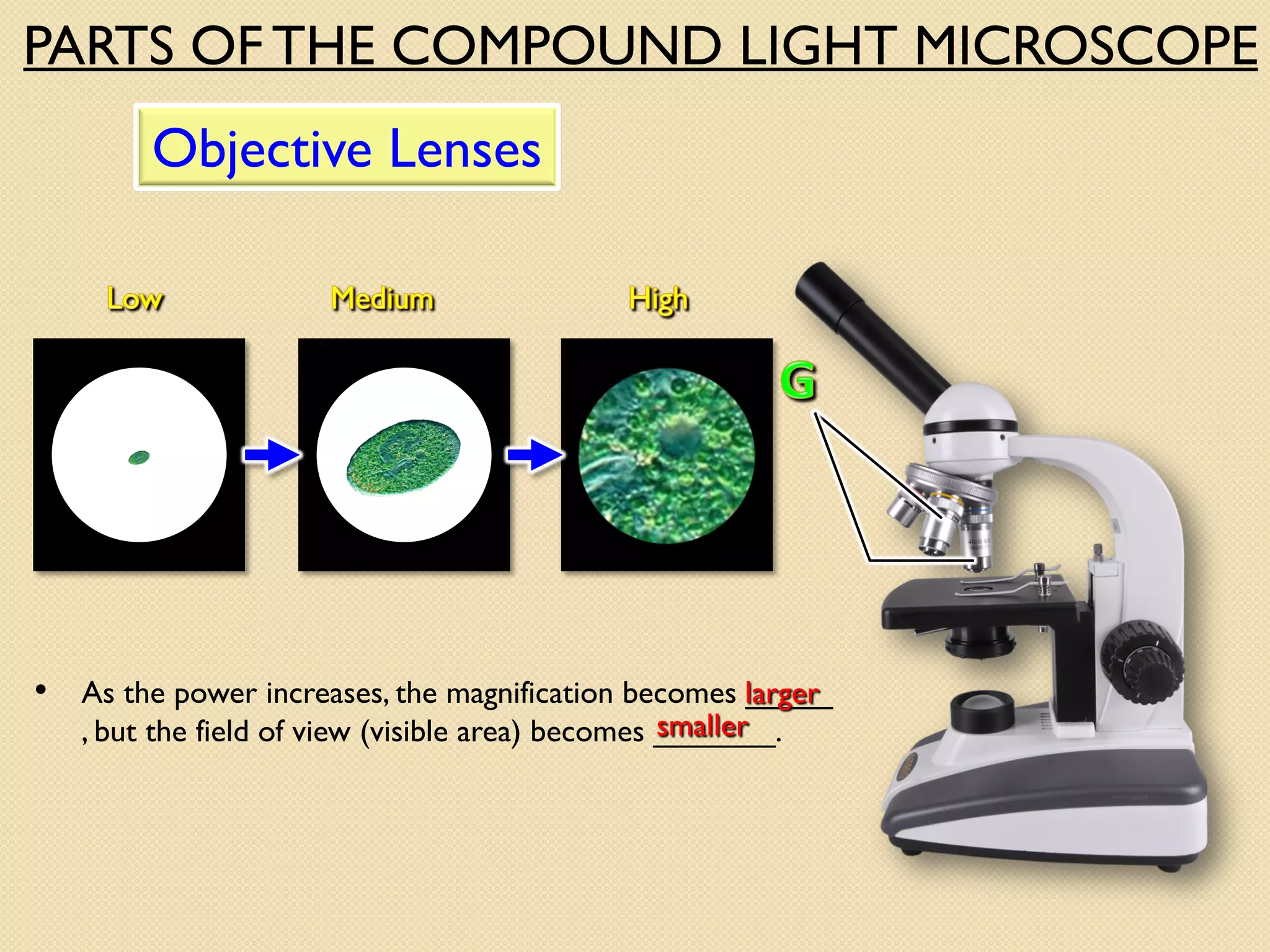
PARTS OF THE COMPOUND LIGHT MICROSCOPE
• As the power increases, the magnification becomes _____
, but the field of view (visible area) becomes _______.
larger
smaller
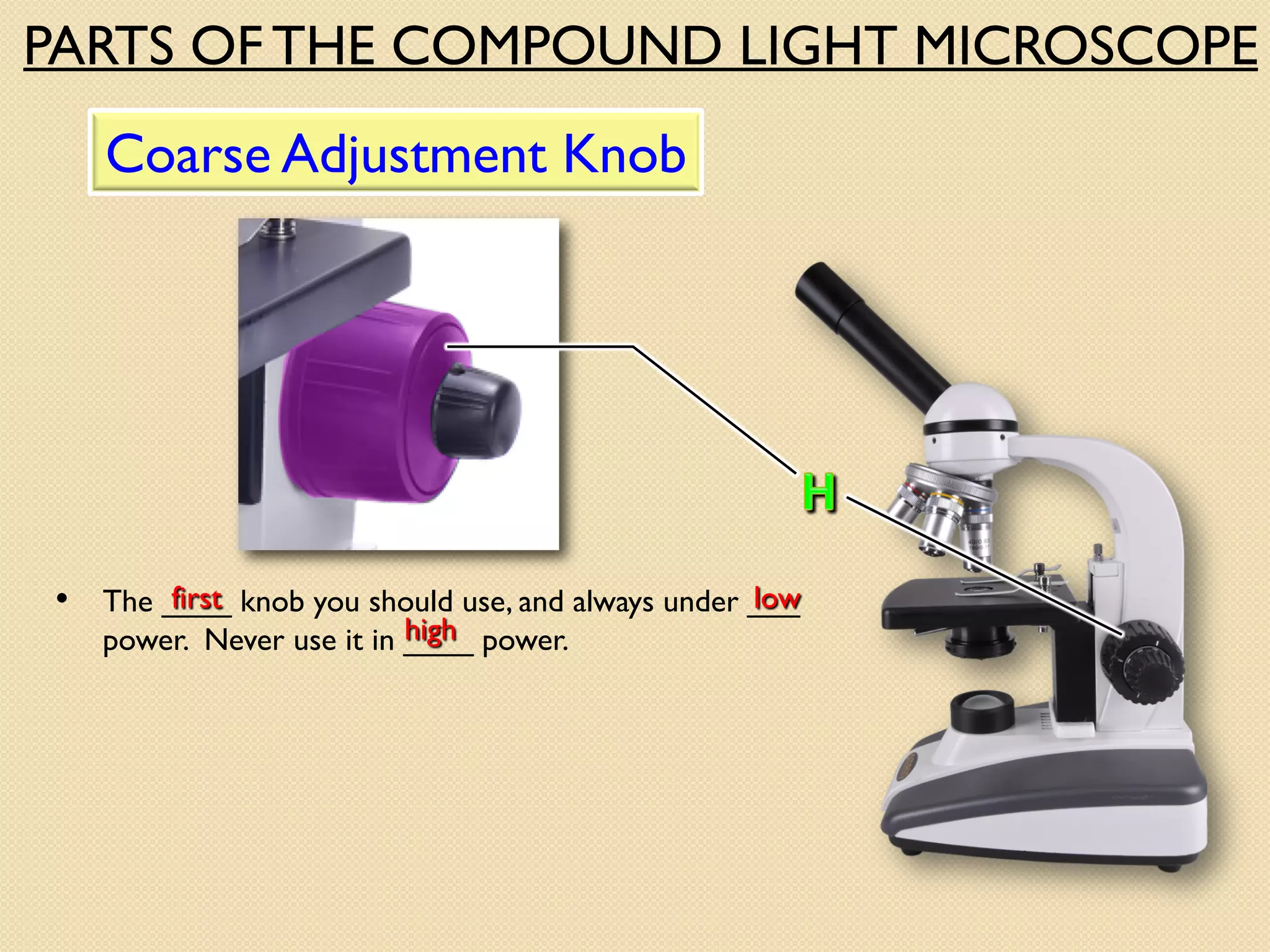
• The ____ knob you should use, and always under ___
power. Never use it in ____ power.
Coarse Adjustment Knob
low
first
high
PARTS OF THE COMPOUND LIGHT MICROSCOPE
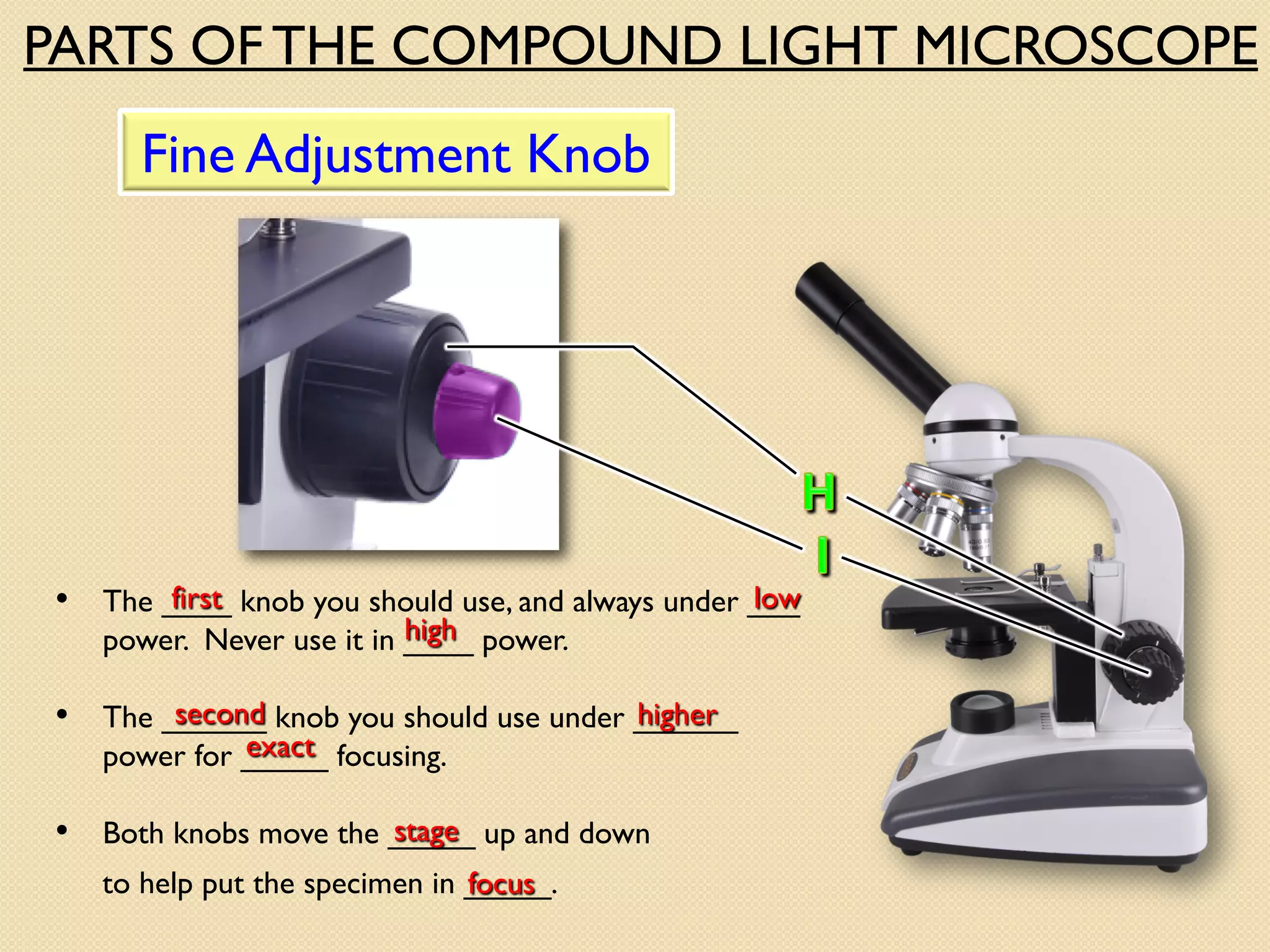
• The ____ knob you should use, and always under ___
power. Never use it in ____ power.
to help put the specimen in _____.
• Both knobs move the _____ up and down
focus
• The ______ knob you should use under ______
power for _____ focusing.
second higher
stage
Fine Adjustment Knob
low
first
high
exact
PARTS OF THE COMPOUND LIGHT MICROSCOPE
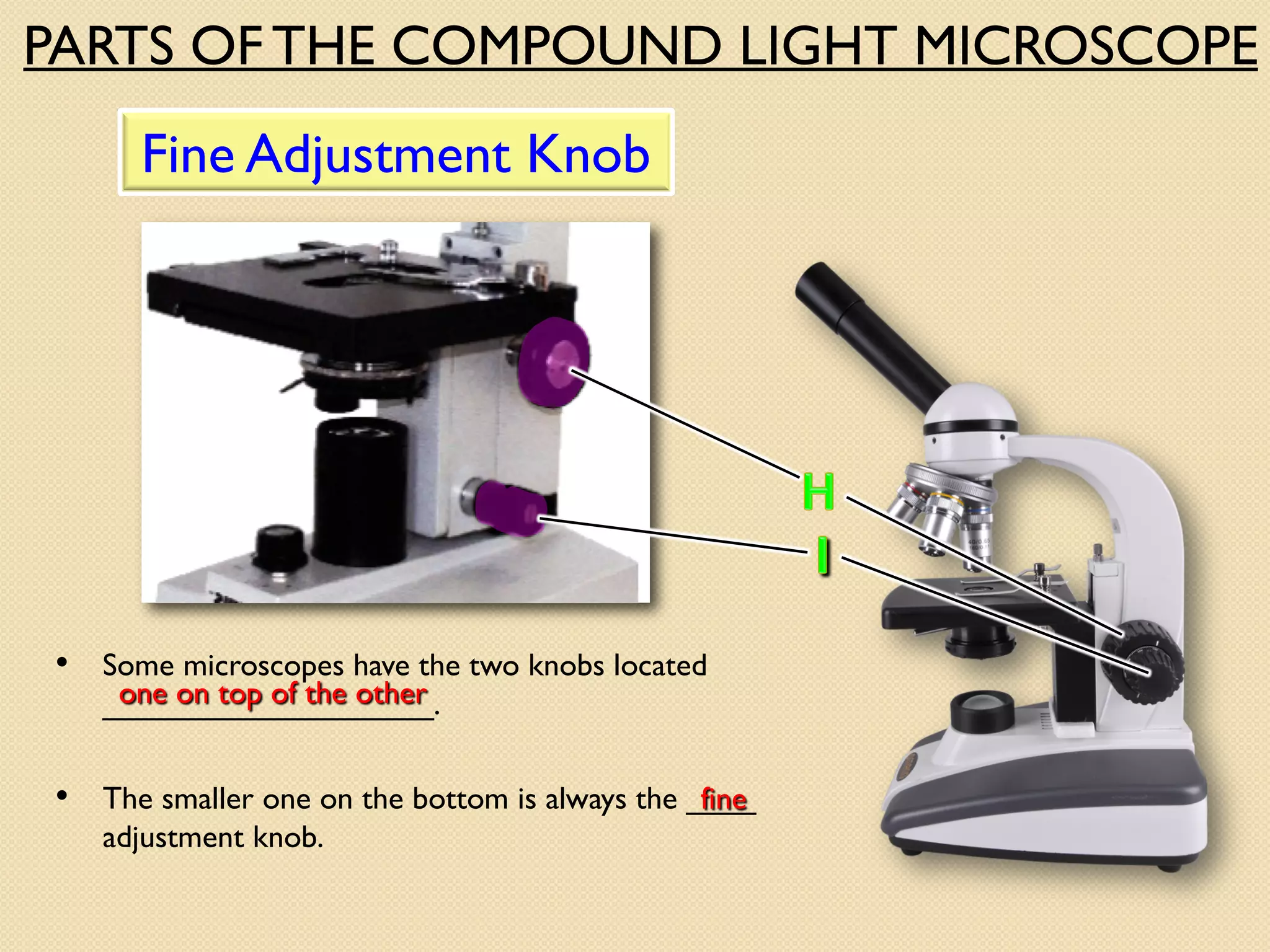
• Some microscopes have the two knobs located
___________________.
Fine Adjustment Knob
one on top of the other
PARTS OF THE COMPOUND LIGHT MICROSCOPE
• The smaller one on the bottom is always the ____
adjustment knob.
fine
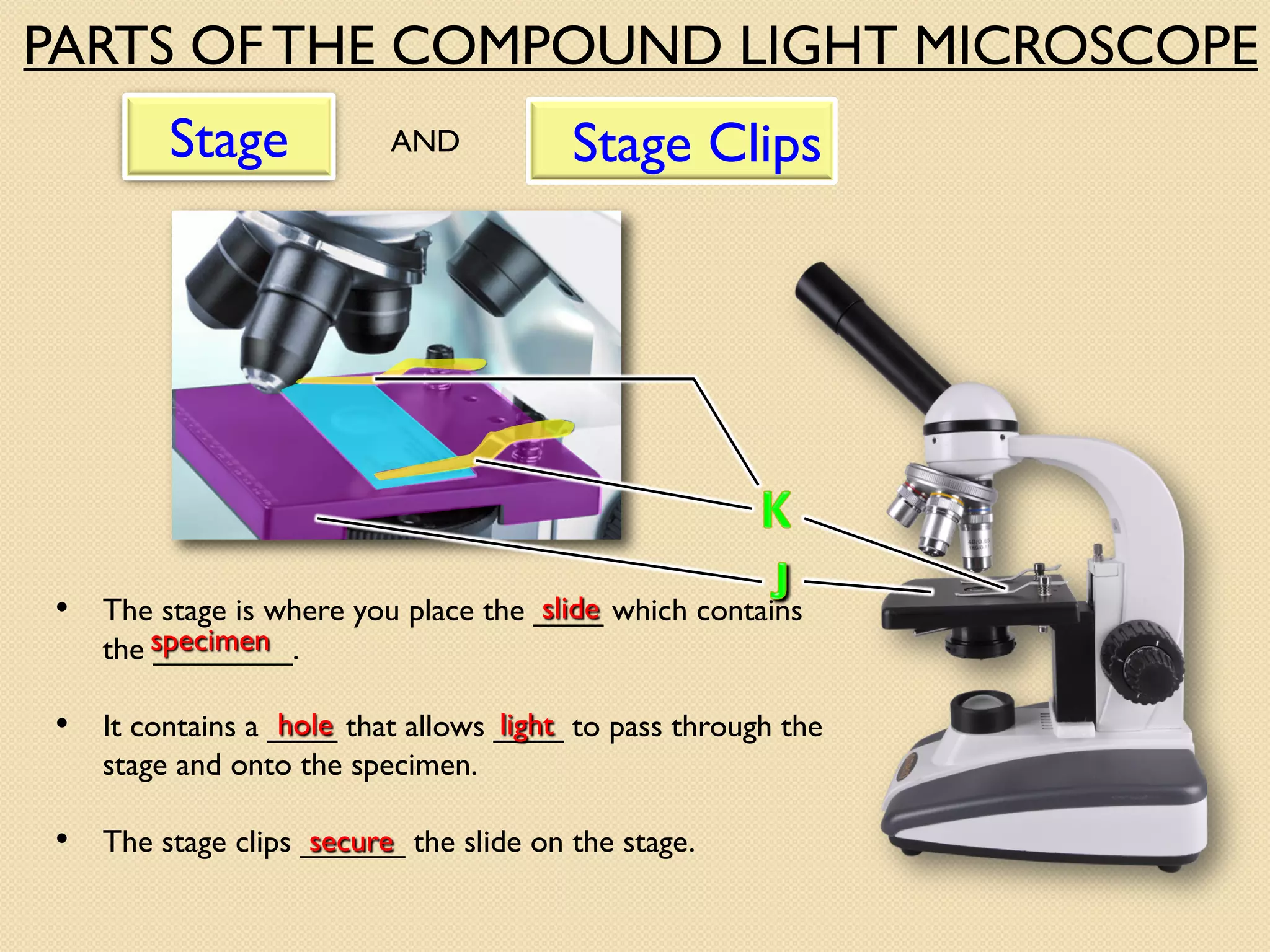
Stage Clips
• The stage is where you place the ____ which contains
the ________.
slide
specimen
• The stage clips ______ the slide on the stage.
secure
• It contains a ____ that allows ____ to pass through the
stage and onto the specimen.
hole light
PARTS OF THE COMPOUND LIGHT MICROSCOPE
Stage AND
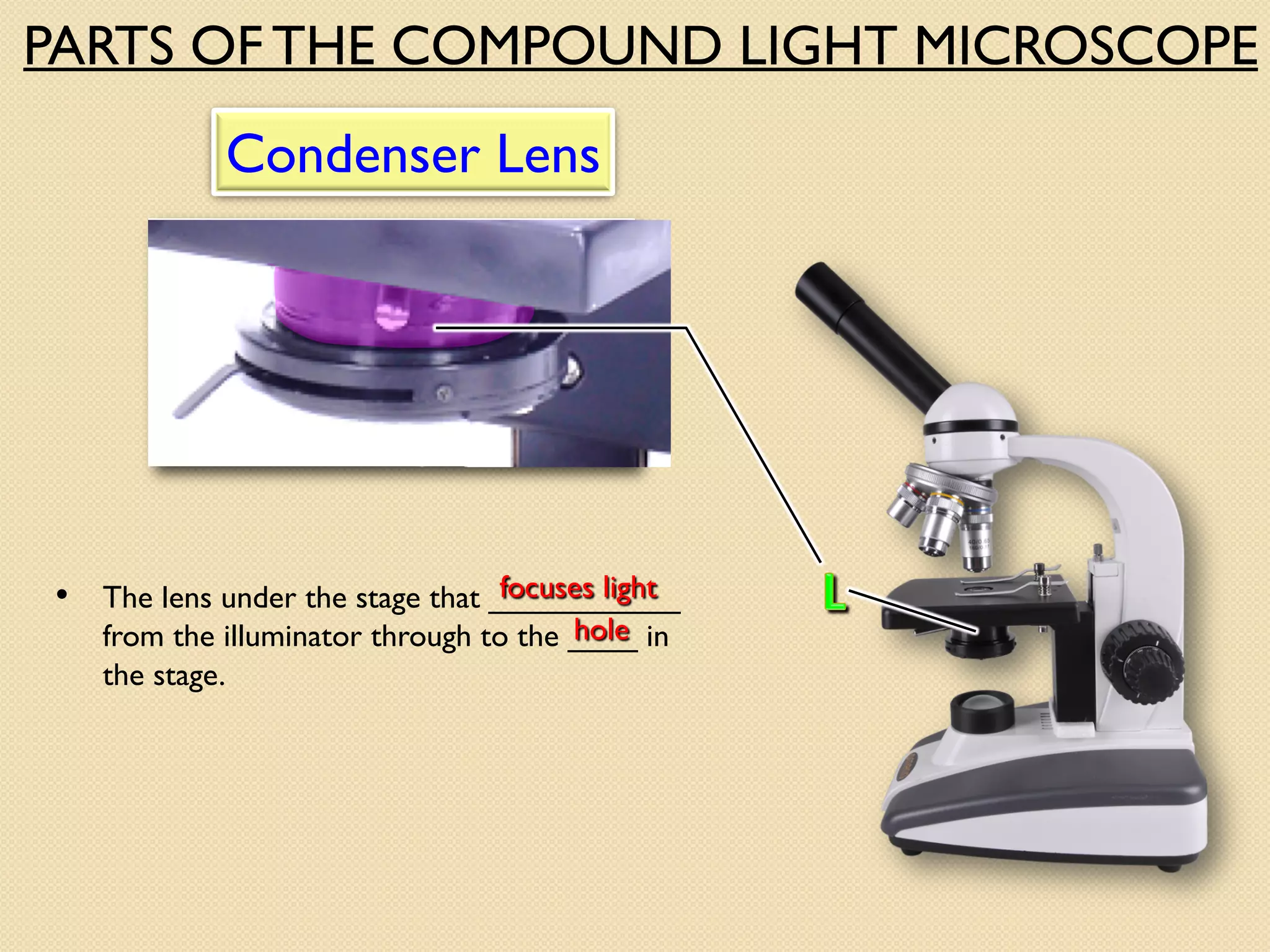
• The lens under the stage that ___________
from the illuminator through to the ____ in
the stage.
focuses light
Condenser Lens
hole
PARTS OF THE COMPOUND LIGHT MICROSCOPE
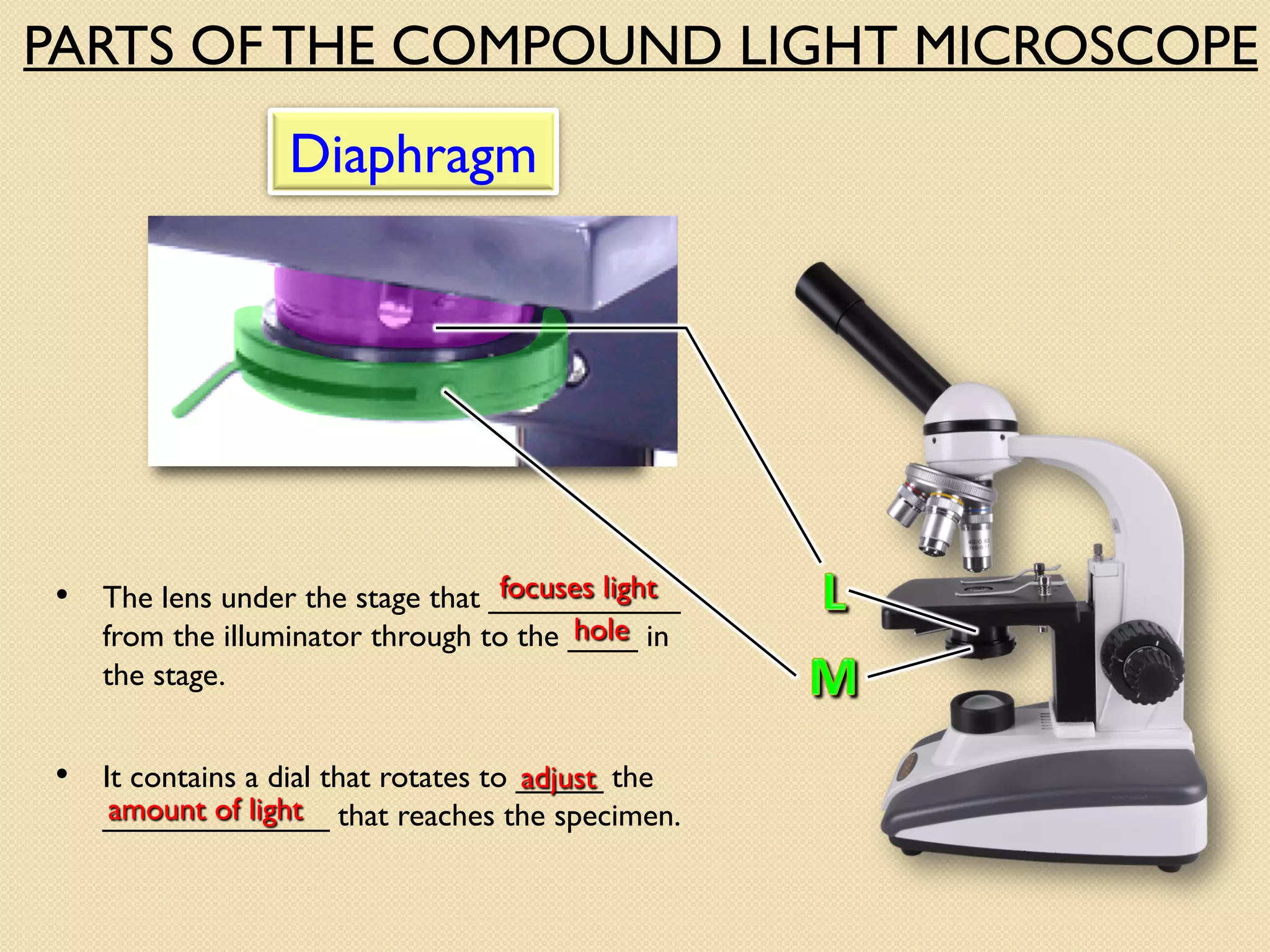
• The lens under the stage that ___________
from the illuminator through to the ____ in
the stage.
focuses light
Diaphragm
hole
• It contains a dial that rotates to _____ the
_____________ that reaches the specimen.
adjust
amount of light
PARTS OF THE COMPOUND LIGHT MICROSCOPE
Microscope
https://www.youtube.com/watch?v=Swcz_TJMz0I

THE MICROSCOPE.

  • 1.
    Introduction of Microscopes Microscope:Instrument used to make small object appear larger. Simple and Compound. Simple Microscope vs. Compound Microscope One lens More than one lens used
  • 2.
    Microscopes There are twotypes of microscope ◦ Light ◦ Electron Properties of microscopes — Magnification:The process of enlarging something in appearance. — Resolution:Ability to distinguish the individual parts of a object.This is another term for the sharpness of an image.
  • 3.
    Microscopes Magnification and Lenses —The lenses in light microscopes magnify an object by bending the light that passes through them. — On a hand lens you will see that the lens is curved, not flat.The center of the lens is thicker than the edge. — A lens with this curved shape is called a convex lens.
  • 4.
    Microscopes Magnification and Lenses —When light passes through the sides of the lens it bends inward. — When this light hits the eye, the eye sees the object as larger than it really is.
  • 5.
    Microscopes Compound Microscope Magnification —Compound microscopes contain multiple lenses which makes it more powerful than just one lens. — The first lens, near the specimen, magnifies the object.Then a second lens, near the eye, further magnifies the enlarged image. — The total magnification of the microscope is equal to the magnifications of the two lenses multiplied together. Light passes through a specimen and then through two lenses, as seen in the picture on this slide.
  • 6.
    Microscopes How it works: —The first lens makes an object look 10 times bigger than it actually is. — The second lens makes the object look 40 times bigger than it actually is. — The total magnification of the microscope is 10 x 40, or 400.
  • 11.
    ocular lens/eyepiece objective lenses bodytube base coarse adjustment knob fine adjustment knob stage stage clips diaphragm arm revolving/rotating nosepiece light source/ illuminator condenser PARTS OF THE COMPOUND LIGHT MICROSCOPE
  • 12.
    Ocular Lens /Eyepiece • Contains a lens to _______ the image of the specimen. • The usual magnification is ___ X. • Some microscopes have ___ ocular lenses. magnify 10 two PARTS OF THE COMPOUND LIGHT MICROSCOPE
  • 13.
    Body Tube • It________ the eyepiece to the objective lenses. connects • It ensures the correct ________ of the microscope components to correctly _____ the light from the specimen into the viewer’s eye alignment direct PARTS OF THE COMPOUND LIGHT MICROSCOPE
  • 14.
    • One ____should be around the arm when _______ the microscope (the other should be under the ____) Arm • It ________ the body tube to the base. connects hand carrying base PARTS OF THE COMPOUND LIGHT MICROSCOPE
  • 15.
    • It containsthe _________ and __________. • It ________ the weight of the microscope. • One hand should be _____ the base while _______ the microscope (the other hand should be holding the arm). Base supports electronics carrying light source under PARTS OF THE COMPOUND LIGHT MICROSCOPE
  • 16.
    Light Source /Illuminator • It sends light _______ through the _____________ and through the ____ in the stage onto the ________ on the slide. hole specimen condenser lens upwards PARTS OF THE COMPOUND LIGHT MICROSCO mirror • Older microscopes used to use ______ to ______ the ambient light upwards. mirrors reflect
  • 17.
    Revolving/Rotating Nose Piece •The _____________ are attached to it. • _______ the nose piece allows you to _____ between the different lenses. objective lenses Rotating switch PARTS OF THE COMPOUND LIGHT MICROSCO
  • 18.
    Objective Lenses • Theselenses further _______ the image of the specimen. magnify • The magnifications are usually ___ , ____ and ____ . 4 X 10 X 40 X 4 X 10 X 40 X • There are usually __ lenses but some have _4_ lenses. 3 PARTS OF THE COMPOUND LIGHT MICROSCOPE
  • 19.
    Objective Lenses PARTS OFTHE COMPOUND LIGHT MICROSCOPE • As the power increases, the magnification becomes _____ , but the field of view (visible area) becomes _______. larger smaller
  • 20.
    • The ____knob you should use, and always under ___ power. Never use it in ____ power. Coarse Adjustment Knob low first high PARTS OF THE COMPOUND LIGHT MICROSCOPE
  • 21.
    • The ____knob you should use, and always under ___ power. Never use it in ____ power. to help put the specimen in _____. • Both knobs move the _____ up and down focus • The ______ knob you should use under ______ power for _____ focusing. second higher stage Fine Adjustment Knob low first high exact PARTS OF THE COMPOUND LIGHT MICROSCOPE
  • 22.
    • Some microscopeshave the two knobs located ___________________. Fine Adjustment Knob one on top of the other PARTS OF THE COMPOUND LIGHT MICROSCOPE • The smaller one on the bottom is always the ____ adjustment knob. fine
  • 23.
    Stage Clips • Thestage is where you place the ____ which contains the ________. slide specimen • The stage clips ______ the slide on the stage. secure • It contains a ____ that allows ____ to pass through the stage and onto the specimen. hole light PARTS OF THE COMPOUND LIGHT MICROSCOPE Stage AND
  • 24.
    • The lensunder the stage that ___________ from the illuminator through to the ____ in the stage. focuses light Condenser Lens hole PARTS OF THE COMPOUND LIGHT MICROSCOPE
  • 25.
    • The lensunder the stage that ___________ from the illuminator through to the ____ in the stage. focuses light Diaphragm hole • It contains a dial that rotates to _____ the _____________ that reaches the specimen. adjust amount of light PARTS OF THE COMPOUND LIGHT MICROSCOPE
  • 26.