MENSTRUAL CYCLE
Definition
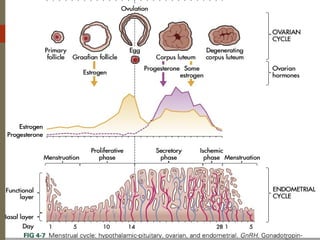
Menstruation is the periodic uterine
bleeding that begins approximately 14
days after ovulation.
It is controlled by a feed- back system of
three cycles: endometrial, hypothalamic-
pituitary, and ovarian.
The menstrual cycle has two phases: pre
ovulatory and post ovulatory
Menstrual cycle
The average length of a menstrual cycle is
28 days, but variations are normal. The first
day of bleeding is des- ignated as day 1 of
the menstrual cycle, or menses
The average duration of menstrual flow is 5
days (with a range of 3 to 6 days) and the
average blood loss is 50 ml (with a range of
20 to 80 ml), but this duration of flow and
blood loss vary greatly.
Menstrual cycle
 Uterine discharge includes mucus and epithelial cells
in addition to blood.
 The menstrual cycle is a complex interplay of events
that occur simultaneously in the endometrium, the
hypothalamus, the pitu- itary glands, and the ovaries.
 The menstrual cycle prepares the uterus for
pregnancy.
 When pregnancy does not occur, menstru ation
follows. A woman’s age, physical and emotional
status, and environment influence the regularity of
her menstrual cycles.
Phases of the menstrual cycle
Pre-ovulatory phase
 The pre-ovulatory phase is a fertile period that
begins with the production of cervical mucus, which
indicates maturation of an ovarian follicle and is
also critical to the progression of spermatozoa. This
phase ends with ovulation.
Phases of the menstrual cycle
 ii. Ovulation
 Ovulation is the release of a reproductive cell
(also referred to as an oocyte, or an ovule),
which generally occurs around the 14th day
before the next menstruation (14th day in a
28-day cycle).
 The mature follicle grows out of the ovarian
surface and ruptures to release an ovule,
ovules will reach maturity; others degenerate).
  The ovary releases a single ovule in every
cycle from puberty to menopause (only 400 to
500 )
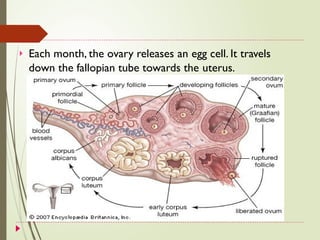
 Each month, the ovary releases an egg cell. It travels
down the fallopian tube towards the uterus.
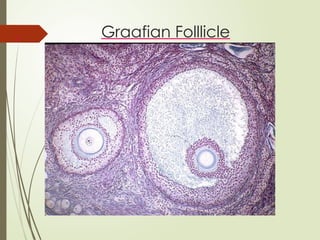
Graafian Folllicle
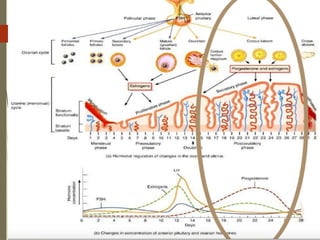
Post-ovulatory phase or luteal phase
After ovulation the post-ovulatory follicle
transforms itself under the action of LH into
the yellow body OR corpus luteum and
secretes progesterone and estrogen.
Under the influence of the two hormones,
the endometrium completes its
development and reaches the pre-
pregnancy stage
Post-ovulatory phase or luteal phase CONT
Through a negative feedback process from
the progesterone and estrogen the pituitary
gland produces less and less LH; the yellow
body consequently degenerates.
There is decreased production of
testosterone and estrogen; the endometrium
wall breaks down, causing menstruation.
 The luteal phase is a relatively fixed period
of 14 days.
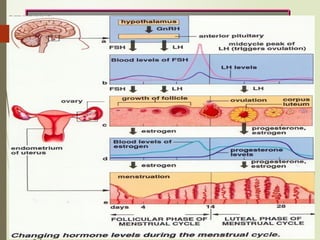
Hypothalamic-Pituitary Cycle
Toward the end of the normal menstrual
cycle, blood levels of estrogen and
progesterone decrease.
Low blood levels of these ovarian
hormones stimulate the hypothalamus to
secrete gonadotropin-releasing hormone
(GnRH).
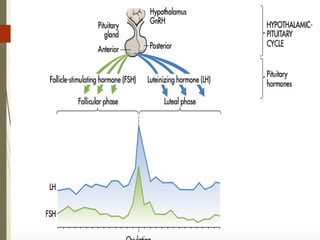
Hypothalamic-Pituitary Cycle
In turn, GnRH stimulates anterior pituitary
secretion of follicle-stimulating hormone
(FSH).
 FSH stimulates development of ovarian
graafian follicles and their production of
estrogen.
Hypothalamic-Pituitary Cycle
Estrogen levels begin to decrease, and
hypothalamic GnRH triggers the anterior
pituitary to release luteinizing hormone (LH).
A marked surge of LH and a smaller peak of
estrogen (day 12) precede the expulsion of
the ovum from the graafian follicle by
about 24 to 36 hours.

Hypothalamic-Pituitary Cycle
LH peaks at about day 13 or 14 of a 28-
day cycle. If fertilization and implantation
of the ovum have not occurred by this
time, regression of the corpus luteum
follows.
Levels of progesterone and estrogen
decline, menstruation occurs, and the
hypothalamus is once again stimulated to
secrete GnRH. This process is called the
hypothalamic-pituitary cycle.
Ovarian Cycle
The primitive graafian follicles contain
immature oocytes (primordial ova).
Before ovulation, from 1 to 30 follicles begin
to mature in each ovary under the
influence of FSH and estrogen.
The preovulatory surge of LH affects a
selected follicle.
OVULATION
 The mature Graafian follicle moves toward the surface of
the ovary and ruptures releasing the egg(ovum) from the
follicle and the ovary.
 This process, ovulation occurs about the 14th day after
the beginning of the menstrual period.
 When the ovum is released it enters the oviduct and
passes along the oviduct to the uterus
 After ovulation, the pituitary gland secretes lutenizing
hormone (LH).
 LH changes the remains of the follicle into the corpus
luteum/yellow body.
 Corpus luteum produces the hormone
progesterone.
 Progesterone further thickens the uterus lining and
increases blood supply
 If fertilization does occur the corpus luteum enlarges and
continues to produce progesterone.The lining of the
uterus thickens and blood supply increases.
 Progesterone also causes the breast to enlarge.
 These are pregnancy changes, progesterone is also known as
the ‘pregnancy hormone’.
 Both oestrogen and progesterone slow down FSH
production when their concentrations become high. Thus
no more eggs develop. *negative feedback *
 If fertilization does not occur the corpus luteum
degenerates to ordinary ovary tissue and the
progesterone level falls.
 The lining of the uterus breaks down and the egg dies.
 Lining along with blood passes out the vagina as the
menstrual period.
 Cycle continues with increased FSH production and egg
development.
 Cycle lasts approximately 28days
Ovarian Cycle
The oocyte matures, ovulation occurs, and
the empty follicle begins its transformation
into the corpus luteum or yellow body .
More than one follicle is selected and
more than one oocyte matures and
undergoes ovulation.
Ovarian Cycle
After ovulation, estrogen levels drop.
For 90% of women, only a small amount of
withdrawal bleeding occurs, and it goes
unnoticed.
In 10% of women, there is sufficient
bleeding for it to be visible, resulting in what
is termed midcycle bleeding.
Ovarian Cycle
The luteal phase begins immediately after
ovulation and ends with the start of
menstruation.
This postovulatory phase of the ovarian
cycle usually requires 14 days (range 13 to
15 days).
The corpus luteum reaches its peak of
functional activity 8 days after ovulation,
secreting the steroids estrogen and
progesterone
Ovarian Cycle
Coincident with this time of peak luteal
functioning, the fertilized ovum is implanted
in the endometrium.
If no implantation occurs, the corpus
luteum regresses and steroid levels drop.
Two weeks after ovulation, if fertilization
and implantation do not occur, the
functional layer of the uterine endometrium
is shed through menstruation.
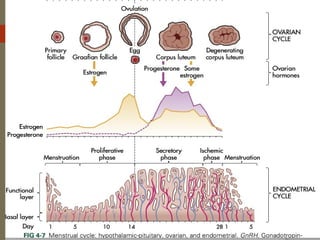
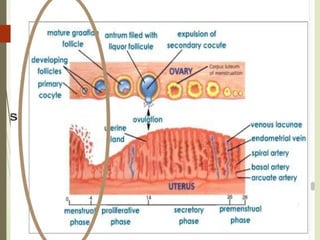
Endometrial OR Uterine Cycle
The four phases of the endometrial cycle
are:
 (1) the menstrual phase,
(2) the proliferative phase,
(3) the secretory phase, and
(4) the ischemic phase
Endometrial OR Uterine Cycle
During the menstrual phase shedding of
the functional two thirds of the endome-
trium (the compact and spongy layers) is
initiated by periodic vasoconstriction in
the upper layers of the endometrium.
Two layered
Superficial layer that sheds during the
menstrual cycle
Basal layer that doesn’t take part, but
regenerates the superficial layer
Endometrial OR Uterine Cycle
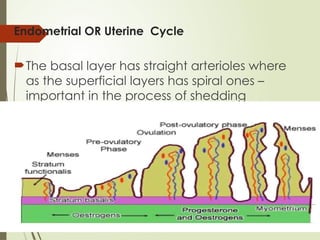
The basal layer has straight arterioles where
as the superficial layers has spiral ones –
important in the process of shedding
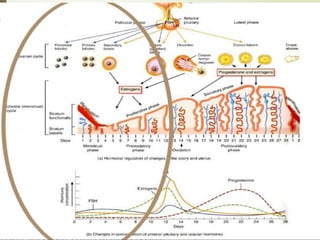
Uterine Cycle – Proliferative Phase
 The proliferative phase is a period of rapid
growth lasting from about the fifth day to the
time of ovulation. The endometrial surface is
completely restored in approximately 4 days,
or slightly before bleeding ceases.
 The proliferative phase depends on estrogen
stimulation derived from ovarian follicles.
 Endometrium exposed to oestrogen
regeneration from the last menstrual cycle
Uterine Cycle – Secretory Phase
 The secretory phase extends from the day of
ovulation to about 3 days before the next
menstrual period.
 After ovulation, large amounts of progesterone
are produced.
 An edematous, vascular, functional
endometrium is now apparent.
 At the end of the secretory phase, the fully
matured secretory endometrium reaches the
thickness of heavy, soft velvet.
 It becomes luxuriant with blood and glandular
secretions, creating a suitable protective and
nutritive bed for a fertilized ovum.
Uterine Cycle – Menstrual Phase
Luteal phase lasts 14 days – then there is a
regression of corpus luteum
decline in oestrogen and progesterone
This leads to an intense spasmodic
contraction of spiral section of endometrial
arterioles TO ischaemic necrosis TO shedding
of superficial layer TO bleeding.
These spasms are associated with
prostoglandin, which are also associated
with increased uterine contractions during
menstrual flow.
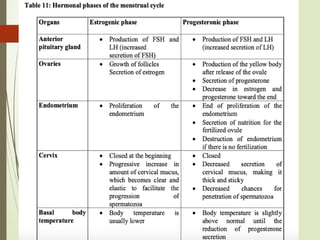
Cervical Mucus
Important to stop ascending infection
Changes during the menstrual cycle
Early follicular phase – viscid and
impermeable
Late follicular phase – increasing oestrogen
levels TO mucus becomes watery and easily
penetrated, allowing spermatozoa to get
through. Change is known as Spinnbarkheit
Post-ovulation – progesterone from corpus
luteum counteracts oestrogens effects TO
mucus becomes impermeable and the
cervical os contracts
Other Changes
Body temperature – Rise of 0.5°C after
ovulation till onset of menstruation. Due to
progesterone levels. If conception occurs –
this temperature is maintained throughout
pregnancy
Breast changes – breast swelling during
luteal phase due to increasing
progesterone levels
Psychological changes – change in mood
and an increase in emotional lability. Might
be due to falling progesterone levels.
Normal Menstrual Cycle
What is the mean duration of the MC?
Mean 28 days (only
15% of ♀) Range 21-35
What is the average duration of menses?
3-8 days
What is the normal estimated blood
loss?
Approximately 30 ml
When does ovulation occur?
Usually day 14
36 hrs after the onset of mid-
cycle LH surge
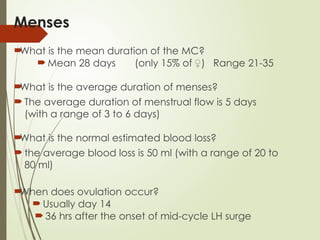
Menses

What is the mean duration of the MC?
 Mean 28 days (only 15% of ♀) Range 21-35

What is the average duration of menses?
 The average duration of menstrual flow is 5 days
(with a range of 3 to 6 days)

What is the normal estimated blood loss?
 the average blood loss is 50 ml (with a range of 20 to
80 ml)

When does ovulation occur?
 Usually day 14
 36 hrs after the onset of mid-cycle LH surge
Menstrual Cramps
 Menstrual cramps are pains in the abdominal (belly) and
pelvic areas that are experienced by a woman as a result
of her menstrual period.
 Menstrual cramps can range from mild to quite severe.
Mild menstrual cramps may be barely noticeable and of
short duration - sometimes felt just as a sense of light
heaviness in the belly. Severe menstrual cramps can be so
painful that they interfere with a woman's regular
activities for several days.
What causes menstrual cramps
 When the old uterine lining begins to break down,
molecular compounds called prostaglandins are released.
These compounds cause the muscles of the uterus to
contract.When the uterine muscles contract, they
constrict the blood supply to the endometrium.
 This contraction blocks the delivery of oxygen to the
tissue of the endometrium which, in turn, breaks down
and dies.After the death of this tissue, the uterine
contractions literally squeeze the old endometrial tissue
through the cervix and out of the body by way of the
vagina.
MENSTRUAL CYCLE .pptxxxxxxxxxxxxxxxxxxxxx

MENSTRUAL CYCLE .pptxxxxxxxxxxxxxxxxxxxxx

  • 1.
  • 3.
    Definition Menstruation is theperiodic uterine bleeding that begins approximately 14 days after ovulation. It is controlled by a feed- back system of three cycles: endometrial, hypothalamic- pituitary, and ovarian. The menstrual cycle has two phases: pre ovulatory and post ovulatory
  • 4.
    Menstrual cycle The averagelength of a menstrual cycle is 28 days, but variations are normal. The first day of bleeding is des- ignated as day 1 of the menstrual cycle, or menses The average duration of menstrual flow is 5 days (with a range of 3 to 6 days) and the average blood loss is 50 ml (with a range of 20 to 80 ml), but this duration of flow and blood loss vary greatly.
  • 5.
    Menstrual cycle  Uterinedischarge includes mucus and epithelial cells in addition to blood.  The menstrual cycle is a complex interplay of events that occur simultaneously in the endometrium, the hypothalamus, the pitu- itary glands, and the ovaries.  The menstrual cycle prepares the uterus for pregnancy.  When pregnancy does not occur, menstru ation follows. A woman’s age, physical and emotional status, and environment influence the regularity of her menstrual cycles.
  • 6.
    Phases of themenstrual cycle Pre-ovulatory phase  The pre-ovulatory phase is a fertile period that begins with the production of cervical mucus, which indicates maturation of an ovarian follicle and is also critical to the progression of spermatozoa. This phase ends with ovulation.
  • 7.
    Phases of themenstrual cycle  ii. Ovulation  Ovulation is the release of a reproductive cell (also referred to as an oocyte, or an ovule), which generally occurs around the 14th day before the next menstruation (14th day in a 28-day cycle).  The mature follicle grows out of the ovarian surface and ruptures to release an ovule, ovules will reach maturity; others degenerate).   The ovary releases a single ovule in every cycle from puberty to menopause (only 400 to 500 )
  • 8.
     Each month,the ovary releases an egg cell. It travels down the fallopian tube towards the uterus.
  • 9.
  • 10.
    Post-ovulatory phase orluteal phase After ovulation the post-ovulatory follicle transforms itself under the action of LH into the yellow body OR corpus luteum and secretes progesterone and estrogen. Under the influence of the two hormones, the endometrium completes its development and reaches the pre- pregnancy stage
  • 11.
    Post-ovulatory phase orluteal phase CONT Through a negative feedback process from the progesterone and estrogen the pituitary gland produces less and less LH; the yellow body consequently degenerates. There is decreased production of testosterone and estrogen; the endometrium wall breaks down, causing menstruation.  The luteal phase is a relatively fixed period of 14 days.
  • 12.
    Hypothalamic-Pituitary Cycle Toward theend of the normal menstrual cycle, blood levels of estrogen and progesterone decrease. Low blood levels of these ovarian hormones stimulate the hypothalamus to secrete gonadotropin-releasing hormone (GnRH).
  • 14.
    Hypothalamic-Pituitary Cycle In turn,GnRH stimulates anterior pituitary secretion of follicle-stimulating hormone (FSH).  FSH stimulates development of ovarian graafian follicles and their production of estrogen.
  • 15.
    Hypothalamic-Pituitary Cycle Estrogen levelsbegin to decrease, and hypothalamic GnRH triggers the anterior pituitary to release luteinizing hormone (LH). A marked surge of LH and a smaller peak of estrogen (day 12) precede the expulsion of the ovum from the graafian follicle by about 24 to 36 hours. 
  • 16.
    Hypothalamic-Pituitary Cycle LH peaksat about day 13 or 14 of a 28- day cycle. If fertilization and implantation of the ovum have not occurred by this time, regression of the corpus luteum follows. Levels of progesterone and estrogen decline, menstruation occurs, and the hypothalamus is once again stimulated to secrete GnRH. This process is called the hypothalamic-pituitary cycle.
  • 17.
    Ovarian Cycle The primitivegraafian follicles contain immature oocytes (primordial ova). Before ovulation, from 1 to 30 follicles begin to mature in each ovary under the influence of FSH and estrogen. The preovulatory surge of LH affects a selected follicle.
  • 18.
    OVULATION  The matureGraafian follicle moves toward the surface of the ovary and ruptures releasing the egg(ovum) from the follicle and the ovary.  This process, ovulation occurs about the 14th day after the beginning of the menstrual period.  When the ovum is released it enters the oviduct and passes along the oviduct to the uterus
  • 19.
     After ovulation,the pituitary gland secretes lutenizing hormone (LH).  LH changes the remains of the follicle into the corpus luteum/yellow body.  Corpus luteum produces the hormone progesterone.  Progesterone further thickens the uterus lining and increases blood supply
  • 20.
     If fertilizationdoes occur the corpus luteum enlarges and continues to produce progesterone.The lining of the uterus thickens and blood supply increases.  Progesterone also causes the breast to enlarge.  These are pregnancy changes, progesterone is also known as the ‘pregnancy hormone’.  Both oestrogen and progesterone slow down FSH production when their concentrations become high. Thus no more eggs develop. *negative feedback *
  • 21.
     If fertilizationdoes not occur the corpus luteum degenerates to ordinary ovary tissue and the progesterone level falls.  The lining of the uterus breaks down and the egg dies.  Lining along with blood passes out the vagina as the menstrual period.  Cycle continues with increased FSH production and egg development.  Cycle lasts approximately 28days
  • 23.
    Ovarian Cycle The oocytematures, ovulation occurs, and the empty follicle begins its transformation into the corpus luteum or yellow body . More than one follicle is selected and more than one oocyte matures and undergoes ovulation.
  • 24.
    Ovarian Cycle After ovulation,estrogen levels drop. For 90% of women, only a small amount of withdrawal bleeding occurs, and it goes unnoticed. In 10% of women, there is sufficient bleeding for it to be visible, resulting in what is termed midcycle bleeding.
  • 25.
    Ovarian Cycle The lutealphase begins immediately after ovulation and ends with the start of menstruation. This postovulatory phase of the ovarian cycle usually requires 14 days (range 13 to 15 days). The corpus luteum reaches its peak of functional activity 8 days after ovulation, secreting the steroids estrogen and progesterone
  • 26.
    Ovarian Cycle Coincident withthis time of peak luteal functioning, the fertilized ovum is implanted in the endometrium. If no implantation occurs, the corpus luteum regresses and steroid levels drop. Two weeks after ovulation, if fertilization and implantation do not occur, the functional layer of the uterine endometrium is shed through menstruation.
  • 27.
    Endometrial OR UterineCycle The four phases of the endometrial cycle are:  (1) the menstrual phase, (2) the proliferative phase, (3) the secretory phase, and (4) the ischemic phase
  • 29.
    Endometrial OR UterineCycle During the menstrual phase shedding of the functional two thirds of the endome- trium (the compact and spongy layers) is initiated by periodic vasoconstriction in the upper layers of the endometrium. Two layered Superficial layer that sheds during the menstrual cycle Basal layer that doesn’t take part, but regenerates the superficial layer
  • 30.
    Endometrial OR UterineCycle The basal layer has straight arterioles where as the superficial layers has spiral ones – important in the process of shedding
  • 31.
    Uterine Cycle –Proliferative Phase  The proliferative phase is a period of rapid growth lasting from about the fifth day to the time of ovulation. The endometrial surface is completely restored in approximately 4 days, or slightly before bleeding ceases.  The proliferative phase depends on estrogen stimulation derived from ovarian follicles.  Endometrium exposed to oestrogen regeneration from the last menstrual cycle
  • 33.
    Uterine Cycle –Secretory Phase  The secretory phase extends from the day of ovulation to about 3 days before the next menstrual period.  After ovulation, large amounts of progesterone are produced.  An edematous, vascular, functional endometrium is now apparent.  At the end of the secretory phase, the fully matured secretory endometrium reaches the thickness of heavy, soft velvet.  It becomes luxuriant with blood and glandular secretions, creating a suitable protective and nutritive bed for a fertilized ovum.
  • 35.
    Uterine Cycle –Menstrual Phase Luteal phase lasts 14 days – then there is a regression of corpus luteum decline in oestrogen and progesterone This leads to an intense spasmodic contraction of spiral section of endometrial arterioles TO ischaemic necrosis TO shedding of superficial layer TO bleeding. These spasms are associated with prostoglandin, which are also associated with increased uterine contractions during menstrual flow.
  • 37.
    Cervical Mucus Important tostop ascending infection Changes during the menstrual cycle Early follicular phase – viscid and impermeable Late follicular phase – increasing oestrogen levels TO mucus becomes watery and easily penetrated, allowing spermatozoa to get through. Change is known as Spinnbarkheit Post-ovulation – progesterone from corpus luteum counteracts oestrogens effects TO mucus becomes impermeable and the cervical os contracts
  • 38.
    Other Changes Body temperature– Rise of 0.5°C after ovulation till onset of menstruation. Due to progesterone levels. If conception occurs – this temperature is maintained throughout pregnancy Breast changes – breast swelling during luteal phase due to increasing progesterone levels Psychological changes – change in mood and an increase in emotional lability. Might be due to falling progesterone levels.
  • 39.
    Normal Menstrual Cycle Whatis the mean duration of the MC? Mean 28 days (only 15% of ♀) Range 21-35 What is the average duration of menses? 3-8 days What is the normal estimated blood loss? Approximately 30 ml When does ovulation occur? Usually day 14 36 hrs after the onset of mid- cycle LH surge
  • 40.
    Menses  What is themean duration of the MC?  Mean 28 days (only 15% of ♀) Range 21-35  What is the average duration of menses?  The average duration of menstrual flow is 5 days (with a range of 3 to 6 days)  What is the normal estimated blood loss?  the average blood loss is 50 ml (with a range of 20 to 80 ml)  When does ovulation occur?  Usually day 14  36 hrs after the onset of mid-cycle LH surge
  • 42.
    Menstrual Cramps  Menstrualcramps are pains in the abdominal (belly) and pelvic areas that are experienced by a woman as a result of her menstrual period.  Menstrual cramps can range from mild to quite severe. Mild menstrual cramps may be barely noticeable and of short duration - sometimes felt just as a sense of light heaviness in the belly. Severe menstrual cramps can be so painful that they interfere with a woman's regular activities for several days.
  • 43.
    What causes menstrualcramps  When the old uterine lining begins to break down, molecular compounds called prostaglandins are released. These compounds cause the muscles of the uterus to contract.When the uterine muscles contract, they constrict the blood supply to the endometrium.  This contraction blocks the delivery of oxygen to the tissue of the endometrium which, in turn, breaks down and dies.After the death of this tissue, the uterine contractions literally squeeze the old endometrial tissue through the cervix and out of the body by way of the vagina.