PIONEERS OF
TOWN PLANNING
FRANK LLOYD
WRIGHT(BROADACRE CITY)
Ar.AyazAhmad Khan
Assistant Professor
InvertisUniversity
INTRODUCTION
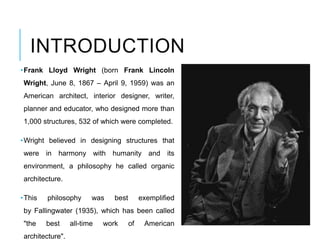
•Frank Lloyd Wright (born Frank Lincoln
Wright, June 8, 1867 – April 9, 1959) was an
American architect, interior designer, writer,
planner and educator, who designed more than
1,000 structures, 532 of which were completed.
•Wright believed in designing structures that
were in harmony with humanity and its
environment, a philosophy he called organic
architecture.
•This philosophy was best exemplified
by Fallingwater (1935), which has been called
"the best all-time work of American
architecture".
PLANNING WORKS
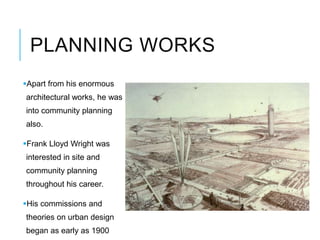
Apart from his enormous
architectural works, he was
into community planning
also.
Frank Lloyd Wright was
interested in site and
community planning
throughout his career.
His commissions and
theories on urban design
began as early as 1900
PLANNING WORKS
The most ambitious designs of his community work was his entry into the City Club of
Chicago Land Development Competition in 1913.
The contest was for the development of a suburban quarter section.
This design expanded on the Quadruple Block Plan and included several social levels.
The design shows the placement of the upscale homes in the most desirable areas and
the blue collar homes and apartments separated by parks and common spaces.
The design also included all the amenities of a small city: schools, museums, markets,
etc.
This view of decentralization was later reinforced by theoretical Broadacre City design.
The philosophy behind his community planning was decentralization.
The new development must be away from the cities. In this decentralized America, all
BROADACRE CITY
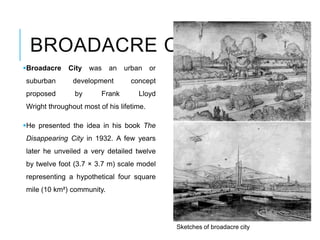
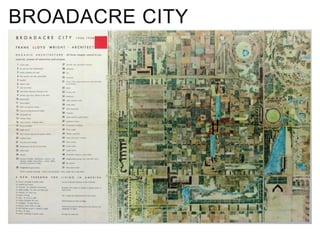
Broadacre City was an urban or
suburban development concept
proposed by Frank Lloyd
Wright throughout most of his lifetime.
He presented the idea in his book The
Disappearing City in 1932. A few years
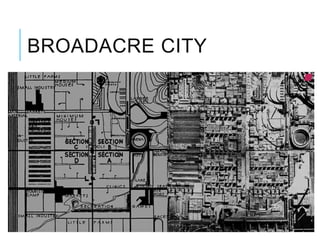
later he unveiled a very detailed twelve
by twelve foot (3.7 × 3.7 m) scale model
representing a hypothetical four square
mile (10 km²) community.
Sketches of broadacre city
BROADACRE CITY – KEY
POINTS
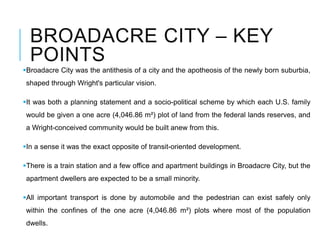
Broadacre City was the antithesis of a city and the apotheosis of the newly born suburbia,
shaped through Wright's particular vision.
It was both a planning statement and a socio-political scheme by which each U.S. family
would be given a one acre (4,046.86 m²) plot of land from the federal lands reserves, and
a Wright-conceived community would be built anew from this.
In a sense it was the exact opposite of transit-oriented development.
There is a train station and a few office and apartment buildings in Broadacre City, but the
apartment dwellers are expected to be a small minority.
All important transport is done by automobile and the pedestrian can exist safely only
within the confines of the one acre (4,046.86 m²) plots where most of the population
dwells.
BROADACRE CITY – KEY
POINTSEach family would be given one acre (4,000 sq.m. from the federal land reserves
Land would be taken into public ownership; then granted to families for as long as they
used it
productively.
12 x 12 ft. model that illustrated the Broadacre City concept as it might be applied to a
representative 4 sq. miles plot of land.
BROADACRE CITY
BROADACRE CITY
ORIGIN OF BROADACRE
CITY
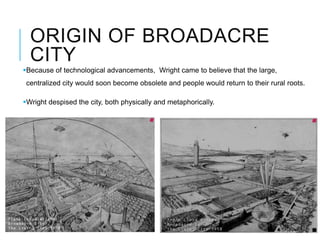
Because of technological advancements, Wright came to believe that the large,
centralized city would soon become obsolete and people would return to their rural roots.
Wright despised the city, both physically and metaphorically.
ASPECTS OF
BROADACRE CITY THAT
BECAME REALITIES
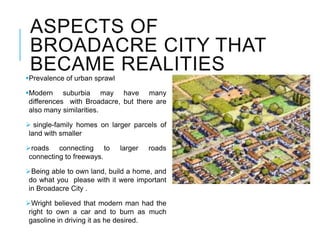
Prevalence of urban sprawl
Modern suburbia may have many
differences with Broadacre, but there are
also many similarities.
 single-family homes on larger parcels of
land with smaller
roads connecting to larger roads
connecting to freeways.
Being able to own land, build a home, and
do what you please with it were important
in Broadacre City .
Wright believed that modern man had the
right to own a car and to burn as much
gasoline in driving it as he desired.
FAILURES AND LESSONS
TO LEARNT
Failures
Too real to be Utopian and too dreamlike to be of practical importance.
Demands motor transportation for even the most casual or ephemeral meetings
Lessons to be learnt
Urban sprawl has become a reality
Decentralization, both physically and economically; being more independent.
CONCLUSIONS
Although the Broadacre city was a utopian concept and never got built but the
idea of FLW was to create a city based on decentralization.
One more concept was his Usonian houses in which he cater the problem of low
income group people.
THANKYOU…

Frank lloyd wright

  • 1.
    PIONEERS OF TOWN PLANNING FRANKLLOYD WRIGHT(BROADACRE CITY) Ar.AyazAhmad Khan Assistant Professor InvertisUniversity
  • 2.
    INTRODUCTION •Frank Lloyd Wright(born Frank Lincoln Wright, June 8, 1867 – April 9, 1959) was an American architect, interior designer, writer, planner and educator, who designed more than 1,000 structures, 532 of which were completed. •Wright believed in designing structures that were in harmony with humanity and its environment, a philosophy he called organic architecture. •This philosophy was best exemplified by Fallingwater (1935), which has been called "the best all-time work of American architecture".
  • 3.
    PLANNING WORKS Apart fromhis enormous architectural works, he was into community planning also. Frank Lloyd Wright was interested in site and community planning throughout his career. His commissions and theories on urban design began as early as 1900
  • 4.
    PLANNING WORKS The mostambitious designs of his community work was his entry into the City Club of Chicago Land Development Competition in 1913. The contest was for the development of a suburban quarter section. This design expanded on the Quadruple Block Plan and included several social levels. The design shows the placement of the upscale homes in the most desirable areas and the blue collar homes and apartments separated by parks and common spaces. The design also included all the amenities of a small city: schools, museums, markets, etc. This view of decentralization was later reinforced by theoretical Broadacre City design. The philosophy behind his community planning was decentralization. The new development must be away from the cities. In this decentralized America, all
  • 5.
    BROADACRE CITY Broadacre Citywas an urban or suburban development concept proposed by Frank Lloyd Wright throughout most of his lifetime. He presented the idea in his book The Disappearing City in 1932. A few years later he unveiled a very detailed twelve by twelve foot (3.7 × 3.7 m) scale model representing a hypothetical four square mile (10 km²) community. Sketches of broadacre city
  • 6.
    BROADACRE CITY –KEY POINTS Broadacre City was the antithesis of a city and the apotheosis of the newly born suburbia, shaped through Wright's particular vision. It was both a planning statement and a socio-political scheme by which each U.S. family would be given a one acre (4,046.86 m²) plot of land from the federal lands reserves, and a Wright-conceived community would be built anew from this. In a sense it was the exact opposite of transit-oriented development. There is a train station and a few office and apartment buildings in Broadacre City, but the apartment dwellers are expected to be a small minority. All important transport is done by automobile and the pedestrian can exist safely only within the confines of the one acre (4,046.86 m²) plots where most of the population dwells.
  • 7.
    BROADACRE CITY –KEY POINTSEach family would be given one acre (4,000 sq.m. from the federal land reserves Land would be taken into public ownership; then granted to families for as long as they used it productively. 12 x 12 ft. model that illustrated the Broadacre City concept as it might be applied to a representative 4 sq. miles plot of land.
  • 8.
  • 9.
  • 10.
    ORIGIN OF BROADACRE CITY Becauseof technological advancements, Wright came to believe that the large, centralized city would soon become obsolete and people would return to their rural roots. Wright despised the city, both physically and metaphorically.
  • 11.
    ASPECTS OF BROADACRE CITYTHAT BECAME REALITIES Prevalence of urban sprawl Modern suburbia may have many differences with Broadacre, but there are also many similarities.  single-family homes on larger parcels of land with smaller roads connecting to larger roads connecting to freeways. Being able to own land, build a home, and do what you please with it were important in Broadacre City . Wright believed that modern man had the right to own a car and to burn as much gasoline in driving it as he desired.
  • 12.
    FAILURES AND LESSONS TOLEARNT Failures Too real to be Utopian and too dreamlike to be of practical importance. Demands motor transportation for even the most casual or ephemeral meetings Lessons to be learnt Urban sprawl has become a reality Decentralization, both physically and economically; being more independent.
  • 13.
    CONCLUSIONS Although the Broadacrecity was a utopian concept and never got built but the idea of FLW was to create a city based on decentralization. One more concept was his Usonian houses in which he cater the problem of low income group people.
  • 14.