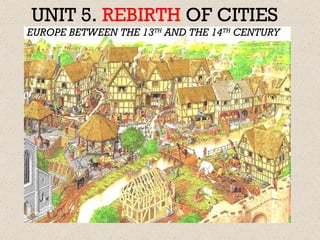
UNIT 5.  REBIRTH   OF CITIES EUROPE BETWEEN THE 13 TH  AND THE 14 TH  CENTURY
INTRODUCTION Between the 11th and the 13th century, Europe  witnessed  the rebirth of cities. There are two main reasons: Prosperity in agriculture and the  increase  of the rural population The reactivation of  trade In some cases the cities that already existed started to  grow . In other cases  new cities  were founded 1 2
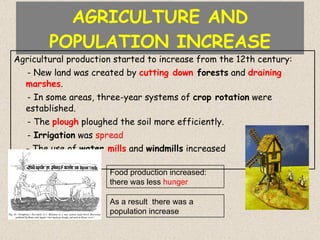
AGRICULTURE AND POPULATION INCREASE Agricultural production started to increase from the 12th century: - New land was created by  cutting   down  forests  and  draining   marshes . - In some areas, three-year systems of  crop rotation  were established.  - The  plough  ploughed the soil more efficiently. -  Irrigation  was  spread   - The use of  water  mills  and  windmills  increased Food production increased: there was less  hunger  As a result  there was a  population increase
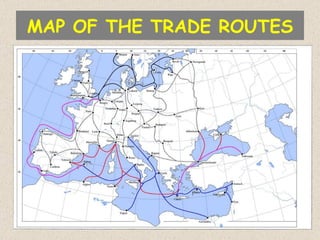
REACTIVATION OF TRADE From the 11th Century  onwards  population and production had grown,  wealth  had increased and there were peace and security. Thanks to these conditions, trade could reactivate. Two kinds of trade:  -  Regional trade : exchange between cities and the  surrounding  lands. -  Interregional trade : between different regions in Europe, but also   with the Muslim world, the Byzantine Empire and the far East Merchants periodically met at  trade fairs . There they took products from all regions
MAP OF THE TRADE ROUTES
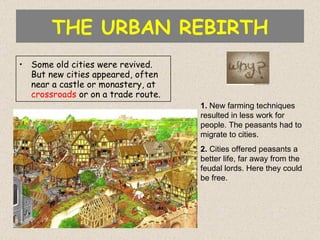
THE URBAN REBIRTH Some old cities were revived. But new cities appeared, often near a castle or monastery, at  crossroads  or on a trade route. 1.  New farming techniques  resulted in less work for people. The peasants had to migrate to cities.  2.  Cities offered peasants a better life, far away from the feudal lords. Here they could be free.
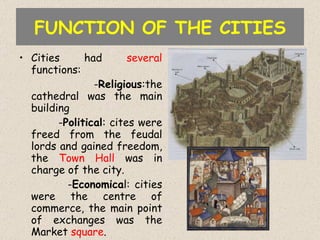
FUNCTION OF THE CITIES Cities had  several  functions: - Religious :the cathedral was the main building  - Political : cites were freed from the feudal lords and gained freedom, the  Town Hall  was in charge of the city. - Economica l: cities were the centre of commerce, the main point of exchanges was the Market  square .
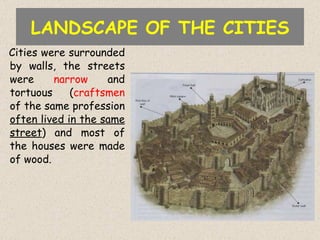
LANDSCAPE OF THE CITIES Cities were surrounded by walls, the streets were  narrow  and tortuous ( craftsmen  of the same profession  often lived in the same street ) and most of the houses were made of wood.
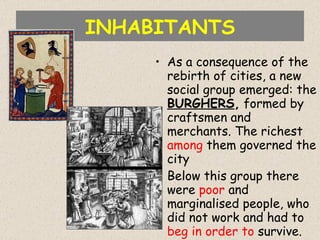
INHABITANTS As a consequence of the rebirth of cities, a new social group emerged: the  BURGHERS ,  formed by craftsmen and merchants. The richest  among  them governed the city Below this group there were  poor  and marginalised people, who did not work and had to  beg   in order to  survive.
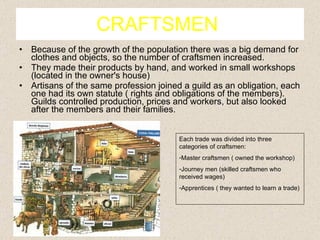
CRAFTSMEN  Because of the growth of the population there was a big demand for clothes and objects, so the number of craftsmen increased. They made their products by hand, and worked in small workshops (located in the owner's house) Artisans of the same profession joined a guild as an obligation, each one had its own statute ( rights and obligations of the members). Guilds controlled production, prices and workers, but also looked after the members and their families. Each trade was divided into three categories of craftsmen: Master craftsmen ( owned the workshop) Journey men (skilled craftsmen who received wages) Apprentices ( they wanted to learn a trade)
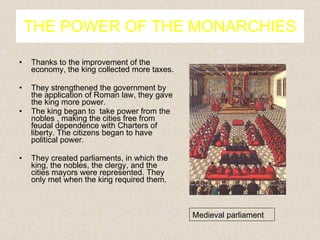
THE POWER OF THE MONARCHIES Thanks to the improvement of the economy, the king collected more taxes. They strengthened the government by the application of Roman law, they gave the king more power. The king began to  take power from the nobles , making the cities free from feudal dependence with Charters of liberty. The citizens began to have political power. They created parliaments, in which the king, the nobles, the clergy, and the cities mayors were represented. They only met when the king required them. Medieval parliament
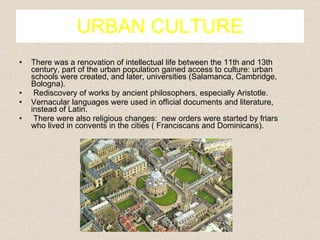
URBAN CULTURE There was a renovation of intellectual life between the 11th and 13th century, part of the urban population gained access to culture: urban schools were created, and later, universities (Salamanca, Cambridge, Bologna). Rediscovery of works by ancient philosophers, especially Aristotle. Vernacular languages were used in official documents and literature, instead of Latin. There were also religious changes:  new orders were started by friars who lived in convents in the cities ( Franciscans and Dominicans).
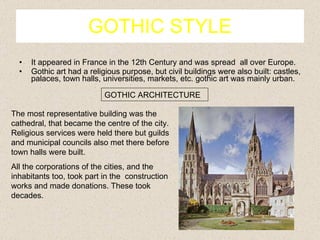
GOTHIC STYLE It appeared in France in the 12th Century and was spread  all over Europe. Gothic art had a religious purpose, but civil buildings were also built: castles, palaces, town halls, universities, markets, etc. gothic art was mainly urban. GOTHIC ARCHITECTURE The most representative building was the cathedral, that became the centre of the city. Religious services were held there but guilds and municipal councils also met there before town halls were built. All the corporations of the cities, and the inhabitants too, took part in the  construction works and made donations. These took decades.
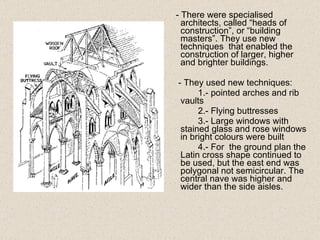
- There were specialised architects, called “heads of construction”, or “building masters”. They use new techniques  that enabled the construction of larger, higher and brighter buildings. - They used new techniques:  1.- pointed arches and rib vaults 2.- Flying buttresses 3.- Large windows with stained glass and rose windows in bright colours were built 4.- For  the ground plan the Latin cross shape continued to be used, but the east end was polygonal not semicircular. The central nave was higher and wider than the side aisles.
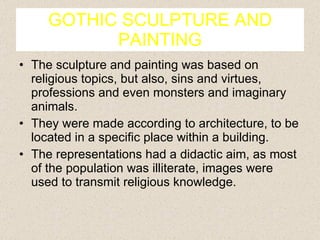
GOTHIC SCULPTURE AND PAINTING The sculpture and painting was based on religious topics, but also, sins and virtues, professions and even monsters and imaginary animals. They were made according to architecture, to be located in a specific place within a building. The representations had a didactic aim, as most of the population was illiterate, images were used to transmit religious knowledge.
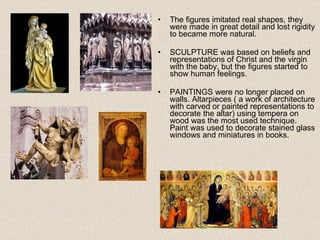
The figures imitated real shapes, they were made in great detail and lost rigidity to became more natural. SCULPTURE was based on beliefs and representations of Christ and the virgin with the baby, but the figures started to show human feelings. PAINTINGS were no longer placed on walls. Altarpieces ( a work of architecture with carved or painted representations to decorate the altar) using tempera on wood was the most used technique. Paint was used to decorate stained glass windows and miniatures in books.

Unit 5. rebirth_of_cities

  • 1.
    UNIT 5. REBIRTH OF CITIES EUROPE BETWEEN THE 13 TH AND THE 14 TH CENTURY
  • 2.
    INTRODUCTION Between the11th and the 13th century, Europe witnessed the rebirth of cities. There are two main reasons: Prosperity in agriculture and the increase of the rural population The reactivation of trade In some cases the cities that already existed started to grow . In other cases new cities were founded 1 2
  • 3.
    AGRICULTURE AND POPULATIONINCREASE Agricultural production started to increase from the 12th century: - New land was created by cutting down forests and draining marshes . - In some areas, three-year systems of crop rotation were established. - The plough ploughed the soil more efficiently. - Irrigation was spread - The use of water mills and windmills increased Food production increased: there was less hunger As a result there was a population increase
  • 4.
    REACTIVATION OF TRADEFrom the 11th Century onwards population and production had grown, wealth had increased and there were peace and security. Thanks to these conditions, trade could reactivate. Two kinds of trade: - Regional trade : exchange between cities and the surrounding lands. - Interregional trade : between different regions in Europe, but also with the Muslim world, the Byzantine Empire and the far East Merchants periodically met at trade fairs . There they took products from all regions
  • 5.
    MAP OF THETRADE ROUTES
  • 6.
    THE URBAN REBIRTHSome old cities were revived. But new cities appeared, often near a castle or monastery, at crossroads or on a trade route. 1. New farming techniques resulted in less work for people. The peasants had to migrate to cities. 2. Cities offered peasants a better life, far away from the feudal lords. Here they could be free.
  • 7.
    FUNCTION OF THECITIES Cities had several functions: - Religious :the cathedral was the main building - Political : cites were freed from the feudal lords and gained freedom, the Town Hall was in charge of the city. - Economica l: cities were the centre of commerce, the main point of exchanges was the Market square .
  • 8.
    LANDSCAPE OF THECITIES Cities were surrounded by walls, the streets were narrow and tortuous ( craftsmen of the same profession often lived in the same street ) and most of the houses were made of wood.
  • 9.
    INHABITANTS As aconsequence of the rebirth of cities, a new social group emerged: the BURGHERS , formed by craftsmen and merchants. The richest among them governed the city Below this group there were poor and marginalised people, who did not work and had to beg in order to survive.
  • 10.
    CRAFTSMEN Becauseof the growth of the population there was a big demand for clothes and objects, so the number of craftsmen increased. They made their products by hand, and worked in small workshops (located in the owner's house) Artisans of the same profession joined a guild as an obligation, each one had its own statute ( rights and obligations of the members). Guilds controlled production, prices and workers, but also looked after the members and their families. Each trade was divided into three categories of craftsmen: Master craftsmen ( owned the workshop) Journey men (skilled craftsmen who received wages) Apprentices ( they wanted to learn a trade)
  • 11.
    THE POWER OFTHE MONARCHIES Thanks to the improvement of the economy, the king collected more taxes. They strengthened the government by the application of Roman law, they gave the king more power. The king began to take power from the nobles , making the cities free from feudal dependence with Charters of liberty. The citizens began to have political power. They created parliaments, in which the king, the nobles, the clergy, and the cities mayors were represented. They only met when the king required them. Medieval parliament
  • 12.
    URBAN CULTURE Therewas a renovation of intellectual life between the 11th and 13th century, part of the urban population gained access to culture: urban schools were created, and later, universities (Salamanca, Cambridge, Bologna). Rediscovery of works by ancient philosophers, especially Aristotle. Vernacular languages were used in official documents and literature, instead of Latin. There were also religious changes: new orders were started by friars who lived in convents in the cities ( Franciscans and Dominicans).
  • 13.
    GOTHIC STYLE Itappeared in France in the 12th Century and was spread all over Europe. Gothic art had a religious purpose, but civil buildings were also built: castles, palaces, town halls, universities, markets, etc. gothic art was mainly urban. GOTHIC ARCHITECTURE The most representative building was the cathedral, that became the centre of the city. Religious services were held there but guilds and municipal councils also met there before town halls were built. All the corporations of the cities, and the inhabitants too, took part in the construction works and made donations. These took decades.
  • 14.
    - There werespecialised architects, called “heads of construction”, or “building masters”. They use new techniques that enabled the construction of larger, higher and brighter buildings. - They used new techniques: 1.- pointed arches and rib vaults 2.- Flying buttresses 3.- Large windows with stained glass and rose windows in bright colours were built 4.- For the ground plan the Latin cross shape continued to be used, but the east end was polygonal not semicircular. The central nave was higher and wider than the side aisles.
  • 15.
    GOTHIC SCULPTURE ANDPAINTING The sculpture and painting was based on religious topics, but also, sins and virtues, professions and even monsters and imaginary animals. They were made according to architecture, to be located in a specific place within a building. The representations had a didactic aim, as most of the population was illiterate, images were used to transmit religious knowledge.
  • 16.
    The figures imitatedreal shapes, they were made in great detail and lost rigidity to became more natural. SCULPTURE was based on beliefs and representations of Christ and the virgin with the baby, but the figures started to show human feelings. PAINTINGS were no longer placed on walls. Altarpieces ( a work of architecture with carved or painted representations to decorate the altar) using tempera on wood was the most used technique. Paint was used to decorate stained glass windows and miniatures in books.