Presented by:
Bhanu Pratap Singh (11/PUR/002)
Subodh Dobhal (11/PUR/003)
(Masters in Urban & Regional Planning)
Gautam Buddha University
(Gr. Noida) India
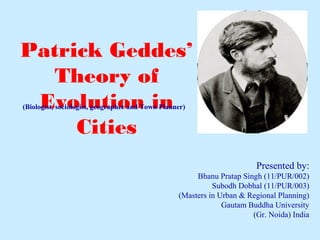
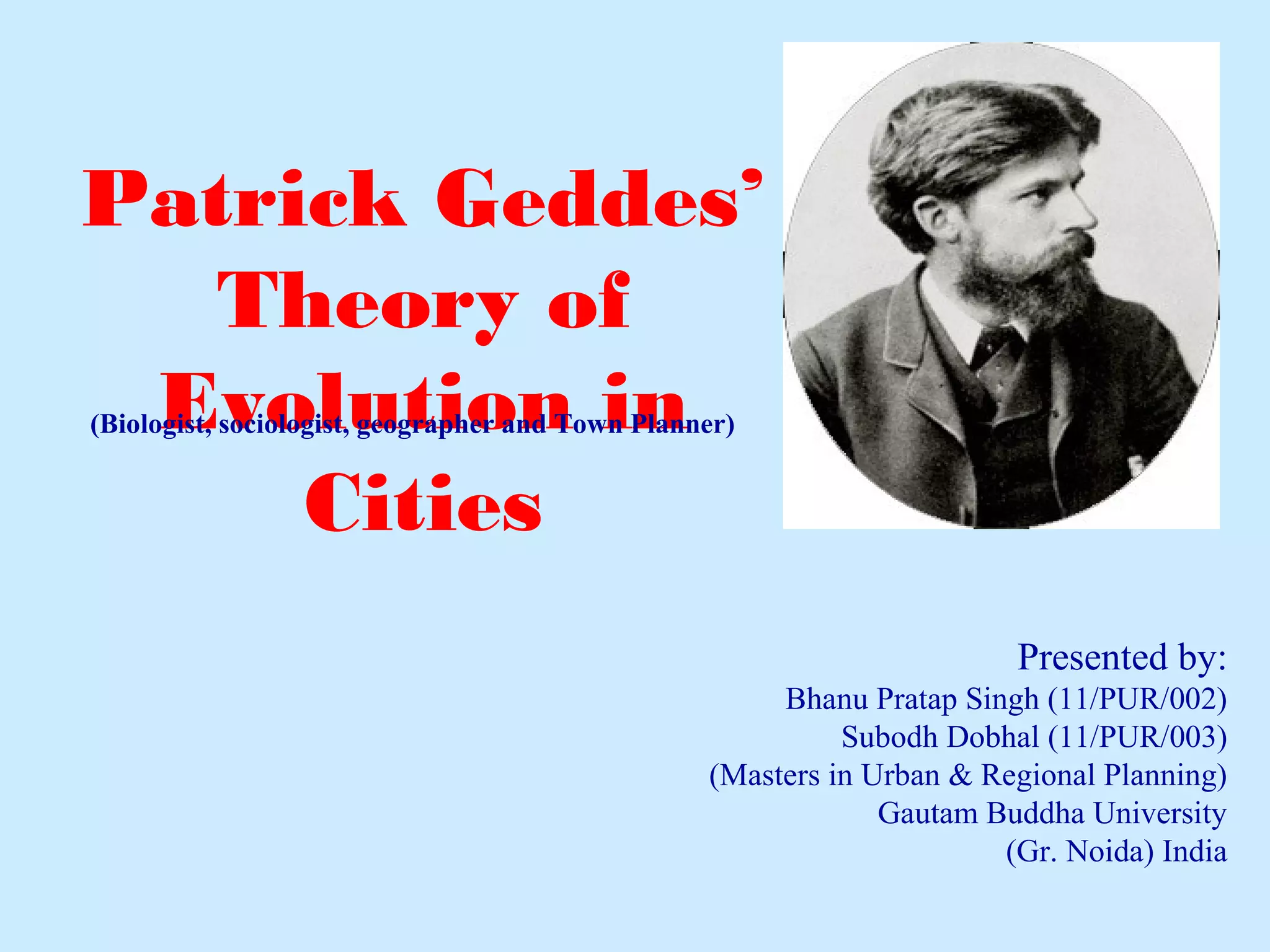
Patrick Geddes’
Theory of
Evolution in
Cities
(Biologist, sociologist, geographer and Town Planner)
Domain of planning theory
• Deals with ideas and arguments related to the conduct of
planning
• Aims to provide some overall or general understanding of
the nature of planning
– What sort of activity is planning?
– What should it aim to do?
– What are its effects on social life?
– What are its effects on urban morphology and function?
– What are the components of good quality urban environments?
– Under what conditions are these qualities most likely to be
realised?
– What part can planning play in creating better/liveable cities?
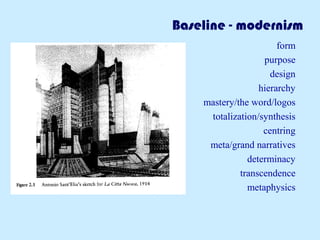
Baseline - modernism
form
purpose
design
hierarchy
mastery/the word/logos
totalization/synthesis
centring
meta/grand narratives
determinacy
transcendence
metaphysics
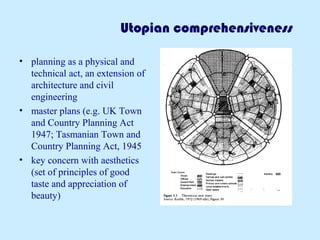
Utopian comprehensiveness
• planning as a physical and
technical act, an extension of
architecture and civil
engineering
• master plans (e.g. UK Town
and Country Planning Act
1947; Tasmanian Town and
Country Planning Act, 1945
• key concern with aesthetics
(set of principles of good
taste and appreciation of
beauty)
• “the art and science of ordering the use of land and the
character and siting of buildings and communicative routes
… Planning … deals primarily with land, and is not
economic social or political planning, though it may
greatly assist in the realisation of the aims of these other
kinds of planning” (Keeble 1952, 1).
Survey-Analysis-Plan
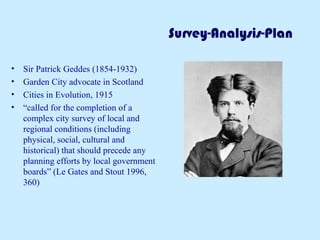
• Sir Patrick Geddes (1854-1932)
• Garden City advocate in Scotland
• Cities in Evolution, 1915
• “called for the completion of a
complex city survey of local and
regional conditions (including
physical, social, cultural and
historical) that should precede any
planning efforts by local government
boards” (Le Gates and Stout 1996,
360)
Survey-Analysis-Plan
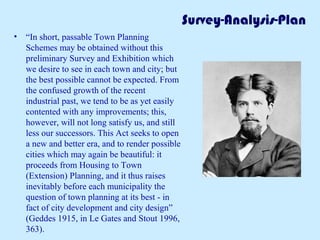
• “In short, passable Town Planning
Schemes may be obtained without this
preliminary Survey and Exhibition which
we desire to see in each town and city; but
the best possible cannot be expected. From
the confused growth of the recent
industrial past, we tend to be as yet easily
contented with any improvements; this,
however, will not long satisfy us, and still
less our successors. This Act seeks to open
a new and better era, and to render possible
cities which may again be beautiful: it
proceeds from Housing to Town
(Extension) Planning, and it thus raises
inevitably before each municipality the
question of town planning at its best - in
fact of city development and city design”
(Geddes 1915, in Le Gates and Stout 1996,
363).
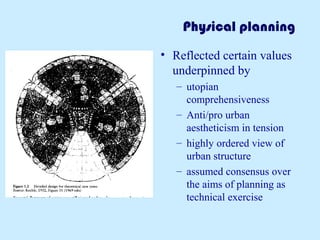
Physical planning
• Reflected certain values
underpinned by
– utopian
comprehensiveness
– Anti/pro urban
aestheticism in tension
– highly ordered view of
urban structure
– assumed consensus over
the aims of planning as
technical exercise
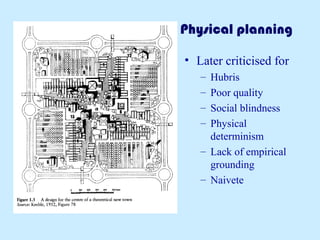
Physical planning
• Later criticised for
– Hubris
– Poor quality
– Social blindness
– Physical
determinism
– Lack of empirical
grounding
– Naivete
Rational systems
• Late 1960s - new systems approach
• Planning - systems analysis and control
• Environment - interconnected system of parts
– Capable of being organized
– Capable of being optimized
• Indebted to cybernetics (science of systems of control
and communications in animals and machines)
• McLoughlin 1969, Urban and Regional Planning - a
systems approach
• Chadwick 1971, A Systems View of Planning
• Faludi 1973, Planning Theory
• Bruton 1974, Spirit and Purpose of Planning
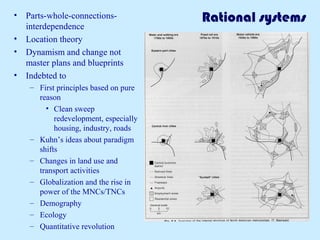
Rational systems• Parts-whole-connections-
interdependence
• Location theory
• Dynamism and change not
master plans and blueprints
• Indebted to
– First principles based on pure
reason
• Clean sweep
redevelopment, especially
housing, industry, roads
– Kuhn’s ideas about paradigm
shifts
– Changes in land use and
transport activities
– Globalization and the rise in
power of the MNCs/TNCs
– Demography
– Ecology
– Quantitative revolution
Rational systems
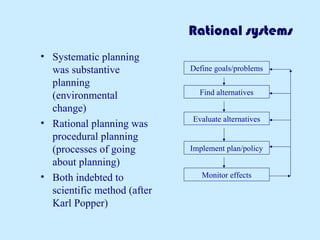
• Systematic planning
was substantive
planning
(environmental
change)
• Rational planning was
procedural planning
(processes of going
about planning)
• Both indebted to
scientific method (after
Karl Popper)
Define goals/problems
Evaluate alternatives
Find alternatives
Implement plan/policy
Monitor effects
Rational systems
• Means not ends - thus instrumental not “a model of
substantive moral reasoning” (Taylor 1998, 71)
• Corrupted - based as much on persuasion as procedure
• Alternative view/critique - Lindblom - disjointed
incrementalism only possible approach”
• “…in most situations, planning has to be piecemeal,
incremental, opportunistic and pragmatic, and …
planners who did not or could not operate in these
ways were generally ineffective” (Taylor 1998, 71).
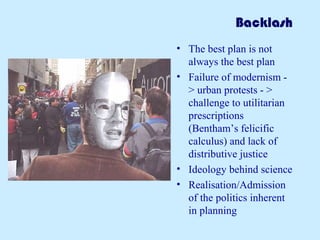
Backlash
• The best plan is not
always the best plan
• Failure of modernism -
> urban protests - >
challenge to utilitarian
prescriptions
(Bentham’s felicific
calculus) and lack of
distributive justice
• Ideology behind science
• Realisation/Admission
of the politics inherent
in planning
Backlash
• “The question is not whether planning will reflect
politics but whose politics it will reflect. What
values and whose values will planners seek to
implement? … In the broadest sense [plans]
represent political philosophies, ways of
implementing differing conceptions of the good
life. No longer can the planner take refuge in the
neutrality of the objectivity of the personally
uninvolved scientist” (N. Long 1959, 168).
Planning, choice and
advocacy
• Reaction to rational and systems planning
• Choice theory of planning (Paul Davidoff and Thomas
Reiner)
– Planning’s ends are goals for the future
– These goals are determined via the identification of alternative
futures
– These ideal futures are narrowed down to plausible and possible
futures
– This narrowing is inherently political
– Planners should be involved only in the technical elements of this
work
Planning, choice and
advocacy
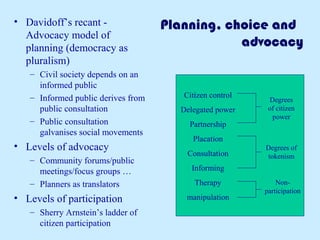
• Davidoff’s recant -
Advocacy model of
planning (democracy as
pluralism)
– Civil society depends on an
informed public
– Informed public derives from
public consultation
– Public consultation
galvanises social movements
• Levels of advocacy
– Community forums/public
meetings/focus groups …
– Planners as translators
• Levels of participation
– Sherry Arnstein’s ladder of
citizen participation
Citizen control
Delegated power
Partnership
Placation
Consultation
Informing
Therapy
manipulation
Degrees
of citizen
power
Degrees of
tokenism
Non-
participation
Rapprochement or
resentment
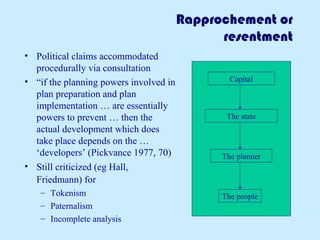
• Political claims accommodated
procedurally via consultation
• “if the planning powers involved in
plan preparation and plan
implementation … are essentially
powers to prevent … then the
actual development which does
take place depends on the …
‘developers’ (Pickvance 1977, 70)
• Still criticized (eg Hall,
Friedmann) for
– Tokenism
– Paternalism
– Incomplete analysis
Capital
The state
The planner
The people
Radical alternatives
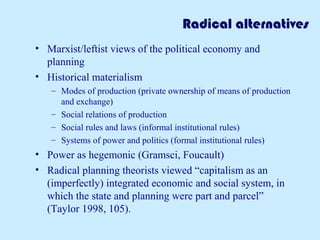
• Marxist/leftist views of the political economy and
planning
• Historical materialism
– Modes of production (private ownership of means of production
and exchange)
– Social relations of production
– Social rules and laws (informal institutional rules)
– Systems of power and politics (formal institutional rules)
• Power as hegemonic (Gramsci, Foucault)
• Radical planning theorists viewed “capitalism as an
(imperfectly) integrated economic and social system, in
which the state and planning were part and parcel”
(Taylor 1998, 105).
Radical
alternatives
• “Planning is necessary to the ruling class
in order to facilitate [capital]
accumulation and maintain social control
in the face of class conflict. The modes
by which urban planners assist
accumulation include the development
of physical infrastructure, land
aggregation and development,
containment of negative environmental
externalities, and the maintenance of
land values … Urban planners specialize
in managing the contradictions of
capitalism manifested in urban form and
spatial development” (Fainstein and
Fainstein 1979, 148-9).
Equity planning
• “those who consciously
seek to redistribute power,
resources, or participation
away from local elites and
toward poor and working
class city residents”
(Krumholz in Sandercock
1998, 93)
• With John Forester,
Making Equity Planning
Work (1990)
• State and capital
reconstituted as capable of
capture by those interested
in distributive justice -
negotiated settlements
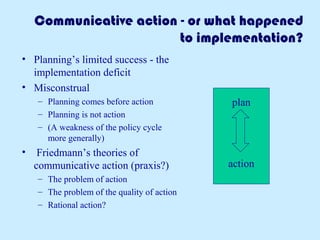
Communicative action - or what happened
to implementation?
• Planning’s limited success - the
implementation deficit
• Misconstrual
– Planning comes before action
– Planning is not action
– (A weakness of the policy cycle
more generally)
• Friedmann’s theories of
communicative action (praxis?)
– The problem of action
– The problem of the quality of action
– Rational action?
plan
action
Communicative action - or what happened
to implementation?
• Public policy
implementation
– Ability to identify actors
needed
– Capacity to establish
contacts and networks
– Capacity to negotiate given
multiple [and often tacit]
agenda
– Policy resides within action
• Communicative action as
multiple flows rather than
linear stages of
consultation
plan
action
Communicative action and then...
• Habermas - theory of communicative action
– Effective communication
• Comprehensible/intelligible
• Truth/veracity
• Sincere
• Legitimate
• Normative ideal for participatory processes in planning
• Note basic agreement among all the foregoing about
social democracy … and then ...
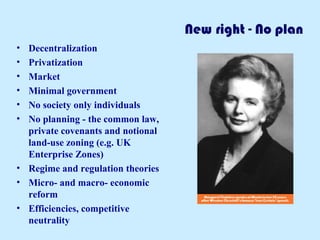
New right - No plan
• Decentralization
• Privatization
• Market
• Minimal government
• No society only individuals
• No planning - the common law,
private covenants and notional
land-use zoning (e.g. UK
Enterprise Zones)
• Regime and regulation theories
• Micro- and macro- economic
reform
• Efficiencies, competitive
neutrality
(Post)modern refrains?
• Move from grand narratives to problem centred planning
– Inner city decline - urban regeneration
– Economic boom - social inequalities
– Ecological crisis - sustainable development
– Urban ugliness - urban design
– State control - public participation
• Two major shifts
– Design - science
– Planners as technicians - planners as (social) scientists
– Were these paradigmatic shifts, however?

Evolution of city in planning

  • 1.
    Presented by: Bhanu PratapSingh (11/PUR/002) Subodh Dobhal (11/PUR/003) (Masters in Urban & Regional Planning) Gautam Buddha University (Gr. Noida) India Patrick Geddes’ Theory of Evolution in Cities (Biologist, sociologist, geographer and Town Planner)
  • 2.
    Domain of planningtheory • Deals with ideas and arguments related to the conduct of planning • Aims to provide some overall or general understanding of the nature of planning – What sort of activity is planning? – What should it aim to do? – What are its effects on social life? – What are its effects on urban morphology and function? – What are the components of good quality urban environments? – Under what conditions are these qualities most likely to be realised? – What part can planning play in creating better/liveable cities?
  • 3.
    Baseline - modernism form purpose design hierarchy mastery/theword/logos totalization/synthesis centring meta/grand narratives determinacy transcendence metaphysics
  • 4.
    Utopian comprehensiveness • planningas a physical and technical act, an extension of architecture and civil engineering • master plans (e.g. UK Town and Country Planning Act 1947; Tasmanian Town and Country Planning Act, 1945 • key concern with aesthetics (set of principles of good taste and appreciation of beauty)
  • 5.
    • “the artand science of ordering the use of land and the character and siting of buildings and communicative routes … Planning … deals primarily with land, and is not economic social or political planning, though it may greatly assist in the realisation of the aims of these other kinds of planning” (Keeble 1952, 1).
  • 6.
    Survey-Analysis-Plan • Sir PatrickGeddes (1854-1932) • Garden City advocate in Scotland • Cities in Evolution, 1915 • “called for the completion of a complex city survey of local and regional conditions (including physical, social, cultural and historical) that should precede any planning efforts by local government boards” (Le Gates and Stout 1996, 360)
  • 7.
    Survey-Analysis-Plan • “In short,passable Town Planning Schemes may be obtained without this preliminary Survey and Exhibition which we desire to see in each town and city; but the best possible cannot be expected. From the confused growth of the recent industrial past, we tend to be as yet easily contented with any improvements; this, however, will not long satisfy us, and still less our successors. This Act seeks to open a new and better era, and to render possible cities which may again be beautiful: it proceeds from Housing to Town (Extension) Planning, and it thus raises inevitably before each municipality the question of town planning at its best - in fact of city development and city design” (Geddes 1915, in Le Gates and Stout 1996, 363).
  • 8.
    Physical planning • Reflectedcertain values underpinned by – utopian comprehensiveness – Anti/pro urban aestheticism in tension – highly ordered view of urban structure – assumed consensus over the aims of planning as technical exercise
  • 9.
    Physical planning • Latercriticised for – Hubris – Poor quality – Social blindness – Physical determinism – Lack of empirical grounding – Naivete
  • 10.
    Rational systems • Late1960s - new systems approach • Planning - systems analysis and control • Environment - interconnected system of parts – Capable of being organized – Capable of being optimized • Indebted to cybernetics (science of systems of control and communications in animals and machines) • McLoughlin 1969, Urban and Regional Planning - a systems approach • Chadwick 1971, A Systems View of Planning • Faludi 1973, Planning Theory • Bruton 1974, Spirit and Purpose of Planning
  • 11.
    Rational systems• Parts-whole-connections- interdependence •Location theory • Dynamism and change not master plans and blueprints • Indebted to – First principles based on pure reason • Clean sweep redevelopment, especially housing, industry, roads – Kuhn’s ideas about paradigm shifts – Changes in land use and transport activities – Globalization and the rise in power of the MNCs/TNCs – Demography – Ecology – Quantitative revolution
  • 12.
    Rational systems • Systematicplanning was substantive planning (environmental change) • Rational planning was procedural planning (processes of going about planning) • Both indebted to scientific method (after Karl Popper) Define goals/problems Evaluate alternatives Find alternatives Implement plan/policy Monitor effects
  • 13.
    Rational systems • Meansnot ends - thus instrumental not “a model of substantive moral reasoning” (Taylor 1998, 71) • Corrupted - based as much on persuasion as procedure • Alternative view/critique - Lindblom - disjointed incrementalism only possible approach” • “…in most situations, planning has to be piecemeal, incremental, opportunistic and pragmatic, and … planners who did not or could not operate in these ways were generally ineffective” (Taylor 1998, 71).
  • 14.
    Backlash • The bestplan is not always the best plan • Failure of modernism - > urban protests - > challenge to utilitarian prescriptions (Bentham’s felicific calculus) and lack of distributive justice • Ideology behind science • Realisation/Admission of the politics inherent in planning
  • 15.
    Backlash • “The questionis not whether planning will reflect politics but whose politics it will reflect. What values and whose values will planners seek to implement? … In the broadest sense [plans] represent political philosophies, ways of implementing differing conceptions of the good life. No longer can the planner take refuge in the neutrality of the objectivity of the personally uninvolved scientist” (N. Long 1959, 168).
  • 16.
    Planning, choice and advocacy •Reaction to rational and systems planning • Choice theory of planning (Paul Davidoff and Thomas Reiner) – Planning’s ends are goals for the future – These goals are determined via the identification of alternative futures – These ideal futures are narrowed down to plausible and possible futures – This narrowing is inherently political – Planners should be involved only in the technical elements of this work
  • 17.
    Planning, choice and advocacy •Davidoff’s recant - Advocacy model of planning (democracy as pluralism) – Civil society depends on an informed public – Informed public derives from public consultation – Public consultation galvanises social movements • Levels of advocacy – Community forums/public meetings/focus groups … – Planners as translators • Levels of participation – Sherry Arnstein’s ladder of citizen participation Citizen control Delegated power Partnership Placation Consultation Informing Therapy manipulation Degrees of citizen power Degrees of tokenism Non- participation
  • 18.
    Rapprochement or resentment • Politicalclaims accommodated procedurally via consultation • “if the planning powers involved in plan preparation and plan implementation … are essentially powers to prevent … then the actual development which does take place depends on the … ‘developers’ (Pickvance 1977, 70) • Still criticized (eg Hall, Friedmann) for – Tokenism – Paternalism – Incomplete analysis Capital The state The planner The people
  • 19.
    Radical alternatives • Marxist/leftistviews of the political economy and planning • Historical materialism – Modes of production (private ownership of means of production and exchange) – Social relations of production – Social rules and laws (informal institutional rules) – Systems of power and politics (formal institutional rules) • Power as hegemonic (Gramsci, Foucault) • Radical planning theorists viewed “capitalism as an (imperfectly) integrated economic and social system, in which the state and planning were part and parcel” (Taylor 1998, 105).
  • 20.
    Radical alternatives • “Planning isnecessary to the ruling class in order to facilitate [capital] accumulation and maintain social control in the face of class conflict. The modes by which urban planners assist accumulation include the development of physical infrastructure, land aggregation and development, containment of negative environmental externalities, and the maintenance of land values … Urban planners specialize in managing the contradictions of capitalism manifested in urban form and spatial development” (Fainstein and Fainstein 1979, 148-9).
  • 21.
    Equity planning • “thosewho consciously seek to redistribute power, resources, or participation away from local elites and toward poor and working class city residents” (Krumholz in Sandercock 1998, 93) • With John Forester, Making Equity Planning Work (1990) • State and capital reconstituted as capable of capture by those interested in distributive justice - negotiated settlements
  • 22.
    Communicative action -or what happened to implementation? • Planning’s limited success - the implementation deficit • Misconstrual – Planning comes before action – Planning is not action – (A weakness of the policy cycle more generally) • Friedmann’s theories of communicative action (praxis?) – The problem of action – The problem of the quality of action – Rational action? plan action
  • 23.
    Communicative action -or what happened to implementation? • Public policy implementation – Ability to identify actors needed – Capacity to establish contacts and networks – Capacity to negotiate given multiple [and often tacit] agenda – Policy resides within action • Communicative action as multiple flows rather than linear stages of consultation plan action
  • 24.
    Communicative action andthen... • Habermas - theory of communicative action – Effective communication • Comprehensible/intelligible • Truth/veracity • Sincere • Legitimate • Normative ideal for participatory processes in planning • Note basic agreement among all the foregoing about social democracy … and then ...
  • 25.
    New right -No plan • Decentralization • Privatization • Market • Minimal government • No society only individuals • No planning - the common law, private covenants and notional land-use zoning (e.g. UK Enterprise Zones) • Regime and regulation theories • Micro- and macro- economic reform • Efficiencies, competitive neutrality
  • 26.
    (Post)modern refrains? • Movefrom grand narratives to problem centred planning – Inner city decline - urban regeneration – Economic boom - social inequalities – Ecological crisis - sustainable development – Urban ugliness - urban design – State control - public participation • Two major shifts – Design - science – Planners as technicians - planners as (social) scientists – Were these paradigmatic shifts, however?