STARBUCKS : Delivering Customer Services
Lokesh Sharma
12382
Background
• 1971 : J.Baldwin , Z.Siegel & G.Bowker founded Starbucks
• 1982 : Howard Schultz joined Starbucks' marketing team
• 1983 : Business trip to Milan by H.Schultz where got impressed by an espresso bar’s warm community
experience
• 1987 : Howard bought Starbucks after rejection of his proposal to implement that same idea in Starbucks
• 1992 : Company had a successful market with 140 stores in Northwest & Chicago and almost nothing spent on
advertising
Explaining Starbucks' Success
 Highly differentiated and tightly integrated VALUE PROPOSITION perfectly aligning with the needs of carefully-
conceptualized TARGET MARKET
 VALUE PROPOSITION TARGET MARKET
Serious Coffee lovers-white collar, affluent, well
-educated, often female, age between 25-44
Ready to pay premium price for premium coffee
experience
Their affection towards premium coffee lifestyle
promoted the company’s ” LIVE COFFEE" culture
A strong Brand position above the existing competition
Best Quality Coffee-
Maximum control over supply-chain
Customer Intimacy-recognizing customer or his drink
just the way he likes it
Atmosphere-encourage to stay
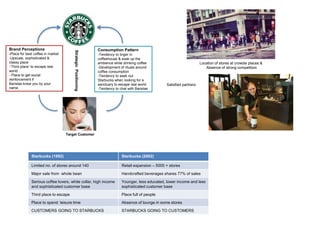
Brand Perceptions
-Place for best coffee in market
-Upscale, sophisticated &
classy place
-‘Third place’ to escape real
world
- Place to get social
reinforcement if
Baristas knew you by your
name
Consumption Pattern
-Tendency to linger in
coffeehouse & soak up the
ambience while drinking coffee
-Development of rituals around
coffee consumption
-Tendency to seek out
Starbucks when looking for a
sanctuary to escape real world
-Tendency to chat with Baristas
Target Customer
StrategicPositioning
Location of stores at crowdie places &
Absence of strong competitors
Satisfied partners
Starbucks (1992) Starbucks (2002)
Limited no. of stores around 140 Retail expansion – 5000 + stores
Major sale from whole bean Handcrafted beverages shares 77% of sales
Serious coffee lovers, white collar, high income
and sophisticated customer base
Younger, less educated, lower income and less
sophisticated customer base
Third place to escape Place full of people
Place to spend leisure time Absence of lounge in some stores
CUSTOMERS GOING TO STARBUCKS STARBUCKS GOING TO CUSTOMERS
Declined
Customer
Satisfaction
Bad research method
Mystery shopper programme is subjective
measure to record results there might be
inconsistency b/w two mystery shoppers how
they perceive same service
Actual service decline
Retail expansion & product
innovation has affected coffee
quality, service & atmosphere
Changing needs of customer
Growing customer base has given rise to new
sets of demands & their expectations are high
due to competitors
Rough Brand Image
People starts thinking of Starbucks
as money making Corporate with its
increasing stores
Decreased Partner Satisfaction
With increasing work load their partner’s
satisfaction level decreased which
affected their soft skills during service
delivery
Ideal Starbucks Customer
Customer > Unsatisfied Satisfied Highly satisfied Loyal
Visits/month 3.9 4.3 7.2 18
Visits/year 46.8 51.6 86.4 216
Ticket size
/transaction
$3.88 $4.06 $4.42 $4.42
Revs/year $182 $210 $382 $955
Avg. life 1.1 4.4 8.3 8.3
Revs/life $200 $922 $3170 $7924
Assuming a high probability of correlation b/w number of visits and satisfaction level,
it is safe to call a loyal customer also a highly satisfied customer. So we can use
company data for loyal customer also.
From the perspective of profitability we can see a loyal customer is an ideal
customer for Starbucks with maximum life-time value
Strengths
-Large market share
-Well known & trusted
brand
-Good coffee on run
-Accessible,
convenient, consistent
Weakness
-Price
-Slow service
-Less friendlier staff
Opportunities
-Global expansion
-Regional market
expansion
-Better customer
satisfaction
-Strategy marketing
group establishment
Threats
-Competitors from
same industries
-Competitors with
substitute products
Problem
Decline in customer satisfaction
Should they invest $40 million in 4500 stores focusing on improving the speed of customer service
Break Even Analysis
Investment to be made for labor in stores- $40million
Total no. of stores- 4500
Investment on each store- $8888
Difference b/w revenue/year from highly satisfied to satisfied customer- $172
No. of customers that needs to be converted from satisfied to highly satisfied by each store to break even for this investment- 52
Av. Daily customer count per store- 570
Nearly 9% increase in no. of highly satisfied customers needs to be made by each store to break even
If satisfaction doesn’t increase
No. of new customers that needs to be acquired by each store every day- 7
Nearly 1.2% increase in daily customers by each store needs to be done to break even
If no. of customers remains same
Extra money spent by each customer in each visit- $0.05
Possible
Solutions
Allocate money based on
size of store
No. of customer
Location
Need for additional labour
More thorough analysis of
customer base
Identifying stores with
higher percentage of
unsatisfied customer
because of speed of
service
Establishment of internal
strategic marketing group
to get faster feedback& be
proactive instead of
reactive
Product innovation
Remove less popular
products from menu
Assumptions-
Speed of service is no. 1 drive for customer satisfaction
Additional labor will provide the increase of speed of service
All stores are equal in size, no. of people they serve, location & price
Additional investment is done equally in all stores
Satisfaction is correlated with loyalty
Store clustering
Put new machines
SVC prepaid card
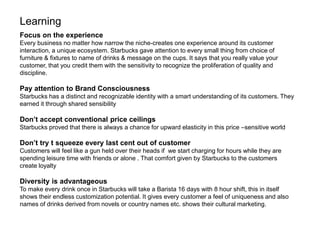
Learning
Focus on the experience
Every business no matter how narrow the niche-creates one experience around its customer
interaction, a unique ecosystem. Starbucks gave attention to every small thing from choice of
furniture & fixtures to name of drinks & message on the cups. It says that you really value your
customer, that you credit them with the sensitivity to recognize the proliferation of quality and
discipline.
Pay attention to Brand Consciousness
Starbucks has a distinct and recognizable identity with a smart understanding of its customers. They
earned it through shared sensibility
Don’t accept conventional price ceilings
Starbucks proved that there is always a chance for upward elasticity in this price –sensitive world
Don’t try t squeeze every last cent out of customer
Customers will feel like a gun held over their heads if we start charging for hours while they are
spending leisure time with friends or alone . That comfort given by Starbucks to the customers
create loyalty
Diversity is advantageous
To make every drink once in Starbucks will take a Barista 16 days with 8 hour shift, this in itself
shows their endless customization potential. It gives every customer a feel of uniqueness and also
names of drinks derived from novels or country names etc. shows their cultural marketing.
Thank You…

Starbucks

  • 1.
    STARBUCKS : DeliveringCustomer Services Lokesh Sharma 12382
  • 2.
    Background • 1971 :J.Baldwin , Z.Siegel & G.Bowker founded Starbucks • 1982 : Howard Schultz joined Starbucks' marketing team • 1983 : Business trip to Milan by H.Schultz where got impressed by an espresso bar’s warm community experience • 1987 : Howard bought Starbucks after rejection of his proposal to implement that same idea in Starbucks • 1992 : Company had a successful market with 140 stores in Northwest & Chicago and almost nothing spent on advertising Explaining Starbucks' Success  Highly differentiated and tightly integrated VALUE PROPOSITION perfectly aligning with the needs of carefully- conceptualized TARGET MARKET  VALUE PROPOSITION TARGET MARKET Serious Coffee lovers-white collar, affluent, well -educated, often female, age between 25-44 Ready to pay premium price for premium coffee experience Their affection towards premium coffee lifestyle promoted the company’s ” LIVE COFFEE" culture A strong Brand position above the existing competition Best Quality Coffee- Maximum control over supply-chain Customer Intimacy-recognizing customer or his drink just the way he likes it Atmosphere-encourage to stay
  • 3.
    Brand Perceptions -Place forbest coffee in market -Upscale, sophisticated & classy place -‘Third place’ to escape real world - Place to get social reinforcement if Baristas knew you by your name Consumption Pattern -Tendency to linger in coffeehouse & soak up the ambience while drinking coffee -Development of rituals around coffee consumption -Tendency to seek out Starbucks when looking for a sanctuary to escape real world -Tendency to chat with Baristas Target Customer StrategicPositioning Location of stores at crowdie places & Absence of strong competitors Satisfied partners Starbucks (1992) Starbucks (2002) Limited no. of stores around 140 Retail expansion – 5000 + stores Major sale from whole bean Handcrafted beverages shares 77% of sales Serious coffee lovers, white collar, high income and sophisticated customer base Younger, less educated, lower income and less sophisticated customer base Third place to escape Place full of people Place to spend leisure time Absence of lounge in some stores CUSTOMERS GOING TO STARBUCKS STARBUCKS GOING TO CUSTOMERS
  • 4.
    Declined Customer Satisfaction Bad research method Mysteryshopper programme is subjective measure to record results there might be inconsistency b/w two mystery shoppers how they perceive same service Actual service decline Retail expansion & product innovation has affected coffee quality, service & atmosphere Changing needs of customer Growing customer base has given rise to new sets of demands & their expectations are high due to competitors Rough Brand Image People starts thinking of Starbucks as money making Corporate with its increasing stores Decreased Partner Satisfaction With increasing work load their partner’s satisfaction level decreased which affected their soft skills during service delivery Ideal Starbucks Customer Customer > Unsatisfied Satisfied Highly satisfied Loyal Visits/month 3.9 4.3 7.2 18 Visits/year 46.8 51.6 86.4 216 Ticket size /transaction $3.88 $4.06 $4.42 $4.42 Revs/year $182 $210 $382 $955 Avg. life 1.1 4.4 8.3 8.3 Revs/life $200 $922 $3170 $7924 Assuming a high probability of correlation b/w number of visits and satisfaction level, it is safe to call a loyal customer also a highly satisfied customer. So we can use company data for loyal customer also. From the perspective of profitability we can see a loyal customer is an ideal customer for Starbucks with maximum life-time value Strengths -Large market share -Well known & trusted brand -Good coffee on run -Accessible, convenient, consistent Weakness -Price -Slow service -Less friendlier staff Opportunities -Global expansion -Regional market expansion -Better customer satisfaction -Strategy marketing group establishment Threats -Competitors from same industries -Competitors with substitute products
  • 5.
    Problem Decline in customersatisfaction Should they invest $40 million in 4500 stores focusing on improving the speed of customer service Break Even Analysis Investment to be made for labor in stores- $40million Total no. of stores- 4500 Investment on each store- $8888 Difference b/w revenue/year from highly satisfied to satisfied customer- $172 No. of customers that needs to be converted from satisfied to highly satisfied by each store to break even for this investment- 52 Av. Daily customer count per store- 570 Nearly 9% increase in no. of highly satisfied customers needs to be made by each store to break even If satisfaction doesn’t increase No. of new customers that needs to be acquired by each store every day- 7 Nearly 1.2% increase in daily customers by each store needs to be done to break even If no. of customers remains same Extra money spent by each customer in each visit- $0.05 Possible Solutions Allocate money based on size of store No. of customer Location Need for additional labour More thorough analysis of customer base Identifying stores with higher percentage of unsatisfied customer because of speed of service Establishment of internal strategic marketing group to get faster feedback& be proactive instead of reactive Product innovation Remove less popular products from menu Assumptions- Speed of service is no. 1 drive for customer satisfaction Additional labor will provide the increase of speed of service All stores are equal in size, no. of people they serve, location & price Additional investment is done equally in all stores Satisfaction is correlated with loyalty Store clustering Put new machines SVC prepaid card
  • 6.
    Learning Focus on theexperience Every business no matter how narrow the niche-creates one experience around its customer interaction, a unique ecosystem. Starbucks gave attention to every small thing from choice of furniture & fixtures to name of drinks & message on the cups. It says that you really value your customer, that you credit them with the sensitivity to recognize the proliferation of quality and discipline. Pay attention to Brand Consciousness Starbucks has a distinct and recognizable identity with a smart understanding of its customers. They earned it through shared sensibility Don’t accept conventional price ceilings Starbucks proved that there is always a chance for upward elasticity in this price –sensitive world Don’t try t squeeze every last cent out of customer Customers will feel like a gun held over their heads if we start charging for hours while they are spending leisure time with friends or alone . That comfort given by Starbucks to the customers create loyalty Diversity is advantageous To make every drink once in Starbucks will take a Barista 16 days with 8 hour shift, this in itself shows their endless customization potential. It gives every customer a feel of uniqueness and also names of drinks derived from novels or country names etc. shows their cultural marketing.
  • 7.