STARBUCKS: DELIVERING CUSTOMER SERVICE

MONOJ K RABHA

IIM KOZHIKODE
CRM SECTION A

1
Brief Introduction
• Founded in 1971 by three coffee fanatics- Gerald Baldwin, Gordon Bowker & Ziev

Siegl
• Schultz joined the marketing team in 1982
• Later, the founders sold the entire business to Schultz
• By 2002, it served 20 million unique customers in 5000 stores across the globe
• Sales had a CAGR of 40%, while Net Earnings had a CAGR of 50%
Key people in the CASE:
VP of Administration in North America: Christine Day
CEO: Orin Smith (A Harvard MBA who joined 1990)
Chairman & Chief Global Strategist: Schultz
CRM SECTION A

2
Problem Statement
Starbucks failed to meet customer expectations and deliver satisfaction thereby losing
customer loyalty

Whether to invest the $40 million dollars to enhance the labor in each store?

If invested, How it will impact the sales and profitability?

CRM SECTION A

3
Factors responsible for the early success of Starbucks
Experiential Branding Strategy consisting of the three major components:

• High quality coffee- It monitored roasting process to distribution around the world
• Service- Provide intimate and uplifting experience each time
• Atmosphere- Friendly environment with universal appeal, encouraged lounging

and layouts
Other factors that contributed the early success includes:
• Attractive Market- Unexploited without strong competitors
• Partner Satisfaction- High satisfaction rate(80-90%) & low turnover rate
• Company’s Distribution strategy and location of stores- high traffic & high
visibility

CRM SECTION A

4
Core Value Proposition
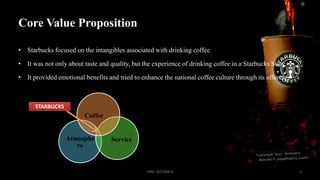
• Starbucks focused on the intangibles associated with drinking coffee

• It was not only about taste and quality, but the experience of drinking coffee in a Starbucks Store
• It provided emotional benefits and tried to enhance the national coffee culture through its offerings

STARBUCKS

Coffee

Atmosphe
re

Service

CRM SECTION A

5
Declining Customer Satisfaction
Imperfect tool for measuring customer satisfaction: Customer Snapshot
– Mystery shopping program thrice in a quarter
– Rated based on 4 criteria- service, cleanliness, product quality & speed of service
– Legendary services- behaviour that created memorable experience for customer
Reasons based on research outcomes:
• Rough brand image of primarily making money & building more stores
• Perceived differentiation between Starbucks and others was very less
• Somehow less trendy as compared to others
• Unsatisfactory service of partners
• Low speed of service- customized drinks slowed down the process of delivering
CRM SECTION A

6
Changing Landscape
• The Starbucks of 1992 had 140 stores, whereas in 2002, it had more than 5000 stores across the world

• 77% of the sales were from beverages, while in 1992, half of the sales constituted of whole bean
coffees
• The Starbucks of 2002 was far more complex with the addition of new products on the menu
• The Partners had to spent more time as beverages became more customized
• The demographics of the customers changed Earlier only the affluent, well educated and high income group used to visit
 In 2002 another group evolved which was less educated, younger and had low income

CRM SECTION A

7
Ideal Customer & Satisfaction
• The most ideal customer will be the most loyal (frequent) customer with around 18 visits per month
[ A Loyal customer will also be a highly satisfied customer too, so he/she will spend $ 4.42 dollar per
visit;
From Exhibit 9]
• So total lifetime value of a loyal customer is = (4.42*18*12*8.3) = $ 7924 dollars
• While lifetime value of a highly satisfied customer is = (4.42*7.2*12*8.3) = $ 3169 dollars
Satisfaction can be increased by:
• Speeding up the service
• Free cups: reduce the perception that Starbucks is only obsessed with expansion and money making
• Better training of partners to treat customers better

CRM SECTION A

8
Recommendation
• Starbucks can significantly increase its sales by converting the satisfied customers into loyal

customers
• However, that will require better handling of customers by partners and shortened service time
YES! They should make the investment in labor as it will improve the ‘service’ which
is the major factor driving the value proposition.
Further, $ 40 million results in investment of $ 8000 dollar per store (5000 stores)
Now the difference between income of a satisfied ($ 209.49) and highly satisfied customer ($ 381.88) is =
$ 172 dollar
Therefore, It will require (8000/172)= 46 customers to break even in each of its stores
From Exhibit 3, no of visitors per store each day = 570
CRM SECTION A

So, daily 46 more customers (out of 570) need to be highly satisfied to break even.

9
Thank You!
CRM SECTION A

10

Starbucks delivering customer service

  • 1.
    STARBUCKS: DELIVERING CUSTOMERSERVICE MONOJ K RABHA IIM KOZHIKODE CRM SECTION A 1
  • 2.
    Brief Introduction • Foundedin 1971 by three coffee fanatics- Gerald Baldwin, Gordon Bowker & Ziev Siegl • Schultz joined the marketing team in 1982 • Later, the founders sold the entire business to Schultz • By 2002, it served 20 million unique customers in 5000 stores across the globe • Sales had a CAGR of 40%, while Net Earnings had a CAGR of 50% Key people in the CASE: VP of Administration in North America: Christine Day CEO: Orin Smith (A Harvard MBA who joined 1990) Chairman & Chief Global Strategist: Schultz CRM SECTION A 2
  • 3.
    Problem Statement Starbucks failedto meet customer expectations and deliver satisfaction thereby losing customer loyalty Whether to invest the $40 million dollars to enhance the labor in each store? If invested, How it will impact the sales and profitability? CRM SECTION A 3
  • 4.
    Factors responsible forthe early success of Starbucks Experiential Branding Strategy consisting of the three major components: • High quality coffee- It monitored roasting process to distribution around the world • Service- Provide intimate and uplifting experience each time • Atmosphere- Friendly environment with universal appeal, encouraged lounging and layouts Other factors that contributed the early success includes: • Attractive Market- Unexploited without strong competitors • Partner Satisfaction- High satisfaction rate(80-90%) & low turnover rate • Company’s Distribution strategy and location of stores- high traffic & high visibility CRM SECTION A 4
  • 5.
    Core Value Proposition •Starbucks focused on the intangibles associated with drinking coffee • It was not only about taste and quality, but the experience of drinking coffee in a Starbucks Store • It provided emotional benefits and tried to enhance the national coffee culture through its offerings STARBUCKS Coffee Atmosphe re Service CRM SECTION A 5
  • 6.
    Declining Customer Satisfaction Imperfecttool for measuring customer satisfaction: Customer Snapshot – Mystery shopping program thrice in a quarter – Rated based on 4 criteria- service, cleanliness, product quality & speed of service – Legendary services- behaviour that created memorable experience for customer Reasons based on research outcomes: • Rough brand image of primarily making money & building more stores • Perceived differentiation between Starbucks and others was very less • Somehow less trendy as compared to others • Unsatisfactory service of partners • Low speed of service- customized drinks slowed down the process of delivering CRM SECTION A 6
  • 7.
    Changing Landscape • TheStarbucks of 1992 had 140 stores, whereas in 2002, it had more than 5000 stores across the world • 77% of the sales were from beverages, while in 1992, half of the sales constituted of whole bean coffees • The Starbucks of 2002 was far more complex with the addition of new products on the menu • The Partners had to spent more time as beverages became more customized • The demographics of the customers changed Earlier only the affluent, well educated and high income group used to visit  In 2002 another group evolved which was less educated, younger and had low income CRM SECTION A 7
  • 8.
    Ideal Customer &Satisfaction • The most ideal customer will be the most loyal (frequent) customer with around 18 visits per month [ A Loyal customer will also be a highly satisfied customer too, so he/she will spend $ 4.42 dollar per visit; From Exhibit 9] • So total lifetime value of a loyal customer is = (4.42*18*12*8.3) = $ 7924 dollars • While lifetime value of a highly satisfied customer is = (4.42*7.2*12*8.3) = $ 3169 dollars Satisfaction can be increased by: • Speeding up the service • Free cups: reduce the perception that Starbucks is only obsessed with expansion and money making • Better training of partners to treat customers better CRM SECTION A 8
  • 9.
    Recommendation • Starbucks cansignificantly increase its sales by converting the satisfied customers into loyal customers • However, that will require better handling of customers by partners and shortened service time YES! They should make the investment in labor as it will improve the ‘service’ which is the major factor driving the value proposition. Further, $ 40 million results in investment of $ 8000 dollar per store (5000 stores) Now the difference between income of a satisfied ($ 209.49) and highly satisfied customer ($ 381.88) is = $ 172 dollar Therefore, It will require (8000/172)= 46 customers to break even in each of its stores From Exhibit 3, no of visitors per store each day = 570 CRM SECTION A So, daily 46 more customers (out of 570) need to be highly satisfied to break even. 9
  • 10.