Building Customer
   Satisfaction
  Dr. Vikram Sharma
Session Coverage
Defining Customer Value and Satisfaction

Customer Satisfaction Through
  Quality
  Service
  Value

Delivering Customer Value and
 Satisfaction
Profit through customer satisfaction
Most companies adopt marketing concept
 only when driven by adverse
 circumstances:

•   Sales decline
•   Slow market growth rate
•   Changing buying patterns
•   Increasing competition
•   Increasing expenditures
How can companies increase value
         to Customer?
•   Most obvious answer..reduce price !!
•   Different sources of value
•   Quality Improvement
•   Add attribute that enhance performance
    – Identify purchase patterns
• Observe how customers use product?
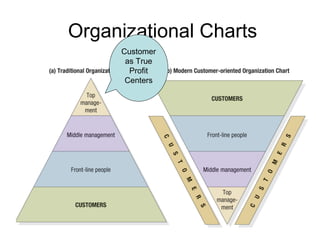
Organizational Charts
     Customer
      as True
       Profit
      Centers
Satisfaction is...
...a person’s feelings of pleasure or
disappointment resulting from
comparing a product’s perceived
performance (or outcome) in
relation to his or her expectations.

•Consumer Expectations Come from:
•Past Buying Experiences
•Friends & Associates advice
•Competitor's Information and Promises
Satisfied Customers:
Buy more (new products & upgrades)
• Spread favorable word-of-mouth
• Pay More (less price sensitive)
• Offer feedback
• Reduce transaction costs
• Stay Longer-Make companies more
  profitable.
Building Customer Satisfaction, Value,
and Retention


 It is no longer enough to satisfy
 customers. You must delight them.

                  Kotler on Marketing
Defining Customer Value and
            Satisfaction

• Customer Perceived Value (CPV)
   – Total customer value
   – Total customer cost
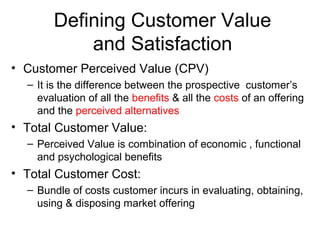
Defining Customer Value
            and Satisfaction
• Customer Perceived Value (CPV)
  – It is the difference between the prospective customer’s
    evaluation of all the benefits & all the costs of an offering
    and the perceived alternatives
• Total Customer Value:
  – Perceived Value is combination of economic , functional
    and psychological benefits
• Total Customer Cost:
  – Bundle of costs customer incurs in evaluating, obtaining,
    using & disposing market offering
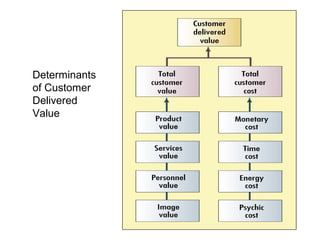
Determinants
of Customer
Delivered
Value
CPV-HP V/S DELL
• HP beginning to outpace Dell in Customer
  Perceived Value.
• Dell highly successful in low priced computers-
  logistic efficiency, after sales service (LOW
  COST)
• Co shifted its Customer Centric Call Center to
  India and Philippines to cut cost.
• Understaffed call centers led to 30 min wait for
  customers.
• To discourage customers, Toll Free Number,
  removed from the website.
HP V/S DELL
• Customer Satisfaction Dips, competitors match
  its quality and prices and offered improved
  services.
• Dell MS and Stock Price Decline Sharply
• Michael Dell Confesses “Team was managing
  cost instead of managing quality”
• HP “Perusing solution approach based on
  strengthening channel relationships.
• “HP-One of the easiest sales methods is to go
  into an account that has been serviced by Dell”
HP on Customer Satisfaction
• A very satisfied customer is 6x more likely to
  repurchase than a satisfied one
• The average customer with a problem
  eventually tells 9 other people
• Acquiring a new customer costs 5-7x more
  than retaining one
• An increase in customer retention of 5% can
  boost profits 25-85%
Virgin Atlantic-Value Enhancement
 An Advertisement-A customer says
• VA picks me up from home, gives me a
  boarding pass at my car window. I go
  straight to VA lounge. On the flight, I can
  get my hair cut, my shoes polished. I am
  asked how and when I want my meal.
  When I get off, I don’t have to queue for
  taxi in a strange place.
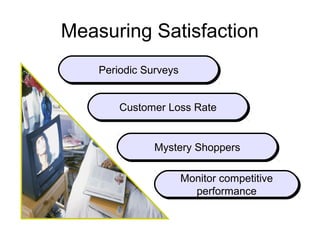
Measuring Satisfaction
    Periodic Surveys
    Periodic Surveys


        Customer Loss Rate
        Customer Loss Rate


              Mystery Shoppers
              Mystery Shoppers

                       Monitor competitive
                       Monitor competitive
                         performance
                         performance
Tools for Tracking and Measuring
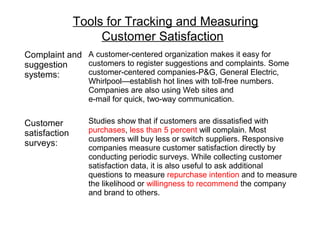
                    Customer Satisfaction
Complaint and A customer-centered organization makes it easy for
suggestion    customers to register suggestions and complaints. Some
systems:      customer-centered companies-P&G, General Electric,
                 Whirlpool—establish hot lines with toll-free numbers.
                 Companies are also using Web sites and
                 e-mail for quick, two-way communication.


Customer         Studies show that if customers are dissatisfied with
satisfaction     purchases, less than 5 percent will complain. Most
                 customers will buy less or switch suppliers. Responsive
surveys:
                 companies measure customer satisfaction directly by
                 conducting periodic surveys. While collecting customer
                 satisfaction data, it is also useful to ask additional
                 questions to measure repurchase intention and to measure
                 the likelihood or willingness to recommend the company
                 and brand to others.
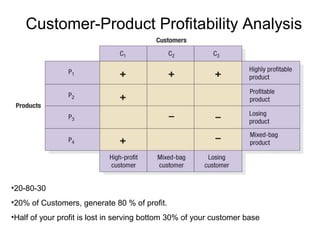
Customer-Product Profitability Analysis


•20-80-30
•20% of Customers, generate 80 % of profit.
•Half of your profit is lost in serving bottom 30% of your customer base
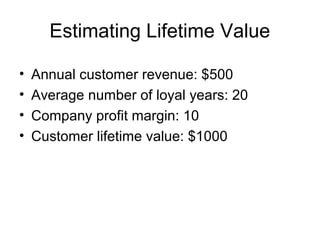
Estimating Lifetime Value

•   Annual customer revenue: $500
•   Average number of loyal years: 20
•   Company profit margin: 10
•   Customer lifetime value: $1000
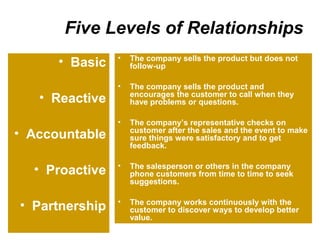
Five Levels of Relationships
                •   The company sells the product but does not
      • Basic       follow-up

                •   The company sells the product and
                    encourages the customer to call when they
   • Reactive       have problems or questions.

                •   The company’s representative checks on
                    customer after the sales and the event to make
• Accountable       sure things were satisfactory and to get
                    feedback.

                •
  • Proactive       The salesperson or others in the company
                    phone customers from time to time to seek
                    suggestions.

                •
• Partnership       The company works continuously with the
                    customer to discover ways to develop better
                    value.

Building customer satisfaction

  • 1.
    Building Customer Satisfaction Dr. Vikram Sharma
  • 2.
    Session Coverage Defining CustomerValue and Satisfaction Customer Satisfaction Through Quality Service Value Delivering Customer Value and Satisfaction
  • 3.
    Profit through customersatisfaction Most companies adopt marketing concept only when driven by adverse circumstances: • Sales decline • Slow market growth rate • Changing buying patterns • Increasing competition • Increasing expenditures
  • 4.
    How can companiesincrease value to Customer? • Most obvious answer..reduce price !! • Different sources of value • Quality Improvement • Add attribute that enhance performance – Identify purchase patterns • Observe how customers use product?
  • 5.
    Organizational Charts Customer as True Profit Centers
  • 6.
    Satisfaction is... ...a person’sfeelings of pleasure or disappointment resulting from comparing a product’s perceived performance (or outcome) in relation to his or her expectations. •Consumer Expectations Come from: •Past Buying Experiences •Friends & Associates advice •Competitor's Information and Promises
  • 7.
    Satisfied Customers: Buy more(new products & upgrades) • Spread favorable word-of-mouth • Pay More (less price sensitive) • Offer feedback • Reduce transaction costs • Stay Longer-Make companies more profitable.
  • 8.
    Building Customer Satisfaction,Value, and Retention It is no longer enough to satisfy customers. You must delight them. Kotler on Marketing
  • 9.
    Defining Customer Valueand Satisfaction • Customer Perceived Value (CPV) – Total customer value – Total customer cost
  • 10.
    Defining Customer Value and Satisfaction • Customer Perceived Value (CPV) – It is the difference between the prospective customer’s evaluation of all the benefits & all the costs of an offering and the perceived alternatives • Total Customer Value: – Perceived Value is combination of economic , functional and psychological benefits • Total Customer Cost: – Bundle of costs customer incurs in evaluating, obtaining, using & disposing market offering
  • 11.
  • 12.
    CPV-HP V/S DELL •HP beginning to outpace Dell in Customer Perceived Value. • Dell highly successful in low priced computers- logistic efficiency, after sales service (LOW COST) • Co shifted its Customer Centric Call Center to India and Philippines to cut cost. • Understaffed call centers led to 30 min wait for customers. • To discourage customers, Toll Free Number, removed from the website.
  • 13.
    HP V/S DELL •Customer Satisfaction Dips, competitors match its quality and prices and offered improved services. • Dell MS and Stock Price Decline Sharply • Michael Dell Confesses “Team was managing cost instead of managing quality” • HP “Perusing solution approach based on strengthening channel relationships. • “HP-One of the easiest sales methods is to go into an account that has been serviced by Dell”
  • 14.
    HP on CustomerSatisfaction • A very satisfied customer is 6x more likely to repurchase than a satisfied one • The average customer with a problem eventually tells 9 other people • Acquiring a new customer costs 5-7x more than retaining one • An increase in customer retention of 5% can boost profits 25-85%
  • 15.
    Virgin Atlantic-Value Enhancement An Advertisement-A customer says • VA picks me up from home, gives me a boarding pass at my car window. I go straight to VA lounge. On the flight, I can get my hair cut, my shoes polished. I am asked how and when I want my meal. When I get off, I don’t have to queue for taxi in a strange place.
  • 16.
    Measuring Satisfaction Periodic Surveys Periodic Surveys Customer Loss Rate Customer Loss Rate Mystery Shoppers Mystery Shoppers Monitor competitive Monitor competitive performance performance
  • 17.
    Tools for Trackingand Measuring Customer Satisfaction Complaint and A customer-centered organization makes it easy for suggestion customers to register suggestions and complaints. Some systems: customer-centered companies-P&G, General Electric, Whirlpool—establish hot lines with toll-free numbers. Companies are also using Web sites and e-mail for quick, two-way communication. Customer Studies show that if customers are dissatisfied with satisfaction purchases, less than 5 percent will complain. Most customers will buy less or switch suppliers. Responsive surveys: companies measure customer satisfaction directly by conducting periodic surveys. While collecting customer satisfaction data, it is also useful to ask additional questions to measure repurchase intention and to measure the likelihood or willingness to recommend the company and brand to others.
  • 18.
    Customer-Product Profitability Analysis •20-80-30 •20%of Customers, generate 80 % of profit. •Half of your profit is lost in serving bottom 30% of your customer base
  • 19.
    Estimating Lifetime Value • Annual customer revenue: $500 • Average number of loyal years: 20 • Company profit margin: 10 • Customer lifetime value: $1000
  • 20.
    Five Levels ofRelationships • The company sells the product but does not • Basic follow-up • The company sells the product and encourages the customer to call when they • Reactive have problems or questions. • The company’s representative checks on customer after the sales and the event to make • Accountable sure things were satisfactory and to get feedback. • • Proactive The salesperson or others in the company phone customers from time to time to seek suggestions. • • Partnership The company works continuously with the customer to discover ways to develop better value.