Primates
The Difference Between Old
   World Monkeys and New
            World Monkeys.
         By: Karina Montoya
New World Monkeys
   New world monkeys
    have flat noses with
    nostrils that face to the
    side.
   These noses are called
    platyrrhine noses.
   The monkey shown to
    the right is the Golden
    Lion Tamarin showing
    off his very distinctive
    platyrrhine nose.
New World Monkeys’ Tails
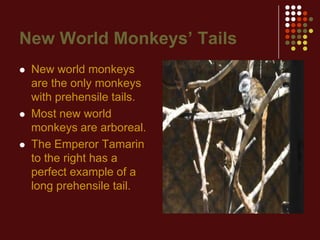
   New world monkeys
    are the only monkeys
    with prehensile tails.
   Most new world
    monkeys are arboreal.
   The Emperor Tamarin
    to the right has a
    perfect example of a
    long prehensile tail.
New World Monkeys’ Nails
                 Most primates have nails
                  instead of claws.
                 The nails help the primate feel
                  and grab things just like how a
                  human would.
                 The type of primates that are
                  an exception to this
                  characteristic are the tamarins.
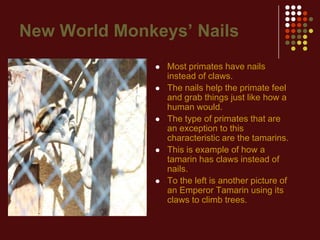
                 This is example of how a
                  tamarin has claws instead of
                  nails.
                 To the left is another picture of
                  an Emperor Tamarin using its
                  claws to climb trees.
New World Monkeys’ Tail
   The final new world monkey             Below is the Crested Capuchin
    that I saw during my trip to the        which moves in brachiation , it
    zoo was the Crested                     also is showing off its very
    Capuchin.                               curled prehensile tail.
   It is usually known as a helper
    monkey, because it is usually
    a guide animal to a person
    who is need of the services.
   It is also one of the most easily
    trained primates, therefore it is
    used in many commercials and
    movies.
   It also has a curled tail that is
    prehensile meaning it could be
    used as a third arm.
Old World Monkeys
   Old world monkeys are just
    very different from new
    world monkeys.
   For instance they do not
    any form of a prehensile
    tail, which basically means
    the do not have the
    advantages of a extra limb.
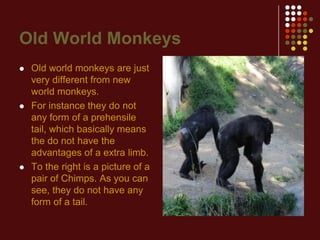
   To the right is a picture of a
    pair of Chimps. As you can
    see, they do not have any
    form of a tail.
Old World Monkeys’ Eating
Habits
   Old world monkeys are
    also omnivorous.
   This means that the
    primate eats both meat
    and
    vegetables, fruits, and
    plants.
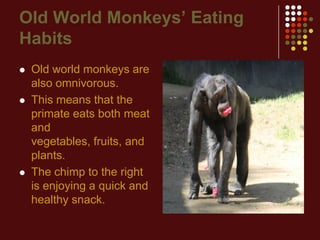
   The chimp to the right
    is enjoying a quick and
    healthy snack.
Old World Monkeys’ Face
                  Chimps also have a flat
                   face.
                  This is due to its binocular
                   vision.
                  One more interesting fact
                   about these chimps is the
                   fact that they always hunt in
                   groups.
                  The chimp on the top is a
                   great example of a flat face.
                  The chimps on the bottom
                   show how many of these
                   chimps hunt in groups in the
                   wild.
Old World Monkeys’ Noses


   Old world monkeys have a very unusual nose.
   This type of primate has a catarrhine nose.
   The nostrils on a catarrhine nose face downwards, where as in a platyrrhine nose they
    would face to the side.
   Above are two examples of how the nose of a orangutan differs from the nose of the
    Crested Capuchin.
   The one of the left is the Crested Capuchin which has tiny nostrils that face to the side.
   The picture on the right is of a orangutan, which has nostrils that face downwards.
Fun Facts !
                 The Siamangs to the left
                  use breakiation to move
                  around.
                 They have throat sacs that
                  fill with air, and they act like
                  a chamber to augment.
                 The Siamangs most
                  powerful asset is its very
                  loud voice.
                 It is a arboreal type of
                  gibbon.

Primates

  • 1.
    Primates The Difference BetweenOld World Monkeys and New World Monkeys. By: Karina Montoya
  • 2.
    New World Monkeys  New world monkeys have flat noses with nostrils that face to the side.  These noses are called platyrrhine noses.  The monkey shown to the right is the Golden Lion Tamarin showing off his very distinctive platyrrhine nose.
  • 3.
    New World Monkeys’Tails  New world monkeys are the only monkeys with prehensile tails.  Most new world monkeys are arboreal.  The Emperor Tamarin to the right has a perfect example of a long prehensile tail.
  • 4.
    New World Monkeys’Nails  Most primates have nails instead of claws.  The nails help the primate feel and grab things just like how a human would.  The type of primates that are an exception to this characteristic are the tamarins.  This is example of how a tamarin has claws instead of nails.  To the left is another picture of an Emperor Tamarin using its claws to climb trees.
  • 5.
    New World Monkeys’Tail  The final new world monkey  Below is the Crested Capuchin that I saw during my trip to the which moves in brachiation , it zoo was the Crested also is showing off its very Capuchin. curled prehensile tail.  It is usually known as a helper monkey, because it is usually a guide animal to a person who is need of the services.  It is also one of the most easily trained primates, therefore it is used in many commercials and movies.  It also has a curled tail that is prehensile meaning it could be used as a third arm.
  • 6.
    Old World Monkeys  Old world monkeys are just very different from new world monkeys.  For instance they do not any form of a prehensile tail, which basically means the do not have the advantages of a extra limb.  To the right is a picture of a pair of Chimps. As you can see, they do not have any form of a tail.
  • 7.
    Old World Monkeys’Eating Habits  Old world monkeys are also omnivorous.  This means that the primate eats both meat and vegetables, fruits, and plants.  The chimp to the right is enjoying a quick and healthy snack.
  • 8.
    Old World Monkeys’Face  Chimps also have a flat face.  This is due to its binocular vision.  One more interesting fact about these chimps is the fact that they always hunt in groups.  The chimp on the top is a great example of a flat face.  The chimps on the bottom show how many of these chimps hunt in groups in the wild.
  • 9.
    Old World Monkeys’Noses  Old world monkeys have a very unusual nose.  This type of primate has a catarrhine nose.  The nostrils on a catarrhine nose face downwards, where as in a platyrrhine nose they would face to the side.  Above are two examples of how the nose of a orangutan differs from the nose of the Crested Capuchin.  The one of the left is the Crested Capuchin which has tiny nostrils that face to the side.  The picture on the right is of a orangutan, which has nostrils that face downwards.
  • 10.
    Fun Facts !  The Siamangs to the left use breakiation to move around.  They have throat sacs that fill with air, and they act like a chamber to augment.  The Siamangs most powerful asset is its very loud voice.  It is a arboreal type of gibbon.