EVOLUTION AND PRIMATE
SYSTEMATICS
BY
MS. SALMAH JOMBELA
BASIC CLASSIFICATION HIERARCHY
- DOMAIN (
- KINGDOM
- DIVISION or PHYLUM
- SUBPHYLUM
- CLASS
- - ORDER
- FAMILY
- GENUS
- SPECIES
(many levels can have sublevels: e.g. subfamily)
INTRODUCTION
• Almost all extant primate groups predominantly inhabit tropical and
subtropical environments and a few extending into drier and colder
habitats
• Primates are largely divided into Prosimian/ Strespsirhini (Pre-monkey)
of the primitive forms (lorises, lemurs and tarsiers) and Anthropidea
(Haplorrhini) that comprises of monkeys, apes and humans
Characteristics of primates
• Vision: forward-facing eyes, color vision and depth perception
• Limbs: five digits, nails innated of claws, flexibility (grasping hand)
with opposable thumbs and big toes
• Tendency towards erect posture
• Retention of clavicle for flexible shoulder joints
• Brain: gradual increase in brain size
• Complex social structure
ORDER PRIMATES
• The difference between the order primates from other mammalian
orders is that all its members fall into a graded series or scale of
organization that suggests an actual trend of evolution leading from
the least to the most advanced
Prosimians (Sub order
Strepsirrhini) vs Anthropoids
(Sub order Haplorrhini)
PROSIMIANS/ STREPSIRRHINES (PRE-MONKEY)
• Most primitive of primates
• Primates with wet noses
• Include lemurs, lorises and tarsiers
CHARACTERISTICS
• Reliance on olfaction
• Laterally placed eyes
• Dental modification into a “dental comb”
• Shorter gestation periods (about 6 months)
LEMURS
• Found on the island of
Madagascar and other smaller
islands off the coast of Africa
• Larger lemurs are diurnal and feed
on fruit, leaves, buds and bark
• Smaller lemurs are nocturnal and
are insectivorous
LORISES
• Found in the forests and woodlands of
Africa, India, South East Asia and Sri
Lanka
• Use climbing quadrupedalism
• Most are nocturnal
• Diet consists of insects and
supplemented with fruit leaves gums
and slugs
• Female form associations for foraging
TARSIERS
• These are found on the islands on
South East Asia
• Very small nocturnal primates
• Basic social unit is a family i.e.,
mating pairs and their offspring
• Feed on insects and small
invertebrate they catch through
leaping
Simian/Haplorrhini/Anthropoidea (Sub-order)
• Primates with dry noses
• This consists of monkeys, apes and
humans
Common traits
• Larger brain size (advanced cognition)
• Reduced reliance on olfactory
• Greater color vision
• Fused mandibles
• Longer gestation periods
• Bony plates at the back of the eye socket
ANTHROPOIDEA
It is divided onto:
• Catarrhine (old world monkeys, apes and
humans)
• Platyrrhines (new world monkeys)
Monkeys
• Represent about 70% of all primate species
• Are divided into two groups i.e.,
1. New World monkeys
2. Old World Monkeys
• The groups are separated by geography and several million years of
evolution
New World Monkeys (Platyrrhines)
• Exclusively arboreal
• Found in Southern Mexico,
Central and South America
Divided into 3 families
1. Callitrichidae
2. Cebidae
3. Atelines
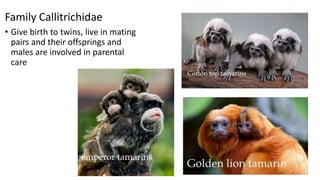
Family Callitrichidae
• Give birth to twins, live in mating
pairs and their offsprings and
males are involved in parental
care
Family Cebidae
• They possess prehensile tails
• Live in groups of both sexes and all
ages while others are monogamous
Family Atelidae
• Formerly under Cebidae
• Has four extant genera
• Moderate sized monkeys
• Long prehensile tails
• Arboreal and diurnal
• Give birth to single infants
• Live in large social groups of up to 25 individuals
• Species include spider monkeys
OLD WORLD MONKEYS/CATARRHINES
• Inhabit a variety of habitats from tropical forests to semi-arid and
snow-covered habitats in Africa and Asia
• Most quadrupedal primates
• All belong to family Cercopithecidae
• Divided into sub-family Cercopithecoidea and Hominoidea
Cercopithecoids/Cercopithecidae (Family )
There are two sub-families i.e.,
1. Cercopithecinae (baboons, macaques and guenons)
2. Colobinae (Colobus monkeys)
CERCOPITHANCINAE
Characteristics
• Medium to large size
• Have cheek pouches
• Ominivorous with simple stomachs
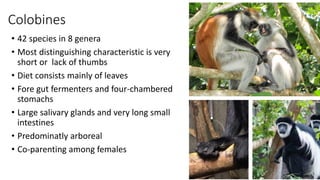
Colobines
• 42 species in 8 genera
• Most distinguishing characteristic is very
short or lack of thumbs
• Diet consists mainly of leaves
• Fore gut fermenters and four-chambered
stomachs
• Large salivary glands and very long small
intestines
• Predominatly arboreal
• Co-parenting among females
Hominoids/ Hominoidea (Apes and Humans)
Characteristics
• Large body size
• Absence of tail
• Shorter trunk
• Increased brain size and complexity
• Complex social behavior
• Longer period of development and dependence
Hylobates (Lesser apes)
• These include Gibbons and Siamangs
• Thrive in the tropics of South East Asia
• Adaptation for brachiation related to feeding
while hanging in the trees
• Diet is largely fruits, and occasionally leaves
and insects
• The basic social unit is a monogamous pair
with offspring
• Females and male delineate their territories
with whoops and songs
HYLOBATES
• Gibbons
• Siamangs
APES
• Sub-divided into:
1. Hominids (Greater Apes)
2. Hylobates (Lesser Apes):
• Found in the tropics of South East Asia
• Adaptation for brachiation related to feeding while hanging in the trees
• Diet is largely fruits, with leaves and insects
• Basic social unit is monogamous pair with offsprings
• Female and male delineate their territories with whoops and songs
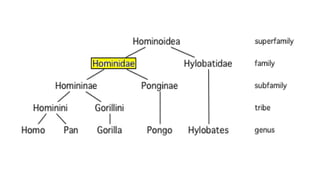
Hominids (Greater Apes)
• Consist of:
1. Homininae
- Pan
- Gorilla
- Homo
2. Pongo
Pongids
Consists of only 2 species Orangutans
(Sumatran and Bornean)
• Only found in heavily forested areas of
Borneo and Sumatra
• Completely arboreal and solitary
• Frugivorous
• Pronounced sexual dimorphism
• Parental care can last about 8 years
Pan
Consists of:
1. Chimpanzees
2. Bonobos
CHIMPANZEES:
• Only thrive in Equatorial Africa
• Knuckle walking and as brachiation forms of locomotion
• Predominantly terrestrial
• Are Omnivores
• Live in a multimale multifemale community that can be as
large as 200 individuals
Bonobos
• Only found in a small area south of
the Zaire River in DRC
• Are omnivores with the same social
structure as chimpanzees
Gorilla
• Largest living primate
• Confined to forested regions of Central Africa
• Fully terrestrial and move by knuckle walking
• The basic social unit is a family, with one silverback male, a few
females and their subadult offspring
• Species include the lowland gorilla and mountain gorilla
Humans (Homo sapiens)
• Only living species in the family Hominidae
• Very advanced cognitive ability due to the dramatic increase in brain
size
• Bipedal
• Heavy dependence on vison for orientation in their environment
EVOLUTION OF PRIMATES
• Early Mammalian Ancestors (Cretaceous –Paleocene)
Plesiadapiformes: Earliest ancestors, small, nocturnal, insect-eating eating
mammals. They had some primate-like features e.g grasping hands, and
feet for climbing but lacked large brains and forward-facing eyes
Early primates (Eocene 55-34 mya)
Adapiformes: Resembled modern lemurs and were likely the ancestors of
lemurs and lorises
Omomyids: Resembled modern tarsiers but are also thought to be closely
related to Anthropoid primates
Had larger brains, grasping hands, forward-facing eyes, and dexterous
hands
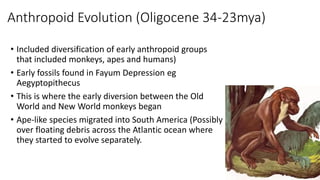
Anthropoid Evolution (Oligocene 34-23mya)
• Included diversification of early anthropoid groups
that included monkeys, apes and humans)
• Early fossils found in Fayum Depression eg
Aegyptopithecus
• This is where the early diversion between the Old
World and New World monkeys began
• Ape-like species migrated into South America (Possibly
over floating debris across the Atlantic ocean where
they started to evolve separately.
Emergence of Apes (Mioecene 23-5mya)
• Referred to as the golden age of apes with many
ape species evolving and spreading out through
Africa and Eurasia
• Proconsul-More primitive and displayed some
characteristics to modern apes like reduced tails
and changes in arm structures for brachiation (arm
swinging)
• Late Miocene: ancestors of the great apes emerged
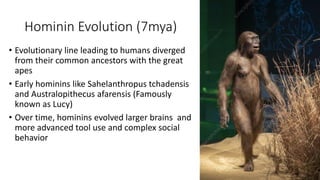
Hominin Evolution (7mya)
• Evolutionary line leading to humans diverged
from their common ancestors with the great
apes
• Early hominins like Sahelanthropus tchadensis
and Australopithecus afarensis (Famously
known as Lucy)
• Over time, hominins evolved larger brains and
more advanced tool use and complex social
behavior
GENUS Homo
• Evolved about 2.5 mya with homo habilis and later
homo erectus which was followed by migration out of
Africa
• Homo Sapiens: Evolved about 300,000 in Africa and
spread across the globe and eventually becoming the
only surviving hominin species
TAKE HOME!
• A trend in primate evolution has been towards a more elaborate
brain
• Anthropoid brain is larger relative to body size than that of prosimians
characterized by a complicated pattern of fissure and folds
• Generally, there is a clear pattern of advancement from the lowest to
the most advanced primates
The gradual increase in brain size and complexity
characterizes the evolution of primates
Thank You for Listening!

EVOLUTION AND PRIMATE SYSTEMATICS...pdf

  • 1.
  • 2.
    BASIC CLASSIFICATION HIERARCHY -DOMAIN ( - KINGDOM - DIVISION or PHYLUM - SUBPHYLUM - CLASS - - ORDER - FAMILY - GENUS - SPECIES (many levels can have sublevels: e.g. subfamily)
  • 3.
    INTRODUCTION • Almost allextant primate groups predominantly inhabit tropical and subtropical environments and a few extending into drier and colder habitats • Primates are largely divided into Prosimian/ Strespsirhini (Pre-monkey) of the primitive forms (lorises, lemurs and tarsiers) and Anthropidea (Haplorrhini) that comprises of monkeys, apes and humans
  • 4.
    Characteristics of primates •Vision: forward-facing eyes, color vision and depth perception • Limbs: five digits, nails innated of claws, flexibility (grasping hand) with opposable thumbs and big toes • Tendency towards erect posture • Retention of clavicle for flexible shoulder joints • Brain: gradual increase in brain size • Complex social structure
  • 5.
    ORDER PRIMATES • Thedifference between the order primates from other mammalian orders is that all its members fall into a graded series or scale of organization that suggests an actual trend of evolution leading from the least to the most advanced
  • 8.
    Prosimians (Sub order Strepsirrhini)vs Anthropoids (Sub order Haplorrhini)
  • 9.
    PROSIMIANS/ STREPSIRRHINES (PRE-MONKEY) •Most primitive of primates • Primates with wet noses • Include lemurs, lorises and tarsiers CHARACTERISTICS • Reliance on olfaction • Laterally placed eyes • Dental modification into a “dental comb” • Shorter gestation periods (about 6 months)
  • 11.
    LEMURS • Found onthe island of Madagascar and other smaller islands off the coast of Africa • Larger lemurs are diurnal and feed on fruit, leaves, buds and bark • Smaller lemurs are nocturnal and are insectivorous
  • 12.
    LORISES • Found inthe forests and woodlands of Africa, India, South East Asia and Sri Lanka • Use climbing quadrupedalism • Most are nocturnal • Diet consists of insects and supplemented with fruit leaves gums and slugs • Female form associations for foraging
  • 13.
    TARSIERS • These arefound on the islands on South East Asia • Very small nocturnal primates • Basic social unit is a family i.e., mating pairs and their offspring • Feed on insects and small invertebrate they catch through leaping
  • 14.
    Simian/Haplorrhini/Anthropoidea (Sub-order) • Primateswith dry noses • This consists of monkeys, apes and humans Common traits • Larger brain size (advanced cognition) • Reduced reliance on olfactory • Greater color vision • Fused mandibles • Longer gestation periods • Bony plates at the back of the eye socket
  • 15.
    ANTHROPOIDEA It is dividedonto: • Catarrhine (old world monkeys, apes and humans) • Platyrrhines (new world monkeys)
  • 16.
    Monkeys • Represent about70% of all primate species • Are divided into two groups i.e., 1. New World monkeys 2. Old World Monkeys • The groups are separated by geography and several million years of evolution
  • 17.
    New World Monkeys(Platyrrhines) • Exclusively arboreal • Found in Southern Mexico, Central and South America Divided into 3 families 1. Callitrichidae 2. Cebidae 3. Atelines
  • 18.
    Family Callitrichidae • Givebirth to twins, live in mating pairs and their offsprings and males are involved in parental care
  • 19.
    Family Cebidae • Theypossess prehensile tails • Live in groups of both sexes and all ages while others are monogamous
  • 20.
    Family Atelidae • Formerlyunder Cebidae • Has four extant genera • Moderate sized monkeys • Long prehensile tails • Arboreal and diurnal • Give birth to single infants • Live in large social groups of up to 25 individuals • Species include spider monkeys
  • 21.
    OLD WORLD MONKEYS/CATARRHINES •Inhabit a variety of habitats from tropical forests to semi-arid and snow-covered habitats in Africa and Asia • Most quadrupedal primates • All belong to family Cercopithecidae • Divided into sub-family Cercopithecoidea and Hominoidea
  • 24.
    Cercopithecoids/Cercopithecidae (Family ) Thereare two sub-families i.e., 1. Cercopithecinae (baboons, macaques and guenons) 2. Colobinae (Colobus monkeys) CERCOPITHANCINAE Characteristics • Medium to large size • Have cheek pouches • Ominivorous with simple stomachs
  • 25.
    Colobines • 42 speciesin 8 genera • Most distinguishing characteristic is very short or lack of thumbs • Diet consists mainly of leaves • Fore gut fermenters and four-chambered stomachs • Large salivary glands and very long small intestines • Predominatly arboreal • Co-parenting among females
  • 26.
    Hominoids/ Hominoidea (Apesand Humans) Characteristics • Large body size • Absence of tail • Shorter trunk • Increased brain size and complexity • Complex social behavior • Longer period of development and dependence
  • 28.
    Hylobates (Lesser apes) •These include Gibbons and Siamangs • Thrive in the tropics of South East Asia • Adaptation for brachiation related to feeding while hanging in the trees • Diet is largely fruits, and occasionally leaves and insects • The basic social unit is a monogamous pair with offspring • Females and male delineate their territories with whoops and songs
  • 29.
  • 30.
    APES • Sub-divided into: 1.Hominids (Greater Apes) 2. Hylobates (Lesser Apes): • Found in the tropics of South East Asia • Adaptation for brachiation related to feeding while hanging in the trees • Diet is largely fruits, with leaves and insects • Basic social unit is monogamous pair with offsprings • Female and male delineate their territories with whoops and songs
  • 31.
    Hominids (Greater Apes) •Consist of: 1. Homininae - Pan - Gorilla - Homo 2. Pongo
  • 33.
    Pongids Consists of only2 species Orangutans (Sumatran and Bornean) • Only found in heavily forested areas of Borneo and Sumatra • Completely arboreal and solitary • Frugivorous • Pronounced sexual dimorphism • Parental care can last about 8 years
  • 34.
    Pan Consists of: 1. Chimpanzees 2.Bonobos CHIMPANZEES: • Only thrive in Equatorial Africa • Knuckle walking and as brachiation forms of locomotion • Predominantly terrestrial • Are Omnivores • Live in a multimale multifemale community that can be as large as 200 individuals
  • 35.
    Bonobos • Only foundin a small area south of the Zaire River in DRC • Are omnivores with the same social structure as chimpanzees
  • 36.
    Gorilla • Largest livingprimate • Confined to forested regions of Central Africa • Fully terrestrial and move by knuckle walking • The basic social unit is a family, with one silverback male, a few females and their subadult offspring • Species include the lowland gorilla and mountain gorilla
  • 38.
    Humans (Homo sapiens) •Only living species in the family Hominidae • Very advanced cognitive ability due to the dramatic increase in brain size • Bipedal • Heavy dependence on vison for orientation in their environment
  • 39.
    EVOLUTION OF PRIMATES •Early Mammalian Ancestors (Cretaceous –Paleocene) Plesiadapiformes: Earliest ancestors, small, nocturnal, insect-eating eating mammals. They had some primate-like features e.g grasping hands, and feet for climbing but lacked large brains and forward-facing eyes Early primates (Eocene 55-34 mya) Adapiformes: Resembled modern lemurs and were likely the ancestors of lemurs and lorises Omomyids: Resembled modern tarsiers but are also thought to be closely related to Anthropoid primates Had larger brains, grasping hands, forward-facing eyes, and dexterous hands
  • 40.
    Anthropoid Evolution (Oligocene34-23mya) • Included diversification of early anthropoid groups that included monkeys, apes and humans) • Early fossils found in Fayum Depression eg Aegyptopithecus • This is where the early diversion between the Old World and New World monkeys began • Ape-like species migrated into South America (Possibly over floating debris across the Atlantic ocean where they started to evolve separately.
  • 41.
    Emergence of Apes(Mioecene 23-5mya) • Referred to as the golden age of apes with many ape species evolving and spreading out through Africa and Eurasia • Proconsul-More primitive and displayed some characteristics to modern apes like reduced tails and changes in arm structures for brachiation (arm swinging) • Late Miocene: ancestors of the great apes emerged
  • 42.
    Hominin Evolution (7mya) •Evolutionary line leading to humans diverged from their common ancestors with the great apes • Early hominins like Sahelanthropus tchadensis and Australopithecus afarensis (Famously known as Lucy) • Over time, hominins evolved larger brains and more advanced tool use and complex social behavior
  • 43.
    GENUS Homo • Evolvedabout 2.5 mya with homo habilis and later homo erectus which was followed by migration out of Africa • Homo Sapiens: Evolved about 300,000 in Africa and spread across the globe and eventually becoming the only surviving hominin species
  • 44.
    TAKE HOME! • Atrend in primate evolution has been towards a more elaborate brain • Anthropoid brain is larger relative to body size than that of prosimians characterized by a complicated pattern of fissure and folds • Generally, there is a clear pattern of advancement from the lowest to the most advanced primates
  • 45.
    The gradual increasein brain size and complexity characterizes the evolution of primates
  • 46.
    Thank You forListening!