
Legal Year in Review: Digital Access Cases
Lily Bond (Moderator)
Director of Marketing,
3Play Media
lily@3playmedia.com
www.3playmedia.com
twitter: @3playmedia
 Type questions in the control panel during the presentation
 This presentation is being recorded and will be available for replay
 To view live captions, please follow the link in the chat window
Paul Grossman
Adj. Prof. of Disability Law,
Hastings Col. of Law, U.C.
Chief Regional Attorney, US
ED, OCR, SF, retired
paulgrossman@comcast.net
The Legal Year in Review:
Digital Access Cases
Paul D. Grossman is one of the nation's leading experts in disability rights law,
particularly with regard to students in post-secondary education. For over 40 years,
Paul served as a civil rights attorney for the US Department of Education, Office
for Civil Rights (OCR); 30 years as its Chief Regional Attorney in San Francisco.
Paul worked in OCR Headquarters at the time of the writing of the first disability
anti-discrimination regulations and in San Francisco, witnessing the historic “504
sit-in” at United Nations Plaza Over his career, Paul investigated, wrote
decisions, and settled hundreds of disability discrimination cases, in many
instances developing new approaches to protecting students with disabilities
including with a regard to accessible media for post-secondary students with
visual and auditory impairments.
Recently retired from OCR, Paul continues to teach as an Adjunct Professor of
Disability Law at Hasting College of Law, University of California. Along with
Distinguished Professor Ruth Colker, Paul publishes a disability law textbook,
teachers’ manual and legislative guide as well as a disability law textbook for
higher education professionals.
Paul is a member of the Board of Directors for the Association on Higher
Education and Disability (AHEAD), the Public Policy Committee of the
Association for Children and Adults with AD/HD (CHADD), and the Disability
Rights Advocates (DRA), expert advisory panel. 2
Most Pertinent Publication
Colker and Grossman, The Law of Disability Discrimination For Higher
Education Professionals, Lexis-Nexis (2014 )
◦Lexisnexis.com
◦Hardcopy and e-book
◦http://www.lexisnexis.com/store/catalog/booktemplate/p
roductdetail.jsp?pageName=relatedProducts&prodId=pro
d20900324
◦Updated annually for free to purchasers
PAUL GROSSMAN/NASPA FOUNDATION 3
Caveat
The information set forth in this presentation and accompanying
documents is presented for informational purposes only and
should not be construed as legal advice.
4
DIGITAL ACCESS
OVER 48 MILLION AMERICANS
ARE DEAF OR HARD OF HEARING
OVER 7 MILLION AMERICANS
ARE BLIND OR HAVE LOW VISION
5
Digital Access Presentation Agenda
Roots
Deliberate Indifference
◦ Dudley v. Miami University
Key Compliance Review
◦ OCR Letter to University of Cincinnati
◦ DOJ and edX settlement
Scope of Duty to Accommodate EIT Workers and Calculating Undue Burden
◦ Reyazuddin v. Montgomery County, Maryland
Captioning
◦ National Association of the Deaf (NAD) v. Harvard and MIT
On the Horizon
◦ National Federation of the Blind (NFB) v. Scribd
6
Roots
Section 504: Recipients of FFA
General nondiscrimination provision including disparate impact, indirect prohibitions, requires auxiliary aids as necessary to participate in programs
or activities, and the Kindle Letter for higher education entities
Limitation of fundamental alteration and undue burden
Title II of the ADA: Public Entities
Much the same as 504, plus equal communication provision, accessible EIT provision and the Kindle Letter
Same limitations
Title III: Public Accommodations
Auxiliary aids when necessary to achieve full enjoyment of goods and service
More limitations including that a public accommodation is not required “to alter its inventory to include accessible or special goods that are
designed for, or facilitate use by, individuals with disabilities,” such as “Brailled versions of books ….”
But what is a public accommodation?
 Not something that is conveyed by EIT
 Sort of
 Yes
 Waiting for the regulations
7
Digital Access
DELIBERATE INDIFFERENCE?
8
Dudley v. Miami University
Background
Settlement is pending!
 Complaint filed by NFB in S.D. Ohio 2014 under Title II of the ADA. See
https://nfb.org/ images/nfb/documents/pdf/miami%20teach.pdf.
Motion for intervention by DOJ filed May 25, 2014, http://www.ada.gov/
miami_university/motion_intervene.pdf
Complaint concerned a blind student pursuing a degree in zoology for
the objective of attending veterinary school at Miami University.
NFB alleges “deliberate indifference” is demonstrated by the fact that
the University could have purchased accessible programs but failed to do
so – not even taking the question into account
9
US Moves to Intervene (1)
On April 7, 2014, the United States initiated an investigation
On April 23, 2014, the Federal District Court, tolled the proceedings,
On June 25, 2014 DOJ advised the parties that it had found violations of
Title II of the ADA at Miami University.
Among the violations found:
◦ Miami used technologies that are inaccessible to individuals with
disabilities, including those with learning, hearing, and vision
disabilities
10
US Moves to Intervene(2)
“Miami University’s failure to make its digital- and web-based
technologies accessible to individuals with disabilities, or to
otherwise take appropriate steps to ensure effective
communication with such individuals, places them at a great
disadvantage, depriving them of equal access to Miami University’s
educational content and services. The denial of educational
opportunities is precisely the type of discrimination that Congress
sought to end ….”
Stay tuned!
11
Digital Access
KEY OCR AND DOJ COMPLIANCE REVIEWS
12
Letter to University of Cincinnati
The best letter to share with a CIO, procurement officer, or campus
Chancellor
OCR compliance review #15-13-6001 (December 2014)
Partial findings and partial settlement short of findings
Along with Letter to Youngstown State (compliance review # 15-13-
6002) does a good job of laying out:
◦ legal standards;
◦ applying standards to concrete examples; and,
◦ providing a narrative with insights on how persons who use
adaptive technology are challenged by EIT
13
Major EIT Components
General website (face to the world)
◦ Admissions
◦ Academic program descriptions
◦ Athletics
◦ Library services
◦ Health services
◦ Faculty and student directory
◦ Research tools and resources
Blackboard
Distance learning
14
Summary of Review Findings (1)
Inadequate tools for implementing accessible web-sites
◦ Web access policies were posted on-line but no notice to faculty
that they exist and where they may be found
◦ No training for staff responsible for seeing to it that web sites are
accessible
◦ No training to ensure all staff and faculty comply
◦ Particularly problematic as web postings are decentralized
◦ Few web pages are submitted for review in advance
15
Summary of Review(2)
Blackboard
◦ No policy, practices or protocols for making content accessible
Distance learning
◦ No training for faculty or staff on making content or format
accessible
16
Summary of Review(3)
Web accessibility
◦ Even priority web pages are not accessible to persons who rely upon adaptive
technology
◦ Entry page
◦ Pages that garner the most traffic such as
◦ Admissions
◦ Curriculum requirements
◦ Student handbook
◦ Code of conduct
◦ Student services
◦ Extra-curricular activities
◦ University only addresses compatibility by responding to complaints [just-in-time,
ad hoc, patching]
17
Summary of Remedial Agreement (1)
1) Develop for OCR review a policy to ensure that information provided
through University websites, on-line or e-learning systems, course
management systems or EIT are accessible to students, prospective students,
employees, guests, and visitors with visual, hearing, and manual impairments
◦ Identify standards
◦ Create a plan for implementing the standards and remediating the
violations
◦ Identify and empower an individual to coordinate and implement the
standards: “EIT Accessibility Coordinator”
◦ Create a complaint system and inform students, faculty, guest and visitors
how to file a complaint
18
Summary of Remedial Agreement(2)
2) Develop and implement a plan for accessibility audits by
the access coordinator with audit accounting
3) Develop and implement a plan for acquisition and
contracting that ensure purchases are accessible
4) Annual training on EIT access for faculty, staff,
administrators, support staff, and student employees and a
qualified individual available to assist them on complying
with technical standards
19
Summary of Remedial Agreement (3)
Reporting/monitoring
◦OCR reviews, edits, approves draft policies
◦OCR gets monitoring reports, every quarter through
2018
◦Reports by the plan’s EIT Access Coordinator or a
qualified independent contractor
20
Settlement between DOJ and edX (1)
http://www.ada.gov/edx_sa.htm
Litigation not filed
Background
◦ edX has approximately 60 university and institutional members
◦ edX is their MOOC platform
◦ Provide over 450 courses to over 3,000,000 learners.
◦ The courses are offered largely for free
◦ Subject matters as varied as business, computer sciences, hard sciences,
food and nutrition and social sciences.
21
DOJ edX Settlement(2)
Of note is the deference paid in this agreement to
the Web Content Accessibility Guidelines (WCAG) 2.0
AA.
The agreement specifically requires edX to make
significant modifications to its website, platform and
mobile applications to conform to these guidelines.
22
DOJ edX Settlement (3)
The four-year agreement requires edX to:
◦make the edX website, its mobile applications, and learning
management system software, through which online courses
are offered, fully accessible within 18 months;
◦ensure that its content management system is fully accessible
and supports authoring and publishing of accessible content
within an additional 18 months;
◦provide guidance to course creators at its member universities
and other institutions on best practices for making online
courses fully accessible;
23
DOJ edX Settlement(4)
Quality control
◦appoint a Web Accessibility Coordinator;
◦adopt a Web Accessibility Policy;
◦solicit feedback from learners on the accessibility of the
courses;
◦conduct Web Accessibility Training for employees
responsible for the website, platform, and mobile
applications; and
◦retain a consultant to evaluate conformance of the
website, platform, and mobile applications
24
Digital Access
SCOPE OF DUTY TO ACCOMMODATE EIT WORKERS
AND CALCULATING UNDUE BURDEN
25
Reyazuddin v. Montgomery County,
Maryland: Facts
No. 14-1299, 4th Cir. (June 15, 2015).
As part of an $80 million upgrade, the County opened a new, consolidated, 311 call center
(“customer service center”) using new software that was not accessible to persons with
vision impairments
Ms. Yasmin Reyazuddin, who is blind, worked successfully for Montgomery County as a 311
operator prior to the workplace consolidation
The County concluded that she was no longer qualified to perform the essential functions
of her position and did not transfer her or hire her into a position at the consolidated call
center.
County retained her salary level and reassigned her to other public contact positions, which
she claimed were “make work,” part-time positions.
She alleged disability discrimination in employment under Section 504 of the Rehabilitation
Act and Title II of the ADA
26
Software
The new system could be operated in two “modes”
◦ One was accessible, one of which was not, at least not without a significant
work-around
◦ The County’s software license allows it to run the software in either mode. The
County however, chose to run only the inaccessible (“high-interactivity”) version.
◦ The high-interactivity version has some useful but not necessarily essential
functions --- some related to safety:
◦ Scripts to read to callers
◦ A “solutions button” with a “short, concise paragraph about how the [C]ounty handles” the
caller’s particular concern and instructions for employees on how to handle the call
◦ A field for notetaking
◦ A “service request template” with fields that automatically populate
◦ A function for transferring calls to 911
27
District Court Decision
Summary judgement for the County
Pl. was not qualified to perform the essential functions of a 311 operator at the
new call center because that the accommodations she proposed were not
reasonable as the County had demonstrated that they would entail an undue
burden
Moreover the County’s reassignment of the Plaintiff had satisfied its reasonable
accommodation duties under Section 504
28
Fourth Circuit Decision
The Fourth Circuit reversed the District Court finding that
several issues remained in genuine dispute for a jury to
resolve:
◦1) whether Ms. Reyazuddin could perform the essential
job functions of a call center employee;
◦(2) whether the County reasonably accommodated her;
and
◦(3), if the County had not, whether its failure to do so may
be excused because the County had proven that her
requested accommodations would impose an undue
burden on the County.
29
Undue Burden (1)
The Appellate Court concluded that the District Court had made several errors
in its determination of undue burden
◦ The District Court found relevant that the County had only budgeted $15,500
for accommodations.
“Taken to its logical extreme, the employer could budget $0 for
reasonable accommodation and thereby avoid liability. The
County’s overall budget ($3.73 billion in fiscal year 2010) and the
[new system] operating budget (about $4 million) are relevant
factors. [Citation omitted.] But the County’s line-item budget
for reasonable accommodations is not.”
30
Undue Burden (2)
The Appellate Court further faulted the District Court for not giving nearly
enough weight to:
◦ The fact that four other cities in the U.S., using the same software, are
accessible to individuals who are blind by operating in both modes and by
providing other modifications.
◦ The savings gained by the new 311 system and the availability of in-house
computer personnel to address accessibility challenges also should be included
in the consideration of undue burden.
◦ The hugely different estimates as to the effect or cost of running a 311 system
using both modes and making the highly interactive mode partially or fully
accessible --- differences that could only be resolved through further
proceedings.
31
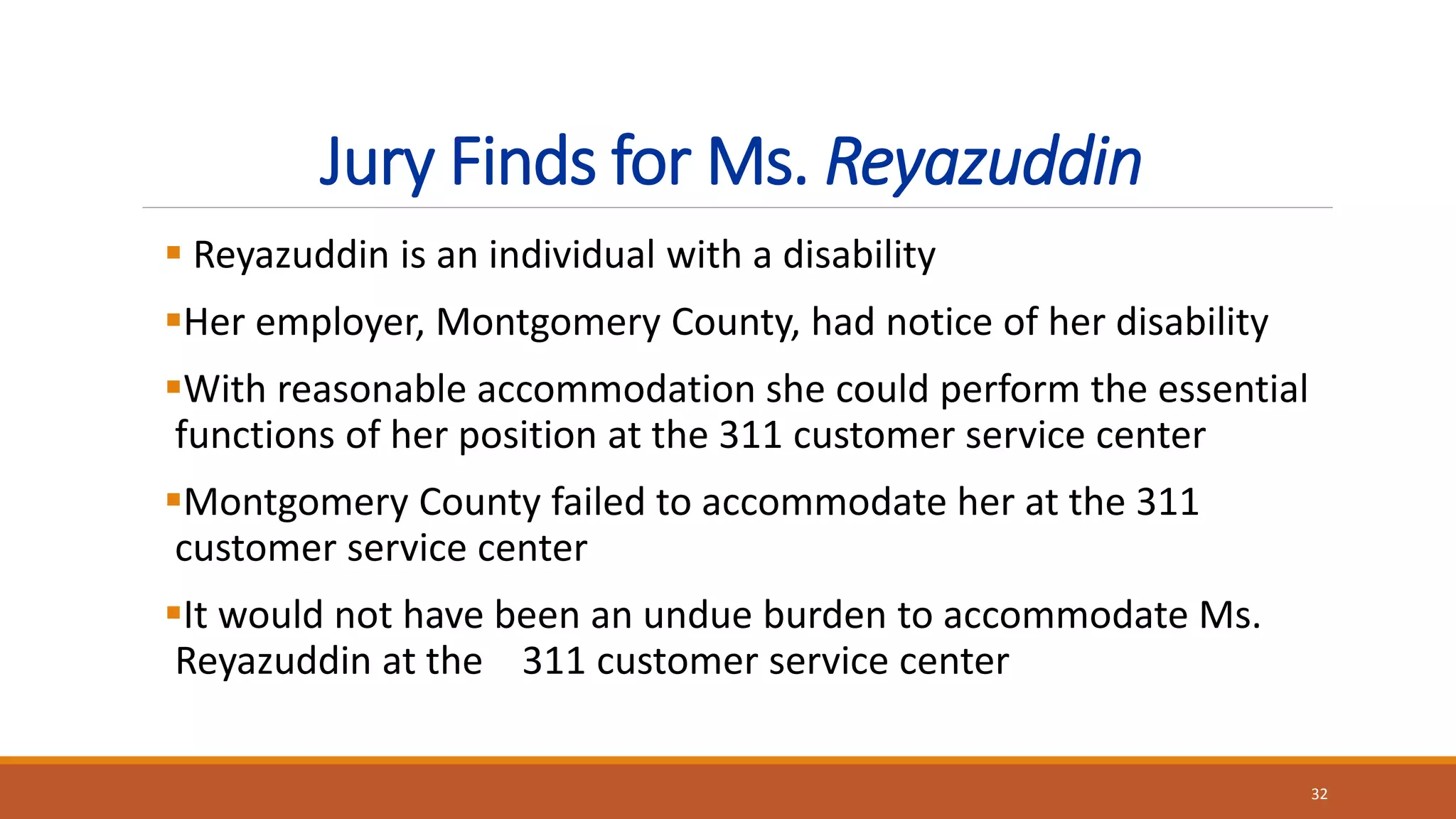
Jury Finds for Ms. Reyazuddin
 Reyazuddin is an individual with a disability
Her employer, Montgomery County, had notice of her disability
With reasonable accommodation she could perform the essential
functions of her position at the 311 customer service center
Montgomery County failed to accommodate her at the 311
customer service center
It would not have been an undue burden to accommodate Ms.
Reyazuddin at the 311 customer service center
32
Digital Access
CAPTIONING
33
DOJ Takes an Comprehensive Position
National Association of the Deaf, et al., v. Harvard University, et
al., US Department of Justice statement of Interest, Civil Action No.
3:15-cv-30023-MGM, D. Mass (June 23, 2015).
http://www.ada.gov/briefs/harvard_soi.pdf
National Association of the Deaf, et al., v. Massachusetts Institute
of Technology, US Department of Justice statement of Interest, Civil
Action No. 3:15-cv-300024-MGM.
http://www.ada.gov/briefs/mit_soi.pdf
34
Claims of the National Association of the Deaf (NAD)
Plaintiffs allege that Harvard and MIT violate the Title III of the
ADA and Section 504 by denying equal access to free online
courses and lectures to individuals who are deaf or hard of
hearing because they fail to provide appropriate auxiliary aids,
benefits and services, including captioning.
As a result, it is alleged that Harvard and MIT are failing to
ensure effective communication and an equal opportunity for
the deaf and hard of hearing [individuals] to benefit from the
online video content.
NAD is Joined by the United States (DOJ)
DOJ filed Statements of Interest in these two matters.
◦ “We [DOJ] can use our broad introductory
regulations that prohibit disability
discrimination to enforce new concepts of
nondiscrimination.”
[See also, Fortyune v. City of Lomita, 766 F.3d
1098 (9th Cir. 2014)]
36
Magistrate Recommends Rejecting
Harvard’s Motion to Dismiss
February 9, 2016
Harvard, in its motion to dismiss, argues that the complaints
should be stayed or dismissed on two grounds:
◦DOJ has not yet issued regulations under the ADA on website
accessibility
◦ ANPRM issued in 2010; final version of Title III regulation now
expected in 2018.
◦Neither the terms of the ADA nor Section 504 of the
Rehabilitation Act require the provision of captions for their
online programming
Analysis of Magistrate: Section 504
Harvard receives Federal financial assistance and is subject to Section 504
Supreme Court precedents, including Southeastern v. Davis and Alexander v. Choate,
make clear that Section 504 requires “meaning access” to the programs of
recipients.
The court declines to draw any inference from the fact that [the introductory 504
regulation] does not explicitly address the responsibilities of federal fund recipients
vis-á-vis website accessibility. Online content may not be specifically mentioned in
the regulation, but neither is it specifically excluded.
ED/DOJ agency guidance through the June 29, 2010 Kindle Letter and subsequent Q
& A guidance, e.g., makes it clear that ED and DOJ believe that on-line programs
should be covered, as does the DOJ statement of interest
Analysis of the Magistrate: Title III
The ADA establishes that it is discriminatory for a public accommodation to fail “to
take such steps as may be necessary to ensure that no individual with a disability is
excluded, denied services, segregated or otherwise treated differently … because of
the absence of auxiliary aids and services, unless ….such steps would fundamentally
alter the … service … or would result in an undue burden.”
The court rejects Harvard’s argument that Plaintiffs’ theory of discrimination would
run afoul of DOJ’s “accessible or special goods” implementing regulation, which
provides that a public accommodation is not required “to alter its inventory to
include accessible … that … facilitate use by individuals with disabilities,” such as
“Brailled versions of books …. [Because] the auxiliary aid requirement functions as
an exception to the …. [inventory] rule. [By] its very definition, an auxiliary aid or
service is an additional and different service that establishments must offer the
disabled.”
Delaying a Ruling, Until Regulations are
Issued is Not Necessary
It is speculative and uncertain that DOJ will ever issue a Title III regulation on this
issue, but ruling on this question is “strongly in the public interest”
The duty is already clear
◦ The general introductory regulations already cover this issue
◦ Justice has had the same interpretation for the past 10 years
◦ DOJ has made itself available to the court for expert guidance in this case
(statement of interest)
What Harvard may ultimately be required to implement will not foreclose DOJ from
issuing regulations
How Harvard will implement its responsibilities to make its websites accessible will
be individual to Harvard as it may argue how the fundamental alteration, undue
burden, affirmative defenses apply to its individual circumstances.
A Personal Observation of
What Appears to be the Expectation
“Just in time” is O.K. for films and videos used in brick and mortar classes
that are likely to be used only once, provided they can be captioned ASAP if
a Deaf/HH student enrolls
“Just in time” is OK for films and videos that are used in closed on line
classes of limited size, where they are likely to be used only once, provided
they can be captioned ASAP if a Deaf/HH student enrolls
Films and videos that will be used in an open on line setting, for fee or free,
must be captioned
Films and videos that will be used repeatedly in any setting must be
captioned
41
Digital Access
ON THE HORIZON
42
What Is a “Public Accommodation”
Subject to Title III of the ADA? (1)
Compare jurisdiction in:
- NFB v. H & R Block – on line services of a brick and mortar company (below)-
court approved settlement
- NFB v. Target -- title III covers on-line services that pertain to in-store
experiences, like on-line pharmacy with in-store pick-up process– court
approved settlement
- NAD v. Netflix – purely on-line presence -- Netflix agreed to 100% closed
captions in Netflix's on–demand streaming content within two years— after
court found a purely on-line service could be a “public accommodation”
43
What is a “Public Accommodation”
Subject to Title III of the ADA? (2)
National Federation of the Blind v. Scribd, Inc., Case No. 2:14-cv-162, 2015
U.S. Dist. LEXIS 34213, 2015 WL 1263336 (D. Vt. Mar. 19, 2015) Motion to
dismiss denied, following Netflix analysis. Settlement discussed below.
Cullen v. Netflix, Inc., 600 Fed. Appx. 508, 2015 U.S. App. LEXIS 5257 (9th Cir.
Cal. 2015); Earll v. Ebay, Inc., 599 Fed. Appx. 695, 2015 U.S. App. LEXIS 5256
(9th Cir. Cal. 2015). Companion cases that follow NFB v. Target analysis
National Federation of the Blind of California, Kelly, Hingson, and Pederson v.
Uber Technologies, Inc., Case No. 14-cv-04086 NC, N.D. Cal (2015) District
court avoids NFB v. Target analysis by classifying Uber as a “travel service” an
enumerated “public accommodation”
44
National Federation of the Blind v. Scribd, Inc. (1)
Case No. 2:14-cv-162, 2015 U.S. Dist. LEXIS 34213, 2015 WL 1263336 (D. Vt. Mar. 19,
2015)
Worth reading for its comprehensive overview of the question of whether an entity that
conducts business only by the Internet is a “public accommodation” subject to the anti-
discrimination protections of Title III of the ADA
Scribd
◦ A California-based digital library that operates reading subscription services on its
website and on apps for mobile phones and tablets.
◦ Scribd's customers pay a monthly fee to gain access to its collection of over forty million
titles, including e-books, academic papers, legal filings, and other user-uploaded digital
documents.
◦ NFB alleged that because its websites are picture-based, they are not accessible to the
adaptive technologies commonly used by visually impaired individuals.
45
National Federation of the Blind v. Scribd, Inc.(2)
The court denied Scribd’s motion to dismiss. Quoting from the Netflix
decision of Judge Ponser, the court held that:
“The Internet is central to every aspect of the ‘economic and social
mainstream of American life.’ In such a society, ‘excluding businesses
that sell services through the Internet from the ADA would 'run afoul of
the purposes of the ADA and would severely frustrate Congress's intent
that individuals with disabilities fully enjoy the goods, services,
privileges, and advantages available indiscriminately to other members
of the general public.’”
46
Questions and Answers
paulgrossman@comcast.net
47
448
Paul Grossman, J.D.
Adj. Prof. of Disability Law,
Hastings Col. of Law, U.C.
Chief Regional Attorney, US
ED, OCR, SF, retired
paulgrossman@comcast.net
Lily Bond
Director of Marketing
3Play Media
lily@3playmedia.com
617-764-5189 x119
Participate in a National Study on Closed
Captioning
 Take Part in a National Study of Closed Captioning in
Higher Education
 Student Survey
 Institutional Survey
Find out more at:
http://oregonstate.qualtrics.com/jfe/form/
SV_4MUaroFCSopphMV
Q&A
Please type your questions into the window in your control panel. A recording of this webinar will be available for replay.

The Legal Year in Review: Digital Access Cases

  • 1.
    Legal Year inReview: Digital Access Cases Lily Bond (Moderator) Director of Marketing, 3Play Media lily@3playmedia.com www.3playmedia.com twitter: @3playmedia  Type questions in the control panel during the presentation  This presentation is being recorded and will be available for replay  To view live captions, please follow the link in the chat window Paul Grossman Adj. Prof. of Disability Law, Hastings Col. of Law, U.C. Chief Regional Attorney, US ED, OCR, SF, retired paulgrossman@comcast.net
  • 2.
    The Legal Yearin Review: Digital Access Cases Paul D. Grossman is one of the nation's leading experts in disability rights law, particularly with regard to students in post-secondary education. For over 40 years, Paul served as a civil rights attorney for the US Department of Education, Office for Civil Rights (OCR); 30 years as its Chief Regional Attorney in San Francisco. Paul worked in OCR Headquarters at the time of the writing of the first disability anti-discrimination regulations and in San Francisco, witnessing the historic “504 sit-in” at United Nations Plaza Over his career, Paul investigated, wrote decisions, and settled hundreds of disability discrimination cases, in many instances developing new approaches to protecting students with disabilities including with a regard to accessible media for post-secondary students with visual and auditory impairments. Recently retired from OCR, Paul continues to teach as an Adjunct Professor of Disability Law at Hasting College of Law, University of California. Along with Distinguished Professor Ruth Colker, Paul publishes a disability law textbook, teachers’ manual and legislative guide as well as a disability law textbook for higher education professionals. Paul is a member of the Board of Directors for the Association on Higher Education and Disability (AHEAD), the Public Policy Committee of the Association for Children and Adults with AD/HD (CHADD), and the Disability Rights Advocates (DRA), expert advisory panel. 2
  • 3.
    Most Pertinent Publication Colkerand Grossman, The Law of Disability Discrimination For Higher Education Professionals, Lexis-Nexis (2014 ) ◦Lexisnexis.com ◦Hardcopy and e-book ◦http://www.lexisnexis.com/store/catalog/booktemplate/p roductdetail.jsp?pageName=relatedProducts&prodId=pro d20900324 ◦Updated annually for free to purchasers PAUL GROSSMAN/NASPA FOUNDATION 3
  • 4.
    Caveat The information setforth in this presentation and accompanying documents is presented for informational purposes only and should not be construed as legal advice. 4
  • 5.
    DIGITAL ACCESS OVER 48MILLION AMERICANS ARE DEAF OR HARD OF HEARING OVER 7 MILLION AMERICANS ARE BLIND OR HAVE LOW VISION 5
  • 6.
    Digital Access PresentationAgenda Roots Deliberate Indifference ◦ Dudley v. Miami University Key Compliance Review ◦ OCR Letter to University of Cincinnati ◦ DOJ and edX settlement Scope of Duty to Accommodate EIT Workers and Calculating Undue Burden ◦ Reyazuddin v. Montgomery County, Maryland Captioning ◦ National Association of the Deaf (NAD) v. Harvard and MIT On the Horizon ◦ National Federation of the Blind (NFB) v. Scribd 6
  • 7.
    Roots Section 504: Recipientsof FFA General nondiscrimination provision including disparate impact, indirect prohibitions, requires auxiliary aids as necessary to participate in programs or activities, and the Kindle Letter for higher education entities Limitation of fundamental alteration and undue burden Title II of the ADA: Public Entities Much the same as 504, plus equal communication provision, accessible EIT provision and the Kindle Letter Same limitations Title III: Public Accommodations Auxiliary aids when necessary to achieve full enjoyment of goods and service More limitations including that a public accommodation is not required “to alter its inventory to include accessible or special goods that are designed for, or facilitate use by, individuals with disabilities,” such as “Brailled versions of books ….” But what is a public accommodation?  Not something that is conveyed by EIT  Sort of  Yes  Waiting for the regulations 7
  • 8.
  • 9.
    Dudley v. MiamiUniversity Background Settlement is pending!  Complaint filed by NFB in S.D. Ohio 2014 under Title II of the ADA. See https://nfb.org/ images/nfb/documents/pdf/miami%20teach.pdf. Motion for intervention by DOJ filed May 25, 2014, http://www.ada.gov/ miami_university/motion_intervene.pdf Complaint concerned a blind student pursuing a degree in zoology for the objective of attending veterinary school at Miami University. NFB alleges “deliberate indifference” is demonstrated by the fact that the University could have purchased accessible programs but failed to do so – not even taking the question into account 9
  • 10.
    US Moves toIntervene (1) On April 7, 2014, the United States initiated an investigation On April 23, 2014, the Federal District Court, tolled the proceedings, On June 25, 2014 DOJ advised the parties that it had found violations of Title II of the ADA at Miami University. Among the violations found: ◦ Miami used technologies that are inaccessible to individuals with disabilities, including those with learning, hearing, and vision disabilities 10
  • 11.
    US Moves toIntervene(2) “Miami University’s failure to make its digital- and web-based technologies accessible to individuals with disabilities, or to otherwise take appropriate steps to ensure effective communication with such individuals, places them at a great disadvantage, depriving them of equal access to Miami University’s educational content and services. The denial of educational opportunities is precisely the type of discrimination that Congress sought to end ….” Stay tuned! 11
  • 12.
    Digital Access KEY OCRAND DOJ COMPLIANCE REVIEWS 12
  • 13.
    Letter to Universityof Cincinnati The best letter to share with a CIO, procurement officer, or campus Chancellor OCR compliance review #15-13-6001 (December 2014) Partial findings and partial settlement short of findings Along with Letter to Youngstown State (compliance review # 15-13- 6002) does a good job of laying out: ◦ legal standards; ◦ applying standards to concrete examples; and, ◦ providing a narrative with insights on how persons who use adaptive technology are challenged by EIT 13
  • 14.
    Major EIT Components Generalwebsite (face to the world) ◦ Admissions ◦ Academic program descriptions ◦ Athletics ◦ Library services ◦ Health services ◦ Faculty and student directory ◦ Research tools and resources Blackboard Distance learning 14
  • 15.
    Summary of ReviewFindings (1) Inadequate tools for implementing accessible web-sites ◦ Web access policies were posted on-line but no notice to faculty that they exist and where they may be found ◦ No training for staff responsible for seeing to it that web sites are accessible ◦ No training to ensure all staff and faculty comply ◦ Particularly problematic as web postings are decentralized ◦ Few web pages are submitted for review in advance 15
  • 16.
    Summary of Review(2) Blackboard ◦No policy, practices or protocols for making content accessible Distance learning ◦ No training for faculty or staff on making content or format accessible 16
  • 17.
    Summary of Review(3) Webaccessibility ◦ Even priority web pages are not accessible to persons who rely upon adaptive technology ◦ Entry page ◦ Pages that garner the most traffic such as ◦ Admissions ◦ Curriculum requirements ◦ Student handbook ◦ Code of conduct ◦ Student services ◦ Extra-curricular activities ◦ University only addresses compatibility by responding to complaints [just-in-time, ad hoc, patching] 17
  • 18.
    Summary of RemedialAgreement (1) 1) Develop for OCR review a policy to ensure that information provided through University websites, on-line or e-learning systems, course management systems or EIT are accessible to students, prospective students, employees, guests, and visitors with visual, hearing, and manual impairments ◦ Identify standards ◦ Create a plan for implementing the standards and remediating the violations ◦ Identify and empower an individual to coordinate and implement the standards: “EIT Accessibility Coordinator” ◦ Create a complaint system and inform students, faculty, guest and visitors how to file a complaint 18
  • 19.
    Summary of RemedialAgreement(2) 2) Develop and implement a plan for accessibility audits by the access coordinator with audit accounting 3) Develop and implement a plan for acquisition and contracting that ensure purchases are accessible 4) Annual training on EIT access for faculty, staff, administrators, support staff, and student employees and a qualified individual available to assist them on complying with technical standards 19
  • 20.
    Summary of RemedialAgreement (3) Reporting/monitoring ◦OCR reviews, edits, approves draft policies ◦OCR gets monitoring reports, every quarter through 2018 ◦Reports by the plan’s EIT Access Coordinator or a qualified independent contractor 20
  • 21.
    Settlement between DOJand edX (1) http://www.ada.gov/edx_sa.htm Litigation not filed Background ◦ edX has approximately 60 university and institutional members ◦ edX is their MOOC platform ◦ Provide over 450 courses to over 3,000,000 learners. ◦ The courses are offered largely for free ◦ Subject matters as varied as business, computer sciences, hard sciences, food and nutrition and social sciences. 21
  • 22.
    DOJ edX Settlement(2) Ofnote is the deference paid in this agreement to the Web Content Accessibility Guidelines (WCAG) 2.0 AA. The agreement specifically requires edX to make significant modifications to its website, platform and mobile applications to conform to these guidelines. 22
  • 23.
    DOJ edX Settlement(3) The four-year agreement requires edX to: ◦make the edX website, its mobile applications, and learning management system software, through which online courses are offered, fully accessible within 18 months; ◦ensure that its content management system is fully accessible and supports authoring and publishing of accessible content within an additional 18 months; ◦provide guidance to course creators at its member universities and other institutions on best practices for making online courses fully accessible; 23
  • 24.
    DOJ edX Settlement(4) Qualitycontrol ◦appoint a Web Accessibility Coordinator; ◦adopt a Web Accessibility Policy; ◦solicit feedback from learners on the accessibility of the courses; ◦conduct Web Accessibility Training for employees responsible for the website, platform, and mobile applications; and ◦retain a consultant to evaluate conformance of the website, platform, and mobile applications 24
  • 25.
    Digital Access SCOPE OFDUTY TO ACCOMMODATE EIT WORKERS AND CALCULATING UNDUE BURDEN 25
  • 26.
    Reyazuddin v. MontgomeryCounty, Maryland: Facts No. 14-1299, 4th Cir. (June 15, 2015). As part of an $80 million upgrade, the County opened a new, consolidated, 311 call center (“customer service center”) using new software that was not accessible to persons with vision impairments Ms. Yasmin Reyazuddin, who is blind, worked successfully for Montgomery County as a 311 operator prior to the workplace consolidation The County concluded that she was no longer qualified to perform the essential functions of her position and did not transfer her or hire her into a position at the consolidated call center. County retained her salary level and reassigned her to other public contact positions, which she claimed were “make work,” part-time positions. She alleged disability discrimination in employment under Section 504 of the Rehabilitation Act and Title II of the ADA 26
  • 27.
    Software The new systemcould be operated in two “modes” ◦ One was accessible, one of which was not, at least not without a significant work-around ◦ The County’s software license allows it to run the software in either mode. The County however, chose to run only the inaccessible (“high-interactivity”) version. ◦ The high-interactivity version has some useful but not necessarily essential functions --- some related to safety: ◦ Scripts to read to callers ◦ A “solutions button” with a “short, concise paragraph about how the [C]ounty handles” the caller’s particular concern and instructions for employees on how to handle the call ◦ A field for notetaking ◦ A “service request template” with fields that automatically populate ◦ A function for transferring calls to 911 27
  • 28.
    District Court Decision Summaryjudgement for the County Pl. was not qualified to perform the essential functions of a 311 operator at the new call center because that the accommodations she proposed were not reasonable as the County had demonstrated that they would entail an undue burden Moreover the County’s reassignment of the Plaintiff had satisfied its reasonable accommodation duties under Section 504 28
  • 29.
    Fourth Circuit Decision TheFourth Circuit reversed the District Court finding that several issues remained in genuine dispute for a jury to resolve: ◦1) whether Ms. Reyazuddin could perform the essential job functions of a call center employee; ◦(2) whether the County reasonably accommodated her; and ◦(3), if the County had not, whether its failure to do so may be excused because the County had proven that her requested accommodations would impose an undue burden on the County. 29
  • 30.
    Undue Burden (1) TheAppellate Court concluded that the District Court had made several errors in its determination of undue burden ◦ The District Court found relevant that the County had only budgeted $15,500 for accommodations. “Taken to its logical extreme, the employer could budget $0 for reasonable accommodation and thereby avoid liability. The County’s overall budget ($3.73 billion in fiscal year 2010) and the [new system] operating budget (about $4 million) are relevant factors. [Citation omitted.] But the County’s line-item budget for reasonable accommodations is not.” 30
  • 31.
    Undue Burden (2) TheAppellate Court further faulted the District Court for not giving nearly enough weight to: ◦ The fact that four other cities in the U.S., using the same software, are accessible to individuals who are blind by operating in both modes and by providing other modifications. ◦ The savings gained by the new 311 system and the availability of in-house computer personnel to address accessibility challenges also should be included in the consideration of undue burden. ◦ The hugely different estimates as to the effect or cost of running a 311 system using both modes and making the highly interactive mode partially or fully accessible --- differences that could only be resolved through further proceedings. 31
  • 32.
    Jury Finds forMs. Reyazuddin  Reyazuddin is an individual with a disability Her employer, Montgomery County, had notice of her disability With reasonable accommodation she could perform the essential functions of her position at the 311 customer service center Montgomery County failed to accommodate her at the 311 customer service center It would not have been an undue burden to accommodate Ms. Reyazuddin at the 311 customer service center 32
  • 33.
  • 34.
    DOJ Takes anComprehensive Position National Association of the Deaf, et al., v. Harvard University, et al., US Department of Justice statement of Interest, Civil Action No. 3:15-cv-30023-MGM, D. Mass (June 23, 2015). http://www.ada.gov/briefs/harvard_soi.pdf National Association of the Deaf, et al., v. Massachusetts Institute of Technology, US Department of Justice statement of Interest, Civil Action No. 3:15-cv-300024-MGM. http://www.ada.gov/briefs/mit_soi.pdf 34
  • 35.
    Claims of theNational Association of the Deaf (NAD) Plaintiffs allege that Harvard and MIT violate the Title III of the ADA and Section 504 by denying equal access to free online courses and lectures to individuals who are deaf or hard of hearing because they fail to provide appropriate auxiliary aids, benefits and services, including captioning. As a result, it is alleged that Harvard and MIT are failing to ensure effective communication and an equal opportunity for the deaf and hard of hearing [individuals] to benefit from the online video content.
  • 36.
    NAD is Joinedby the United States (DOJ) DOJ filed Statements of Interest in these two matters. ◦ “We [DOJ] can use our broad introductory regulations that prohibit disability discrimination to enforce new concepts of nondiscrimination.” [See also, Fortyune v. City of Lomita, 766 F.3d 1098 (9th Cir. 2014)] 36
  • 37.
    Magistrate Recommends Rejecting Harvard’sMotion to Dismiss February 9, 2016 Harvard, in its motion to dismiss, argues that the complaints should be stayed or dismissed on two grounds: ◦DOJ has not yet issued regulations under the ADA on website accessibility ◦ ANPRM issued in 2010; final version of Title III regulation now expected in 2018. ◦Neither the terms of the ADA nor Section 504 of the Rehabilitation Act require the provision of captions for their online programming
  • 38.
    Analysis of Magistrate:Section 504 Harvard receives Federal financial assistance and is subject to Section 504 Supreme Court precedents, including Southeastern v. Davis and Alexander v. Choate, make clear that Section 504 requires “meaning access” to the programs of recipients. The court declines to draw any inference from the fact that [the introductory 504 regulation] does not explicitly address the responsibilities of federal fund recipients vis-á-vis website accessibility. Online content may not be specifically mentioned in the regulation, but neither is it specifically excluded. ED/DOJ agency guidance through the June 29, 2010 Kindle Letter and subsequent Q & A guidance, e.g., makes it clear that ED and DOJ believe that on-line programs should be covered, as does the DOJ statement of interest
  • 39.
    Analysis of theMagistrate: Title III The ADA establishes that it is discriminatory for a public accommodation to fail “to take such steps as may be necessary to ensure that no individual with a disability is excluded, denied services, segregated or otherwise treated differently … because of the absence of auxiliary aids and services, unless ….such steps would fundamentally alter the … service … or would result in an undue burden.” The court rejects Harvard’s argument that Plaintiffs’ theory of discrimination would run afoul of DOJ’s “accessible or special goods” implementing regulation, which provides that a public accommodation is not required “to alter its inventory to include accessible … that … facilitate use by individuals with disabilities,” such as “Brailled versions of books …. [Because] the auxiliary aid requirement functions as an exception to the …. [inventory] rule. [By] its very definition, an auxiliary aid or service is an additional and different service that establishments must offer the disabled.”
  • 40.
    Delaying a Ruling,Until Regulations are Issued is Not Necessary It is speculative and uncertain that DOJ will ever issue a Title III regulation on this issue, but ruling on this question is “strongly in the public interest” The duty is already clear ◦ The general introductory regulations already cover this issue ◦ Justice has had the same interpretation for the past 10 years ◦ DOJ has made itself available to the court for expert guidance in this case (statement of interest) What Harvard may ultimately be required to implement will not foreclose DOJ from issuing regulations How Harvard will implement its responsibilities to make its websites accessible will be individual to Harvard as it may argue how the fundamental alteration, undue burden, affirmative defenses apply to its individual circumstances.
  • 41.
    A Personal Observationof What Appears to be the Expectation “Just in time” is O.K. for films and videos used in brick and mortar classes that are likely to be used only once, provided they can be captioned ASAP if a Deaf/HH student enrolls “Just in time” is OK for films and videos that are used in closed on line classes of limited size, where they are likely to be used only once, provided they can be captioned ASAP if a Deaf/HH student enrolls Films and videos that will be used in an open on line setting, for fee or free, must be captioned Films and videos that will be used repeatedly in any setting must be captioned 41
  • 42.
  • 43.
    What Is a“Public Accommodation” Subject to Title III of the ADA? (1) Compare jurisdiction in: - NFB v. H & R Block – on line services of a brick and mortar company (below)- court approved settlement - NFB v. Target -- title III covers on-line services that pertain to in-store experiences, like on-line pharmacy with in-store pick-up process– court approved settlement - NAD v. Netflix – purely on-line presence -- Netflix agreed to 100% closed captions in Netflix's on–demand streaming content within two years— after court found a purely on-line service could be a “public accommodation” 43
  • 44.
    What is a“Public Accommodation” Subject to Title III of the ADA? (2) National Federation of the Blind v. Scribd, Inc., Case No. 2:14-cv-162, 2015 U.S. Dist. LEXIS 34213, 2015 WL 1263336 (D. Vt. Mar. 19, 2015) Motion to dismiss denied, following Netflix analysis. Settlement discussed below. Cullen v. Netflix, Inc., 600 Fed. Appx. 508, 2015 U.S. App. LEXIS 5257 (9th Cir. Cal. 2015); Earll v. Ebay, Inc., 599 Fed. Appx. 695, 2015 U.S. App. LEXIS 5256 (9th Cir. Cal. 2015). Companion cases that follow NFB v. Target analysis National Federation of the Blind of California, Kelly, Hingson, and Pederson v. Uber Technologies, Inc., Case No. 14-cv-04086 NC, N.D. Cal (2015) District court avoids NFB v. Target analysis by classifying Uber as a “travel service” an enumerated “public accommodation” 44
  • 45.
    National Federation ofthe Blind v. Scribd, Inc. (1) Case No. 2:14-cv-162, 2015 U.S. Dist. LEXIS 34213, 2015 WL 1263336 (D. Vt. Mar. 19, 2015) Worth reading for its comprehensive overview of the question of whether an entity that conducts business only by the Internet is a “public accommodation” subject to the anti- discrimination protections of Title III of the ADA Scribd ◦ A California-based digital library that operates reading subscription services on its website and on apps for mobile phones and tablets. ◦ Scribd's customers pay a monthly fee to gain access to its collection of over forty million titles, including e-books, academic papers, legal filings, and other user-uploaded digital documents. ◦ NFB alleged that because its websites are picture-based, they are not accessible to the adaptive technologies commonly used by visually impaired individuals. 45
  • 46.
    National Federation ofthe Blind v. Scribd, Inc.(2) The court denied Scribd’s motion to dismiss. Quoting from the Netflix decision of Judge Ponser, the court held that: “The Internet is central to every aspect of the ‘economic and social mainstream of American life.’ In such a society, ‘excluding businesses that sell services through the Internet from the ADA would 'run afoul of the purposes of the ADA and would severely frustrate Congress's intent that individuals with disabilities fully enjoy the goods, services, privileges, and advantages available indiscriminately to other members of the general public.’” 46
  • 47.
  • 48.
    448 Paul Grossman, J.D. Adj.Prof. of Disability Law, Hastings Col. of Law, U.C. Chief Regional Attorney, US ED, OCR, SF, retired paulgrossman@comcast.net Lily Bond Director of Marketing 3Play Media lily@3playmedia.com 617-764-5189 x119 Participate in a National Study on Closed Captioning  Take Part in a National Study of Closed Captioning in Higher Education  Student Survey  Institutional Survey Find out more at: http://oregonstate.qualtrics.com/jfe/form/ SV_4MUaroFCSopphMV Q&A Please type your questions into the window in your control panel. A recording of this webinar will be available for replay.