Accessibility Compliance:
One State, Two Approaches
Stephanie J. Adams Tennessee Tech University
Jennifer Mezick Pellissippi State Community College
Corey Halaychik The University of Tennessee, Knoxville
Overview
 Accessibility defined
 Types of disabilities and accessible design features
 Laws and lawsuits
 Task Force formation
 Tennessee Board of Regents (TBR) Libraries Accessibility Task
Force activities and plans
 Accessibility documentation standards
 University of Tennessee System process, results, and plans
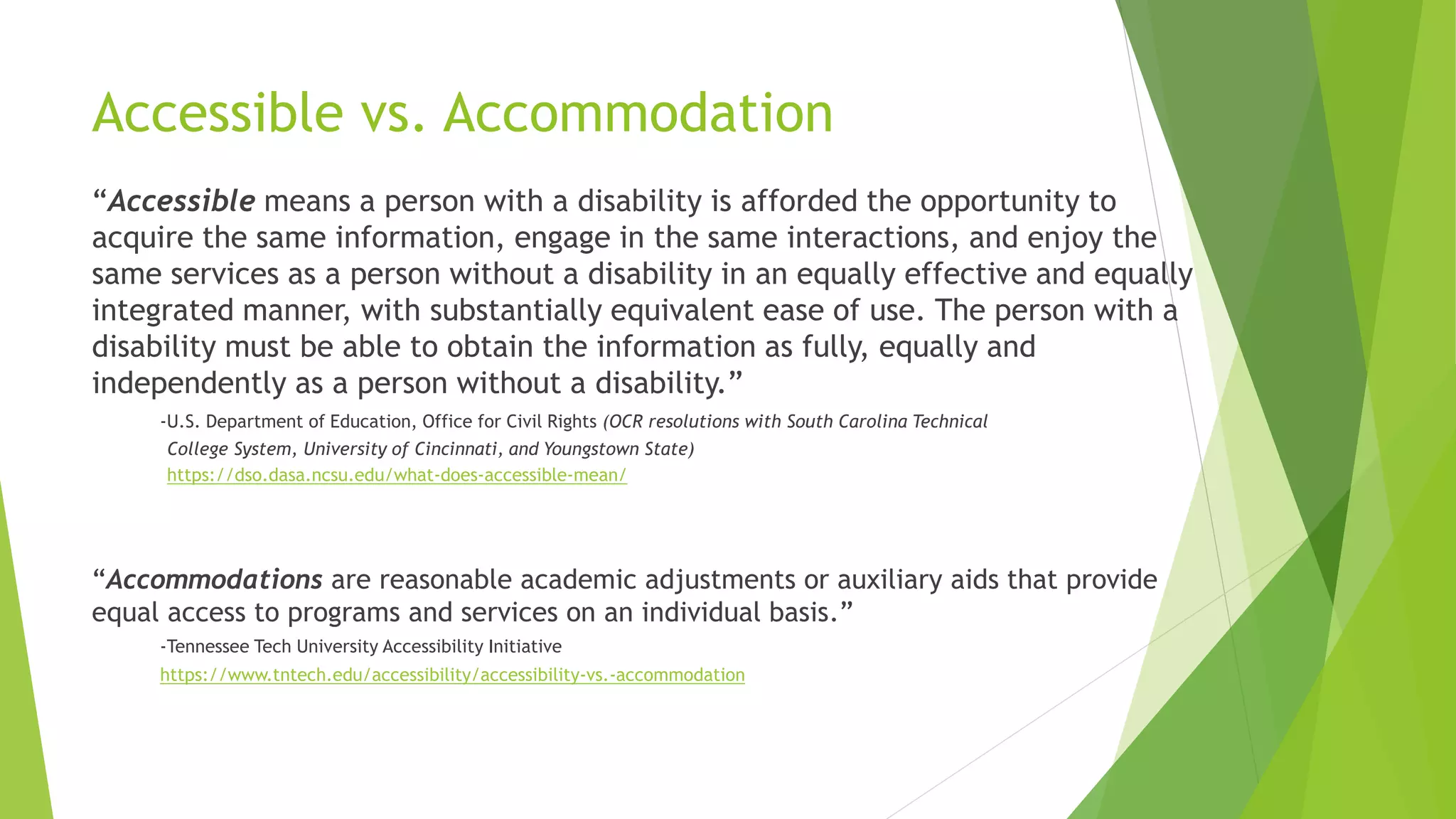
Accessible vs. Accommodation
“Accessible means a person with a disability is afforded the opportunity to
acquire the same information, engage in the same interactions, and enjoy the
same services as a person without a disability in an equally effective and equally
integrated manner, with substantially equivalent ease of use. The person with a
disability must be able to obtain the information as fully, equally and
independently as a person without a disability.”
-U.S. Department of Education, Office for Civil Rights (OCR resolutions with South Carolina Technical
College System, University of Cincinnati, and Youngstown State)
https://dso.dasa.ncsu.edu/what-does-accessible-mean/
“Accommodations are reasonable academic adjustments or auxiliary aids that provide
equal access to programs and services on an individual basis.”
-Tennessee Tech University Accessibility Initiative
https://www.tntech.edu/accessibility/accessibility-vs.-accommodation
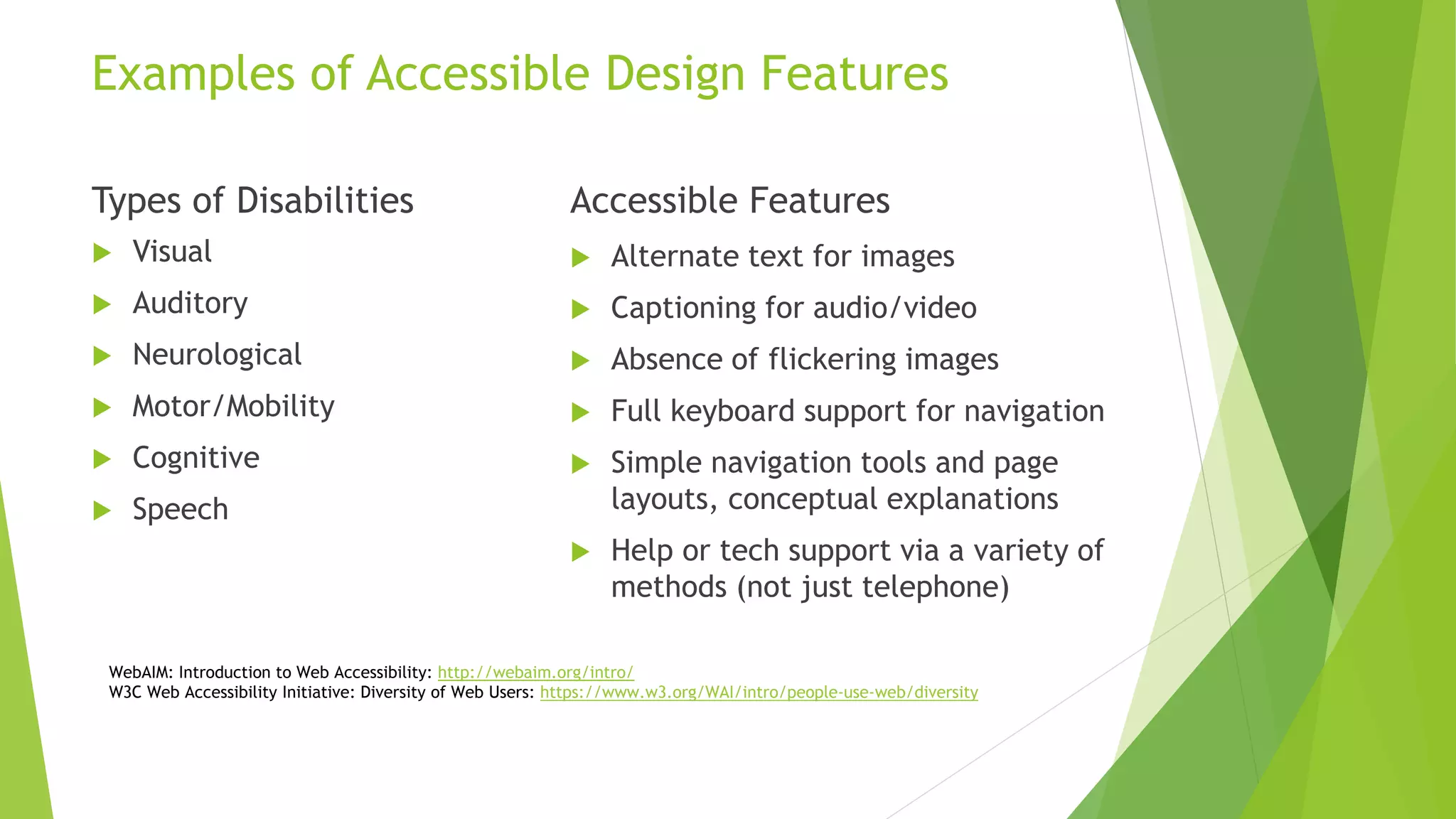
Examples of Accessible Design Features
Types of Disabilities
 Visual
 Auditory
 Neurological
 Motor/Mobility
 Cognitive
 Speech
Accessible Features
 Alternate text for images
 Captioning for audio/video
 Absence of flickering images
 Full keyboard support for navigation
 Simple navigation tools and page
layouts, conceptual explanations
 Help or tech support via a variety of
methods (not just telephone)
WebAIM: Introduction to Web Accessibility: http://webaim.org/intro/
W3C Web Accessibility Initiative: Diversity of Web Users: https://www.w3.org/WAI/intro/people-use-web/diversity
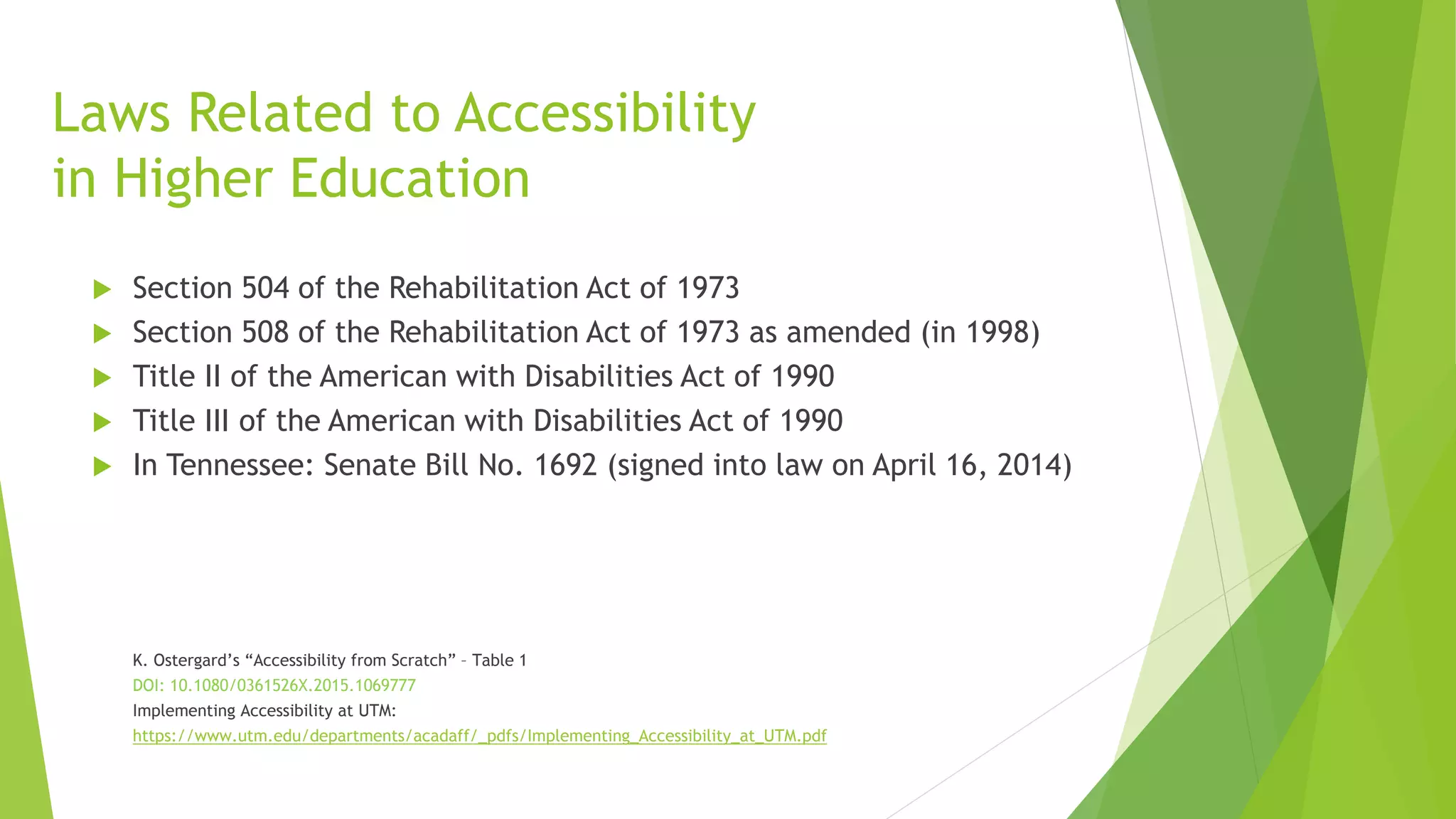
Laws Related to Accessibility
in Higher Education
 Section 504 of the Rehabilitation Act of 1973
 Section 508 of the Rehabilitation Act of 1973 as amended (in 1998)
 Title II of the American with Disabilities Act of 1990
 Title III of the American with Disabilities Act of 1990
 In Tennessee: Senate Bill No. 1692 (signed into law on April 16, 2014)
K. Ostergard’s “Accessibility from Scratch” – Table 1
DOI: 10.1080/0361526X.2015.1069777
Implementing Accessibility at UTM:
https://www.utm.edu/departments/acadaff/_pdfs/Implementing_Accessibility_at_UTM.pdf
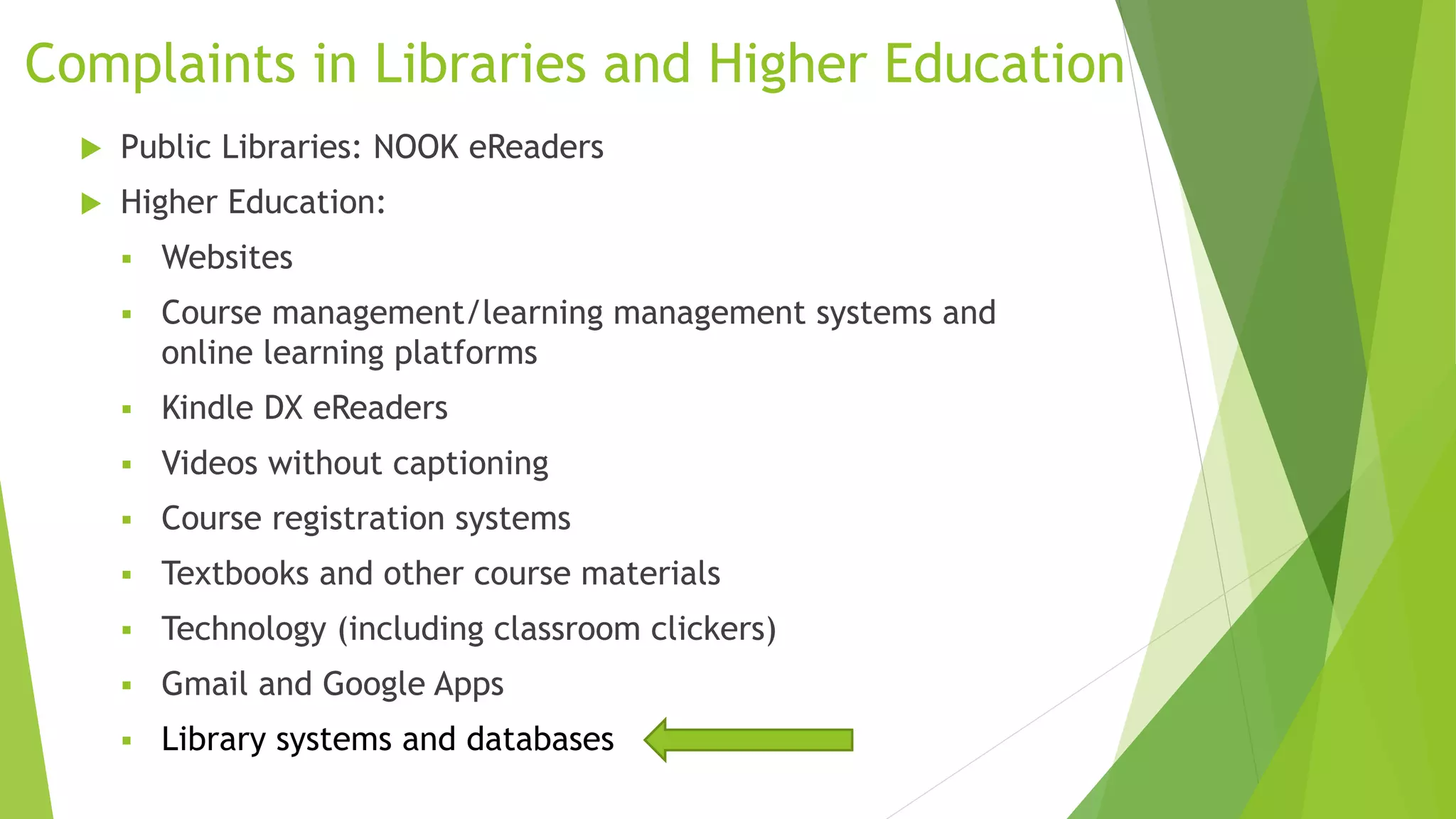
Complaints in Libraries and Higher Education
 Public Libraries: NOOK eReaders
 Higher Education:
 Websites
 Course management/learning management systems and
online learning platforms
 Kindle DX eReaders
 Videos without captioning
 Course registration systems
 Textbooks and other course materials
 Technology (including classroom clickers)
 Gmail and Google Apps
 Library systems and databases
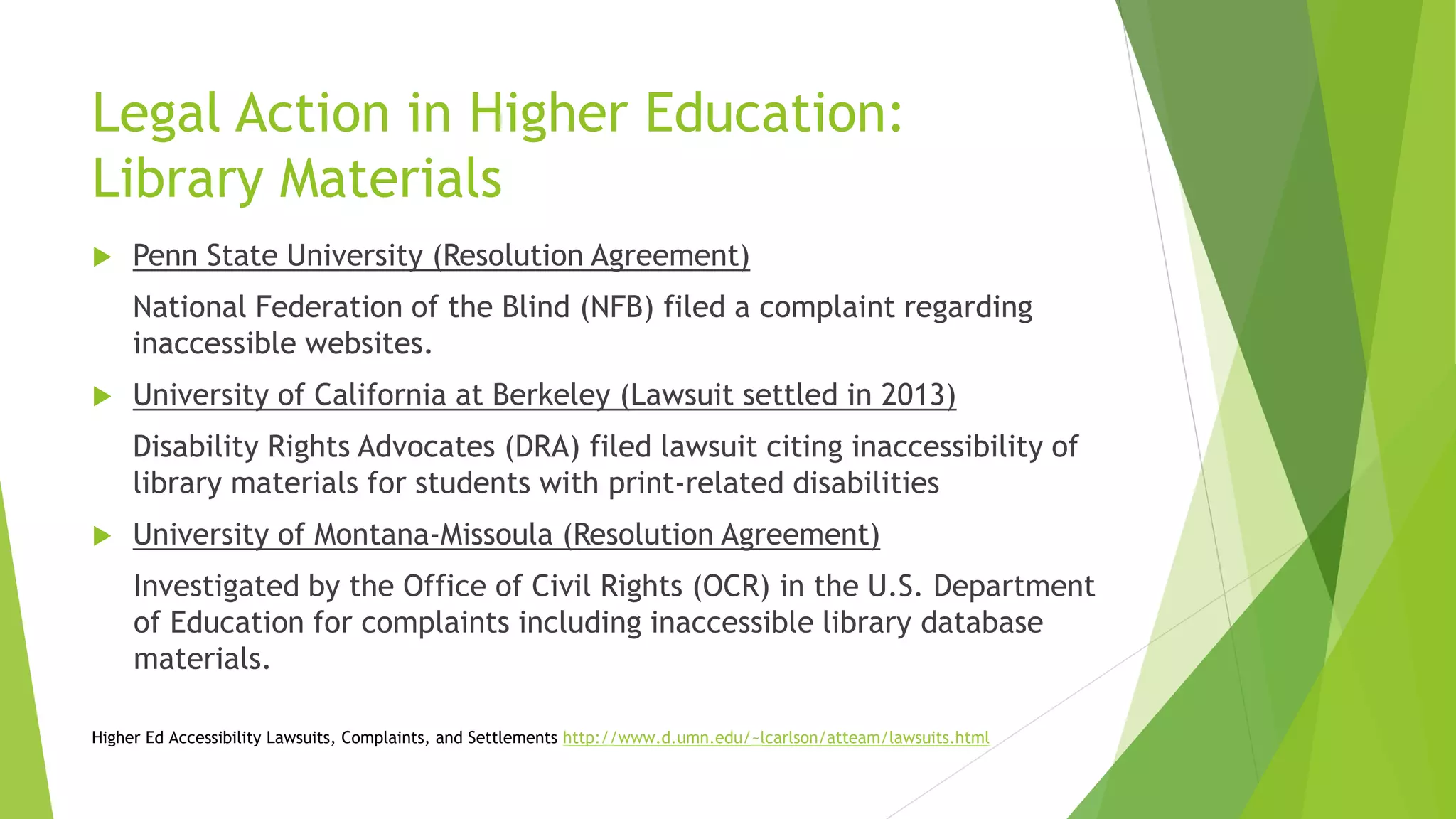
Legal Action in Higher Education:
Library Materials
 Penn State University (Resolution Agreement)
National Federation of the Blind (NFB) filed a complaint regarding
inaccessible websites.
 University of California at Berkeley (Lawsuit settled in 2013)
Disability Rights Advocates (DRA) filed lawsuit citing inaccessibility of
library materials for students with print-related disabilities
 University of Montana-Missoula (Resolution Agreement)
Investigated by the Office of Civil Rights (OCR) in the U.S. Department
of Education for complaints including inaccessible library database
materials.
Higher Ed Accessibility Lawsuits, Complaints, and Settlements http://www.d.umn.edu/~lcarlson/atteam/lawsuits.html
Tennessee Board of Regents System:
Who We Are
 One of two systems of Tennessee public higher education
 Largest system of higher education in Tennessee
 13 Community Colleges
 27 Colleges of Applied Technology
 TN eCampus (46 partner institutions, 500+ certificates and degrees)
 Serves 100,000+ students
 6 Universities
 Serve 88,000 students (75,000 undergraduate & 13,000 graduate
and professional students)
https://www.tbr.edu/
Tennessee Board of Regents Libraries
Accessibility Task Force
 Tennessee Higher Education Commission (THEC) Accessibility Task
Force charged TBR and UT with creating policies for accessible IMT
(information materials and technologies)
 TBR Accessibility Task Force formed in Spring 2015
 TBR Libraries Accessibility Task Force formed in Spring 2016
 Members: interested library staff from any of the TBR and UT schools
 Purpose: deliver a plan for an accessibility audit of library resources
TBR Libraries Accessibility Task Force:
Initial Goals
 Initial audit of library instructional materials and technology (IMT)
 Challenges
• Selecting tools/developing audit rubric (WAVE, WebAIM
checklist)
• Interpreting results
• Recruiting end-user testers
 Develop a collaborative process for procurement of AIMT (Accessible
IMT)
 Master list of eResources (divide and conquer approach)
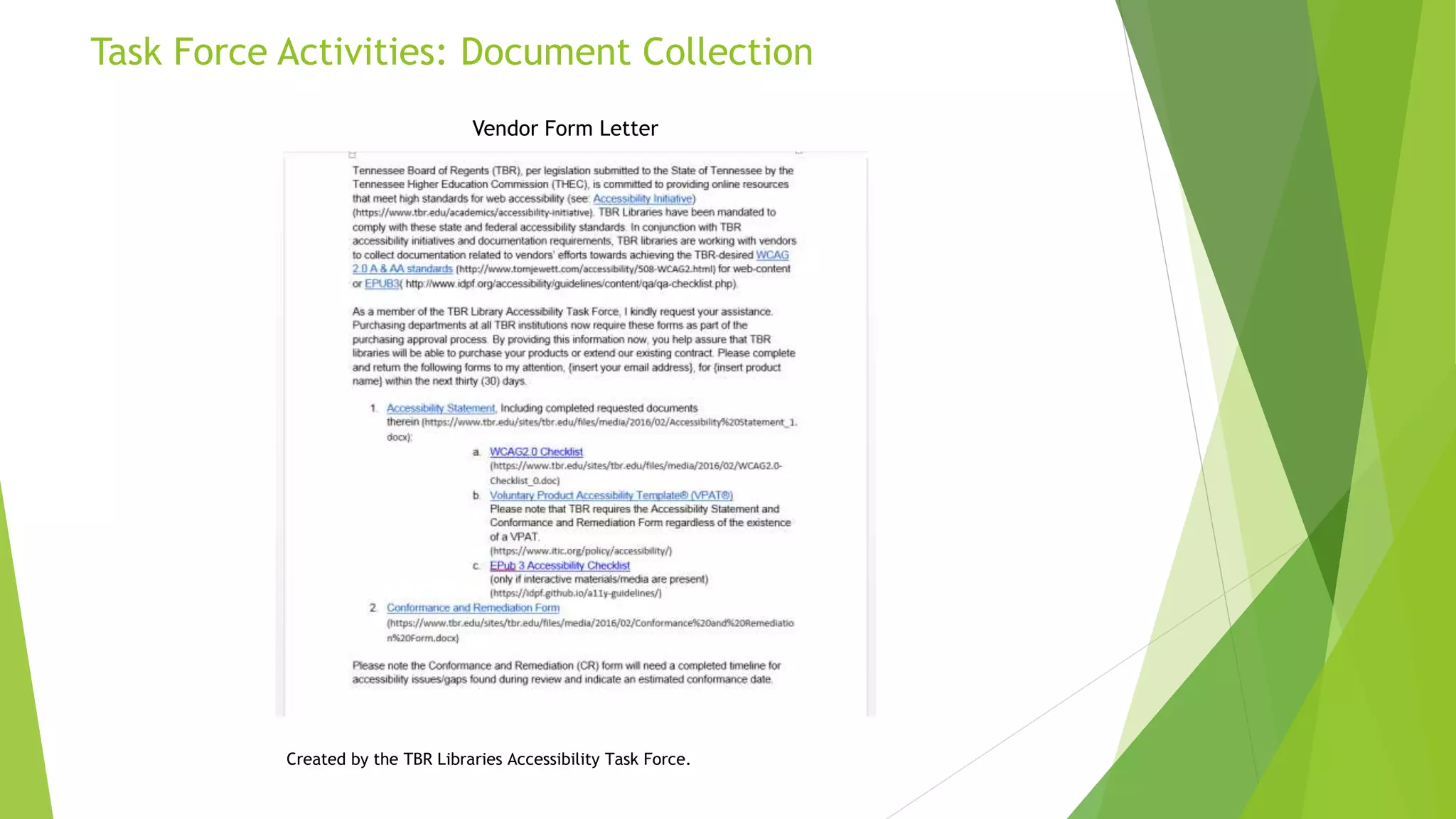
 Vendor form letter
 Accessibility document roundup
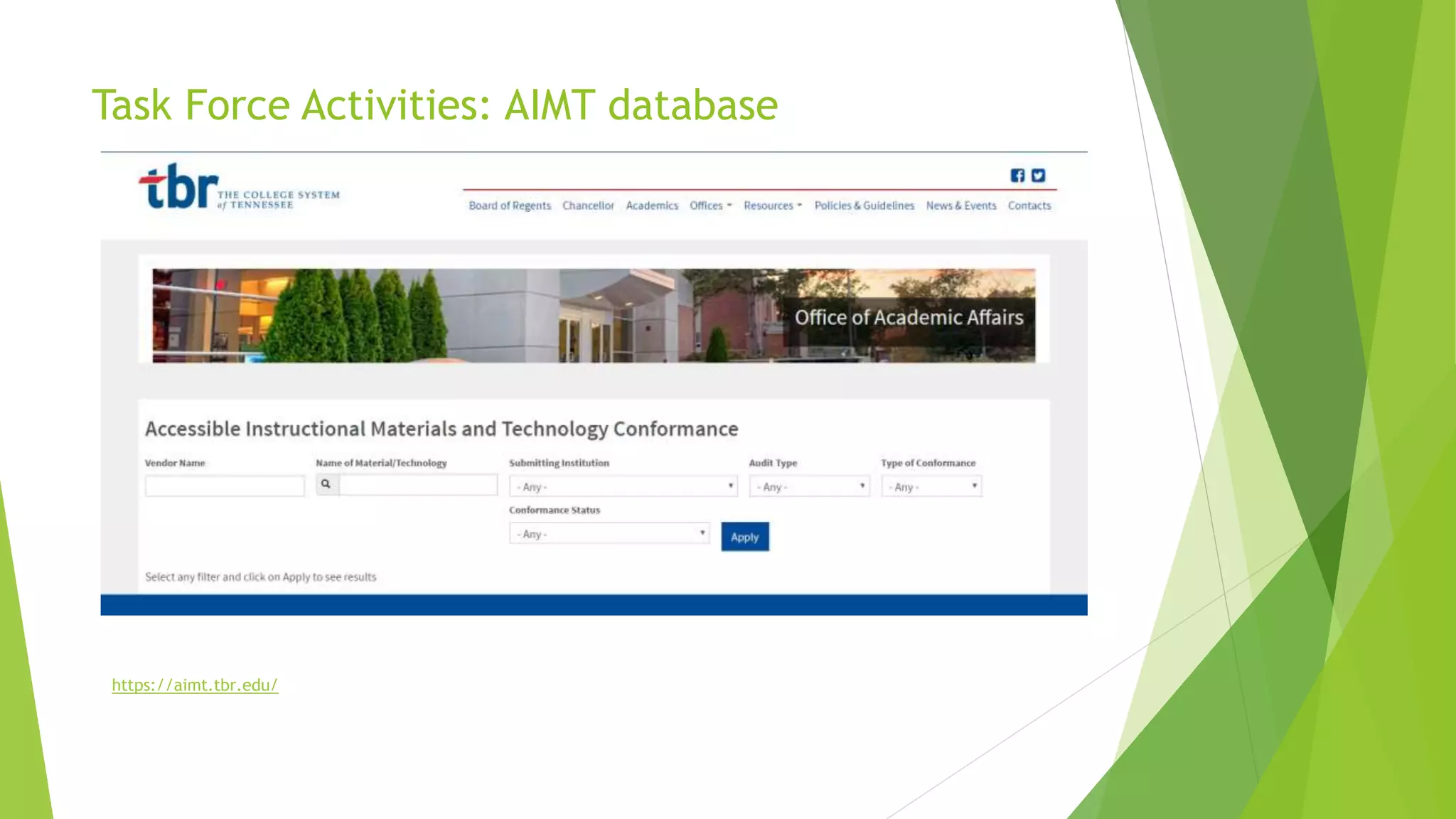
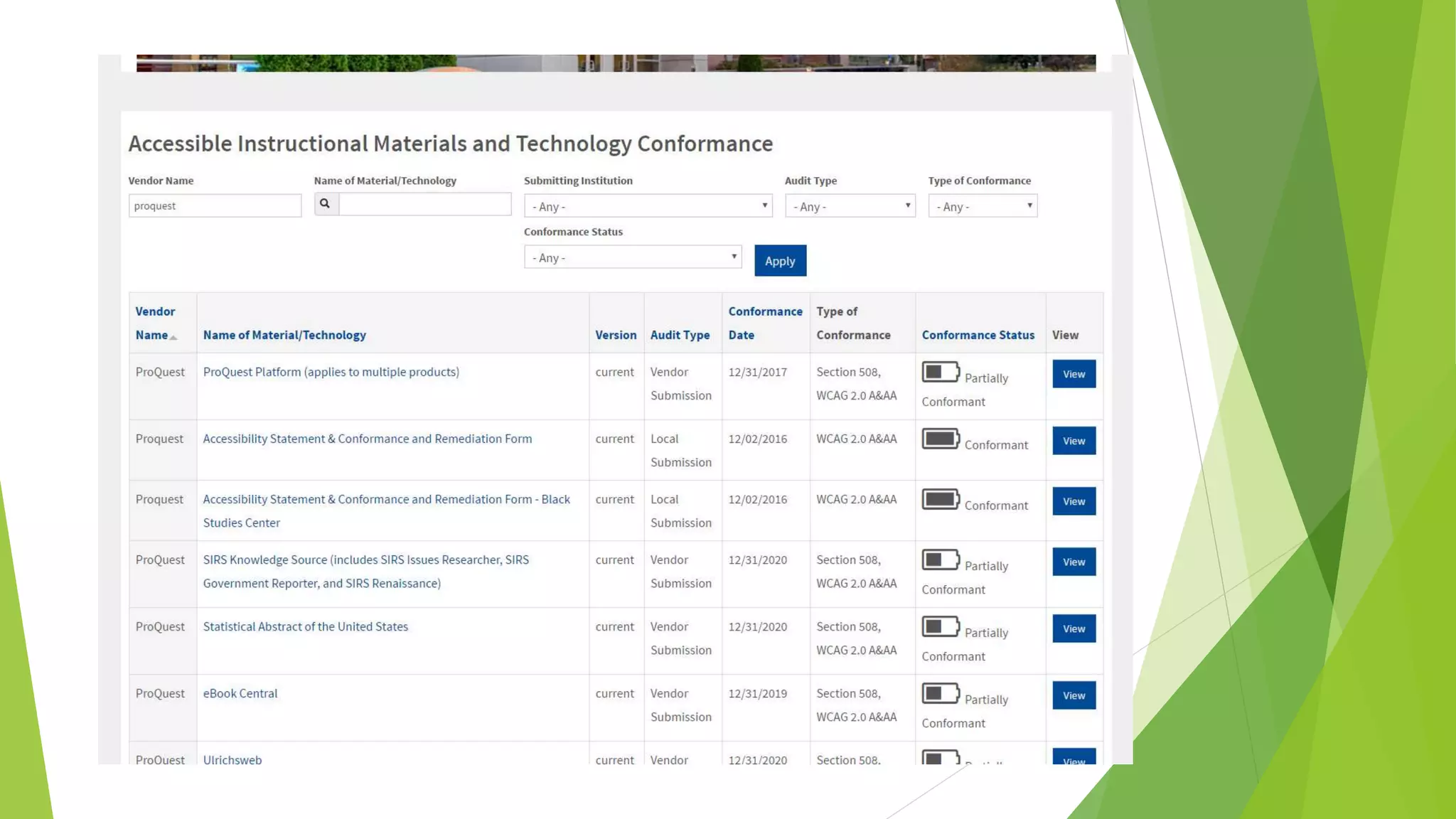
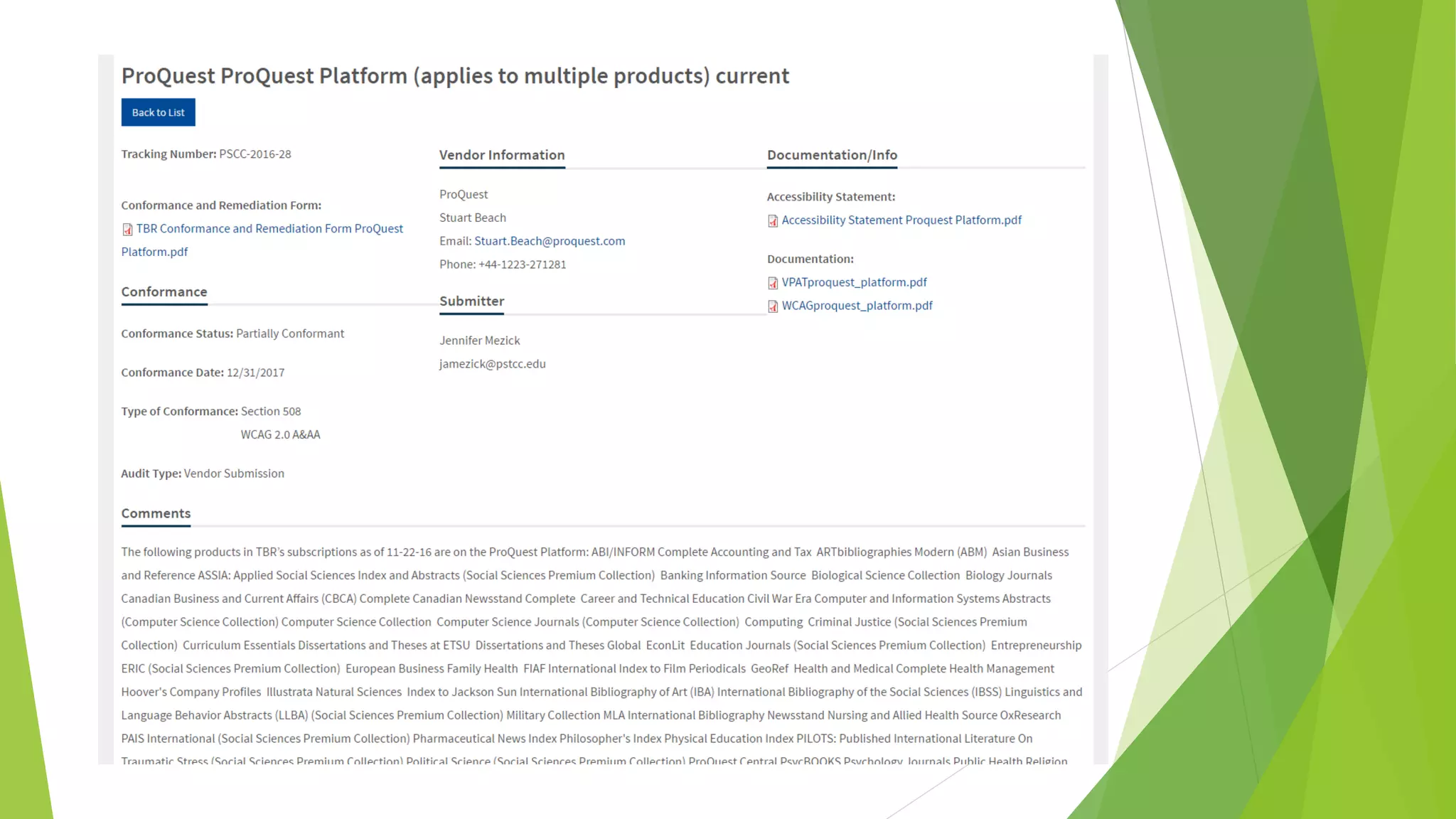
 AIMT database contributions
Accessible Product Documentation:
Standard Forms
 Accessibility Statement: statement of commitment to ensuring equal
access to all users
 VPAT: Voluntary Product Accessibility Template
 WCAG 2.0 Checklist
 EPUB 3 Accessibility Checklist
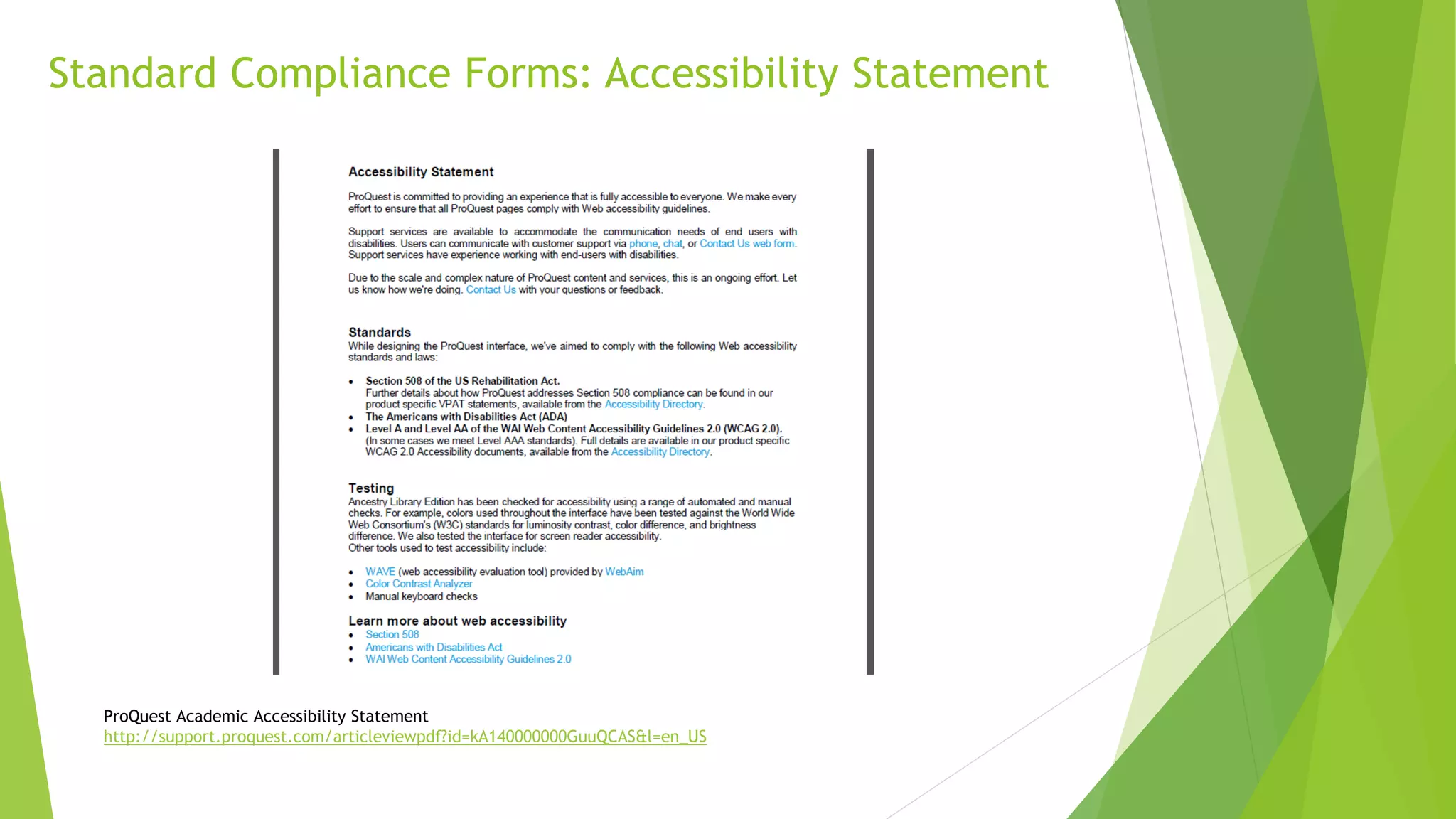
Standard Compliance Forms: Accessibility Statement
ProQuest Academic Accessibility Statement
http://support.proquest.com/articleviewpdf?id=kA140000000GuuQCAS&l=en_US
VPAT: Voluntary Product Accessibility
Template
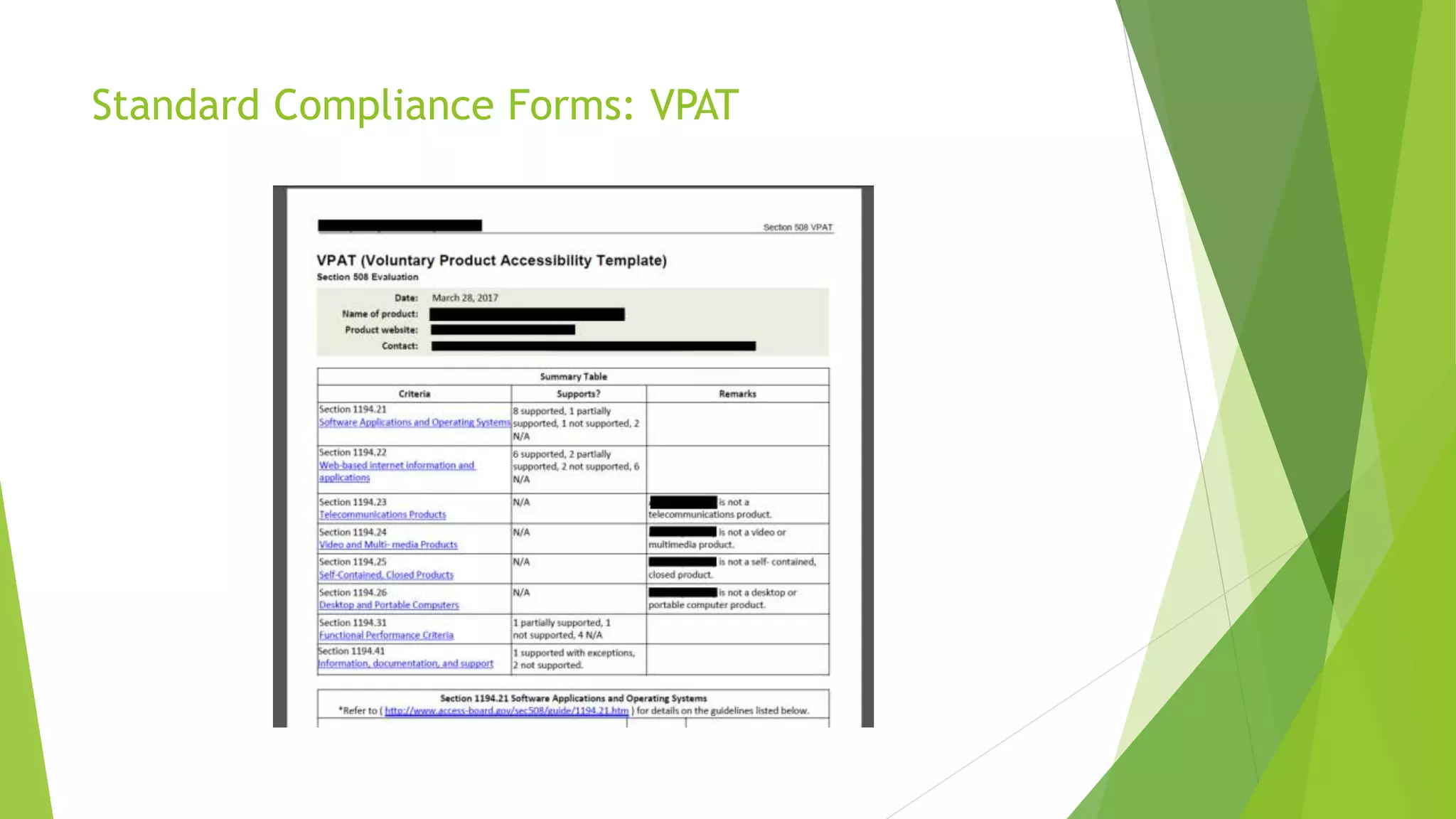
 Developed by ITI (Information Technology Industry Council) and the
GSA (U.S. General Services Administration)
 Provides information on how EIT conforms to the Section 508
Accessibility Standards
 Form is to be completed by vendors or publishers
 Template available at: http://www.itic.org/policy/accessibility/
 LUA (Libraries for Universal Access) maintains a VPAT Repository at:
http://uniaccessig.org/lua/vpat-repository/
Standard Compliance Forms: VPAT
Web Content Accessibility Guidelines
WCAG 2.0 – Levels A through AAA
Key Principles
 Perceivable: Information must be presented in a manner that users can
perceive (Example: captions for audio)
 Operable: User must be able to navigate and operate the interface
(Example: Keyboard shortcuts in place of using the mouse)
 Understandable: User must be able to understand how to use the
interface (Example: Consistent navigation on each page)
 Robust: Content must be able to be interpreted by assistive technology
(Example: Markup language contains start and end tags for screen
readers)
WC3: Web Accessibility Initiative
https://www.w3.org/WAI/WCAG20/quickref/
Standard Compliance Forms: WCAG 2.0 Checklist
Blank checklist used by TBR available at:
https://www.tbr.edu/sites/tbr.edu/files/media/2016/02/WCAG2.0-Checklist_0.doc
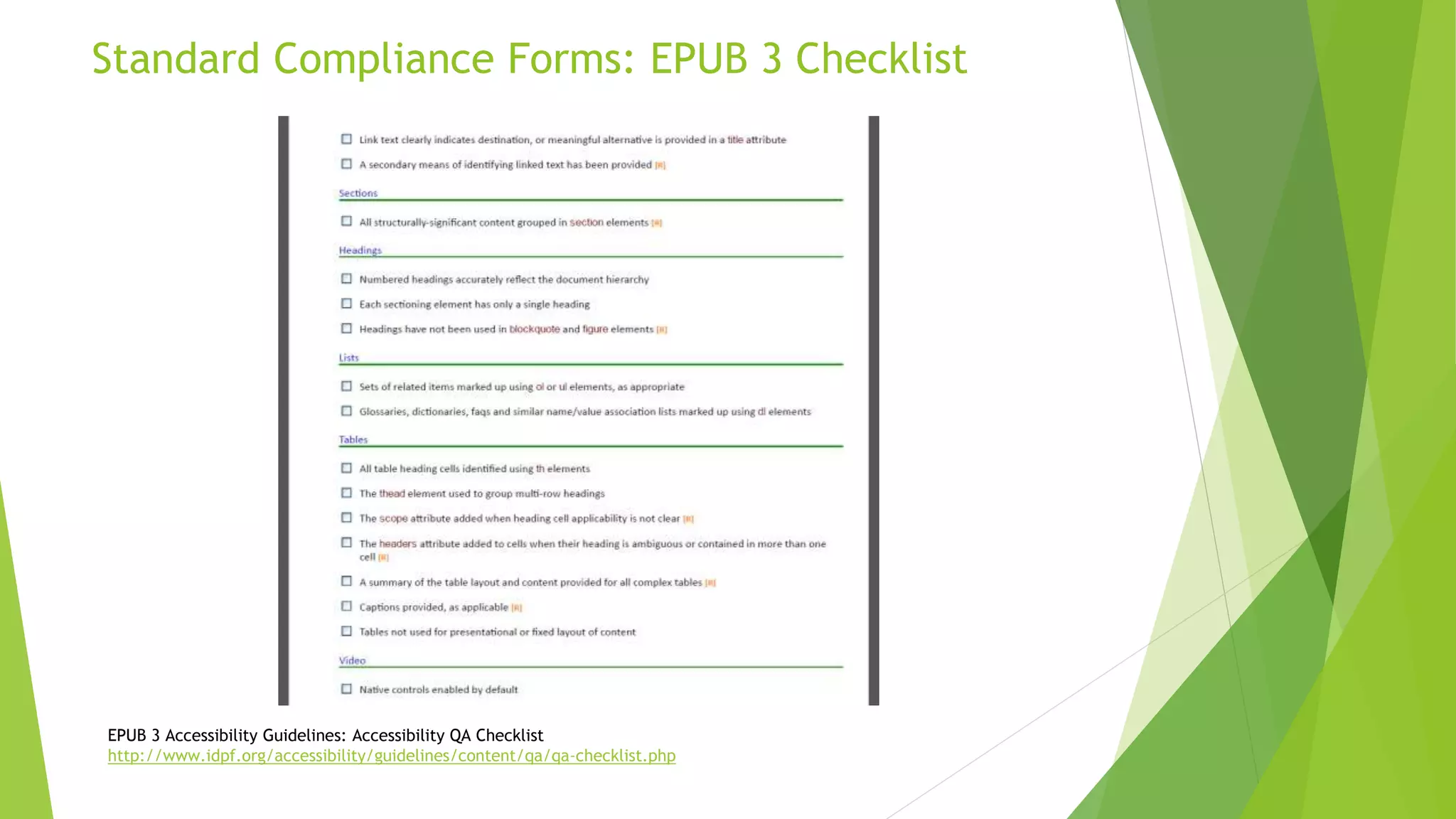
Standard Compliance Forms: EPUB 3 Checklist
EPUB 3 Accessibility Guidelines: Accessibility QA Checklist
http://www.idpf.org/accessibility/guidelines/content/qa/qa-checklist.php
Accessible Product Documentation:
Additional TBR Forms
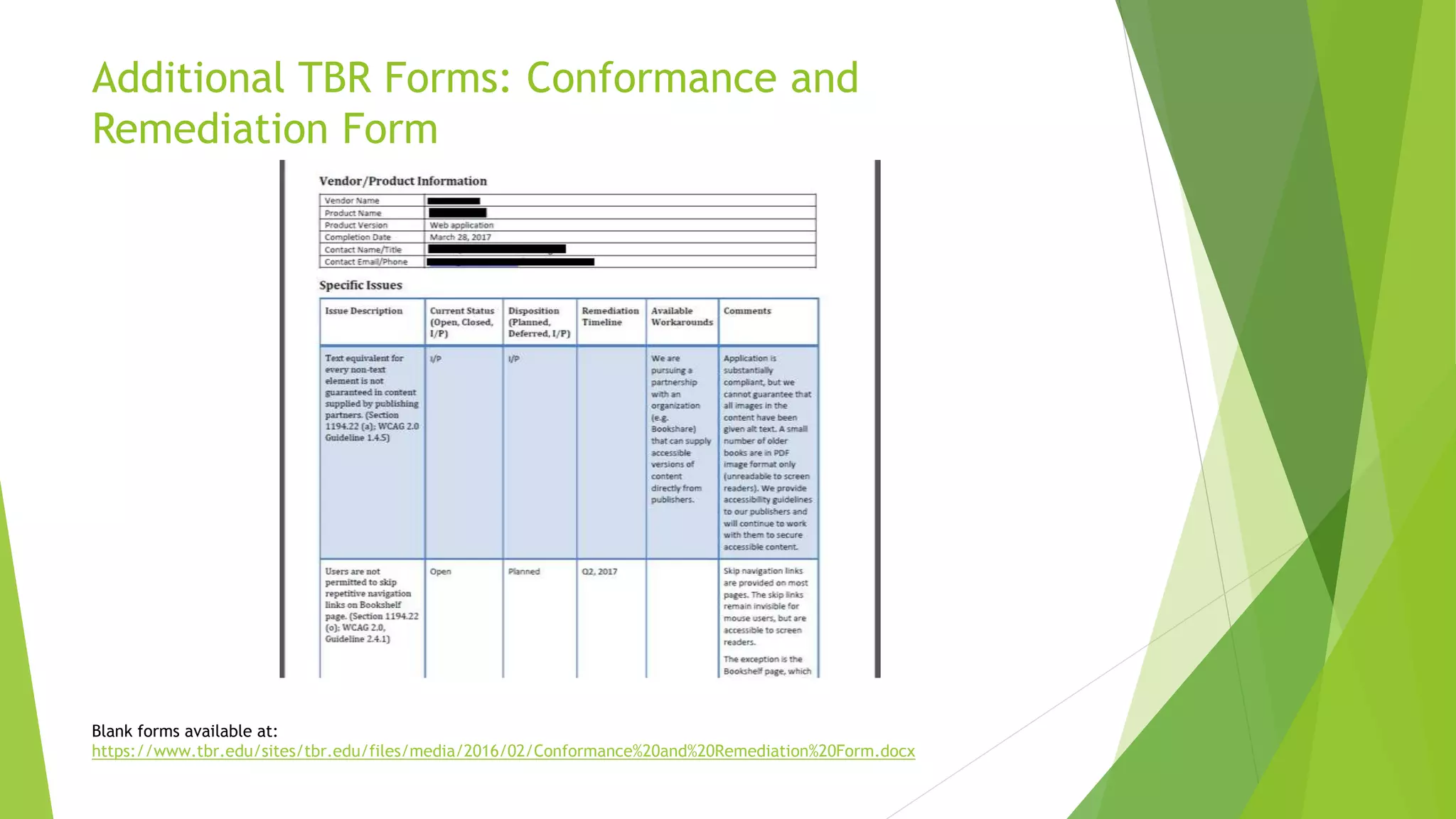
 Conformance and Remediation Form: identifies
accessibility issues/gaps and indicates a timeline for
conformance
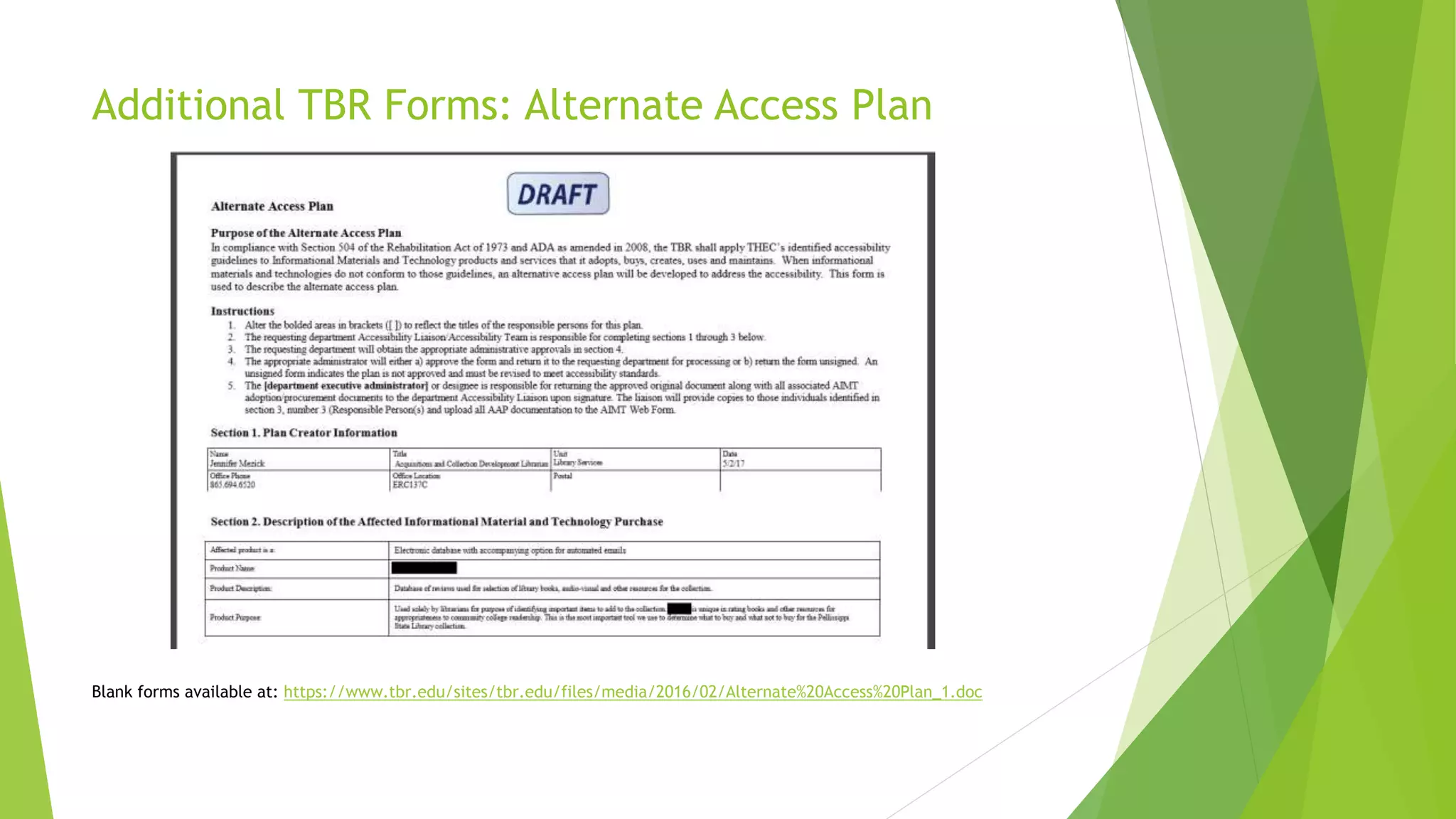
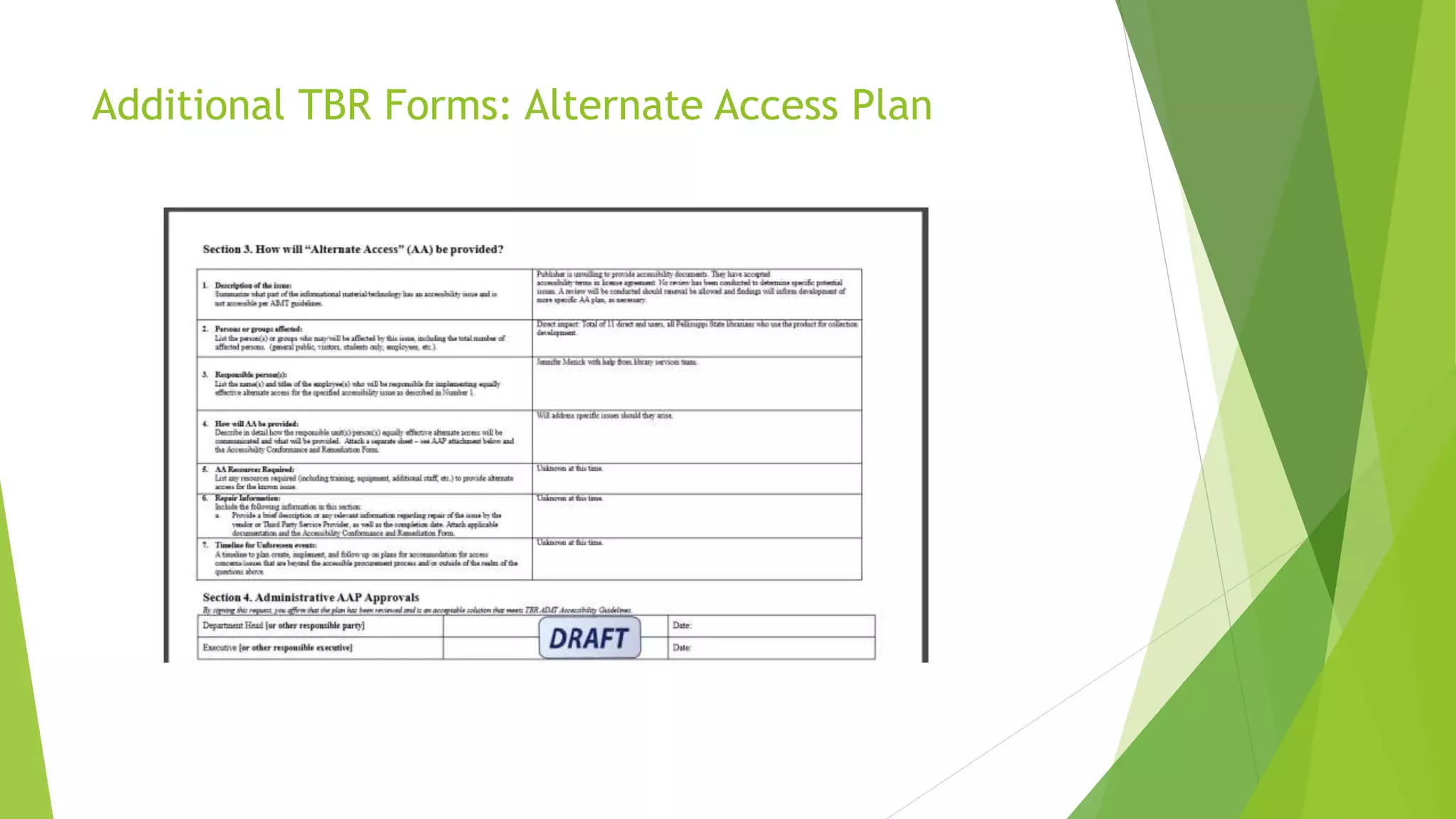
 Alternate Access Plan: describes the process for accessing
AIMT when it does not conform to accepted accessibility
guidelines (for example: WCAG 2.0 Level AA)
Additional TBR Forms: Conformance and
Remediation Form
Blank forms available at:
https://www.tbr.edu/sites/tbr.edu/files/media/2016/02/Conformance%20and%20Remediation%20Form.docx
Additional TBR Forms: Alternate Access Plan
Blank forms available at: https://www.tbr.edu/sites/tbr.edu/files/media/2016/02/Alternate%20Access%20Plan_1.doc
Additional TBR Forms: Alternate Access Plan
Task Force Activities: Document Collection
Created by the TBR Libraries Accessibility Task Force.
Vendor Form Letter
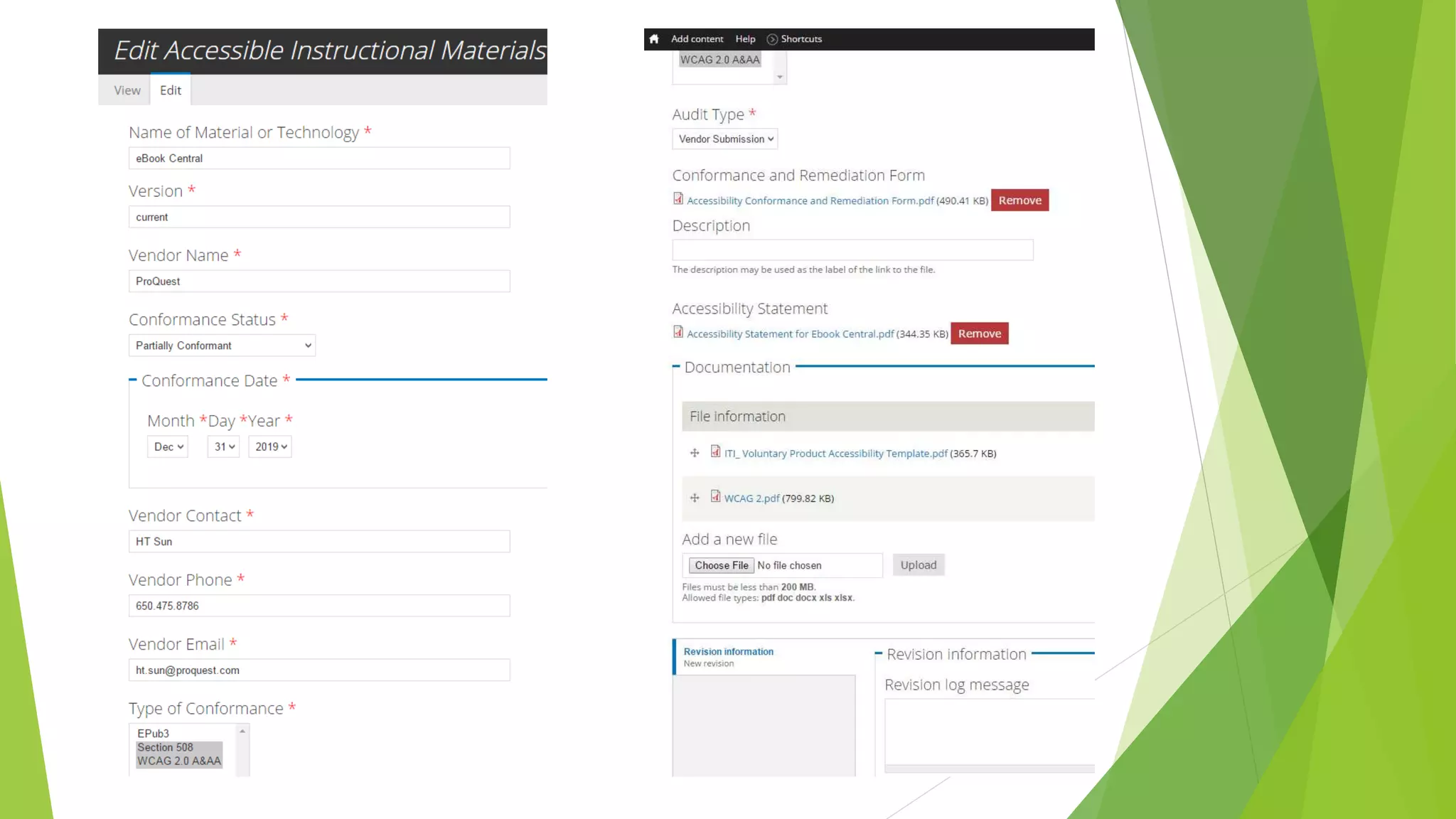
Task Force Activities: AIMT database
https://aimt.tbr.edu/
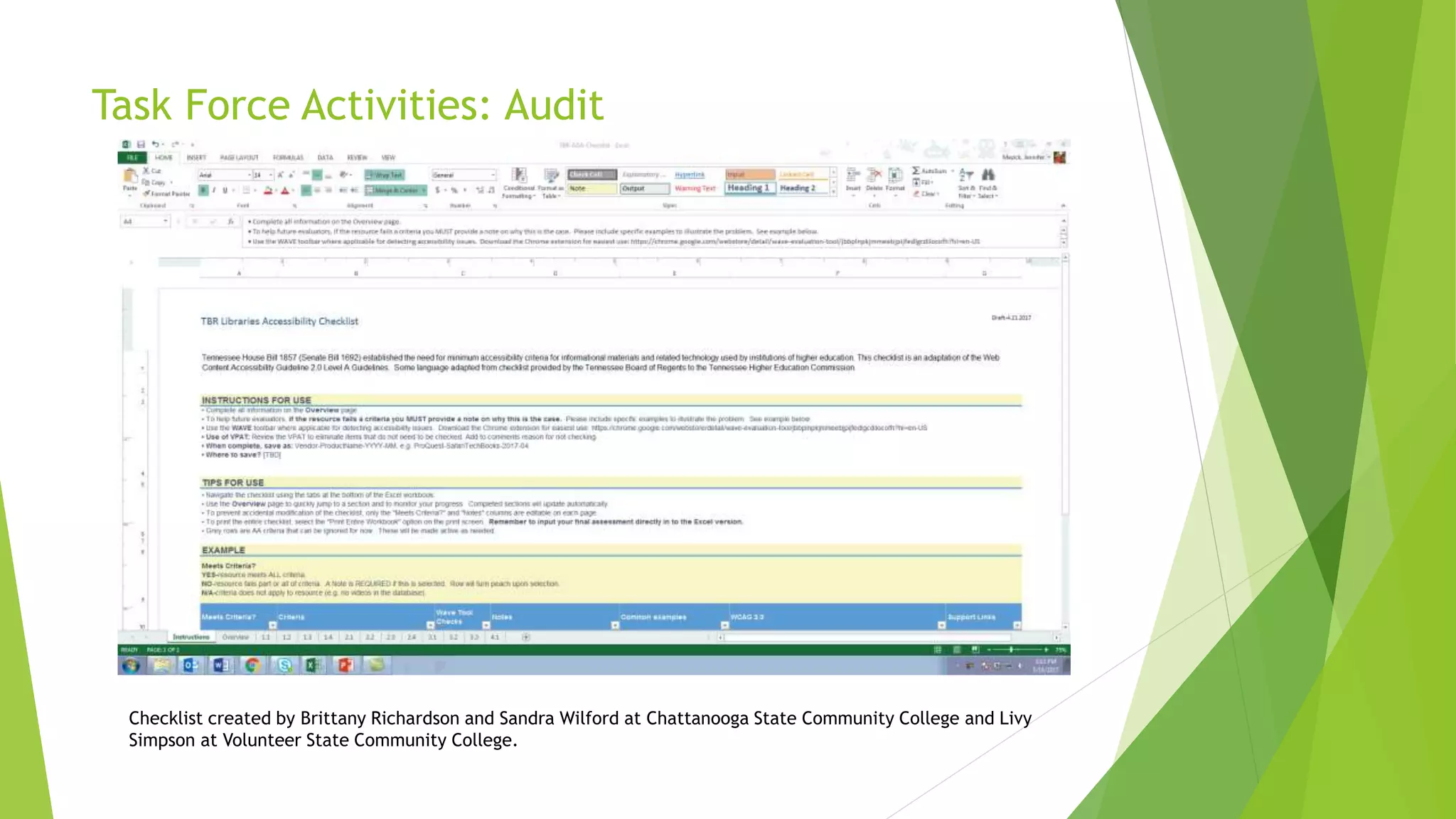
Task Force Activities: Audit
Checklist created by Brittany Richardson and Sandra Wilford at Chattanooga State Community College and Livy
Simpson at Volunteer State Community College.
TBR Task Force: Moving Forward
 Finalize audit checklist
 Audit a sampling of databases
 Continue to gather and share documents
 Work with TBR to improve AIMT database format & features
 Develop and share Alternate Access Plans
 Follow-up on Conformance and Remediation Form timelines
TBR Licensing Language
Service and Software Accessibility Standards. The Contractor warrants
and represents that the service and software, including any updates,
provided to the Institution will meet the accessibility standards set forth
in WCAG 2.0 AA (also known as ISO standard, ISO/IEC 40500:2012) and
will be compliant with Section 508 of the Americans with Disabilities Act
(ADA) with exceptions, if applicable. Copies of Contractor’s Voluntary
Product Accessibility Templates (“VPATs”) for the various products and
other accessibility information are available at URL.”
University of Tennessee: Who We Are
 Public university system
 4 Campuses (Chattanooga, Knoxville, Martin, & Memphis)
 3 Institutes (Agriculture-Veterinary, Public Service, &
Space)
 1 Medical library (UT Medical Center)
 Serves 49,000 students (38,000 undergraduate & 11,000
graduate)
http://tennessee.edu/
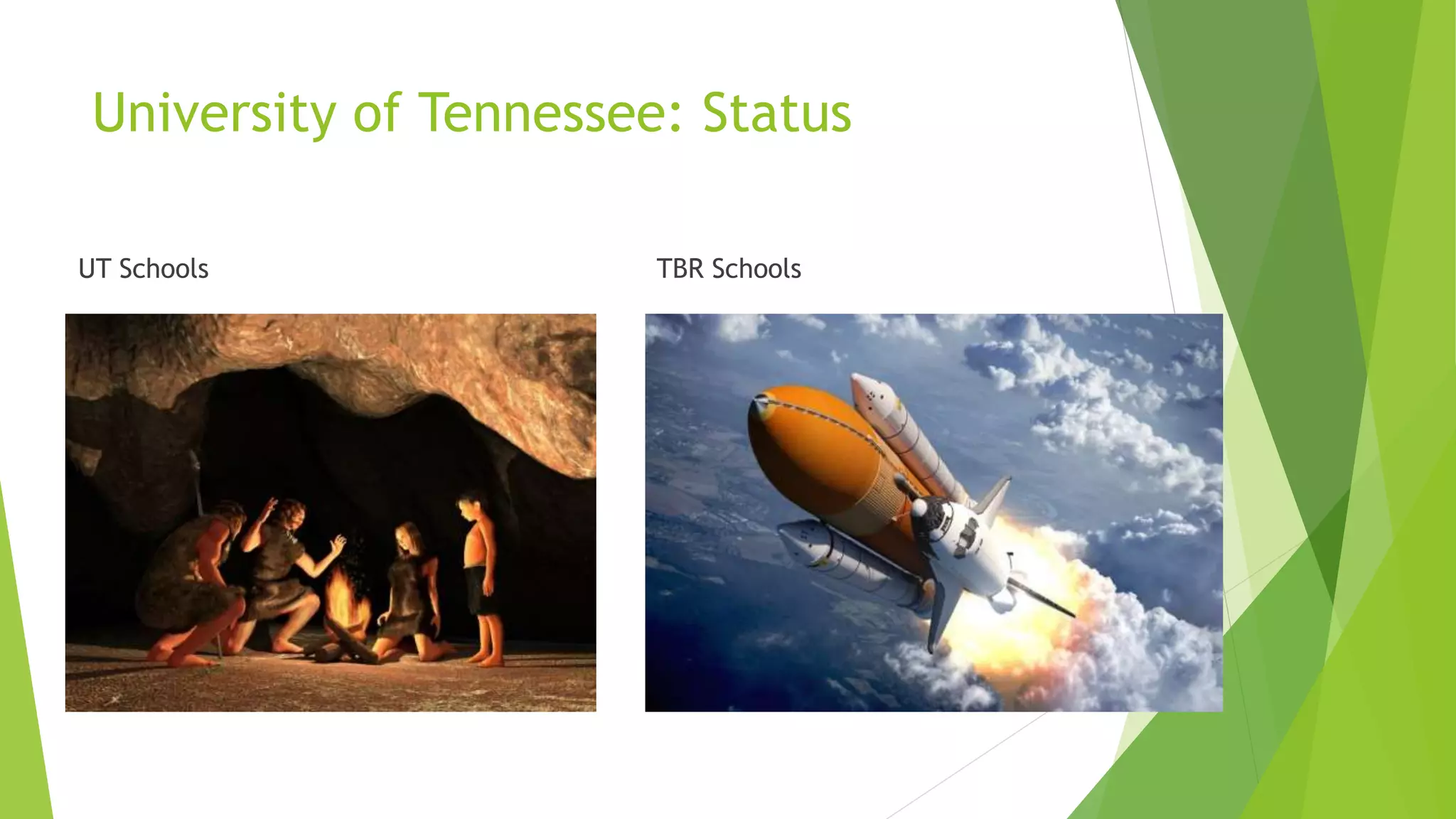
University of Tennessee: Status
UT Schools TBR Schools
University of Tennessee: Process
 Libraries have been largely absent
 No combined effort
 System Office of General Counsel
 System Procurement Office
 Campus task forces
 Libraries (internal & external)
 Limited proactivity
 No documentation, auditing, or testing
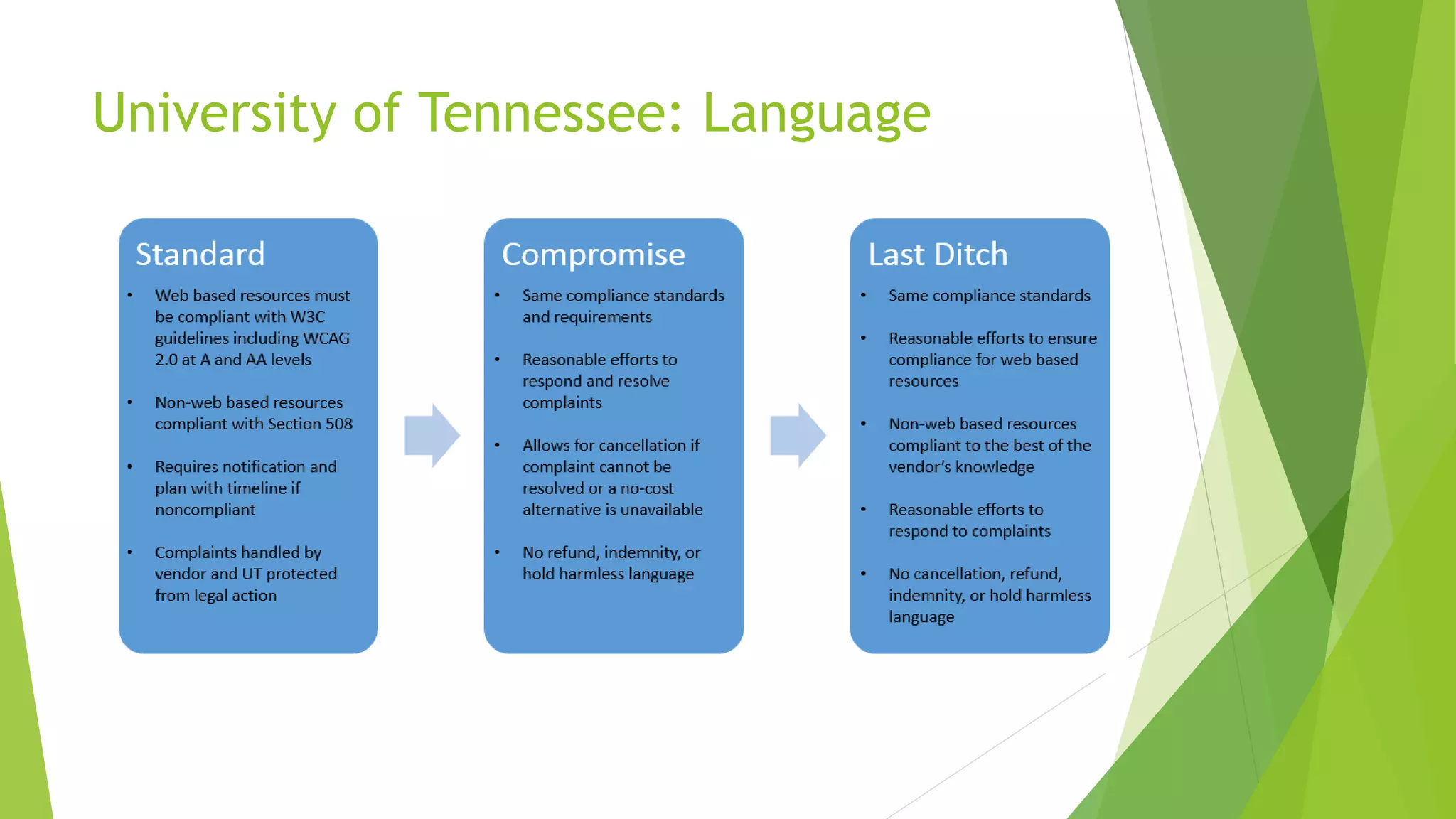
University of Tennessee: Language
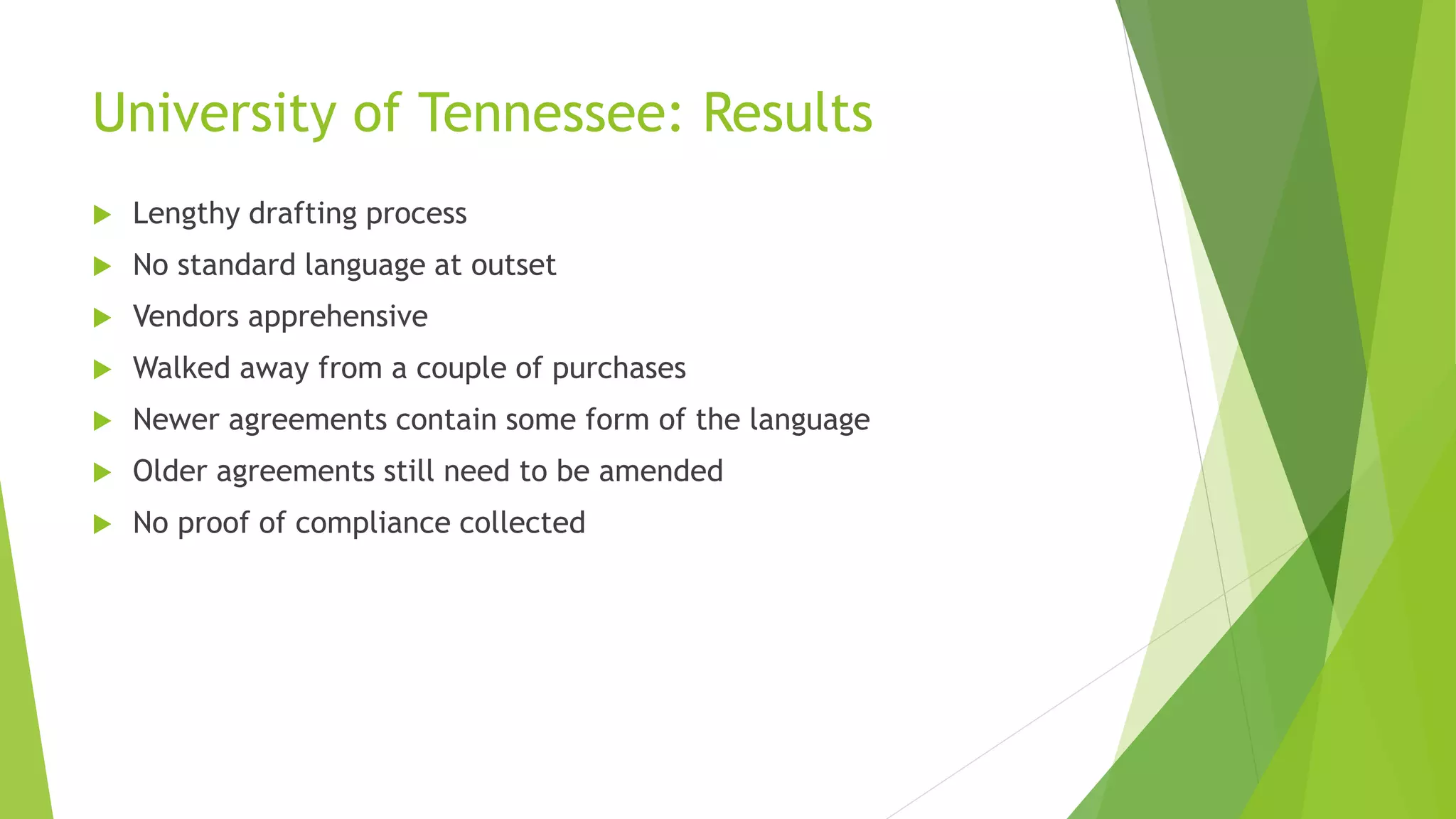
University of Tennessee: Results
 Lengthy drafting process
 No standard language at outset
 Vendors apprehensive
 Walked away from a couple of purchases
 Newer agreements contain some form of the language
 Older agreements still need to be amended
 No proof of compliance collected
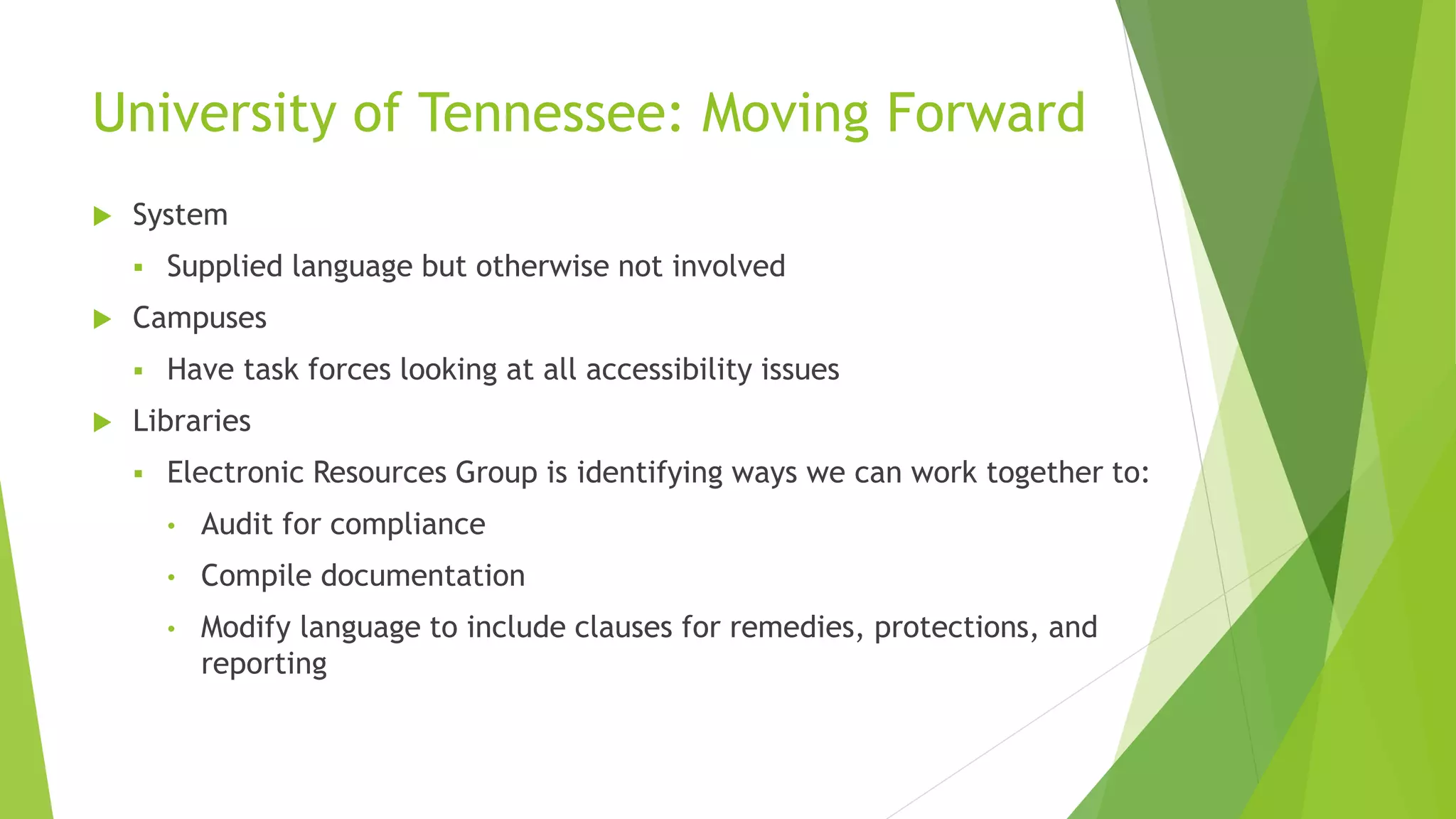
University of Tennessee: Moving Forward
 System
 Supplied language but otherwise not involved
 Campuses
 Have task forces looking at all accessibility issues
 Libraries
 Electronic Resources Group is identifying ways we can work together to:
• Audit for compliance
• Compile documentation
• Modify language to include clauses for remedies, protections, and
reporting
Additional Resources
Recommendations of the [Tennessee] Higher Education Accessibility Task Force
https://www.tbr.edu/sites/tbr.edu/files/media/2015/08/Accessibility%20Task%2
0Force%20Recs-Final.pdf
TBR Libraries: Accessibility Audit Plan (as of April 2016)
http://www.tbr.edu/sites/tbr.edu/files/media/2016/05/AccessibilityAuditPlanTB
RLibraries_2016apr26.docx
Tennessee Board of Regents: Accessibility Initiative
https://www.tbr.edu/academics/accessibility-initiative
Questions?
Tennessee Board of Regents System
Stephanie J. Adams
Tennessee Tech University
sjadams@tntech.edu
Jennifer Mezick
Pellissippi State Community College
jamezick@pstcc.edu
University of Tennessee System
Corey Halaychik
The University of Tennessee, Knoxville
chalaych@utk.edu

Accessibility Compliance: One State, Two Approaches

  • 1.
    Accessibility Compliance: One State,Two Approaches Stephanie J. Adams Tennessee Tech University Jennifer Mezick Pellissippi State Community College Corey Halaychik The University of Tennessee, Knoxville
  • 2.
    Overview  Accessibility defined Types of disabilities and accessible design features  Laws and lawsuits  Task Force formation  Tennessee Board of Regents (TBR) Libraries Accessibility Task Force activities and plans  Accessibility documentation standards  University of Tennessee System process, results, and plans
  • 3.
    Accessible vs. Accommodation “Accessiblemeans a person with a disability is afforded the opportunity to acquire the same information, engage in the same interactions, and enjoy the same services as a person without a disability in an equally effective and equally integrated manner, with substantially equivalent ease of use. The person with a disability must be able to obtain the information as fully, equally and independently as a person without a disability.” -U.S. Department of Education, Office for Civil Rights (OCR resolutions with South Carolina Technical College System, University of Cincinnati, and Youngstown State) https://dso.dasa.ncsu.edu/what-does-accessible-mean/ “Accommodations are reasonable academic adjustments or auxiliary aids that provide equal access to programs and services on an individual basis.” -Tennessee Tech University Accessibility Initiative https://www.tntech.edu/accessibility/accessibility-vs.-accommodation
  • 4.
    Examples of AccessibleDesign Features Types of Disabilities  Visual  Auditory  Neurological  Motor/Mobility  Cognitive  Speech Accessible Features  Alternate text for images  Captioning for audio/video  Absence of flickering images  Full keyboard support for navigation  Simple navigation tools and page layouts, conceptual explanations  Help or tech support via a variety of methods (not just telephone) WebAIM: Introduction to Web Accessibility: http://webaim.org/intro/ W3C Web Accessibility Initiative: Diversity of Web Users: https://www.w3.org/WAI/intro/people-use-web/diversity
  • 5.
    Laws Related toAccessibility in Higher Education  Section 504 of the Rehabilitation Act of 1973  Section 508 of the Rehabilitation Act of 1973 as amended (in 1998)  Title II of the American with Disabilities Act of 1990  Title III of the American with Disabilities Act of 1990  In Tennessee: Senate Bill No. 1692 (signed into law on April 16, 2014) K. Ostergard’s “Accessibility from Scratch” – Table 1 DOI: 10.1080/0361526X.2015.1069777 Implementing Accessibility at UTM: https://www.utm.edu/departments/acadaff/_pdfs/Implementing_Accessibility_at_UTM.pdf
  • 6.
    Complaints in Librariesand Higher Education  Public Libraries: NOOK eReaders  Higher Education:  Websites  Course management/learning management systems and online learning platforms  Kindle DX eReaders  Videos without captioning  Course registration systems  Textbooks and other course materials  Technology (including classroom clickers)  Gmail and Google Apps  Library systems and databases
  • 7.
    Legal Action inHigher Education: Library Materials  Penn State University (Resolution Agreement) National Federation of the Blind (NFB) filed a complaint regarding inaccessible websites.  University of California at Berkeley (Lawsuit settled in 2013) Disability Rights Advocates (DRA) filed lawsuit citing inaccessibility of library materials for students with print-related disabilities  University of Montana-Missoula (Resolution Agreement) Investigated by the Office of Civil Rights (OCR) in the U.S. Department of Education for complaints including inaccessible library database materials. Higher Ed Accessibility Lawsuits, Complaints, and Settlements http://www.d.umn.edu/~lcarlson/atteam/lawsuits.html
  • 8.
    Tennessee Board ofRegents System: Who We Are  One of two systems of Tennessee public higher education  Largest system of higher education in Tennessee  13 Community Colleges  27 Colleges of Applied Technology  TN eCampus (46 partner institutions, 500+ certificates and degrees)  Serves 100,000+ students  6 Universities  Serve 88,000 students (75,000 undergraduate & 13,000 graduate and professional students) https://www.tbr.edu/
  • 9.
    Tennessee Board ofRegents Libraries Accessibility Task Force  Tennessee Higher Education Commission (THEC) Accessibility Task Force charged TBR and UT with creating policies for accessible IMT (information materials and technologies)  TBR Accessibility Task Force formed in Spring 2015  TBR Libraries Accessibility Task Force formed in Spring 2016  Members: interested library staff from any of the TBR and UT schools  Purpose: deliver a plan for an accessibility audit of library resources
  • 10.
    TBR Libraries AccessibilityTask Force: Initial Goals  Initial audit of library instructional materials and technology (IMT)  Challenges • Selecting tools/developing audit rubric (WAVE, WebAIM checklist) • Interpreting results • Recruiting end-user testers  Develop a collaborative process for procurement of AIMT (Accessible IMT)  Master list of eResources (divide and conquer approach)  Vendor form letter  Accessibility document roundup  AIMT database contributions
  • 11.
    Accessible Product Documentation: StandardForms  Accessibility Statement: statement of commitment to ensuring equal access to all users  VPAT: Voluntary Product Accessibility Template  WCAG 2.0 Checklist  EPUB 3 Accessibility Checklist
  • 12.
    Standard Compliance Forms:Accessibility Statement ProQuest Academic Accessibility Statement http://support.proquest.com/articleviewpdf?id=kA140000000GuuQCAS&l=en_US
  • 13.
    VPAT: Voluntary ProductAccessibility Template  Developed by ITI (Information Technology Industry Council) and the GSA (U.S. General Services Administration)  Provides information on how EIT conforms to the Section 508 Accessibility Standards  Form is to be completed by vendors or publishers  Template available at: http://www.itic.org/policy/accessibility/  LUA (Libraries for Universal Access) maintains a VPAT Repository at: http://uniaccessig.org/lua/vpat-repository/
  • 14.
  • 15.
    Web Content AccessibilityGuidelines WCAG 2.0 – Levels A through AAA Key Principles  Perceivable: Information must be presented in a manner that users can perceive (Example: captions for audio)  Operable: User must be able to navigate and operate the interface (Example: Keyboard shortcuts in place of using the mouse)  Understandable: User must be able to understand how to use the interface (Example: Consistent navigation on each page)  Robust: Content must be able to be interpreted by assistive technology (Example: Markup language contains start and end tags for screen readers) WC3: Web Accessibility Initiative https://www.w3.org/WAI/WCAG20/quickref/
  • 16.
    Standard Compliance Forms:WCAG 2.0 Checklist Blank checklist used by TBR available at: https://www.tbr.edu/sites/tbr.edu/files/media/2016/02/WCAG2.0-Checklist_0.doc
  • 17.
    Standard Compliance Forms:EPUB 3 Checklist EPUB 3 Accessibility Guidelines: Accessibility QA Checklist http://www.idpf.org/accessibility/guidelines/content/qa/qa-checklist.php
  • 18.
    Accessible Product Documentation: AdditionalTBR Forms  Conformance and Remediation Form: identifies accessibility issues/gaps and indicates a timeline for conformance  Alternate Access Plan: describes the process for accessing AIMT when it does not conform to accepted accessibility guidelines (for example: WCAG 2.0 Level AA)
  • 19.
    Additional TBR Forms:Conformance and Remediation Form Blank forms available at: https://www.tbr.edu/sites/tbr.edu/files/media/2016/02/Conformance%20and%20Remediation%20Form.docx
  • 20.
    Additional TBR Forms:Alternate Access Plan Blank forms available at: https://www.tbr.edu/sites/tbr.edu/files/media/2016/02/Alternate%20Access%20Plan_1.doc
  • 21.
    Additional TBR Forms:Alternate Access Plan
  • 22.
    Task Force Activities:Document Collection Created by the TBR Libraries Accessibility Task Force. Vendor Form Letter
  • 23.
    Task Force Activities:AIMT database https://aimt.tbr.edu/
  • 27.
    Task Force Activities:Audit Checklist created by Brittany Richardson and Sandra Wilford at Chattanooga State Community College and Livy Simpson at Volunteer State Community College.
  • 28.
    TBR Task Force:Moving Forward  Finalize audit checklist  Audit a sampling of databases  Continue to gather and share documents  Work with TBR to improve AIMT database format & features  Develop and share Alternate Access Plans  Follow-up on Conformance and Remediation Form timelines
  • 29.
    TBR Licensing Language Serviceand Software Accessibility Standards. The Contractor warrants and represents that the service and software, including any updates, provided to the Institution will meet the accessibility standards set forth in WCAG 2.0 AA (also known as ISO standard, ISO/IEC 40500:2012) and will be compliant with Section 508 of the Americans with Disabilities Act (ADA) with exceptions, if applicable. Copies of Contractor’s Voluntary Product Accessibility Templates (“VPATs”) for the various products and other accessibility information are available at URL.”
  • 30.
    University of Tennessee:Who We Are  Public university system  4 Campuses (Chattanooga, Knoxville, Martin, & Memphis)  3 Institutes (Agriculture-Veterinary, Public Service, & Space)  1 Medical library (UT Medical Center)  Serves 49,000 students (38,000 undergraduate & 11,000 graduate) http://tennessee.edu/
  • 31.
    University of Tennessee:Status UT Schools TBR Schools
  • 32.
    University of Tennessee:Process  Libraries have been largely absent  No combined effort  System Office of General Counsel  System Procurement Office  Campus task forces  Libraries (internal & external)  Limited proactivity  No documentation, auditing, or testing
  • 33.
  • 34.
    University of Tennessee:Results  Lengthy drafting process  No standard language at outset  Vendors apprehensive  Walked away from a couple of purchases  Newer agreements contain some form of the language  Older agreements still need to be amended  No proof of compliance collected
  • 35.
    University of Tennessee:Moving Forward  System  Supplied language but otherwise not involved  Campuses  Have task forces looking at all accessibility issues  Libraries  Electronic Resources Group is identifying ways we can work together to: • Audit for compliance • Compile documentation • Modify language to include clauses for remedies, protections, and reporting
  • 36.
    Additional Resources Recommendations ofthe [Tennessee] Higher Education Accessibility Task Force https://www.tbr.edu/sites/tbr.edu/files/media/2015/08/Accessibility%20Task%2 0Force%20Recs-Final.pdf TBR Libraries: Accessibility Audit Plan (as of April 2016) http://www.tbr.edu/sites/tbr.edu/files/media/2016/05/AccessibilityAuditPlanTB RLibraries_2016apr26.docx Tennessee Board of Regents: Accessibility Initiative https://www.tbr.edu/academics/accessibility-initiative
  • 37.
    Questions? Tennessee Board ofRegents System Stephanie J. Adams Tennessee Tech University sjadams@tntech.edu Jennifer Mezick Pellissippi State Community College jamezick@pstcc.edu University of Tennessee System Corey Halaychik The University of Tennessee, Knoxville chalaych@utk.edu