Equity and Inclusion in
Licensing: The
Accessibility Imperative

Judy Ruttenberg, Association of Research Libraries
Charleston Conference
November 6, 2013
The Accessibility Narrative
• Personal Stories or Personas
• Complaints and Settlements
• Universal Design
Agenda
• Law and disability policies
• Institutional roles, responsibilities
• Licensing and procurement
Law and Disability Policies
• ADA of 1990: Titles I, II, III
• Rehabilitation Act of 1973: Sec. 504
• Rehabilitation Act, 1998 Amendment:
Sec. 508 (see Assistive Technology
Act)
• DOJ: Civil Rights Division
• Department of Education: Office of
Civil Rights
Letter to Colleges and Universities
“Requiring use of an emerging technology in a
classroom environment when the technology is
inaccessible to an entire population of individuals
with disabilities—individuals with visual disabilities
—is discrimination prohibited by the Americans with
Disabilities Act of 1990 (ADA) and Section 504 of
the Rehabilitation Act of 1973 (Section 504) unless
those individuals are provided accommodations or
modifications that permit them to receive all the
educational benefits provided by the technology in
an equally effective and equally integrated manner.”
6/29/2010
http://www2.ed.gov/about/offices/list/ocr/letters/colleague-201105-pse.html
Complaints and Settlements
Case Western Reserve
Reed College
Pace University
Arizona State University
Princeton University
Darden School of Business, UVA
Louisiana Tech University
Complaints and Settlements
Penn State University
Florida State University
Free Library of Philadelphia
Sacramento Public Library
University of Montana
Copyright
• Copyright Act:
Sections 107, 108, and 121
• The Authors Guild v. HathiTrust
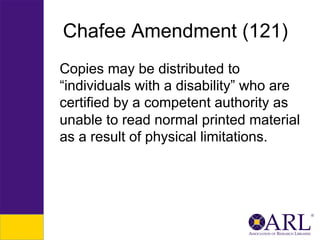
Chafee Amendment (121)
Copies may be distributed to
“individuals with a disability” who are
certified by a competent authority as
unable to read normal printed material
as a result of physical limitations.
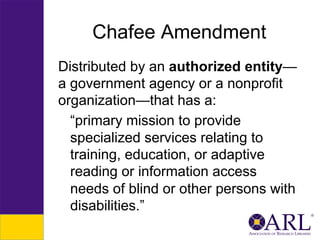
Chafee Amendment
Distributed by an authorized entity—
a government agency or a nonprofit
organization—that has a:
“primary mission to provide
specialized services relating to
training, education, or adaptive
reading or information access
needs of blind or other persons with
disabilities.”
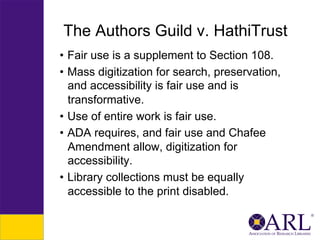
The Authors Guild v. HathiTrust
•  Fair use is a supplement to Section 108.
•  Mass digitization for search, preservation,
and accessibility is fair use and is
transformative.
•  Use of entire work is fair use.
•  ADA requires, and fair use and Chafee
Amendment allow, digitization for
accessibility.
•  Library collections must be equally
accessible to the print disabled.
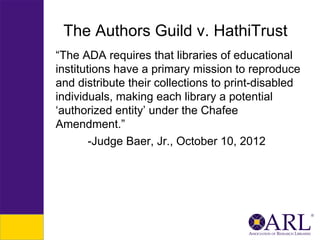
The Authors Guild v. HathiTrust
“The ADA requires that libraries of educational
institutions have a primary mission to reproduce
and distribute their collections to print-disabled
individuals, making each library a potential
‘authorized entity’ under the Chafee
Amendment.”
-Judge Baer, Jr., October 10, 2012
The Authors Guild v. HathiTrust
“I cannot imagine a definition of fair use that would
not encompass the transformative uses made by
[HDL] and would require that I terminate this
invaluable contribution to the progress of science
and cultivation of the arts that at the same time
effectuates the ideals espoused by the ADA."
– Judge Baer, Jr., October 10, 2012
Limits of legislation
• Undue burden = (reasonable efforts)
• Burden of self-advocacy and selfdisclosure to obtain services
• Law lags behind technology: claim of
ADA [or 508] compliance does not
mean that the product is accessible,
or usable
• WCAG 2.0 and 508 refresh
Institutional Roles
High expectations from the “ADA
generation” who grew up with:
• Curb cuts
• K-12 legislation
“High Expectations: Transforming the American
Workforce as the ADA Generation Comes of Age”
http://www.harkin.senate.gov/documents/pdf/
52446704c3501.pdf
Recommendation
• Collaborate within institutions
• Collaborate across institutions
• Advance industry standards
Institutional Actors
• Disability Services
• Information Technology
• Legal
• Libraries
• Faculty Development Centers
• Diversity and Inclusion Offices
• Other?
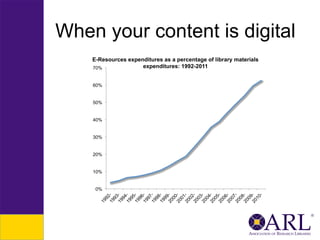
When your content is digital
E-Resources expenditures as a percentage of library materials
expenditures: 1992-2011
70%
60%

50%

40%

30%

20%

10%

0%
Importance of licensing
• Customers lament lack of
accessible options.
• Providers claim no customer
demand.
• Providers are not liable–your
institution is.
Recommendation
Accessibility should be a central
decision factor in choosing, licensing,
and procuring information products
and services:
• Databases
• Born-digital texts
• E-readers
• Mobile devices
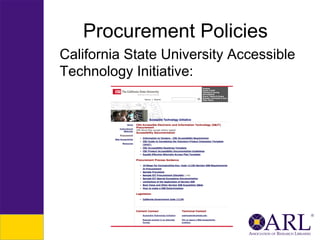
Procurement Policies
California State University Accessible
Technology Initiative:
Model Language
•  Specify assistive software or devices largeprint interfaces, text-to-speech output,
refreshable braille displays, voice-activated input,
and alternate keyboard or pointer interfaces.
•  Reference standards: Web Content
Accessibility Guidelines published by the World
Wide Web Consortium’s Web Accessibility
Initiative.
•  Require a VPAT: A current completed Voluntary
Product Accessibility Template (VPAT) to detail
compliance with the federal Section 508
standards.
Model Language
•  Usability: Content must be perceivable and
operable by persons with visual, perceptual, or
physical disabilities and be useable with assistive
devices, such as screen readers and screen
reading software.
•  Stricter standards: Web content must conform
with the World Wide Web Consortium Web
Content Accessibility Guidelines (WCAG) 2.0,
initially at Level A and increasing to Level AA.62.
Recommendation
• Negotiate for favorable terms to
adapt content to meet the needs of
patrons.
• Aggressively assert fair use in
support of accessible services for
patrons with print disabilities.
Model Language
•  Remediation: Licensor will promptly
make modifications that will make the
Licensed Materials Accessibility
compliant.
•  Fair use: Licensee shall have right to
modify or copy the Licensed Materials in
order to make it useable for Authorized
Users.
Aim higher
Make digital accessibility imperative:
• Cancelation
• Indemnification
Resources
•  ARL Task Force report (make URLs)
http://www.arl.org/focus-areas/accessibility
•  Web Content Accessibility Guidelines (WCAG)
2.0 http://www.w3.org/TR/WCAG20/
•  CSU Accessible Technology Initiative
http://www.calstate.edu/accessibility
•  Oregon State University Accessibility
http://oregonstate.edu/accessibility
•  Penn State University AccessAbility
http://accessibility.psu.edu
•  Watch for: Cornell, others
Thank you!
Questions?
Contact me:
judy@arl.org

Equity and Inclusion in Licensing: The Accessibility Imperative

  • 1.
    Equity and Inclusionin Licensing: The Accessibility Imperative Judy Ruttenberg, Association of Research Libraries Charleston Conference November 6, 2013
  • 2.
    The Accessibility Narrative • PersonalStories or Personas • Complaints and Settlements • Universal Design
  • 3.
    Agenda • Law and disabilitypolicies • Institutional roles, responsibilities • Licensing and procurement
  • 4.
    Law and DisabilityPolicies • ADA of 1990: Titles I, II, III • Rehabilitation Act of 1973: Sec. 504 • Rehabilitation Act, 1998 Amendment: Sec. 508 (see Assistive Technology Act) • DOJ: Civil Rights Division • Department of Education: Office of Civil Rights
  • 5.
    Letter to Collegesand Universities “Requiring use of an emerging technology in a classroom environment when the technology is inaccessible to an entire population of individuals with disabilities—individuals with visual disabilities —is discrimination prohibited by the Americans with Disabilities Act of 1990 (ADA) and Section 504 of the Rehabilitation Act of 1973 (Section 504) unless those individuals are provided accommodations or modifications that permit them to receive all the educational benefits provided by the technology in an equally effective and equally integrated manner.” 6/29/2010 http://www2.ed.gov/about/offices/list/ocr/letters/colleague-201105-pse.html
  • 6.
    Complaints and Settlements CaseWestern Reserve Reed College Pace University Arizona State University Princeton University Darden School of Business, UVA Louisiana Tech University
  • 7.
    Complaints and Settlements PennState University Florida State University Free Library of Philadelphia Sacramento Public Library University of Montana
  • 8.
    Copyright • Copyright Act: Sections 107,108, and 121 • The Authors Guild v. HathiTrust
  • 9.
    Chafee Amendment (121) Copiesmay be distributed to “individuals with a disability” who are certified by a competent authority as unable to read normal printed material as a result of physical limitations.
  • 10.
    Chafee Amendment Distributed byan authorized entity— a government agency or a nonprofit organization—that has a: “primary mission to provide specialized services relating to training, education, or adaptive reading or information access needs of blind or other persons with disabilities.”
  • 11.
    The Authors Guildv. HathiTrust •  Fair use is a supplement to Section 108. •  Mass digitization for search, preservation, and accessibility is fair use and is transformative. •  Use of entire work is fair use. •  ADA requires, and fair use and Chafee Amendment allow, digitization for accessibility. •  Library collections must be equally accessible to the print disabled.
  • 12.
    The Authors Guildv. HathiTrust “The ADA requires that libraries of educational institutions have a primary mission to reproduce and distribute their collections to print-disabled individuals, making each library a potential ‘authorized entity’ under the Chafee Amendment.” -Judge Baer, Jr., October 10, 2012
  • 13.
    The Authors Guildv. HathiTrust “I cannot imagine a definition of fair use that would not encompass the transformative uses made by [HDL] and would require that I terminate this invaluable contribution to the progress of science and cultivation of the arts that at the same time effectuates the ideals espoused by the ADA." – Judge Baer, Jr., October 10, 2012
  • 14.
    Limits of legislation • Undueburden = (reasonable efforts) • Burden of self-advocacy and selfdisclosure to obtain services • Law lags behind technology: claim of ADA [or 508] compliance does not mean that the product is accessible, or usable • WCAG 2.0 and 508 refresh
  • 15.
    Institutional Roles High expectationsfrom the “ADA generation” who grew up with: • Curb cuts • K-12 legislation “High Expectations: Transforming the American Workforce as the ADA Generation Comes of Age” http://www.harkin.senate.gov/documents/pdf/ 52446704c3501.pdf
  • 16.
    Recommendation • Collaborate within institutions • Collaborateacross institutions • Advance industry standards
  • 17.
    Institutional Actors • Disability Services • InformationTechnology • Legal • Libraries • Faculty Development Centers • Diversity and Inclusion Offices • Other?
  • 18.
    When your contentis digital E-Resources expenditures as a percentage of library materials expenditures: 1992-2011 70% 60% 50% 40% 30% 20% 10% 0%
  • 19.
    Importance of licensing • Customerslament lack of accessible options. • Providers claim no customer demand. • Providers are not liable–your institution is.
  • 20.
    Recommendation Accessibility should bea central decision factor in choosing, licensing, and procuring information products and services: • Databases • Born-digital texts • E-readers • Mobile devices
  • 21.
    Procurement Policies California StateUniversity Accessible Technology Initiative:
  • 22.
    Model Language •  Specifyassistive software or devices largeprint interfaces, text-to-speech output, refreshable braille displays, voice-activated input, and alternate keyboard or pointer interfaces. •  Reference standards: Web Content Accessibility Guidelines published by the World Wide Web Consortium’s Web Accessibility Initiative. •  Require a VPAT: A current completed Voluntary Product Accessibility Template (VPAT) to detail compliance with the federal Section 508 standards.
  • 23.
    Model Language •  Usability:Content must be perceivable and operable by persons with visual, perceptual, or physical disabilities and be useable with assistive devices, such as screen readers and screen reading software. •  Stricter standards: Web content must conform with the World Wide Web Consortium Web Content Accessibility Guidelines (WCAG) 2.0, initially at Level A and increasing to Level AA.62.
  • 24.
    Recommendation • Negotiate for favorableterms to adapt content to meet the needs of patrons. • Aggressively assert fair use in support of accessible services for patrons with print disabilities.
  • 25.
    Model Language •  Remediation:Licensor will promptly make modifications that will make the Licensed Materials Accessibility compliant. •  Fair use: Licensee shall have right to modify or copy the Licensed Materials in order to make it useable for Authorized Users.
  • 26.
    Aim higher Make digitalaccessibility imperative: • Cancelation • Indemnification
  • 27.
    Resources •  ARL TaskForce report (make URLs) http://www.arl.org/focus-areas/accessibility •  Web Content Accessibility Guidelines (WCAG) 2.0 http://www.w3.org/TR/WCAG20/ •  CSU Accessible Technology Initiative http://www.calstate.edu/accessibility •  Oregon State University Accessibility http://oregonstate.edu/accessibility •  Penn State University AccessAbility http://accessibility.psu.edu •  Watch for: Cornell, others
  • 28.