


Coaching
  Skills
  2013
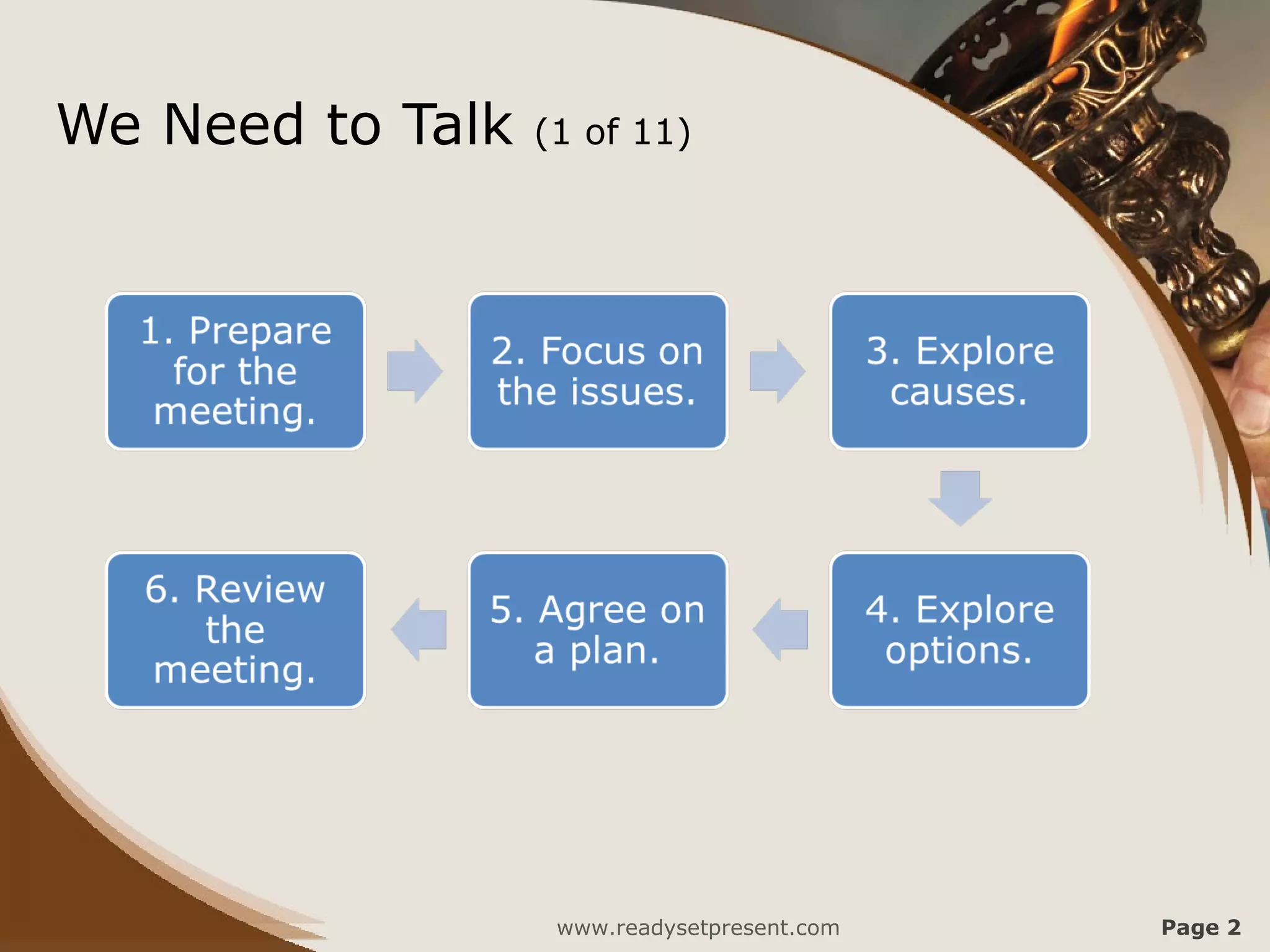
We Need to Talk   (1 of 11)


                   www.readysetpresent.com   Page 2
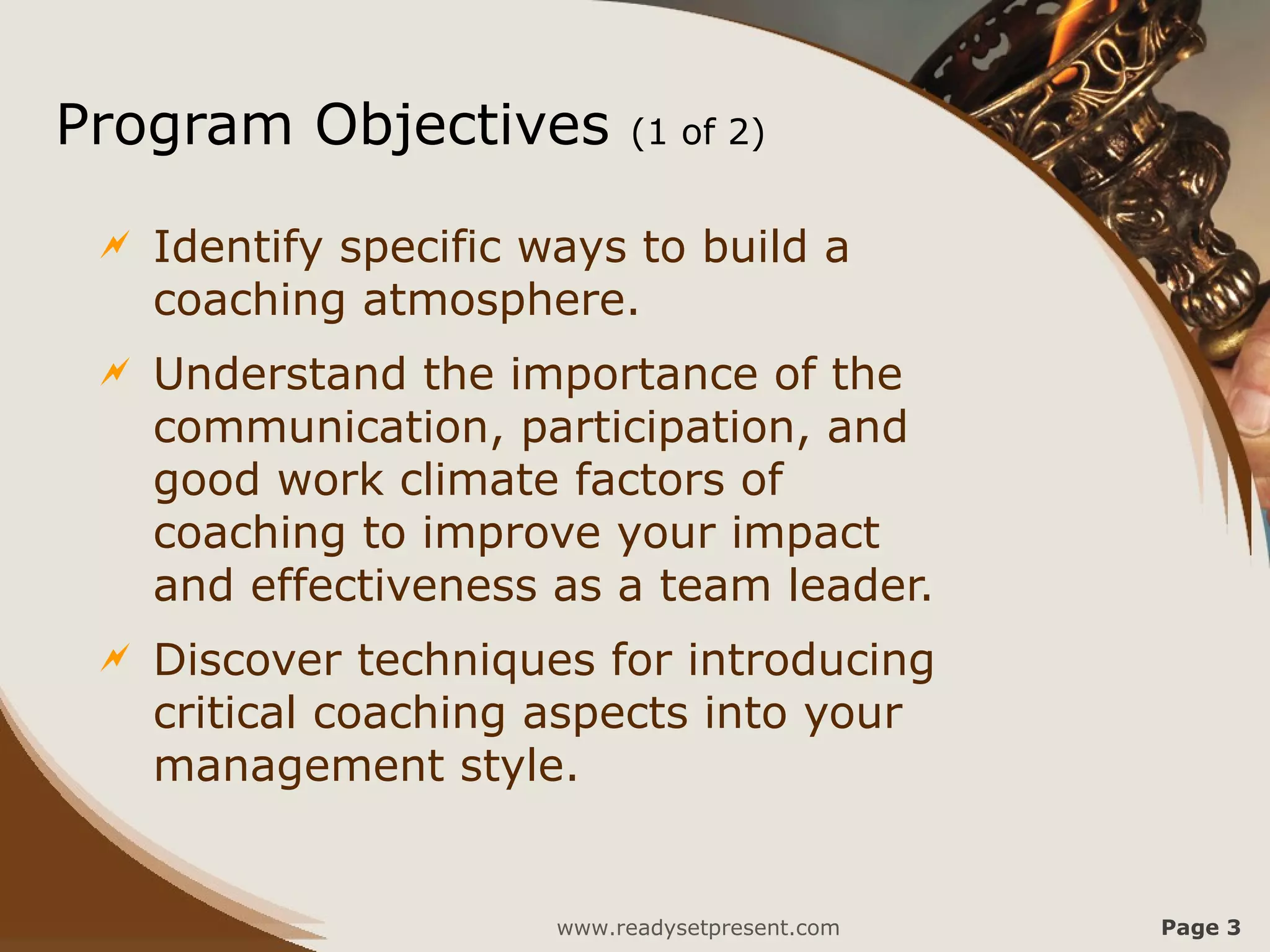
Program Objectives           (1 of 2)


    Identify specific ways to build a
     coaching atmosphere.
    Understand the importance of the
     communication, participation, and
     good work climate factors of
     coaching to improve your impact
     and effectiveness as a team leader.
    Discover techniques for introducing
     critical coaching aspects into your
     management style.


                        www.readysetpresent.com   Page 3
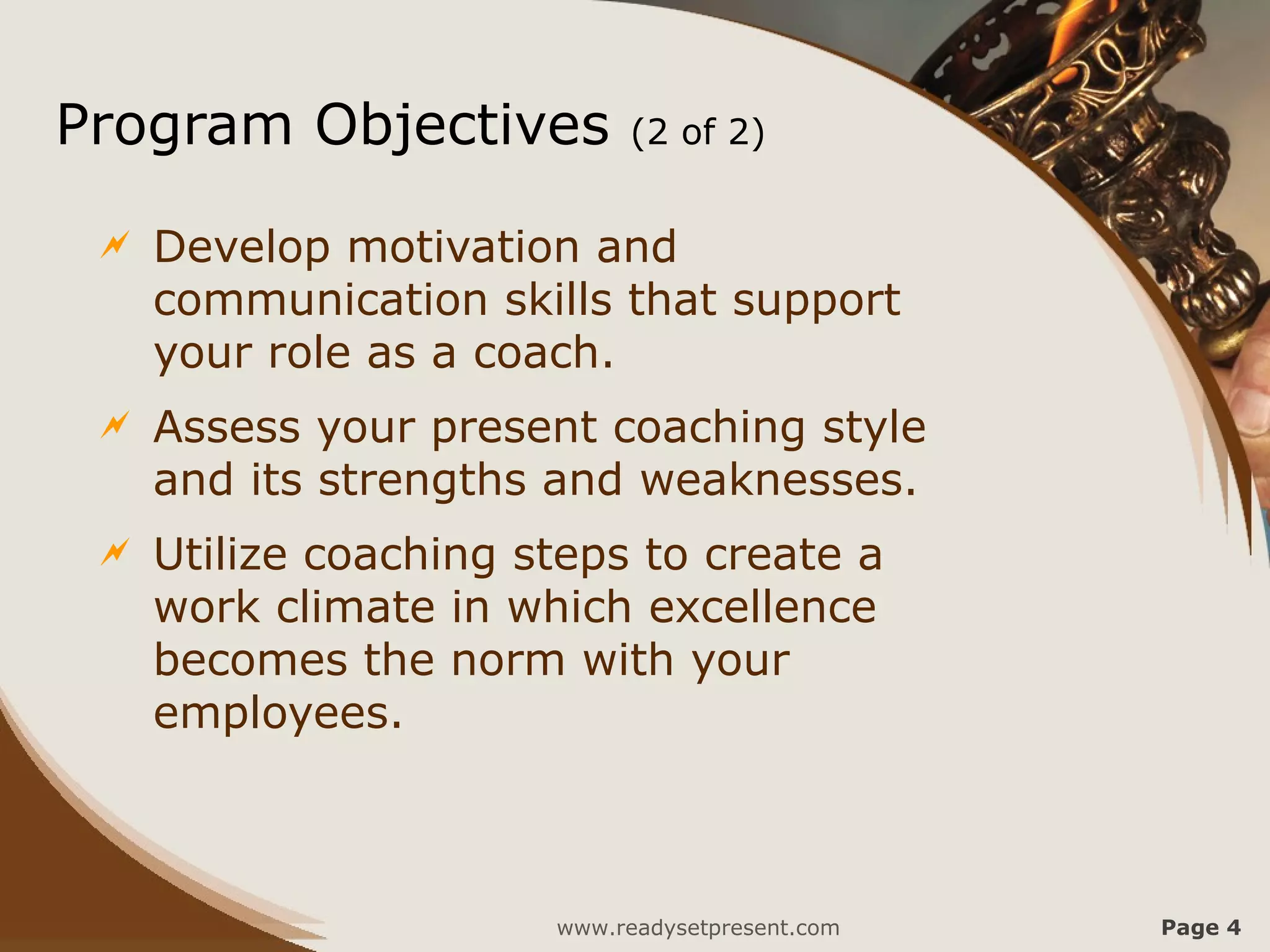
Program Objectives          (2 of 2)


    Develop motivation and
     communication skills that support
     your role as a coach.
    Assess your present coaching style
     and its strengths and weaknesses.
    Utilize coaching steps to create a
     work climate in which excellence
     becomes the norm with your
     employees.


                       www.readysetpresent.com   Page 4
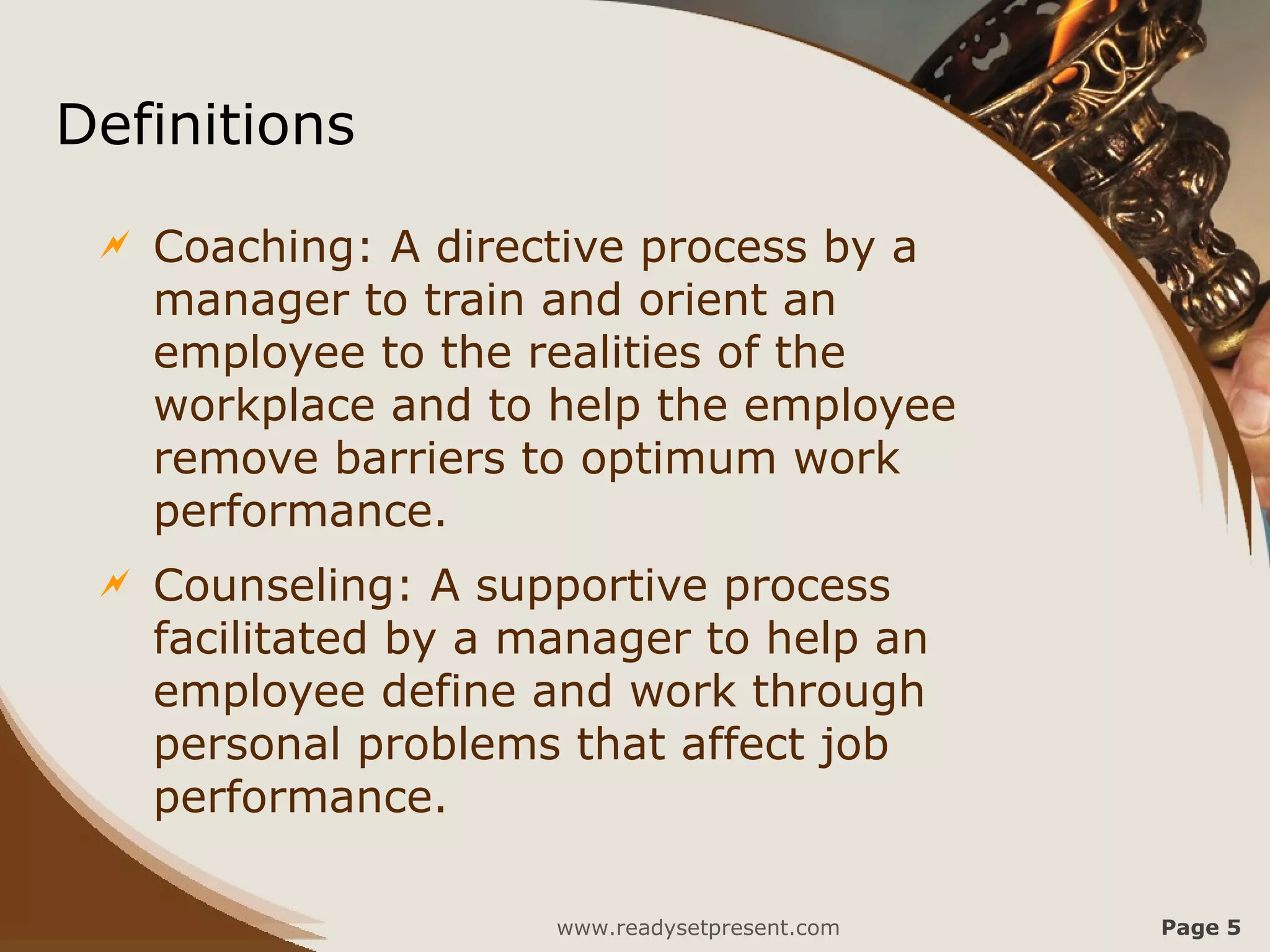
Definitions
    Coaching: A directive process by a
     manager to train and orient an
     employee to the realities of the
     workplace and to help the employee
     remove barriers to optimum work
     performance.
    Counseling: A supportive process
     facilitated by a manager to help an
     employee define and work through
     personal problems that affect job
     performance.

                       www.readysetpresent.com   Page 5
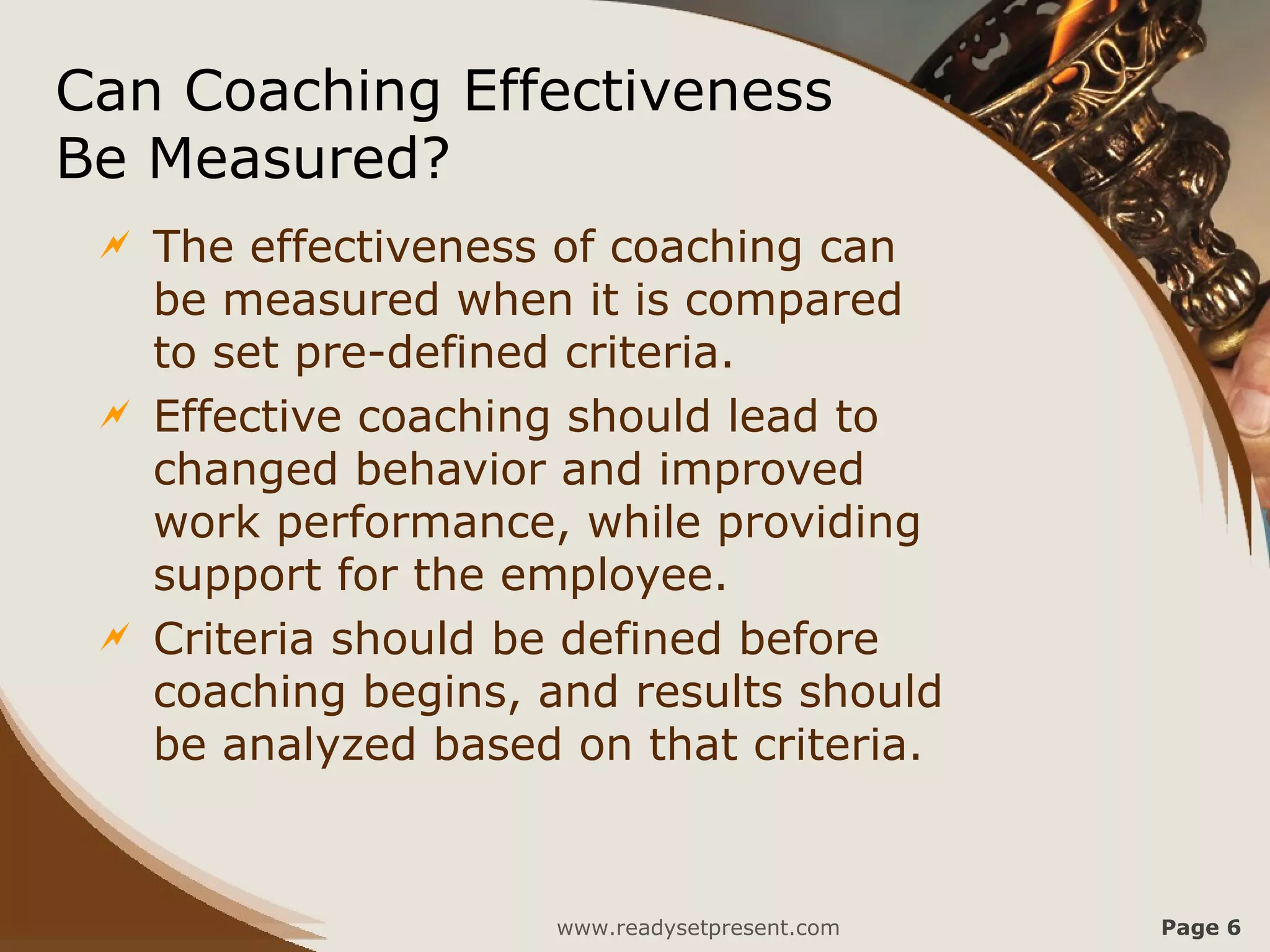
Can Coaching Effectiveness
Be Measured?
  The effectiveness of coaching can
   be measured when it is compared
   to set pre-defined criteria.
  Effective coaching should lead to
   changed behavior and improved
   work performance, while providing
   support for the employee.
  Criteria should be defined before
   coaching begins, and results should
   be analyzed based on that criteria.


                     www.readysetpresent.com   Page 6
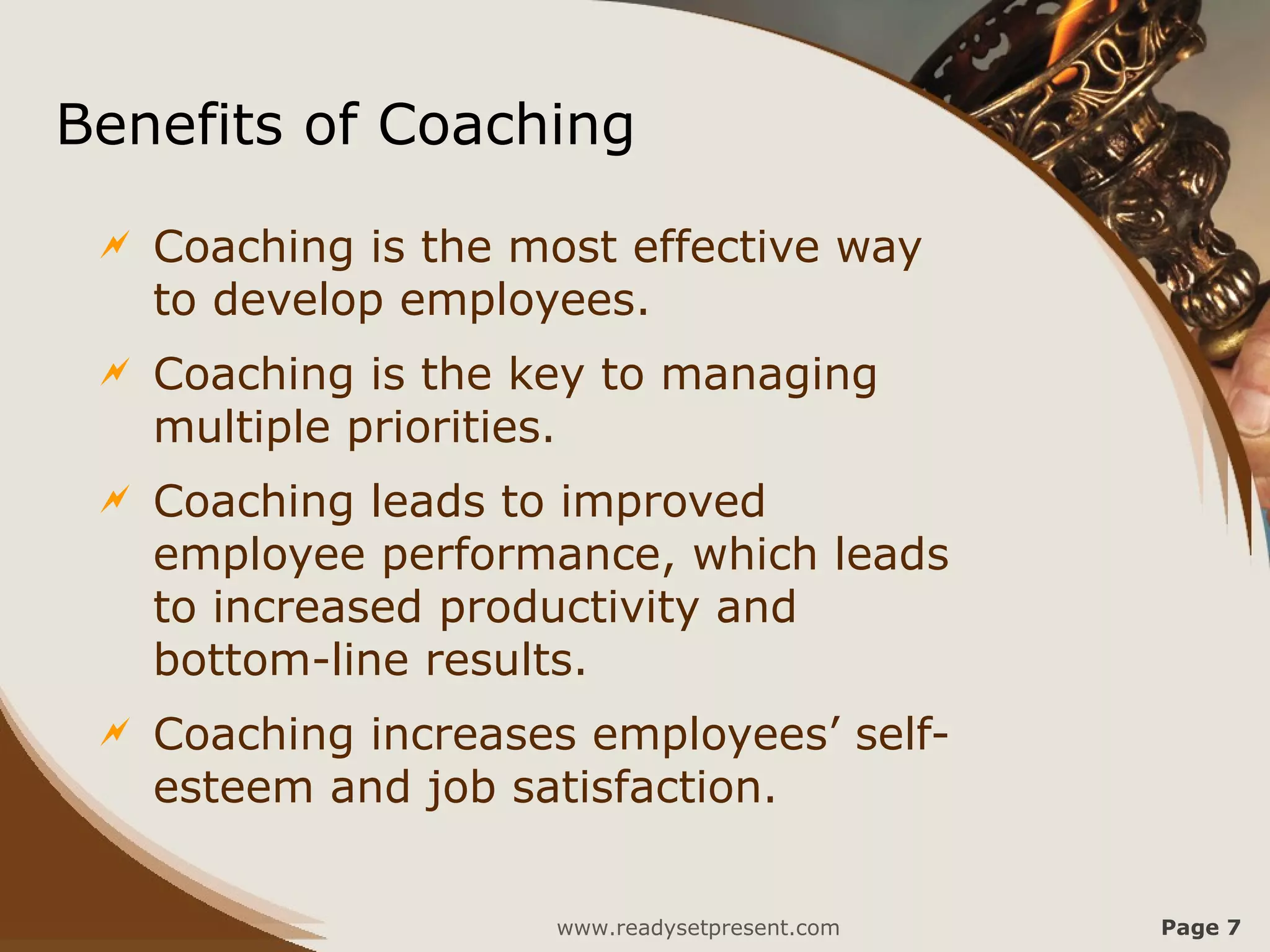
Benefits of Coaching
    Coaching is the most effective way
     to develop employees.
    Coaching is the key to managing
     multiple priorities.
    Coaching leads to improved
     employee performance, which leads
     to increased productivity and
     bottom-line results.
    Coaching increases employees’ self-
     esteem and job satisfaction.


                      www.readysetpresent.com   Page 7
Three
Defensive
Behaviors


            www.readysetpresent.com   Page 8
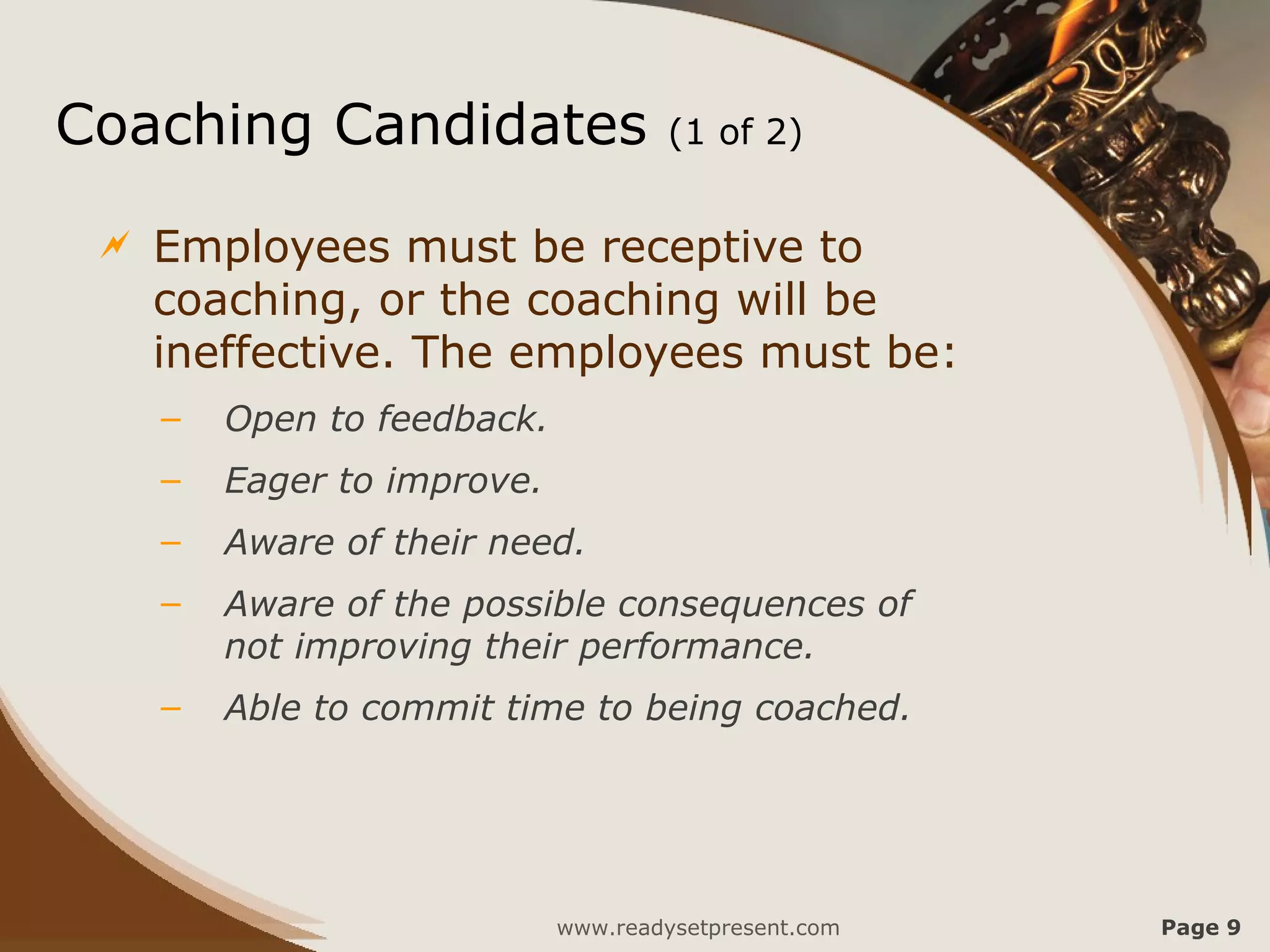
Coaching Candidates                   (1 of 2)


    Employees must be receptive to
     coaching, or the coaching will be
     ineffective. The employees must be:
     –   Open to feedback.
     –   Eager to improve.
     –   Aware of their need.
     –   Aware of the possible consequences of
         not improving their performance.
     –   Able to commit time to being coached.


                             www.readysetpresent.com   Page 9
We Need
    to Talk

www.readysetpresent.com   Page 10
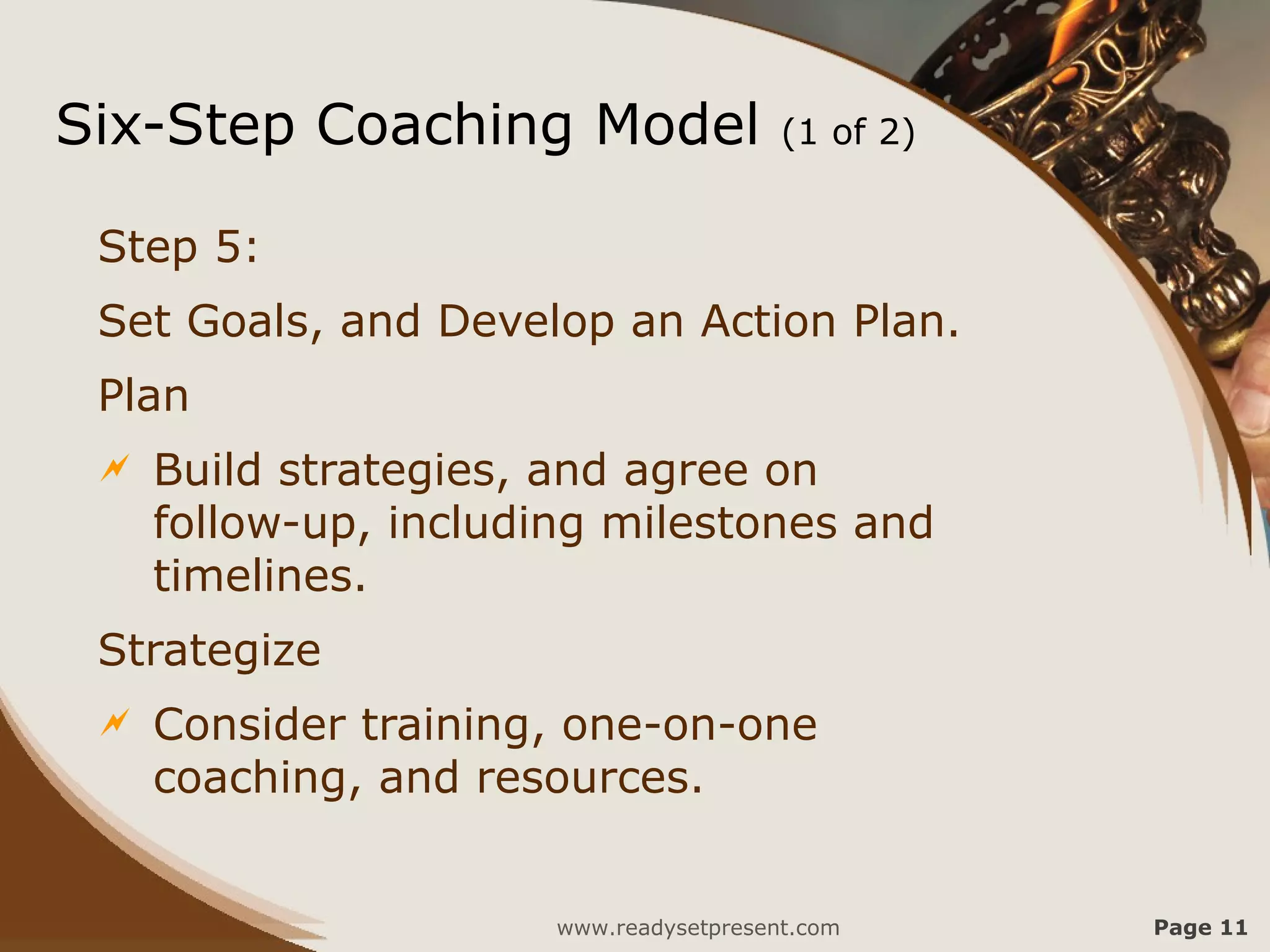
Six-Step Coaching Model                  (1 of 2)


 Step 5:
 Set Goals, and Develop an Action Plan.
 Plan
    Build strategies, and agree on
     follow-up, including milestones and
     timelines.
 Strategize
    Consider training, one-on-one
     coaching, and resources.


                       www.readysetpresent.com      Page 11
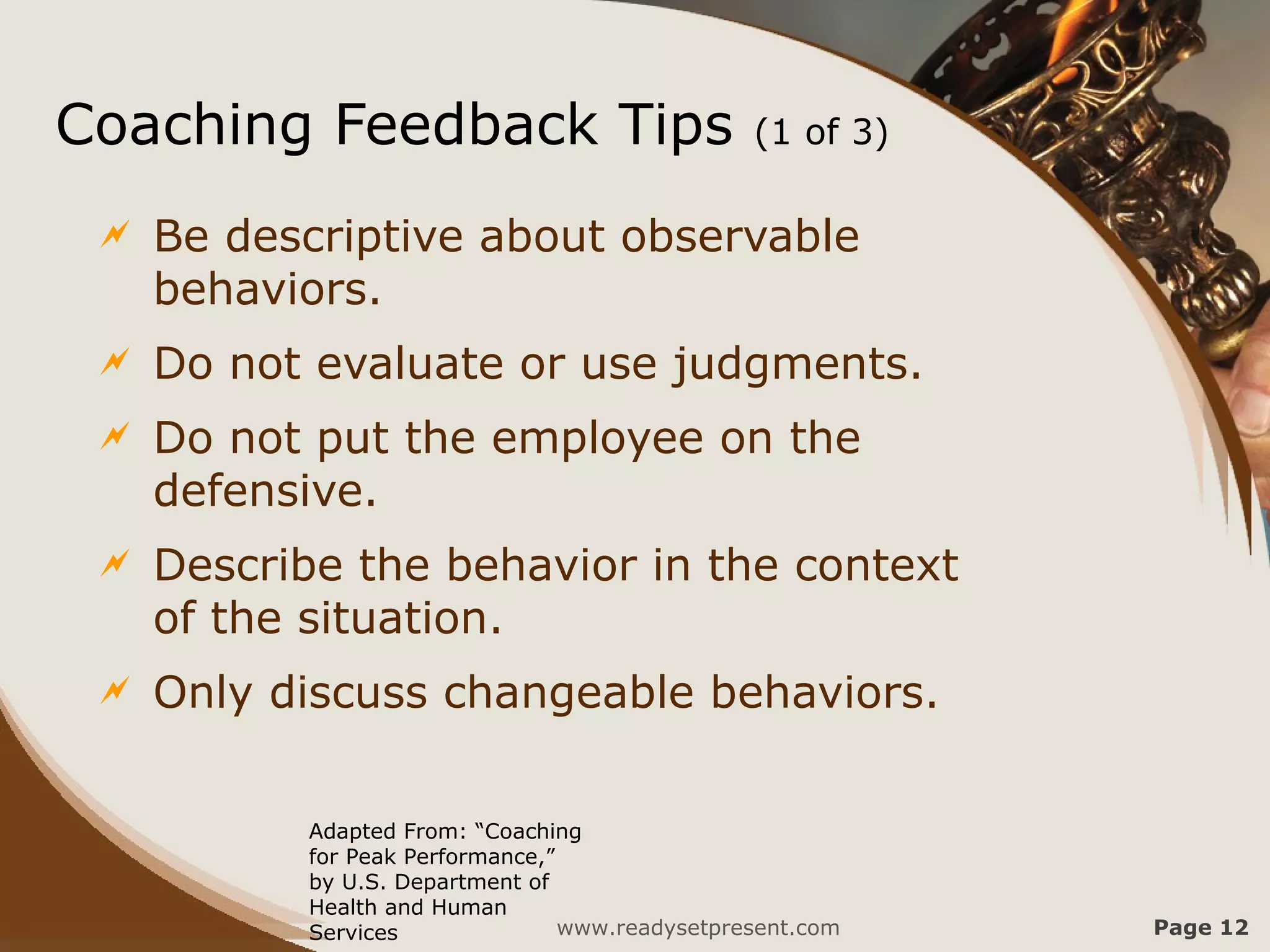
Coaching Feedback Tips                           (1 of 3)

    Be descriptive about observable
     behaviors.
    Do not evaluate or use judgments.
    Do not put the employee on the
     defensive.
    Describe the behavior in the context
     of the situation.
    Only discuss changeable behaviors.

           Adapted From: “Coaching
           for Peak Performance,”
           by U.S. Department of
           Health and Human
           Services               www.readysetpresent.com   Page 12
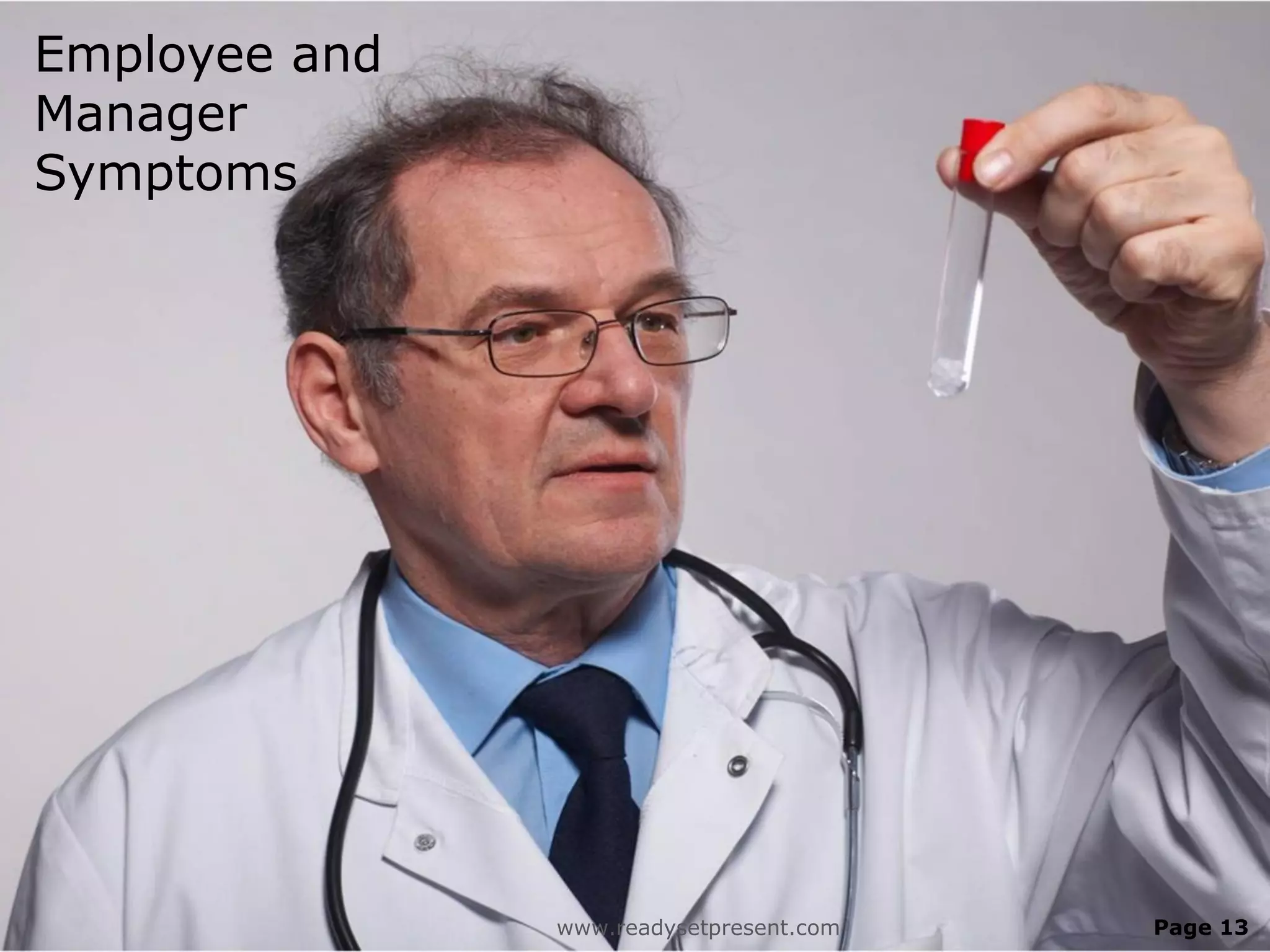
Employee and
Manager
Symptoms


               www.readysetpresent.com   Page 13
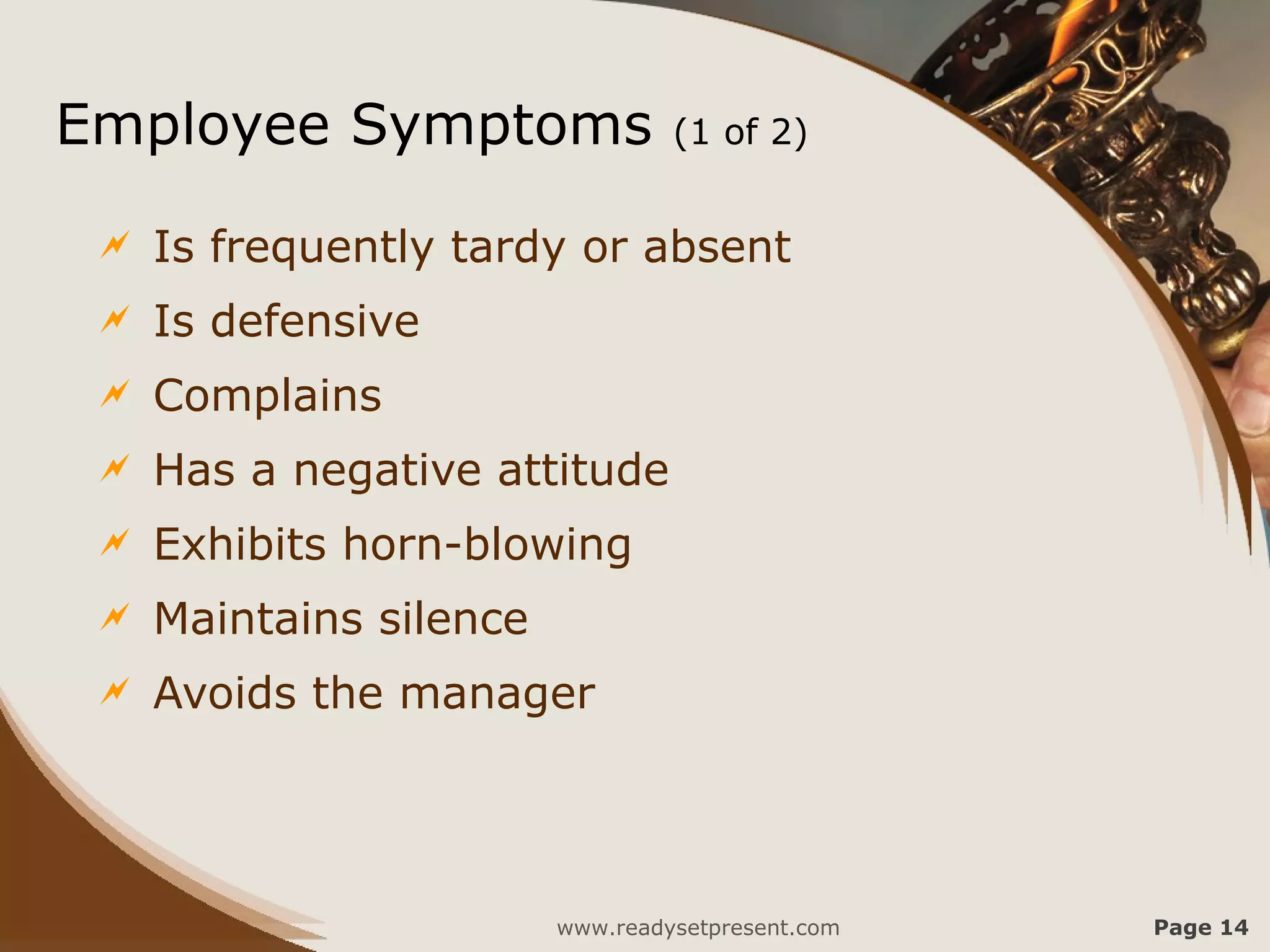
Employee Symptoms                 (1 of 2)


    Is frequently tardy or absent
    Is defensive
    Complains
    Has a negative attitude
    Exhibits horn-blowing
    Maintains silence
    Avoids the manager


                         www.readysetpresent.com   Page 14
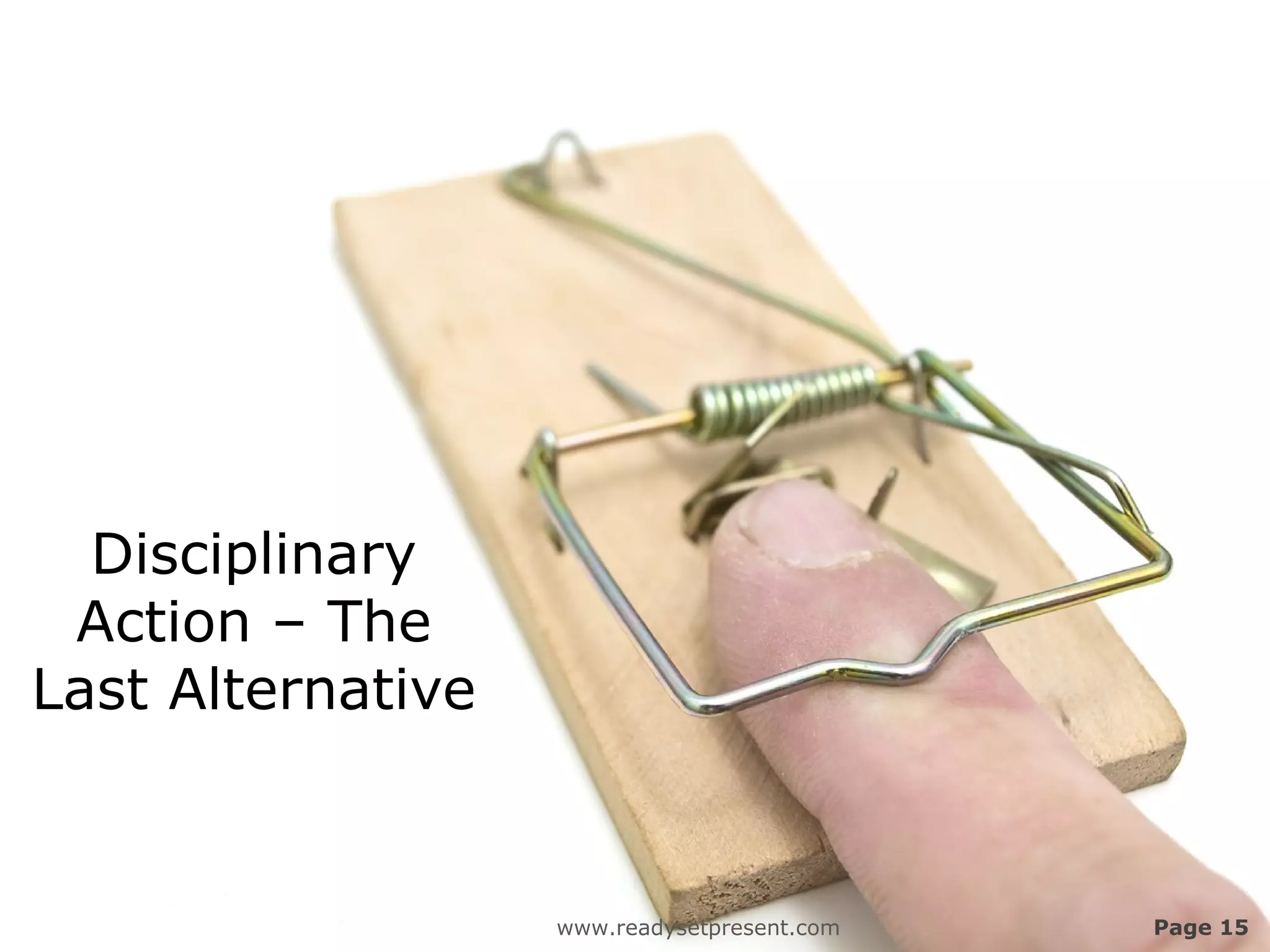
Disciplinary
 Action – The
Last Alternative


                   www.readysetpresent.com   Page 15
Steps in Disciplinary Action
(3 of 3)

     Updates to HR and the manager’s
      manager
     Termination discussion
      –    For a termination resulting from poor
           performance to occur, the manager must
           have a minimum of one counseling
           session per week.


                            www.readysetpresent.com   Page 16
What is
                      your next
                        step?


www.readysetpresent.com       Page 17
Download “Coaching”
                  PowerPoint presentation
                 at ReadySetPresent.com
145 slides include: 6 points on the untraditional approach, 10 uses for
 coaching, 3 points on measurement of effective coaching, slides on the
  characteristics and skills of coaches, the benefits of coaching, 3 points
    on defensive behaviors, 7 points on what coaching is, 11 points on
 coach characteristics, 10 slides on “We Need to Talk”, 4 slides on closed
 questions made open, 13 coaching guidelines, 7 points on the causes of
  poor performance, 12 points on coaching candidates, 5 points on goal
   setting, Kirkpatrick's 4 level model, 13 points on avoiding coaching
  pitfalls, Six-step coaching model with in-depth descriptions, An eight-
 step coaching model 6 slides on modeling coaching behavior, 14 tips on
feedback, 2 slides on 1-miute praising, 3 slides on 1-minute reprimands,
 3 slides on steps in disciplinary action, 5 slides on role-playing, 8 points
      on observer guidelines, learning how to utilize open and closed
       questions, 4 slides on action steps, how to's and much more.


        Royalty Free - Use Them Over and Over Again.
              Updated & Expanded 2013
       Now: more content, graphics, and diagrams

                                      www.readysetpresent.com                   Page 18

Coaching PowerPoint PPT Content Modern Sample

  • 1.
  • 2.
    We Need toTalk (1 of 11) www.readysetpresent.com Page 2
  • 3.
    Program Objectives (1 of 2)  Identify specific ways to build a coaching atmosphere.  Understand the importance of the communication, participation, and good work climate factors of coaching to improve your impact and effectiveness as a team leader.  Discover techniques for introducing critical coaching aspects into your management style. www.readysetpresent.com Page 3
  • 4.
    Program Objectives (2 of 2)  Develop motivation and communication skills that support your role as a coach.  Assess your present coaching style and its strengths and weaknesses.  Utilize coaching steps to create a work climate in which excellence becomes the norm with your employees. www.readysetpresent.com Page 4
  • 5.
    Definitions  Coaching: A directive process by a manager to train and orient an employee to the realities of the workplace and to help the employee remove barriers to optimum work performance.  Counseling: A supportive process facilitated by a manager to help an employee define and work through personal problems that affect job performance. www.readysetpresent.com Page 5
  • 6.
    Can Coaching Effectiveness BeMeasured?  The effectiveness of coaching can be measured when it is compared to set pre-defined criteria.  Effective coaching should lead to changed behavior and improved work performance, while providing support for the employee.  Criteria should be defined before coaching begins, and results should be analyzed based on that criteria. www.readysetpresent.com Page 6
  • 7.
    Benefits of Coaching  Coaching is the most effective way to develop employees.  Coaching is the key to managing multiple priorities.  Coaching leads to improved employee performance, which leads to increased productivity and bottom-line results.  Coaching increases employees’ self- esteem and job satisfaction. www.readysetpresent.com Page 7
  • 8.
    Three Defensive Behaviors www.readysetpresent.com Page 8
  • 9.
    Coaching Candidates (1 of 2)  Employees must be receptive to coaching, or the coaching will be ineffective. The employees must be: – Open to feedback. – Eager to improve. – Aware of their need. – Aware of the possible consequences of not improving their performance. – Able to commit time to being coached. www.readysetpresent.com Page 9
  • 10.
    We Need to Talk www.readysetpresent.com Page 10
  • 11.
    Six-Step Coaching Model (1 of 2) Step 5: Set Goals, and Develop an Action Plan. Plan  Build strategies, and agree on follow-up, including milestones and timelines. Strategize  Consider training, one-on-one coaching, and resources. www.readysetpresent.com Page 11
  • 12.
    Coaching Feedback Tips (1 of 3)  Be descriptive about observable behaviors.  Do not evaluate or use judgments.  Do not put the employee on the defensive.  Describe the behavior in the context of the situation.  Only discuss changeable behaviors. Adapted From: “Coaching for Peak Performance,” by U.S. Department of Health and Human Services www.readysetpresent.com Page 12
  • 13.
    Employee and Manager Symptoms www.readysetpresent.com Page 13
  • 14.
    Employee Symptoms (1 of 2)  Is frequently tardy or absent  Is defensive  Complains  Has a negative attitude  Exhibits horn-blowing  Maintains silence  Avoids the manager www.readysetpresent.com Page 14
  • 15.
    Disciplinary Action –The Last Alternative www.readysetpresent.com Page 15
  • 16.
    Steps in DisciplinaryAction (3 of 3)  Updates to HR and the manager’s manager  Termination discussion – For a termination resulting from poor performance to occur, the manager must have a minimum of one counseling session per week. www.readysetpresent.com Page 16
  • 17.
    What is your next step? www.readysetpresent.com Page 17
  • 18.
    Download “Coaching” PowerPoint presentation at ReadySetPresent.com 145 slides include: 6 points on the untraditional approach, 10 uses for coaching, 3 points on measurement of effective coaching, slides on the characteristics and skills of coaches, the benefits of coaching, 3 points on defensive behaviors, 7 points on what coaching is, 11 points on coach characteristics, 10 slides on “We Need to Talk”, 4 slides on closed questions made open, 13 coaching guidelines, 7 points on the causes of poor performance, 12 points on coaching candidates, 5 points on goal setting, Kirkpatrick's 4 level model, 13 points on avoiding coaching pitfalls, Six-step coaching model with in-depth descriptions, An eight- step coaching model 6 slides on modeling coaching behavior, 14 tips on feedback, 2 slides on 1-miute praising, 3 slides on 1-minute reprimands, 3 slides on steps in disciplinary action, 5 slides on role-playing, 8 points on observer guidelines, learning how to utilize open and closed questions, 4 slides on action steps, how to's and much more. Royalty Free - Use Them Over and Over Again. Updated & Expanded 2013 Now: more content, graphics, and diagrams www.readysetpresent.com Page 18