Downloaded 1,155 times
![Coaching your
Photo by Ashraful Kadir [link]
employees
Ed Batista
March 20, 2014
An HBR Exchange Webinar](https://image.slidesharecdn.com/ed-batista-coaching-your-employees-2014-03-20-140320132134-phpapp02/85/Coaching-Your-Employees-March-2014-1-320.jpg)


![Agenda
The headline
Leadership roles
When coaching works (& when it doesn’t)
Coaching tools
Coaching traps
Putting it into practice
Photo by Theresa Thompson [link]](https://image.slidesharecdn.com/ed-batista-coaching-your-employees-2014-03-20-140320132134-phpapp02/85/Coaching-Your-Employees-March-2014-4-320.jpg)
![The headline
Coaching is an essential leadership role…
…that can result in huge benefits
…but it’s not an all-purpose tool
…& it requires specific skills
Photo by Garry Knight [link]](https://image.slidesharecdn.com/ed-batista-coaching-your-employees-2014-03-20-140320132134-phpapp02/85/Coaching-Your-Employees-March-2014-5-320.jpg)
![Leadership roles
Photo by Keoni Cabral [link]](https://image.slidesharecdn.com/ed-batista-coaching-your-employees-2014-03-20-140320132134-phpapp02/85/Coaching-Your-Employees-March-2014-6-320.jpg)


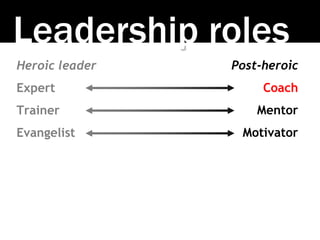
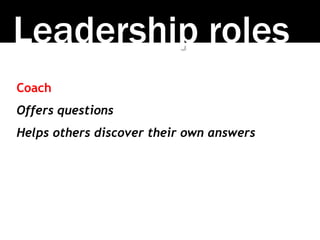


![When does
Photo by Antony Stanley [link]
coaching work?](https://image.slidesharecdn.com/ed-batista-coaching-your-employees-2014-03-20-140320132134-phpapp02/85/Coaching-Your-Employees-March-2014-16-320.jpg)


![When does
Photo by Ed Yourdon [link]
coaching not work?](https://image.slidesharecdn.com/ed-batista-coaching-your-employees-2014-03-20-140320132134-phpapp02/85/Coaching-Your-Employees-March-2014-20-320.jpg)


![Coaching tools
Photo by zzpza [link]](https://image.slidesharecdn.com/ed-batista-coaching-your-employees-2014-03-20-140320132134-phpapp02/85/Coaching-Your-Employees-March-2014-28-320.jpg)

![Carol Dweck
Perceptions shape reality
How do we perceive our abilities?
How do we perceive our mistakes?
Mindset
Photo by Mike Disharoon [link]](https://image.slidesharecdn.com/ed-batista-coaching-your-employees-2014-03-20-140320132134-phpapp02/85/Coaching-Your-Employees-March-2014-30-320.jpg)
![Talent & intelligence
are inherent traits
Mistakes are failures or
character flaws
Negative emotional
response to mistakes
Talent & intelligence
can be developed
Mistakes are learning
opportunities
Pay close attention to
mistakes & learn
more
Fixed Growth
Mindset
Adapted from Carol Dweck [link]](https://image.slidesharecdn.com/ed-batista-coaching-your-employees-2014-03-20-140320132134-phpapp02/85/Coaching-Your-Employees-March-2014-31-320.jpg)
![A coaching
mindset
Photo by Andrew Yee [link]](https://image.slidesharecdn.com/ed-batista-coaching-your-employees-2014-03-20-140320132134-phpapp02/85/Coaching-Your-Employees-March-2014-32-320.jpg)
![A coaching
mindset
Growth mindset applied to employees
Emphasis on learning
Support + challenge
Empathy + accountability
Not trying to “fix”
Adapted from Hunt & Weintraub [link]](https://image.slidesharecdn.com/ed-batista-coaching-your-employees-2014-03-20-140320132134-phpapp02/85/Coaching-Your-Employees-March-2014-33-320.jpg)
![Listening skills
Photo by Ed Yourdon [link]](https://image.slidesharecdn.com/ed-batista-coaching-your-employees-2014-03-20-140320132134-phpapp02/85/Coaching-Your-Employees-March-2014-34-320.jpg)

![Powerful
Photo by Erik Charlton [link]
questions](https://image.slidesharecdn.com/ed-batista-coaching-your-employees-2014-03-20-140320132134-phpapp02/85/Coaching-Your-Employees-March-2014-36-320.jpg)

![Modes of inquiry
Photo by Garry Knight [link]](https://image.slidesharecdn.com/ed-batista-coaching-your-employees-2014-03-20-140320132134-phpapp02/85/Coaching-Your-Employees-March-2014-38-320.jpg)


![Modes of inquiry
Pure inquiry
Starts with receptivity (even silence)
Key is avoiding presumptive questions
Adapted from Edgar Schein [link]](https://image.slidesharecdn.com/ed-batista-coaching-your-employees-2014-03-20-140320132134-phpapp02/85/Coaching-Your-Employees-March-2014-42-320.jpg)
![Modes of inquiry
Pure inquiry
Diagnostic inquiry
Focus & redirect
Feelings, motives, actions
Adapted from Edgar Schein [link]](https://image.slidesharecdn.com/ed-batista-coaching-your-employees-2014-03-20-140320132134-phpapp02/85/Coaching-Your-Employees-March-2014-43-320.jpg)
![Modes of inquiry
Pure inquiry
Diagnostic inquiry
Confrontational inquiry
Introduces new ideas & hypotheses
Substitutes the coach’s narrative
Adapted from Edgar Schein [link]](https://image.slidesharecdn.com/ed-batista-coaching-your-employees-2014-03-20-140320132134-phpapp02/85/Coaching-Your-Employees-March-2014-44-320.jpg)
![Modes of inquiry
Pure inquiry
Diagnostic inquiry
Confrontational inquiry
Process inquiry
Focus on the coaching relationship
Infrequent but essential
Adapted from Edgar Schein [link]](https://image.slidesharecdn.com/ed-batista-coaching-your-employees-2014-03-20-140320132134-phpapp02/85/Coaching-Your-Employees-March-2014-45-320.jpg)
![Emotion
Photo by Ed Yourdon [link]
management](https://image.slidesharecdn.com/ed-batista-coaching-your-employees-2014-03-20-140320132134-phpapp02/85/Coaching-Your-Employees-March-2014-46-320.jpg)

![Emotion
management
Reasoning = just the tip of the iceberg
Emotions = vaster, faster, more powerful
Work in concert, not in opposition
(Not always)
Photo by NOAA [link]](https://image.slidesharecdn.com/ed-batista-coaching-your-employees-2014-03-20-140320132134-phpapp02/85/Coaching-Your-Employees-March-2014-48-320.jpg)
![Emotion
management
Regulation ≠ suppression
Emotions convey emphasis
Emotional experiences stick
Photo by NOAA [link]](https://image.slidesharecdn.com/ed-batista-coaching-your-employees-2014-03-20-140320132134-phpapp02/85/Coaching-Your-Employees-March-2014-49-320.jpg)

![Effective
feedback
Photo by Ana Karenina [link]](https://image.slidesharecdn.com/ed-batista-coaching-your-employees-2014-03-20-140320132134-phpapp02/85/Coaching-Your-Employees-March-2014-51-320.jpg)


![My behavior…
Actions
Statements
Non-Verbals
Needs
Motives
Intentions
Feelings
Reactions
Responses
The net
Me and my… You and your…
Photo by The Mighty Tim Inconnu [link]](https://image.slidesharecdn.com/ed-batista-coaching-your-employees-2014-03-20-140320132134-phpapp02/85/Coaching-Your-Employees-March-2014-56-320.jpg)
![The net
Stay on our side of the net
Focus on observed behavior
Disclose our response
When you do [X], I feel [Y].
Minimize defensive triggers
Photo by The Mighty Tim Inconnu [link]](https://image.slidesharecdn.com/ed-batista-coaching-your-employees-2014-03-20-140320132134-phpapp02/85/Coaching-Your-Employees-March-2014-57-320.jpg)
![Traps for the
coaching manager
Photo by Casey Fleser [link]](https://image.slidesharecdn.com/ed-batista-coaching-your-employees-2014-03-20-140320132134-phpapp02/85/Coaching-Your-Employees-March-2014-58-320.jpg)
![Traps for the
coaching manager
Giving advice prematurely
Overpowering resistance
Creating dependence
Excessive support
Insufficient support
Adapted from Edgar Schein [link]](https://image.slidesharecdn.com/ed-batista-coaching-your-employees-2014-03-20-140320132134-phpapp02/85/Coaching-Your-Employees-March-2014-59-320.jpg)
![Putting it into
practice
Photo by Erich Ferdinand [link]](https://image.slidesharecdn.com/ed-batista-coaching-your-employees-2014-03-20-140320132134-phpapp02/85/Coaching-Your-Employees-March-2014-60-320.jpg)


![Resources
Photo by See-ming Lee [link]](https://image.slidesharecdn.com/ed-batista-coaching-your-employees-2014-03-20-140320132134-phpapp02/85/Coaching-Your-Employees-March-2014-65-320.jpg)


![Thank you
Photo by Alex Guerrero [link]
Follow me @edbatista
Read more at www.edbatista.com](https://image.slidesharecdn.com/ed-batista-coaching-your-employees-2014-03-20-140320132134-phpapp02/85/Coaching-Your-Employees-March-2014-75-320.jpg)

The document discusses the importance of coaching in leadership, highlighting its benefits and the necessary skills for effective coaching. It outlines when coaching is most effective, such as for high-potential employees, and when it fails, such as with serious underperformers. Additionally, the document provides insights on coaching tools, techniques, and the potential traps for managers engaging in coaching.


