Managerial Theories
Managerial Theories
There are three basic managerial theories.
- Baumol’s Model of Sales Revenue
Maximization.
- Marris’s Theory of Managerial
Enterprise.
- Williamson’s Theory of Managerial
Discretion
Baumol’s Model of Sales Revenue
Maximization
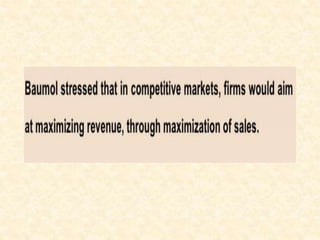
W.J.Baumol suggested
“Sale Revenue Maximization as an
Alternative goal to profit maximization”
Rationale of the Hypothesis
1.Managers are separated from the
ownership in modern times.
2.This has given power to managers who
pursue their own goals rather than the
goal of owners.
3.Manager ensure a minimum acceptable
level of profit to satisfy the shareholders.
But would pursue a goal which enhances
their own utility.
Why Managers attempt to
maximize sales rather than profits.
1. Incomes of top executives are closely related
to sales rather than profits.
2. Banks and financial institutions are impressed
by the amount of sales and treat this as a
good indicator of the performance of the firm.
3.Large and continuing sales enhance prestige of
the Managers, who ensure regular
distribution of dividends.
4. A steady performance with satisfactory
amount of profits is preferable to irregular
spectacular profits in some one or two years.
Having shown high profits, if the level is not
maintained, it will lead to discontent of
shareholders.
5. Large sales strengthens the competitive
power of the firm (competitors), while low or
declining sales diminishes this power.
Basic Assumption
- A firm decision making is limited to a single period.
During this period, the firm attempts to maximize
total revenue.
- Sales revenue maximization is subject to provision
of minimum required profit to ensure a fair dividend
to shareholders, thus ensuring stability of his job.
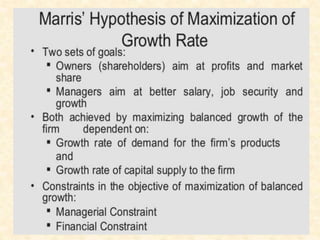
Marris’s Theory of Managerial
Enterprise.
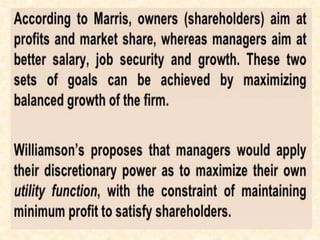
“In corporate firm, there is a structural division
of ownership and management which allows
managers to set goals which do not necessarily
confirms with those of the owners.”
Owners
The shareholders are the owners of
organizations. Their utility functions
includes variables such as:-
- Profits
- Size of output
- Size of Capital
- Market Share
- Public Image
Managers
The managers have other ideas. Their utility
function include variables such as:-
- Salaries
- Job Securities
- Power and Status
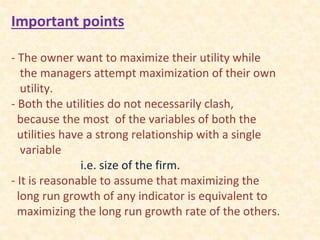
Important points
- The owner want to maximize their utility while
the managers attempt maximization of their own
utility.
- Both the utilities do not necessarily clash,
because the most of the variables of both the
utilities have a strong relationship with a single
variable
i.e. size of the firm.
- It is reasonable to assume that maximizing the
long run growth of any indicator is equivalent to
maximizing the long run growth rate of the others.
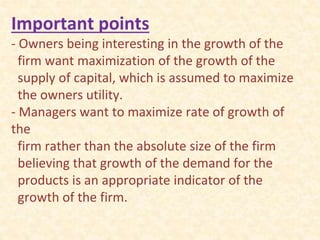
Important points
- Owners being interesting in the growth of the
firm want maximization of the growth of the
supply of capital, which is assumed to maximize
the owners utility.
- Managers want to maximize rate of growth of
the
firm rather than the absolute size of the firm
believing that growth of the demand for the
products is an appropriate indicator of the
growth of the firm.
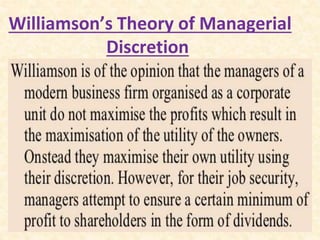
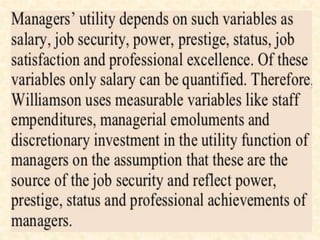
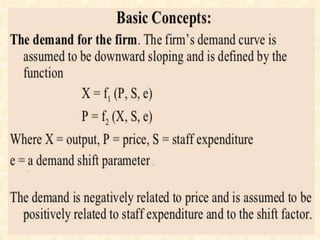
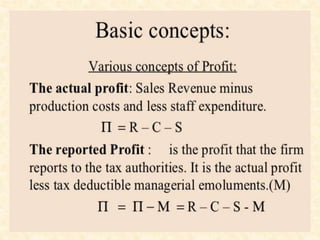
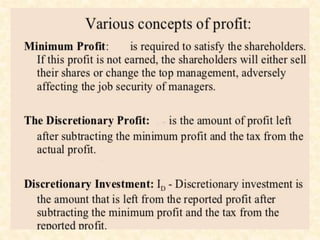
Williamson’s Theory of Managerial
Discretion
Leadership styles
Managerial theories
Managerial theories
Managerial theories

Managerial theories

  • 2.
  • 3.
    Managerial Theories There arethree basic managerial theories. - Baumol’s Model of Sales Revenue Maximization. - Marris’s Theory of Managerial Enterprise. - Williamson’s Theory of Managerial Discretion
  • 4.
    Baumol’s Model ofSales Revenue Maximization W.J.Baumol suggested “Sale Revenue Maximization as an Alternative goal to profit maximization”
  • 5.
    Rationale of theHypothesis 1.Managers are separated from the ownership in modern times. 2.This has given power to managers who pursue their own goals rather than the goal of owners. 3.Manager ensure a minimum acceptable level of profit to satisfy the shareholders. But would pursue a goal which enhances their own utility.
  • 6.
    Why Managers attemptto maximize sales rather than profits. 1. Incomes of top executives are closely related to sales rather than profits. 2. Banks and financial institutions are impressed by the amount of sales and treat this as a good indicator of the performance of the firm. 3.Large and continuing sales enhance prestige of the Managers, who ensure regular distribution of dividends.
  • 7.
    4. A steadyperformance with satisfactory amount of profits is preferable to irregular spectacular profits in some one or two years. Having shown high profits, if the level is not maintained, it will lead to discontent of shareholders. 5. Large sales strengthens the competitive power of the firm (competitors), while low or declining sales diminishes this power.
  • 8.
    Basic Assumption - Afirm decision making is limited to a single period. During this period, the firm attempts to maximize total revenue. - Sales revenue maximization is subject to provision of minimum required profit to ensure a fair dividend to shareholders, thus ensuring stability of his job.
  • 9.
    Marris’s Theory ofManagerial Enterprise. “In corporate firm, there is a structural division of ownership and management which allows managers to set goals which do not necessarily confirms with those of the owners.”
  • 10.
    Owners The shareholders arethe owners of organizations. Their utility functions includes variables such as:- - Profits - Size of output - Size of Capital - Market Share - Public Image
  • 11.
    Managers The managers haveother ideas. Their utility function include variables such as:- - Salaries - Job Securities - Power and Status
  • 13.
    Important points - Theowner want to maximize their utility while the managers attempt maximization of their own utility. - Both the utilities do not necessarily clash, because the most of the variables of both the utilities have a strong relationship with a single variable i.e. size of the firm. - It is reasonable to assume that maximizing the long run growth of any indicator is equivalent to maximizing the long run growth rate of the others.
  • 14.
    Important points - Ownersbeing interesting in the growth of the firm want maximization of the growth of the supply of capital, which is assumed to maximize the owners utility. - Managers want to maximize rate of growth of the firm rather than the absolute size of the firm believing that growth of the demand for the products is an appropriate indicator of the growth of the firm.
  • 15.
    Williamson’s Theory ofManagerial Discretion
  • 34.