The IOP Criteria
www.ibscrewed.or
What is IOP?
IOP is the Individual Oral Presentation
You choose texts from Part 4 of the English
syllabus and do a presentation on a topic of your
choice.
The presentation can be in the form of an oral
essay, role play, etc. It is very open.
You may focus on anything from characterisation,
to cultural setting, themes, techniques and style.
Knowledge and
Understanding
How well does the candidate know and understand the
content of the extract or works?
Thorough knowledge and understanding of
the context of the extract or works
Ensure that you read and re-read your texts.
Do background research and wider research on the texts
Discuss purpose and effect for all the literary devices
Gain a good, wide understanding of the works and things
you talk about so that you can answer questions
Don’t include irrelevant quotes and material to the topic
In your analysis, make the author active by discussing their
intentions, etc
Discuss things in depth – don’t be superficial
Get someone who knows the texts to ask you questions
How well does the candidate situate the extract or
works within the context of the larger work from
which it has been taken or the body of works to
which it belongs, where relevant?
Precise knowledge of the appropriate
context of the extract or works, where
relevant
When using an extract, understand and explain what
happens before and after the extract
Show the extract is important with the text
Discuss the background of the life of the author
Consider the cultural context in your points
Criterion B –
Interpretation and Personal Response
How valid is the candidate’s interpretation of the
extract or works?
Excellent, valid interpretation of the thought and
feeling expressed in the extract or works,
including a considered critical response where
appropriate
Don’t try to analyse in an overly abstract way
Interpret the way it makes sense
Research the author’s life and other works to get an
understanding of common themes
Consider what the author wanted to achieve
Present a clear interpretation of what you believe the
author is showing to back up your argument
Conduct your background research
How well has the candidate identified and
analysed the effects of literary features in the
extract or works, such as diction, imagery, tone,
structure, style and technique?
Clear awareness and analysis of the effects of
the literary features of the extract or works
Name the literary features
Explain the effect they have on readers
o Why did the author put them there?
Look at a range of literary devices
Make a thorough response to the thesis/ question
Make a table with columns ‘quote,’ ‘literary device’ and
‘meaning’ – help to identify intent, etc
Use SCASI [Setting, Characters, Action, Style and
Ideas
To what extent does the candidate’s response
show critical thinking and originality?
Don’t simply go for the obvious topic, literary features,
etc
Look deeply into the work and meaning
When using other resources to help analyse the text,
do not limit yourself to the ideas and other literary
devices they identify – there is more!
Clear argument in the thesis statement
How precise and relevant are the candidate’s
references to the extract or works?
The response is well-supported by accurate
and relevant references to the extract or
works
Use quotes to back up what you are saying
Make sure the quotes are relevant and concise
Pick the quotes that best fit your topic and the point
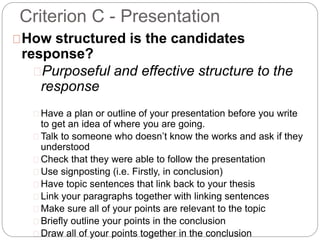
Criterion C - Presentation
How structured is the candidates
response?
Purposeful and effective structure to the
response
Have a plan or outline of your presentation before you write
to get an idea of where you are going.
Talk to someone who doesn’t know the works and ask if they
understood
Check that they were able to follow the presentation
Use signposting (i.e. Firstly, in conclusion)
Have topic sentences that link back to your thesis
Link your paragraphs together with linking sentences
Make sure all of your points are relevant to the topic
Briefly outline your points in the conclusion
Draw all of your points together in the conclusion
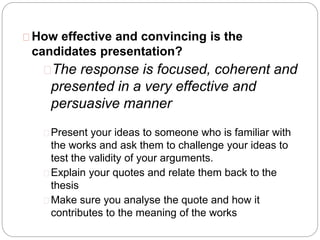
How effective and convincing is the
candidates presentation?
The response is focused, coherent and
presented in a very effective and
persuasive manner
Present your ideas to someone who is familiar with
the works and ask them to challenge your ideas to
test the validity of your arguments.
Explain your quotes and relate them back to the
thesis
Make sure you analyse the quote and how it
contributes to the meaning of the works
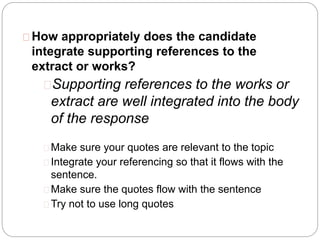
How appropriately does the candidate
integrate supporting references to the
extract or works?
Supporting references to the works or
extract are well integrated into the body
of the response
Make sure your quotes are relevant to the topic
Integrate your referencing so that it flows with the
sentence.
Make sure the quotes flow with the sentence
Try not to use long quotes
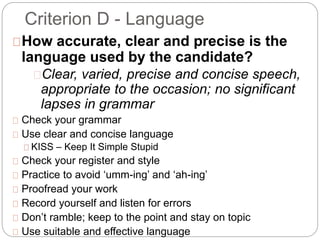
Criterion D - Language
How accurate, clear and precise is the
language used by the candidate?
Clear, varied, precise and concise speech,
appropriate to the occasion; no significant
lapses in grammar
Check your grammar
Use clear and concise language
KISS – Keep It Simple Stupid
Check your register and style
Practice to avoid ‘umm-ing’ and ‘ah-ing’
Proofread your work
Record yourself and listen for errors
Don’t ramble; keep to the point and stay on topic
Use suitable and effective language
How appropriate is the candidate’s choice of
register and style for the occasion, including
vocabulary, tone, sentence structure and idiom
An effective choice of register and style;
precise use of wide vocabulary
Use a thesaurus to find new words and vary your
vocabulary
Check that your register suits the type of
presentation your are doing
Have a good introduction and conclusion, and topic
sentences
Literary terms taken in the widest possible sense
– novel, play, poem, persona, character, narrator
Literary terms used appropriately
Use and name literary devices
Check that you have correctly identified them
Good luck!!

The IOP criteria

  • 1.
  • 2.
    What is IOP? IOPis the Individual Oral Presentation You choose texts from Part 4 of the English syllabus and do a presentation on a topic of your choice. The presentation can be in the form of an oral essay, role play, etc. It is very open. You may focus on anything from characterisation, to cultural setting, themes, techniques and style.
  • 3.
    Knowledge and Understanding How welldoes the candidate know and understand the content of the extract or works? Thorough knowledge and understanding of the context of the extract or works Ensure that you read and re-read your texts. Do background research and wider research on the texts Discuss purpose and effect for all the literary devices Gain a good, wide understanding of the works and things you talk about so that you can answer questions Don’t include irrelevant quotes and material to the topic In your analysis, make the author active by discussing their intentions, etc Discuss things in depth – don’t be superficial Get someone who knows the texts to ask you questions
  • 4.
    How well doesthe candidate situate the extract or works within the context of the larger work from which it has been taken or the body of works to which it belongs, where relevant? Precise knowledge of the appropriate context of the extract or works, where relevant When using an extract, understand and explain what happens before and after the extract Show the extract is important with the text Discuss the background of the life of the author Consider the cultural context in your points
  • 5.
    Criterion B – Interpretationand Personal Response How valid is the candidate’s interpretation of the extract or works? Excellent, valid interpretation of the thought and feeling expressed in the extract or works, including a considered critical response where appropriate Don’t try to analyse in an overly abstract way Interpret the way it makes sense Research the author’s life and other works to get an understanding of common themes Consider what the author wanted to achieve Present a clear interpretation of what you believe the author is showing to back up your argument Conduct your background research
  • 6.
    How well hasthe candidate identified and analysed the effects of literary features in the extract or works, such as diction, imagery, tone, structure, style and technique? Clear awareness and analysis of the effects of the literary features of the extract or works Name the literary features Explain the effect they have on readers o Why did the author put them there? Look at a range of literary devices Make a thorough response to the thesis/ question Make a table with columns ‘quote,’ ‘literary device’ and ‘meaning’ – help to identify intent, etc Use SCASI [Setting, Characters, Action, Style and Ideas
  • 7.
    To what extentdoes the candidate’s response show critical thinking and originality? Don’t simply go for the obvious topic, literary features, etc Look deeply into the work and meaning When using other resources to help analyse the text, do not limit yourself to the ideas and other literary devices they identify – there is more! Clear argument in the thesis statement
  • 8.
    How precise andrelevant are the candidate’s references to the extract or works? The response is well-supported by accurate and relevant references to the extract or works Use quotes to back up what you are saying Make sure the quotes are relevant and concise Pick the quotes that best fit your topic and the point
  • 9.
    Criterion C -Presentation How structured is the candidates response? Purposeful and effective structure to the response Have a plan or outline of your presentation before you write to get an idea of where you are going. Talk to someone who doesn’t know the works and ask if they understood Check that they were able to follow the presentation Use signposting (i.e. Firstly, in conclusion) Have topic sentences that link back to your thesis Link your paragraphs together with linking sentences Make sure all of your points are relevant to the topic Briefly outline your points in the conclusion Draw all of your points together in the conclusion
  • 10.
    How effective andconvincing is the candidates presentation? The response is focused, coherent and presented in a very effective and persuasive manner Present your ideas to someone who is familiar with the works and ask them to challenge your ideas to test the validity of your arguments. Explain your quotes and relate them back to the thesis Make sure you analyse the quote and how it contributes to the meaning of the works
  • 11.
    How appropriately doesthe candidate integrate supporting references to the extract or works? Supporting references to the works or extract are well integrated into the body of the response Make sure your quotes are relevant to the topic Integrate your referencing so that it flows with the sentence. Make sure the quotes flow with the sentence Try not to use long quotes
  • 12.
    Criterion D -Language How accurate, clear and precise is the language used by the candidate? Clear, varied, precise and concise speech, appropriate to the occasion; no significant lapses in grammar Check your grammar Use clear and concise language KISS – Keep It Simple Stupid Check your register and style Practice to avoid ‘umm-ing’ and ‘ah-ing’ Proofread your work Record yourself and listen for errors Don’t ramble; keep to the point and stay on topic Use suitable and effective language
  • 13.
    How appropriate isthe candidate’s choice of register and style for the occasion, including vocabulary, tone, sentence structure and idiom An effective choice of register and style; precise use of wide vocabulary Use a thesaurus to find new words and vary your vocabulary Check that your register suits the type of presentation your are doing Have a good introduction and conclusion, and topic sentences
  • 14.
    Literary terms takenin the widest possible sense – novel, play, poem, persona, character, narrator Literary terms used appropriately Use and name literary devices Check that you have correctly identified them
  • 15.