Individual Oral Presentation                                                   English 11 Honors/IB
The Individual Oral Presentation is based on a work or works studied in Semester 1 of the junior year:
   o The Adventures of Huckleberry Finn
   o The Great Gatsby
   o Beloved
   o Narrow Road to the Interior
Each student chooses a topic for this exercise in consultation with the teacher.

Choice of Topic
Students may choose topics which reflect their personal interests. Topics may be based on any aspect(s) of
the work(s) studied, including:
    o cultural setting of the work(s) and related issues
    o thematic focus
    o characterization
    o techniques and style
    o author’s attitude to particular elements of the works such as character(s), subject matter, etc.
    o interpretation of particular elements from different perspectives.

Activities (Individual Oral Presentation)
The following lists contain examples of the wide range of activities which are acceptable for the Individual Oral
Presentation. These lists of examples are neither exhaustive nor prescriptive. They are only suggestions and
may be added to by teachers, or by students with the approval of teachers. Students should select the activity
most appropriate to the topic chosen.

Structured Discussions
    o   Class discussions where a student has been given special responsibilities (advance preparation,
        particular topics, a short report, a provocative position). The whole class may participate, but only the
        presenter will be assessed.
    o   The presentation of material lending itself to discussion within the class, such as the offering of two
        opposing readings of a work (the presenter will take questions from the class).
    o   Interview of a student by the teacher on an agreed topic or work(s).

Oral Exposés
    o   An introduction to a writer, a work or a particular text.
    o   An explanation of a particular aspect of an author’s work.
    o   The examination of a particular interpretation of a work.
    o   The setting of a particular writer’s work against another body of material, such as details on social
        background or political views.
    o   A commentary on the use of a particular image, idea or symbol in one text or in a writer’s work.
    o   An imitation of a poem being studied. This activity should be followed by some explanation of, and
        discussion on, what the student had attempted to do.
    o   A comparison of two passages, two characters or two works.
    o   A commentary on an extract from a work studied in class which has been prepared at home.
    o   An account of the student’s developing response to a work.

Role Play
Students who choose role play should provide a rationale for what they have done.
    o A monologue by a character at an important point in the work.
    o Reminiscences by a character from a point in later life.
    o An author’s reaction to a particular interpretation of elements of his/her work in a given context. For
       example, a critical defense of the work against a charge of subversion, or immorality, before a
       censorship board.

Focus of Individual Oral Presentation
The focus of each oral presentation will depend on the nature and scope of the topic chosen. The
sophistication of literary criticism expected is indicated in the rubric (page 3). Whatever the topic and type of
presentation chosen, students will be expected to show:
                                                      -1-
o   knowledge and understanding of the works
    o   thorough appreciation of the aspect discussed
    o   knowledge and use of the linguistic register appropriate for the type of presentation, where register
        refers to the student’s sensitivity to elements such as the vocabulary, tone, sentence structure and
        idiom appropriate to the task.
    o   Where appropriate, a consideration of the effects of the means by which the author(s) have explored
        the aspect discussed.

Structure of Individual Oral Presentation
The structure of each oral presentation depends largely on the type of activity selected for the topic. Some
activities, such as the structured discussion and the oral exposé, may be well suited to formal discussions
which follow a logical sequence, while others, like the role play, may not. It is the responsibility of the student
to select the type of presentation which most effectively enables the objectives of the topic to be realized.
Whatever the activity chosen, all presentations must have a coherent structure.

Preparation of Individual Oral Presentation
It is expected that students will prepare for their Individual Oral Presentation outside class hours. When
students have chosen the topic for their presentation it will be their responsibility to:
     o select appropriate material for the presentation
     o organize the material into a coherent structure
     o choose and rehearse the linguistic register appropriate for the presentation.


Presentation and Subsequent Discussion (10-15 minutes)
Teachers must allow students to do their presentation without any interruption or assistance. When the
presentation is completed teachers should engage in a discussion with students in order to probe further into
their knowledge and understanding of the work(s) or topic. Teachers must be satisfied that students have
justified their selection of:
     o the material used in the presentation
     o the activity chosen to convey the topic
     o linguistic register for the presentation.
The whole class may participate in the subsequent discussion.


Criteria
A: Knowledge and Understanding of Extract or Work(s)
How well does the student know and understand the content of the extract or work(s)?
How well does the student situate the extract or work(s) within the context of the larger work from which it has
been taken or the body of works to which it belongs, where relevant?

B: Interpretation and Personal Response
How valid is the student’s interpretation of the extract or work(s)?
How well has the student identified and analyzed the effects of literary features in the extract or work(s), such
as diction, imagery, tone, structure, style and technique?
To what extent does the student’s response show critical thinking and originality?
How precise and relevant are the student’s references to the extract or work(s)?

C: Presentation
How structured is the student’s response?
How effective and convincing is the student’s presentation?
How appropriately does the student integrate supporting references to the extract or work(s)?

D: Use of Language
How accurate, clear and precise is the language used by the student?
How appropriate is the student’s choice of register and style for the occasion? (Register refers, in this context,
to the student’s sensitivity to elements such as the vocabulary, tone, sentence structure and idiom appropriate
to the task.) Literary terms are taken in the widest possible sense, for example, novel, play, poem, persona,
character, narrator.


                                                       -2-
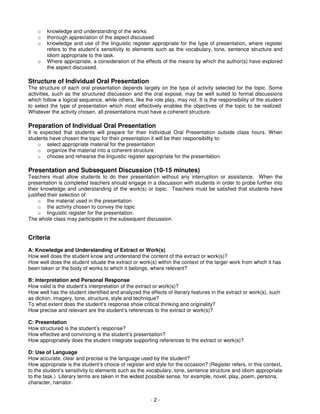
Oral Component Internal Assessment Criteria                                                                                          Student__________________________________ Topic_____________________________
                                 0                                      (A/D=1)                   (B/C=1-2)     (A/D=2)                    (B/C=3-4)    (A/D=3)                   (B/C=5-6)       (A/D=4)                    (B/C=7-8)      (A/D=5)                  (B/C=9-10)
                                                                        Little knowledge of the extract         Some knowledge of the extract           Adequate understanding of the             Good understanding of the                 Excellent understanding of the
                                                                        or work(s)                              or work(s)                              extract or work(s)                        extract or work(s)                        extract or work(s)
A: Knowledge and

Extract or Work(s)


                                                                        little knowledge or understanding       some knowledge but superficial          adequate knowledge and                    good knowledge and                        thorough knowledge and
Understanding of


                                                                                                                                                                                                                                    
                                                                        of the content of the extract or        understanding of the content of the     understanding of the content of the       understanding of the content of the       understanding of the content of the
                                                                        work(s)                                 extract or work(s)                      extract or work(s)                        extract or work(s)                        extract or work(s)
                                                                        little knowledge of the appropriate
                                                                                                              some knowledge of the appropriate
                                                                                                                                                      adequate knowledge of the
                                                                                                                                                                                                good knowledge of the appropriate
                                                                                                                                                                                                                                          precise knowledge of the
                                                                                                                                                                                                                                               
                                                                        context of the extract or work(s),      context of the extract or work(s),      appropriate context of the extract or     context of the extract or work(s),        appropriate context of the extract or
                                                                        where relevant.                         where relevant.                         work(s), where                            where relevant.                           work(s), where relevant.
                                                                                                                                                        relevant.

                                                                        Little interpretation of the            Some interpretation of the              Adequate interpretation of the            Good interpretation of the                Excellent interpretation of the
                                                                        extract or work(s)                      extract or work(s)                      extract or work(s)                        extract or work(s)                        extract or work(s)
B: Interpretation and Personal


                                                                        little interpretation of the thought
                                                                                                              some interpretation of the thought
                                                                                                                                                      a generally valid and adequate
                                                                                                                                                                                                a valid and generally detailed
                                                                                                                                                                                                                                          a convincing and detailed
                                                                                                                                                                                                                                            
                                                                        and feeling expressed in the            and feeling expressed in the extract    interpretation of the thought and         interpretation of the thought and         interpretation of the thought and
                                                                        extract or work(s)                      or work(s) including some elements      feeling expressed                         feeling expressed in                      feeling expressed in the
                                                                        response consists mainly of
                                                                                                              of a relevant personal response,        in the extract or work(s) including       the extract or work(s) including a        extract or work(s) including a fully
                                                                        narration and/or repetition of          where appropriate                       some degree of a critical personal        considered critical response, where       considered and independent critical
                                                                        content                                 some awareness of the literary
                                                                                                                                                      response, where appropriate               appropriate                               response, where appropriate
                                 The student has not reached level 1.


                                                                        little awareness of the literary
                                                                                                              features of the extract or work(s)      adequate awareness and some
                                                                                                                                                                                                good awareness and detailed
                                                                                                                                                                                                                                          excellent awareness and critical
                                                                                                                                                                                                                                               
                                                                        features of the extract or work(s).     the response is supported by some
                                                                                                                                                      analysis of the effects of the literary   analysis of the effects of the literary   analysis of the effects of the literary
                                                                                                                references to the extract or work(s).   features of the extract or work(s)        features of the extract or work(s)        features of the extract or work(s)
Response


                                                                                                                                                        the response is generally
                                                                                                                                                                                                the response is supported by
                                                                                                                                                                                                                                          the response is fully supported by
                                                                                                                                                                                                                                                  
                                                                                                                                                        supported by relevant references to       relevant references to the extract or     precise references to the extract or
                                                                                                                                                        the extract or work(s).                   work(s).                                  work(s).

                                                                        Little sense of a focused and           Some sense of a focused and             A generally focused and                   A focused and developed                   A clearly focused, well-developed
                                                                        developed response                      developed response                      developed response                        response                                  and persuasive response
                                                                        little evidence of a structure to the
                                                                                                              some evidence of a structure to the
                                                                                                                                                      adequate structure to the response
                                                                                                                                                                                                clear and logical structure to the
                                                                                                                                                                                                                                          purposeful and effective structure to
                                                                                                                                                                                                                                            
                                                                        response                                response                                the response is generally focused
                                                                                                                                                                                                response                                  the response
                                                                        little attempt to present the
                                                                                                              some attempt to present the
                                                                                                                                                      and presented in a coherent and           the response is focused and
                                                                                                                                                                                                                                          the response is focused, coherent
                                                                                                                                                                                                                                               
                                                                        response with coherence and             response with coherence although        effective manner                          presented in a clear, coherent,           and presented in a very effective
                                                                        focus                                   it is not always focused                supporting references to the
                                                                                                                                                                                                effective and convincing                  and persuasive manner
C: Presentation


                                                                        the response is supported by few
                                                                                                              supporting references to the
                                                                                                                                                      work(s) or extract, where relevant,       manner                                    supporting references to the work(s)
                                                                                                                                                                                                                                                  
                                                                        references to the work(s) or            work(s) or extract, where relevant,     are sometimes appropriately               supporting references to the
                                                                                                                                                                                                                                          or extract are well integrated into
                                                                        extract.                                are not appropriately                   integrated into the body of the           work(s) or extract, where relevant,       the body of the response.
                                                                                                                integrated into the body of the         response.                                 are appropriately
                                                                                                                response.                                                                         integrated into the body of the
                                                                                                                                                                                                  response.

                                                                        The language is rarely clear or         The language is only sometimes          The language is generally clear           The language is clear, varied and         The language is clear, varied,
                                                                        coherent                                clear and coherent                      and coherent                              precise                                   precise and concise
                                                                        the speech is not readily
                                                                                                              some degree of clarity and
                                                                                                                                                      clear speech, appropriate to the
                                                                                                                                                                                                clear, varied and precise speech,
                                                                                                                                                                                                                                          clear, varied, precise and concise
                                                                                                                                                                                                                                            
                                                                        comprehensible                          coherence in the speech                 occasion                                  appropriate to the occasion               speech, appropriate to the occasion
D: Use of Language


                                                                        many lapses in grammar and
                                                                                                              some degree of accuracy in
                                                                                                                                                      only a few significant lapses in
                                                                                                                                                                                                no significant lapses in grammar
                                                                                                                                                                                                                                          no significant lapses in grammar
                                                                                                                                                                                                                                               
                                                                        expression                              grammar and expression                  grammar and expression                    and expression                            and expression
                                                                        vocabulary is rarely accurate or
                                                                                                              vocabulary is sometimes
                                                                                                                                                      attempts to use a register
                                                                                                                                                                                                uses a register and style
                                                                                                                                                                                                                                          an effective choice of register and
                                                                                                                                                                                                                                                  
                                                                        appropriate.                            appropriate for the discussion of       appropriate to the oral activity.         appropriate to the oral activity          style
                                                                                                                literature.                                                                       some literary terms used
                                                                                                                                                                                                                                          precise use of wide vocabulary and
                                                                                                                                                                                                                                                     
                                                                                                                                                                                                  appropriately.                            varied grammatical structures
                                                                                                                                                                                                                                            literary terms used appropriately.
                                                                                                                                                                                                                                                        


                                                                                                                                                                  -3-
A Few Presentation Ideas
A wide range of topics are possible, including those mentioned above. Below are a few that are especially
pertinent to our study. You will submit a proposal which includes the following:
    o Topic question or statement
    o Proposed structure of presentation (lecture, guided activity, etc.)
    o Materials needed (DVD or VCR, copies, etc.). Please give me 24 hour advance notice (minimum).
Outside research may be necessary. Be sure to acknowledge your sources: before your presentation, please
turn in a typed, MLA-formatted bibliography.

The Adventures of Huckleberry Finn
   o How does Twain’s earlier work, The Adventures of Tom Sawyer, relate to this work? Why is Tom
       Sawyer considered a “boy’s book” (even by Twain), but Huck Finn considered a great work?
   o What was Twain’s process for composing Huck Finn? How did his trip down the Mississippi, in
       preparation for writing Life on the Mississippi, affect it?
   o What is the history of one of the genres that Twain employs, such as comedy, satire, romance,
       “shaggy dog story,” or other conventional forms?
   o How did Twain’s style compare to other fiction in his time? (Consider other contemporaries such as
       Hawthorne, Wolcott, Bret Harte, Stephen Crane, et al?) Or compare to fiction before his time (see his
       essay on “Fenimore Cooper’s Literary Offenses”; see also Dumas and other writers of romances ).
   o What were Twain’s views on evolution, and other scientific advances in his day?
   o Since copyright law had not yet been enacted, piracy of books was widespread. How did Twain go
       about trying to ensure making a living from his books? How might this have affected the writing of
       Huck Finn?
   o Why did Twain write a book
           o about a boy helping a slave escape to freedom by floating south on the Mississippi River?
           o about the slavery issue 20 years after the Civil War ended?
           o which ends the way it does?
   o How does Twain use symbolism? (Sir Walter Scott, the steamboat at the end of Chapter 28, etc.)
   o Why was Huck Finn banned in Twain’s time? Why do many schools still ban or censor it?
   o Provide more depth on one or two of the reigning interpretations of the novel (“9 Hucks”).

The Great Gatsby
   o Compare the fictional setting to actual locations on Long Island and New York City; what was the
       social significance of various settings?
   o What are some of the racial implications of Fitzgerald’s portrayals?
   o What was Fitzgerald’s process for composing The Great Gatsby? How does it inform your
       understanding of his choice of plot structure, characterization, point of view, etc?
   o How reliable is Nick as a narrator?
   o Are Fitzgerald’s characterizations realistic?
   o Comment on Fitzgerald’s style, particularly his sentence structure, word choice, etc.
   o Fitzgerald coined the term “jazz age”: What did he mean, and how does it apply to Gatsby?

Beloved
    o Why did Morrison’s book win both the Pulitzer and Nobel Prizes?
    o What are the probable routes that Sethe and Paul D took in their journeys to Cincinnati?
    o What are the ethical issues of the choice that Sethe made in killing her oldest daughter?
    o What is the history of one of the genres that Morisson employs, such as stream of consciousness,
       magical realism, the ghost story, etc?
    o What are the sources of Morrison’s novel; that is, what research did she have to do to write it?
    o Is Beloved written mainly to inform, entertain, or provoke?

Narrow Road to the Interior
    o What is the Japanese convention of the haibun?
    o What is the cultural context for Basho’s work? Consider Japanese history, literature, and art. Also
       consider its contact with the Western world at the time of writing.
    o What are some problems which the translator faces? Compare several translations of the same
       passages or poems and comment. Present translators’ views.
    o What are some important influences Asian poets have had on Western poets?
    o Who are Basho’s major influences? Or, how does he compare to other major Japanese poets?
    o How does lyric writing differ from rhetorical writing? How does the mind process each?

                                                    -4-

Individual oral presentation edited

  • 1.
    Individual Oral Presentation English 11 Honors/IB The Individual Oral Presentation is based on a work or works studied in Semester 1 of the junior year: o The Adventures of Huckleberry Finn o The Great Gatsby o Beloved o Narrow Road to the Interior Each student chooses a topic for this exercise in consultation with the teacher. Choice of Topic Students may choose topics which reflect their personal interests. Topics may be based on any aspect(s) of the work(s) studied, including: o cultural setting of the work(s) and related issues o thematic focus o characterization o techniques and style o author’s attitude to particular elements of the works such as character(s), subject matter, etc. o interpretation of particular elements from different perspectives. Activities (Individual Oral Presentation) The following lists contain examples of the wide range of activities which are acceptable for the Individual Oral Presentation. These lists of examples are neither exhaustive nor prescriptive. They are only suggestions and may be added to by teachers, or by students with the approval of teachers. Students should select the activity most appropriate to the topic chosen. Structured Discussions o Class discussions where a student has been given special responsibilities (advance preparation, particular topics, a short report, a provocative position). The whole class may participate, but only the presenter will be assessed. o The presentation of material lending itself to discussion within the class, such as the offering of two opposing readings of a work (the presenter will take questions from the class). o Interview of a student by the teacher on an agreed topic or work(s). Oral Exposés o An introduction to a writer, a work or a particular text. o An explanation of a particular aspect of an author’s work. o The examination of a particular interpretation of a work. o The setting of a particular writer’s work against another body of material, such as details on social background or political views. o A commentary on the use of a particular image, idea or symbol in one text or in a writer’s work. o An imitation of a poem being studied. This activity should be followed by some explanation of, and discussion on, what the student had attempted to do. o A comparison of two passages, two characters or two works. o A commentary on an extract from a work studied in class which has been prepared at home. o An account of the student’s developing response to a work. Role Play Students who choose role play should provide a rationale for what they have done. o A monologue by a character at an important point in the work. o Reminiscences by a character from a point in later life. o An author’s reaction to a particular interpretation of elements of his/her work in a given context. For example, a critical defense of the work against a charge of subversion, or immorality, before a censorship board. Focus of Individual Oral Presentation The focus of each oral presentation will depend on the nature and scope of the topic chosen. The sophistication of literary criticism expected is indicated in the rubric (page 3). Whatever the topic and type of presentation chosen, students will be expected to show: -1-
  • 2.
    o knowledge and understanding of the works o thorough appreciation of the aspect discussed o knowledge and use of the linguistic register appropriate for the type of presentation, where register refers to the student’s sensitivity to elements such as the vocabulary, tone, sentence structure and idiom appropriate to the task. o Where appropriate, a consideration of the effects of the means by which the author(s) have explored the aspect discussed. Structure of Individual Oral Presentation The structure of each oral presentation depends largely on the type of activity selected for the topic. Some activities, such as the structured discussion and the oral exposé, may be well suited to formal discussions which follow a logical sequence, while others, like the role play, may not. It is the responsibility of the student to select the type of presentation which most effectively enables the objectives of the topic to be realized. Whatever the activity chosen, all presentations must have a coherent structure. Preparation of Individual Oral Presentation It is expected that students will prepare for their Individual Oral Presentation outside class hours. When students have chosen the topic for their presentation it will be their responsibility to: o select appropriate material for the presentation o organize the material into a coherent structure o choose and rehearse the linguistic register appropriate for the presentation. Presentation and Subsequent Discussion (10-15 minutes) Teachers must allow students to do their presentation without any interruption or assistance. When the presentation is completed teachers should engage in a discussion with students in order to probe further into their knowledge and understanding of the work(s) or topic. Teachers must be satisfied that students have justified their selection of: o the material used in the presentation o the activity chosen to convey the topic o linguistic register for the presentation. The whole class may participate in the subsequent discussion. Criteria A: Knowledge and Understanding of Extract or Work(s) How well does the student know and understand the content of the extract or work(s)? How well does the student situate the extract or work(s) within the context of the larger work from which it has been taken or the body of works to which it belongs, where relevant? B: Interpretation and Personal Response How valid is the student’s interpretation of the extract or work(s)? How well has the student identified and analyzed the effects of literary features in the extract or work(s), such as diction, imagery, tone, structure, style and technique? To what extent does the student’s response show critical thinking and originality? How precise and relevant are the student’s references to the extract or work(s)? C: Presentation How structured is the student’s response? How effective and convincing is the student’s presentation? How appropriately does the student integrate supporting references to the extract or work(s)? D: Use of Language How accurate, clear and precise is the language used by the student? How appropriate is the student’s choice of register and style for the occasion? (Register refers, in this context, to the student’s sensitivity to elements such as the vocabulary, tone, sentence structure and idiom appropriate to the task.) Literary terms are taken in the widest possible sense, for example, novel, play, poem, persona, character, narrator. -2-
  • 3.
    Oral Component InternalAssessment Criteria Student__________________________________ Topic_____________________________ 0 (A/D=1) (B/C=1-2) (A/D=2) (B/C=3-4) (A/D=3) (B/C=5-6) (A/D=4) (B/C=7-8) (A/D=5) (B/C=9-10) Little knowledge of the extract Some knowledge of the extract Adequate understanding of the Good understanding of the Excellent understanding of the or work(s) or work(s) extract or work(s) extract or work(s) extract or work(s) A: Knowledge and Extract or Work(s) little knowledge or understanding some knowledge but superficial adequate knowledge and good knowledge and thorough knowledge and Understanding of      of the content of the extract or understanding of the content of the understanding of the content of the understanding of the content of the understanding of the content of the work(s) extract or work(s) extract or work(s) extract or work(s) extract or work(s) little knowledge of the appropriate  some knowledge of the appropriate  adequate knowledge of the  good knowledge of the appropriate  precise knowledge of the  context of the extract or work(s), context of the extract or work(s), appropriate context of the extract or context of the extract or work(s), appropriate context of the extract or where relevant. where relevant. work(s), where where relevant. work(s), where relevant. relevant. Little interpretation of the Some interpretation of the Adequate interpretation of the Good interpretation of the Excellent interpretation of the extract or work(s) extract or work(s) extract or work(s) extract or work(s) extract or work(s) B: Interpretation and Personal little interpretation of the thought  some interpretation of the thought  a generally valid and adequate  a valid and generally detailed  a convincing and detailed  and feeling expressed in the and feeling expressed in the extract interpretation of the thought and interpretation of the thought and interpretation of the thought and extract or work(s) or work(s) including some elements feeling expressed feeling expressed in feeling expressed in the response consists mainly of  of a relevant personal response, in the extract or work(s) including the extract or work(s) including a extract or work(s) including a fully narration and/or repetition of where appropriate some degree of a critical personal considered critical response, where considered and independent critical content some awareness of the literary  response, where appropriate appropriate response, where appropriate The student has not reached level 1. little awareness of the literary  features of the extract or work(s) adequate awareness and some  good awareness and detailed  excellent awareness and critical  features of the extract or work(s). the response is supported by some  analysis of the effects of the literary analysis of the effects of the literary analysis of the effects of the literary references to the extract or work(s). features of the extract or work(s) features of the extract or work(s) features of the extract or work(s) Response the response is generally  the response is supported by  the response is fully supported by  supported by relevant references to relevant references to the extract or precise references to the extract or the extract or work(s). work(s). work(s). Little sense of a focused and Some sense of a focused and A generally focused and A focused and developed A clearly focused, well-developed developed response developed response developed response response and persuasive response little evidence of a structure to the  some evidence of a structure to the  adequate structure to the response  clear and logical structure to the  purposeful and effective structure to  response response the response is generally focused  response the response little attempt to present the  some attempt to present the  and presented in a coherent and the response is focused and  the response is focused, coherent  response with coherence and response with coherence although effective manner presented in a clear, coherent, and presented in a very effective focus it is not always focused supporting references to the  effective and convincing and persuasive manner C: Presentation the response is supported by few  supporting references to the  work(s) or extract, where relevant, manner supporting references to the work(s)  references to the work(s) or work(s) or extract, where relevant, are sometimes appropriately supporting references to the  or extract are well integrated into extract. are not appropriately integrated into the body of the work(s) or extract, where relevant, the body of the response. integrated into the body of the response. are appropriately response. integrated into the body of the response. The language is rarely clear or The language is only sometimes The language is generally clear The language is clear, varied and The language is clear, varied, coherent clear and coherent and coherent precise precise and concise the speech is not readily  some degree of clarity and  clear speech, appropriate to the  clear, varied and precise speech,  clear, varied, precise and concise  comprehensible coherence in the speech occasion appropriate to the occasion speech, appropriate to the occasion D: Use of Language many lapses in grammar and  some degree of accuracy in  only a few significant lapses in  no significant lapses in grammar  no significant lapses in grammar  expression grammar and expression grammar and expression and expression and expression vocabulary is rarely accurate or  vocabulary is sometimes  attempts to use a register  uses a register and style  an effective choice of register and  appropriate. appropriate for the discussion of appropriate to the oral activity. appropriate to the oral activity style literature. some literary terms used  precise use of wide vocabulary and  appropriately. varied grammatical structures literary terms used appropriately.  -3-
  • 4.
    A Few PresentationIdeas A wide range of topics are possible, including those mentioned above. Below are a few that are especially pertinent to our study. You will submit a proposal which includes the following: o Topic question or statement o Proposed structure of presentation (lecture, guided activity, etc.) o Materials needed (DVD or VCR, copies, etc.). Please give me 24 hour advance notice (minimum). Outside research may be necessary. Be sure to acknowledge your sources: before your presentation, please turn in a typed, MLA-formatted bibliography. The Adventures of Huckleberry Finn o How does Twain’s earlier work, The Adventures of Tom Sawyer, relate to this work? Why is Tom Sawyer considered a “boy’s book” (even by Twain), but Huck Finn considered a great work? o What was Twain’s process for composing Huck Finn? How did his trip down the Mississippi, in preparation for writing Life on the Mississippi, affect it? o What is the history of one of the genres that Twain employs, such as comedy, satire, romance, “shaggy dog story,” or other conventional forms? o How did Twain’s style compare to other fiction in his time? (Consider other contemporaries such as Hawthorne, Wolcott, Bret Harte, Stephen Crane, et al?) Or compare to fiction before his time (see his essay on “Fenimore Cooper’s Literary Offenses”; see also Dumas and other writers of romances ). o What were Twain’s views on evolution, and other scientific advances in his day? o Since copyright law had not yet been enacted, piracy of books was widespread. How did Twain go about trying to ensure making a living from his books? How might this have affected the writing of Huck Finn? o Why did Twain write a book o about a boy helping a slave escape to freedom by floating south on the Mississippi River? o about the slavery issue 20 years after the Civil War ended? o which ends the way it does? o How does Twain use symbolism? (Sir Walter Scott, the steamboat at the end of Chapter 28, etc.) o Why was Huck Finn banned in Twain’s time? Why do many schools still ban or censor it? o Provide more depth on one or two of the reigning interpretations of the novel (“9 Hucks”). The Great Gatsby o Compare the fictional setting to actual locations on Long Island and New York City; what was the social significance of various settings? o What are some of the racial implications of Fitzgerald’s portrayals? o What was Fitzgerald’s process for composing The Great Gatsby? How does it inform your understanding of his choice of plot structure, characterization, point of view, etc? o How reliable is Nick as a narrator? o Are Fitzgerald’s characterizations realistic? o Comment on Fitzgerald’s style, particularly his sentence structure, word choice, etc. o Fitzgerald coined the term “jazz age”: What did he mean, and how does it apply to Gatsby? Beloved o Why did Morrison’s book win both the Pulitzer and Nobel Prizes? o What are the probable routes that Sethe and Paul D took in their journeys to Cincinnati? o What are the ethical issues of the choice that Sethe made in killing her oldest daughter? o What is the history of one of the genres that Morisson employs, such as stream of consciousness, magical realism, the ghost story, etc? o What are the sources of Morrison’s novel; that is, what research did she have to do to write it? o Is Beloved written mainly to inform, entertain, or provoke? Narrow Road to the Interior o What is the Japanese convention of the haibun? o What is the cultural context for Basho’s work? Consider Japanese history, literature, and art. Also consider its contact with the Western world at the time of writing. o What are some problems which the translator faces? Compare several translations of the same passages or poems and comment. Present translators’ views. o What are some important influences Asian poets have had on Western poets? o Who are Basho’s major influences? Or, how does he compare to other major Japanese poets? o How does lyric writing differ from rhetorical writing? How does the mind process each? -4-