QUEERTHEORY
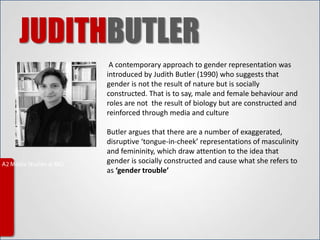
JUDITHBUTLER
      A contemporary approach to gender representation was
     introduced by Judith Butler (1990) who suggests that
     gender is not the result of nature but is socially
     constructed. That is to say, male and female behaviour and
     roles are not the result of biology but are constructed and
     reinforced through media and culture

     Butler argues that there are a number of exaggerated,
     disruptive ‘tongue-in-cheek’ representations of masculinity
     and femininity, which draw attention to the idea that
     gender is socially constructed and cause what she refers to
     as ‘gender trouble’
GENDERTROUBLE?
QUEERTHEORY
Butler’s theories of gender trouble have also been linked to queer theory, which
explores and challenges the way in which heterosexual is constructed as normal and
the media has limited the representations of gay men and women. It has been
suggested for example, Hollywood films construct and portray images of ‘normal’ ,
happy heterosexual couples are often represented in terms of sin or sickness
           Can you think of any examples that support or refute this?

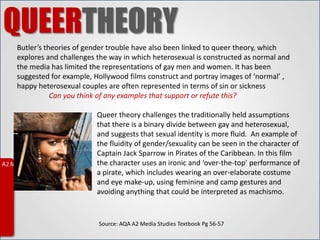
                        Queer theory challenges the traditionally held assumptions
                        that there is a binary divide between gay and heterosexual,
                        and suggests that sexual identity is more fluid. An example of
                        the fluidity of gender/sexuality can be seen in the character of
                        Captain Jack Sparrow in Pirates of the Caribbean. In this film
                        the character uses an ironic and ‘over-the-top’ performance of
                        a pirate, which includes wearing an over-elaborate costume
                        and eye make-up, using feminine and camp gestures and
                        avoiding anything that could be interpreted as machismo.


                        Source: AQA A2 Media Studies Textbook Pg 56-57
A summary of Butler’s key points on gender representation
and queer theory

 • Nothing within your identity is fixed.
 • Your identity is little more than a pile of (social and cutural) things which
   you have previously expressed, or which have been said about you.
 • There is not really an ‘inner self’. We come to believe we have one through
   the repetition of discourses about it
 • Gender, like other aspects of identity, is a performance (though not
   necessarily a consciously chosen one). Again, this is reinforced through
   repetition.
 • People can therefore change.
 • The binary divide between masculinity and femininity is a social construct
   built on the binary divide between men and women – which is also a
   social construction.
 • We should challenge the traditional views of masculinity, femininity and
   sexuality by causing gender trouble.
 Source: GAUNTLETT, D. (2008). Media, gender and identity: an introduction. London, Routledge.
TASK
Butler (1990) argues that gender is a performance, albeit not always a
conscious performance. This is reinforced through repetition. She also
argued that the binary divide between masculinity and femininity is a
social construction built on the divide between men and women which is
also a social construction.

Do some research on Butler and ‘Queer Theory’. Create a series of
presentation slides to explain Queer Theory and how it relates to the
media. You need to include an introduction of Butler’s key ideas on
gender (the print out you were asked to read for homework should help
with this)

You should include some examples of “Gender Trouble” in the media –
explain how your examples subvert traditionally held assumptions
about gender.

Your final slide should contain your thoughts on Queer Theory – do you
agree with Butler?

Queer theory

  • 1.
  • 2.
    JUDITHBUTLER A contemporary approach to gender representation was introduced by Judith Butler (1990) who suggests that gender is not the result of nature but is socially constructed. That is to say, male and female behaviour and roles are not the result of biology but are constructed and reinforced through media and culture Butler argues that there are a number of exaggerated, disruptive ‘tongue-in-cheek’ representations of masculinity and femininity, which draw attention to the idea that gender is socially constructed and cause what she refers to as ‘gender trouble’
  • 3.
  • 4.
    QUEERTHEORY Butler’s theories ofgender trouble have also been linked to queer theory, which explores and challenges the way in which heterosexual is constructed as normal and the media has limited the representations of gay men and women. It has been suggested for example, Hollywood films construct and portray images of ‘normal’ , happy heterosexual couples are often represented in terms of sin or sickness Can you think of any examples that support or refute this? Queer theory challenges the traditionally held assumptions that there is a binary divide between gay and heterosexual, and suggests that sexual identity is more fluid. An example of the fluidity of gender/sexuality can be seen in the character of Captain Jack Sparrow in Pirates of the Caribbean. In this film the character uses an ironic and ‘over-the-top’ performance of a pirate, which includes wearing an over-elaborate costume and eye make-up, using feminine and camp gestures and avoiding anything that could be interpreted as machismo. Source: AQA A2 Media Studies Textbook Pg 56-57
  • 5.
    A summary ofButler’s key points on gender representation and queer theory • Nothing within your identity is fixed. • Your identity is little more than a pile of (social and cutural) things which you have previously expressed, or which have been said about you. • There is not really an ‘inner self’. We come to believe we have one through the repetition of discourses about it • Gender, like other aspects of identity, is a performance (though not necessarily a consciously chosen one). Again, this is reinforced through repetition. • People can therefore change. • The binary divide between masculinity and femininity is a social construct built on the binary divide between men and women – which is also a social construction. • We should challenge the traditional views of masculinity, femininity and sexuality by causing gender trouble. Source: GAUNTLETT, D. (2008). Media, gender and identity: an introduction. London, Routledge.
  • 6.
    TASK Butler (1990) arguesthat gender is a performance, albeit not always a conscious performance. This is reinforced through repetition. She also argued that the binary divide between masculinity and femininity is a social construction built on the divide between men and women which is also a social construction. Do some research on Butler and ‘Queer Theory’. Create a series of presentation slides to explain Queer Theory and how it relates to the media. You need to include an introduction of Butler’s key ideas on gender (the print out you were asked to read for homework should help with this) You should include some examples of “Gender Trouble” in the media – explain how your examples subvert traditionally held assumptions about gender. Your final slide should contain your thoughts on Queer Theory – do you agree with Butler?

Editor's Notes

  • #4 Look at the pictures on this slide. How do they challenge assumptions on gender? Beyond biological differences what is it that makes somebody “male” or “female”? Think about how ideas about gender are reinforced by media representations. Is there a hegemonic ideal of male and female roles in society?
  • #5 It should be pointed out that Queer Theory is not exclusively a theory about homosexuality – this is merely one aspect of it.