
MEMBRANE STRUCTURE 
Presented by IB Screwed
PHOSPHOLIPID BILAYER 
What is a phospholipid? 
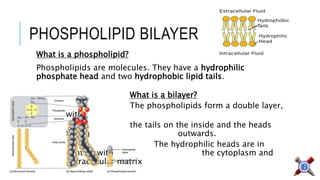
Phospholipids are molecules. They have a hydrophilic phosphate head and two hydrophobic lipid tails. 
What is a bilayer? 
The phospholipids form a double layer, with 
the tails on the inside and the heads facing outwards. 
The hydrophilic heads are in contact with the cytoplasm and extracellular matrix
FLUID MOSAIC MODEL 
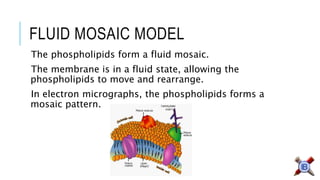
The phospholipids form a fluid mosaic. 
The membrane is in a fluid state, allowing the phospholipids to move and rearrange. 
In electron micrographs, the phospholipids forms a mosaic pattern.
HYDROPHILIC VS. HYDROPHOBIC 
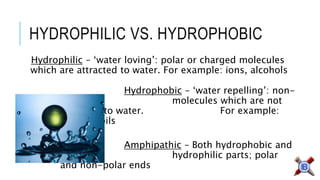
Hydrophilic–‘water loving’: polar or charged molecules which are attracted to water. For example:ions, alcohols 
Hydrophobic–‘water repelling’: non-polar molecules which are not attracted to water. For example: fats and oils 
Amphipathic–Both hydrophobic and hydrophilic parts; polar and non-polar ends
MEMBRANE PROTEINS 
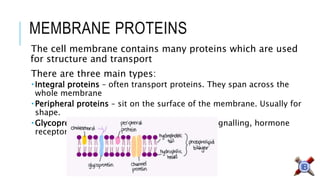
The cell membrane contains many proteins which are used for structure and transport 
There are three main types: 
Integral proteins –often transport proteins. They span across the whole membrane 
Peripheral proteins –sit on the surface of the membrane. Usually for shape. 
Glycoproteins–used for cell recognition and signalling, hormone receptors
FUNCTION OF MEMBRANE PROTEINS 
Since the inner part of the membrane is hydrophobic, necessary molecules like ions, proteins, etccannot cross without the membrane protein channels. They can provide facilitated diffusion or active transport (using ATP) 
Other membrane proteins can be enzymes. 
Some proteins are electron carriers.
CHOLESTEROL 
In the media, cholesterol gets a bad name for its role in heart problems. 
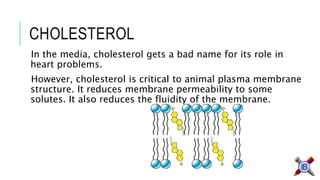
However, cholesterol is critical to animal plasma membrane structure. It reduces membrane permeability to some solutes. It also reduces the fluidity of the membrane.

Membrane structure

  • 1.
  • 2.
    PHOSPHOLIPID BILAYER Whatis a phospholipid? Phospholipids are molecules. They have a hydrophilic phosphate head and two hydrophobic lipid tails. What is a bilayer? The phospholipids form a double layer, with the tails on the inside and the heads facing outwards. The hydrophilic heads are in contact with the cytoplasm and extracellular matrix
  • 3.
    FLUID MOSAIC MODEL The phospholipids form a fluid mosaic. The membrane is in a fluid state, allowing the phospholipids to move and rearrange. In electron micrographs, the phospholipids forms a mosaic pattern.
  • 4.
    HYDROPHILIC VS. HYDROPHOBIC Hydrophilic–‘water loving’: polar or charged molecules which are attracted to water. For example:ions, alcohols Hydrophobic–‘water repelling’: non-polar molecules which are not attracted to water. For example: fats and oils Amphipathic–Both hydrophobic and hydrophilic parts; polar and non-polar ends
  • 5.
    MEMBRANE PROTEINS Thecell membrane contains many proteins which are used for structure and transport There are three main types: Integral proteins –often transport proteins. They span across the whole membrane Peripheral proteins –sit on the surface of the membrane. Usually for shape. Glycoproteins–used for cell recognition and signalling, hormone receptors
  • 6.
    FUNCTION OF MEMBRANEPROTEINS Since the inner part of the membrane is hydrophobic, necessary molecules like ions, proteins, etccannot cross without the membrane protein channels. They can provide facilitated diffusion or active transport (using ATP) Other membrane proteins can be enzymes. Some proteins are electron carriers.
  • 7.
    CHOLESTEROL In themedia, cholesterol gets a bad name for its role in heart problems. However, cholesterol is critical to animal plasma membrane structure. It reduces membrane permeability to some solutes. It also reduces the fluidity of the membrane.