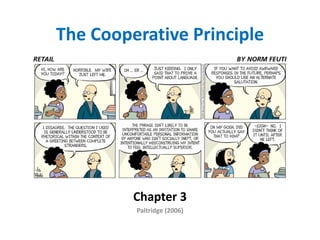
The Cooperative Principle
Chapter 3
Paltridge (2006)
H. P. Grice
• In Grice’s paper, ‘Logic and
conversation’ (1975), he argued that
in order for a person to interpret
what someone else says, some kind
of cooperative principle is assumed
to be in operation.
The Cooperative Principle
• The Cooperative Principle, proposed by Grice,
maintains that people follow a pattern in
conversation:
– i.e. There is a set of principles which direct us to a
particular interpretation of what is said.
Specifically, the cooperative principle
says …
• We should aim to make our conversational
contribution:
(Grice, 1975, p. 45)
1.Such as is required (What needs to be said)
2. At the stage at which it occurs (At appropriate point in the interaction)
3. By the accepted purpose or
direction of the exchange
(They have reason for saying what they say)
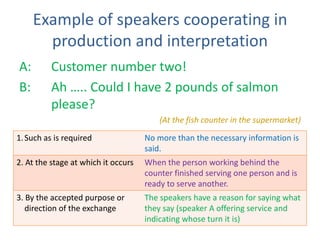
Example of speakers cooperating in
production and interpretation
A: Customer number two!
B: Ah ….. Could I have 2 pounds of salmon
please?
(At the fish counter in the supermarket)
1.Such as is required No more than the necessary information is
said.
2. At the stage at which it occurs When the person working behind the
counter finished serving one person and is
ready to serve another.
3. By the accepted purpose or
direction of the exchange
The speakers have a reason for saying what
they say (speaker A offering service and
indicating whose turn it is)
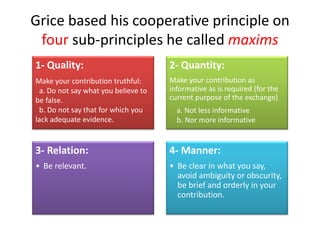
Grice based his cooperative principle on
four sub-principles he called maxims
1- Quality:
Make your contribution truthful:
a. Do not say what you believe to
be false.
b. Do not say that for which you
lack adequate evidence.
2- Quantity:
Make your contribution as
informative as is required (for the
current purpose of the exchange)
a. Not less informative
b. Nor more informative
3- Relation:
• Be relevant.
4- Manner:
• Be clear in what you say,
avoid ambiguity or obscurity,
be brief and orderly in your
contribution.
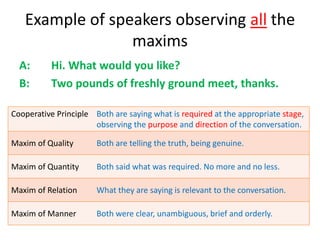
Example of speakers observing all the
maxims
A: Hi. What would you like?
B: Two pounds of freshly ground meet, thanks.
Cooperative Principle Both are saying what is required at the appropriate stage,
observing the purpose and direction of the conversation.
Maxim of Quality Both are telling the truth, being genuine.
Maxim of Quantity Both said what was required. No more and no less.
Maxim of Relation What they are saying is relevant to the conversation.
Maxim of Manner Both were clear, unambiguous, brief and orderly.
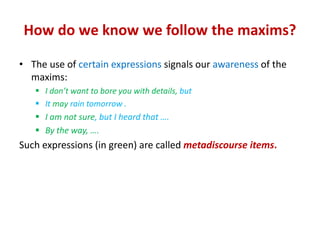
How do we know we follow the maxims?
• The use of certain expressions signals our awareness of the
maxims:
 I don’t want to bore you with details, but
 It may rain tomorrow .
 I am not sure, but I heard that ….
 By the way, ….
Such expressions (in green) are called metadiscourse items.
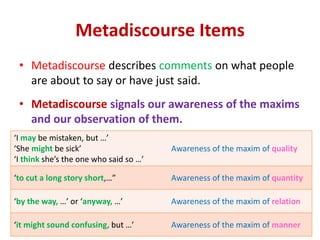
Metadiscourse Items
• Metadiscourse describes comments on what people
are about to say or have just said.
• Metadiscourse signals our awareness of the maxims
and our observation of them.
Paltridge (2006) – Chapter 3, Prepared by
M. Al Khalil
‘I may be mistaken, but …’
‘She might be sick’
‘I think she’s the one who said so …’
Awareness of the maxim of quality
‘to cut a long story short,…” Awareness of the maxim of quantity
‘by the way, …’ or ‘anyway, …’ Awareness of the maxim of relation
‘it might sound confusing, but …’ Awareness of the maxim of manner
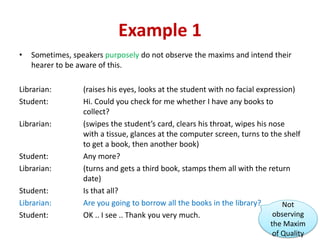
Example 1
• Sometimes, speakers purposely do not observe the maxims and intend their
hearer to be aware of this.
Librarian: (raises his eyes, looks at the student with no facial expression)
Student: Hi. Could you check for me whether I have any books to
collect?
Librarian: (swipes the student’s card, clears his throat, wipes his nose
with a tissue, glances at the computer screen, turns to the shelf
to get a book, then another book)
Student: Any more?
Librarian: (turns and gets a third book, stamps them all with the return
date)
Student: Is that all?
Librarian: Are you going to borrow all the books in the library?
Student: OK .. I see .. Thank you very much.
Not
observing
the Maxim
of Quality
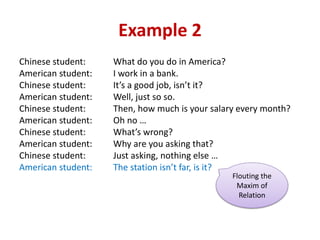
Example 2
Chinese student: What do you do in America?
American student: I work in a bank.
Chinese student: It’s a good job, isn’t it?
American student: Well, just so so.
Chinese student: Then, how much is your salary every month?
American student: Oh no …
Chinese student: What’s wrong?
American student: Why are you asking that?
Chinese student: Just asking, nothing else …
American student: The station isn’t far, is it?
Flouting the
Maxim of
Relation
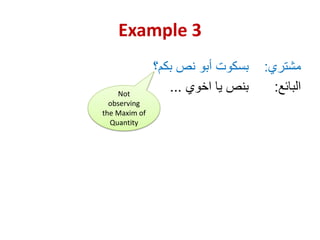
Example 3
‫مشتري‬
:
‫بكم؟‬ ‫نص‬ ‫أبو‬ ‫بسكوت‬
‫البائع‬
:
‫اخوي‬ ‫يا‬ ‫بنص‬
...
Not
observing
the Maxim of
Quantity
Not Observing a Maxim
When we don’t observe a maxim, we:
1- Flout a maxim:
– When we have NO intention to deceive or mislead hearer.
– Speaker knows that Hearer will get the meaning implied.
2- Violate a maxim:
– There is an intention to deceive hearer.
Father: Mummy’s gone on a little holiday because she needs a rest.
[Truth] Mummy’s gone away to decide if she wants a divorce or not.
3- Opt out of a maxim:
– Speaker chooses not to observe a maxim for ethical or legal
reasons.
• Lying for the sake of working things out is an example for ethical
reasons.
• When a doctor lies about a patient’s medical case to an
unauthorized person, he does this for legal reasons.
Violating Quality and
Manner
Which maxims are flouted, violated,
and opted out of?
(1)
 Wife (to husband): I would die if you left me.
(2)
 Mother (to son): I tried calling you a hundred
times!
(3)
 Son: My phone was on silent mode.
(It wasn’t, but he knew she would ask him to
come home early.)
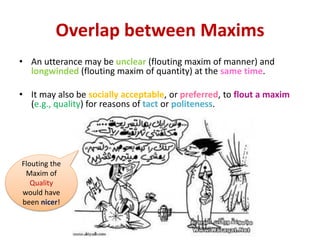
Overlap between Maxims
• An utterance may be unclear (flouting maxim of manner) and
longwinded (flouting maxim of quantity) at the same time.
• It may also be socially acceptable, or preferred, to flout a maxim
(e.g., quality) for reasons of tact or politeness.
Paltridge (2006) – Chapter 3, Prepared by
M. Al Khalil
Flouting the
Maxim of
Quality
would have
been nicer!
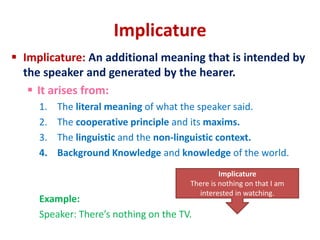
Implicature
 Implicature: An additional meaning that is intended by
the speaker and generated by the hearer.
 It arises from:
1. The literal meaning of what the speaker said.
2. The cooperative principle and its maxims.
3. The linguistic and the non-linguistic context.
4. Background Knowledge and knowledge of the world.
Example:
Speaker: There’s nothing on the TV.
Implicature
There is nothing on that I am
interested in watching.
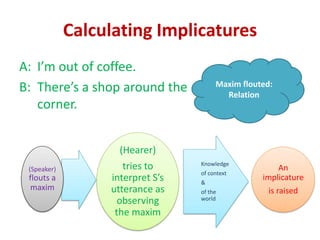
Calculating Implicatures
A: I’m out of coffee.
B: There’s a shop around the
corner.
Maxim flouted:
Relation
(Speaker)
flouts a
maxim
Knowledge
of context
&
of the
world
(Hearer)
tries to
interpret S’s
utterance as
observing
the maxim
An
implicature
is raised
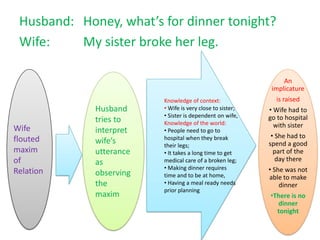
Husband: Honey, what’s for dinner tonight?
Wife: My sister broke her leg.
Wife
flouted
maxim
of
Relation
Knowledge of context:
• Wife is very close to sister;
• Sister is dependent on wife,
Knowledge of the world:
• People need to go to
hospital when they break
their legs;
• It takes a long time to get
medical care of a broken leg;
• Making dinner requires
time and to be at home,
• Having a meal ready needs
prior planning
Husband
tries to
interpret
wife’s
utterance
as
observing
the
maxim
An
implicature
is raised
• Wife had to
go to hospital
with sister
• She had to
spend a good
part of the
day there
• She was not
able to make
dinner
•There is no
dinner
tonight
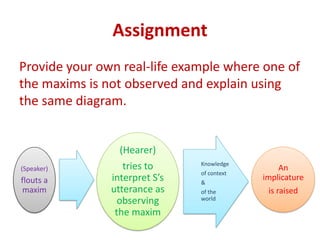
Assignment
Provide your own real-life example where one of
the maxims is not observed and explain using
the same diagram.
(Speaker)
flouts a
maxim
Knowledge
of context
&
of the
world
(Hearer)
tries to
interpret S’s
utterance as
observing
the maxim
An
implicature
is raised

Imp slides for cooperative_principle.pdf

  • 1.
  • 2.
    H. P. Grice •In Grice’s paper, ‘Logic and conversation’ (1975), he argued that in order for a person to interpret what someone else says, some kind of cooperative principle is assumed to be in operation.
  • 3.
    The Cooperative Principle •The Cooperative Principle, proposed by Grice, maintains that people follow a pattern in conversation: – i.e. There is a set of principles which direct us to a particular interpretation of what is said.
  • 4.
    Specifically, the cooperativeprinciple says … • We should aim to make our conversational contribution: (Grice, 1975, p. 45) 1.Such as is required (What needs to be said) 2. At the stage at which it occurs (At appropriate point in the interaction) 3. By the accepted purpose or direction of the exchange (They have reason for saying what they say)
  • 5.
    Example of speakerscooperating in production and interpretation A: Customer number two! B: Ah ….. Could I have 2 pounds of salmon please? (At the fish counter in the supermarket) 1.Such as is required No more than the necessary information is said. 2. At the stage at which it occurs When the person working behind the counter finished serving one person and is ready to serve another. 3. By the accepted purpose or direction of the exchange The speakers have a reason for saying what they say (speaker A offering service and indicating whose turn it is)
  • 6.
    Grice based hiscooperative principle on four sub-principles he called maxims 1- Quality: Make your contribution truthful: a. Do not say what you believe to be false. b. Do not say that for which you lack adequate evidence. 2- Quantity: Make your contribution as informative as is required (for the current purpose of the exchange) a. Not less informative b. Nor more informative 3- Relation: • Be relevant. 4- Manner: • Be clear in what you say, avoid ambiguity or obscurity, be brief and orderly in your contribution.
  • 7.
    Example of speakersobserving all the maxims A: Hi. What would you like? B: Two pounds of freshly ground meet, thanks. Cooperative Principle Both are saying what is required at the appropriate stage, observing the purpose and direction of the conversation. Maxim of Quality Both are telling the truth, being genuine. Maxim of Quantity Both said what was required. No more and no less. Maxim of Relation What they are saying is relevant to the conversation. Maxim of Manner Both were clear, unambiguous, brief and orderly.
  • 8.
    How do weknow we follow the maxims? • The use of certain expressions signals our awareness of the maxims:  I don’t want to bore you with details, but  It may rain tomorrow .  I am not sure, but I heard that ….  By the way, …. Such expressions (in green) are called metadiscourse items.
  • 9.
    Metadiscourse Items • Metadiscoursedescribes comments on what people are about to say or have just said. • Metadiscourse signals our awareness of the maxims and our observation of them. Paltridge (2006) – Chapter 3, Prepared by M. Al Khalil ‘I may be mistaken, but …’ ‘She might be sick’ ‘I think she’s the one who said so …’ Awareness of the maxim of quality ‘to cut a long story short,…” Awareness of the maxim of quantity ‘by the way, …’ or ‘anyway, …’ Awareness of the maxim of relation ‘it might sound confusing, but …’ Awareness of the maxim of manner
  • 10.
    Example 1 • Sometimes,speakers purposely do not observe the maxims and intend their hearer to be aware of this. Librarian: (raises his eyes, looks at the student with no facial expression) Student: Hi. Could you check for me whether I have any books to collect? Librarian: (swipes the student’s card, clears his throat, wipes his nose with a tissue, glances at the computer screen, turns to the shelf to get a book, then another book) Student: Any more? Librarian: (turns and gets a third book, stamps them all with the return date) Student: Is that all? Librarian: Are you going to borrow all the books in the library? Student: OK .. I see .. Thank you very much. Not observing the Maxim of Quality
  • 11.
    Example 2 Chinese student:What do you do in America? American student: I work in a bank. Chinese student: It’s a good job, isn’t it? American student: Well, just so so. Chinese student: Then, how much is your salary every month? American student: Oh no … Chinese student: What’s wrong? American student: Why are you asking that? Chinese student: Just asking, nothing else … American student: The station isn’t far, is it? Flouting the Maxim of Relation
  • 12.
    Example 3 ‫مشتري‬ : ‫بكم؟‬ ‫نص‬‫أبو‬ ‫بسكوت‬ ‫البائع‬ : ‫اخوي‬ ‫يا‬ ‫بنص‬ ... Not observing the Maxim of Quantity
  • 13.
    Not Observing aMaxim When we don’t observe a maxim, we: 1- Flout a maxim: – When we have NO intention to deceive or mislead hearer. – Speaker knows that Hearer will get the meaning implied. 2- Violate a maxim: – There is an intention to deceive hearer. Father: Mummy’s gone on a little holiday because she needs a rest. [Truth] Mummy’s gone away to decide if she wants a divorce or not. 3- Opt out of a maxim: – Speaker chooses not to observe a maxim for ethical or legal reasons. • Lying for the sake of working things out is an example for ethical reasons. • When a doctor lies about a patient’s medical case to an unauthorized person, he does this for legal reasons. Violating Quality and Manner
  • 14.
    Which maxims areflouted, violated, and opted out of? (1)  Wife (to husband): I would die if you left me. (2)  Mother (to son): I tried calling you a hundred times! (3)  Son: My phone was on silent mode. (It wasn’t, but he knew she would ask him to come home early.)
  • 15.
    Overlap between Maxims •An utterance may be unclear (flouting maxim of manner) and longwinded (flouting maxim of quantity) at the same time. • It may also be socially acceptable, or preferred, to flout a maxim (e.g., quality) for reasons of tact or politeness. Paltridge (2006) – Chapter 3, Prepared by M. Al Khalil Flouting the Maxim of Quality would have been nicer!
  • 16.
    Implicature  Implicature: Anadditional meaning that is intended by the speaker and generated by the hearer.  It arises from: 1. The literal meaning of what the speaker said. 2. The cooperative principle and its maxims. 3. The linguistic and the non-linguistic context. 4. Background Knowledge and knowledge of the world. Example: Speaker: There’s nothing on the TV. Implicature There is nothing on that I am interested in watching.
  • 17.
    Calculating Implicatures A: I’mout of coffee. B: There’s a shop around the corner. Maxim flouted: Relation (Speaker) flouts a maxim Knowledge of context & of the world (Hearer) tries to interpret S’s utterance as observing the maxim An implicature is raised
  • 18.
    Husband: Honey, what’sfor dinner tonight? Wife: My sister broke her leg. Wife flouted maxim of Relation Knowledge of context: • Wife is very close to sister; • Sister is dependent on wife, Knowledge of the world: • People need to go to hospital when they break their legs; • It takes a long time to get medical care of a broken leg; • Making dinner requires time and to be at home, • Having a meal ready needs prior planning Husband tries to interpret wife’s utterance as observing the maxim An implicature is raised • Wife had to go to hospital with sister • She had to spend a good part of the day there • She was not able to make dinner •There is no dinner tonight
  • 19.
    Assignment Provide your ownreal-life example where one of the maxims is not observed and explain using the same diagram. (Speaker) flouts a maxim Knowledge of context & of the world (Hearer) tries to interpret S’s utterance as observing the maxim An implicature is raised