Strategies to Accelerate
Academic Learning
for English Learners
Inspección InglésInspección Inglés
G.Zazpe - S. RomanoG.Zazpe - S. Romano
OBJECTIVES
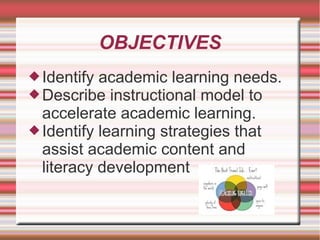
Identify academic learning needs.
Describe instructional model to
accelerate academic learning.
Identify learning strategies that
assist academic content and
literacy development
Academic needs of English
Learners
Develop academic vocabulary
Read to acquire new information
Understand information presented
orally
Participate in classroom
discussions
Write to communicate knowledge
and ideas
What is academic content?
Alligned to National Curriculum
and the English syllabus
Cognitively appropriate
Content information and content
processes
How does academic content
develop literacy?
Practice in reading and writing
across curriculum areas
Interaction with authentic texts
Development of discipline-specific
vocabulary
Incrase motivation through
interesting topics
What is academic content?
Language used during teaching and
learning
Language in content textbooks
Language of literature
Language used to cummunicate new
concepts
Language of literacy
Input: academic Language
and Content Texts
 Literature genres: stories,
novels,poetry, biography
 Informational texts: articles, essays
textbooks.
 Oral texts: teachers, speakers, peers
presenting their work, video,
TV,films, live performance
 Personal texts: Journals, e-mails,
instant messages, letters
The teacher´s role
Model academic language
Add language activities to content
lessons
Have high expectations
Teach students how to learn
(through strategies) SBL
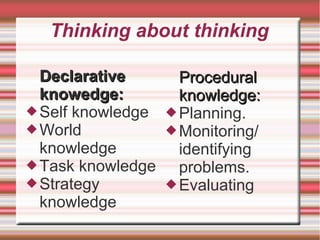
Thinking about thinking
DeclarativeDeclarative
knowedge:knowedge:
Self knowledge
World
knowledge
Task knowledge
Strategy
knowledge
ProceduralProcedural
knowledge:knowledge:
Planning.
Monitoring/
identifying
problems.
Evaluating
What are learning strategies?
Thoughts and actions that assist
learning tasks
Ways to understand, remember
and recall information.
Ways to practice skills efficiently.
What does research say?
 All second language learners use strategies BUT :
GOOD language learners use more varied
strategies and use them more flexibly
 Frequent use of learning strategies is correlated to
higher self-efficacy.
 Strategy instruction improves academic
performance.
 Instruction needs to be explicit.
 Students need to develop metacognition
 Transfer is difficult
 Language instruction matters.
Why teach learning stragies?
Show students how to be better
learners
Build students´ self – efficacy.
Increase student motivation for
learning.
Help students become reflective
and critical thinkers.
Metacognitive strategies
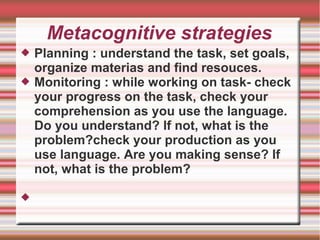
 Planning : understand the task, set goals,
organize materias and find resouces.
 Monitoring : while working on task- check
your progress on the task, check your
comprehension as you use the language.
Do you understand? If not, what is the
problem?check your production as you
use language. Are you making sense? If
not, what is the problem?

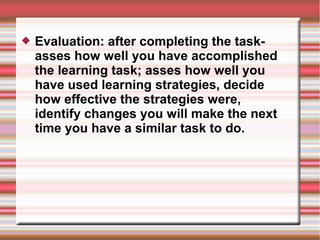
 Evaluation: after completing the task-
asses how well you have accomplished
the learning task; asses how well you
have used learning strategies, decide
how effective the strategies were,
identify changes you will make the next
time you have a similar task to do.
Metacognitive strategies
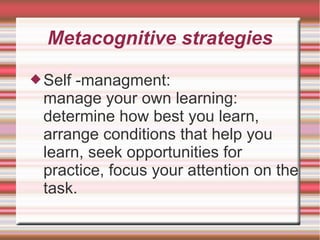
Self -managment:
manage your own learning:
determine how best you learn,
arrange conditions that help you
learn, seek opportunities for
practice, focus your attention on the
task.
Social learning strategies
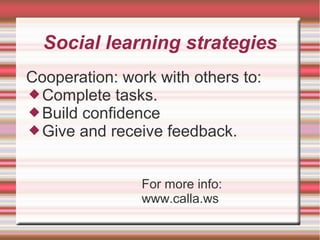
Cooperation: work with others to:
Complete tasks.
Build confidence
Give and receive feedback.
For more info:
www.calla.ws
New competencies for EFL
professionals
What do they imply and which key
elements or qualities are involved in
today´s teacher praxis?
Why the need to talk about
professionals?
 Know the subject well
 Act ethically
 Have good interpersonal relationship skills
 Work cooperatively,avoid working in isolation
 Consult others in case of doubts or queries
 Be accountable for what you do
 Evaluate what you do constantly
 Keep on learning and updating yourselves
Let´s reflect together.....
“The most important knowledge
teachers need to do good work is a
knowledge of how students are
experiencing learning and perceiving
their teacher´s actions.”
Steven Brookfield
Our praxis
Our profession is evolving
permanently, there are some basic
and classical skills we must
manage, but there are others
related to the profession itself which
need to be taken care of as well.
New teaching competences
 Teachers should be fully equipped to
respond to the evolving challenges of
the knowledge society, but also to
participate actively in it and to prepare
learners to be autonomous lifelong
learners.
 What actions do you take in your
lessons to achieve this goal? Talk it
over with a colleague
Top qualities for teachers working
as EFL instructors
Work in pairs and exchange ideas
on the above issue.
Qualities for teachers
Now , change the pair you have
worked with and consider the
issue above.
Let´s share our professional
skills.......
 Focus on the competencies our students need
to develop as successful learners.
 Differentiate our teaching, use formative
evaluation to actively fight against school
failure
 Develop an active and cooperative pedagogy,
based on problem solving activities and
projects
 Be ethical in everything you do and remain true
to yourself (facing ethical dilemmas of our
professional)

Professional development
 Keep on developing yourselves, reading,
participating and reflecting on you praxis.
 Reflect on your teaching, question
everything you do either individually or in
groups (or both)
 Participate in the ongoing development of
novice or inexperienced teachers
 Work cooperatively explaining what you do
and what can work well in certain situations
and with specific students
Professional development
 Involve yourself in institutional
projects, support principal´s ideas
and contribute with innovative and
creative ideas
Commit yourselves on individual or
collective methods of innovation.
Integrate the ICTs
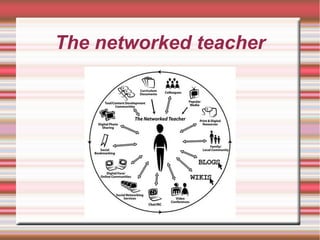
The networked teacher
The reflective practitioner
 We have to fall back on routines in which
previous thought and sentiment has been
sedimented. It is here that the full importance of
refelction-on and in-action becomes revealed.
(Schön)
 As we think and act, questions arise that
cannot be answered in the pesent. The space
afforded by recording, supervision and
conversation with our peers allows us to
approach these. Reflection requires space in
the present and the promise of space in the
futures (Smith 1994: 150)
What research has shown....
 Research on effective teaching over the past
two decades has shown that effective
practice is linked to inquiry, reflection, and
continuous professional growth (Harris
1998)
 Reflective practice can be beneficial form of
professional development at both the pre-
service and in-service levels of teaching. By
gaining a better understanding of their own
individual teaching styles through reflective
practice, teachers can improve their
effectiveness in the classroom.
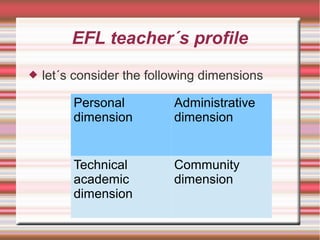
EFL teacher´s profile
 let´s consider the following dimensions
Personal
dimension
Administrative
dimension
Technical
academic
dimension
Community
dimension
Administrative dimension
 Register (record of sts´progress, daily plans,
syllabus, students´profile)
 Follow annual plan and syllabus coverage
 Analysis of diagnostic results
 Keep registers at the right place so they can be
available
 Never take registers home
 Written tests should also be kept at school
after being turned in to students
 Keep record of students sent to Tutorias.
Technical dimension
 Be good model of the language taught
 Possess deep theoretical knowledge to back up your
praxis.
 Motivate students
 Practice the four skills daily, balance the activities
presented.
 Be able to adapt to different realities.
 Use the foreign language as much as possible.
 Encourage students to use English all the time. Adopt
ICT´s and develop technology oriented lessons.
 Teach not only the language but also the culture.
Academic dimension
 Be commited to your own profession.
 Keep updated, attend salas, meetings,
workshops.
 Share good practices (materials we use in
our lessons, websites)
 Avoid working in isolation
 Be members of a professional organization
 Be suscribed to EFL magazines (online or
printed)
Communitary dimension
 Attend salas by the ones organized by your
PADs
 Share the best practices with your
community.
 Promote, organize and participate actively in
the activities that concern your classes and
institutions (e.g. Organizing local activities)
 Be open to interact with native speakers and
foster students interaction with ETA´s and
the like.
Problems detected...
written tests 2014
Why do we have to change the
format of the written tests?
Is it true that Inspección does not
want that we teach Grammar in the
classroom?
Why we need to change.......?
 We have observed that tests do not asses
what has been taught.
 We need to weigh according to outcomes
and course emphasis.
 Improve instructions
 Contextualize all tasks
 Improve students´writing dramatically
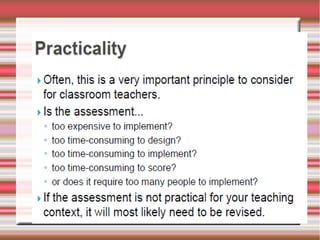
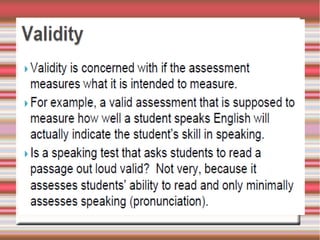
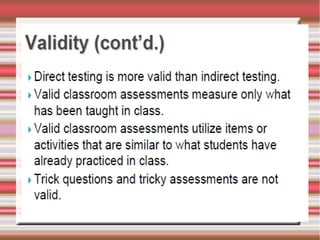
Principles of assessment
When testing we have to consider:
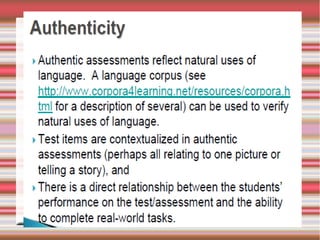
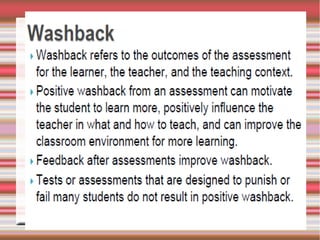
praticality, reliability, validity,
authenticity and washback effect.
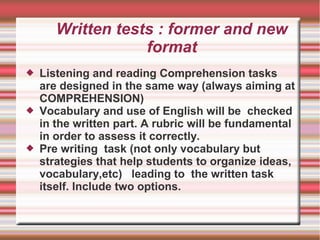
Written tests : former and new
format
 Listening and reading Comprehension tasks
are designed in the same way (always aiming at
COMPREHENSION)
 Vocabulary and use of English will be checked
in the written part. A rubric will be fundamental
in order to assess it correctly.
 Pre writing task (not only vocabulary but
strategies that help students to organize ideas,
vocabulary,etc) leading to the written task
itself. Include two options.
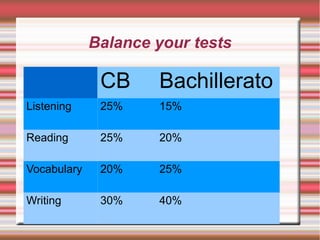
Balance your tests
CB Bachillerato
Listening 25% 15%
Reading 25% 20%
Vocabulary 20% 25%
Writing 30% 40%
PRE WRITING ACTIVITIES
 They should provide key words/ideas
 Provide meaning and be meaningful
 Provide structure
 Help organize students´work
 Motivate/ facilitate
THIS HELPS STUDENTS OVERCOME THEIR
FEAR TO WRITE
The use of graphic organizers as pre
writing activities
 Graphic organizers guide learners´thinking as they
fill in and build upon a visual map or diagram.
 They are visual learning strategies for students
and are applied across the curriculum to enhance
learning and understanding of subject matter
content.
 In a variety of formats dependent upon the task
graphic organizers facilitatestudents learning´by
helping them identify areas of focus within a broad
topic such as a novel or article. Because they help
the learner make connections and structure
thinking students often turn graphic organizers for
writing projects.
Types of graphic organizers
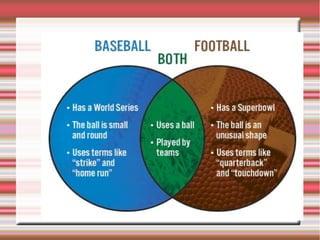
 Webs, concept maps, mind maps and
plots such as bar charts, pie
charts,Venn diagrams, are some of the
types of graphic organizers used in
visual learning to enhance thinking
skills and improve academic
performance on written papers, tests
and homework assignmets.
Teaching with graphic
organizers
 Cause and effect
 Note taking
 Comparing and contrasting concepts
 Organizing problems and soluctions
 Relating information to main themes and
ideas
 Organizational skills
 Vocabulary knowledge
 Sequency
The writing prompt
 Do not give so much information that the
student just repeats the prompt in his or her
writing.
 Make sure you indicate the audience
 The topic should be of interest to the students
and the teacher. Remember you have to rad the
writing!
 Avoid topics that are too abstract have hidden
biases, are too controversial or are too
complex.
 Provide limits on the amount of writing you
expect.
Assessing writing
 Content (the ideas expressed)
 Organization and structure of the writing
cohesiveness
 Clarity, logical organization
 Accuracy of meaning (vocabulary)
 Accuracy of language conventions
(grammar,spelling,punctuation)
 Register (level of formality of the writing)
 Style (for advanced levels)
What we assess depends on our purpose
Use of rubrics to assess writing
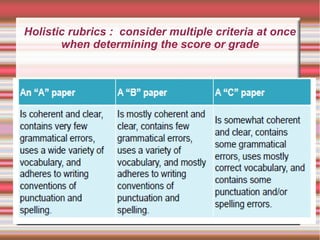
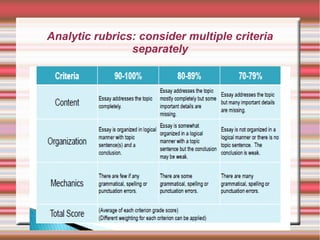
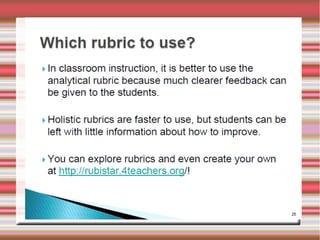
 A rubric can be holistic or analytical.
 A rubric is a list of criteria and a
description of how well the criteria is
met at different scores, ranges.
Holistic rubrics : consider multiple criteria at once
when determining the score or grade
Analytic rubrics: consider multiple criteria
separately
Strategies to encourage
 Stick posters or positive messages and
labels on the walls to familiarize students
with written codes.
 Have a bulletin board with weird news,
news from famous people, horoscope,
beauty tips, fashion styles, etc.
 Have a mailbox.
 Make “word snakes” for new vocabulary
 Make collages with visual
representations of specific vocabulary
 Copy songs, rhymes or poems
 Paste labels with idioms.
Encourage creative pieces of work
 Have a graffitti as a sort of “ complaint wall”
 Make sts fill in soundless filmstrips.
 Complete cartoon strips.
 Make them write postcards for a special person
 Make them keep a journal with new vocabulary.
 Make them re-write a fairy story
 Make them write weather reports with pictures
 Make them design new covers for books
 Copy shopping lists or restaurant menu
Ways to contact us:

Salas febrero 2014

  • 1.
    Strategies to Accelerate AcademicLearning for English Learners Inspección InglésInspección Inglés G.Zazpe - S. RomanoG.Zazpe - S. Romano
  • 2.
    OBJECTIVES Identify academic learningneeds. Describe instructional model to accelerate academic learning. Identify learning strategies that assist academic content and literacy development
  • 3.
    Academic needs ofEnglish Learners Develop academic vocabulary Read to acquire new information Understand information presented orally Participate in classroom discussions Write to communicate knowledge and ideas
  • 4.
    What is academiccontent? Alligned to National Curriculum and the English syllabus Cognitively appropriate Content information and content processes
  • 5.
    How does academiccontent develop literacy? Practice in reading and writing across curriculum areas Interaction with authentic texts Development of discipline-specific vocabulary Incrase motivation through interesting topics
  • 6.
    What is academiccontent? Language used during teaching and learning Language in content textbooks Language of literature Language used to cummunicate new concepts Language of literacy
  • 7.
    Input: academic Language andContent Texts  Literature genres: stories, novels,poetry, biography  Informational texts: articles, essays textbooks.  Oral texts: teachers, speakers, peers presenting their work, video, TV,films, live performance  Personal texts: Journals, e-mails, instant messages, letters
  • 8.
    The teacher´s role Modelacademic language Add language activities to content lessons Have high expectations Teach students how to learn (through strategies) SBL
  • 9.
    Thinking about thinking DeclarativeDeclarative knowedge:knowedge: Selfknowledge World knowledge Task knowledge Strategy knowledge ProceduralProcedural knowledge:knowledge: Planning. Monitoring/ identifying problems. Evaluating
  • 10.
    What are learningstrategies? Thoughts and actions that assist learning tasks Ways to understand, remember and recall information. Ways to practice skills efficiently.
  • 11.
    What does researchsay?  All second language learners use strategies BUT : GOOD language learners use more varied strategies and use them more flexibly  Frequent use of learning strategies is correlated to higher self-efficacy.  Strategy instruction improves academic performance.  Instruction needs to be explicit.  Students need to develop metacognition  Transfer is difficult  Language instruction matters.
  • 12.
    Why teach learningstragies? Show students how to be better learners Build students´ self – efficacy. Increase student motivation for learning. Help students become reflective and critical thinkers.
  • 13.
    Metacognitive strategies  Planning: understand the task, set goals, organize materias and find resouces.  Monitoring : while working on task- check your progress on the task, check your comprehension as you use the language. Do you understand? If not, what is the problem?check your production as you use language. Are you making sense? If not, what is the problem? 
  • 14.
     Evaluation: aftercompleting the task- asses how well you have accomplished the learning task; asses how well you have used learning strategies, decide how effective the strategies were, identify changes you will make the next time you have a similar task to do.
  • 15.
    Metacognitive strategies Self -managment: manageyour own learning: determine how best you learn, arrange conditions that help you learn, seek opportunities for practice, focus your attention on the task.
  • 16.
    Social learning strategies Cooperation:work with others to: Complete tasks. Build confidence Give and receive feedback. For more info: www.calla.ws
  • 17.
    New competencies forEFL professionals What do they imply and which key elements or qualities are involved in today´s teacher praxis?
  • 18.
    Why the needto talk about professionals?  Know the subject well  Act ethically  Have good interpersonal relationship skills  Work cooperatively,avoid working in isolation  Consult others in case of doubts or queries  Be accountable for what you do  Evaluate what you do constantly  Keep on learning and updating yourselves
  • 19.
    Let´s reflect together..... “Themost important knowledge teachers need to do good work is a knowledge of how students are experiencing learning and perceiving their teacher´s actions.” Steven Brookfield
  • 20.
    Our praxis Our professionis evolving permanently, there are some basic and classical skills we must manage, but there are others related to the profession itself which need to be taken care of as well.
  • 21.
    New teaching competences Teachers should be fully equipped to respond to the evolving challenges of the knowledge society, but also to participate actively in it and to prepare learners to be autonomous lifelong learners.  What actions do you take in your lessons to achieve this goal? Talk it over with a colleague
  • 22.
    Top qualities forteachers working as EFL instructors Work in pairs and exchange ideas on the above issue.
  • 23.
    Qualities for teachers Now, change the pair you have worked with and consider the issue above.
  • 24.
    Let´s share ourprofessional skills.......  Focus on the competencies our students need to develop as successful learners.  Differentiate our teaching, use formative evaluation to actively fight against school failure  Develop an active and cooperative pedagogy, based on problem solving activities and projects  Be ethical in everything you do and remain true to yourself (facing ethical dilemmas of our professional) 
  • 25.
    Professional development  Keepon developing yourselves, reading, participating and reflecting on you praxis.  Reflect on your teaching, question everything you do either individually or in groups (or both)  Participate in the ongoing development of novice or inexperienced teachers  Work cooperatively explaining what you do and what can work well in certain situations and with specific students
  • 26.
    Professional development  Involveyourself in institutional projects, support principal´s ideas and contribute with innovative and creative ideas Commit yourselves on individual or collective methods of innovation. Integrate the ICTs
  • 27.
  • 28.
    The reflective practitioner We have to fall back on routines in which previous thought and sentiment has been sedimented. It is here that the full importance of refelction-on and in-action becomes revealed. (Schön)  As we think and act, questions arise that cannot be answered in the pesent. The space afforded by recording, supervision and conversation with our peers allows us to approach these. Reflection requires space in the present and the promise of space in the futures (Smith 1994: 150)
  • 29.
    What research hasshown....  Research on effective teaching over the past two decades has shown that effective practice is linked to inquiry, reflection, and continuous professional growth (Harris 1998)  Reflective practice can be beneficial form of professional development at both the pre- service and in-service levels of teaching. By gaining a better understanding of their own individual teaching styles through reflective practice, teachers can improve their effectiveness in the classroom.
  • 30.
    EFL teacher´s profile let´s consider the following dimensions Personal dimension Administrative dimension Technical academic dimension Community dimension
  • 31.
    Administrative dimension  Register(record of sts´progress, daily plans, syllabus, students´profile)  Follow annual plan and syllabus coverage  Analysis of diagnostic results  Keep registers at the right place so they can be available  Never take registers home  Written tests should also be kept at school after being turned in to students  Keep record of students sent to Tutorias.
  • 32.
    Technical dimension  Begood model of the language taught  Possess deep theoretical knowledge to back up your praxis.  Motivate students  Practice the four skills daily, balance the activities presented.  Be able to adapt to different realities.  Use the foreign language as much as possible.  Encourage students to use English all the time. Adopt ICT´s and develop technology oriented lessons.  Teach not only the language but also the culture.
  • 33.
    Academic dimension  Becommited to your own profession.  Keep updated, attend salas, meetings, workshops.  Share good practices (materials we use in our lessons, websites)  Avoid working in isolation  Be members of a professional organization  Be suscribed to EFL magazines (online or printed)
  • 34.
    Communitary dimension  Attendsalas by the ones organized by your PADs  Share the best practices with your community.  Promote, organize and participate actively in the activities that concern your classes and institutions (e.g. Organizing local activities)  Be open to interact with native speakers and foster students interaction with ETA´s and the like.
  • 35.
    Problems detected... written tests2014 Why do we have to change the format of the written tests? Is it true that Inspección does not want that we teach Grammar in the classroom?
  • 36.
    Why we needto change.......?  We have observed that tests do not asses what has been taught.  We need to weigh according to outcomes and course emphasis.  Improve instructions  Contextualize all tasks  Improve students´writing dramatically
  • 37.
    Principles of assessment Whentesting we have to consider: praticality, reliability, validity, authenticity and washback effect.
  • 43.
    Written tests :former and new format  Listening and reading Comprehension tasks are designed in the same way (always aiming at COMPREHENSION)  Vocabulary and use of English will be checked in the written part. A rubric will be fundamental in order to assess it correctly.  Pre writing task (not only vocabulary but strategies that help students to organize ideas, vocabulary,etc) leading to the written task itself. Include two options.
  • 44.
    Balance your tests CBBachillerato Listening 25% 15% Reading 25% 20% Vocabulary 20% 25% Writing 30% 40%
  • 45.
    PRE WRITING ACTIVITIES They should provide key words/ideas  Provide meaning and be meaningful  Provide structure  Help organize students´work  Motivate/ facilitate THIS HELPS STUDENTS OVERCOME THEIR FEAR TO WRITE
  • 46.
    The use ofgraphic organizers as pre writing activities  Graphic organizers guide learners´thinking as they fill in and build upon a visual map or diagram.  They are visual learning strategies for students and are applied across the curriculum to enhance learning and understanding of subject matter content.  In a variety of formats dependent upon the task graphic organizers facilitatestudents learning´by helping them identify areas of focus within a broad topic such as a novel or article. Because they help the learner make connections and structure thinking students often turn graphic organizers for writing projects.
  • 47.
    Types of graphicorganizers  Webs, concept maps, mind maps and plots such as bar charts, pie charts,Venn diagrams, are some of the types of graphic organizers used in visual learning to enhance thinking skills and improve academic performance on written papers, tests and homework assignmets.
  • 49.
    Teaching with graphic organizers Cause and effect  Note taking  Comparing and contrasting concepts  Organizing problems and soluctions  Relating information to main themes and ideas  Organizational skills  Vocabulary knowledge  Sequency
  • 50.
    The writing prompt Do not give so much information that the student just repeats the prompt in his or her writing.  Make sure you indicate the audience  The topic should be of interest to the students and the teacher. Remember you have to rad the writing!  Avoid topics that are too abstract have hidden biases, are too controversial or are too complex.  Provide limits on the amount of writing you expect.
  • 51.
    Assessing writing  Content(the ideas expressed)  Organization and structure of the writing cohesiveness  Clarity, logical organization  Accuracy of meaning (vocabulary)  Accuracy of language conventions (grammar,spelling,punctuation)  Register (level of formality of the writing)  Style (for advanced levels) What we assess depends on our purpose
  • 52.
    Use of rubricsto assess writing  A rubric can be holistic or analytical.  A rubric is a list of criteria and a description of how well the criteria is met at different scores, ranges.
  • 53.
    Holistic rubrics :consider multiple criteria at once when determining the score or grade
  • 54.
    Analytic rubrics: considermultiple criteria separately
  • 57.
    Strategies to encourage Stick posters or positive messages and labels on the walls to familiarize students with written codes.  Have a bulletin board with weird news, news from famous people, horoscope, beauty tips, fashion styles, etc.  Have a mailbox.  Make “word snakes” for new vocabulary  Make collages with visual representations of specific vocabulary  Copy songs, rhymes or poems  Paste labels with idioms.
  • 58.
    Encourage creative piecesof work  Have a graffitti as a sort of “ complaint wall”  Make sts fill in soundless filmstrips.  Complete cartoon strips.  Make them write postcards for a special person  Make them keep a journal with new vocabulary.  Make them re-write a fairy story  Make them write weather reports with pictures  Make them design new covers for books  Copy shopping lists or restaurant menu
  • 59.