Seminar Type
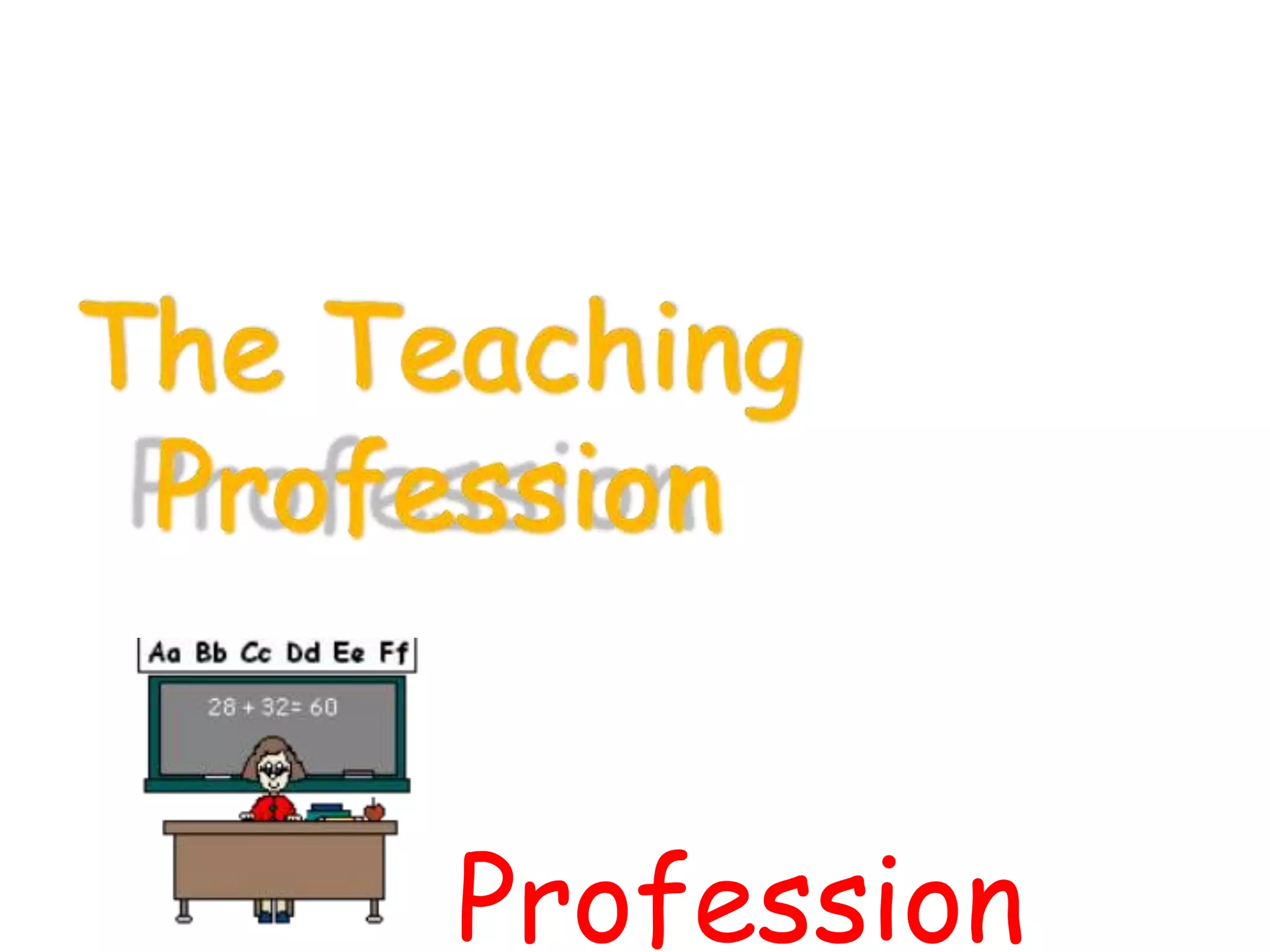
Profession
I. Teaching as a Vocation
A vocation is an occupation
either professional or
voluntary that is carried out
more for its altruistic
benefit than for income
II. Teaching as a Profession
Definition of Profession
• an occupation requiring considerable
training and specialized study
(American Heritage Dictionary of
English Language, 1992)
• “a professional is an individual that sets
her apart from society” (Seagul and
Wilsos, 1998. p.29)
•“a profession is an occupation requiring
expert knowledge that justifies a
monopoly of services granted by
government licensing (Spring 1998, p.
41)
Primary Aspects of a
Profession
1. Specialized Body of Knowledge
Effective teacher possess of at least 4 kinds of
Knowledge
A. Knowledge of content they are teaching
B. Pedagogical content knowledge
C. General pedagogical knowledge
D. Knowledge of learners and learning
2. Training for licensure
3. Autonomy
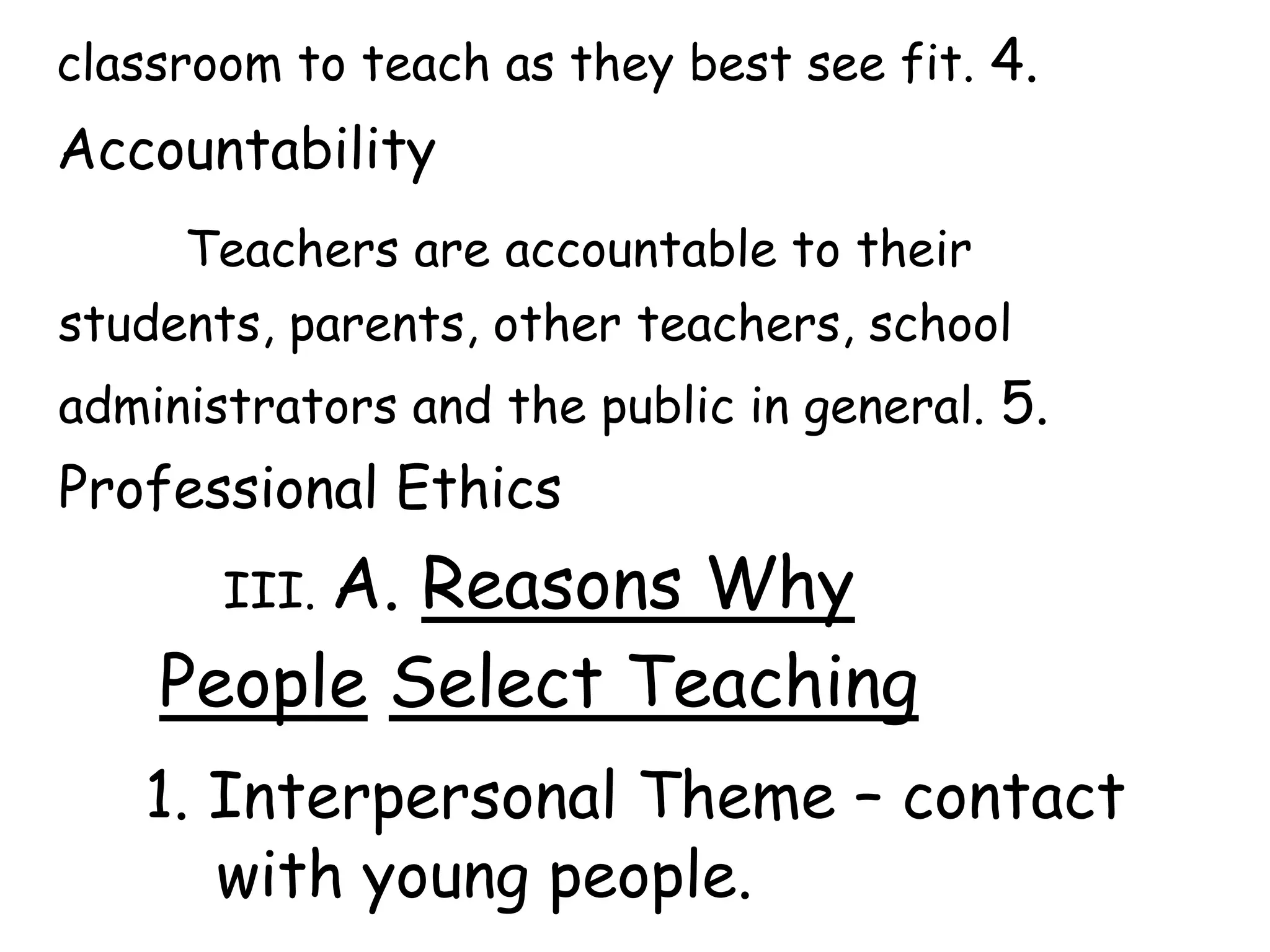
Teachers have freedom within the
classroom to teach as they best see fit. 4.
Accountability
Teachers are accountable to their
students, parents, other teachers, school
administrators and the public in general. 5.
Professional Ethics
III. A. Reasons Why
People Select Teaching
1. Interpersonal Theme – contact
with young people.
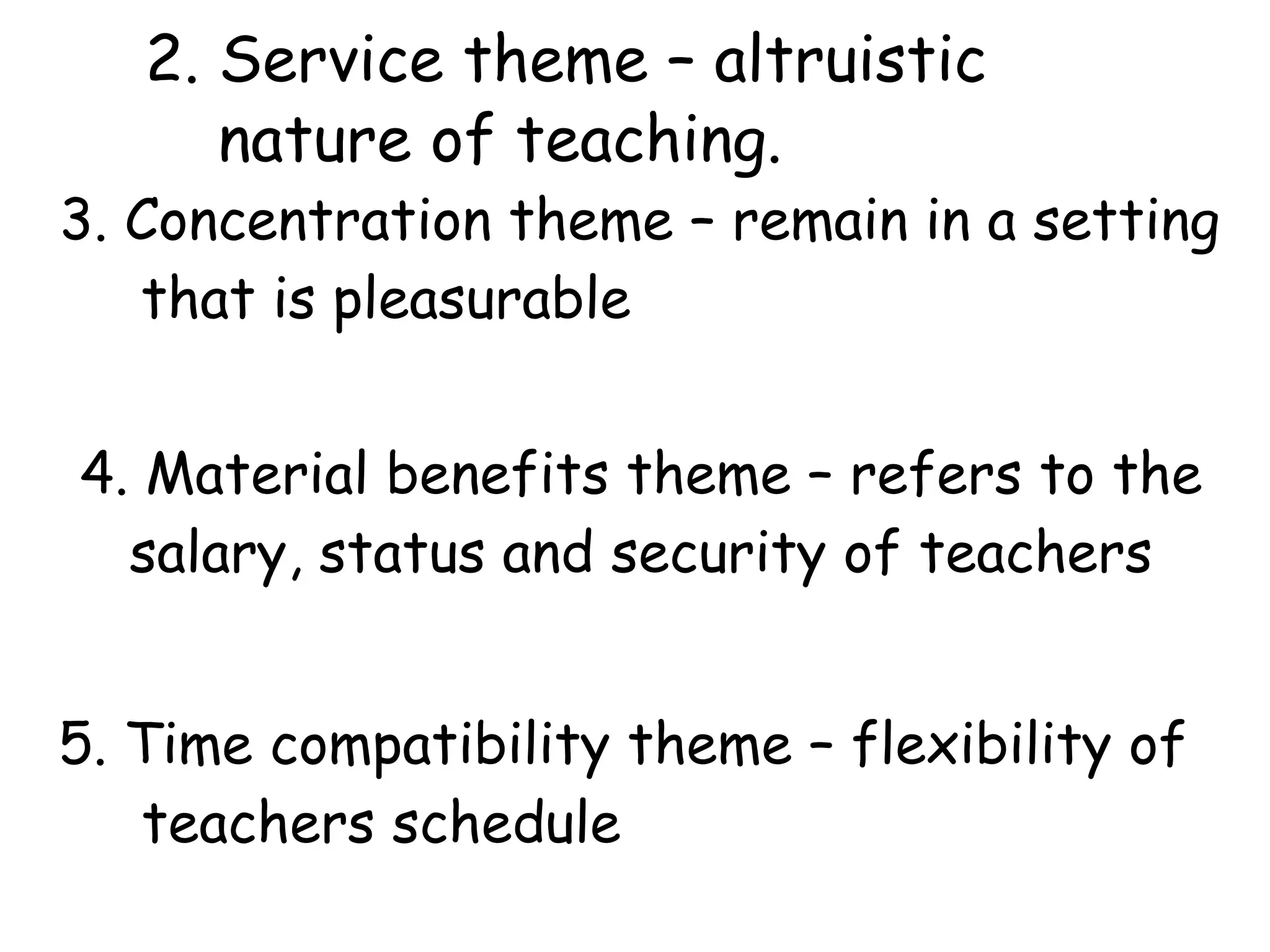
2. Service theme – altruistic
nature of teaching.
3. Concentration theme – remain in a setting
that is pleasurable
4. Material benefits theme – refers to the
salary, status and security of teachers
5. Time compatibility theme – flexibility of
teachers schedule
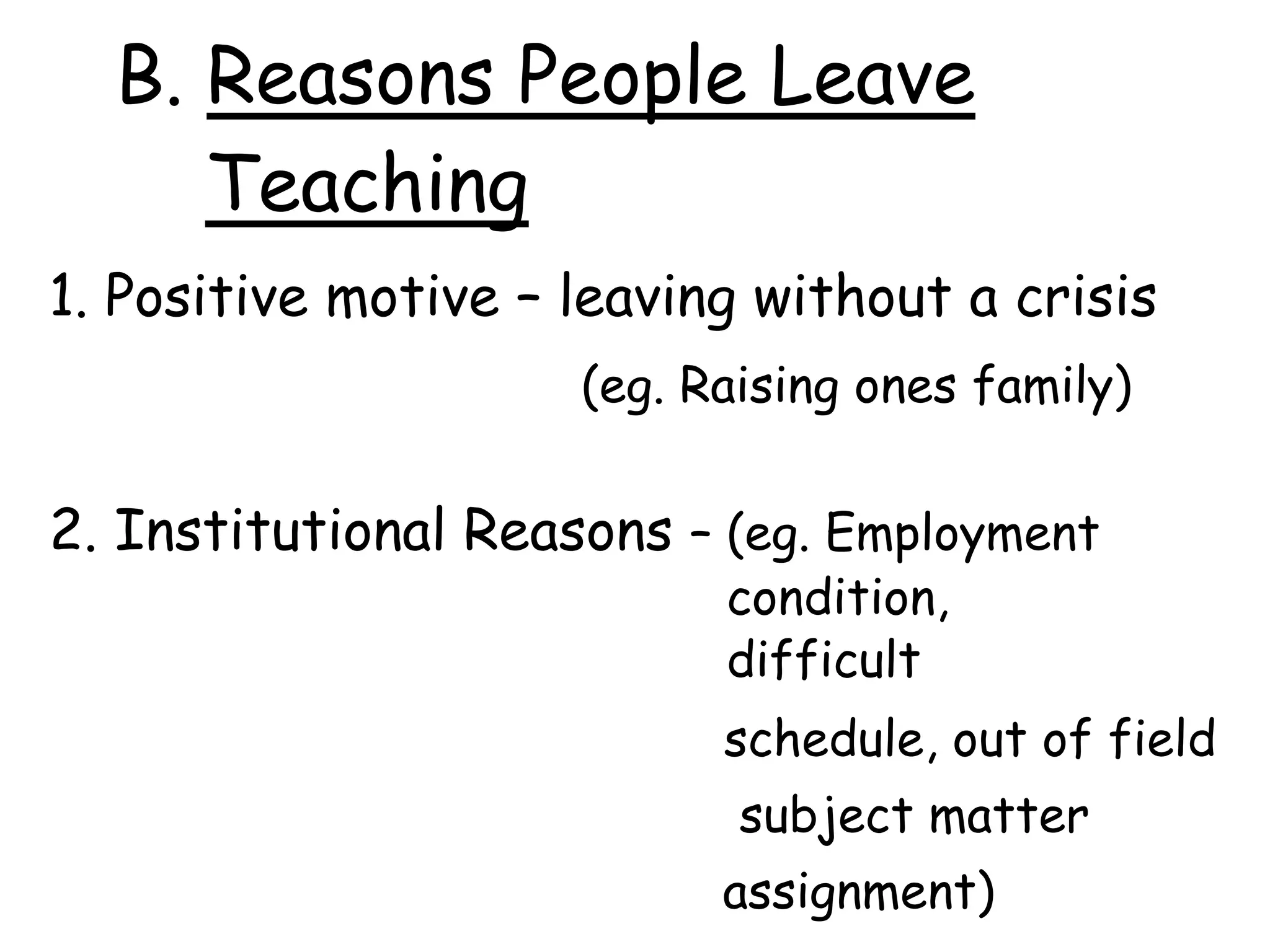
B. Reasons People Leave
Teaching
1. Positive motive – leaving without a crisis
(eg. Raising ones family)
2. Institutional Reasons – (eg. Employment
condition,
difficult
schedule, out of field
subject matter
assignment)
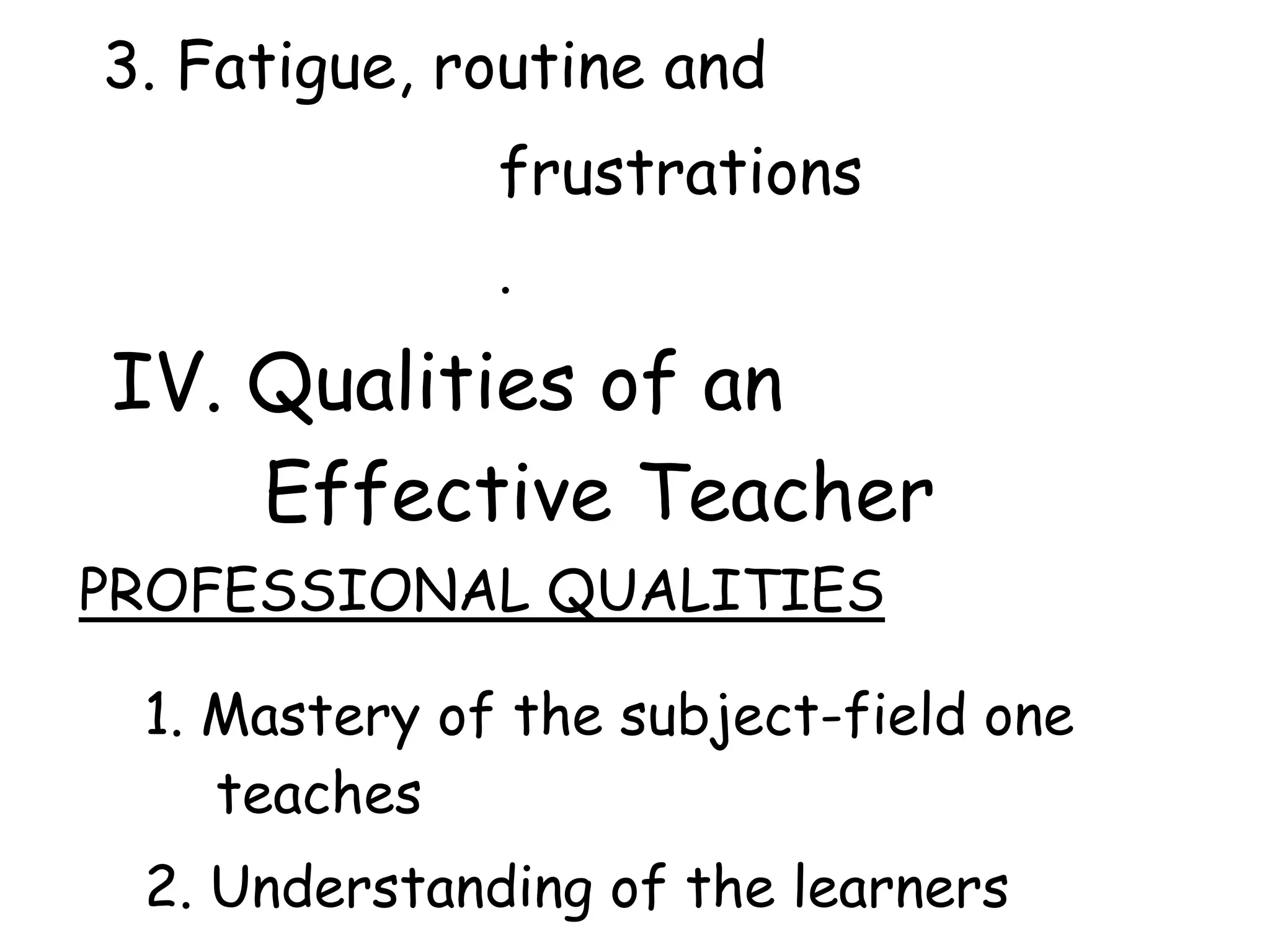
3. Fatigue, routine and
frustrations
.
IV. Qualities of an
Effective Teacher
PROFESSIONAL QUALITIES
1. Mastery of the subject-field one
teaches
2. Understanding of the learners
3. Understanding of teaching
principles and skill in the
use of techniques for
their implementation
4. General understanding of other
branches of knowledge
5. Understanding and appreciation
of the teaching profession
PERSONAL
QUALITIES
1. Intellectual
2. Physical
3. Emotional
4. Moral
V. Teacher’s Job
1. Guiding the learning process
2. Counseling and Guidance 3.
Sponsoring extra curricular
activities
4. Working with parents and the
community
5. Professional responsibilities
IV. Teacher’s Preparation
1. Pre-service
education
2. In-service
education
VII. Professional
Development for Teachers
Professional Development – a system of
continuous growth and learning to
respond the needs of all learners.
❖NETWORKING
• creating interdependent or
interconnected groups or systems
for mutual benefit of all members
in the ecosystem
❖WORKSHOPS
• gathering or training
sessions ❖SEMINARS
• a form of academic
instruction ❖DEMONSTRATION
• a method of teaching by example
rather than sample explanation ❖
COURSES
• a program of education leading to
• a degree or diploma
❖OBSERVATION
❖REFLECTIVE PRACTICE
• consider critical incidents within
your life's experiences
❖SUPERVISION
• the act of watching over the
work or task of another who
may lack full knowledge of
the concept at hand.
PRIVATE READING
VIII. PERSONAL
DEVELOPMENT
1. Take the initiative to learn
about the subculture in their
area.
2. Develop understanding of
intercultural interactions 3.
Know learning style variations 4.
across culture
4. Know how to deal with his /
her students
5. Interact with their students
and learn their different
characteristics
IX. Community – School
- Relations
What the school should know about the
community?
➢
Information about the composition of
the community such as income,
educational level and occupation
➢
Opinions of community regarding
broad educational issues
➢
Familiarity with educational
resources available in the
community.
How to gather information about the
community?
1. Community Survey
2. Home Visits
3. Telephone use
Involving Students in the Community
Involving the Community in the
School
X. Linkages and Networking
1. Give you important contacts that
can advance your career
2. Allows opportunity for job leads
3. Gives you the information on the
latest development in one’s field 4.
Gives you support and
encouragement
As a teacher, you must expand your
networks of contacts.
SOME BASIC TOOLS:
1. An address book to record and
keep track of contacts, addresses,
notes of meeting, commitments 2. An
appointment calendar
3. Business cards that contain fax
number and e-mail address.
XI. Multicultural Classroom
― students and teachers are
accepting all race, cultures and
religion.
❑What is the best way to
incorporate multiculturalism
in the classroom?
― include books in your
curriculum and class library
that feature multicultural
characteristics.
❑Why is multiculturalism
important?
― the world is fast changing and we
have to learn and accept and to get
along with all cultural races and
religion to become productive
citizens of the world
❑What can I do to make my classroom
more multicultural?
― provide books that feature children of
many different races
― place posters on the wall that feature a
variety of multicultural children
― discuss differences and similarities in
culture but stress similarities
― find an international pen pal in your
class
― if you discuss one holiday, make sure to
discuss them all
XII. Teacher Exchange
Program
Purpose:
1. Promote understanding of the people
of other countries through
educational exchange
2. Provide opportunity to compare and
learn about different education
system
3. To exchange ideas and
knowledge
4. To contribute in the professional
development of yourself and
teacher colleagues.
Benefits of TEP
1. Benefits to Teachers and
Administrator
A. Professional Development
B. A Different Teaching Environment
C. A Change of Scene
D. The Exchange of Teacher as a
Resource
E. Basis for Links, Networking and
Joint Projects
2. Benefits to Students
A. Increase understanding of host
country, language, and academic
field
B. Career enhancing experience
which allows teachers to be
exposed to new teaching
methods C. Develop lifelong
friendship and professional
relationships.
3. Benefit to Schools
A. Increase knowledge and international
awareness among professional
colleagues
4. Benefits to Communities
A. Presence of foreign teacher allows the
whole community the opportunity to
learn from another nation
B. Increase awareness of diversity of
ideas, world views and ways of life
THE GLOBAL TEACHER
What is the global teacher program?
Its purpose is to promote within
education the knowledge, attitudes
and skills that young people need in
order to practice social and
environmental responsibility as a
multicultural society and
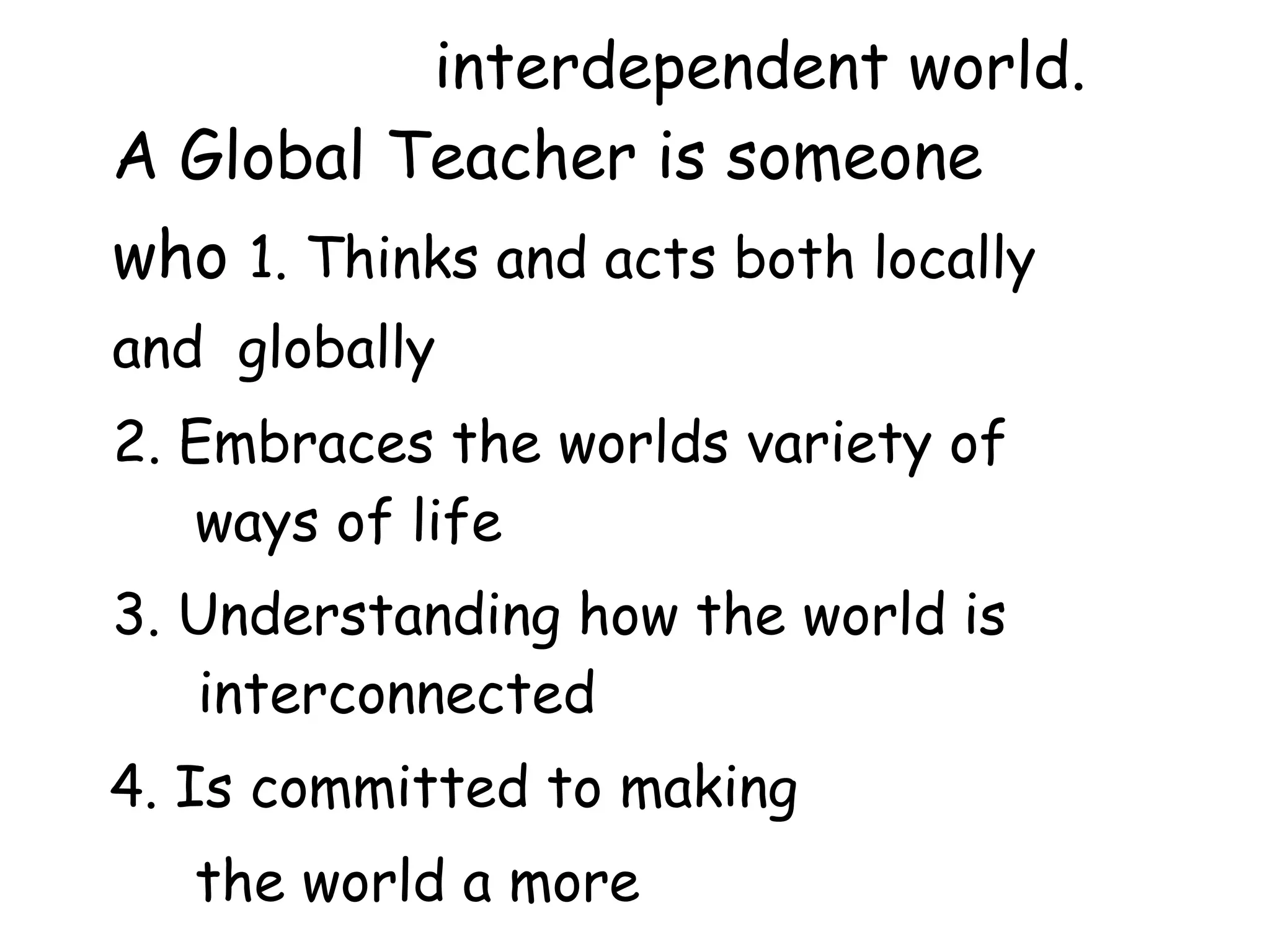
interdependent world.
A Global Teacher is someone
who 1. Thinks and acts both locally
and globally
2. Embraces the worlds variety of
ways of life
3. Understanding how the world is
interconnected
4. Is committed to making
the world a more
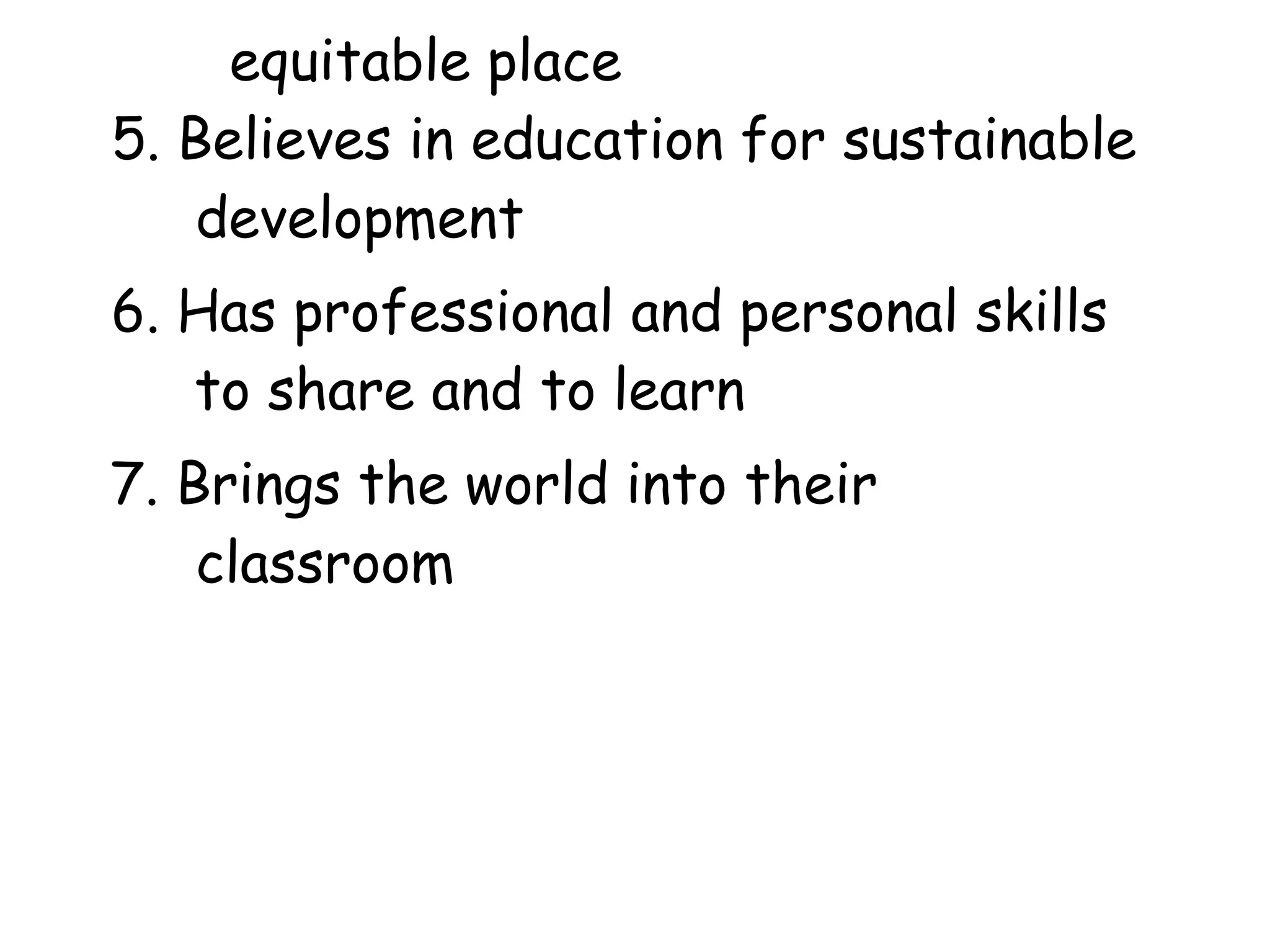
equitable place
5. Believes in education for sustainable
development
6. Has professional and personal skills
to share and to learn
7. Brings the world into their
classroom

Chapter 1 Lesson 2a.docx

  • 1.
  • 2.
  • 3.
    I. Teaching asa Vocation A vocation is an occupation either professional or voluntary that is carried out more for its altruistic benefit than for income II. Teaching as a Profession
  • 4.
    Definition of Profession •an occupation requiring considerable training and specialized study (American Heritage Dictionary of English Language, 1992) • “a professional is an individual that sets her apart from society” (Seagul and Wilsos, 1998. p.29) •“a profession is an occupation requiring expert knowledge that justifies a monopoly of services granted by government licensing (Spring 1998, p. 41) Primary Aspects of a
  • 5.
    Profession 1. Specialized Bodyof Knowledge Effective teacher possess of at least 4 kinds of Knowledge A. Knowledge of content they are teaching B. Pedagogical content knowledge C. General pedagogical knowledge D. Knowledge of learners and learning 2. Training for licensure 3. Autonomy Teachers have freedom within the
  • 6.
    classroom to teachas they best see fit. 4. Accountability Teachers are accountable to their students, parents, other teachers, school administrators and the public in general. 5. Professional Ethics III. A. Reasons Why People Select Teaching 1. Interpersonal Theme – contact with young people.
  • 7.
    2. Service theme– altruistic nature of teaching. 3. Concentration theme – remain in a setting that is pleasurable 4. Material benefits theme – refers to the salary, status and security of teachers 5. Time compatibility theme – flexibility of teachers schedule
  • 8.
    B. Reasons PeopleLeave Teaching 1. Positive motive – leaving without a crisis (eg. Raising ones family) 2. Institutional Reasons – (eg. Employment condition, difficult schedule, out of field subject matter assignment)
  • 9.
    3. Fatigue, routineand frustrations . IV. Qualities of an Effective Teacher PROFESSIONAL QUALITIES 1. Mastery of the subject-field one teaches 2. Understanding of the learners
  • 10.
    3. Understanding ofteaching principles and skill in the use of techniques for their implementation 4. General understanding of other branches of knowledge 5. Understanding and appreciation of the teaching profession
  • 11.
    PERSONAL QUALITIES 1. Intellectual 2. Physical 3.Emotional 4. Moral V. Teacher’s Job
  • 12.
    1. Guiding thelearning process 2. Counseling and Guidance 3. Sponsoring extra curricular activities 4. Working with parents and the community 5. Professional responsibilities IV. Teacher’s Preparation 1. Pre-service
  • 13.
    education 2. In-service education VII. Professional Developmentfor Teachers Professional Development – a system of continuous growth and learning to respond the needs of all learners.
  • 14.
    ❖NETWORKING • creating interdependentor interconnected groups or systems for mutual benefit of all members in the ecosystem ❖WORKSHOPS • gathering or training sessions ❖SEMINARS • a form of academic instruction ❖DEMONSTRATION
  • 15.
    • a methodof teaching by example rather than sample explanation ❖ COURSES • a program of education leading to • a degree or diploma ❖OBSERVATION ❖REFLECTIVE PRACTICE • consider critical incidents within your life's experiences ❖SUPERVISION
  • 16.
    • the actof watching over the work or task of another who may lack full knowledge of the concept at hand. PRIVATE READING VIII. PERSONAL DEVELOPMENT 1. Take the initiative to learn about the subculture in their
  • 17.
    area. 2. Develop understandingof intercultural interactions 3. Know learning style variations 4. across culture 4. Know how to deal with his / her students 5. Interact with their students and learn their different
  • 18.
    characteristics IX. Community –School - Relations What the school should know about the community? ➢ Information about the composition of the community such as income, educational level and occupation ➢ Opinions of community regarding broad educational issues
  • 19.
    ➢ Familiarity with educational resourcesavailable in the community. How to gather information about the community? 1. Community Survey 2. Home Visits 3. Telephone use Involving Students in the Community
  • 20.
    Involving the Communityin the School X. Linkages and Networking 1. Give you important contacts that can advance your career 2. Allows opportunity for job leads 3. Gives you the information on the latest development in one’s field 4. Gives you support and
  • 21.
    encouragement As a teacher,you must expand your networks of contacts. SOME BASIC TOOLS: 1. An address book to record and keep track of contacts, addresses, notes of meeting, commitments 2. An appointment calendar 3. Business cards that contain fax number and e-mail address.
  • 22.
    XI. Multicultural Classroom ―students and teachers are accepting all race, cultures and religion. ❑What is the best way to incorporate multiculturalism in the classroom? ― include books in your curriculum and class library
  • 23.
    that feature multicultural characteristics. ❑Whyis multiculturalism important? ― the world is fast changing and we have to learn and accept and to get along with all cultural races and religion to become productive citizens of the world ❑What can I do to make my classroom more multicultural?
  • 24.
    ― provide booksthat feature children of many different races ― place posters on the wall that feature a variety of multicultural children ― discuss differences and similarities in culture but stress similarities ― find an international pen pal in your class ― if you discuss one holiday, make sure to discuss them all XII. Teacher Exchange
  • 25.
    Program Purpose: 1. Promote understandingof the people of other countries through educational exchange 2. Provide opportunity to compare and learn about different education system 3. To exchange ideas and knowledge 4. To contribute in the professional
  • 26.
    development of yourselfand teacher colleagues. Benefits of TEP 1. Benefits to Teachers and Administrator A. Professional Development B. A Different Teaching Environment C. A Change of Scene D. The Exchange of Teacher as a
  • 27.
    Resource E. Basis forLinks, Networking and Joint Projects 2. Benefits to Students A. Increase understanding of host country, language, and academic field B. Career enhancing experience which allows teachers to be exposed to new teaching
  • 28.
    methods C. Developlifelong friendship and professional relationships. 3. Benefit to Schools A. Increase knowledge and international awareness among professional colleagues 4. Benefits to Communities A. Presence of foreign teacher allows the whole community the opportunity to learn from another nation
  • 29.
    B. Increase awarenessof diversity of ideas, world views and ways of life THE GLOBAL TEACHER What is the global teacher program? Its purpose is to promote within education the knowledge, attitudes and skills that young people need in order to practice social and environmental responsibility as a multicultural society and
  • 30.
    interdependent world. A GlobalTeacher is someone who 1. Thinks and acts both locally and globally 2. Embraces the worlds variety of ways of life 3. Understanding how the world is interconnected 4. Is committed to making the world a more
  • 31.
    equitable place 5. Believesin education for sustainable development 6. Has professional and personal skills to share and to learn 7. Brings the world into their classroom