
The implementation of education equity in ODL   --- Measures, Innovation and Quality LI Yawan CCRTVU
Main contents Background of the research Perception of education equity Measures taken in the CRTVUs Innovative approach Facilitate education equity with quality Conclusion
Background of the research
1.1 Chinese context Territory Area: 9.6 million square kilometers Mid-year population: 1.3 billion Minorities: 56 Urban/Rural population: 43.9%:56.1%  Ranking of China in the World in Terms of Main Indicators: 4 th   (Sources: Database of United Nations, "Industrial Commodity Statistics Yearbook", Database of FAO)
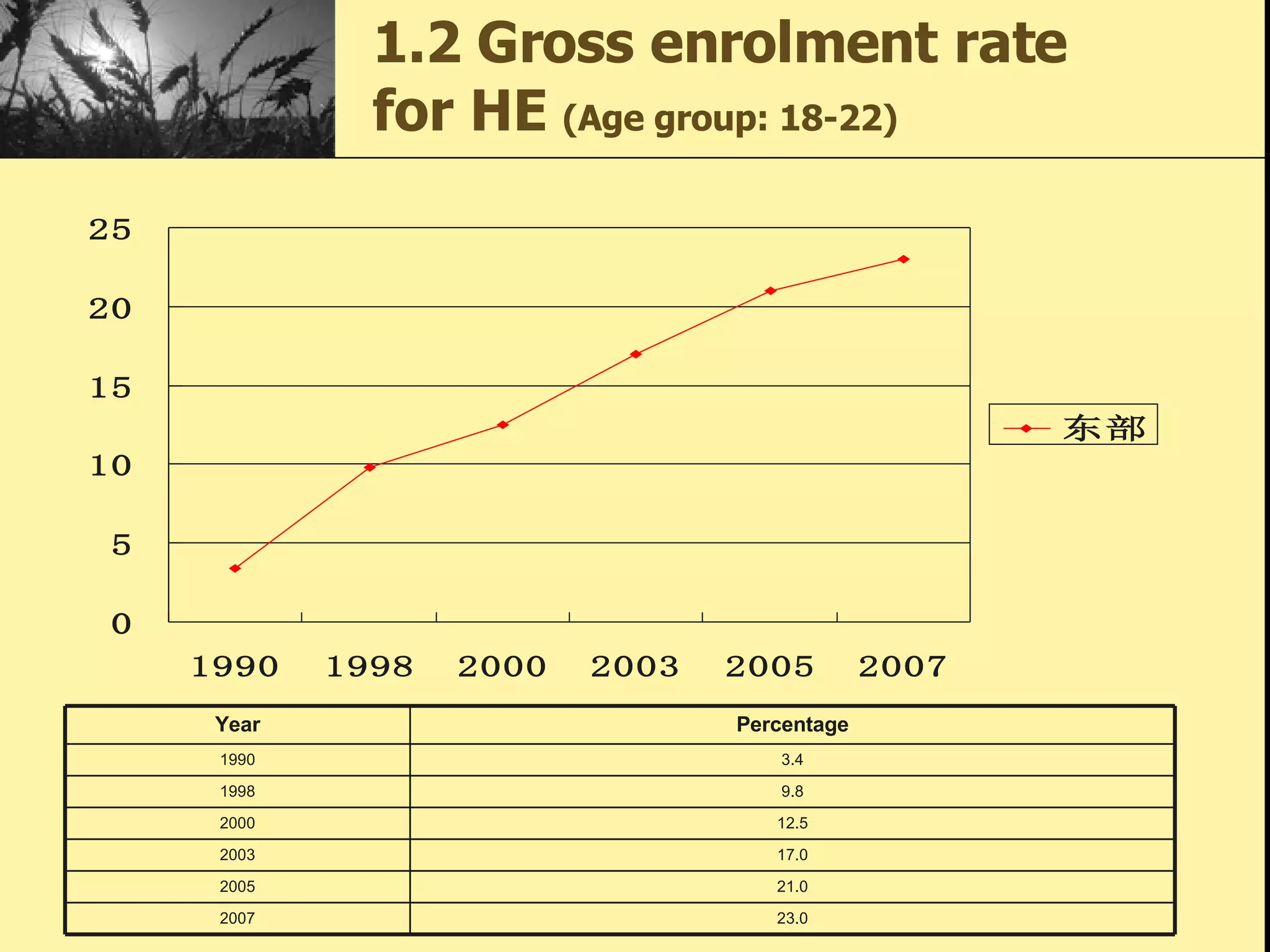
1.2 Gross enrolment rate  for HE   (Age group: 18-22) Year Percentage 1990 3.4 1998 9.8 2000 12.5 2003 17.0 2005 21.0 2007 23.0
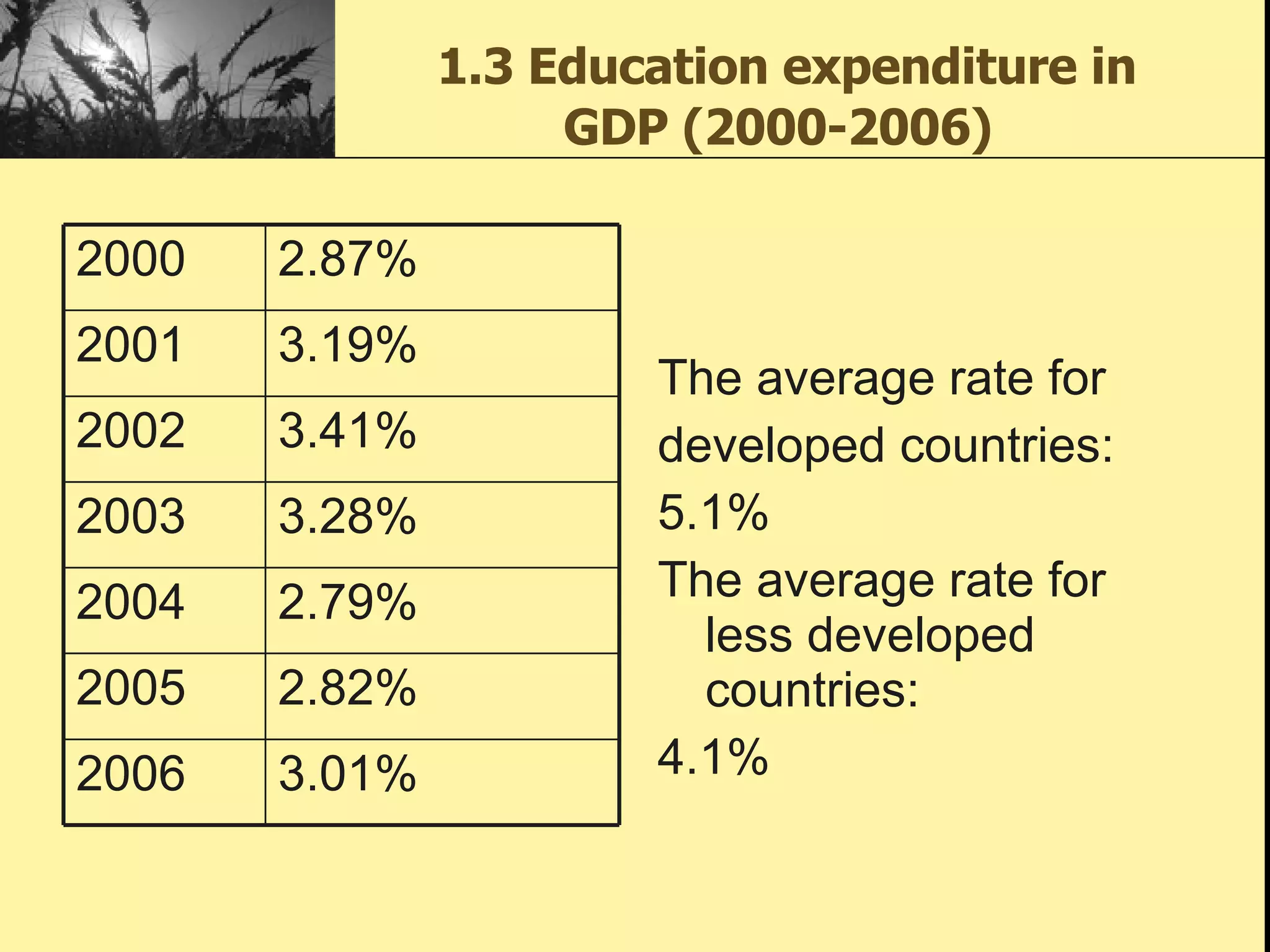
  1.3 Education expenditure in GDP (2000-2006) The average rate for  developed countries: 5.1% The average rate for less developed countries: 4.1% 2000 2.87% 2001 3.19% 2002 3.41% 2003 3.28% 2004 2.79% 2005 2.82% 2006 3.01%
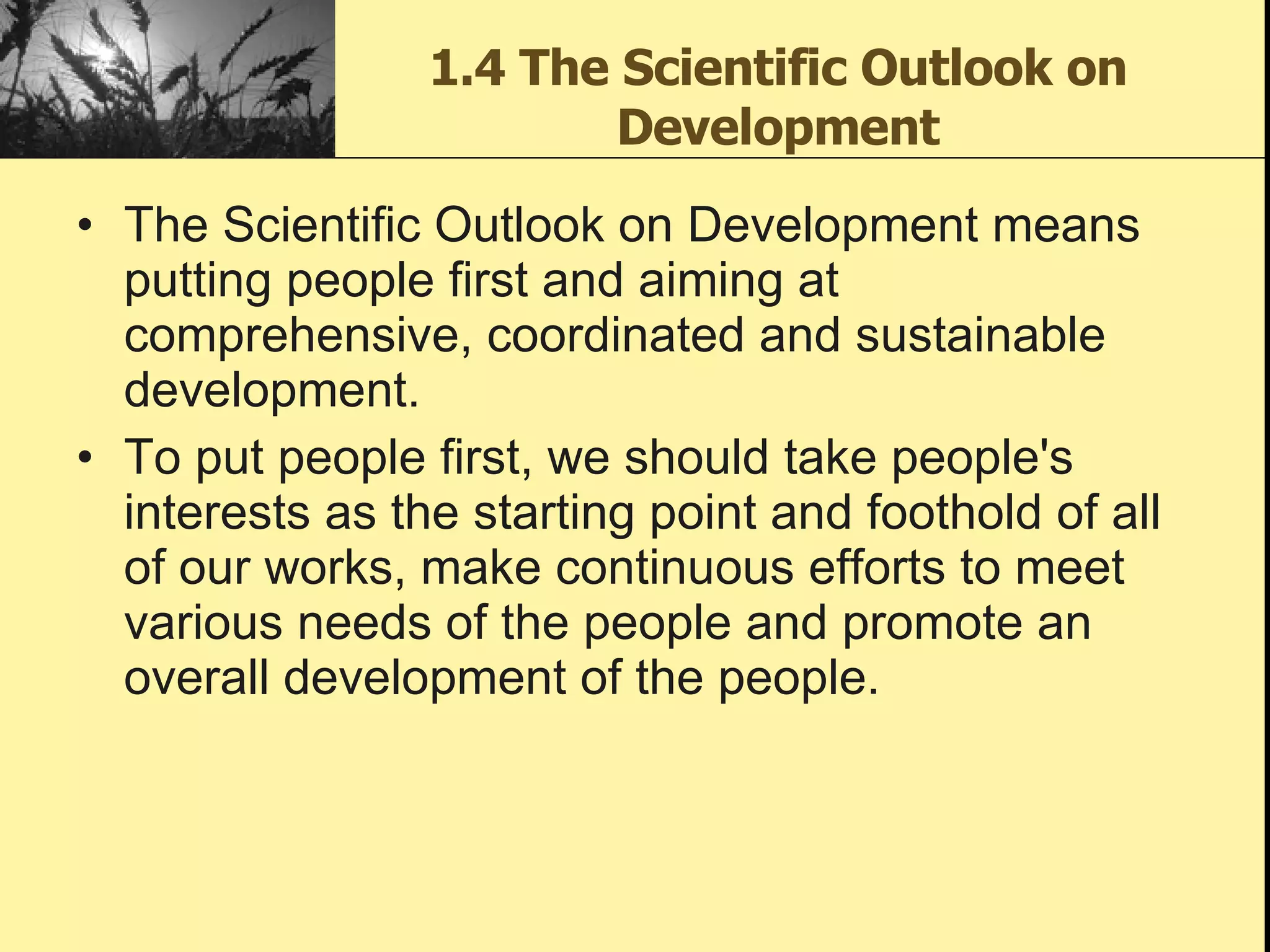
1.4 The Scientific Outlook on Development The Scientific Outlook on Development means putting people first and aiming at comprehensive, coordinated and sustainable development. To put people first, we should take people's interests as the starting point and foothold of all of our works, make continuous efforts to meet various needs of the people and promote an overall development of the people.
2. Perception of education equity
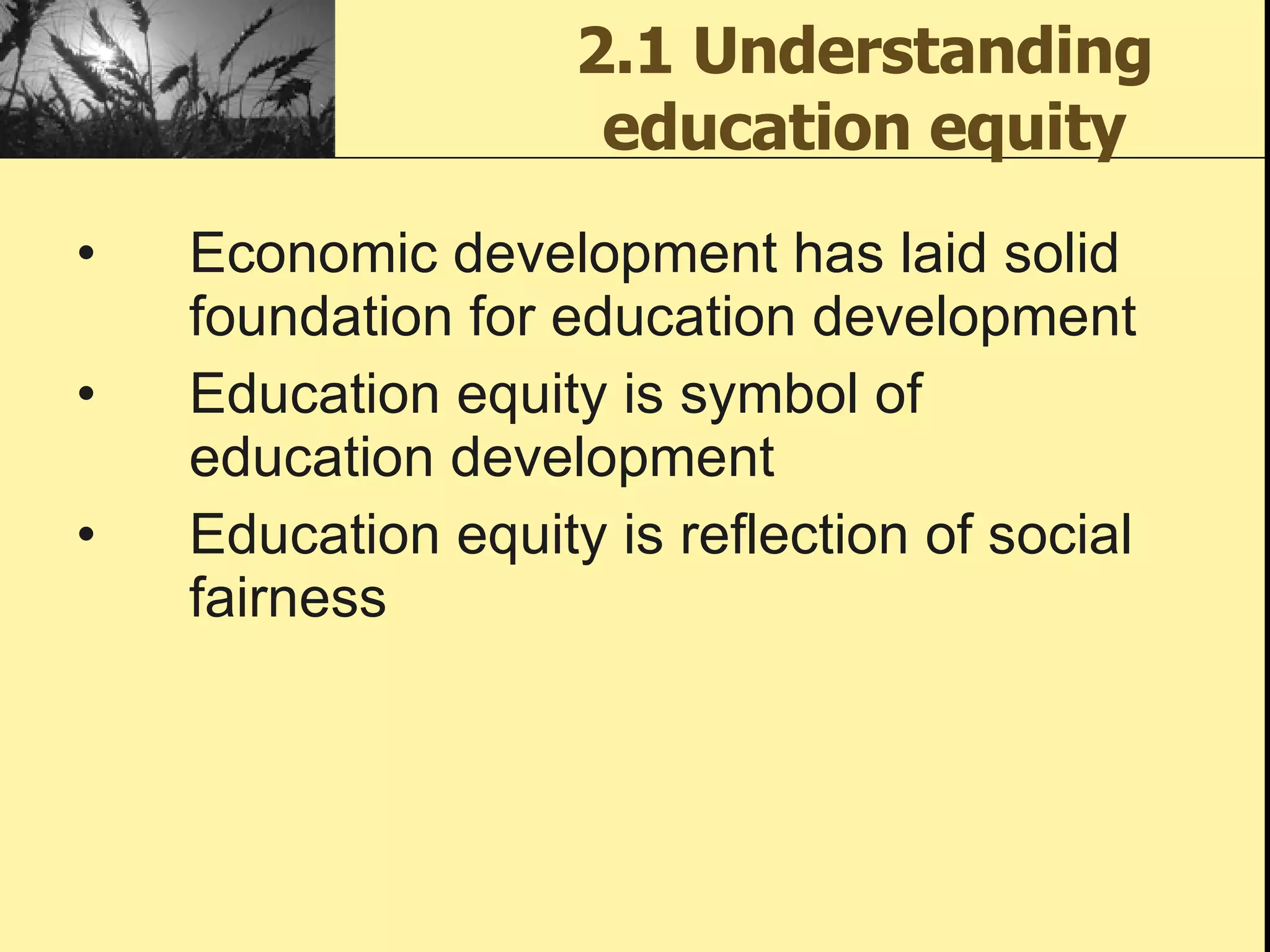
2.1 Understanding education equity Economic development has laid solid foundation for education development Education equity is symbol of education development Education equity is reflection of social fairness
2.2 Implication of education equity ♦  Equal opportunities ♦  Reasonable distribution of educational resources ♦  Easy access to public educational infrastructure ♦  Quality education available to everyone
2.3 ODL is a feasible way to realize education equity Advantages of ODL ♦   increase the number of students ♦  realize cost efficiency ♦  share expertise and quality resources ♦  utilize effectively ICT to facilitate education innovation
2.4 The value of ODL matching the goal of education equity One of the important measures to develop education which can achieve greater, faster, better and more economic results --- Deng Xiaoping Through 30 year operation, CRTVUs have become backbones of modern distance education in China and also a strong force to drive mass education and life-long learning--- Chen Zhil The orientation of CRTVUs is more distinctive: we will face to localities, the grass-roots units, the remote, rural and minority-group inhabited areas---Ge Daokai More than ¾ students coming from under prefectural administrative areas More than 90% of our students are working adults
3. Measures taken in the CRTVUs
3.1 Objectives of ODL in China Meeting diversified groups and serving the general public Obtaining degree & diploma Getting certificates for qualification Updating knowledge and skills Acquiring competencies  Improving career development Increasing life quality
3.2 Open education project Started in 1999 Aim: increase access and meet the social demands Content: explore academic and administrative mode for training new-typed applied professional Basis: integrate various learning resources Support: create learning environment
 
3.3 Extend public service Started in 2002 Contracts made with 38 conventional universities by 2008 teaching and management platform  to transmit ODL programs 1464 study centers by July 2008 Organizing distance learning exam 3.58 million person/time
3.4 Construct technology-supported learning environment
3.5 Concrete actions Showing concern to those who are vulnerable and those who have special needs Ethnic minorities The elderly People with disabilities People in rural areas The military personnel
3.5.1 Contribute to the rural development Initiate a project of “One student in one village”—with enrolment of 100 thousand Objective: train managers and technicians Operation: 580 teaching venues in 37 PRTVUs with the support of locality Learning resources and platform for rural development in 16 specialties of 4 fields of study including technology in agriculture and forestry, husbandry & veterinary science and management for agriculture and forestry. Graduates’ contribution to rural development
 
3.5.2 Looking after the interests of the disabled College for the Disabled:  2002 Teaching point: 23  Enrolments: 2444 Targets: handicapped Specialties offered: digital media design and production, accounting, English, and community management Allow disabled to transcend themselves, to merge in the social family and enjoy the human rights
 
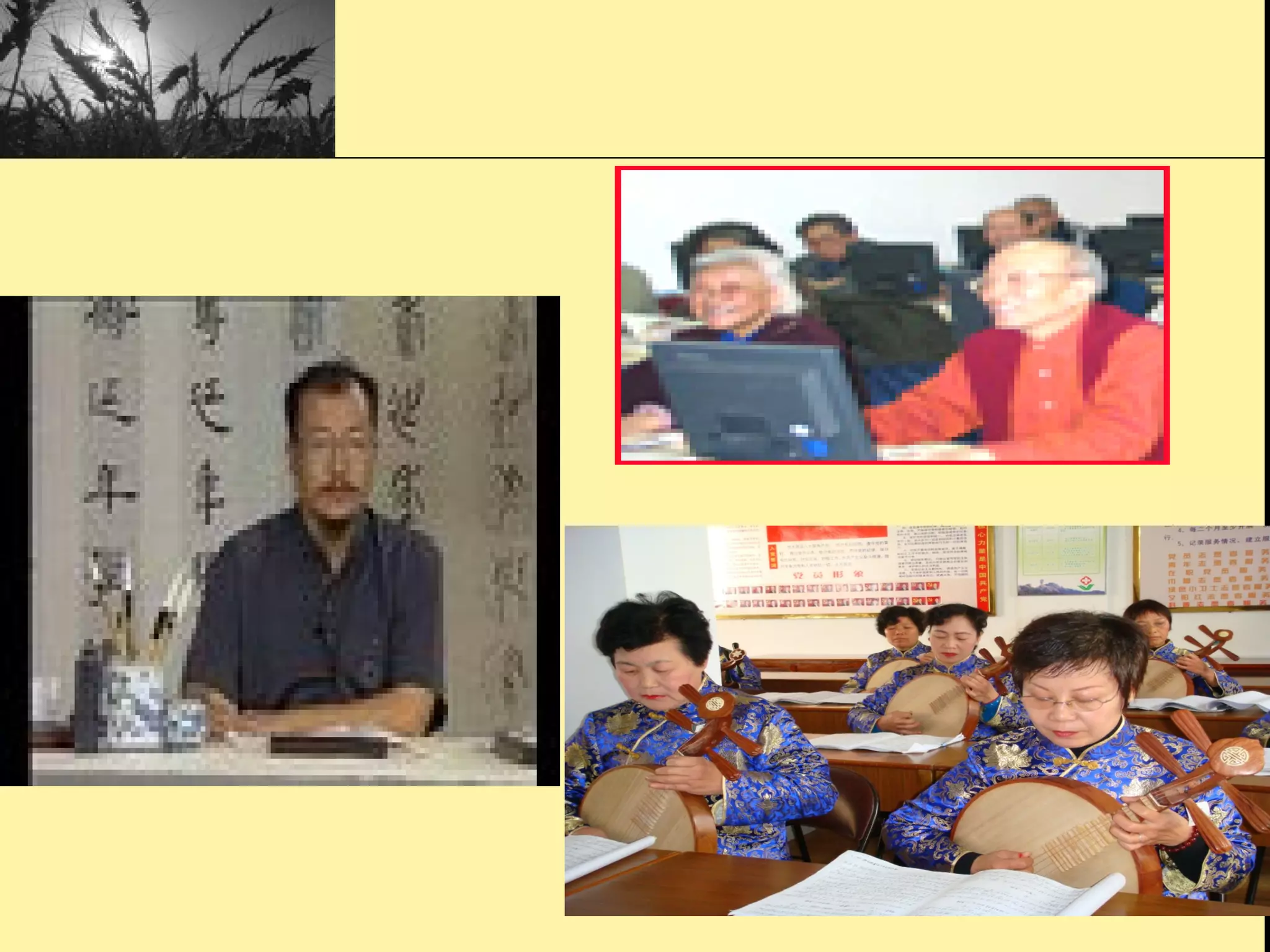
3.5.3 Showing concern for the elderly people According to 2007’s National Statistics Bureau reports, there are more than 106 million people above the age of 65, which makes up 8.1% of the total population. Colleges for elderly have emerged in the RTVUs in the past few years Special programs made for their enjoyment and enrichment Calligraphy, painting, singing and dancing
 
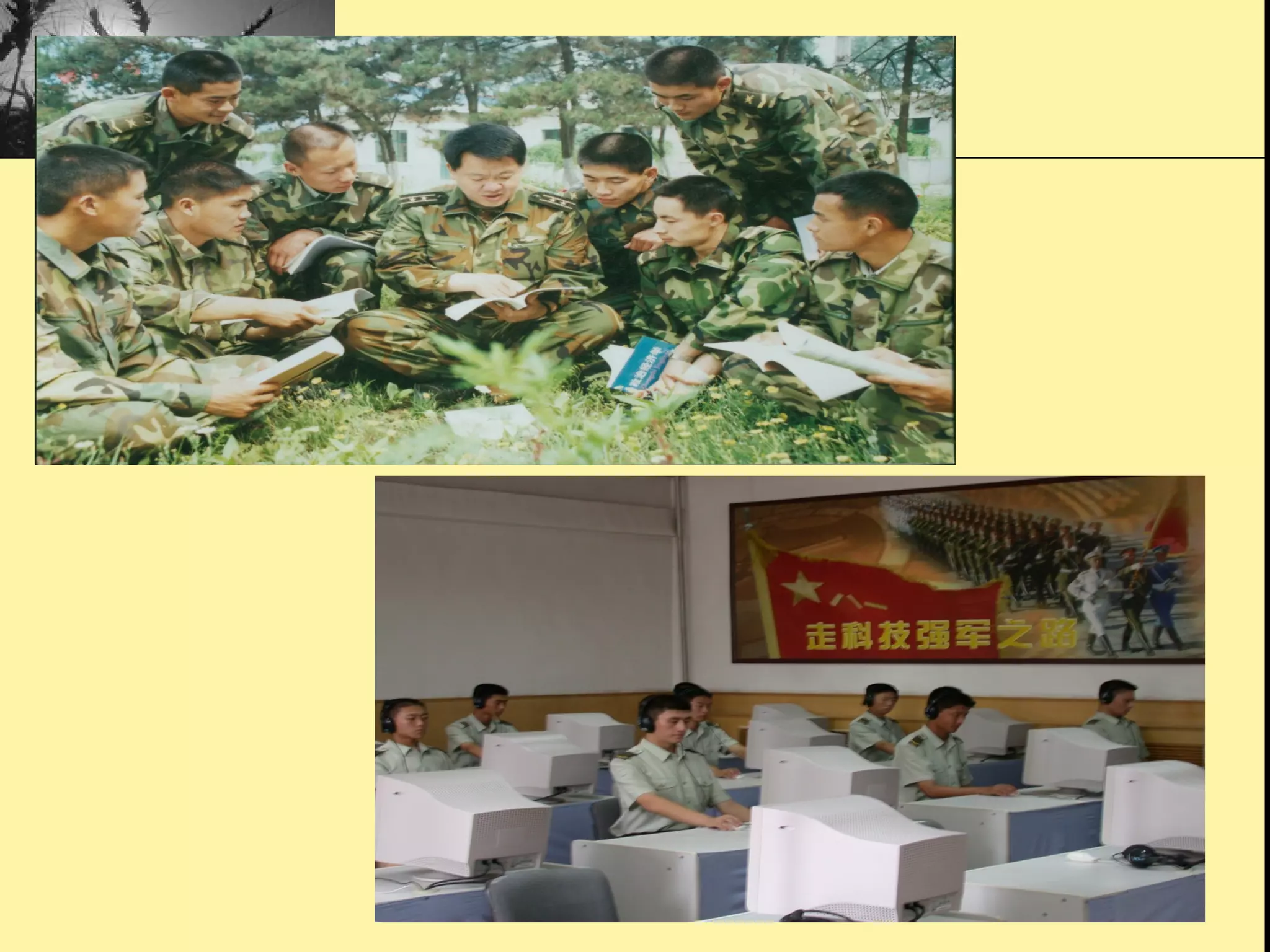
3.5.4 ODL in military forces Started in 2000 Objective: to foster qualified military man and prepare for tomorrow Enrolment & graduates: 66403 & 37587 469 teaching venues scattered the whole country Specialties offered: Law Administration Business management Estate management Computer & application Communication technology
 
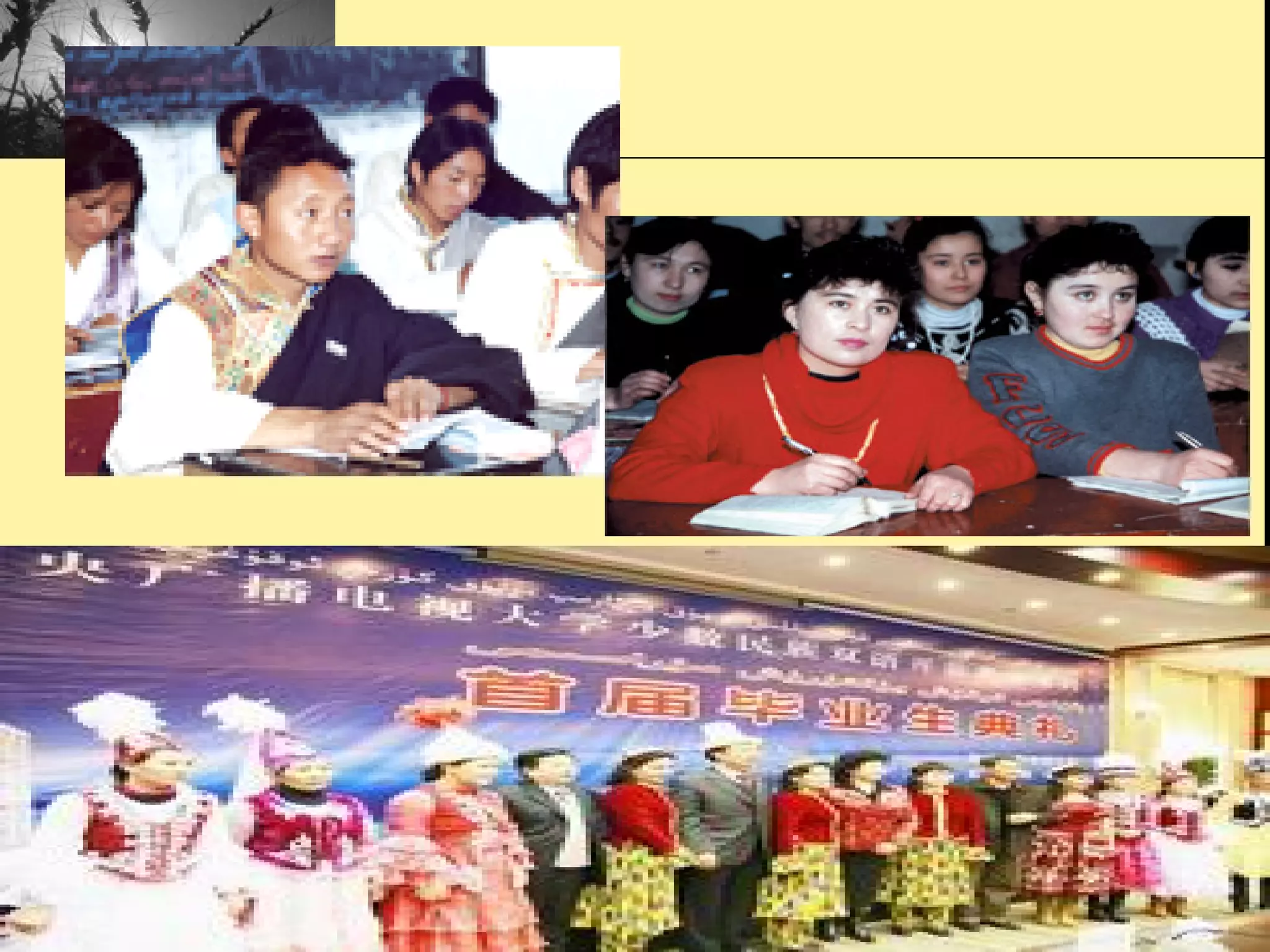
3.5.5 Minority people improve themselves via ODL Tibetan College: Started in 2002 By June, 2008 it is with 1332 graduates and 1949 enrolment Program relevant to the development of Tibet: law, administration, accounting, English, Chinese, computer science and technology Bilingual languages programs in Inner Mongolia, Xinjiang Uyghurs, Korean-inhabited regions, etc.
 
4. Innovative approach
4.1 Utilization of social strength Inviting renowned expertise in special fields of study 1189 course presenters and editors 37052 part-time teachers in the total of 84855 Enhancing multi-channel collaboration with government, industry and association Ministries  People’s Bank Trade of Union National Association for disabled Making full use of existing infrastructure in locality
4.2 Construction of relevant resources Investigate the requirements from the society Follow the principle of ODL Develop relevant and usable specialties and course Fit for local context of infrastructure and learning conditions  Obtain feedback from different sources
4.3 Appropriate methodologies Interaction with guided-learning Flexibility for multiple choices Direct learning in accordance with demands Show special concern for the most vulnerable
5. Facilitate education equity with quality
5.1 The organizing structure for quality assurance Institutional authority T A S  Representative  of authority  Evaluation system
5.2 Evaluate in accordance with the criteria Criteria for developing teaching resources Criteria for teaching and learning process Criteria for learning support Criteria for teaching management Criteria for infrastructure & conditions
5.3 Further discussion What kind of resources should be built? How can we bring new technology to be used at its most? How can we promote professional development of our ODL practitioners? How can we establish a more collaborative & coordinated mechanism to facilitate the implementation the ODL?  How can we clear up all the obstacles in promoting education equity?
6. Conclusion
6.1 Significance of education equity Education equity reflects the idea of education democracy Education equity is the basis of social fairness Education equity implies social value Education equity promotes human and social development
6.2 Approach further on education equity Education equity in ODL does not only refer to the equal opportunities to all categories of people, but the balanced distribution of quality resources and delivery, as well as the assurance of equivalent high quality education.
6.3 Continuing education equity Education equity should be reflected at the starting point of educational provision, in the process, and for the outcome.  Therefore, we need to define our research scope, look at the features in each country and find out appropriate evaluation index so as to give impetus of the implementation of education equity.
6.4 Further actions Government strategies support Instructional capacity building Commitment of practitioners Students’ awareness of their own rights
Thank you! Keep in contact: liyw@crtvu.edu.cn

The implementation of education equity in ODL

  • 1.
    The implementation ofeducation equity in ODL --- Measures, Innovation and Quality LI Yawan CCRTVU
  • 2.
    Main contents Backgroundof the research Perception of education equity Measures taken in the CRTVUs Innovative approach Facilitate education equity with quality Conclusion
  • 3.
  • 4.
    1.1 Chinese contextTerritory Area: 9.6 million square kilometers Mid-year population: 1.3 billion Minorities: 56 Urban/Rural population: 43.9%:56.1% Ranking of China in the World in Terms of Main Indicators: 4 th (Sources: Database of United Nations, "Industrial Commodity Statistics Yearbook", Database of FAO)
  • 5.
    1.2 Gross enrolmentrate for HE (Age group: 18-22) Year Percentage 1990 3.4 1998 9.8 2000 12.5 2003 17.0 2005 21.0 2007 23.0
  • 6.
    1.3Education expenditure in GDP (2000-2006) The average rate for developed countries: 5.1% The average rate for less developed countries: 4.1% 2000 2.87% 2001 3.19% 2002 3.41% 2003 3.28% 2004 2.79% 2005 2.82% 2006 3.01%
  • 7.
    1.4 The ScientificOutlook on Development The Scientific Outlook on Development means putting people first and aiming at comprehensive, coordinated and sustainable development. To put people first, we should take people's interests as the starting point and foothold of all of our works, make continuous efforts to meet various needs of the people and promote an overall development of the people.
  • 8.
    2. Perception ofeducation equity
  • 9.
    2.1 Understanding educationequity Economic development has laid solid foundation for education development Education equity is symbol of education development Education equity is reflection of social fairness
  • 10.
    2.2 Implication ofeducation equity ♦ Equal opportunities ♦ Reasonable distribution of educational resources ♦ Easy access to public educational infrastructure ♦ Quality education available to everyone
  • 11.
    2.3 ODL isa feasible way to realize education equity Advantages of ODL ♦ increase the number of students ♦ realize cost efficiency ♦ share expertise and quality resources ♦ utilize effectively ICT to facilitate education innovation
  • 12.
    2.4 The valueof ODL matching the goal of education equity One of the important measures to develop education which can achieve greater, faster, better and more economic results --- Deng Xiaoping Through 30 year operation, CRTVUs have become backbones of modern distance education in China and also a strong force to drive mass education and life-long learning--- Chen Zhil The orientation of CRTVUs is more distinctive: we will face to localities, the grass-roots units, the remote, rural and minority-group inhabited areas---Ge Daokai More than ¾ students coming from under prefectural administrative areas More than 90% of our students are working adults
  • 13.
    3. Measures takenin the CRTVUs
  • 14.
    3.1 Objectives ofODL in China Meeting diversified groups and serving the general public Obtaining degree & diploma Getting certificates for qualification Updating knowledge and skills Acquiring competencies Improving career development Increasing life quality
  • 15.
    3.2 Open educationproject Started in 1999 Aim: increase access and meet the social demands Content: explore academic and administrative mode for training new-typed applied professional Basis: integrate various learning resources Support: create learning environment
  • 16.
  • 17.
    3.3 Extend publicservice Started in 2002 Contracts made with 38 conventional universities by 2008 teaching and management platform to transmit ODL programs 1464 study centers by July 2008 Organizing distance learning exam 3.58 million person/time
  • 18.
  • 19.
    3.5 Concrete actionsShowing concern to those who are vulnerable and those who have special needs Ethnic minorities The elderly People with disabilities People in rural areas The military personnel
  • 20.
    3.5.1 Contribute tothe rural development Initiate a project of “One student in one village”—with enrolment of 100 thousand Objective: train managers and technicians Operation: 580 teaching venues in 37 PRTVUs with the support of locality Learning resources and platform for rural development in 16 specialties of 4 fields of study including technology in agriculture and forestry, husbandry & veterinary science and management for agriculture and forestry. Graduates’ contribution to rural development
  • 21.
  • 22.
    3.5.2 Looking afterthe interests of the disabled College for the Disabled: 2002 Teaching point: 23 Enrolments: 2444 Targets: handicapped Specialties offered: digital media design and production, accounting, English, and community management Allow disabled to transcend themselves, to merge in the social family and enjoy the human rights
  • 23.
  • 24.
    3.5.3 Showing concernfor the elderly people According to 2007’s National Statistics Bureau reports, there are more than 106 million people above the age of 65, which makes up 8.1% of the total population. Colleges for elderly have emerged in the RTVUs in the past few years Special programs made for their enjoyment and enrichment Calligraphy, painting, singing and dancing
  • 25.
  • 26.
    3.5.4 ODL inmilitary forces Started in 2000 Objective: to foster qualified military man and prepare for tomorrow Enrolment & graduates: 66403 & 37587 469 teaching venues scattered the whole country Specialties offered: Law Administration Business management Estate management Computer & application Communication technology
  • 27.
  • 28.
    3.5.5 Minority peopleimprove themselves via ODL Tibetan College: Started in 2002 By June, 2008 it is with 1332 graduates and 1949 enrolment Program relevant to the development of Tibet: law, administration, accounting, English, Chinese, computer science and technology Bilingual languages programs in Inner Mongolia, Xinjiang Uyghurs, Korean-inhabited regions, etc.
  • 29.
  • 30.
  • 31.
    4.1 Utilization ofsocial strength Inviting renowned expertise in special fields of study 1189 course presenters and editors 37052 part-time teachers in the total of 84855 Enhancing multi-channel collaboration with government, industry and association Ministries People’s Bank Trade of Union National Association for disabled Making full use of existing infrastructure in locality
  • 32.
    4.2 Construction ofrelevant resources Investigate the requirements from the society Follow the principle of ODL Develop relevant and usable specialties and course Fit for local context of infrastructure and learning conditions Obtain feedback from different sources
  • 33.
    4.3 Appropriate methodologiesInteraction with guided-learning Flexibility for multiple choices Direct learning in accordance with demands Show special concern for the most vulnerable
  • 34.
    5. Facilitate educationequity with quality
  • 35.
    5.1 The organizingstructure for quality assurance Institutional authority T A S Representative of authority Evaluation system
  • 36.
    5.2 Evaluate inaccordance with the criteria Criteria for developing teaching resources Criteria for teaching and learning process Criteria for learning support Criteria for teaching management Criteria for infrastructure & conditions
  • 37.
    5.3 Further discussionWhat kind of resources should be built? How can we bring new technology to be used at its most? How can we promote professional development of our ODL practitioners? How can we establish a more collaborative & coordinated mechanism to facilitate the implementation the ODL? How can we clear up all the obstacles in promoting education equity?
  • 38.
  • 39.
    6.1 Significance ofeducation equity Education equity reflects the idea of education democracy Education equity is the basis of social fairness Education equity implies social value Education equity promotes human and social development
  • 40.
    6.2 Approach furtheron education equity Education equity in ODL does not only refer to the equal opportunities to all categories of people, but the balanced distribution of quality resources and delivery, as well as the assurance of equivalent high quality education.
  • 41.
    6.3 Continuing educationequity Education equity should be reflected at the starting point of educational provision, in the process, and for the outcome. Therefore, we need to define our research scope, look at the features in each country and find out appropriate evaluation index so as to give impetus of the implementation of education equity.
  • 42.
    6.4 Further actionsGovernment strategies support Instructional capacity building Commitment of practitioners Students’ awareness of their own rights
  • 43.
    Thank you! Keepin contact: liyw@crtvu.edu.cn