EDUCATIONAL
REFORMS IN
PAKISTAN.
GROUP MEMBERS:
2
• Muqaddas Javaid
• Nimra Tariq
• Noor Fatima
• Noor-Ul-Ain
• Omaima Khan
OUTLINE:
• Importance
• Education in Pakistan
• Flaws in education system
• Literacy Rate
• Issues
• Reforms
• Conclusion
3
4
TRANSITION HEADLINE
IMPORTANCE:
5
• Education is the base and everybody knows the
importance.
• Education gives the path towards bright future.
• Education builds the nation and become powerful
tool.
• It is the only tool that can help to remove millions
of people from jaws of poverty.
“It is obligatory for every
Muslim, man and woman
to acquire knowledge.
6
EDUCATION IN PAKISTAN:
7
• Pakistan produce about 445,000 university
graduates per year.
• With 18 million of population, the 11% of people
having the command over English, it makes it 9th
largest country in the world and 3rd largest
country in Asia.
FLAWS IN EDUCATION SYSTEM:
• Medium of education.
• Regional disparity.
• Gender discrimination.
• Lack of technical education.
• Less trained faculty.
• Lack of Government interest.
8
9
“Literacy is a bridge from
misery to hope.
10
11
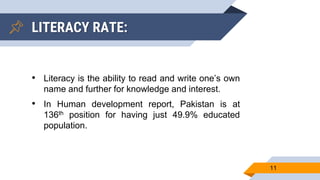
• Literacy is the ability to read and write one’s own
name and further for knowledge and interest.
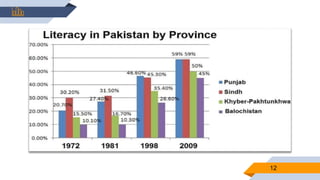
• In Human development report, Pakistan is at
136th position for having just 49.9% educated
population.
LITERACY RATE:
12
13
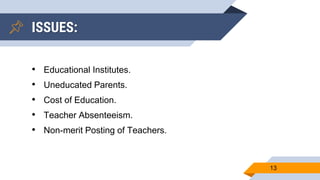
• Educational Institutes.
• Uneducated Parents.
• Cost of Education.
• Teacher Absenteeism.
• Non-merit Posting of Teachers.
ISSUES:
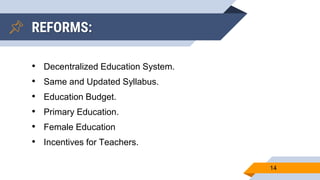
REFORMS:
• Decentralized Education System.
• Same and Updated Syllabus.
• Education Budget.
• Primary Education.
• Female Education
• Incentives for Teachers.
14
REFORMS [con…]
• Promotion of Technical Education.
• Security for Educational Institutes.
• Special attention for Rural Areas.
• Examination System should be improved.
• Criteria for evaluation.
• Critical Thinking.
15
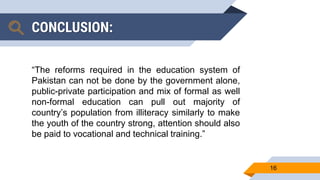
CONCLUSION:
“The reforms required in the education system of
Pakistan can not be done by the government alone,
public-private participation and mix of formal as well
non-formal education can pull out majority of
country’s population from illiteracy similarly to make
the youth of the country strong, attention should also
be paid to vocational and technical training.”
16
17
THANKS!
Any questions?

Educational Reforms in Pakistan

  • 1.
  • 2.
    GROUP MEMBERS: 2 • MuqaddasJavaid • Nimra Tariq • Noor Fatima • Noor-Ul-Ain • Omaima Khan
  • 3.
    OUTLINE: • Importance • Educationin Pakistan • Flaws in education system • Literacy Rate • Issues • Reforms • Conclusion 3
  • 4.
  • 5.
    IMPORTANCE: 5 • Education isthe base and everybody knows the importance. • Education gives the path towards bright future. • Education builds the nation and become powerful tool. • It is the only tool that can help to remove millions of people from jaws of poverty.
  • 6.
    “It is obligatoryfor every Muslim, man and woman to acquire knowledge. 6
  • 7.
    EDUCATION IN PAKISTAN: 7 •Pakistan produce about 445,000 university graduates per year. • With 18 million of population, the 11% of people having the command over English, it makes it 9th largest country in the world and 3rd largest country in Asia.
  • 8.
    FLAWS IN EDUCATIONSYSTEM: • Medium of education. • Regional disparity. • Gender discrimination. • Lack of technical education. • Less trained faculty. • Lack of Government interest. 8
  • 9.
  • 10.
    “Literacy is abridge from misery to hope. 10
  • 11.
    11 • Literacy isthe ability to read and write one’s own name and further for knowledge and interest. • In Human development report, Pakistan is at 136th position for having just 49.9% educated population. LITERACY RATE:
  • 12.
  • 13.
    13 • Educational Institutes. •Uneducated Parents. • Cost of Education. • Teacher Absenteeism. • Non-merit Posting of Teachers. ISSUES:
  • 14.
    REFORMS: • Decentralized EducationSystem. • Same and Updated Syllabus. • Education Budget. • Primary Education. • Female Education • Incentives for Teachers. 14
  • 15.
    REFORMS [con…] • Promotionof Technical Education. • Security for Educational Institutes. • Special attention for Rural Areas. • Examination System should be improved. • Criteria for evaluation. • Critical Thinking. 15
  • 16.
    CONCLUSION: “The reforms requiredin the education system of Pakistan can not be done by the government alone, public-private participation and mix of formal as well non-formal education can pull out majority of country’s population from illiteracy similarly to make the youth of the country strong, attention should also be paid to vocational and technical training.” 16
  • 17.