IEP policy workshop Y2K1 Péter Radó Equity in Education The policy implications
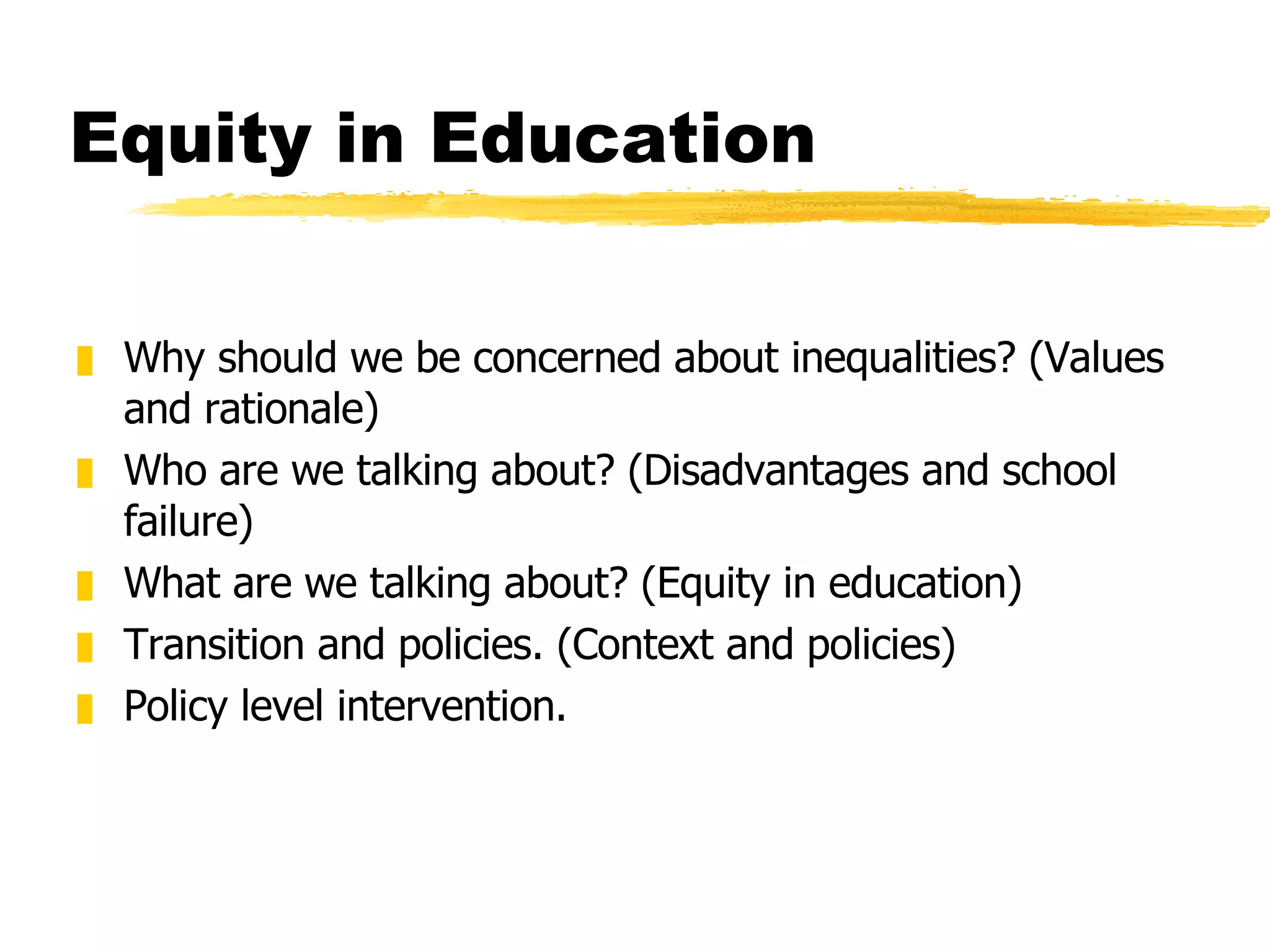
Equity in Education Why should we be concerned about inequalities? (Values and rationale) Who are we talking about? (Disadvantages and school failure) What are we talking about? (Equity in education) Transition and policies. (Context and policies) Policy level intervention.
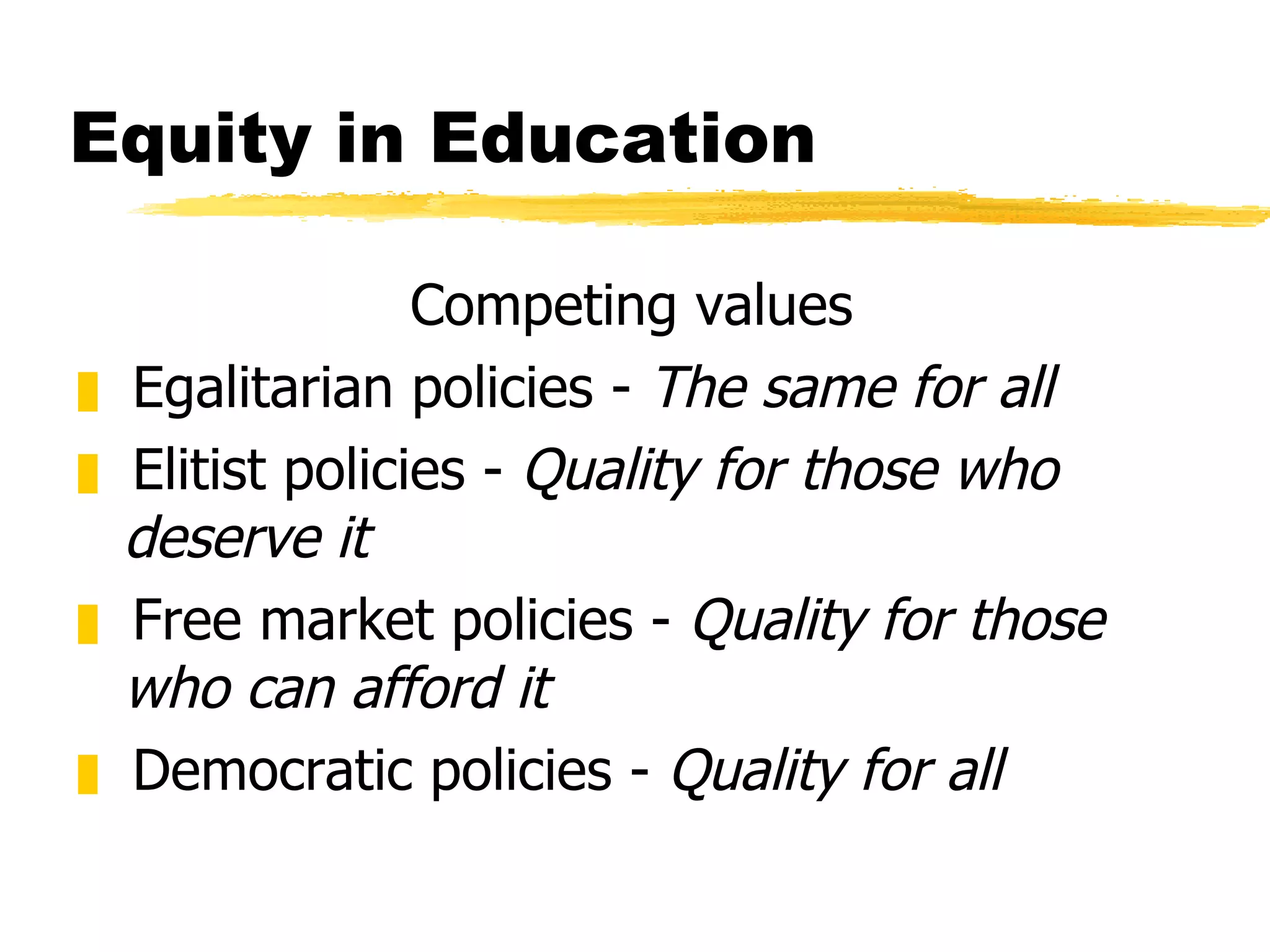
Equity in Education Competing values Egalitarian policies -  The same for all Elitist policies -  Quality for those who deserve it Free market policies -  Quality for those who can afford it Democratic policies -  Quality for all
Equity in Education The rationale Investment to human capital Strengthening social cohesion Reduction of social safety costs
Equity in Education The dimensions of disadvantages socio-economic status place of residence individual abilities ethnic affiliation gender
Equity in Education Children falling behind (participation) Children dropping out from basic education Children completing basic education but not enrolled till the end of compulsory schooling Children completing special schools for disabled Children dropping out from secondary education without certification Children completing low value traditional vocational training programs
Equity in Education Children falling behind (learning outcomes) The achievement of students in international comparison  The profile of poor achievers The comparative achievement of students belonging to the target groups
Equity in Education
Equity in Education The signs of selectivity The growing private sector for those who can afford it The system of elite public schools High enrollment in special schools of disabled Institutionalized segregation of Roma Low value added “repositories” in vocational training  Unfair streaming of students
Equity in Education Quality in terms of equity Education that is open to the entire target group Education that is differentiated, that takes into account the individual educational needs of each children Education that adapts to the needs of different target groups Education that adapts to the changing needs of individual persons and the society as a whole
Equity in Education
Equity in Education The trade-off myth Equity versus decentralization Equity versus liberalization Equity versus choice Equity versus cost-efficiency
Equity in Education “Transition compatible” policy tools Monitoring of the students’ achievement Information system that identifies the target groups Targeted allocation of extra resources Extra support to under-performing schools Reconsidering educational objectives (reform of process and output regulation)
Equity in Education “Transition compatible” policy tools INSET Investment to the initial phase of education Building local co-operation networks of services Anti-discrimination regulation and monitoring
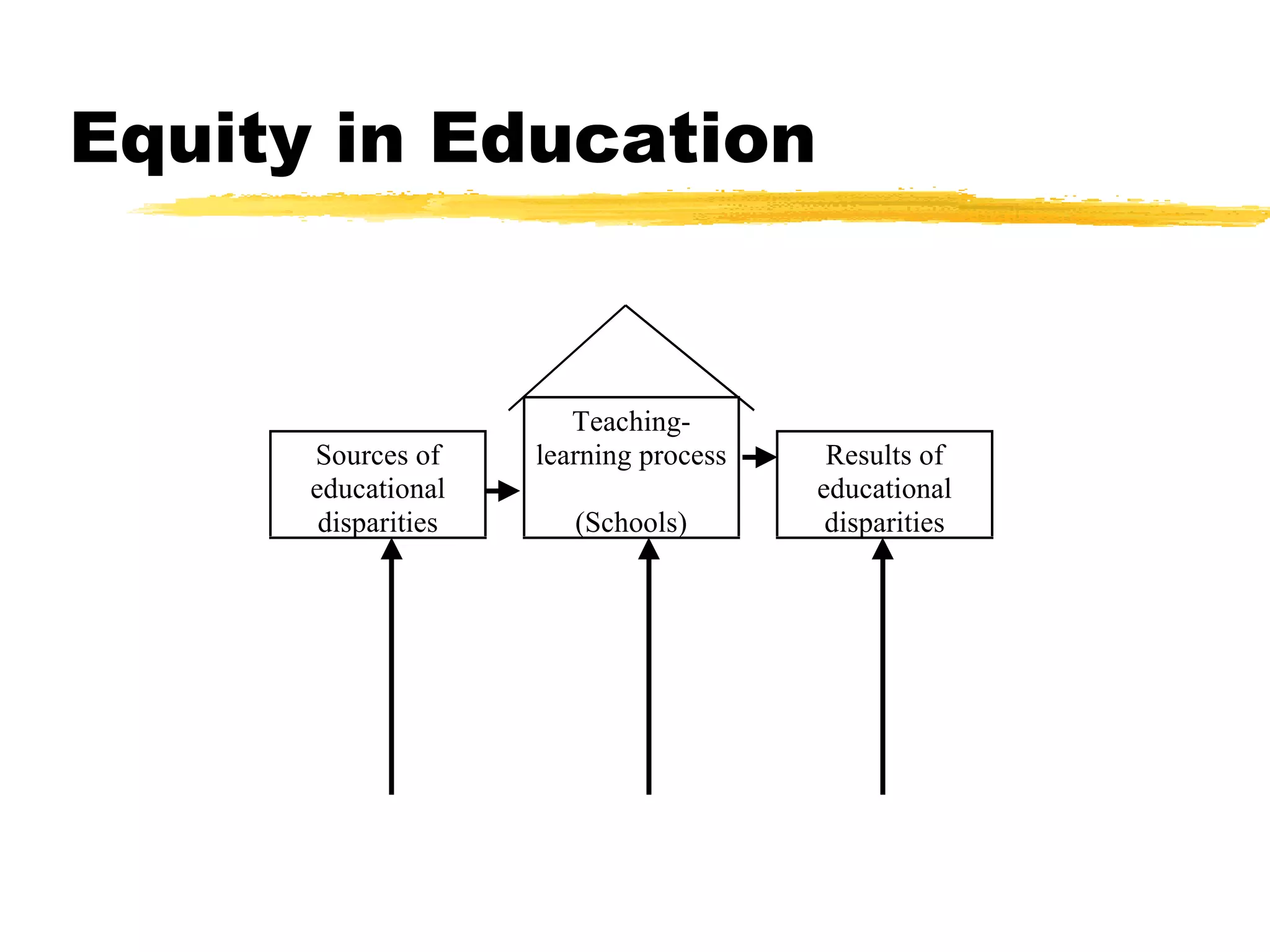
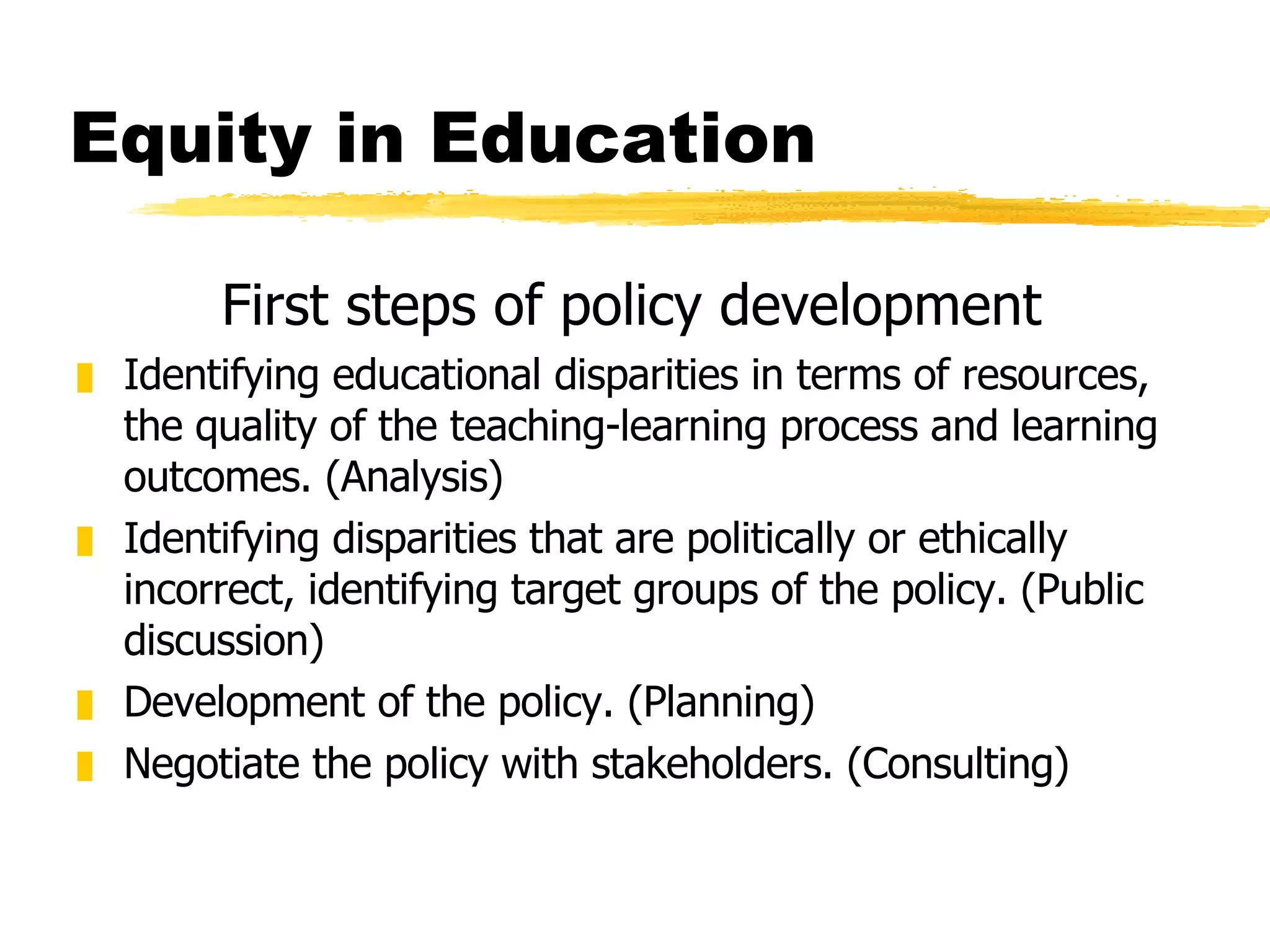
Equity in Education First steps of policy development Identifying educational disparities in terms of resources, the quality of the teaching-learning process and learning outcomes. (Analysis) Identifying disparities that are politically or ethically incorrect, identifying target groups of the policy. (Public discussion) Development of the policy. (Planning) Negotiate the policy with stakeholders. (Consulting)
Equity in Education Possible developments Supporting research and analysis Generating and shaping public and professional discourse Modeling good practices Supporting policy development Developing the systemic conditions

Equity In Education

  • 1.
    IEP policy workshopY2K1 Péter Radó Equity in Education The policy implications
  • 2.
    Equity in EducationWhy should we be concerned about inequalities? (Values and rationale) Who are we talking about? (Disadvantages and school failure) What are we talking about? (Equity in education) Transition and policies. (Context and policies) Policy level intervention.
  • 3.
    Equity in EducationCompeting values Egalitarian policies - The same for all Elitist policies - Quality for those who deserve it Free market policies - Quality for those who can afford it Democratic policies - Quality for all
  • 4.
    Equity in EducationThe rationale Investment to human capital Strengthening social cohesion Reduction of social safety costs
  • 5.
    Equity in EducationThe dimensions of disadvantages socio-economic status place of residence individual abilities ethnic affiliation gender
  • 6.
    Equity in EducationChildren falling behind (participation) Children dropping out from basic education Children completing basic education but not enrolled till the end of compulsory schooling Children completing special schools for disabled Children dropping out from secondary education without certification Children completing low value traditional vocational training programs
  • 7.
    Equity in EducationChildren falling behind (learning outcomes) The achievement of students in international comparison The profile of poor achievers The comparative achievement of students belonging to the target groups
  • 8.
  • 9.
    Equity in EducationThe signs of selectivity The growing private sector for those who can afford it The system of elite public schools High enrollment in special schools of disabled Institutionalized segregation of Roma Low value added “repositories” in vocational training Unfair streaming of students
  • 10.
    Equity in EducationQuality in terms of equity Education that is open to the entire target group Education that is differentiated, that takes into account the individual educational needs of each children Education that adapts to the needs of different target groups Education that adapts to the changing needs of individual persons and the society as a whole
  • 11.
  • 12.
    Equity in EducationThe trade-off myth Equity versus decentralization Equity versus liberalization Equity versus choice Equity versus cost-efficiency
  • 13.
    Equity in Education“Transition compatible” policy tools Monitoring of the students’ achievement Information system that identifies the target groups Targeted allocation of extra resources Extra support to under-performing schools Reconsidering educational objectives (reform of process and output regulation)
  • 14.
    Equity in Education“Transition compatible” policy tools INSET Investment to the initial phase of education Building local co-operation networks of services Anti-discrimination regulation and monitoring
  • 15.
    Equity in EducationFirst steps of policy development Identifying educational disparities in terms of resources, the quality of the teaching-learning process and learning outcomes. (Analysis) Identifying disparities that are politically or ethically incorrect, identifying target groups of the policy. (Public discussion) Development of the policy. (Planning) Negotiate the policy with stakeholders. (Consulting)
  • 16.
    Equity in EducationPossible developments Supporting research and analysis Generating and shaping public and professional discourse Modeling good practices Supporting policy development Developing the systemic conditions