Topic
Sir Ali Imtiaz
Education Polices
1978 and 1992
Submitted to
Presented by
Samia Yasir
Kainat Siddique
Syed Hasan raza
Aiman Hera
Memoona Riaz
Policy
• A method of action selected, by Government,
Institution, from among alternative and in the light
of even conditions to guide and usually, to
determine present and future decision.
Education
Education is about learning skills and
knowledge.
It also means helping people to learn
how to do things and support them to
think about what they learn.
It also important for educators to teach
ways to find and use information.
Education policy
 It is a policy or a document issued from time
to time by the Government for the
development of education in the country.
 The policy is the result of a long detailed
serious deliberations and discussions and
thoughts made on various forms.
 It provides a conceptual framework
sometimes also a plan of action for the type
of education to be implemented in the
country.
Educational policy 1978
 The Education Policy 1978 appeared under
the military regime of General Muhammad
Zia-ul-Huq.
 In this policy the Islamisation of education
got a great boast due to which it was also
called Islamic Educational Policy.
 The policy focused on the promotion of the
Islamic Ideology and religious identity of the
people of Pakistan.
Aim of policy 1978
 The basic aim of this policy is to groom
students according to the teachings of Holy
Quran and sunnah.
 It includes turning Islamiat as a compulsory
subject in all institutions of country.
 All the curriculum and textbooks alterations
at all levels were suggested to modify
education system according to the Ideology
of Pakistan and the principles of Islam.
Features of policy
Following are the features of this policy:
Primary education
Secondary education
Science education
Technical and vocational education
Teacher education
Higher education
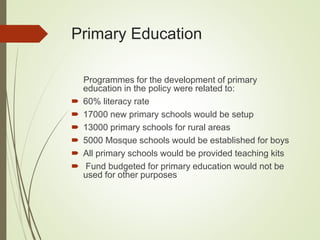
Primary Education
Programmes for the development of primary
education in the policy were related to:
 60% literacy rate
 17000 new primary schools would be setup
 13000 primary schools for rural areas
 5000 Mosque schools would be established for boys
 All primary schools would be provided teaching kits
 Fund budgeted for primary education would not be
used for other purposes
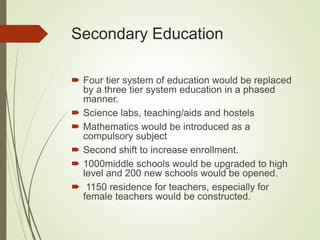
Secondary Education
 Four tier system of education would be replaced
by a three tier system education in a phased
manner.
 Science labs, teaching/aids and hostels
 Mathematics would be introduced as a
compulsory subject
 Second shift to increase enrollment.
 1000middle schools would be upgraded to high
level and 200 new schools would be opened.
 1150 residence for teachers, especially for
female teachers would be constructed.
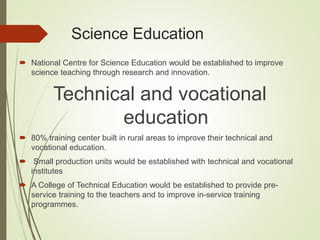
Science Education
 National Centre for Science Education would be established to improve
science teaching through research and innovation.
Technical and vocational
education
 80% training center built in rural areas to improve their technical and
vocational education.
 Small production units would be established with technical and vocational
institutes
 A College of Technical Education would be established to provide pre-
service training to the teachers and to improve in-service training
programmes.
Teacher Education
 All teachers would be required to do at least one service
training course during every five years.
 Strong committed to ideology of Pakistan
 AEPM establishment
 Strengthening of provisional education extension centers
and AIOU for CT, PTC, B.ED
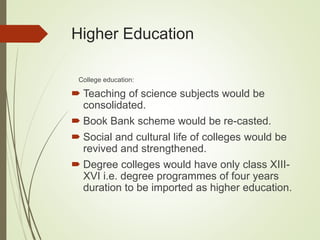
Higher Education
College education:
 Teaching of science subjects would be
consolidated.
 Book Bank scheme would be re-casted.
 Social and cultural life of colleges would be
revived and strengthened.
 Degree colleges would have only class XIII-
XVI i.e. degree programmes of four years
duration to be imported as higher education.
University Education
 The University Grants Commission (UGC) would
be strengthened to coordinate and regulate
higher education and research in the country.
 A National Institute of Educational Research
would be established to supervise and co-
ordinate research on important national issues
and problems.
 A National Students Centre would be established
to study and conduct researches on student’s
problems, issues and attitudes.
Educational Policy 1992
 The National Education Policy 1992, had been
structured on the basis of “guide-lines’’ provided
by the Prime Minister’s Directive on 10th
February, 1991. The Federal Minister of
Education announced the policy on 20th
December, 1992.
 The participation rate at various levels of
education had been very low in Pakistan. The
National Education Policy 1992 was attempt to
streamline the process of education which was a
victim of various external and internal problems.
The Thrust of Policy:
The main objectives of the policy were:
 To restructure the continuing education system
on modern lines in accordance with the
principles of Islam so as to create a healthy,
forward looking and democratic society
 To improve the quality of education and
promote research activities in the universities,
especially in the modern fields of science and
technology.
Features of Policy
Following are the features of this
educational policy:
Primary Education
Quality of public instructions
Higher Education and Technology
Administration and Management of
Education
Education for better living
Women Education
Primary Education
 Development of primary education in private
sector would be encouraged
 About 26500 new primary school teachers would
be trained
 About 107000 new primary and mosque schools
would be opened.
 The pay structure and service conditions of
.primary school teachers would be improved
 Teachers would be given training on the new
concepts, introduced in curricula.
 The Teaching kit would be upgraded.
Quality of Public Instructions
 Major changes would be introduced in curricula, textbooks,
teaching methods and evaluation techniques
 Teaching learning process would be strengthened through
various types of delivery of education
 The policies maintained that the teacher training institutions
would be equipped and their faculty would be provided
opportunities to update their, knowledge and skill
Higher Education and
Technology:
 Participation rate of higher education would be enhanced
 Universities would be encouraged to generate funds by
various means; Participation of teachers at international
conferences would be facilitated.
 All university administrators will be required to undertake
training in management of higher education.
 All curriculums will be modernized, in order to
accommodate new knowledge and new disciplines.
Conti……
 More funds would be provided to universities for research.
 A separate high education services policy would be
formulated,
 Degree education would be diversified to increase
employability of the graduates.
 Colleges of Distance Education would be established in the
provinces.
Administration and
management of Education
 School Management Committee would be constituted at
village and institutional level.
 Not more than 15 primary schools would be allocated to
each supervisor.
 The number of Directorates of Technical Education would
be increased.
Education for woman living:
 This policy stressed on strengthening women’s education
as well
 . To improve the female education, innovative approaches,
both in the formal and non-formal sectors were
emphasized.
Education for better living:
 The existing provision of Islamic education formed the
basis for the development of new curriculam.
 The religious education was so directed as to facilitate
students to learn high ethical and moral values encoded in
the spirit of Islam.
Conclusion:
 The different Education Policies clearly bring out that there
has been concern regarding the need to reform education
 The implementation has never matched the fine words of
the policies.
Educational polices 1978 to 1992 pakistan