Foundation of Education
Unit # 7
Significant Educational Policies and
Initiatives
First Educational Conference
1947
In the supervision of Quaid-e-Azam &
Educational Minister Fazal-ur-
Rehman
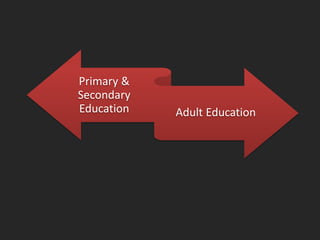
Primary &
Secondary
Education Adult Education
Implementation
The policy could not be
implemented due to
increased number of
immigrants and
administrative problems of
new born country.
National Education Commission
1959
General Muhammad Ayub Khan
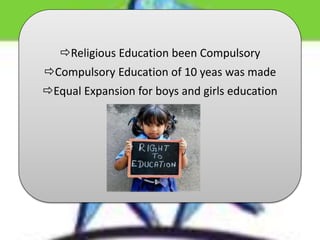
Religious Education been Compulsory
Compulsory Education of 10 yeas was made
Equal Expansion for boys and girls education
Implementation
Due to conditions of
country and situation
of resources this
policy was not applied
well.
New Education Policy
1970
General Muhammad Ayub Khan
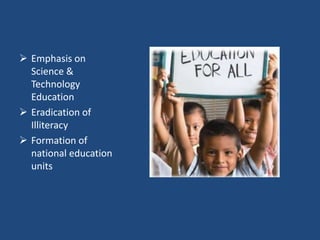
 Emphasis on
Science &
Technology
Education
 Eradication of
Illiteracy
 Formation of
national education
units
Implementation
The policy was not implemented due the war
with India and separation of East Pakistan.
Education Policy
1972
Zulifqar Ali Bhutto
Features:
 Promotion of
Ideology of
Pakistan
 Universal
Education
 Equality in
Education
 Announced
Free education
up to grade X.
Implementation
This policy was a good approach towards betterment but has
many drawbacks due to which it cannot be achieved
thoroughly.
National Education Policy
1979
Education Minister Ayub Khan
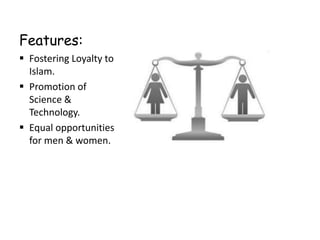
Features:
 Fostering Loyalty to
Islam.
 Promotion of
Science &
Technology.
 Equal opportunities
for men & women.
Implementation
• This policy was not implemented properly and failed
due to lack of planning & financial resources.
New Education Policy
1992
In the presence of Federal Education
Minister, Senate & National Assembly
Members.
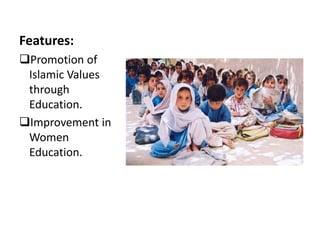
Features:
Promotion of
Islamic Values
through
Education.
Improvement in
Women
Education.
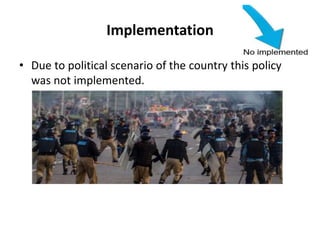
Implementation
• Due to political scenario of the country this policy
was not implemented.
National Education Policy
1998-2010
Prime Minister of Pakistan
Nawaz Sharif
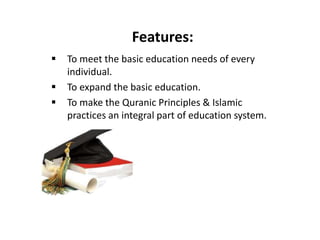
Features:
 To meet the basic education needs of every
individual.
 To expand the basic education.
 To make the Quranic Principles & Islamic
practices an integral part of education system.
This originated from the policy of 1998-
2010.
 The major thrust areas of ESR are as follows:
• Free & Universal primary education
• Free text books
• Equal access to opportunities of learning
• Improving all aspects in quality education
• Introduction to new educational curricula
• Development of training learning resources and
materials
• Offering incentives for private sector
• Introduction of computer course at all levels
• Strengthening of research in higher education
• Grant for affiliation of Madaris
• The allocation for education would be 7% of the
national GDP by 2015
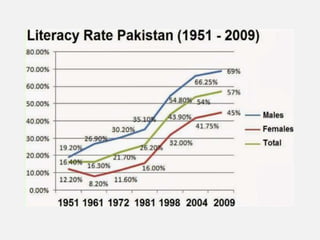
• The literacy rate will be enhanced to 86% by 2015
• A Bachelor degree, with a B.Ed. shall be the
minimum requirement for teaching at the
elementary level
• A Master degree for the secondary and higher
secondary with a B.Ed. is being ensured by 2018.
••••••••••••••••••••••••••••••••••
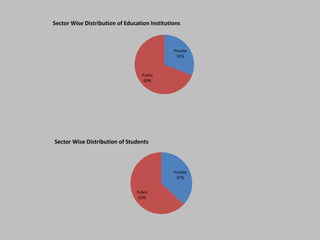
Private
37%
Public
63%
Sector Wise Distribution of Students
Private
31%
Public
69%
Sector Wise Distribution of Education Institutions
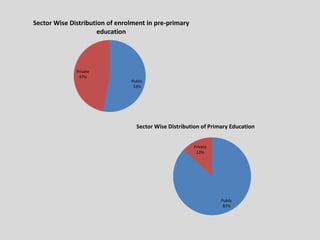
Public
53%
Private
47%
Sector Wise Distribution of enrolment in pre-primary
education
Public
87%
Private
13%
Sector Wise Distribution of Primary Education
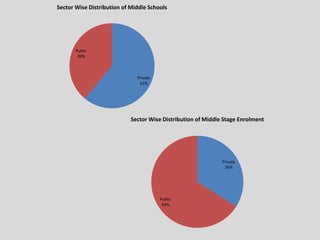
Private
61%
Public
39%
Sector Wise Distribution of Middle Schools
Private
36%
Public
64%
Sector Wise Distribution of Middle Stage Enrolment
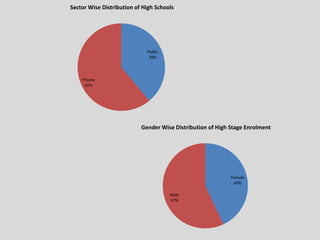
Public
39%
Private
61%
Sector Wise Distribution of High Schools
Female
43%
Male
57%
Gender Wise Distribution of High Stage Enrolment
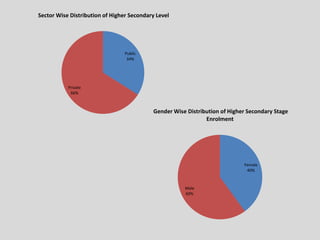
Public
34%
Private
66%
Sector Wise Distribution of Higher Secondary Level
Female
40%
Male
60%
Gender Wise Distribution of Higher Secondary Stage
Enrolment
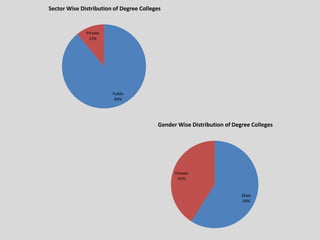
Public
89%
Private
11%
Sector Wise Distribution of Degree Colleges
Male
59%
Female
41%
Gender Wise Distribution of Degree Colleges
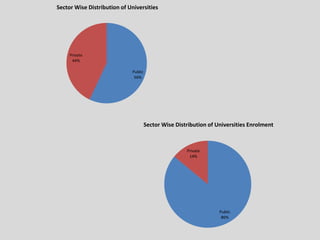
Public
56%
Private
44%
Sector Wise Distribution of Universities
Public
86%
Private
14%
Sector Wise Distribution of Universities Enrolment
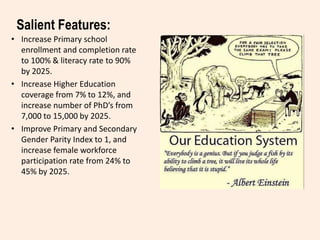
Salient Features:
• Increase Primary school
enrollment and completion rate
to 100% & literacy rate to 90%
by 2025.
• Increase Higher Education
coverage from 7% to 12%, and
increase number of PhD’s from
7,000 to 15,000 by 2025.
• Improve Primary and Secondary
Gender Parity Index to 1, and
increase female workforce
participation rate from 24% to
45% by 2025.
Significant Educational Policies and Initiatives