Human Body Systems
    A Presentation By
         Hardik
          XF
Human Body Systems
                    Section 35–1
 This section describes human organ systems and
 explains how the body maintains homeostasis.
Organization of the Body
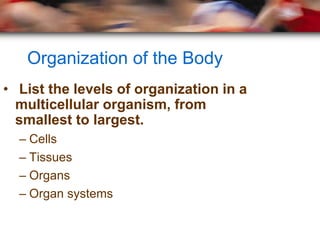
• List the levels of organization in a
  multicellular organism, from
  smallest to largest.
  – Cells
  – Tissues
  – Organs
  – Organ systems
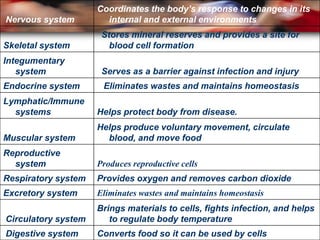
Coordinates the body’s response to changes in its
Nervous system         internal and external environments
                      Stores mineral reserves and provides a site for
Skeletal system         blood cell formation
Integumentary
   system             Serves as a barrier against infection and injury
Endocrine system      Eliminates wastes and maintains homeostasis
Lymphatic/Immune
  systems            Helps protect body from disease.
                     Helps produce voluntary movement, circulate
Muscular system        blood, and move food
Reproductive
  system             Produces reproductive cells
Respiratory system   Provides oxygen and removes carbon dioxide
Excretory system     Eliminates wastes and maintains homeostasis
                     Brings materials to cells, fights infection, and helps
Circulatory system      to regulate body temperature
Digestive system     Converts food so it can be used by cells
Organization of the Body
• What are four types of tissues found
  in the human body

• The four types of tissues are
     •   muscle tissue,
     •   epithelial tissue,
     •   connective tissue,
     •   nervous tissue
Organization of the Body
• The eye is an example of a (an) ____.


•organ
Organization of the Body
 Circle the letter of the type of tissue
 that covers interior and exterior
 body surfaces.


• epithelial
Organization of the Body

What is a gland?


• A gland is a structure that makes
  and secretes a particular product
  such as saliva, sweat, or milk.
Organization of the Body
• Circle the letter of the type of tissue
  that connects body parts.


• connective
Maintaining Homeostasis
• The process of maintaining a
  controlled, stable internal
  environment is called


• homeostasis
Maintaining Homeostasis
• The process in which a stimulus
  produces a response that opposes
  the original stimulus is referred to
  as________.

• feedback inhibition
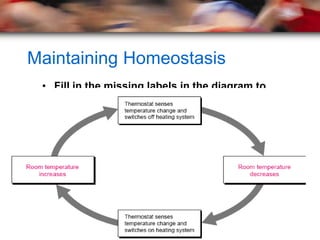
Maintaining Homeostasis
 • Fill in the missing labels in the diagram to
   show how a thermostat uses feedback
   inhibition to maintain a stable temperature in
   a house.
Maintaining Homeostasis
• Is the following sentence true or
  false?
• The part of the brain that monitors
  and controls body temperature is the
  hypothalamus.

• true
Maintaining Homeostasis
• What happens if nerve cells sense
  that the core body temperature has
  dropped below 37°C?
• The hypothalamus produces
  chemicals that signal cells
  throughout the body to speed up
  their activities, which causes a
  gradual rise in body temperature.
Maintaining Homeostasis
• What happens if the body
  temperature rises too far above
  37°C?


• The hypothalamus slows down
  cellular activities, minimizing the
  production of heat.
Human body system by hardik

Human body system by hardik

  • 1.
    Human Body Systems A Presentation By Hardik XF
  • 2.
    Human Body Systems Section 35–1 This section describes human organ systems and explains how the body maintains homeostasis.
  • 3.
    Organization of theBody • List the levels of organization in a multicellular organism, from smallest to largest. – Cells – Tissues – Organs – Organ systems
  • 4.
    Coordinates the body’sresponse to changes in its Nervous system internal and external environments Stores mineral reserves and provides a site for Skeletal system blood cell formation Integumentary system Serves as a barrier against infection and injury Endocrine system Eliminates wastes and maintains homeostasis Lymphatic/Immune systems Helps protect body from disease. Helps produce voluntary movement, circulate Muscular system blood, and move food Reproductive system Produces reproductive cells Respiratory system Provides oxygen and removes carbon dioxide Excretory system Eliminates wastes and maintains homeostasis Brings materials to cells, fights infection, and helps Circulatory system to regulate body temperature Digestive system Converts food so it can be used by cells
  • 5.
    Organization of theBody • What are four types of tissues found in the human body • The four types of tissues are • muscle tissue, • epithelial tissue, • connective tissue, • nervous tissue
  • 6.
    Organization of theBody • The eye is an example of a (an) ____. •organ
  • 7.
    Organization of theBody Circle the letter of the type of tissue that covers interior and exterior body surfaces. • epithelial
  • 8.
    Organization of theBody What is a gland? • A gland is a structure that makes and secretes a particular product such as saliva, sweat, or milk.
  • 9.
    Organization of theBody • Circle the letter of the type of tissue that connects body parts. • connective
  • 10.
    Maintaining Homeostasis • Theprocess of maintaining a controlled, stable internal environment is called • homeostasis
  • 11.
    Maintaining Homeostasis • Theprocess in which a stimulus produces a response that opposes the original stimulus is referred to as________. • feedback inhibition
  • 12.
    Maintaining Homeostasis •Fill in the missing labels in the diagram to show how a thermostat uses feedback inhibition to maintain a stable temperature in a house.
  • 13.
    Maintaining Homeostasis • Isthe following sentence true or false? • The part of the brain that monitors and controls body temperature is the hypothalamus. • true
  • 14.
    Maintaining Homeostasis • Whathappens if nerve cells sense that the core body temperature has dropped below 37°C? • The hypothalamus produces chemicals that signal cells throughout the body to speed up their activities, which causes a gradual rise in body temperature.
  • 15.
    Maintaining Homeostasis • Whathappens if the body temperature rises too far above 37°C? • The hypothalamus slows down cellular activities, minimizing the production of heat.