Precambrian GeologyPrecambrian Geology
 The Precambrian lasted for more than 4 billionThe Precambrian lasted for more than 4 billion
years!years!
 This large time span is difficult for humans toThis large time span is difficult for humans to
comprehendcomprehend
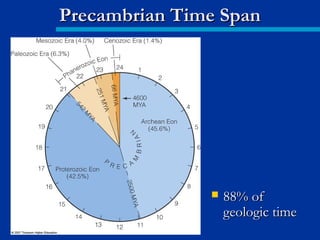
 Suppose that a 24-hour clock representedSuppose that a 24-hour clock represented
 all 4.6 billion years of geologic timeall 4.6 billion years of geologic time
 then the Precambrian would bethen the Precambrian would be
 slightly more than 21 hours long,slightly more than 21 hours long,
 constituting about 88% of all geologic timeconstituting about 88% of all geologic time
PrecambrianPrecambrian
 88% of88% of
geologic timegeologic time
Precambrian Time SpanPrecambrian Time Span
 The termThe term PrecambrianPrecambrian is informalis informal
 but widely used, referring to both time and rocksbut widely used, referring to both time and rocks
 The Precambrian includesThe Precambrian includes
 time from Earth’s origin 4.6 billion years agotime from Earth’s origin 4.6 billion years ago
 to the beginning of the Phanerozoic Eonto the beginning of the Phanerozoic Eon
 542 million years ago542 million years ago
 It encompassesIt encompasses
 all rocks older than Cambrian-age rocksall rocks older than Cambrian-age rocks
 No rocks are known for the firstNo rocks are known for the first
 640 million years of geologic time640 million years of geologic time
 The oldest known rocks on EarthThe oldest known rocks on Earth
 are 3.96 billion years oldare 3.96 billion years old
PrecambrianPrecambrian
 The earliest record of geologic timeThe earliest record of geologic time
 preserved in rocks is difficult to interpretpreserved in rocks is difficult to interpret
 because many Precambrian rocks have beenbecause many Precambrian rocks have been
 altered by metamorphismaltered by metamorphism
 complexly deformedcomplexly deformed
 buried deep beneath younger rocksburied deep beneath younger rocks
 fossils are rare, andfossils are rare, and
 the few fossils present are of little use in stratigraphythe few fossils present are of little use in stratigraphy
 Subdivisions of the PrecambrianSubdivisions of the Precambrian
 have been difficult to establishhave been difficult to establish
 Two eons for the PrecambrianTwo eons for the Precambrian
 are theare the ArcheanArchean andand ProterozoicProterozoic
Rocks Difficult to InterpretRocks Difficult to Interpret
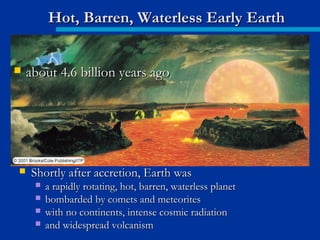
 Shortly after accretion, Earth wasShortly after accretion, Earth was
 a rapidly rotating, hot, barren, waterless planeta rapidly rotating, hot, barren, waterless planet
 bombarded by comets and meteoritesbombarded by comets and meteorites
 with no continents, intense cosmic radiationwith no continents, intense cosmic radiation
 and widespread volcanismand widespread volcanism
Hot, Barren, Waterless Early EarthHot, Barren, Waterless Early Earth
 about 4.6 billion years agoabout 4.6 billion years ago
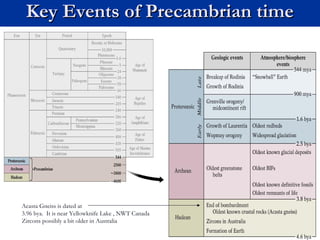
Key Events of Precambrian timeKey Events of Precambrian time
Acasta Gneiss is dated at
3.96 bya. It is near Yellowknife Lake , NWT Canada
Zircons possibly a bit older in Australia
Global Evolution: The First FiveGlobal Evolution: The First Five
Billion YearsBillion Years
Global Evolution: The First Five Billion YearsGlobal Evolution: The First Five Billion Years
The National Academy of Sciences says that it is the role of science to provideThe National Academy of Sciences says that it is the role of science to provide
plausible(probable) natural explanations of natural phenomena.plausible(probable) natural explanations of natural phenomena.
The ultimate question for Earth System History is: How did a giant cloud of coldThe ultimate question for Earth System History is: How did a giant cloud of cold
dilute gas and dust evolve into astronauts in a spacecraft orbiting a planet orbiting adilute gas and dust evolve into astronauts in a spacecraft orbiting a planet orbiting a
star?star?
The short answer is when energy flows, complexity grows.The short answer is when energy flows, complexity grows.
The fact is that the solid Earth, hydrosphere, atmosphere, and biosphere haveThe fact is that the solid Earth, hydrosphere, atmosphere, and biosphere have
undergone nearlyundergone nearly
five billion years of physical, chemical, and/or biological evolution because of thefive billion years of physical, chemical, and/or biological evolution because of the
flows of energy and/or matter into and/or out of these systems, a process that isflows of energy and/or matter into and/or out of these systems, a process that is
called global evolution.called global evolution.
Each section addresses the structures, functions, composition, interactions and flowsEach section addresses the structures, functions, composition, interactions and flows
of energy and matter,and origin and evolution of a complex natural system.of energy and matter,and origin and evolution of a complex natural system.
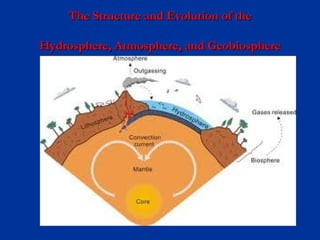
The Structure and Evolution of theThe Structure and Evolution of the
Hydrosphere, Atmosphere, and GeobiosphereHydrosphere, Atmosphere, and Geobiosphere
 How did a giant cloud of cold dilute gas andHow did a giant cloud of cold dilute gas and
dust evolve into astronauts in a spacecraftdust evolve into astronauts in a spacecraft
orbiting a planet orbiting a star?orbiting a planet orbiting a star?
The short answer is when energy flows,The short answer is when energy flows,
complexity grows.complexity grows.
The Structure and Evolution of theThe Structure and Evolution of the
Hydrosphere, Atmosphere, and GeobiosphereHydrosphere, Atmosphere, and Geobiosphere
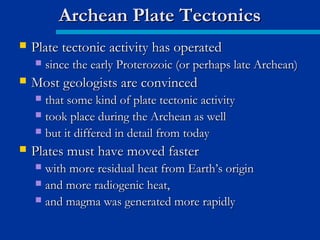
 Earth’s early atmosphere and hydrosphereEarth’s early atmosphere and hydrosphere
 were quite different than they are nowwere quite different than they are now
 They also played an important roleThey also played an important role
 in the development of the biospherein the development of the biosphere
 Today’s atmosphere is mostlyToday’s atmosphere is mostly
 nitrogen (Nnitrogen (N22))
 abundant free oxygen (Oabundant free oxygen (O22),),
 or oxygen not combined with other elementsor oxygen not combined with other elements
 such as in carbon dioxide (COsuch as in carbon dioxide (CO22))
 water vapor (Hwater vapor (H22O)O)
 small amounts of other gases, like ozone (Osmall amounts of other gases, like ozone (O33))
 which is common enough in the upper atmospherewhich is common enough in the upper atmosphere
 to block most of the Sun’s ultraviolet radiationto block most of the Sun’s ultraviolet radiation
Evalution of Atmosphere andEvalution of Atmosphere and
HydrosphereHydrosphere
 Earth’s very early atmosphere was probablyEarth’s very early atmosphere was probably
composed ofcomposed of
 hydrogen and helium,hydrogen and helium,
 the most abundant gases in the universethe most abundant gases in the universe
 If so, it would have quickly been lost into spaceIf so, it would have quickly been lost into space
 because Earth’s gravity is insufficient to retain thembecause Earth’s gravity is insufficient to retain them
 because Earth had no magnetic field until its corebecause Earth had no magnetic field until its core
formed (magnetosphere)formed (magnetosphere)
 Without a magnetic field,Without a magnetic field,
 the solar wind would have swept awaythe solar wind would have swept away
 any atmospheric gasesany atmospheric gases
Earth’s Very Early AtmosphereEarth’s Very Early Atmosphere
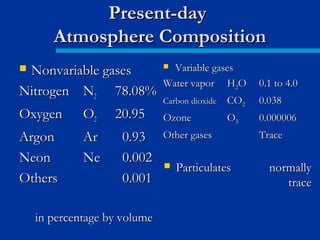
 Nonvariable gasesNonvariable gases
NitrogenNitrogen NN22 78.08%78.08%
OxygenOxygen OO22 20.9520.95
ArgonArgon ArAr 0.930.93
NeonNeon NeNe 0.0020.002
OthersOthers 0.0010.001
in percentage by volumein percentage by volume
Present-dayPresent-day
Atmosphere CompositionAtmosphere Composition
 Variable gasesVariable gases
Water vaporWater vapor HH22OO 0.1 to 4.00.1 to 4.0
Carbon dioxideCarbon dioxide COCO22 0.0380.038
OzoneOzone OO33 0.0000060.000006
Other gasesOther gases TraceTrace
 ParticulatesParticulates normallynormally
tracetrace
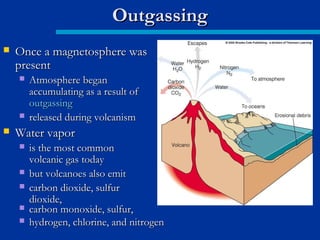
 Once a magnetosphere wasOnce a magnetosphere was
presentpresent
 Atmosphere beganAtmosphere began
accumulating as a result ofaccumulating as a result of
outgassingoutgassing
 released during volcanismreleased during volcanism
 Water vaporWater vapor
 is the most commonis the most common
volcanic gas todayvolcanic gas today
 but volcanoes also emitbut volcanoes also emit
 carbon dioxide, sulfurcarbon dioxide, sulfur
dioxide,dioxide,
OutgassingOutgassing
 carbon monoxide, sulfur,carbon monoxide, sulfur,
 hydrogen, chlorine, and nitrogenhydrogen, chlorine, and nitrogen
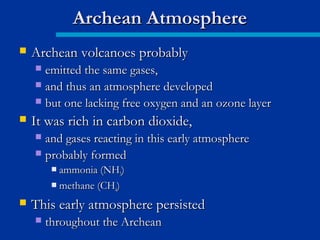
 Archean volcanoes probablyArchean volcanoes probably
 emitted the same gases,emitted the same gases,
 and thus an atmosphere developedand thus an atmosphere developed
 but one lacking free oxygen and an ozone layerbut one lacking free oxygen and an ozone layer
 It was rich in carbon dioxide,It was rich in carbon dioxide,
 and gases reacting in this early atmosphereand gases reacting in this early atmosphere
 probably formedprobably formed
 ammonia (NHammonia (NH33))
 methane (CHmethane (CH44))
 This early atmosphere persistedThis early atmosphere persisted
 throughout the Archeanthroughout the Archean
Archean AtmosphereArchean Atmosphere
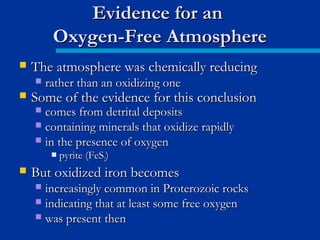
 The atmosphere was chemically reducingThe atmosphere was chemically reducing
 rather than an oxidizing onerather than an oxidizing one
 Some of the evidence for this conclusionSome of the evidence for this conclusion
 comes from detrital depositscomes from detrital deposits
 containing minerals that oxidize rapidlycontaining minerals that oxidize rapidly
 in the presence of oxygenin the presence of oxygen
 pyrite (FeSpyrite (FeS22))
 But oxidized iron becomesBut oxidized iron becomes
 increasingly common in Proterozoic rocksincreasingly common in Proterozoic rocks
 indicating that at least some free oxygenindicating that at least some free oxygen
 was present thenwas present then
Evidence for anEvidence for an
Oxygen-Free AtmosphereOxygen-Free Atmosphere
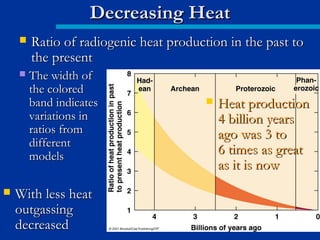
 Ratio of radiogenic heat production in the past toRatio of radiogenic heat production in the past to
the presentthe present
Decreasing HeatDecreasing Heat
 The width ofThe width of
the coloredthe colored
band indicatesband indicates
variations invariations in
ratios fromratios from
differentdifferent
modelsmodels
 Heat productionHeat production
4 billion years4 billion years
ago was 3 toago was 3 to
6 times as great6 times as great
as it is nowas it is now
 With less heatWith less heat
outgassingoutgassing
decreaseddecreased
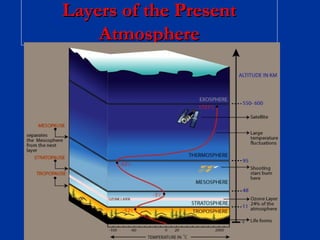
Layers of the PresentLayers of the Present
AtmosphereAtmosphere
HydrosphereHydrosphere
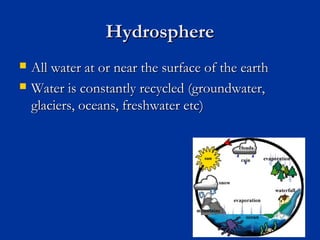
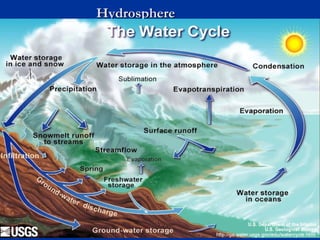
 All water at or near the surface of the earthAll water at or near the surface of the earth
 Water is constantly recycled (groundwater,Water is constantly recycled (groundwater,
glaciers, oceans, freshwater etc)glaciers, oceans, freshwater etc)
HydrosphereHydrosphere
The BiosphereThe Biosphere
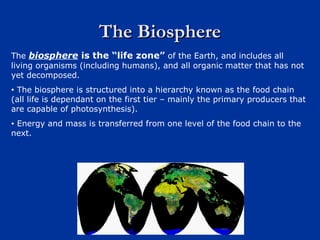
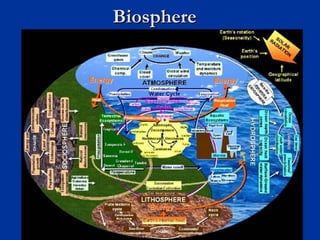
The biosphere is the “life zone” of the Earth, and includes all
living organisms (including humans), and all organic matter that has not
yet decomposed.
• The biosphere is structured into a hierarchy known as the food chain
(all life is dependant on the first tier – mainly the primary producers that
are capable of photosynthesis).
• Energy and mass is transferred from one level of the food chain to the
next.
BiosphereBiosphere
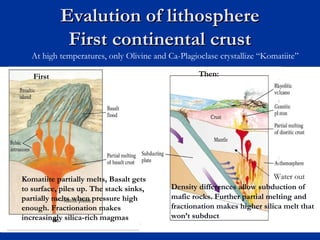
Evalution of lithosphereEvalution of lithosphere
First continental crustFirst continental crust
Density differences allow subduction of
mafic rocks. Further partial melting and
fractionation makes higher silica melt that
won’t subduct
Water outKomatiite partially melts, Basalt gets
to surface, piles up. The stack sinks,
partially melts when pressure high
enough. Fractionation makes
increasingly silica-rich magmas
First Then:
At high temperatures, only Olivine and Ca-Plagioclase crystallize “Komatiite”
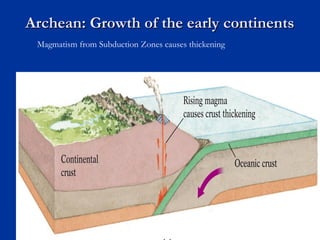
Archean: Growth of the early continentsArchean: Growth of the early continents
Magmatism from Subduction Zones causes thickening
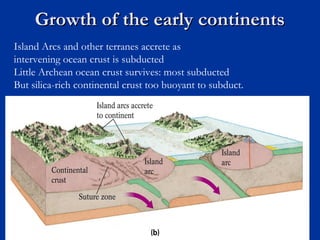
Growth of the early continentsGrowth of the early continents
Island Arcs and other terranes accrete as
intervening ocean crust is subducted
Little Archean ocean crust survives: most subducted
But silica-rich continental crust too buoyant to subduct.
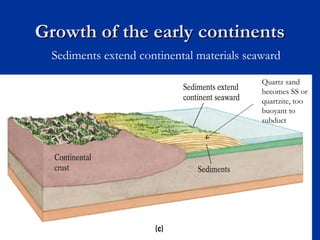
Growth of the early continentsGrowth of the early continents
Sediments extend continental materials seaward
Quartz sand
becomes SS or
quartzite, too
buoyant to
subduct
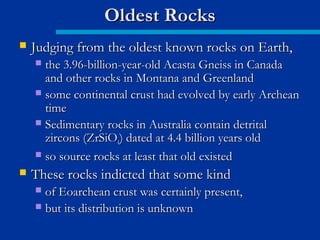
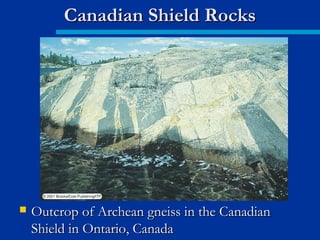
 Judging from the oldest known rocks on Earth,Judging from the oldest known rocks on Earth,
 the 3.96-billion-year-old Acasta Gneiss in Canadathe 3.96-billion-year-old Acasta Gneiss in Canada
and other rocks in Montana and Greenlandand other rocks in Montana and Greenland
 some continental crust had evolved by early Archeansome continental crust had evolved by early Archean
timetime
 Sedimentary rocks in Australia contain detritalSedimentary rocks in Australia contain detrital
zircons (ZrSiOzircons (ZrSiO44) dated at 4.4 billion years old) dated at 4.4 billion years old
 so source rocks at least that old existedso source rocks at least that old existed
 These rocks indicted that some kindThese rocks indicted that some kind
 of Eoarchean crust was certainly present,of Eoarchean crust was certainly present,
 but its distribution is unknownbut its distribution is unknown
Oldest RocksOldest Rocks
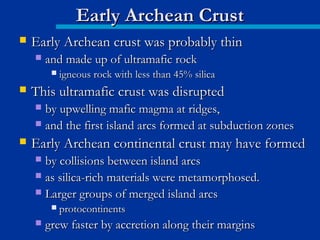
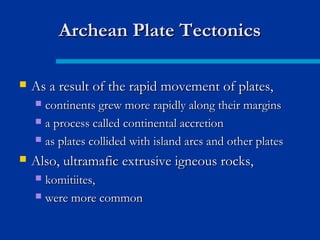
 Early Archean crust was probably thinEarly Archean crust was probably thin
 and made up of ultramafic rockand made up of ultramafic rock
 igneous rock with less than 45% silicaigneous rock with less than 45% silica
 This ultramafic crust was disruptedThis ultramafic crust was disrupted
 by upwelling mafic magma at ridges,by upwelling mafic magma at ridges,
 and the first island arcs formed at subduction zonesand the first island arcs formed at subduction zones
 Early Archean continental crust may have formedEarly Archean continental crust may have formed
 by collisions between island arcsby collisions between island arcs
 as silica-rich materials were metamorphosed.as silica-rich materials were metamorphosed.
 Larger groups of merged island arcsLarger groups of merged island arcs
 protocontinentsprotocontinents
 grew faster by accretion along their marginsgrew faster by accretion along their margins
Early Archean CrustEarly Archean Crust
Origin of Continental CrustOrigin of Continental Crust
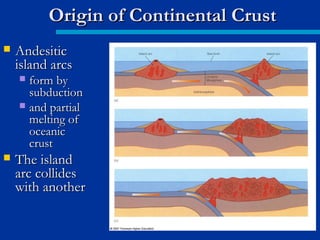
 AndesiticAndesitic
island arcsisland arcs
 form byform by
subductionsubduction
 and partialand partial
melting ofmelting of
oceanicoceanic
crustcrust
 The islandThe island
arc collidesarc collides
with anotherwith another
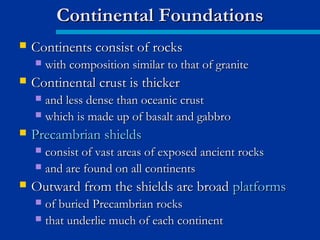
 Continents consist of rocksContinents consist of rocks
 with composition similar to that of granitewith composition similar to that of granite
 Continental crust is thickerContinental crust is thicker
 and less dense than oceanic crustand less dense than oceanic crust
 which is made up of basalt and gabbrowhich is made up of basalt and gabbro
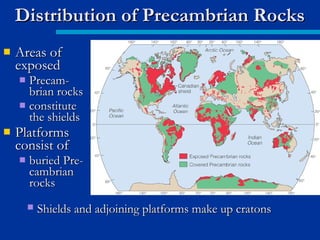
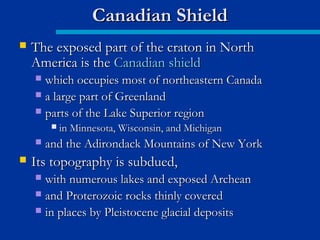
 Precambrian shieldsPrecambrian shields
 consist of vast areas of exposed ancient rocksconsist of vast areas of exposed ancient rocks
 and are found on all continentsand are found on all continents
 Outward from the shields are broadOutward from the shields are broad platformsplatforms
 of buried Precambrian rocksof buried Precambrian rocks
 that underlie much of each continentthat underlie much of each continent
Continental FoundationsContinental Foundations
Distribution of Precambrian RocksDistribution of Precambrian Rocks
 Areas ofAreas of
exposedexposed
 Precam-Precam-
brian rocksbrian rocks
 constituteconstitute
the shieldsthe shields
 PlatformsPlatforms
consist ofconsist of
 buried Pre-buried Pre-
cambriancambrian
rocksrocks
 Shields and adjoining platforms make up cratonsShields and adjoining platforms make up cratons
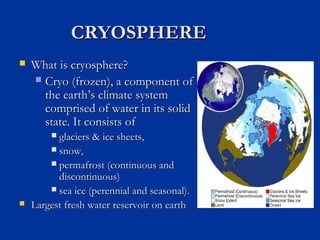
CRYOSPHERECRYOSPHERE
 What is cryosphere?What is cryosphere?
 Cryo (frozen), a component ofCryo (frozen), a component of
the earththe earth’s climate system’s climate system
comprised of water in its solidcomprised of water in its solid
state. It consists ofstate. It consists of
 glaciers & ice sheets,glaciers & ice sheets,
 snow,snow,
 permafrost (continuous andpermafrost (continuous and
discontinuous)discontinuous)
 sea ice (perennial and seasonal).sea ice (perennial and seasonal).
 Largest fresh water reservoir on earthLargest fresh water reservoir on earth
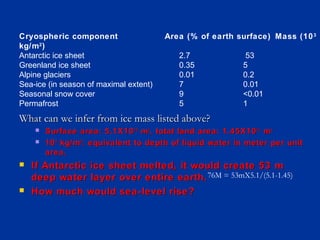
Cryospheric component Area (% of earth surface) Mass (103
kg/m2
)
Antarctic ice sheet 2.7 53
Greenland ice sheet 0.35 5
Alpine glaciers 0.01 0.2
Sea-ice (in season of maximal extent) 7 0.01
Seasonal snow cover 9 <0.01
Permafrost 5 1
What can we infer from ice mass listed above?What can we infer from ice mass listed above?
 Surface area: 5.1X10Surface area: 5.1X101414
mm22
, total land area: 1.45X10, total land area: 1.45X101414
mm22
 101033
kg/mkg/m22
: equivalent to depth of liquid water in meter per unit: equivalent to depth of liquid water in meter per unit
area.area.
 If Antarctic ice sheet melted, it would create 53 mIf Antarctic ice sheet melted, it would create 53 m
deep water layer over entire earth.deep water layer over entire earth.
 How much would sea-level rise?How much would sea-level rise?
76M = 53mX5.1/(5.1-1.45)
Role in climate system:Role in climate system:
 Largest fresh water storage:Largest fresh water storage:
 Influence sea-level riseInfluence sea-level rise
 Water resourcesWater resources
 Influence ocean circulationInfluence ocean circulation
 Regular earthRegular earth’s albedo change,’s albedo change,
 Reduce turbulent transport of heat, water andReduce turbulent transport of heat, water and
momentummomentum
 Change ocean buoyancy flux, S and TChange ocean buoyancy flux, S and T
 Glacial runoff from Antarctic is a major source ofGlacial runoff from Antarctic is a major source of
fresh water for southern ocean.fresh water for southern ocean.
 Regular regional-global climateRegular regional-global climate
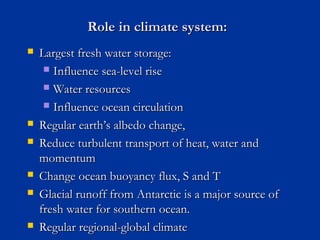
How do we estimate water in snow and ice?How do we estimate water in snow and ice?
 Snow (ice) equivalent depth: snow is porous and itsSnow (ice) equivalent depth: snow is porous and its
porosity depends on temperature and age of theporosity depends on temperature and age of the
snow. A measure of liquid water contained in snowsnow. A measure of liquid water contained in snow
is water equivalent depth, his water equivalent depth, hmm::
hhmm==ρρss//ρρww·h·hss
ρρss,,ρρww: density of the snow and water, respectively.: density of the snow and water, respectively.
hhss: depth of the snow/ice layer: depth of the snow/ice layer
hhmm: The depth of water that will resulted from complete melt of: The depth of water that will resulted from complete melt of
snow/ice.snow/ice.
Snow relative density,Snow relative density, ρρss//ρρww ranges from 0.15-0.4ranges from 0.15-0.4
Snow/ice albedo (whiteness):Snow/ice albedo (whiteness):
 Albedo: ratio of the reflected vs. incidentAlbedo: ratio of the reflected vs. incident
radiative flux. It is a function of wavelength.radiative flux. It is a function of wavelength.
Surface Typical Albedo
Fresh asphalt 0.04
Conifer forest (Summer) 0.08, 0.09 to 0.15
Worn asphalt 0.12
Deciduous trees 0.15 to 0.18
Bare soil 0.17
Green grass 0.25
Desert sand 0.40
New concrete 0.55
Fresh snow 0.80–0.90
Snow:Snow:
Distribution andDistribution and
variations:variations:
 Seasonal snow coversSeasonal snow covers
~12.5% of the global~12.5% of the global
surface, mainly in highsurface, mainly in high
latitudes and highlatitudes and high
altitudes;altitudes;
 Snow cover variesSnow cover varies
strongly (50%), seasonallystrongly (50%), seasonally
(8-16.5%), weekly,(8-16.5%), weekly,
interannually, decadally;interannually, decadally;
Glacier:Glacier:
 when snow/ice deposit reaches 50 m, pressure compactionwhen snow/ice deposit reaches 50 m, pressure compaction
and melt-freeze cycles cause iceand melt-freeze cycles cause ice ρρ=550 kgm=550 kgm-3-3
, i.e., firn. As, i.e., firn. As
firnfirn ρρ increases to 820 kgmincreases to 820 kgm-3-3
, air no longer can circulate, air no longer can circulate
within ice and glacier ice forms.within ice and glacier ice forms.
 As the thickness of glacier ice continues to increase andAs the thickness of glacier ice continues to increase and
pressure at the base of the glacier increase, melting at thepressure at the base of the glacier increase, melting at the
glacier base occurs. Glacier behavior as a 3D lattice, andglacier base occurs. Glacier behavior as a 3D lattice, and
deform and slip along slop of underlying topography atdeform and slip along slop of underlying topography at
speed upto to 1-10 km/yr.speed upto to 1-10 km/yr.
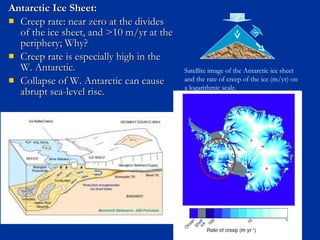
Antarctic Ice Sheet:Antarctic Ice Sheet:
 Creep rate: near zero at the dividesCreep rate: near zero at the divides
of the ice sheet, and >10 m/yr at theof the ice sheet, and >10 m/yr at the
periphery; Why?periphery; Why?
 Creep rate is especially high in theCreep rate is especially high in the
W. Antarctic.W. Antarctic.
 Collapse of W. Antarctic can causeCollapse of W. Antarctic can cause
abrupt sea-level rise.abrupt sea-level rise.
Satellite image of the Antarctic ice sheet
and the rate of creep of the ice (m/yr) on
a logarithmic scale.
P
S
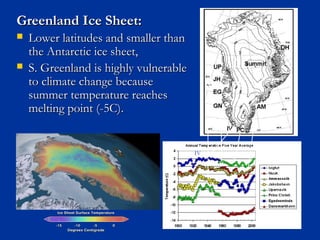
Greenland Ice Sheet:Greenland Ice Sheet:
 Lower latitudes and smaller thanLower latitudes and smaller than
the Antarctic ice sheet,the Antarctic ice sheet,
 S. Greenland is highly vulnerableS. Greenland is highly vulnerable
to climate change becauseto climate change because
summer temperature reachessummer temperature reaches
melting point (-5C).melting point (-5C).
IV
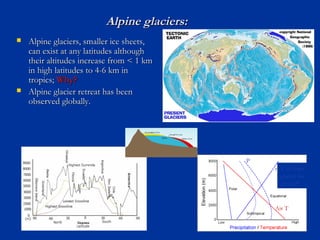
Alpine glaciers:Alpine glaciers:
 Alpine glaciers, smaller ice sheets,Alpine glaciers, smaller ice sheets,
can exist at any latitudes althoughcan exist at any latitudes although
their altitudes increase from < 1 kmtheir altitudes increase from < 1 km
in high latitudes to 4-6 km inin high latitudes to 4-6 km in
tropics;tropics; Why?Why?
 Alpine glacier retreat has beenAlpine glacier retreat has been
observed globally.observed globally.
Air T
T to form
glacier for
given P
P
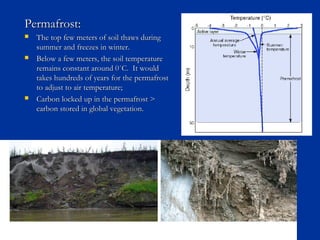
Permafrost:Permafrost:
 The top few meters of soil thaws duringThe top few meters of soil thaws during
summer and freezes in winter.summer and freezes in winter.
 Below a few meters, the soil temperatureBelow a few meters, the soil temperature
remains constant around 0˚C. It wouldremains constant around 0˚C. It would
takes hundreds of years for the permafrosttakes hundreds of years for the permafrost
to adjust to air temperature;to adjust to air temperature;
 Carbon locked up in the permafrost >Carbon locked up in the permafrost >
carbon stored in global vegetation.carbon stored in global vegetation.
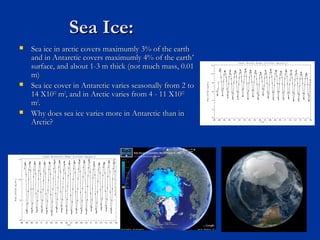
Sea Ice:Sea Ice:
 Sea ice in arctic covers maximumly 3% of the earthSea ice in arctic covers maximumly 3% of the earth
and in Antarctic covers maximumly 4% of the earthand in Antarctic covers maximumly 4% of the earth’’
surface, and about 1-3 m thick (not much mass, 0.01surface, and about 1-3 m thick (not much mass, 0.01
m)m)
 Sea ice cover in Antarctic varies seasonally from 2 toSea ice cover in Antarctic varies seasonally from 2 to
14 X1014 X101212
mm22
, and in Arctic varies from 4 - 11 X10, and in Arctic varies from 4 - 11 X101212
mm22
..
 Why does sea ice varies more in Antarctic than inWhy does sea ice varies more in Antarctic than in
Arctic?Arctic?
Formation of sea ice transition andFormation of sea ice transition and
columnar zonescolumnar zones
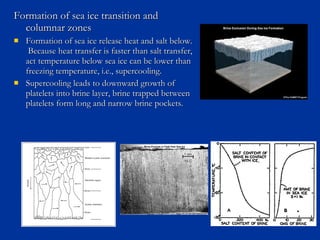
 Formation of sea ice release heat and salt below.Formation of sea ice release heat and salt below.
Because heat transfer is faster than salt transfer,Because heat transfer is faster than salt transfer,
act temperature below sea ice can be lower thanact temperature below sea ice can be lower than
freezing temperature, i.e., supercooling.freezing temperature, i.e., supercooling.
 Supercooling leads to downward growth ofSupercooling leads to downward growth of
platelets into brine layer, brine trapped betweenplatelets into brine layer, brine trapped between
platelets form long and narrow brine pockets.platelets form long and narrow brine pockets.
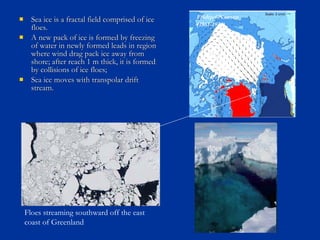
 Sea ice is a fractal field comprised of iceSea ice is a fractal field comprised of ice
floes.floes.
 A new pack of ice is formed by freezingA new pack of ice is formed by freezing
of water in newly formed leads in regionof water in newly formed leads in region
where wind drag pack ice away fromwhere wind drag pack ice away from
shore; after reach 1 m thick, it is formedshore; after reach 1 m thick, it is formed
by collisions of ice floes;by collisions of ice floes;
 Sea ice moves with transpolar driftSea ice moves with transpolar drift
stream.stream.
leads
floes
Floes streaming southward off the east
coast of Greenland
Fridtjof Nansen
(1861-1930)
SummarySummary What is cryosphere?What is cryosphere?
 Cryo (frozen), a component of the earthCryo (frozen), a component of the earth’s climate system comprised’s climate system comprised
of water in its solid state. It consists ofof water in its solid state. It consists of
 glaciers & ice sheets,glaciers & ice sheets,
 snow,snow,
 permafrost (continuous and discontinuous)permafrost (continuous and discontinuous)
 sea ice (perennial and seasonal).sea ice (perennial and seasonal).
 What is the distribution of different components of cryosphere?What is the distribution of different components of cryosphere?
 Largest mass in Antarctic and Greenland, 58 m deep of water globally if theyLargest mass in Antarctic and Greenland, 58 m deep of water globally if they
melt completely;melt completely;
 Sea ice and land snow cover 8-16% of the earthSea ice and land snow cover 8-16% of the earth’s surface’s surface
 Greenland and W. Antarctic ice sheet, Arctic sea ice and alpine glaciers haveGreenland and W. Antarctic ice sheet, Arctic sea ice and alpine glaciers have
retreated rapidly in recent decades.retreated rapidly in recent decades.
 What is the roles of cryosphere in climate system?What is the roles of cryosphere in climate system?
 Largest storage of global surface fresh waterLargest storage of global surface fresh water
 Contribute to the thermal inertial of the earthContribute to the thermal inertial of the earth’s climate’s climate
 Contribute to albedo of the earthContribute to albedo of the earth
 Controls fresh water flux in the polar region, thus influence oceanicControls fresh water flux in the polar region, thus influence oceanic
thermohaline circulation;thermohaline circulation;
 Store more carbon than that by global vegetationStore more carbon than that by global vegetation
 A shield and platform make up aA shield and platform make up a craton,craton,
 a continent’s ancient nucleusa continent’s ancient nucleus
 Along the margins of cratons,Along the margins of cratons,
 more continental crust was addedmore continental crust was added
 as the continents took their present sizes and shapesas the continents took their present sizes and shapes
 Both Archean and Proterozoic rocksBoth Archean and Proterozoic rocks
 are present in cratons and show evidence ofare present in cratons and show evidence of
 episodes of deformation accompanied byepisodes of deformation accompanied by
 metamorphism, igneous activity,metamorphism, igneous activity,
 and mountain buildingand mountain building
 Cratons have experienced little deformationCratons have experienced little deformation
 since the Precambriansince the Precambrian
CratonsCratons
 Certainly several small cratonsCertainly several small cratons
 existed during the Archeanexisted during the Archean
 and grew by periodic continental accretionand grew by periodic continental accretion
 during the rest of that eonduring the rest of that eon
 They amalgamated into a larger unitThey amalgamated into a larger unit
 during the Proterozoicduring the Proterozoic
 By the end of the Archean,By the end of the Archean,
 30-40% of the present volume30-40% of the present volume
 of continental crust existedof continental crust existed
The Origin of CratonsThe Origin of Cratons
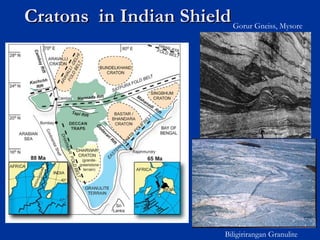
Cratons in Indian ShieldCratons in Indian ShieldGorur Gneiss, Mysore
Biligirirangan Granulite
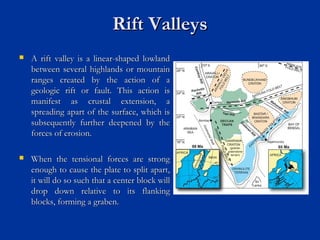
Rift ValleysRift Valleys
 A rift valley is a linear-shaped lowlandA rift valley is a linear-shaped lowland
between several highlands or mountainbetween several highlands or mountain
ranges created by the action of aranges created by the action of a
geologic rift or fault. This action isgeologic rift or fault. This action is
manifest as crustal extension, amanifest as crustal extension, a
spreading apart of the surface, which isspreading apart of the surface, which is
subsequently further deepened by thesubsequently further deepened by the
forces of erosion.forces of erosion.
 When the tensional forces are strongWhen the tensional forces are strong
enough to cause the plate to split apart,enough to cause the plate to split apart,
it will do so such that a center block willit will do so such that a center block will
drop down relative to its flankingdrop down relative to its flanking
blocks, forming a graben.blocks, forming a graben.
 This creates the nearly parallel steeply dipping walls. ThisThis creates the nearly parallel steeply dipping walls. This
feature is the beginning of the rift valley. As this processfeature is the beginning of the rift valley. As this process
continues, the valley widens, until it becomes a large basin,continues, the valley widens, until it becomes a large basin,
that fills with sediment from the rift walls and the surroundingthat fills with sediment from the rift walls and the surrounding
area.area.
 Rifts can occur at all elevations, from the sea floor to plateausRifts can occur at all elevations, from the sea floor to plateaus
and mountain ranges.and mountain ranges.
 They can occur in continental crust or in oceanic crust. RiftThey can occur in continental crust or in oceanic crust. Rift
valleys are often associated with a number of adjoiningvalleys are often associated with a number of adjoining
subsidiary or co-extensive valleys, which are typicallysubsidiary or co-extensive valleys, which are typically
considered part of the principal rift valley geologically.considered part of the principal rift valley geologically.
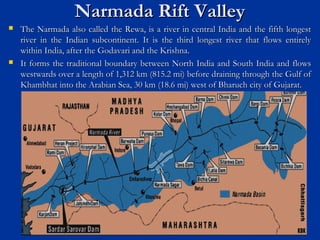
Narmada Rift ValleyNarmada Rift Valley
 The Narmada also called the Rewa, is a river in central India and the fifth longestThe Narmada also called the Rewa, is a river in central India and the fifth longest
river in the Indian subcontinent. It is the third longest river that flows entirelyriver in the Indian subcontinent. It is the third longest river that flows entirely
within India, after the Godavari and the Krishna.within India, after the Godavari and the Krishna.
 It forms the traditional boundary between North India and South India and flowsIt forms the traditional boundary between North India and South India and flows
westwards over a length of 1,312 km (815.2 mi) before draining through the Gulf ofwestwards over a length of 1,312 km (815.2 mi) before draining through the Gulf of
Khambhat into the Arabian Sea, 30 km (18.6 mi) west of Bharuch city of Gujarat.Khambhat into the Arabian Sea, 30 km (18.6 mi) west of Bharuch city of Gujarat.
 It is one of only three major rivers in peninsular India that run from east toIt is one of only three major rivers in peninsular India that run from east to
west (longest west flowing river), along with the Tapti River and the Mahiwest (longest west flowing river), along with the Tapti River and the Mahi
River. It is the one of the rivers in India that flows in a rift valley,flowing westRiver. It is the one of the rivers in India that flows in a rift valley,flowing west
between the Satpura and Vindhya ranges.between the Satpura and Vindhya ranges.
 The Narmada basin, hemmed between Vindya and Satpura ranges, extendsThe Narmada basin, hemmed between Vindya and Satpura ranges, extends
over an area of 98,796 km2 (38,145.3 sq mi) and lies between east longitudesover an area of 98,796 km2 (38,145.3 sq mi) and lies between east longitudes
72 degrees 32' to 81 degrees 45' and north latitudes 21 degrees 20‘ to 2372 degrees 32' to 81 degrees 45' and north latitudes 21 degrees 20‘ to 23
degrees 45' lying on the northern extremity of the Deccan Plateau.degrees 45' lying on the northern extremity of the Deccan Plateau.
 The basin covers large areas in the states of Madhya Pradesh (86%), GujaratThe basin covers large areas in the states of Madhya Pradesh (86%), Gujarat
(14%) and a comparatively smaller area (2%) in Maharashtra. In the river(14%) and a comparatively smaller area (2%) in Maharashtra. In the river
course of 1,312 km (815.2 mi) explained above, there are 41 tributaries, out ofcourse of 1,312 km (815.2 mi) explained above, there are 41 tributaries, out of
which 22 are from the Satpuda range and the rest on the right bank are fromwhich 22 are from the Satpuda range and the rest on the right bank are from
the Vindhya range.the Vindhya range.
 Dhupgarh (1,350m), near Pachmarhi is the highest point of the NarmadaDhupgarh (1,350m), near Pachmarhi is the highest point of the Narmada
basin.basin.
 The other rivers which flows through rift valley include Damodar River inThe other rivers which flows through rift valley include Damodar River in
Chota Nagpur Plateau & Tapti.Chota Nagpur Plateau & Tapti.
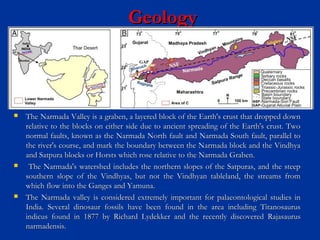
GeologyGeology
 The Narmada Valley is a graben, a layered block of the Earth's crust that dropped downThe Narmada Valley is a graben, a layered block of the Earth's crust that dropped down
relative to the blocks on either side due to ancient spreading of the Earth's crust. Tworelative to the blocks on either side due to ancient spreading of the Earth's crust. Two
normal faults, known as the Narmada North fault and Narmada South fault, parallel tonormal faults, known as the Narmada North fault and Narmada South fault, parallel to
the river's course, and mark the boundary between the Narmada block and the Vindhyathe river's course, and mark the boundary between the Narmada block and the Vindhya
and Satpura blocks or Horsts which rose relative to the Narmada Graben.and Satpura blocks or Horsts which rose relative to the Narmada Graben.
 The Narmada's watershed includes the northern slopes of the Satpuras, and the steepThe Narmada's watershed includes the northern slopes of the Satpuras, and the steep
southern slope of the Vindhyas, but not the Vindhyan tableland, the streams fromsouthern slope of the Vindhyas, but not the Vindhyan tableland, the streams from
which flow into the Ganges and Yamuna.which flow into the Ganges and Yamuna.
 The Narmada valley is considered extremely important for palaeontological studies inThe Narmada valley is considered extremely important for palaeontological studies in
India. Several dinosaur fossils have been found in the area including TitanosaurusIndia. Several dinosaur fossils have been found in the area including Titanosaurus
indicus found in 1877 by Richard Lydekker and the recently discovered Rajasaurusindicus found in 1877 by Richard Lydekker and the recently discovered Rajasaurus
narmadensis.narmadensis.
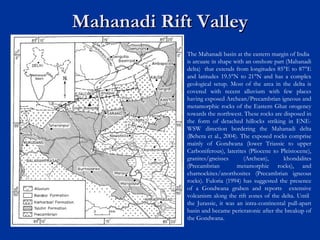
Mahanadi Rift ValleyMahanadi Rift Valley
The Mahanadi basin at the eastern margin of India
is arcuate in shape with an onshore part (Mahanadi
delta) that extends from longitudes 85°E to 87°E
and latitudes 19.5°N to 21°N and has a complex
geological setup. Most of the area in the delta is
covered with recent alluvium with few places
having exposed Archean/Precambrian igneous and
metamorphic rocks of the Eastern Ghat orogeney
towards the northwest. These rocks are disposed in
the form of detached hillocks striking in ENE-
WSW direction bordering the Mahanadi delta
(Behera et al., 2004). The exposed rocks comprise
mainly of Gondwana (lower Triassic to upper
Carboniferous), laterites (Pliocene to Pleistocene),
granites/gneisses (Archean), khondalites
(Precambrian metamorphic rocks), and
charnockites/anorthosites (Precambrian igneous
rocks). Fuloria (1994) has suggested the presence
of a Gondwana graben and reports extensive
volcanism along the rift zones of the delta. Until
the Jurassic, it was an intra-continental pull-apart
basin and became pericratonic after the breakup of
the Gondwana.
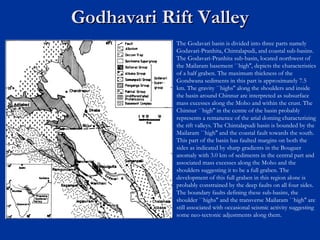
Godhavari Rift ValleyGodhavari Rift Valley
The Godavari basin is divided into three parts namely
Godavari-Pranhita, Chintalapudi, and coastal sub-basins.
The Godavari-Pranhita sub-basin, located northwest of
the Mailaram basement ``high'', depicts the characteristics
of a half graben. The maximum thickness of the
Gondwana sediments in this part is approximately 7.5
km. The gravity ``highs'' along the shoulders and inside
the basin around Chinnur are interpreted as subsurface
mass excesses along the Moho and within the crust. The
Chinnur ``high'' in the centre of the basin probably
represents a remanence of the arial doming characterizing
the rift valleys. The Chintalapudi basin is bounded by the
Mailaram ``high'' and the coastal fault towards the south.
This part of the basin has faulted margins on both the
sides as indicated by sharp gradients in the Bouguer
anomaly with 3.0 km of sediments in the central part and
associated mass excesses along the Moho and the
shoulders suggesting it to be a full graben. The
development of this full graben in this region alone is
probably constrained by the deep faults on all four sides.
The boundary faults defining these sub-basins, the
shoulder ``highs'' and the transverse Mailaram ``high'' are
still associated with occasional seismic activity suggesting
some neo-tectonic adjustments along them. 
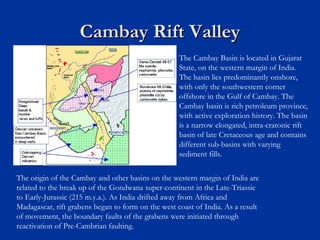
Cambay Rift ValleyCambay Rift Valley
The Cambay Basin is located in Gujarat
State, on the western margin of India.
The basin lies predominantly onshore,
with only the southwestern corner
offshore in the Gulf of Cambay. The
Cambay basin is rich petroleum province,
with active exploration history. The basin
is a narrow elongated, intra-cratonic rift
basin of late Cretaceous age and contains
different sub-basins with varying
sediment fills.
The origin of the Cambay and other basins on the western margin of India are
related to the break up of the Gondwana super-continent in the Late-Triassic
to Early-Jurassic (215 m.y.a.). As India drifted away from Africa and
Madagascar, rift grabens began to form on the west coast of India. As a result
of movement, the boundary faults of the grabens were initiated through
reactivation of Pre-Cambrian faulting.
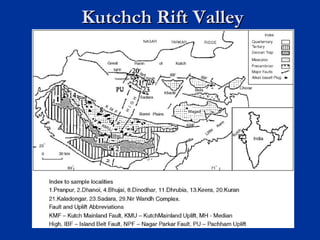
Kutchch Rift ValleyKutchch Rift Valley
Cratons of the Indian ShieldCratons of the Indian Shield
 The Indian shield is made up of a mosaic of PrecambrianThe Indian shield is made up of a mosaic of Precambrian
metamorphic terrains that exhibit low to high-grade crystallinemetamorphic terrains that exhibit low to high-grade crystalline
rocks in the age range of 3.6–2.6 Ga.rocks in the age range of 3.6–2.6 Ga.
 These terrains, constituting the continental crust, attainedThese terrains, constituting the continental crust, attained
tectonic stability for prolonged period (since Precambrian time)tectonic stability for prolonged period (since Precambrian time)
and are designated cratons.The cratons are flanked by a fold belt,and are designated cratons.The cratons are flanked by a fold belt,
with or without a discernible suture or shear zone, suggestingwith or without a discernible suture or shear zone, suggesting
that the cratons, as crustal blocks or microplates, moved againstthat the cratons, as crustal blocks or microplates, moved against
each other and collided to generate these fold belts.each other and collided to generate these fold belts.
 Alternatively, these cratons could be the result of fragmentationAlternatively, these cratons could be the result of fragmentation
of a large craton that constituted the Indian shield.of a large craton that constituted the Indian shield.
Cratons of the Indian ShieldCratons of the Indian Shield
 These six cratons shows different geological characteristics. we enquire intoThese six cratons shows different geological characteristics. we enquire into
the age, composition, and structural architecture of these cratonic masses tothe age, composition, and structural architecture of these cratonic masses to
which the fold belts had accreted.which the fold belts had accreted.
 In general, the cratons are dominated by granite and metamorphic rocks,In general, the cratons are dominated by granite and metamorphic rocks,
mainly gneisses, which imply a series of intense mountain making episodesmainly gneisses, which imply a series of intense mountain making episodes
(deformation and metamorphism) in the Precambrian time before the stable(deformation and metamorphism) in the Precambrian time before the stable
conditions set in. A common feature of these cratonic regions is theconditions set in. A common feature of these cratonic regions is the
occurrence of greenstone-gneiss association, as found in other Archaeanoccurrence of greenstone-gneiss association, as found in other Archaean
cratons of the world.cratons of the world.
 Geochronological data have disclosed that rocks, especially the grey tonaliticGeochronological data have disclosed that rocks, especially the grey tonalitic
gneisses, range in age from 3.4 to 2.6 Ga old, which may be taken to indicategneisses, range in age from 3.4 to 2.6 Ga old, which may be taken to indicate
that all these regions contain continental nucleus. Another feature of thesethat all these regions contain continental nucleus. Another feature of these
cratons is that they are often bordered by a shear zone or a major fault systemcratons is that they are often bordered by a shear zone or a major fault system
and the intervening fold belt is composed of metamorphosed, deformedand the intervening fold belt is composed of metamorphosed, deformed
Proterozoic rocks.Proterozoic rocks.
Cratons of the Indian ShieldCratons of the Indian Shield
 This implies that the stable Archaean cratons subdivided byThis implies that the stable Archaean cratons subdivided by
mobile belts or fold belts had split or rifted during themobile belts or fold belts had split or rifted during the
Proterozoic and the resulting basin was wholly ensialic, with noProterozoic and the resulting basin was wholly ensialic, with no
rock associations that could be equated with ancient oceanrock associations that could be equated with ancient ocean
basins.basins.
 In most fold belts, one observes that gneiss-amphibolite-In most fold belts, one observes that gneiss-amphibolite-
migmatites are exposed as the dominant cratonic rocks,migmatites are exposed as the dominant cratonic rocks,
suggesting that the supracrustals sequences rested upon thesuggesting that the supracrustals sequences rested upon the
Archaean gneissic rocks of the cratons and that both basementArchaean gneissic rocks of the cratons and that both basement
and cover rocks were deformed and recrystallized in theand cover rocks were deformed and recrystallized in the
subsequent orogeny.subsequent orogeny.
Cratons of Indian ShieldCratons of Indian Shield
 Cratonic blocks are described with respect to their geology,Cratonic blocks are described with respect to their geology,
geochronology, and structural characteristics :geochronology, and structural characteristics :
(1) Dharwar Craton (also called Karnataka Craton) in the south(1) Dharwar Craton (also called Karnataka Craton) in the south
(2) Bastar Craton (also called Bastar-Bhandara Craton) in the central(2) Bastar Craton (also called Bastar-Bhandara Craton) in the central
partpart
(3) Singhbhum Craton (also called Singhbhum-Orissa Craton) in the(3) Singhbhum Craton (also called Singhbhum-Orissa Craton) in the
northeastnortheast
(4) Chhotanagpur Gneiss Complex in eastern India(4) Chhotanagpur Gneiss Complex in eastern India
(5) Rajasthan (Aravalli-Bundelkhand) Craton in the north(5) Rajasthan (Aravalli-Bundelkhand) Craton in the north
(6) Meghalaya Craton in east Indian shield(6) Meghalaya Craton in east Indian shield
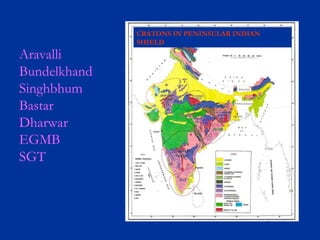
CRATONS IN PENINSULAR INDIAN
SHIELD
Aravalli
Bundelkhand
Singhbhum
Bastar
Dharwar
EGMB
SGT
Aravalli (Rajasthan) CratonAravalli (Rajasthan) Craton
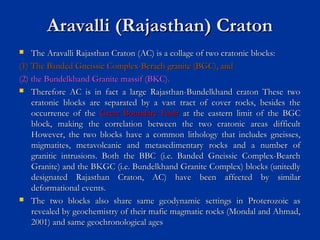
 The Aravalli Rajasthan Craton (AC) is a collage of two cratonic blocks:The Aravalli Rajasthan Craton (AC) is a collage of two cratonic blocks:
(1) The Banded Gneissic Complex-Berach granite (BGC), and(1) The Banded Gneissic Complex-Berach granite (BGC), and
(2) the Bundelkhand Granite massif (BKC).(2) the Bundelkhand Granite massif (BKC).
 Therefore AC is in fact a large Rajasthan-Bundelkhand craton These twoTherefore AC is in fact a large Rajasthan-Bundelkhand craton These two
cratonic blocks are separated by a vast tract of cover rocks, besides thecratonic blocks are separated by a vast tract of cover rocks, besides the
occurrence of theoccurrence of the Great Boundary FaultGreat Boundary Fault at the eastern limit of the BGCat the eastern limit of the BGC
block, making the correlation between the two cratonic areas difficultblock, making the correlation between the two cratonic areas difficult
However, the two blocks have a common lithology that includes gneisses,However, the two blocks have a common lithology that includes gneisses,
migmatites, metavolcanic and metasedimentary rocks and a number ofmigmatites, metavolcanic and metasedimentary rocks and a number of
granitic intrusions. Both the BBC (i.e. Banded Gneissic Complex-Bearchgranitic intrusions. Both the BBC (i.e. Banded Gneissic Complex-Bearch
Granite) and the BKGC (i.e. Bundelkhand Granite Complex) blocks (unitedlyGranite) and the BKGC (i.e. Bundelkhand Granite Complex) blocks (unitedly
designated Rajasthan Craton, AC) have been affected by similardesignated Rajasthan Craton, AC) have been affected by similar
deformational events.deformational events.
 The two blocks also share same geodynamic settings in Proterozoic asThe two blocks also share same geodynamic settings in Proterozoic as
revealed by geochemistry of their mafic magmatic rocks (Mondal and Ahmad,revealed by geochemistry of their mafic magmatic rocks (Mondal and Ahmad,
2001) and same geochronological ages2001) and same geochronological ages
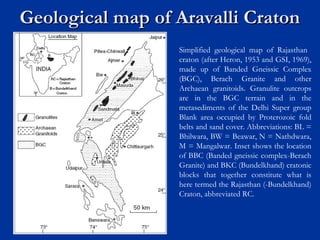
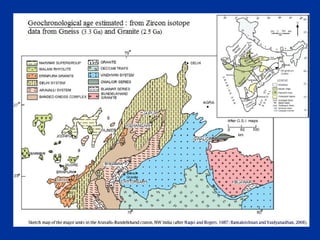
Geological map of Aravalli CratonGeological map of Aravalli Craton
Simplified geological map of Rajasthan
craton (after Heron, 1953 and GSI, 1969),
made up of Banded Gneissic Complex
(BGC), Berach Granite and other
Archaean granitoids. Granulite outcrops
are in the BGC terrain and in the
metasediments of the Delhi Super group
Blank area occupied by Proterozoic fold
belts and sand cover. Abbreviations: BL =
Bhilwara, BW = Beawar, N = Nathdwara,
M = Mangalwar. Inset shows the location
of BBC (Banded gneissic complex-Berach
Granite) and BKC (Bundelkhand) cratonic
blocks that together constitute what is
here termed the Rajasthan (-Bundelkhand)
Craton, abbreviated RC.
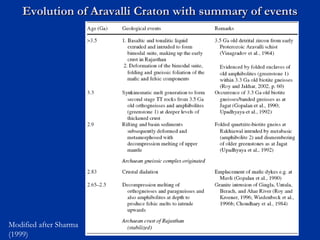
Evolution of Aravalli Craton with summary of eventsEvolution of Aravalli Craton with summary of events
Modified after Sharma
(1999)
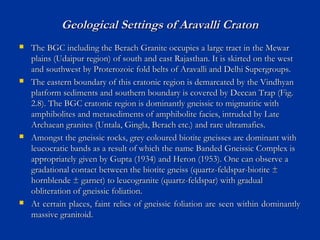
Geological Settings of Aravalli CratonGeological Settings of Aravalli Craton
 The BGC including the Berach Granite occupies a large tract in the MewarThe BGC including the Berach Granite occupies a large tract in the Mewar
plains (Udaipur region) of south and east Rajasthan. It is skirted on the westplains (Udaipur region) of south and east Rajasthan. It is skirted on the west
and southwest by Proterozoic fold belts of Aravalli and Delhi Supergroups.and southwest by Proterozoic fold belts of Aravalli and Delhi Supergroups.
 The eastern boundary of this cratonic region is demarcated by the VindhyanThe eastern boundary of this cratonic region is demarcated by the Vindhyan
platform sediments and southern boundary is covered by Deccan Trap (Fig.platform sediments and southern boundary is covered by Deccan Trap (Fig.
2.8). The BGC cratonic region is dominantly gneissic to migmatitic with2.8). The BGC cratonic region is dominantly gneissic to migmatitic with
amphibolites and metasediments of amphibolite facies, intruded by Lateamphibolites and metasediments of amphibolite facies, intruded by Late
Archaean granites (Untala, Gingla, Berach etc.) and rare ultramafics.Archaean granites (Untala, Gingla, Berach etc.) and rare ultramafics.
 Amongst the gneissic rocks, grey coloured biotite gneisses are dominant withAmongst the gneissic rocks, grey coloured biotite gneisses are dominant with
leucocratic bands as a result of which the name Banded Gneissic Complex isleucocratic bands as a result of which the name Banded Gneissic Complex is
appropriately given by Gupta (1934) and Heron (1953). One can observe aappropriately given by Gupta (1934) and Heron (1953). One can observe a
gradational contact between the biotite gneiss (quartz-feldspar-biotite ±gradational contact between the biotite gneiss (quartz-feldspar-biotite ±
hornblende ± garnet) to leucogranite (quartz-feldspar) with gradualhornblende ± garnet) to leucogranite (quartz-feldspar) with gradual
obliteration of gneissic foliation.obliteration of gneissic foliation.
 At certain places, faint relics of gneissic foliation are seen within dominantlyAt certain places, faint relics of gneissic foliation are seen within dominantly
massive granitoid.massive granitoid.
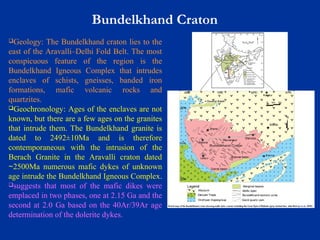
Bundelkhand Craton
Geology: The Bundelkhand craton lies to the
east of the Aravalli–Delhi Fold Belt. The most
conspicuous feature of the region is the
Bundelkhand Igneous Complex that intrudes
enclaves of schists, gneisses, banded iron
formations, mafic volcanic rocks and
quartzites.
Geochronology: Ages of the enclaves are not
known, but there are a few ages on the granites
that intrude them. The Bundelkhand granite is
dated to 2492±10Ma and is therefore
contemporaneous with the intrusion of the
Berach Granite in the Aravalli craton dated
2500Ma numerous mafic dykes of unknown∼
age intrude the Bundelkhand Igneous Complex.
suggests that most of the mafic dikes were
emplaced in two phases, one at 2.15 Ga and the
second at 2.0 Ga based on the 40Ar/39Ar age
determination of the dolerite dykes.
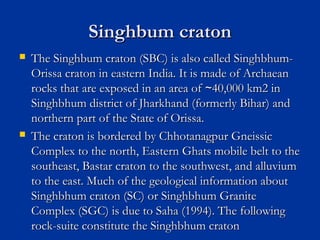
Singhbum cratonSinghbum craton
 The Singhbum craton (SBC) is also called Singhbhum-The Singhbum craton (SBC) is also called Singhbhum-
Orissa craton in eastern India. It is made of ArchaeanOrissa craton in eastern India. It is made of Archaean
rocks that are exposed in an area of 40,000 km2 in∼rocks that are exposed in an area of 40,000 km2 in∼
Singhbhum district of Jharkhand (formerly Bihar) andSinghbhum district of Jharkhand (formerly Bihar) and
northern part of the State of Orissa.northern part of the State of Orissa.
 The craton is bordered by Chhotanagpur GneissicThe craton is bordered by Chhotanagpur Gneissic
Complex to the north, Eastern Ghats mobile belt to theComplex to the north, Eastern Ghats mobile belt to the
southeast, Bastar craton to the southwest, and alluviumsoutheast, Bastar craton to the southwest, and alluvium
to the east. Much of the geological information aboutto the east. Much of the geological information about
Singhbhum craton (SC) or Singhbhum GraniteSinghbhum craton (SC) or Singhbhum Granite
Complex (SGC) is due to Saha (1994). The followingComplex (SGC) is due to Saha (1994). The following
rock-suite constitute the Singhbhum cratonrock-suite constitute the Singhbhum craton
Singhbum cratonSinghbum craton
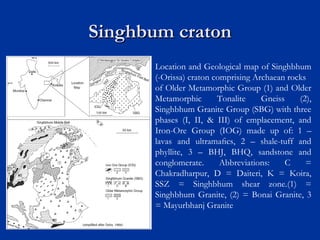
Location and Geological map of Singhbhum
(-Orissa) craton comprising Archaean rocks
of Older Metamorphic Group (1) and Older
Metamorphic Tonalite Gneiss (2),
Singhbhum Granite Group (SBG) with three
phases (I, II, & III) of emplacement, and
Iron-Ore Group (IOG) made up of: 1 –
lavas and ultramafics, 2 – shale-tuff and
phyllite, 3 – BHJ, BHQ, sandstone and
conglomerate. Abbreviations: C =
Chakradharpur, D = Daiteri, K = Koira,
SSZ = Singhbhum shear zone.(1) =
Singhbhum Granite, (2) = Bonai Granite, 3
= Mayurbhanj Granite
General geologic settingsGeneral geologic settings
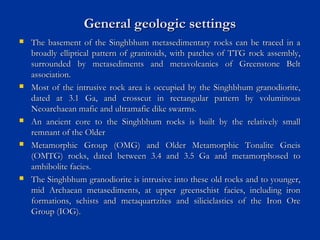
 The basement of the Singhbhum metasedimentary rocks can be traced in aThe basement of the Singhbhum metasedimentary rocks can be traced in a
broadly elliptical pattern of granitoids, with patches of TTG rock assembly,broadly elliptical pattern of granitoids, with patches of TTG rock assembly,
surrounded by metasediments and metavolcanics of Greenstone Beltsurrounded by metasediments and metavolcanics of Greenstone Belt
association.association.
 Most of the intrusive rock area is occupied by the Singhbhum granodiorite,Most of the intrusive rock area is occupied by the Singhbhum granodiorite,
dated at 3.1 Ga, and crosscut in rectangular pattern by voluminousdated at 3.1 Ga, and crosscut in rectangular pattern by voluminous
Neoarchaean mafic and ultramafic dike swarms.Neoarchaean mafic and ultramafic dike swarms.
 An ancient core to the Singhbhum rocks is built by the relatively smallAn ancient core to the Singhbhum rocks is built by the relatively small
remnant of the Olderremnant of the Older
 Metamorphic Group (OMG) and Older Metamorphic Tonalite GneisMetamorphic Group (OMG) and Older Metamorphic Tonalite Gneis
(OMTG) rocks, dated between 3.4 and 3.5 Ga and metamorphosed to(OMTG) rocks, dated between 3.4 and 3.5 Ga and metamorphosed to
amhibolite facies.amhibolite facies.
 The Singhbhum granodiorite is intrusive into these old rocks and to younger,The Singhbhum granodiorite is intrusive into these old rocks and to younger,
mid Archaean metasediments, at upper greenschist facies, including ironmid Archaean metasediments, at upper greenschist facies, including iron
formations, schists and metaquartzites and siliciclastics of the Iron Oreformations, schists and metaquartzites and siliciclastics of the Iron Ore
Group (IOG).Group (IOG).
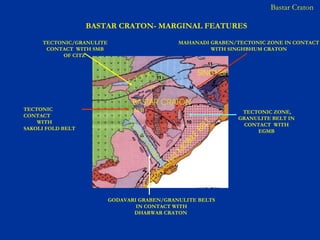
MAHANADI GRABEN/TECTONIC ZONE IN CONTACT
WITH SINGHBHUM CRATON
GODAVARI GRABEN/GRANULITE BELTS
IN CONTACT WITH
DHARWAR CRATON
TECTONIC ZONE,
GRANULITE BELT IN
CONTACT WITH
EGMB
TECTONIC/GRANULITE
CONTACT WITH SMB
OF CITZ
TECTONIC
CONTACT
WITH
SAKOLI FOLD BELT
C I T Z
SMB
SFB
BASTAR CRATON- MARGINAL FEATURES
Bastar Craton
Bastar cratonBastar craton
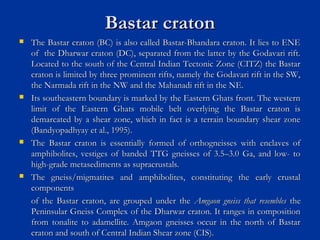
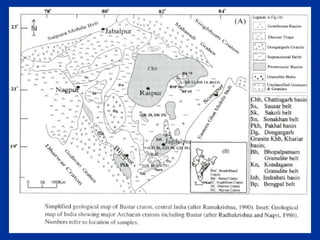
 The Bastar craton (BC) is also called Bastar-Bhandara craton. It lies to ENEThe Bastar craton (BC) is also called Bastar-Bhandara craton. It lies to ENE
of the Dharwar craton (DC), separated from the latter by the Godavari rift.of the Dharwar craton (DC), separated from the latter by the Godavari rift.
Located to the south of the Central Indian Tectonic Zone (CITZ) the BastarLocated to the south of the Central Indian Tectonic Zone (CITZ) the Bastar
craton is limited by three prominent rifts, namely the Godavari rift in the SW,craton is limited by three prominent rifts, namely the Godavari rift in the SW,
the Narmada rift in the NW and the Mahanadi rift in the NE.the Narmada rift in the NW and the Mahanadi rift in the NE.
 Its southeastern boundary is marked by the Eastern Ghats front. The westernIts southeastern boundary is marked by the Eastern Ghats front. The western
limit of the Eastern Ghats mobile belt overlying the Bastar craton islimit of the Eastern Ghats mobile belt overlying the Bastar craton is
demarcated by a shear zone, which in fact is a terrain boundary shear zonedemarcated by a shear zone, which in fact is a terrain boundary shear zone
(Bandyopadhyay et al., 1995).(Bandyopadhyay et al., 1995).
 The Bastar craton is essentially formed of orthogneisses with enclaves ofThe Bastar craton is essentially formed of orthogneisses with enclaves of
amphibolites, vestiges of banded TTG gneisses of 3.5–3.0 Ga, and low- toamphibolites, vestiges of banded TTG gneisses of 3.5–3.0 Ga, and low- to
high-grade metasediments as supracrustals.high-grade metasediments as supracrustals.
 The gneiss/migmatites and amphibolites, constituting the early crustalThe gneiss/migmatites and amphibolites, constituting the early crustal
componentscomponents
of the Bastar craton, are grouped under theof the Bastar craton, are grouped under the Amgaon gneiss that resemblesAmgaon gneiss that resembles thethe
Peninsular Gneiss Complex of the Dharwar craton. It ranges in compositionPeninsular Gneiss Complex of the Dharwar craton. It ranges in composition
from tonalite to adamellite. Amgaon gneisses occur in the north of Bastarfrom tonalite to adamellite. Amgaon gneisses occur in the north of Bastar
craton and south of Central Indian Shear zone (CIS).craton and south of Central Indian Shear zone (CIS).
Bastar cratonBastar craton
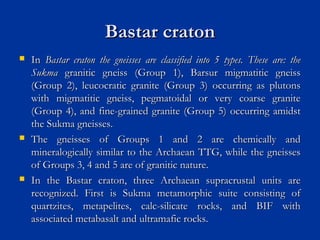
 InIn Bastar craton the gneisses are classified into 5 types. These are: theBastar craton the gneisses are classified into 5 types. These are: the
SukmaSukma granitic gneiss (Group 1), Barsur migmatitic gneissgranitic gneiss (Group 1), Barsur migmatitic gneiss
(Group 2), leucocratic granite (Group 3) occurring as plutons(Group 2), leucocratic granite (Group 3) occurring as plutons
with migmatitic gneiss, pegmatoidal or very coarse granitewith migmatitic gneiss, pegmatoidal or very coarse granite
(Group 4), and fine-grained granite (Group 5) occurring amidst(Group 4), and fine-grained granite (Group 5) occurring amidst
the Sukma gneisses.the Sukma gneisses.
 The gneisses of Groups 1 and 2 are chemically andThe gneisses of Groups 1 and 2 are chemically and
mineralogically similar to the Archaean TTG, while the gneissesmineralogically similar to the Archaean TTG, while the gneisses
of Groups 3, 4 and 5 are of granitic nature.of Groups 3, 4 and 5 are of granitic nature.
 In the Bastar craton, three Archaean supracrustal units areIn the Bastar craton, three Archaean supracrustal units are
recognized. First is Sukma metamorphic suite consisting ofrecognized. First is Sukma metamorphic suite consisting of
quartzites, metapelites, calc-silicate rocks, and BIF withquartzites, metapelites, calc-silicate rocks, and BIF with
associated metabasalt and ultramafic rocks.associated metabasalt and ultramafic rocks.
Bastar cratonBastar craton
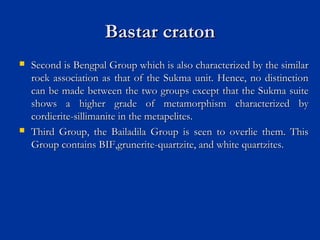
 Second is Bengpal Group which is also characterized by the similarSecond is Bengpal Group which is also characterized by the similar
rock association as that of the Sukma unit. Hence, no distinctionrock association as that of the Sukma unit. Hence, no distinction
can be made between the two groups except that the Sukma suitecan be made between the two groups except that the Sukma suite
shows a higher grade of metamorphism characterized byshows a higher grade of metamorphism characterized by
cordierite-sillimanite in the metapelites.cordierite-sillimanite in the metapelites.
 Third Group, the Bailadila Group is seen to overlie them. ThisThird Group, the Bailadila Group is seen to overlie them. This
Group contains BIF,grunerite-quartzite, and white quartzites.Group contains BIF,grunerite-quartzite, and white quartzites.
Bastar cratonBastar craton
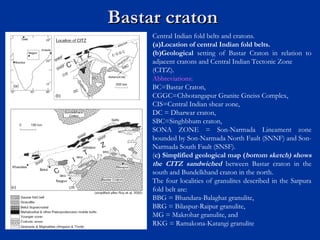
Central Indian fold belts and cratons.
(a)Location of central Indian fold belts.
(b)Geological setting of Bastar Craton in relation to
adjacent cratons and Central Indian Tectonic Zone
(CITZ).
Abbreviations:
BC=Bastar Craton,
CGGC=Chhotangapur Granite Gneiss Complex,
CIS=Central Indian shear zone,
DC = Dharwar craton,
SBC=Singhbhum craton,
SONA ZONE = Son-Narmada Lineament zone
bounded by Son-Narmada North Fault (SNNF) and Son-
Narmada South Fault (SNSF).
(c) Simplified geological map (bottom sketch) shows
the CITZ sandwiched between Bastar craton in the
south and Bundelkhand craton in the north.
The four localities of granulites described in the Satpura
fold belt are:
BBG = Bhandara-Balaghat granulite,
BRG = Bilaspur-Raipur granulite,
MG = Makrohar granulite, and
RKG = Ramakona-Katangi granulite
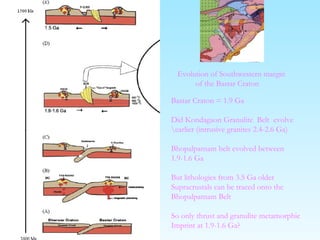
Evolution of Southwestern margin
of the Bastar Craton
Bastar Craton = 1.9 Ga
Did Kondagaon Granulite Belt evolve
earlier (intrusive granites 2.4-2.6 Ga)
Bhopalpatnam belt evolved between
1.9-1.6 Ga
But lithologies from 3.5 Ga older
Supracrustals can be traced onto the
Bhopalpatnam Belt
So only thrust and granulite metamorphic
Imprint at 1.9-1.6 Ga?
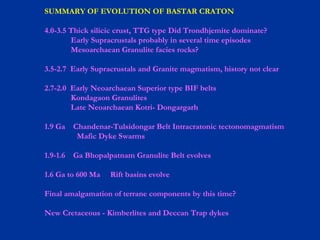
SUMMARY OF EVOLUTION OF BASTAR CRATON
4.0-3.5 Thick silicic crust, TTG type Did Trondhjemite dominate?
Early Supracrustals probably in several time episodes
Mesoarchaean Granulite facies rocks?
3.5-2.7 Early Supracrustals and Granite magmatism, history not clear
2.7-2.0 Early Neoarchaean Superior type BIF belts
Kondagaon Granulites
Late Neoarchaean Kotri- Dongargarh
1.9 Ga Chandenar-Tulsidongar Belt Intracratonic tectonomagmatism
Mafic Dyke Swarms
1.9-1.6 Ga Bhopalpatnam Granulite Belt evolves
1.6 Ga to 600 Ma Rift basins evolve
Final amalgamation of terrane components by this time?
New Cretaceous - Kimberlites and Deccan Trap dykes
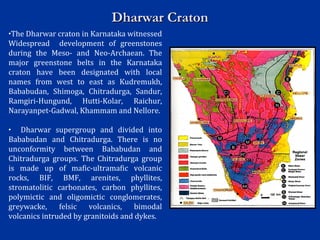
Dharwar CratonDharwar Craton
•The Dharwar craton in Karnataka witnessed
Widespread development of greenstones
during the Meso- and Neo-Archaean. The
major greenstone belts in the Karnataka
craton have been designated with local
names from west to east as Kudremukh,
Bababudan, Shimoga, Chitradurga, Sandur,
Ramgiri-Hungund, Hutti-Kolar, Raichur,
Narayanpet-Gadwal, Khammam and Nellore.
• Dharwar supergroup and divided into
Bababudan and Chitradurga. There is no
unconformity between Bababudan and
Chitradurga groups. The Chitradurga group
is made up of mafic-ultramafic volcanic
rocks, BIF, BMF, arenites, phyllites,
stromatolitic carbonates, carbon phyllites,
polymictic and oligomictic conglomerates,
greywacke, felsic volcanics, bimodal
volcanics intruded by granitoids and dykes.
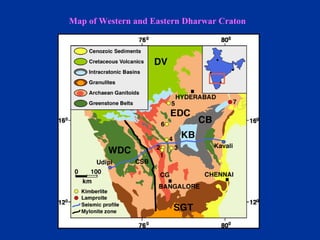
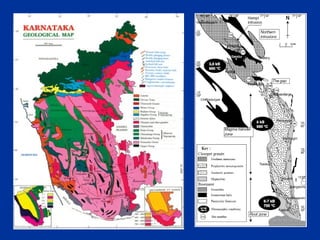
Map of Western and Eastern Dharwar Craton

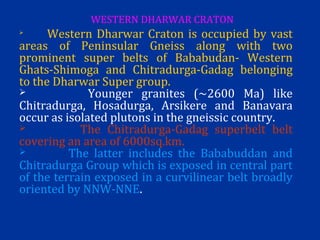
Western Dharwar Craton is occupied by vast
areas of Peninsular Gneiss along with two
prominent super belts of Bababudan- Western
Ghats-Shimoga and Chitradurga-Gadag belonging
to the Dharwar Super group.
 Younger granites (~2600 Ma) like
Chitradurga, Hosadurga, Arsikere and Banavara
occur as isolated plutons in the gneissic country.
 The Chitradurga-Gadag superbelt belt
covering an area of 6000sq.km.
 The latter includes the Bababuddan and
Chitradurga Group which is exposed in central part
of the terrain exposed in a curvilinear belt broadly
oriented by NNW-NNE.
WESTERN DHARWAR CRATON
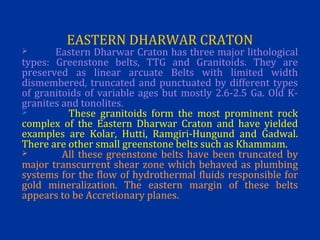
EASTERN DHARWAR CRATON
 Eastern Dharwar Craton has three major lithological
types: Greenstone belts, TTG and Granitoids. They are
preserved as linear arcuate Belts with limited width
dismembered, truncated and punctuated by different types
of granitoids of variable ages but mostly 2.6-2.5 Ga. Old K-
granites and tonolites.
 These granitoids form the most prominent rock
complex of the Eastern Dharwar Craton and have yielded
examples are Kolar, Hutti, Ramgiri-Hungund and Gadwal.
There are other small greenstone belts such as Khammam.
 All these greenstone belts have been truncated by
major transcurrent shear zone which behaved as plumbing
systems for the flow of hydrothermal fluids responsible for
gold mineralization. The eastern margin of these belts
appears to be Accretionary planes.
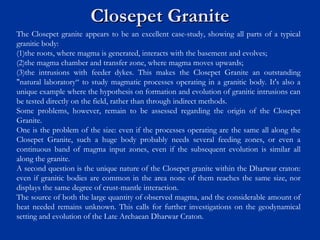
Closepet GraniteClosepet Granite
The Closepet granite appears to be an excellent case-study, showing all parts of a typical
granitic body:
(1)the roots, where magma is generated, interacts with the basement and evolves;
(2)the magma chamber and transfer zone, where magma moves upwards;
(3)the intrusions with feeder dykes. This makes the Closepet Granite an outstanding
"natural laboratory“ to study magmatic processes operating in a granitic body. It's also a
unique example where the hypothesis on formation and evolution of granitic intrusions can
be tested directly on the field, rather than through indirect methods.
Some problems, however, remain to be assessed regarding the origin of the Closepet
Granite.
One is the problem of the size: even if the processes operating are the same all along the
Closepet Granite, such a huge body probably needs several feeding zones, or even a
continuous band of magma input zones, even if the subsequent evolution is similar all
along the granite.
A second question is the unique nature of the Closepet granite within the Dharwar craton:
even if granitic bodies are common in the area none of them reaches the same size, nor
displays the same degree of crust-mantle interaction.
The source of both the large quantity of observed magma, and the considerable amount of
heat needed remains unknown. This calls for further investigations on the geodynamical
setting and evolution of the Late Archaean Dharwar Craton.
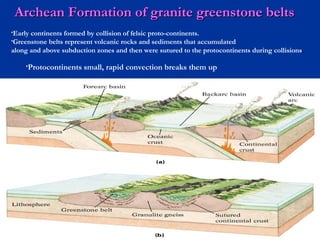
Archean Formation of granite greenstone beltsArchean Formation of granite greenstone belts
•Early continents formed by collision of felsic proto-continents.
•Greenstone belts represent volcanic rocks and sediments that accumulated
along and above subduction zones and then were sutured to the protocontinents during collisions.
•Protocontinents small, rapid convection breaks them up
CHITRADURGA SUPER GROUP
1.Chitradurga Schist belt
2.Gadag Schist belt
3.Javanahalli Schist belt
4.Chikkanayakana Halli Schsit belt
5.Kunigal schist belt
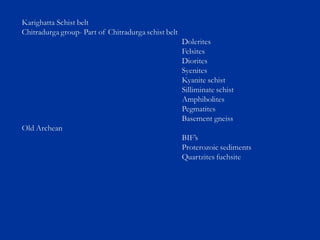
6.Karighatta Schist belt
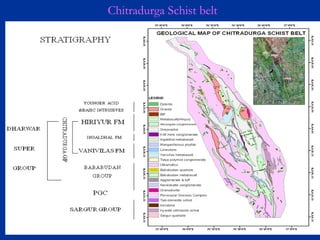
Chitradurga Schist belt
The Chitradurga schist belt extends over a strike length of about 460 km from
Gadag in the north to Srirangapatnam in the south. The lithounits of this
schist belt comprise metavolcanic rocks- both metabasalts and meta acid
volcanics and metasedimentaries comprising graywacke-argillite suite of rocks
and banded iron formation. There is a well known sulphide belt extending
from Yerahalli in the south to Honnemaradi in the north over a strike length
of 40 km hosting sulphides like pyrite, pyrrhotite, arsenopyrite, chalcopyrite,
galena, sphalerite, etc. Parallel to this sulphide belt and sometimes closely
intermixed with this sulphide belt gold mineralisation is also encountered. In
this sulphide belt considerable silver mineralisation is also noticed.
Geologically, this mineralisation simulates mesothermal type of copper-silver-
gold-lead-zinc deposit. At present, exploration for gold in this schist belt is in
progress in the G.R. Halli-C.K. Halli and Honnemaradi area. In addition,
further investigation is in progress in Ajjanahalli and Bellara areas. The details
of the above prospects are furnished in a tabular formt.
Chitradurga Schist belt
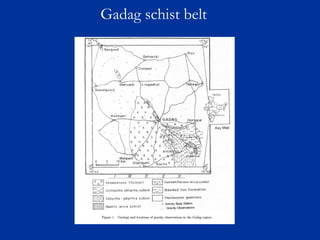
Gadag schist belt
The Gadag schist belt consists of a 2000m thick pile of meta-volcanics and meta-
sediments and a banded iron-formation . The structural disposition of the belt is the
result of an overall E-W compressional regime with uplift and diaperism of the sialic
basement within which the N-S trending Archaean shear systems have caused buckling
and refolding of earlier fold belts, making all the linear elements parallel to the direction
of shear. The underlying gneisses as well as the younger Closepet granite have a similar
trend.
Gadag schist belt is drawn out in the form of a 400 km long narrow N-S to NW-SE
belt with a convexity towards the east. The eastern margin of the schist belt is a major
thrust contact marked by a strong mylonitic zone believed to represent the line of
suture marking the junction of the Archaean nucleus lying to the west and the
comparatively younger gneiss complex to the east. Deep seismic sounding carried
across the schist belt shows a major fault dipping to the east along the eastern margin
of the schist belt. Followed south- ward, the schist belt splits into several narrow belts
inter-layered with gneisses. While the geological nature and the inter- relationship of
the volcano-sedimentary rocks of the supracrustals sequences help in understanding
the tectono-sedimentary environments of deposition, there are no results of detailed
geophysical studies reported so far over the schist belts of the carton.
Javanahalli Schist belt
Rock types:
Dolerite
Quartz vein
Augen Gneiss
Migmatite Gneiss
Fuchsite Quartzite
Ultramafic rock
B M Q
Amphibolite
Calc silicate
Paragneiss
Nuggihalli Schist belt, Hassan district
Sulphide mineralisation (pyrite with subordinate pyrrhotite and chalcopyrite)
associated with titaniferous magnetite bands is seen near Nuggihalli.
In the Tagadur area, sulphide mineralisation (pyrite, pyrrhotite,
pentlandite and cubanite) is seen in gabbro and titaniferous magnetite bands.
Nuggihalli Schist Belt is a narrow arcuate belt (60 km x 12 km) extending
from Arsikere in the north to Kempinkote in south. It occurs as a mega
enclave within the granite gneisses of the Western Dharwar Craton.
Chromite first reported from the serpentinite , was established as segregates
of the fractionated melt and the serpentinite was an altered product of
original dunite - peridotite of a layered complex. Anomalous values of PGE
(approx. 258 ppb of Pt and 43 ppb of Pd) along with significant amount of
gold and copper have been reported from this belt although the PGE values
reported are of semiquantitative in nature.
The Nuggihalli schist belt comprises metavolcanics (hornblende schist and
amphibolite) surrounded by Peninsular gneisses and granites with associated
quartz veins and pegmatites of post-Dharwar age. These formations are
intruded by an ultramafic complex consisting serpentinite, talctremolite
schist (pyroxenite), olivine dolerite titaniferous magnetite veins and
chromite veins.
KUNIGAL SCHIST BELTKUNIGAL SCHIST BELT
HOLENARSIPUR SCHIST BELTHOLENARSIPUR SCHIST BELT
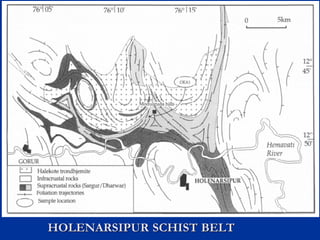
 The Holenarasipur schist belt is one of the most critical, complicated andThe Holenarasipur schist belt is one of the most critical, complicated and
oldest (3.2-3.5 by) supracrustal belts in the Dharwar craton of India. Twooldest (3.2-3.5 by) supracrustal belts in the Dharwar craton of India. Two
lithostratigraphic groups, the Sargur and Dharwar, are separated by an angularlithostratigraphic groups, the Sargur and Dharwar, are separated by an angular
unconformity. The Sargur group starts with a basic-ultrabasic base which isunconformity. The Sargur group starts with a basic-ultrabasic base which is
overlain by metasediments of various compositions, whereas the Dharwaroverlain by metasediments of various compositions, whereas the Dharwar
group develops upward from a basal conglomerate into a sequence ofgroup develops upward from a basal conglomerate into a sequence of
amphibolites, quartzites and banded magnetite quartzites.amphibolites, quartzites and banded magnetite quartzites.
 The Dharwar belt as a whole is metamorphosed to an amphibolite faciesThe Dharwar belt as a whole is metamorphosed to an amphibolite facies
grade, but the Sargur group shows a higher grade (kyanite zone). Recumbent,grade, but the Sargur group shows a higher grade (kyanite zone). Recumbent,
isoclinal, doubly plunging folds are common, but a regional northward plungeisoclinal, doubly plunging folds are common, but a regional northward plunge
is dominant.is dominant.
 Unlike the Dharwars there is no conglomerate at the base or anywhere in theUnlike the Dharwars there is no conglomerate at the base or anywhere in the
succession of the Sargur group. The meta-ultramafics/mafics of the Sargursuccession of the Sargur group. The meta-ultramafics/mafics of the Sargur
group are in places interbedded with fuchsite quartzite and show deformedgroup are in places interbedded with fuchsite quartzite and show deformed
pillow lavas and microspinifex textures. Their composition is similar topillow lavas and microspinifex textures. Their composition is similar to
peridotitic, pyroxenitic and basaltic komatiites.peridotitic, pyroxenitic and basaltic komatiites.
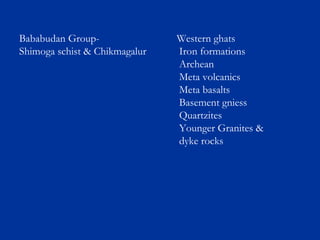
Bababudan Group- Western ghats
Shimoga schist & Chikmagalur Iron formations
Archean
Meta volcanics
Meta basalts
Basement gniess
Quartzites
Younger Granites &
dyke rocks
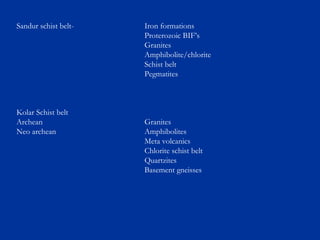
Sandur schist belt- Iron formations
Proterozoic BIF’s
Granites
Amphibolite/chlorite
Schist belt
Pegmatites
Kolar Schist belt
Archean Granites
Neo archean Amphibolites
Meta volcanics
Chlorite schist belt
Quartzites
Basement gneisses
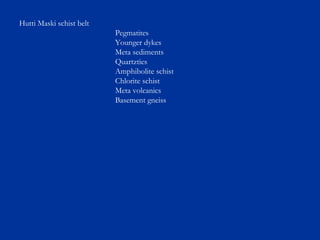
Hutti Maski schist belt
Pegmatites
Younger dykes
Meta sediments
Quartzties
Amphibolite schist
Chlorite schist
Meta volcanics
Basement gneiss
 Mobile belts are elongated areas of mountainMobile belts are elongated areas of mountain
building activity – “orogenic activity”building activity – “orogenic activity”
 along the margins of continentsalong the margins of continents
 where sediments are deposited in thewhere sediments are deposited in the
relatively shallow waters of the continentalrelatively shallow waters of the continental
shelfshelf
 and the deeper waters at the base of theand the deeper waters at the base of the
continental slopecontinental slope
 During plate convergence along these margins,During plate convergence along these margins,
 the sediments are deformedthe sediments are deformed
 and intruded by magmaand intruded by magma
 creating mountain rangescreating mountain ranges
Mobile BeltsMobile Belts
Orogenic (Gr.Orogenic (Gr. Oros means mountain and genic means birth) belts or orogensOros means mountain and genic means birth) belts or orogens
areare some of the most prominent tectonic features of continents.some of the most prominent tectonic features of continents.
These terms are, however, not synonymous to Mountain beltThese terms are, however, not synonymous to Mountain belt
which is a geographic term referring to areas of high and ruggedwhich is a geographic term referring to areas of high and rugged
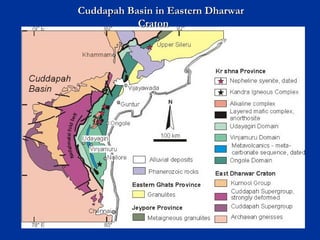
topography. Surely,topography. Surely, mountain belts are also orogenic belts butmountain belts are also orogenic belts but
not all orogenic belts are mountainsnot all orogenic belts are mountains. orogenic belts, also called. orogenic belts, also called
mobile belts, are termed fold belts because they are made up ofmobile belts, are termed fold belts because they are made up of
rocks that show large-scale folds, and faults/thrusts androcks that show large-scale folds, and faults/thrusts and
metamorphism with evidence of melting or high mobility in themetamorphism with evidence of melting or high mobility in the
core region during orogenesis. These belts are characteristicallycore region during orogenesis. These belts are characteristically
formed of (a) thick sequences of shallow water sandstones,formed of (a) thick sequences of shallow water sandstones,
limestones and shales deposited on continental crust and (b)limestones and shales deposited on continental crust and (b)
deep-water trubidites and pelagic sediments, commonly withdeep-water trubidites and pelagic sediments, commonly with
volcanoclastic sediments and volcanic rocks.volcanoclastic sediments and volcanic rocks.
Mobile BeltsMobile Belts
Typical mobile belts, rather fold belts as titled here, have rocksTypical mobile belts, rather fold belts as titled here, have rocks
that were deformed and metamorphosed to varying degrees andthat were deformed and metamorphosed to varying degrees and
intruded by plutonic bodies of granitic compositions. Some foldintruded by plutonic bodies of granitic compositions. Some fold
belts are also characterized by extensive thrust faulting and bybelts are also characterized by extensive thrust faulting and by
movements along large transcurrent fault zones. Evenmovements along large transcurrent fault zones. Even
extensional deformation may be found in such belts. Most beltsextensional deformation may be found in such belts. Most belts
show a linear central region of thick multiply deformed andshow a linear central region of thick multiply deformed and
metamorphosed rocks bordered by continental margins, butmetamorphosed rocks bordered by continental margins, but
some belts are also having oceanic margin on one side.some belts are also having oceanic margin on one side.
Mobile BeltsMobile Belts
 AFBAFB Aravalli Fold BeltAravalli Fold Belt
 Delhi FBDelhi FB Delhi Fold BeltDelhi Fold Belt
 DFBDFB Dongargarh Fold BeltDongargarh Fold Belt
 EGMBEGMB Eastern Ghats Mobile BeltEastern Ghats Mobile Belt
 MFBMFB Mahakoshal Fold BeltMahakoshal Fold Belt
 PMBPMB Pandyan Mobile BeltPandyan Mobile Belt
 Satpura FBSatpura FB Satpura Fold BeltSatpura Fold Belt
 SFBSFB Singhbhum Fold BeltSinghbhum Fold Belt
 SKFB SSKFB S akoli Fold Beltakoli Fold Belt
Pandyan Mobile BeltPandyan Mobile Belt
Pandyan Mobile Belt (PMB) is the name given byPandyan Mobile Belt (PMB) is the name given by
Ramakrishnan (1993, 1988) to the Southern GranuliteRamakrishnan (1993, 1988) to the Southern Granulite
Terrain (SGT) situated to the south of the E-WTerrain (SGT) situated to the south of the E-W
trending Palghat-Cauvery Shear Zone (PCSZ) .Thetrending Palghat-Cauvery Shear Zone (PCSZ) .The
name Pandyan is adopted after the legendary dynastyname Pandyan is adopted after the legendary dynasty
that ruled this part of South India in the historical past.that ruled this part of South India in the historical past.
Interestingly, the SGT has been defined variously byInterestingly, the SGT has been defined variously by
different workers. According to Fermor (1936), thisdifferent workers. According to Fermor (1936), this
terrain is a part of the large “Charnockite Province”terrain is a part of the large “Charnockite Province”
located to the south of the orthopyroxene-in (Opx-in)located to the south of the orthopyroxene-in (Opx-in)
isograd, delineated along a line straddling the joinisograd, delineated along a line straddling the join
Mangalore-Mysore-Bangalore-Chennai (Pichamuthu,Mangalore-Mysore-Bangalore-Chennai (Pichamuthu,
The Pandyan mobile belt (PMB), according to Ramakrishnan (1993),The Pandyan mobile belt (PMB), according to Ramakrishnan (1993),
is the geological domain between the PCSZ in the north and theis the geological domain between the PCSZ in the north and the
AKSZ in the south. Impressed by swirling structural pattern in theAKSZ in the south. Impressed by swirling structural pattern in the
Madurai Block, Similar to Limpopo belt in South Africa, and by theMadurai Block, Similar to Limpopo belt in South Africa, and by the
general occurrence of fold belts either at the peripehery of ageneral occurrence of fold belts either at the peripehery of a
continent or sandwiched between two continents, Ramakrishnancontinent or sandwiched between two continents, Ramakrishnan
carved out his Pandyan mobile belt from the segmented Southerncarved out his Pandyan mobile belt from the segmented Southern
Granulite Terrain. A few years later, Ramakrishnan (2003) enlargedGranulite Terrain. A few years later, Ramakrishnan (2003) enlarged
the domain of his mobile belt and included areas of granulites onthe domain of his mobile belt and included areas of granulites on
both n orth and south margins of his initially proposed Pandyanboth n orth and south margins of his initially proposed Pandyan
mobile belt, perhaps on the consideration of meaningfulmobile belt, perhaps on the consideration of meaningful
geochronological data available over almost entire SGT.geochronological data available over almost entire SGT.
Ramaskrishnan also incorporated the granulite region north of theRamaskrishnan also incorporated the granulite region north of the
MBSZ.MBSZ.
Simplified Geological map of the southern India
(after GSI and ISRO, 1994), showing the
major geological domains, the Western Dharwar
Craton (WDC), Eastern Dharwar Craton (EDC),
and Southern Granulite Terrain (SGT) along
with the Cauveri Shear Zone System (CSZ).
Abbreviations: AKSZ = Achankovil Shear Zone;
AH = Anamalai Hills; AT = Attur; BS =
Bhavani Shear zone; BL = Bangalore; BR
=Biligirirangan; CHS = Chitradurga Shear Zone;
CG = Coorg;
CM = Coimbatore; EDC = East Dharwar
Craton; K = Kabbaldurga; KL = Kolar; KKB =
Kerala Khondalite Belt;MS = Moyar Shear zone;
N = Nilgiri; OT= Ooty; PCSZ = Palgahat Shear
Zone; PL = Pollachi; PMB = Pandyan Mobile
Belt; SGT = Southern Granulite Terrain; SH =
Shevaroy Hills; WDC = West Dharwar Craton;
GR-Am = Isograd between Greenschist and
Amphibolite Facies; Am-Gt = Isograd between
Amphibolite and Granulite Facies; TZ =
Transition Zone of amphibolite and granulite
facies. Inset shows various identified crustal block
 A variety of mineral deposits are of Archean-ageA variety of mineral deposits are of Archean-age
 but gold is the most commonly associated,but gold is the most commonly associated,
 although it is also foundalthough it is also found
 in Proterozoic and Phanerozoic rocksin Proterozoic and Phanerozoic rocks
 This soft yellow metal is prized for jewelry,This soft yellow metal is prized for jewelry,
 but it is or has been used as a monetary standard,but it is or has been used as a monetary standard,
 in glass making, electric circuitry, and chemical industryin glass making, electric circuitry, and chemical industry
 About half the world’s gold since 1886About half the world’s gold since 1886
 has come from Archean and Proterozoic rockshas come from Archean and Proterozoic rocks
 in South Africain South Africa
 Gold mines also exist in Archean rocksGold mines also exist in Archean rocks
 of the Superior craton in Canadaof the Superior craton in Canada
Archean Mineral ResourcesArchean Mineral Resources
 Archean sulfide deposits ofArchean sulfide deposits of
 zinc,zinc,
 coppercopper
 and nickeland nickel
 occur in Australia, Zimbabwe,occur in Australia, Zimbabwe,
 and in the Abitibi greenstone beltand in the Abitibi greenstone belt
 in Ontario, Canadain Ontario, Canada
 Some, at least, formed as mineral depositsSome, at least, formed as mineral deposits
 next to hydrothermal vents on the seafloor,next to hydrothermal vents on the seafloor,
 much as they do now around black smokersmuch as they do now around black smokers
Archean Sulfide DepositsArchean Sulfide Deposits
 About 1/4 of Earth’s chrome reservesAbout 1/4 of Earth’s chrome reserves
 are in Archean rocks, especially in Zimbabweare in Archean rocks, especially in Zimbabwe
 These ore deposits are found inThese ore deposits are found in
 the volcanic units of greenstone beltsthe volcanic units of greenstone belts
 where they appear to have formedwhere they appear to have formed
 when crystals settled and became concentratedwhen crystals settled and became concentrated
 in the lower parts of plutonsin the lower parts of plutons
 such as mafic and ultramafic sillssuch as mafic and ultramafic sills
 Chrome is needed in the steel industryChrome is needed in the steel industry
 The United States has very few chrome depositsThe United States has very few chrome deposits
 so must import most of what it usesso must import most of what it uses
ChromeChrome
 One chrome deposit in the United StatesOne chrome deposit in the United States
 is in the Stillwater Complex in Montanais in the Stillwater Complex in Montana
 Low-grade ores were mined there during warLow-grade ores were mined there during war
times,times,
 but they were simply stockpiledbut they were simply stockpiled
 and never refined for chromeand never refined for chrome
 These rocks also contain platinum,These rocks also contain platinum,
 a precious metal, that is useda precious metal, that is used
 in the automotive industry in catalytic convertersin the automotive industry in catalytic converters
 in the chemical industryin the chemical industry
 for cancer chemotherapyfor cancer chemotherapy
Chrome and PlatinumChrome and Platinum
 Banded Iron formations are sedimentary rocksBanded Iron formations are sedimentary rocks
 consisting of alternating layersconsisting of alternating layers
 of silica (chert) and iron mineralsof silica (chert) and iron minerals
 About 6% of the world’sAbout 6% of the world’s
 banded iron formations were depositedbanded iron formations were deposited
 during the Archean Eonduring the Archean Eon
 Although Archean iron oresAlthough Archean iron ores
 are mined in some areasare mined in some areas
 they are neither as thickthey are neither as thick
 nor as extensive as those of the Proterozoic Eon,nor as extensive as those of the Proterozoic Eon,
 which constitute the world’s major source of ironwhich constitute the world’s major source of iron
IronIron
 PegmatitesPegmatites are very coarsely crystalline igneousare very coarsely crystalline igneous
rocks,rocks,
 commonly associated with granite plutonscommonly associated with granite plutons
 Some Archean pegmatites,Some Archean pegmatites,
 such in the Herb Lake district in Manitoba, Canada,such in the Herb Lake district in Manitoba, Canada,
 and Rhodesian Province in Africa,and Rhodesian Province in Africa,
 contain valuable mineralscontain valuable minerals
 In addition to minerals of gem quality,In addition to minerals of gem quality,
 Archean pegmatites contain minerals minedArchean pegmatites contain minerals mined
 for lithium, beryllium, rubidium, and cesiumfor lithium, beryllium, rubidium, and cesium
PegmatitesPegmatites
Archean To Proterozoic SedimentaryArchean To Proterozoic Sedimentary
RocksRocks
• Archean
•4 bya: mostly deep water clastic deposits such as mudstones and muddy sandstones.
–high concentration of eroded volcanic minerals (Sandstones called Graywackes).
• 3 bya: absence of shallow water shelf carbonates.
–increasing chert.
– low oxygen levels, free iron was much more common in the Archean.
–Iron formed “chemical sinks” that consumed much of the early planetary oxygen.
–Formed banded ironstones, commonly with interbedded chert.
•Proterozoic– 2 bya Carbonates* become important
- Non-marine sediments turn red – iron is oxidized by the oxygen in AIR
• “Purana Basins”.
• Cratonic or Epicratonic basins.
• Platform Basins.
• Witness to the story of early crustal evolution.
• Useful for global comparison with similar basins.
• Importantly, these basins unveil the prelude to the
cambrian explosion of life.
• Occupies 20% of the area of the Precambrian of the
Peninsular India.
Proterozoic SedimentaryProterozoic Sedimentary
BasinsBasins
Purana basins of Peninsular India within differentPurana basins of Peninsular India within different
cratonscratons
Proterozoic sedimentary basins are divided into 2 types
based on age:
(a).Paleoproterozoic basins:
1.Bijawar and Sonrai basins Bundelkhand
and Harda Inlier craton
2.Gwalior basin
3.Abujhmar basin Bastar craton
4.Papaghni sub-basin Dharwar craton
[Cuddapah basin]
(b).(b).Meso-Neoproterozoic basins
11. Vindhyan basin Bundhekhand craton
2. Chhattisgarh basin
3. Khariar basin
4. (a)Ampani basin,
(b)Keskal, Singanpar Bastar craton
and Chedrapal outliers
5. Indravathi basin
6. Sabari[Sukma] basin
7. Pranhita-Godavari basin b/n Bastar and Dharwar
cratons
8. Cuddapah basin
9. Kaladgi basin Dharwar craton
10. Bhima basin
Palaeoproterozoic Basins
1. Bijawar Basin- trends ENE-WSW for about 100km with a
width of 4 to 20km from Ken River in the east to sonari in the
west. Sandwiched b/n Bundelkhand granite and Vindhyan
sediments.
2. Sonari Basin- 28km long and 5km wide, E-W trending situated
to the west of the ‘type’ Bijawar basin.
3. Harda Inlier- it exposed at Harda within the-Vindhyan
succession and Deccan Trap of Narmada valley.
4. Gwalior Basin- extends E-W for 80km with a width of
25km,near Gwalior to the north of Bundelkhand granite,almost
200km N-W of Bijawar basin.
5. Abujhmar Basin- named for ‘abujh mar’ or ‘unknown hills’
in the remote bansal region, covers an area of 3000sq.
km
6. Papaghni sub-basin : This sub-basin is described under
Cuddapah basin.
Meso-Neoproterozoic Basins
1.Vindhyan basin
Largest single Purana basin, spectacular, sickle shaped, ENE
trending, situated on Bundelkhand craton.
Includes 4 groups: (d). Bhander group (1300-1500m)
(c). Rewa group(100-300m)
(b). Kaimur group(400m)
(a). Semri group (3000-4000m)
Major structure is synclinorium with the axis curving along the
middle of the sickle-shaped basin.
Recent robust dating has fixed the beginning of Vindhyan
sedimentation around 1600-1720 Ma.
Life: Stromatolites are abundant in Vindhayan record but they
have long time range and hence have only limited correlative
value.
Geologic map of the Vindhyan basin, central India.
2.Chhattisgarh basin
Larget Purana basin in Bastar craton, covering an area
of about 36000 sq. km is situated on the northern edge
of Bastar craton.
Lithostatigraphy:
(c). Raipur Group[1900m]
(b). Chandrapur Group[400m]
(a). Singhora Group[400m]
Lithology: Felspathic arenite, arkose, basal
conglomerate, sandstone, dolomite shale, limestone.
Evidence of life- Microbiota include prokaryotic
cyanobacteria, unidentified algal remains and
acritarchs.
Generalised geological map of Chhattisgarh basin(after Das etGeneralised geological map of Chhattisgarh basin(after Das et
al.1992)al.1992)
3.Khariar Basin3.Khariar Basin
It is an irregular, oval-shaped basin occupyingIt is an irregular, oval-shaped basin occupying
the N-S trending Nawagarh-Khariar plateau.the N-S trending Nawagarh-Khariar plateau.
Covering an area of 1500sq.km and containingCovering an area of 1500sq.km and containing
1000m thick sediments.1000m thick sediments.
Sediments are called asSediments are called as Pairi GroupPairi Group(600-1000m)(600-1000m)
Stromatolites indicate Lower to Upper RipheanStromatolites indicate Lower to Upper Riphean
age, but no radiometric data are available.age, but no radiometric data are available.
Occupying an area of 220 sq.km on a small plateau
south of Khariar near Ampani consists of a 280m thick
sandstone – shale sequence.
The sediments are domed up around hornblend
granodiorite at Khaligarh,which is thought to be
intrusive.
5.Indravati Basin
Irregular rhomboid basin covering an area of 900 sq.km
and containing orthoquartzite-shale-carbonate sequence
of about 500m thick on the average.
Cement grade Limestone and dolomite are important
economic minerals.
4.Ampani Basin
6.Sabari Basin
A triangular basin of 700 sq.km
Sabari group consists of a basal conglomerate and thick-
bedded ortho-quartzite, overlain by a cream to grey
coloured limestone and followed by purple to grey shale.
7. Pranhita-Godavari Basin
Occurs in two parallel NW-SE trending sub-basins,
situated at the junction of Dharwar and Bastar cratons.
Developed after amalgamation of the cratons in
Palaeoproterozoic.
The western sub-basin is called the Pakhal belt and the
eastern sub-basin as the Albaka belt.
The P-G basin is extends for a length of ~400km with
width of ~100km.
Includes the width of ~40km for Godavari graben of
Gondwana sediments occurring in the middle and
separating the two sub-basins.
The aggregate thickness of the sediments of the P-G basin
is estimated at about 6000m.
Divided into 4 major groups, namely Mallampalli, Mulug,
Penganga and Sullavai separated by 3 unconformities.
8.Cuddapah Basin
Crescent shaped,easterly concave and N-S trending,covers
an area of 44000 sq.km in the east-central part of Dharwar
craton.
Characterised by quartzite-carbonate-shale cycles having an
aggregate thickness i.e estimated b/n 6 to 12km.
The western half of the basin is undeformed and consists
of 4 sub-basins: the Papaghni, Kurnool, Srisailam and Palnad.
Life-Stromatolites are abounding,carbonaceous
microfossils like Tawuia, Chuaria, trace fossils, calcareous
algae indicate Neoproterozoic age.
Cuddapah Basin in Eastern DharwarCuddapah Basin in Eastern Dharwar
CratonCraton
9.Kaladgi Basin
E-W trending irregular basin,covers an area 8300sq.km
The older succession of Kaladgi basin is called the
Bagalkot Group that correspond to the Cuddapah
supergroup
The upper succession is called the Badami Group i.e the
possible equivalent of Kurnool Group.
Bagalkot Group is divided into the lower Lokpur
Subgroup and the upper Simikeri subgroup.
Life - Bagalkot Group contains microstromatolites
suggest early Riphean age, Badami Group also contains
acritarchs & trace fossils that suggest Vendian age.
10.Bhima basin
Irregular,NE trending,consisting dominantly of limestone
covers an area of 5200sq.km,situated to the northwest of
Cuddapah basin and northeast of Kaladgi basin.
Aggregate thickness of sediments is about 270m.
Well known for its large reserves of limestone and the newly
discovered uranium occurrence near Gogi.
Sediments are practically horizontal, but disturbed along
transverse faults.
Bhima basin Dharwar craton(after Kale andBhima basin Dharwar craton(after Kale and
Peshwa,1991)Peshwa,1991)
Economic mineral depositsEconomic mineral deposits
Diamond- Vindhyan and Kurnool formationsDiamond- Vindhyan and Kurnool formations
Pyrite- the Bijaigarh shales of the Lower KaimursPyrite- the Bijaigarh shales of the Lower Kaimurs
Coal- Semris and Kaimurs groupCoal- Semris and Kaimurs group
Lime stone- in the Sone Valley in Bihar and U.P., in Rewa, inLime stone- in the Sone Valley in Bihar and U.P., in Rewa, in
Jabalpur, in Guntur and in the Bhima Valley in HyderabadJabalpur, in Guntur and in the Bhima Valley in Hyderabad
Building and decorative stones- Lower Vindhyan and LowerBuilding and decorative stones- Lower Vindhyan and Lower
Bhander stages, limestones of the Palnad regionBhander stages, limestones of the Palnad region
Glass Sand- Some Vindhyan sandstones near Allahabad, U.PGlass Sand- Some Vindhyan sandstones near Allahabad, U.P
Life during PrecambrianLife during Precambrian
 The Precambrian fossil record is poorer than that for the succeeding Phanerozoic, andThe Precambrian fossil record is poorer than that for the succeeding Phanerozoic, and
those fossils present (e.g. stromatolites) are of limited biostratigraphy biostratigraphicthose fossils present (e.g. stromatolites) are of limited biostratigraphy biostratigraphic
use.use.
 This is because many Precambrian rocks are heavily metamorphic rockThis is because many Precambrian rocks are heavily metamorphic rock
metamorphosed, obscuring their origins, while others have either been destroyed bymetamorphosed, obscuring their origins, while others have either been destroyed by
erosion, or remain deeply buried beneath Phanerozoic strataerosion, or remain deeply buried beneath Phanerozoic strata
 The oldest fossil evidence of complex life comes from the Lantian formation, at leastThe oldest fossil evidence of complex life comes from the Lantian formation, at least
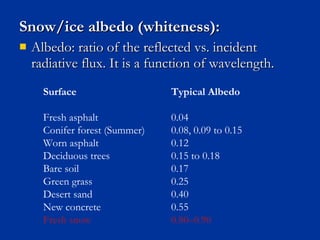
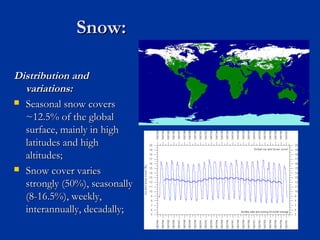
580 million years ago. A quite diverse collection of soft-bodied forms is known from a580 million years ago. A quite diverse collection of soft-bodied forms is known from a
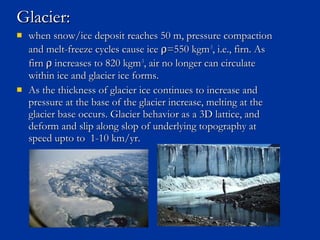
variety of locations worldwide between 542 and 600 Ma. These are referred to asvariety of locations worldwide between 542 and 600 Ma. These are referred to as
Ediacaran biota Ediacaran or Vendian biota. Hard-shelled creatures appeared towardEdiacaran biota Ediacaran or Vendian biota. Hard-shelled creatures appeared toward
the end of that time span. By the middle of the later Cambrian period a very diversethe end of that time span. By the middle of the later Cambrian period a very diverse
fauna is recorded in the Burgess shale, including some which may represent stemfauna is recorded in the Burgess shale, including some which may represent stem
groups of modern taxa. The rapid radiation of lifeforms during the early Cambrian isgroups of modern taxa. The rapid radiation of lifeforms during the early Cambrian is
called the Cambrian explosion of life.While land seems to have been devoid of plantscalled the Cambrian explosion of life.While land seems to have been devoid of plants
and animals, cyanobacteria and other microbes formed prokaryotic mats that coveredand animals, cyanobacteria and other microbes formed prokaryotic mats that covered
terrestrial areas.terrestrial areas.
 The first organisms were membersThe first organisms were members
 of the kingdom Moneraof the kingdom Monera
 consisting of bacteria and archaea,consisting of bacteria and archaea,
 both of which consist ofboth of which consist of prokaryotic cellsprokaryotic cells,,
 cells that lack an internal, membrane-bounded nucleuscells that lack an internal, membrane-bounded nucleus
and other structuresand other structures
 Prior to the 1950s, scientists assumed that lifePrior to the 1950s, scientists assumed that life
 must have had a long early historymust have had a long early history
 but the fossil record offered little to support this ideabut the fossil record offered little to support this idea
 The Precambrian, once calledThe Precambrian, once called AzoicAzoic
 (“without life”), seemed devoid of life(“without life”), seemed devoid of life
Oldest Known OrganismsOldest Known Organisms
 Charles Walcott (early 1900s) described structuresCharles Walcott (early 1900s) described structures
 from the Paleoproterozoic Gunflint Iron Formation of Ontario,from the Paleoproterozoic Gunflint Iron Formation of Ontario,
CanadaCanada
 that he proposed represented reefs constructed bythat he proposed represented reefs constructed by
algaealgae
Oldest Know OrganismsOldest Know Organisms
• Now called
stromatolites,
– not until 1954 were
they shown
– to be products of
organic activity
Present-day stromatolites (Shark Bay, Australia)
 Different types of stromatolites includeDifferent types of stromatolites include
 irregular mats, columns, and columns linked by matsirregular mats, columns, and columns linked by mats
StromatolitesStromatolites
 Present-day stromatolites form and growPresent-day stromatolites form and grow
 as sediment grains are trappedas sediment grains are trapped
 on sticky matson sticky mats
 of photosynthesizing cyanobacteriaof photosynthesizing cyanobacteria
 although now they are restrictedalthough now they are restricted
 to environments where snails cannot liveto environments where snails cannot live
 The oldest known undisputed stromatolitesThe oldest known undisputed stromatolites
 are found in rocks in South Africaare found in rocks in South Africa
 that are 3.0 billion years oldthat are 3.0 billion years old
 but probable ones are also knownbut probable ones are also known
 from the Warrawoona Group in Australiafrom the Warrawoona Group in Australia
 which is 3.3 to 3.5 billion years oldwhich is 3.3 to 3.5 billion years old
StromatolitesStromatolites
 Chemical evidence in rocks 3.85 billion years oldChemical evidence in rocks 3.85 billion years old
 in Greenland indicate life was perhaps present thenin Greenland indicate life was perhaps present then
 The oldest known cyanobacteriaThe oldest known cyanobacteria
 were photosynthesizing organismswere photosynthesizing organisms
 but photosynthesis is a complex metabolic processbut photosynthesis is a complex metabolic process
 A simpler type of metabolismA simpler type of metabolism
 must have preceded itmust have preceded it
 No fossils are known of these earliest organismsNo fossils are known of these earliest organisms
Other Evidence of Early LifeOther Evidence of Early Life
 The earliest organisms must have resembledThe earliest organisms must have resembled
 tinytiny anaerobicanaerobic bacteriabacteria
 meaning they required no oxygenmeaning they required no oxygen
 They must have totally dependedThey must have totally depended
 on an external source of nutrientson an external source of nutrients
 that is, they werethat is, they were heterotrophicheterotrophic
 as opposed toas opposed to autotrophicautotrophic organismsorganisms
 that make their own nutrients, as in photosynthesisthat make their own nutrients, as in photosynthesis
 They all hadThey all had prokaryotic cellsprokaryotic cells
Earliest OrganismsEarliest Organisms
 The earliest organisms, then,The earliest organisms, then,
 were anaerobic, heterotrophic prokaryoteswere anaerobic, heterotrophic prokaryotes
 Their nutrient source was most likelyTheir nutrient source was most likely
 adenosine triphosphate (ATP)adenosine triphosphate (ATP)
 from their environmentfrom their environment
 which was used to drivewhich was used to drive
 the energy-requiring reactions in cellsthe energy-requiring reactions in cells
 ATP can easily be synthesizedATP can easily be synthesized
 from simple gases and phosphatefrom simple gases and phosphate
 so it was availableso it was available
 in the early Earth environmentin the early Earth environment
Earliest OrganismsEarliest Organisms
Proterozoic Fossil RecordProterozoic Fossil Record
 EukaryotesEukaryotes (large cells with nuclei and organelles)(large cells with nuclei and organelles)
appeared by Mesoproterozoic time. Appeared byappeared by Mesoproterozoic time. Appeared by
1.6 by to 1.4 by. Increased in abundance about 1.41.6 by to 1.4 by. Increased in abundance about 1.4
by ago.by ago.
 Potential for sexual reproduction and increasingPotential for sexual reproduction and increasing
variation (evolution)variation (evolution)
 AcritarchsAcritarchs are single-celledare single-celled
spherical, organic-walledspherical, organic-walled
microfossils.microfossils.
 Not known what sort ofNot known what sort of
organism they were, but theyorganism they were, but they
may have been phytoplankton.may have been phytoplankton.
First appeared 1.6 by ago.First appeared 1.6 by ago.
Maximum diversity andMaximum diversity and
abundance 850 my ago. Theyabundance 850 my ago. They
declined steadily during thedeclined steadily during the
Neoproterozoic glaciation, andNeoproterozoic glaciation, and
few remained by 675 my ago.few remained by 675 my ago.
Useful for correlation inUseful for correlation in
Proterozoic strata.Proterozoic strata.
AcritarchsAcritarchs
Origin of EukaryotesOrigin of Eukaryotes
EukaryotesEukaryotes are thought to have arisen from anare thought to have arisen from an
originally endosymbiotic relationship between two ororiginally endosymbiotic relationship between two or
more prokaryotic cells.more prokaryotic cells.
 Symbiosis - two or more organisms living together,Symbiosis - two or more organisms living together,
where each organism usually derives some benefitwhere each organism usually derives some benefit
froom the relationship.froom the relationship.
 Endosymbiosis - One organism lives inside the other,Endosymbiosis - One organism lives inside the other,
e. g. bacteria in stomachs of cattle.e. g. bacteria in stomachs of cattle.
Origin of EukaryotesOrigin of Eukaryotes
 Organelles (Mitochondria, plastids) were once free livingOrganelles (Mitochondria, plastids) were once free living
bacteria, that entered or were engulfed by anotherbacteria, that entered or were engulfed by another
prokaryote. Eventually, relationship became mutuallyprokaryote. Eventually, relationship became mutually
beneficial.beneficial.
 E. g. host cell provided proto-mitochondrion (primitiveE. g. host cell provided proto-mitochondrion (primitive
oxidizing bacteria) with plenty of food, mitochondrionoxidizing bacteria) with plenty of food, mitochondrion
performed oxidation and released energy for a bacterium thatperformed oxidation and released energy for a bacterium that
previously could only ferment. Eventually proto-mitochondrionpreviously could only ferment. Eventually proto-mitochondrion
gives up trying to reproduce.gives up trying to reproduce.
 E.g. host cell waste products (carbon dioxide etc.) used by aE.g. host cell waste products (carbon dioxide etc.) used by a
cyanobacterium (proto-plastid) to photosynthesize. Plastid leakscyanobacterium (proto-plastid) to photosynthesize. Plastid leaks
energy to host cell. Eventually gives up reproducing on its own.energy to host cell. Eventually gives up reproducing on its own.
Precambrian–CambrianPrecambrian–Cambrian
boundaryboundary
 The Precambrian–Cambrian boundary problemThe Precambrian–Cambrian boundary problem
is being studied in an areno-argillaceousis being studied in an areno-argillaceous
sequence in the Kashmir and Spiti Valley,sequence in the Kashmir and Spiti Valley,
Northwest Himalaya, India. In Kashmir, a richNorthwest Himalaya, India. In Kashmir, a rich
and diversified microbiota – cryptarchs andand diversified microbiota – cryptarchs and
algae of the Late Precambrian, and low Loweralgae of the Late Precambrian, and low Lower
Cambrian trace fossils are recorded. In the SpitiCambrian trace fossils are recorded. In the Spiti
Valley, the yield of microbiota is poor and theValley, the yield of microbiota is poor and the
trace fossils are late Lower Cambrian.trace fossils are late Lower Cambrian.
Microfossils and Precambrian-Cambrian boundaryMicrofossils and Precambrian-Cambrian boundary
Precambrian–Cambrian boundary;Precambrian–Cambrian boundary;
Lesser HimalayaLesser Himalaya
 The affinity of the Ediacaran fossil The affinity of the Ediacaran fossil Shaanxilithes ningqiangensisShaanxilithes ningqiangensis and putatively and putatively
related forms has long been enigmatic; over the past few decades,related forms has long been enigmatic; over the past few decades,
interpretations ranging from trace fossils to algae to metazoans of uncertaininterpretations ranging from trace fossils to algae to metazoans of uncertain
phylogenetic placement have been proposed. Combined morphological andphylogenetic placement have been proposed. Combined morphological and
geochemical evidence from a new occurrence of geochemical evidence from a new occurrence of SS.. ningqiangensis ningqiangensis in the Krol in the Krol
and Tal groups of the Lesser Himalaya of India indicatesand Tal groups of the Lesser Himalaya of India indicates
that that SS.. ningqiangensis ningqiangensis is not a trace fossil, but rather an organic-walled tubular is not a trace fossil, but rather an organic-walled tubular
body fossil of unknown taxonomic affinity.body fossil of unknown taxonomic affinity.
 Specimens consist of compressed organic cylindrical structures, characterizedSpecimens consist of compressed organic cylindrical structures, characterized
by extended, overlapping or fragmented iterated units. Where specimensby extended, overlapping or fragmented iterated units. Where specimens
intersect, overlapping rather than branching or intraplanar crossing isintersect, overlapping rather than branching or intraplanar crossing is
observed. Lithologic comparisons and sequence stratigraphic data all suggestobserved. Lithologic comparisons and sequence stratigraphic data all suggest
a late Ediacaran age for the uppermost Krol Group and basalmost Tal Groupa late Ediacaran age for the uppermost Krol Group and basalmost Tal Group
 Plate tectonic activity has operatedPlate tectonic activity has operated
 since the early Proterozoic (or perhaps late Archean)since the early Proterozoic (or perhaps late Archean)
 Most geologists are convincedMost geologists are convinced
 that some kind of plate tectonic activitythat some kind of plate tectonic activity
 took place during the Archean as welltook place during the Archean as well
 but it differed in detail from todaybut it differed in detail from today
 Plates must have moved fasterPlates must have moved faster
 with more residual heat from Earth’s originwith more residual heat from Earth’s origin
 and more radiogenic heat,and more radiogenic heat,
 and magma was generated more rapidlyand magma was generated more rapidly
Archean Plate TectonicsArchean Plate Tectonics
 As a result of the rapid movement of plates,As a result of the rapid movement of plates,
 continents grew more rapidly along their marginscontinents grew more rapidly along their margins
 a process called continental accretiona process called continental accretion
 as plates collided with island arcs and other platesas plates collided with island arcs and other plates
 Also, ultramafic extrusive igneous rocks,Also, ultramafic extrusive igneous rocks,
 komitiites,komitiites,
 were more commonwere more common
Archean Plate TectonicsArchean Plate Tectonics
 The exposed part of the craton in NorthThe exposed part of the craton in North
America is theAmerica is the Canadian shieldCanadian shield
 which occupies most of northeastern Canadawhich occupies most of northeastern Canada
 a large part of Greenlanda large part of Greenland
 parts of the Lake Superior regionparts of the Lake Superior region
 in Minnesota, Wisconsin, and Michiganin Minnesota, Wisconsin, and Michigan
 and the Adirondack Mountains of New Yorkand the Adirondack Mountains of New York
 Its topography is subdued,Its topography is subdued,
 with numerous lakes and exposed Archeanwith numerous lakes and exposed Archean
 and Proterozoic rocks thinly coveredand Proterozoic rocks thinly covered
 in places by Pleistocene glacial depositsin places by Pleistocene glacial deposits
Canadian ShieldCanadian Shield
 Outcrop of Archean gneiss in the CanadianOutcrop of Archean gneiss in the Canadian
Shield in Ontario, CanadaShield in Ontario, Canada
Canadian Shield RocksCanadian Shield Rocks
 Archean Brahma Schist in the deeply erodedArchean Brahma Schist in the deeply eroded
parts of the Grand Canyon, Arizonaparts of the Grand Canyon, Arizona
Archean Rocks Beyond the ShieldArchean Rocks Beyond the Shield

Precambrian geology

  • 1.
  • 2.
     The Precambrianlasted for more than 4 billionThe Precambrian lasted for more than 4 billion years!years!  This large time span is difficult for humans toThis large time span is difficult for humans to comprehendcomprehend  Suppose that a 24-hour clock representedSuppose that a 24-hour clock represented  all 4.6 billion years of geologic timeall 4.6 billion years of geologic time  then the Precambrian would bethen the Precambrian would be  slightly more than 21 hours long,slightly more than 21 hours long,  constituting about 88% of all geologic timeconstituting about 88% of all geologic time PrecambrianPrecambrian
  • 3.
     88% of88%of geologic timegeologic time Precambrian Time SpanPrecambrian Time Span
  • 4.
     The termTheterm PrecambrianPrecambrian is informalis informal  but widely used, referring to both time and rocksbut widely used, referring to both time and rocks  The Precambrian includesThe Precambrian includes  time from Earth’s origin 4.6 billion years agotime from Earth’s origin 4.6 billion years ago  to the beginning of the Phanerozoic Eonto the beginning of the Phanerozoic Eon  542 million years ago542 million years ago  It encompassesIt encompasses  all rocks older than Cambrian-age rocksall rocks older than Cambrian-age rocks  No rocks are known for the firstNo rocks are known for the first  640 million years of geologic time640 million years of geologic time  The oldest known rocks on EarthThe oldest known rocks on Earth  are 3.96 billion years oldare 3.96 billion years old PrecambrianPrecambrian
  • 5.
     The earliestrecord of geologic timeThe earliest record of geologic time  preserved in rocks is difficult to interpretpreserved in rocks is difficult to interpret  because many Precambrian rocks have beenbecause many Precambrian rocks have been  altered by metamorphismaltered by metamorphism  complexly deformedcomplexly deformed  buried deep beneath younger rocksburied deep beneath younger rocks  fossils are rare, andfossils are rare, and  the few fossils present are of little use in stratigraphythe few fossils present are of little use in stratigraphy  Subdivisions of the PrecambrianSubdivisions of the Precambrian  have been difficult to establishhave been difficult to establish  Two eons for the PrecambrianTwo eons for the Precambrian  are theare the ArcheanArchean andand ProterozoicProterozoic Rocks Difficult to InterpretRocks Difficult to Interpret
  • 6.
     Shortly afteraccretion, Earth wasShortly after accretion, Earth was  a rapidly rotating, hot, barren, waterless planeta rapidly rotating, hot, barren, waterless planet  bombarded by comets and meteoritesbombarded by comets and meteorites  with no continents, intense cosmic radiationwith no continents, intense cosmic radiation  and widespread volcanismand widespread volcanism Hot, Barren, Waterless Early EarthHot, Barren, Waterless Early Earth  about 4.6 billion years agoabout 4.6 billion years ago
  • 7.
    Key Events ofPrecambrian timeKey Events of Precambrian time Acasta Gneiss is dated at 3.96 bya. It is near Yellowknife Lake , NWT Canada Zircons possibly a bit older in Australia
  • 8.
    Global Evolution: TheFirst FiveGlobal Evolution: The First Five Billion YearsBillion Years Global Evolution: The First Five Billion YearsGlobal Evolution: The First Five Billion Years The National Academy of Sciences says that it is the role of science to provideThe National Academy of Sciences says that it is the role of science to provide plausible(probable) natural explanations of natural phenomena.plausible(probable) natural explanations of natural phenomena. The ultimate question for Earth System History is: How did a giant cloud of coldThe ultimate question for Earth System History is: How did a giant cloud of cold dilute gas and dust evolve into astronauts in a spacecraft orbiting a planet orbiting adilute gas and dust evolve into astronauts in a spacecraft orbiting a planet orbiting a star?star? The short answer is when energy flows, complexity grows.The short answer is when energy flows, complexity grows. The fact is that the solid Earth, hydrosphere, atmosphere, and biosphere haveThe fact is that the solid Earth, hydrosphere, atmosphere, and biosphere have undergone nearlyundergone nearly five billion years of physical, chemical, and/or biological evolution because of thefive billion years of physical, chemical, and/or biological evolution because of the flows of energy and/or matter into and/or out of these systems, a process that isflows of energy and/or matter into and/or out of these systems, a process that is called global evolution.called global evolution. Each section addresses the structures, functions, composition, interactions and flowsEach section addresses the structures, functions, composition, interactions and flows of energy and matter,and origin and evolution of a complex natural system.of energy and matter,and origin and evolution of a complex natural system.
  • 9.
    The Structure andEvolution of theThe Structure and Evolution of the Hydrosphere, Atmosphere, and GeobiosphereHydrosphere, Atmosphere, and Geobiosphere  How did a giant cloud of cold dilute gas andHow did a giant cloud of cold dilute gas and dust evolve into astronauts in a spacecraftdust evolve into astronauts in a spacecraft orbiting a planet orbiting a star?orbiting a planet orbiting a star? The short answer is when energy flows,The short answer is when energy flows, complexity grows.complexity grows.
  • 10.
    The Structure andEvolution of theThe Structure and Evolution of the Hydrosphere, Atmosphere, and GeobiosphereHydrosphere, Atmosphere, and Geobiosphere
  • 11.
     Earth’s earlyatmosphere and hydrosphereEarth’s early atmosphere and hydrosphere  were quite different than they are nowwere quite different than they are now  They also played an important roleThey also played an important role  in the development of the biospherein the development of the biosphere  Today’s atmosphere is mostlyToday’s atmosphere is mostly  nitrogen (Nnitrogen (N22))  abundant free oxygen (Oabundant free oxygen (O22),),  or oxygen not combined with other elementsor oxygen not combined with other elements  such as in carbon dioxide (COsuch as in carbon dioxide (CO22))  water vapor (Hwater vapor (H22O)O)  small amounts of other gases, like ozone (Osmall amounts of other gases, like ozone (O33))  which is common enough in the upper atmospherewhich is common enough in the upper atmosphere  to block most of the Sun’s ultraviolet radiationto block most of the Sun’s ultraviolet radiation Evalution of Atmosphere andEvalution of Atmosphere and HydrosphereHydrosphere
  • 12.
     Earth’s veryearly atmosphere was probablyEarth’s very early atmosphere was probably composed ofcomposed of  hydrogen and helium,hydrogen and helium,  the most abundant gases in the universethe most abundant gases in the universe  If so, it would have quickly been lost into spaceIf so, it would have quickly been lost into space  because Earth’s gravity is insufficient to retain thembecause Earth’s gravity is insufficient to retain them  because Earth had no magnetic field until its corebecause Earth had no magnetic field until its core formed (magnetosphere)formed (magnetosphere)  Without a magnetic field,Without a magnetic field,  the solar wind would have swept awaythe solar wind would have swept away  any atmospheric gasesany atmospheric gases Earth’s Very Early AtmosphereEarth’s Very Early Atmosphere
  • 13.
     Nonvariable gasesNonvariablegases NitrogenNitrogen NN22 78.08%78.08% OxygenOxygen OO22 20.9520.95 ArgonArgon ArAr 0.930.93 NeonNeon NeNe 0.0020.002 OthersOthers 0.0010.001 in percentage by volumein percentage by volume Present-dayPresent-day Atmosphere CompositionAtmosphere Composition  Variable gasesVariable gases Water vaporWater vapor HH22OO 0.1 to 4.00.1 to 4.0 Carbon dioxideCarbon dioxide COCO22 0.0380.038 OzoneOzone OO33 0.0000060.000006 Other gasesOther gases TraceTrace  ParticulatesParticulates normallynormally tracetrace
  • 14.
     Once amagnetosphere wasOnce a magnetosphere was presentpresent  Atmosphere beganAtmosphere began accumulating as a result ofaccumulating as a result of outgassingoutgassing  released during volcanismreleased during volcanism  Water vaporWater vapor  is the most commonis the most common volcanic gas todayvolcanic gas today  but volcanoes also emitbut volcanoes also emit  carbon dioxide, sulfurcarbon dioxide, sulfur dioxide,dioxide, OutgassingOutgassing  carbon monoxide, sulfur,carbon monoxide, sulfur,  hydrogen, chlorine, and nitrogenhydrogen, chlorine, and nitrogen
  • 15.
     Archean volcanoesprobablyArchean volcanoes probably  emitted the same gases,emitted the same gases,  and thus an atmosphere developedand thus an atmosphere developed  but one lacking free oxygen and an ozone layerbut one lacking free oxygen and an ozone layer  It was rich in carbon dioxide,It was rich in carbon dioxide,  and gases reacting in this early atmosphereand gases reacting in this early atmosphere  probably formedprobably formed  ammonia (NHammonia (NH33))  methane (CHmethane (CH44))  This early atmosphere persistedThis early atmosphere persisted  throughout the Archeanthroughout the Archean Archean AtmosphereArchean Atmosphere
  • 16.
     The atmospherewas chemically reducingThe atmosphere was chemically reducing  rather than an oxidizing onerather than an oxidizing one  Some of the evidence for this conclusionSome of the evidence for this conclusion  comes from detrital depositscomes from detrital deposits  containing minerals that oxidize rapidlycontaining minerals that oxidize rapidly  in the presence of oxygenin the presence of oxygen  pyrite (FeSpyrite (FeS22))  But oxidized iron becomesBut oxidized iron becomes  increasingly common in Proterozoic rocksincreasingly common in Proterozoic rocks  indicating that at least some free oxygenindicating that at least some free oxygen  was present thenwas present then Evidence for anEvidence for an Oxygen-Free AtmosphereOxygen-Free Atmosphere
  • 17.
     Ratio ofradiogenic heat production in the past toRatio of radiogenic heat production in the past to the presentthe present Decreasing HeatDecreasing Heat  The width ofThe width of the coloredthe colored band indicatesband indicates variations invariations in ratios fromratios from differentdifferent modelsmodels  Heat productionHeat production 4 billion years4 billion years ago was 3 toago was 3 to 6 times as great6 times as great as it is nowas it is now  With less heatWith less heat outgassingoutgassing decreaseddecreased
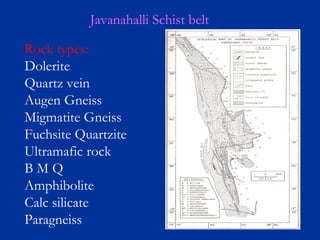
  • 18.
    Layers of thePresentLayers of the Present AtmosphereAtmosphere
  • 19.
    HydrosphereHydrosphere  All waterat or near the surface of the earthAll water at or near the surface of the earth  Water is constantly recycled (groundwater,Water is constantly recycled (groundwater, glaciers, oceans, freshwater etc)glaciers, oceans, freshwater etc)
  • 20.
  • 21.
    The BiosphereThe Biosphere Thebiosphere is the “life zone” of the Earth, and includes all living organisms (including humans), and all organic matter that has not yet decomposed. • The biosphere is structured into a hierarchy known as the food chain (all life is dependant on the first tier – mainly the primary producers that are capable of photosynthesis). • Energy and mass is transferred from one level of the food chain to the next.
  • 22.
  • 23.
    Evalution of lithosphereEvalutionof lithosphere First continental crustFirst continental crust Density differences allow subduction of mafic rocks. Further partial melting and fractionation makes higher silica melt that won’t subduct Water outKomatiite partially melts, Basalt gets to surface, piles up. The stack sinks, partially melts when pressure high enough. Fractionation makes increasingly silica-rich magmas First Then: At high temperatures, only Olivine and Ca-Plagioclase crystallize “Komatiite”
  • 24.
    Archean: Growth ofthe early continentsArchean: Growth of the early continents Magmatism from Subduction Zones causes thickening
  • 25.
    Growth of theearly continentsGrowth of the early continents Island Arcs and other terranes accrete as intervening ocean crust is subducted Little Archean ocean crust survives: most subducted But silica-rich continental crust too buoyant to subduct.
  • 26.
    Growth of theearly continentsGrowth of the early continents Sediments extend continental materials seaward Quartz sand becomes SS or quartzite, too buoyant to subduct
  • 27.
     Judging fromthe oldest known rocks on Earth,Judging from the oldest known rocks on Earth,  the 3.96-billion-year-old Acasta Gneiss in Canadathe 3.96-billion-year-old Acasta Gneiss in Canada and other rocks in Montana and Greenlandand other rocks in Montana and Greenland  some continental crust had evolved by early Archeansome continental crust had evolved by early Archean timetime  Sedimentary rocks in Australia contain detritalSedimentary rocks in Australia contain detrital zircons (ZrSiOzircons (ZrSiO44) dated at 4.4 billion years old) dated at 4.4 billion years old  so source rocks at least that old existedso source rocks at least that old existed  These rocks indicted that some kindThese rocks indicted that some kind  of Eoarchean crust was certainly present,of Eoarchean crust was certainly present,  but its distribution is unknownbut its distribution is unknown Oldest RocksOldest Rocks
  • 28.
     Early Archeancrust was probably thinEarly Archean crust was probably thin  and made up of ultramafic rockand made up of ultramafic rock  igneous rock with less than 45% silicaigneous rock with less than 45% silica  This ultramafic crust was disruptedThis ultramafic crust was disrupted  by upwelling mafic magma at ridges,by upwelling mafic magma at ridges,  and the first island arcs formed at subduction zonesand the first island arcs formed at subduction zones  Early Archean continental crust may have formedEarly Archean continental crust may have formed  by collisions between island arcsby collisions between island arcs  as silica-rich materials were metamorphosed.as silica-rich materials were metamorphosed.  Larger groups of merged island arcsLarger groups of merged island arcs  protocontinentsprotocontinents  grew faster by accretion along their marginsgrew faster by accretion along their margins Early Archean CrustEarly Archean Crust
  • 29.
    Origin of ContinentalCrustOrigin of Continental Crust  AndesiticAndesitic island arcsisland arcs  form byform by subductionsubduction  and partialand partial melting ofmelting of oceanicoceanic crustcrust  The islandThe island arc collidesarc collides with anotherwith another
  • 30.
     Continents consistof rocksContinents consist of rocks  with composition similar to that of granitewith composition similar to that of granite  Continental crust is thickerContinental crust is thicker  and less dense than oceanic crustand less dense than oceanic crust  which is made up of basalt and gabbrowhich is made up of basalt and gabbro  Precambrian shieldsPrecambrian shields  consist of vast areas of exposed ancient rocksconsist of vast areas of exposed ancient rocks  and are found on all continentsand are found on all continents  Outward from the shields are broadOutward from the shields are broad platformsplatforms  of buried Precambrian rocksof buried Precambrian rocks  that underlie much of each continentthat underlie much of each continent Continental FoundationsContinental Foundations
  • 31.
    Distribution of PrecambrianRocksDistribution of Precambrian Rocks  Areas ofAreas of exposedexposed  Precam-Precam- brian rocksbrian rocks  constituteconstitute the shieldsthe shields  PlatformsPlatforms consist ofconsist of  buried Pre-buried Pre- cambriancambrian rocksrocks  Shields and adjoining platforms make up cratonsShields and adjoining platforms make up cratons
  • 32.
    CRYOSPHERECRYOSPHERE  What iscryosphere?What is cryosphere?  Cryo (frozen), a component ofCryo (frozen), a component of the earththe earth’s climate system’s climate system comprised of water in its solidcomprised of water in its solid state. It consists ofstate. It consists of  glaciers & ice sheets,glaciers & ice sheets,  snow,snow,  permafrost (continuous andpermafrost (continuous and discontinuous)discontinuous)  sea ice (perennial and seasonal).sea ice (perennial and seasonal).  Largest fresh water reservoir on earthLargest fresh water reservoir on earth
  • 33.
    Cryospheric component Area(% of earth surface) Mass (103 kg/m2 ) Antarctic ice sheet 2.7 53 Greenland ice sheet 0.35 5 Alpine glaciers 0.01 0.2 Sea-ice (in season of maximal extent) 7 0.01 Seasonal snow cover 9 <0.01 Permafrost 5 1 What can we infer from ice mass listed above?What can we infer from ice mass listed above?  Surface area: 5.1X10Surface area: 5.1X101414 mm22 , total land area: 1.45X10, total land area: 1.45X101414 mm22  101033 kg/mkg/m22 : equivalent to depth of liquid water in meter per unit: equivalent to depth of liquid water in meter per unit area.area.  If Antarctic ice sheet melted, it would create 53 mIf Antarctic ice sheet melted, it would create 53 m deep water layer over entire earth.deep water layer over entire earth.  How much would sea-level rise?How much would sea-level rise? 76M = 53mX5.1/(5.1-1.45)
  • 34.
    Role in climatesystem:Role in climate system:  Largest fresh water storage:Largest fresh water storage:  Influence sea-level riseInfluence sea-level rise  Water resourcesWater resources  Influence ocean circulationInfluence ocean circulation  Regular earthRegular earth’s albedo change,’s albedo change,  Reduce turbulent transport of heat, water andReduce turbulent transport of heat, water and momentummomentum  Change ocean buoyancy flux, S and TChange ocean buoyancy flux, S and T  Glacial runoff from Antarctic is a major source ofGlacial runoff from Antarctic is a major source of fresh water for southern ocean.fresh water for southern ocean.  Regular regional-global climateRegular regional-global climate
  • 35.
    How do weestimate water in snow and ice?How do we estimate water in snow and ice?  Snow (ice) equivalent depth: snow is porous and itsSnow (ice) equivalent depth: snow is porous and its porosity depends on temperature and age of theporosity depends on temperature and age of the snow. A measure of liquid water contained in snowsnow. A measure of liquid water contained in snow is water equivalent depth, his water equivalent depth, hmm:: hhmm==ρρss//ρρww·h·hss ρρss,,ρρww: density of the snow and water, respectively.: density of the snow and water, respectively. hhss: depth of the snow/ice layer: depth of the snow/ice layer hhmm: The depth of water that will resulted from complete melt of: The depth of water that will resulted from complete melt of snow/ice.snow/ice. Snow relative density,Snow relative density, ρρss//ρρww ranges from 0.15-0.4ranges from 0.15-0.4
  • 37.
    Snow/ice albedo (whiteness):Snow/icealbedo (whiteness):  Albedo: ratio of the reflected vs. incidentAlbedo: ratio of the reflected vs. incident radiative flux. It is a function of wavelength.radiative flux. It is a function of wavelength. Surface Typical Albedo Fresh asphalt 0.04 Conifer forest (Summer) 0.08, 0.09 to 0.15 Worn asphalt 0.12 Deciduous trees 0.15 to 0.18 Bare soil 0.17 Green grass 0.25 Desert sand 0.40 New concrete 0.55 Fresh snow 0.80–0.90
  • 38.
    Snow:Snow: Distribution andDistribution and variations:variations: Seasonal snow coversSeasonal snow covers ~12.5% of the global~12.5% of the global surface, mainly in highsurface, mainly in high latitudes and highlatitudes and high altitudes;altitudes;  Snow cover variesSnow cover varies strongly (50%), seasonallystrongly (50%), seasonally (8-16.5%), weekly,(8-16.5%), weekly, interannually, decadally;interannually, decadally;
  • 39.
    Glacier:Glacier:  when snow/icedeposit reaches 50 m, pressure compactionwhen snow/ice deposit reaches 50 m, pressure compaction and melt-freeze cycles cause iceand melt-freeze cycles cause ice ρρ=550 kgm=550 kgm-3-3 , i.e., firn. As, i.e., firn. As firnfirn ρρ increases to 820 kgmincreases to 820 kgm-3-3 , air no longer can circulate, air no longer can circulate within ice and glacier ice forms.within ice and glacier ice forms.  As the thickness of glacier ice continues to increase andAs the thickness of glacier ice continues to increase and pressure at the base of the glacier increase, melting at thepressure at the base of the glacier increase, melting at the glacier base occurs. Glacier behavior as a 3D lattice, andglacier base occurs. Glacier behavior as a 3D lattice, and deform and slip along slop of underlying topography atdeform and slip along slop of underlying topography at speed upto to 1-10 km/yr.speed upto to 1-10 km/yr.
  • 40.
    Antarctic Ice Sheet:AntarcticIce Sheet:  Creep rate: near zero at the dividesCreep rate: near zero at the divides of the ice sheet, and >10 m/yr at theof the ice sheet, and >10 m/yr at the periphery; Why?periphery; Why?  Creep rate is especially high in theCreep rate is especially high in the W. Antarctic.W. Antarctic.  Collapse of W. Antarctic can causeCollapse of W. Antarctic can cause abrupt sea-level rise.abrupt sea-level rise. Satellite image of the Antarctic ice sheet and the rate of creep of the ice (m/yr) on a logarithmic scale. P S
  • 41.
    Greenland Ice Sheet:GreenlandIce Sheet:  Lower latitudes and smaller thanLower latitudes and smaller than the Antarctic ice sheet,the Antarctic ice sheet,  S. Greenland is highly vulnerableS. Greenland is highly vulnerable to climate change becauseto climate change because summer temperature reachessummer temperature reaches melting point (-5C).melting point (-5C). IV
  • 42.
    Alpine glaciers:Alpine glaciers: Alpine glaciers, smaller ice sheets,Alpine glaciers, smaller ice sheets, can exist at any latitudes althoughcan exist at any latitudes although their altitudes increase from < 1 kmtheir altitudes increase from < 1 km in high latitudes to 4-6 km inin high latitudes to 4-6 km in tropics;tropics; Why?Why?  Alpine glacier retreat has beenAlpine glacier retreat has been observed globally.observed globally. Air T T to form glacier for given P P
  • 43.
    Permafrost:Permafrost:  The topfew meters of soil thaws duringThe top few meters of soil thaws during summer and freezes in winter.summer and freezes in winter.  Below a few meters, the soil temperatureBelow a few meters, the soil temperature remains constant around 0˚C. It wouldremains constant around 0˚C. It would takes hundreds of years for the permafrosttakes hundreds of years for the permafrost to adjust to air temperature;to adjust to air temperature;  Carbon locked up in the permafrost >Carbon locked up in the permafrost > carbon stored in global vegetation.carbon stored in global vegetation.
  • 44.
    Sea Ice:Sea Ice: Sea ice in arctic covers maximumly 3% of the earthSea ice in arctic covers maximumly 3% of the earth and in Antarctic covers maximumly 4% of the earthand in Antarctic covers maximumly 4% of the earth’’ surface, and about 1-3 m thick (not much mass, 0.01surface, and about 1-3 m thick (not much mass, 0.01 m)m)  Sea ice cover in Antarctic varies seasonally from 2 toSea ice cover in Antarctic varies seasonally from 2 to 14 X1014 X101212 mm22 , and in Arctic varies from 4 - 11 X10, and in Arctic varies from 4 - 11 X101212 mm22 ..  Why does sea ice varies more in Antarctic than inWhy does sea ice varies more in Antarctic than in Arctic?Arctic?
  • 45.
    Formation of seaice transition andFormation of sea ice transition and columnar zonescolumnar zones  Formation of sea ice release heat and salt below.Formation of sea ice release heat and salt below. Because heat transfer is faster than salt transfer,Because heat transfer is faster than salt transfer, act temperature below sea ice can be lower thanact temperature below sea ice can be lower than freezing temperature, i.e., supercooling.freezing temperature, i.e., supercooling.  Supercooling leads to downward growth ofSupercooling leads to downward growth of platelets into brine layer, brine trapped betweenplatelets into brine layer, brine trapped between platelets form long and narrow brine pockets.platelets form long and narrow brine pockets.
  • 46.
     Sea iceis a fractal field comprised of iceSea ice is a fractal field comprised of ice floes.floes.  A new pack of ice is formed by freezingA new pack of ice is formed by freezing of water in newly formed leads in regionof water in newly formed leads in region where wind drag pack ice away fromwhere wind drag pack ice away from shore; after reach 1 m thick, it is formedshore; after reach 1 m thick, it is formed by collisions of ice floes;by collisions of ice floes;  Sea ice moves with transpolar driftSea ice moves with transpolar drift stream.stream. leads floes Floes streaming southward off the east coast of Greenland Fridtjof Nansen (1861-1930)
  • 47.
    SummarySummary What iscryosphere?What is cryosphere?  Cryo (frozen), a component of the earthCryo (frozen), a component of the earth’s climate system comprised’s climate system comprised of water in its solid state. It consists ofof water in its solid state. It consists of  glaciers & ice sheets,glaciers & ice sheets,  snow,snow,  permafrost (continuous and discontinuous)permafrost (continuous and discontinuous)  sea ice (perennial and seasonal).sea ice (perennial and seasonal).  What is the distribution of different components of cryosphere?What is the distribution of different components of cryosphere?  Largest mass in Antarctic and Greenland, 58 m deep of water globally if theyLargest mass in Antarctic and Greenland, 58 m deep of water globally if they melt completely;melt completely;  Sea ice and land snow cover 8-16% of the earthSea ice and land snow cover 8-16% of the earth’s surface’s surface  Greenland and W. Antarctic ice sheet, Arctic sea ice and alpine glaciers haveGreenland and W. Antarctic ice sheet, Arctic sea ice and alpine glaciers have retreated rapidly in recent decades.retreated rapidly in recent decades.  What is the roles of cryosphere in climate system?What is the roles of cryosphere in climate system?  Largest storage of global surface fresh waterLargest storage of global surface fresh water  Contribute to the thermal inertial of the earthContribute to the thermal inertial of the earth’s climate’s climate  Contribute to albedo of the earthContribute to albedo of the earth  Controls fresh water flux in the polar region, thus influence oceanicControls fresh water flux in the polar region, thus influence oceanic thermohaline circulation;thermohaline circulation;  Store more carbon than that by global vegetationStore more carbon than that by global vegetation
  • 48.
     A shieldand platform make up aA shield and platform make up a craton,craton,  a continent’s ancient nucleusa continent’s ancient nucleus  Along the margins of cratons,Along the margins of cratons,  more continental crust was addedmore continental crust was added  as the continents took their present sizes and shapesas the continents took their present sizes and shapes  Both Archean and Proterozoic rocksBoth Archean and Proterozoic rocks  are present in cratons and show evidence ofare present in cratons and show evidence of  episodes of deformation accompanied byepisodes of deformation accompanied by  metamorphism, igneous activity,metamorphism, igneous activity,  and mountain buildingand mountain building  Cratons have experienced little deformationCratons have experienced little deformation  since the Precambriansince the Precambrian CratonsCratons
  • 49.
     Certainly severalsmall cratonsCertainly several small cratons  existed during the Archeanexisted during the Archean  and grew by periodic continental accretionand grew by periodic continental accretion  during the rest of that eonduring the rest of that eon  They amalgamated into a larger unitThey amalgamated into a larger unit  during the Proterozoicduring the Proterozoic  By the end of the Archean,By the end of the Archean,  30-40% of the present volume30-40% of the present volume  of continental crust existedof continental crust existed The Origin of CratonsThe Origin of Cratons
  • 50.
    Cratons in IndianShieldCratons in Indian ShieldGorur Gneiss, Mysore Biligirirangan Granulite
  • 51.
    Rift ValleysRift Valleys A rift valley is a linear-shaped lowlandA rift valley is a linear-shaped lowland between several highlands or mountainbetween several highlands or mountain ranges created by the action of aranges created by the action of a geologic rift or fault. This action isgeologic rift or fault. This action is manifest as crustal extension, amanifest as crustal extension, a spreading apart of the surface, which isspreading apart of the surface, which is subsequently further deepened by thesubsequently further deepened by the forces of erosion.forces of erosion.  When the tensional forces are strongWhen the tensional forces are strong enough to cause the plate to split apart,enough to cause the plate to split apart, it will do so such that a center block willit will do so such that a center block will drop down relative to its flankingdrop down relative to its flanking blocks, forming a graben.blocks, forming a graben.
  • 52.
     This createsthe nearly parallel steeply dipping walls. ThisThis creates the nearly parallel steeply dipping walls. This feature is the beginning of the rift valley. As this processfeature is the beginning of the rift valley. As this process continues, the valley widens, until it becomes a large basin,continues, the valley widens, until it becomes a large basin, that fills with sediment from the rift walls and the surroundingthat fills with sediment from the rift walls and the surrounding area.area.  Rifts can occur at all elevations, from the sea floor to plateausRifts can occur at all elevations, from the sea floor to plateaus and mountain ranges.and mountain ranges.  They can occur in continental crust or in oceanic crust. RiftThey can occur in continental crust or in oceanic crust. Rift valleys are often associated with a number of adjoiningvalleys are often associated with a number of adjoining subsidiary or co-extensive valleys, which are typicallysubsidiary or co-extensive valleys, which are typically considered part of the principal rift valley geologically.considered part of the principal rift valley geologically.
  • 53.
    Narmada Rift ValleyNarmadaRift Valley  The Narmada also called the Rewa, is a river in central India and the fifth longestThe Narmada also called the Rewa, is a river in central India and the fifth longest river in the Indian subcontinent. It is the third longest river that flows entirelyriver in the Indian subcontinent. It is the third longest river that flows entirely within India, after the Godavari and the Krishna.within India, after the Godavari and the Krishna.  It forms the traditional boundary between North India and South India and flowsIt forms the traditional boundary between North India and South India and flows westwards over a length of 1,312 km (815.2 mi) before draining through the Gulf ofwestwards over a length of 1,312 km (815.2 mi) before draining through the Gulf of Khambhat into the Arabian Sea, 30 km (18.6 mi) west of Bharuch city of Gujarat.Khambhat into the Arabian Sea, 30 km (18.6 mi) west of Bharuch city of Gujarat.
  • 54.
     It isone of only three major rivers in peninsular India that run from east toIt is one of only three major rivers in peninsular India that run from east to west (longest west flowing river), along with the Tapti River and the Mahiwest (longest west flowing river), along with the Tapti River and the Mahi River. It is the one of the rivers in India that flows in a rift valley,flowing westRiver. It is the one of the rivers in India that flows in a rift valley,flowing west between the Satpura and Vindhya ranges.between the Satpura and Vindhya ranges.  The Narmada basin, hemmed between Vindya and Satpura ranges, extendsThe Narmada basin, hemmed between Vindya and Satpura ranges, extends over an area of 98,796 km2 (38,145.3 sq mi) and lies between east longitudesover an area of 98,796 km2 (38,145.3 sq mi) and lies between east longitudes 72 degrees 32' to 81 degrees 45' and north latitudes 21 degrees 20‘ to 2372 degrees 32' to 81 degrees 45' and north latitudes 21 degrees 20‘ to 23 degrees 45' lying on the northern extremity of the Deccan Plateau.degrees 45' lying on the northern extremity of the Deccan Plateau.  The basin covers large areas in the states of Madhya Pradesh (86%), GujaratThe basin covers large areas in the states of Madhya Pradesh (86%), Gujarat (14%) and a comparatively smaller area (2%) in Maharashtra. In the river(14%) and a comparatively smaller area (2%) in Maharashtra. In the river course of 1,312 km (815.2 mi) explained above, there are 41 tributaries, out ofcourse of 1,312 km (815.2 mi) explained above, there are 41 tributaries, out of which 22 are from the Satpuda range and the rest on the right bank are fromwhich 22 are from the Satpuda range and the rest on the right bank are from the Vindhya range.the Vindhya range.  Dhupgarh (1,350m), near Pachmarhi is the highest point of the NarmadaDhupgarh (1,350m), near Pachmarhi is the highest point of the Narmada basin.basin.  The other rivers which flows through rift valley include Damodar River inThe other rivers which flows through rift valley include Damodar River in Chota Nagpur Plateau & Tapti.Chota Nagpur Plateau & Tapti.
  • 55.
    GeologyGeology  The NarmadaValley is a graben, a layered block of the Earth's crust that dropped downThe Narmada Valley is a graben, a layered block of the Earth's crust that dropped down relative to the blocks on either side due to ancient spreading of the Earth's crust. Tworelative to the blocks on either side due to ancient spreading of the Earth's crust. Two normal faults, known as the Narmada North fault and Narmada South fault, parallel tonormal faults, known as the Narmada North fault and Narmada South fault, parallel to the river's course, and mark the boundary between the Narmada block and the Vindhyathe river's course, and mark the boundary between the Narmada block and the Vindhya and Satpura blocks or Horsts which rose relative to the Narmada Graben.and Satpura blocks or Horsts which rose relative to the Narmada Graben.  The Narmada's watershed includes the northern slopes of the Satpuras, and the steepThe Narmada's watershed includes the northern slopes of the Satpuras, and the steep southern slope of the Vindhyas, but not the Vindhyan tableland, the streams fromsouthern slope of the Vindhyas, but not the Vindhyan tableland, the streams from which flow into the Ganges and Yamuna.which flow into the Ganges and Yamuna.  The Narmada valley is considered extremely important for palaeontological studies inThe Narmada valley is considered extremely important for palaeontological studies in India. Several dinosaur fossils have been found in the area including TitanosaurusIndia. Several dinosaur fossils have been found in the area including Titanosaurus indicus found in 1877 by Richard Lydekker and the recently discovered Rajasaurusindicus found in 1877 by Richard Lydekker and the recently discovered Rajasaurus narmadensis.narmadensis.
  • 56.
    Mahanadi Rift ValleyMahanadiRift Valley The Mahanadi basin at the eastern margin of India is arcuate in shape with an onshore part (Mahanadi delta) that extends from longitudes 85°E to 87°E and latitudes 19.5°N to 21°N and has a complex geological setup. Most of the area in the delta is covered with recent alluvium with few places having exposed Archean/Precambrian igneous and metamorphic rocks of the Eastern Ghat orogeney towards the northwest. These rocks are disposed in the form of detached hillocks striking in ENE- WSW direction bordering the Mahanadi delta (Behera et al., 2004). The exposed rocks comprise mainly of Gondwana (lower Triassic to upper Carboniferous), laterites (Pliocene to Pleistocene), granites/gneisses (Archean), khondalites (Precambrian metamorphic rocks), and charnockites/anorthosites (Precambrian igneous rocks). Fuloria (1994) has suggested the presence of a Gondwana graben and reports extensive volcanism along the rift zones of the delta. Until the Jurassic, it was an intra-continental pull-apart basin and became pericratonic after the breakup of the Gondwana.
  • 57.
    Godhavari Rift ValleyGodhavariRift Valley The Godavari basin is divided into three parts namely Godavari-Pranhita, Chintalapudi, and coastal sub-basins. The Godavari-Pranhita sub-basin, located northwest of the Mailaram basement ``high'', depicts the characteristics of a half graben. The maximum thickness of the Gondwana sediments in this part is approximately 7.5 km. The gravity ``highs'' along the shoulders and inside the basin around Chinnur are interpreted as subsurface mass excesses along the Moho and within the crust. The Chinnur ``high'' in the centre of the basin probably represents a remanence of the arial doming characterizing the rift valleys. The Chintalapudi basin is bounded by the Mailaram ``high'' and the coastal fault towards the south. This part of the basin has faulted margins on both the sides as indicated by sharp gradients in the Bouguer anomaly with 3.0 km of sediments in the central part and associated mass excesses along the Moho and the shoulders suggesting it to be a full graben. The development of this full graben in this region alone is probably constrained by the deep faults on all four sides. The boundary faults defining these sub-basins, the shoulder ``highs'' and the transverse Mailaram ``high'' are still associated with occasional seismic activity suggesting some neo-tectonic adjustments along them. 
  • 58.
    Cambay Rift ValleyCambayRift Valley The Cambay Basin is located in Gujarat State, on the western margin of India. The basin lies predominantly onshore, with only the southwestern corner offshore in the Gulf of Cambay. The Cambay basin is rich petroleum province, with active exploration history. The basin is a narrow elongated, intra-cratonic rift basin of late Cretaceous age and contains different sub-basins with varying sediment fills. The origin of the Cambay and other basins on the western margin of India are related to the break up of the Gondwana super-continent in the Late-Triassic to Early-Jurassic (215 m.y.a.). As India drifted away from Africa and Madagascar, rift grabens began to form on the west coast of India. As a result of movement, the boundary faults of the grabens were initiated through reactivation of Pre-Cambrian faulting.
  • 59.
  • 60.
    Cratons of theIndian ShieldCratons of the Indian Shield  The Indian shield is made up of a mosaic of PrecambrianThe Indian shield is made up of a mosaic of Precambrian metamorphic terrains that exhibit low to high-grade crystallinemetamorphic terrains that exhibit low to high-grade crystalline rocks in the age range of 3.6–2.6 Ga.rocks in the age range of 3.6–2.6 Ga.  These terrains, constituting the continental crust, attainedThese terrains, constituting the continental crust, attained tectonic stability for prolonged period (since Precambrian time)tectonic stability for prolonged period (since Precambrian time) and are designated cratons.The cratons are flanked by a fold belt,and are designated cratons.The cratons are flanked by a fold belt, with or without a discernible suture or shear zone, suggestingwith or without a discernible suture or shear zone, suggesting that the cratons, as crustal blocks or microplates, moved againstthat the cratons, as crustal blocks or microplates, moved against each other and collided to generate these fold belts.each other and collided to generate these fold belts.  Alternatively, these cratons could be the result of fragmentationAlternatively, these cratons could be the result of fragmentation of a large craton that constituted the Indian shield.of a large craton that constituted the Indian shield.
  • 61.
    Cratons of theIndian ShieldCratons of the Indian Shield  These six cratons shows different geological characteristics. we enquire intoThese six cratons shows different geological characteristics. we enquire into the age, composition, and structural architecture of these cratonic masses tothe age, composition, and structural architecture of these cratonic masses to which the fold belts had accreted.which the fold belts had accreted.  In general, the cratons are dominated by granite and metamorphic rocks,In general, the cratons are dominated by granite and metamorphic rocks, mainly gneisses, which imply a series of intense mountain making episodesmainly gneisses, which imply a series of intense mountain making episodes (deformation and metamorphism) in the Precambrian time before the stable(deformation and metamorphism) in the Precambrian time before the stable conditions set in. A common feature of these cratonic regions is theconditions set in. A common feature of these cratonic regions is the occurrence of greenstone-gneiss association, as found in other Archaeanoccurrence of greenstone-gneiss association, as found in other Archaean cratons of the world.cratons of the world.  Geochronological data have disclosed that rocks, especially the grey tonaliticGeochronological data have disclosed that rocks, especially the grey tonalitic gneisses, range in age from 3.4 to 2.6 Ga old, which may be taken to indicategneisses, range in age from 3.4 to 2.6 Ga old, which may be taken to indicate that all these regions contain continental nucleus. Another feature of thesethat all these regions contain continental nucleus. Another feature of these cratons is that they are often bordered by a shear zone or a major fault systemcratons is that they are often bordered by a shear zone or a major fault system and the intervening fold belt is composed of metamorphosed, deformedand the intervening fold belt is composed of metamorphosed, deformed Proterozoic rocks.Proterozoic rocks.
  • 62.
    Cratons of theIndian ShieldCratons of the Indian Shield  This implies that the stable Archaean cratons subdivided byThis implies that the stable Archaean cratons subdivided by mobile belts or fold belts had split or rifted during themobile belts or fold belts had split or rifted during the Proterozoic and the resulting basin was wholly ensialic, with noProterozoic and the resulting basin was wholly ensialic, with no rock associations that could be equated with ancient oceanrock associations that could be equated with ancient ocean basins.basins.  In most fold belts, one observes that gneiss-amphibolite-In most fold belts, one observes that gneiss-amphibolite- migmatites are exposed as the dominant cratonic rocks,migmatites are exposed as the dominant cratonic rocks, suggesting that the supracrustals sequences rested upon thesuggesting that the supracrustals sequences rested upon the Archaean gneissic rocks of the cratons and that both basementArchaean gneissic rocks of the cratons and that both basement and cover rocks were deformed and recrystallized in theand cover rocks were deformed and recrystallized in the subsequent orogeny.subsequent orogeny.
  • 63.
    Cratons of IndianShieldCratons of Indian Shield  Cratonic blocks are described with respect to their geology,Cratonic blocks are described with respect to their geology, geochronology, and structural characteristics :geochronology, and structural characteristics : (1) Dharwar Craton (also called Karnataka Craton) in the south(1) Dharwar Craton (also called Karnataka Craton) in the south (2) Bastar Craton (also called Bastar-Bhandara Craton) in the central(2) Bastar Craton (also called Bastar-Bhandara Craton) in the central partpart (3) Singhbhum Craton (also called Singhbhum-Orissa Craton) in the(3) Singhbhum Craton (also called Singhbhum-Orissa Craton) in the northeastnortheast (4) Chhotanagpur Gneiss Complex in eastern India(4) Chhotanagpur Gneiss Complex in eastern India (5) Rajasthan (Aravalli-Bundelkhand) Craton in the north(5) Rajasthan (Aravalli-Bundelkhand) Craton in the north (6) Meghalaya Craton in east Indian shield(6) Meghalaya Craton in east Indian shield
  • 64.
    CRATONS IN PENINSULARINDIAN SHIELD Aravalli Bundelkhand Singhbhum Bastar Dharwar EGMB SGT
  • 65.
    Aravalli (Rajasthan) CratonAravalli(Rajasthan) Craton  The Aravalli Rajasthan Craton (AC) is a collage of two cratonic blocks:The Aravalli Rajasthan Craton (AC) is a collage of two cratonic blocks: (1) The Banded Gneissic Complex-Berach granite (BGC), and(1) The Banded Gneissic Complex-Berach granite (BGC), and (2) the Bundelkhand Granite massif (BKC).(2) the Bundelkhand Granite massif (BKC).  Therefore AC is in fact a large Rajasthan-Bundelkhand craton These twoTherefore AC is in fact a large Rajasthan-Bundelkhand craton These two cratonic blocks are separated by a vast tract of cover rocks, besides thecratonic blocks are separated by a vast tract of cover rocks, besides the occurrence of theoccurrence of the Great Boundary FaultGreat Boundary Fault at the eastern limit of the BGCat the eastern limit of the BGC block, making the correlation between the two cratonic areas difficultblock, making the correlation between the two cratonic areas difficult However, the two blocks have a common lithology that includes gneisses,However, the two blocks have a common lithology that includes gneisses, migmatites, metavolcanic and metasedimentary rocks and a number ofmigmatites, metavolcanic and metasedimentary rocks and a number of granitic intrusions. Both the BBC (i.e. Banded Gneissic Complex-Bearchgranitic intrusions. Both the BBC (i.e. Banded Gneissic Complex-Bearch Granite) and the BKGC (i.e. Bundelkhand Granite Complex) blocks (unitedlyGranite) and the BKGC (i.e. Bundelkhand Granite Complex) blocks (unitedly designated Rajasthan Craton, AC) have been affected by similardesignated Rajasthan Craton, AC) have been affected by similar deformational events.deformational events.  The two blocks also share same geodynamic settings in Proterozoic asThe two blocks also share same geodynamic settings in Proterozoic as revealed by geochemistry of their mafic magmatic rocks (Mondal and Ahmad,revealed by geochemistry of their mafic magmatic rocks (Mondal and Ahmad, 2001) and same geochronological ages2001) and same geochronological ages
  • 66.
    Geological map ofAravalli CratonGeological map of Aravalli Craton Simplified geological map of Rajasthan craton (after Heron, 1953 and GSI, 1969), made up of Banded Gneissic Complex (BGC), Berach Granite and other Archaean granitoids. Granulite outcrops are in the BGC terrain and in the metasediments of the Delhi Super group Blank area occupied by Proterozoic fold belts and sand cover. Abbreviations: BL = Bhilwara, BW = Beawar, N = Nathdwara, M = Mangalwar. Inset shows the location of BBC (Banded gneissic complex-Berach Granite) and BKC (Bundelkhand) cratonic blocks that together constitute what is here termed the Rajasthan (-Bundelkhand) Craton, abbreviated RC.
  • 67.
    Evolution of AravalliCraton with summary of eventsEvolution of Aravalli Craton with summary of events Modified after Sharma (1999)
  • 68.
    Geological Settings ofAravalli CratonGeological Settings of Aravalli Craton  The BGC including the Berach Granite occupies a large tract in the MewarThe BGC including the Berach Granite occupies a large tract in the Mewar plains (Udaipur region) of south and east Rajasthan. It is skirted on the westplains (Udaipur region) of south and east Rajasthan. It is skirted on the west and southwest by Proterozoic fold belts of Aravalli and Delhi Supergroups.and southwest by Proterozoic fold belts of Aravalli and Delhi Supergroups.  The eastern boundary of this cratonic region is demarcated by the VindhyanThe eastern boundary of this cratonic region is demarcated by the Vindhyan platform sediments and southern boundary is covered by Deccan Trap (Fig.platform sediments and southern boundary is covered by Deccan Trap (Fig. 2.8). The BGC cratonic region is dominantly gneissic to migmatitic with2.8). The BGC cratonic region is dominantly gneissic to migmatitic with amphibolites and metasediments of amphibolite facies, intruded by Lateamphibolites and metasediments of amphibolite facies, intruded by Late Archaean granites (Untala, Gingla, Berach etc.) and rare ultramafics.Archaean granites (Untala, Gingla, Berach etc.) and rare ultramafics.  Amongst the gneissic rocks, grey coloured biotite gneisses are dominant withAmongst the gneissic rocks, grey coloured biotite gneisses are dominant with leucocratic bands as a result of which the name Banded Gneissic Complex isleucocratic bands as a result of which the name Banded Gneissic Complex is appropriately given by Gupta (1934) and Heron (1953). One can observe aappropriately given by Gupta (1934) and Heron (1953). One can observe a gradational contact between the biotite gneiss (quartz-feldspar-biotite ±gradational contact between the biotite gneiss (quartz-feldspar-biotite ± hornblende ± garnet) to leucogranite (quartz-feldspar) with gradualhornblende ± garnet) to leucogranite (quartz-feldspar) with gradual obliteration of gneissic foliation.obliteration of gneissic foliation.  At certain places, faint relics of gneissic foliation are seen within dominantlyAt certain places, faint relics of gneissic foliation are seen within dominantly massive granitoid.massive granitoid.
  • 70.
    Bundelkhand Craton Geology: TheBundelkhand craton lies to the east of the Aravalli–Delhi Fold Belt. The most conspicuous feature of the region is the Bundelkhand Igneous Complex that intrudes enclaves of schists, gneisses, banded iron formations, mafic volcanic rocks and quartzites. Geochronology: Ages of the enclaves are not known, but there are a few ages on the granites that intrude them. The Bundelkhand granite is dated to 2492±10Ma and is therefore contemporaneous with the intrusion of the Berach Granite in the Aravalli craton dated 2500Ma numerous mafic dykes of unknown∼ age intrude the Bundelkhand Igneous Complex. suggests that most of the mafic dikes were emplaced in two phases, one at 2.15 Ga and the second at 2.0 Ga based on the 40Ar/39Ar age determination of the dolerite dykes.
  • 71.
    Singhbum cratonSinghbum craton The Singhbum craton (SBC) is also called Singhbhum-The Singhbum craton (SBC) is also called Singhbhum- Orissa craton in eastern India. It is made of ArchaeanOrissa craton in eastern India. It is made of Archaean rocks that are exposed in an area of 40,000 km2 in∼rocks that are exposed in an area of 40,000 km2 in∼ Singhbhum district of Jharkhand (formerly Bihar) andSinghbhum district of Jharkhand (formerly Bihar) and northern part of the State of Orissa.northern part of the State of Orissa.  The craton is bordered by Chhotanagpur GneissicThe craton is bordered by Chhotanagpur Gneissic Complex to the north, Eastern Ghats mobile belt to theComplex to the north, Eastern Ghats mobile belt to the southeast, Bastar craton to the southwest, and alluviumsoutheast, Bastar craton to the southwest, and alluvium to the east. Much of the geological information aboutto the east. Much of the geological information about Singhbhum craton (SC) or Singhbhum GraniteSinghbhum craton (SC) or Singhbhum Granite Complex (SGC) is due to Saha (1994). The followingComplex (SGC) is due to Saha (1994). The following rock-suite constitute the Singhbhum cratonrock-suite constitute the Singhbhum craton
  • 72.
    Singhbum cratonSinghbum craton Locationand Geological map of Singhbhum (-Orissa) craton comprising Archaean rocks of Older Metamorphic Group (1) and Older Metamorphic Tonalite Gneiss (2), Singhbhum Granite Group (SBG) with three phases (I, II, & III) of emplacement, and Iron-Ore Group (IOG) made up of: 1 – lavas and ultramafics, 2 – shale-tuff and phyllite, 3 – BHJ, BHQ, sandstone and conglomerate. Abbreviations: C = Chakradharpur, D = Daiteri, K = Koira, SSZ = Singhbhum shear zone.(1) = Singhbhum Granite, (2) = Bonai Granite, 3 = Mayurbhanj Granite
  • 73.
    General geologic settingsGeneralgeologic settings  The basement of the Singhbhum metasedimentary rocks can be traced in aThe basement of the Singhbhum metasedimentary rocks can be traced in a broadly elliptical pattern of granitoids, with patches of TTG rock assembly,broadly elliptical pattern of granitoids, with patches of TTG rock assembly, surrounded by metasediments and metavolcanics of Greenstone Beltsurrounded by metasediments and metavolcanics of Greenstone Belt association.association.  Most of the intrusive rock area is occupied by the Singhbhum granodiorite,Most of the intrusive rock area is occupied by the Singhbhum granodiorite, dated at 3.1 Ga, and crosscut in rectangular pattern by voluminousdated at 3.1 Ga, and crosscut in rectangular pattern by voluminous Neoarchaean mafic and ultramafic dike swarms.Neoarchaean mafic and ultramafic dike swarms.  An ancient core to the Singhbhum rocks is built by the relatively smallAn ancient core to the Singhbhum rocks is built by the relatively small remnant of the Olderremnant of the Older  Metamorphic Group (OMG) and Older Metamorphic Tonalite GneisMetamorphic Group (OMG) and Older Metamorphic Tonalite Gneis (OMTG) rocks, dated between 3.4 and 3.5 Ga and metamorphosed to(OMTG) rocks, dated between 3.4 and 3.5 Ga and metamorphosed to amhibolite facies.amhibolite facies.  The Singhbhum granodiorite is intrusive into these old rocks and to younger,The Singhbhum granodiorite is intrusive into these old rocks and to younger, mid Archaean metasediments, at upper greenschist facies, including ironmid Archaean metasediments, at upper greenschist facies, including iron formations, schists and metaquartzites and siliciclastics of the Iron Oreformations, schists and metaquartzites and siliciclastics of the Iron Ore Group (IOG).Group (IOG).
  • 74.
    MAHANADI GRABEN/TECTONIC ZONEIN CONTACT WITH SINGHBHUM CRATON GODAVARI GRABEN/GRANULITE BELTS IN CONTACT WITH DHARWAR CRATON TECTONIC ZONE, GRANULITE BELT IN CONTACT WITH EGMB TECTONIC/GRANULITE CONTACT WITH SMB OF CITZ TECTONIC CONTACT WITH SAKOLI FOLD BELT C I T Z SMB SFB BASTAR CRATON- MARGINAL FEATURES Bastar Craton
  • 75.
    Bastar cratonBastar craton The Bastar craton (BC) is also called Bastar-Bhandara craton. It lies to ENEThe Bastar craton (BC) is also called Bastar-Bhandara craton. It lies to ENE of the Dharwar craton (DC), separated from the latter by the Godavari rift.of the Dharwar craton (DC), separated from the latter by the Godavari rift. Located to the south of the Central Indian Tectonic Zone (CITZ) the BastarLocated to the south of the Central Indian Tectonic Zone (CITZ) the Bastar craton is limited by three prominent rifts, namely the Godavari rift in the SW,craton is limited by three prominent rifts, namely the Godavari rift in the SW, the Narmada rift in the NW and the Mahanadi rift in the NE.the Narmada rift in the NW and the Mahanadi rift in the NE.  Its southeastern boundary is marked by the Eastern Ghats front. The westernIts southeastern boundary is marked by the Eastern Ghats front. The western limit of the Eastern Ghats mobile belt overlying the Bastar craton islimit of the Eastern Ghats mobile belt overlying the Bastar craton is demarcated by a shear zone, which in fact is a terrain boundary shear zonedemarcated by a shear zone, which in fact is a terrain boundary shear zone (Bandyopadhyay et al., 1995).(Bandyopadhyay et al., 1995).  The Bastar craton is essentially formed of orthogneisses with enclaves ofThe Bastar craton is essentially formed of orthogneisses with enclaves of amphibolites, vestiges of banded TTG gneisses of 3.5–3.0 Ga, and low- toamphibolites, vestiges of banded TTG gneisses of 3.5–3.0 Ga, and low- to high-grade metasediments as supracrustals.high-grade metasediments as supracrustals.  The gneiss/migmatites and amphibolites, constituting the early crustalThe gneiss/migmatites and amphibolites, constituting the early crustal componentscomponents of the Bastar craton, are grouped under theof the Bastar craton, are grouped under the Amgaon gneiss that resemblesAmgaon gneiss that resembles thethe Peninsular Gneiss Complex of the Dharwar craton. It ranges in compositionPeninsular Gneiss Complex of the Dharwar craton. It ranges in composition from tonalite to adamellite. Amgaon gneisses occur in the north of Bastarfrom tonalite to adamellite. Amgaon gneisses occur in the north of Bastar craton and south of Central Indian Shear zone (CIS).craton and south of Central Indian Shear zone (CIS).
  • 77.
    Bastar cratonBastar craton InIn Bastar craton the gneisses are classified into 5 types. These are: theBastar craton the gneisses are classified into 5 types. These are: the SukmaSukma granitic gneiss (Group 1), Barsur migmatitic gneissgranitic gneiss (Group 1), Barsur migmatitic gneiss (Group 2), leucocratic granite (Group 3) occurring as plutons(Group 2), leucocratic granite (Group 3) occurring as plutons with migmatitic gneiss, pegmatoidal or very coarse granitewith migmatitic gneiss, pegmatoidal or very coarse granite (Group 4), and fine-grained granite (Group 5) occurring amidst(Group 4), and fine-grained granite (Group 5) occurring amidst the Sukma gneisses.the Sukma gneisses.  The gneisses of Groups 1 and 2 are chemically andThe gneisses of Groups 1 and 2 are chemically and mineralogically similar to the Archaean TTG, while the gneissesmineralogically similar to the Archaean TTG, while the gneisses of Groups 3, 4 and 5 are of granitic nature.of Groups 3, 4 and 5 are of granitic nature.  In the Bastar craton, three Archaean supracrustal units areIn the Bastar craton, three Archaean supracrustal units are recognized. First is Sukma metamorphic suite consisting ofrecognized. First is Sukma metamorphic suite consisting of quartzites, metapelites, calc-silicate rocks, and BIF withquartzites, metapelites, calc-silicate rocks, and BIF with associated metabasalt and ultramafic rocks.associated metabasalt and ultramafic rocks.
  • 78.
    Bastar cratonBastar craton Second is Bengpal Group which is also characterized by the similarSecond is Bengpal Group which is also characterized by the similar rock association as that of the Sukma unit. Hence, no distinctionrock association as that of the Sukma unit. Hence, no distinction can be made between the two groups except that the Sukma suitecan be made between the two groups except that the Sukma suite shows a higher grade of metamorphism characterized byshows a higher grade of metamorphism characterized by cordierite-sillimanite in the metapelites.cordierite-sillimanite in the metapelites.  Third Group, the Bailadila Group is seen to overlie them. ThisThird Group, the Bailadila Group is seen to overlie them. This Group contains BIF,grunerite-quartzite, and white quartzites.Group contains BIF,grunerite-quartzite, and white quartzites.
  • 80.
    Bastar cratonBastar craton CentralIndian fold belts and cratons. (a)Location of central Indian fold belts. (b)Geological setting of Bastar Craton in relation to adjacent cratons and Central Indian Tectonic Zone (CITZ). Abbreviations: BC=Bastar Craton, CGGC=Chhotangapur Granite Gneiss Complex, CIS=Central Indian shear zone, DC = Dharwar craton, SBC=Singhbhum craton, SONA ZONE = Son-Narmada Lineament zone bounded by Son-Narmada North Fault (SNNF) and Son- Narmada South Fault (SNSF). (c) Simplified geological map (bottom sketch) shows the CITZ sandwiched between Bastar craton in the south and Bundelkhand craton in the north. The four localities of granulites described in the Satpura fold belt are: BBG = Bhandara-Balaghat granulite, BRG = Bilaspur-Raipur granulite, MG = Makrohar granulite, and RKG = Ramakona-Katangi granulite
  • 81.
    Evolution of Southwesternmargin of the Bastar Craton Bastar Craton = 1.9 Ga Did Kondagaon Granulite Belt evolve earlier (intrusive granites 2.4-2.6 Ga) Bhopalpatnam belt evolved between 1.9-1.6 Ga But lithologies from 3.5 Ga older Supracrustals can be traced onto the Bhopalpatnam Belt So only thrust and granulite metamorphic Imprint at 1.9-1.6 Ga?
  • 82.
    SUMMARY OF EVOLUTIONOF BASTAR CRATON 4.0-3.5 Thick silicic crust, TTG type Did Trondhjemite dominate? Early Supracrustals probably in several time episodes Mesoarchaean Granulite facies rocks? 3.5-2.7 Early Supracrustals and Granite magmatism, history not clear 2.7-2.0 Early Neoarchaean Superior type BIF belts Kondagaon Granulites Late Neoarchaean Kotri- Dongargarh 1.9 Ga Chandenar-Tulsidongar Belt Intracratonic tectonomagmatism Mafic Dyke Swarms 1.9-1.6 Ga Bhopalpatnam Granulite Belt evolves 1.6 Ga to 600 Ma Rift basins evolve Final amalgamation of terrane components by this time? New Cretaceous - Kimberlites and Deccan Trap dykes
  • 83.
    Dharwar CratonDharwar Craton •TheDharwar craton in Karnataka witnessed Widespread development of greenstones during the Meso- and Neo-Archaean. The major greenstone belts in the Karnataka craton have been designated with local names from west to east as Kudremukh, Bababudan, Shimoga, Chitradurga, Sandur, Ramgiri-Hungund, Hutti-Kolar, Raichur, Narayanpet-Gadwal, Khammam and Nellore. • Dharwar supergroup and divided into Bababudan and Chitradurga. There is no unconformity between Bababudan and Chitradurga groups. The Chitradurga group is made up of mafic-ultramafic volcanic rocks, BIF, BMF, arenites, phyllites, stromatolitic carbonates, carbon phyllites, polymictic and oligomictic conglomerates, greywacke, felsic volcanics, bimodal volcanics intruded by granitoids and dykes.
  • 84.
    Map of Westernand Eastern Dharwar Craton
  • 85.
     Western Dharwar Cratonis occupied by vast areas of Peninsular Gneiss along with two prominent super belts of Bababudan- Western Ghats-Shimoga and Chitradurga-Gadag belonging to the Dharwar Super group.  Younger granites (~2600 Ma) like Chitradurga, Hosadurga, Arsikere and Banavara occur as isolated plutons in the gneissic country.  The Chitradurga-Gadag superbelt belt covering an area of 6000sq.km.  The latter includes the Bababuddan and Chitradurga Group which is exposed in central part of the terrain exposed in a curvilinear belt broadly oriented by NNW-NNE. WESTERN DHARWAR CRATON
  • 86.
    EASTERN DHARWAR CRATON Eastern Dharwar Craton has three major lithological types: Greenstone belts, TTG and Granitoids. They are preserved as linear arcuate Belts with limited width dismembered, truncated and punctuated by different types of granitoids of variable ages but mostly 2.6-2.5 Ga. Old K- granites and tonolites.  These granitoids form the most prominent rock complex of the Eastern Dharwar Craton and have yielded examples are Kolar, Hutti, Ramgiri-Hungund and Gadwal. There are other small greenstone belts such as Khammam.  All these greenstone belts have been truncated by major transcurrent shear zone which behaved as plumbing systems for the flow of hydrothermal fluids responsible for gold mineralization. The eastern margin of these belts appears to be Accretionary planes.
  • 87.
    Closepet GraniteClosepet Granite TheClosepet granite appears to be an excellent case-study, showing all parts of a typical granitic body: (1)the roots, where magma is generated, interacts with the basement and evolves; (2)the magma chamber and transfer zone, where magma moves upwards; (3)the intrusions with feeder dykes. This makes the Closepet Granite an outstanding "natural laboratory“ to study magmatic processes operating in a granitic body. It's also a unique example where the hypothesis on formation and evolution of granitic intrusions can be tested directly on the field, rather than through indirect methods. Some problems, however, remain to be assessed regarding the origin of the Closepet Granite. One is the problem of the size: even if the processes operating are the same all along the Closepet Granite, such a huge body probably needs several feeding zones, or even a continuous band of magma input zones, even if the subsequent evolution is similar all along the granite. A second question is the unique nature of the Closepet granite within the Dharwar craton: even if granitic bodies are common in the area none of them reaches the same size, nor displays the same degree of crust-mantle interaction. The source of both the large quantity of observed magma, and the considerable amount of heat needed remains unknown. This calls for further investigations on the geodynamical setting and evolution of the Late Archaean Dharwar Craton.
  • 89.
    Archean Formation ofgranite greenstone beltsArchean Formation of granite greenstone belts •Early continents formed by collision of felsic proto-continents. •Greenstone belts represent volcanic rocks and sediments that accumulated along and above subduction zones and then were sutured to the protocontinents during collisions. •Protocontinents small, rapid convection breaks them up
  • 90.
    CHITRADURGA SUPER GROUP 1.ChitradurgaSchist belt 2.Gadag Schist belt 3.Javanahalli Schist belt 4.Chikkanayakana Halli Schsit belt 5.Kunigal schist belt 6.Karighatta Schist belt
  • 91.
  • 92.
    The Chitradurga schistbelt extends over a strike length of about 460 km from Gadag in the north to Srirangapatnam in the south. The lithounits of this schist belt comprise metavolcanic rocks- both metabasalts and meta acid volcanics and metasedimentaries comprising graywacke-argillite suite of rocks and banded iron formation. There is a well known sulphide belt extending from Yerahalli in the south to Honnemaradi in the north over a strike length of 40 km hosting sulphides like pyrite, pyrrhotite, arsenopyrite, chalcopyrite, galena, sphalerite, etc. Parallel to this sulphide belt and sometimes closely intermixed with this sulphide belt gold mineralisation is also encountered. In this sulphide belt considerable silver mineralisation is also noticed. Geologically, this mineralisation simulates mesothermal type of copper-silver- gold-lead-zinc deposit. At present, exploration for gold in this schist belt is in progress in the G.R. Halli-C.K. Halli and Honnemaradi area. In addition, further investigation is in progress in Ajjanahalli and Bellara areas. The details of the above prospects are furnished in a tabular formt. Chitradurga Schist belt
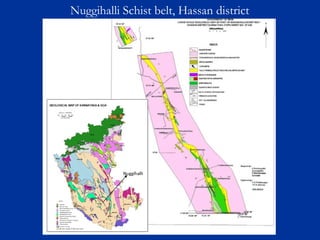
  • 93.
  • 94.
    The Gadag schistbelt consists of a 2000m thick pile of meta-volcanics and meta- sediments and a banded iron-formation . The structural disposition of the belt is the result of an overall E-W compressional regime with uplift and diaperism of the sialic basement within which the N-S trending Archaean shear systems have caused buckling and refolding of earlier fold belts, making all the linear elements parallel to the direction of shear. The underlying gneisses as well as the younger Closepet granite have a similar trend. Gadag schist belt is drawn out in the form of a 400 km long narrow N-S to NW-SE belt with a convexity towards the east. The eastern margin of the schist belt is a major thrust contact marked by a strong mylonitic zone believed to represent the line of suture marking the junction of the Archaean nucleus lying to the west and the comparatively younger gneiss complex to the east. Deep seismic sounding carried across the schist belt shows a major fault dipping to the east along the eastern margin of the schist belt. Followed south- ward, the schist belt splits into several narrow belts inter-layered with gneisses. While the geological nature and the inter- relationship of the volcano-sedimentary rocks of the supracrustals sequences help in understanding the tectono-sedimentary environments of deposition, there are no results of detailed geophysical studies reported so far over the schist belts of the carton.
  • 95.
    Javanahalli Schist belt Rocktypes: Dolerite Quartz vein Augen Gneiss Migmatite Gneiss Fuchsite Quartzite Ultramafic rock B M Q Amphibolite Calc silicate Paragneiss
  • 96.
    Nuggihalli Schist belt,Hassan district
  • 97.
    Sulphide mineralisation (pyritewith subordinate pyrrhotite and chalcopyrite) associated with titaniferous magnetite bands is seen near Nuggihalli. In the Tagadur area, sulphide mineralisation (pyrite, pyrrhotite, pentlandite and cubanite) is seen in gabbro and titaniferous magnetite bands. Nuggihalli Schist Belt is a narrow arcuate belt (60 km x 12 km) extending from Arsikere in the north to Kempinkote in south. It occurs as a mega enclave within the granite gneisses of the Western Dharwar Craton. Chromite first reported from the serpentinite , was established as segregates of the fractionated melt and the serpentinite was an altered product of original dunite - peridotite of a layered complex. Anomalous values of PGE (approx. 258 ppb of Pt and 43 ppb of Pd) along with significant amount of gold and copper have been reported from this belt although the PGE values reported are of semiquantitative in nature. The Nuggihalli schist belt comprises metavolcanics (hornblende schist and amphibolite) surrounded by Peninsular gneisses and granites with associated quartz veins and pegmatites of post-Dharwar age. These formations are intruded by an ultramafic complex consisting serpentinite, talctremolite schist (pyroxenite), olivine dolerite titaniferous magnetite veins and chromite veins.
  • 98.
  • 99.
  • 100.
    HOLENARSIPUR SCHIST BELTHOLENARSIPURSCHIST BELT  The Holenarasipur schist belt is one of the most critical, complicated andThe Holenarasipur schist belt is one of the most critical, complicated and oldest (3.2-3.5 by) supracrustal belts in the Dharwar craton of India. Twooldest (3.2-3.5 by) supracrustal belts in the Dharwar craton of India. Two lithostratigraphic groups, the Sargur and Dharwar, are separated by an angularlithostratigraphic groups, the Sargur and Dharwar, are separated by an angular unconformity. The Sargur group starts with a basic-ultrabasic base which isunconformity. The Sargur group starts with a basic-ultrabasic base which is overlain by metasediments of various compositions, whereas the Dharwaroverlain by metasediments of various compositions, whereas the Dharwar group develops upward from a basal conglomerate into a sequence ofgroup develops upward from a basal conglomerate into a sequence of amphibolites, quartzites and banded magnetite quartzites.amphibolites, quartzites and banded magnetite quartzites.  The Dharwar belt as a whole is metamorphosed to an amphibolite faciesThe Dharwar belt as a whole is metamorphosed to an amphibolite facies grade, but the Sargur group shows a higher grade (kyanite zone). Recumbent,grade, but the Sargur group shows a higher grade (kyanite zone). Recumbent, isoclinal, doubly plunging folds are common, but a regional northward plungeisoclinal, doubly plunging folds are common, but a regional northward plunge is dominant.is dominant.  Unlike the Dharwars there is no conglomerate at the base or anywhere in theUnlike the Dharwars there is no conglomerate at the base or anywhere in the succession of the Sargur group. The meta-ultramafics/mafics of the Sargursuccession of the Sargur group. The meta-ultramafics/mafics of the Sargur group are in places interbedded with fuchsite quartzite and show deformedgroup are in places interbedded with fuchsite quartzite and show deformed pillow lavas and microspinifex textures. Their composition is similar topillow lavas and microspinifex textures. Their composition is similar to peridotitic, pyroxenitic and basaltic komatiites.peridotitic, pyroxenitic and basaltic komatiites.
  • 102.
    Bababudan Group- Westernghats Shimoga schist & Chikmagalur Iron formations Archean Meta volcanics Meta basalts Basement gniess Quartzites Younger Granites & dyke rocks
  • 103.
    Sandur schist belt-Iron formations Proterozoic BIF’s Granites Amphibolite/chlorite Schist belt Pegmatites Kolar Schist belt Archean Granites Neo archean Amphibolites Meta volcanics Chlorite schist belt Quartzites Basement gneisses
  • 105.
    Hutti Maski schistbelt Pegmatites Younger dykes Meta sediments Quartzties Amphibolite schist Chlorite schist Meta volcanics Basement gneiss
  • 106.
     Mobile beltsare elongated areas of mountainMobile belts are elongated areas of mountain building activity – “orogenic activity”building activity – “orogenic activity”  along the margins of continentsalong the margins of continents  where sediments are deposited in thewhere sediments are deposited in the relatively shallow waters of the continentalrelatively shallow waters of the continental shelfshelf  and the deeper waters at the base of theand the deeper waters at the base of the continental slopecontinental slope  During plate convergence along these margins,During plate convergence along these margins,  the sediments are deformedthe sediments are deformed  and intruded by magmaand intruded by magma  creating mountain rangescreating mountain ranges Mobile BeltsMobile Belts
  • 107.
    Mobile BeltsMobile Belts Orogenic(Gr.Orogenic (Gr. Oros means mountain and genic means birth) belts or orogensOros means mountain and genic means birth) belts or orogens areare some of the most prominent tectonic features of continents.some of the most prominent tectonic features of continents. These terms are, however, not synonymous to Mountain beltThese terms are, however, not synonymous to Mountain belt which is a geographic term referring to areas of high and ruggedwhich is a geographic term referring to areas of high and rugged topography. Surely,topography. Surely, mountain belts are also orogenic belts butmountain belts are also orogenic belts but not all orogenic belts are mountainsnot all orogenic belts are mountains. orogenic belts, also called. orogenic belts, also called mobile belts, are termed fold belts because they are made up ofmobile belts, are termed fold belts because they are made up of rocks that show large-scale folds, and faults/thrusts androcks that show large-scale folds, and faults/thrusts and metamorphism with evidence of melting or high mobility in themetamorphism with evidence of melting or high mobility in the core region during orogenesis. These belts are characteristicallycore region during orogenesis. These belts are characteristically formed of (a) thick sequences of shallow water sandstones,formed of (a) thick sequences of shallow water sandstones, limestones and shales deposited on continental crust and (b)limestones and shales deposited on continental crust and (b) deep-water trubidites and pelagic sediments, commonly withdeep-water trubidites and pelagic sediments, commonly with volcanoclastic sediments and volcanic rocks.volcanoclastic sediments and volcanic rocks.
  • 108.
    Mobile BeltsMobile Belts Typicalmobile belts, rather fold belts as titled here, have rocksTypical mobile belts, rather fold belts as titled here, have rocks that were deformed and metamorphosed to varying degrees andthat were deformed and metamorphosed to varying degrees and intruded by plutonic bodies of granitic compositions. Some foldintruded by plutonic bodies of granitic compositions. Some fold belts are also characterized by extensive thrust faulting and bybelts are also characterized by extensive thrust faulting and by movements along large transcurrent fault zones. Evenmovements along large transcurrent fault zones. Even extensional deformation may be found in such belts. Most beltsextensional deformation may be found in such belts. Most belts show a linear central region of thick multiply deformed andshow a linear central region of thick multiply deformed and metamorphosed rocks bordered by continental margins, butmetamorphosed rocks bordered by continental margins, but some belts are also having oceanic margin on one side.some belts are also having oceanic margin on one side.
  • 109.
    Mobile BeltsMobile Belts AFBAFB Aravalli Fold BeltAravalli Fold Belt  Delhi FBDelhi FB Delhi Fold BeltDelhi Fold Belt  DFBDFB Dongargarh Fold BeltDongargarh Fold Belt  EGMBEGMB Eastern Ghats Mobile BeltEastern Ghats Mobile Belt  MFBMFB Mahakoshal Fold BeltMahakoshal Fold Belt  PMBPMB Pandyan Mobile BeltPandyan Mobile Belt  Satpura FBSatpura FB Satpura Fold BeltSatpura Fold Belt  SFBSFB Singhbhum Fold BeltSinghbhum Fold Belt  SKFB SSKFB S akoli Fold Beltakoli Fold Belt
  • 110.
    Pandyan Mobile BeltPandyanMobile Belt Pandyan Mobile Belt (PMB) is the name given byPandyan Mobile Belt (PMB) is the name given by Ramakrishnan (1993, 1988) to the Southern GranuliteRamakrishnan (1993, 1988) to the Southern Granulite Terrain (SGT) situated to the south of the E-WTerrain (SGT) situated to the south of the E-W trending Palghat-Cauvery Shear Zone (PCSZ) .Thetrending Palghat-Cauvery Shear Zone (PCSZ) .The name Pandyan is adopted after the legendary dynastyname Pandyan is adopted after the legendary dynasty that ruled this part of South India in the historical past.that ruled this part of South India in the historical past. Interestingly, the SGT has been defined variously byInterestingly, the SGT has been defined variously by different workers. According to Fermor (1936), thisdifferent workers. According to Fermor (1936), this terrain is a part of the large “Charnockite Province”terrain is a part of the large “Charnockite Province” located to the south of the orthopyroxene-in (Opx-in)located to the south of the orthopyroxene-in (Opx-in) isograd, delineated along a line straddling the joinisograd, delineated along a line straddling the join Mangalore-Mysore-Bangalore-Chennai (Pichamuthu,Mangalore-Mysore-Bangalore-Chennai (Pichamuthu,
  • 111.
    The Pandyan mobilebelt (PMB), according to Ramakrishnan (1993),The Pandyan mobile belt (PMB), according to Ramakrishnan (1993), is the geological domain between the PCSZ in the north and theis the geological domain between the PCSZ in the north and the AKSZ in the south. Impressed by swirling structural pattern in theAKSZ in the south. Impressed by swirling structural pattern in the Madurai Block, Similar to Limpopo belt in South Africa, and by theMadurai Block, Similar to Limpopo belt in South Africa, and by the general occurrence of fold belts either at the peripehery of ageneral occurrence of fold belts either at the peripehery of a continent or sandwiched between two continents, Ramakrishnancontinent or sandwiched between two continents, Ramakrishnan carved out his Pandyan mobile belt from the segmented Southerncarved out his Pandyan mobile belt from the segmented Southern Granulite Terrain. A few years later, Ramakrishnan (2003) enlargedGranulite Terrain. A few years later, Ramakrishnan (2003) enlarged the domain of his mobile belt and included areas of granulites onthe domain of his mobile belt and included areas of granulites on both n orth and south margins of his initially proposed Pandyanboth n orth and south margins of his initially proposed Pandyan mobile belt, perhaps on the consideration of meaningfulmobile belt, perhaps on the consideration of meaningful geochronological data available over almost entire SGT.geochronological data available over almost entire SGT. Ramaskrishnan also incorporated the granulite region north of theRamaskrishnan also incorporated the granulite region north of the MBSZ.MBSZ.
  • 112.
    Simplified Geological mapof the southern India (after GSI and ISRO, 1994), showing the major geological domains, the Western Dharwar Craton (WDC), Eastern Dharwar Craton (EDC), and Southern Granulite Terrain (SGT) along with the Cauveri Shear Zone System (CSZ). Abbreviations: AKSZ = Achankovil Shear Zone; AH = Anamalai Hills; AT = Attur; BS = Bhavani Shear zone; BL = Bangalore; BR =Biligirirangan; CHS = Chitradurga Shear Zone; CG = Coorg; CM = Coimbatore; EDC = East Dharwar Craton; K = Kabbaldurga; KL = Kolar; KKB = Kerala Khondalite Belt;MS = Moyar Shear zone; N = Nilgiri; OT= Ooty; PCSZ = Palgahat Shear Zone; PL = Pollachi; PMB = Pandyan Mobile Belt; SGT = Southern Granulite Terrain; SH = Shevaroy Hills; WDC = West Dharwar Craton; GR-Am = Isograd between Greenschist and Amphibolite Facies; Am-Gt = Isograd between Amphibolite and Granulite Facies; TZ = Transition Zone of amphibolite and granulite facies. Inset shows various identified crustal block
  • 113.
     A varietyof mineral deposits are of Archean-ageA variety of mineral deposits are of Archean-age  but gold is the most commonly associated,but gold is the most commonly associated,  although it is also foundalthough it is also found  in Proterozoic and Phanerozoic rocksin Proterozoic and Phanerozoic rocks  This soft yellow metal is prized for jewelry,This soft yellow metal is prized for jewelry,  but it is or has been used as a monetary standard,but it is or has been used as a monetary standard,  in glass making, electric circuitry, and chemical industryin glass making, electric circuitry, and chemical industry  About half the world’s gold since 1886About half the world’s gold since 1886  has come from Archean and Proterozoic rockshas come from Archean and Proterozoic rocks  in South Africain South Africa  Gold mines also exist in Archean rocksGold mines also exist in Archean rocks  of the Superior craton in Canadaof the Superior craton in Canada Archean Mineral ResourcesArchean Mineral Resources
  • 114.
     Archean sulfidedeposits ofArchean sulfide deposits of  zinc,zinc,  coppercopper  and nickeland nickel  occur in Australia, Zimbabwe,occur in Australia, Zimbabwe,  and in the Abitibi greenstone beltand in the Abitibi greenstone belt  in Ontario, Canadain Ontario, Canada  Some, at least, formed as mineral depositsSome, at least, formed as mineral deposits  next to hydrothermal vents on the seafloor,next to hydrothermal vents on the seafloor,  much as they do now around black smokersmuch as they do now around black smokers Archean Sulfide DepositsArchean Sulfide Deposits
  • 115.
     About 1/4of Earth’s chrome reservesAbout 1/4 of Earth’s chrome reserves  are in Archean rocks, especially in Zimbabweare in Archean rocks, especially in Zimbabwe  These ore deposits are found inThese ore deposits are found in  the volcanic units of greenstone beltsthe volcanic units of greenstone belts  where they appear to have formedwhere they appear to have formed  when crystals settled and became concentratedwhen crystals settled and became concentrated  in the lower parts of plutonsin the lower parts of plutons  such as mafic and ultramafic sillssuch as mafic and ultramafic sills  Chrome is needed in the steel industryChrome is needed in the steel industry  The United States has very few chrome depositsThe United States has very few chrome deposits  so must import most of what it usesso must import most of what it uses ChromeChrome
  • 116.
     One chromedeposit in the United StatesOne chrome deposit in the United States  is in the Stillwater Complex in Montanais in the Stillwater Complex in Montana  Low-grade ores were mined there during warLow-grade ores were mined there during war times,times,  but they were simply stockpiledbut they were simply stockpiled  and never refined for chromeand never refined for chrome  These rocks also contain platinum,These rocks also contain platinum,  a precious metal, that is useda precious metal, that is used  in the automotive industry in catalytic convertersin the automotive industry in catalytic converters  in the chemical industryin the chemical industry  for cancer chemotherapyfor cancer chemotherapy Chrome and PlatinumChrome and Platinum
  • 117.
     Banded Ironformations are sedimentary rocksBanded Iron formations are sedimentary rocks  consisting of alternating layersconsisting of alternating layers  of silica (chert) and iron mineralsof silica (chert) and iron minerals  About 6% of the world’sAbout 6% of the world’s  banded iron formations were depositedbanded iron formations were deposited  during the Archean Eonduring the Archean Eon  Although Archean iron oresAlthough Archean iron ores  are mined in some areasare mined in some areas  they are neither as thickthey are neither as thick  nor as extensive as those of the Proterozoic Eon,nor as extensive as those of the Proterozoic Eon,  which constitute the world’s major source of ironwhich constitute the world’s major source of iron IronIron
  • 118.
     PegmatitesPegmatites arevery coarsely crystalline igneousare very coarsely crystalline igneous rocks,rocks,  commonly associated with granite plutonscommonly associated with granite plutons  Some Archean pegmatites,Some Archean pegmatites,  such in the Herb Lake district in Manitoba, Canada,such in the Herb Lake district in Manitoba, Canada,  and Rhodesian Province in Africa,and Rhodesian Province in Africa,  contain valuable mineralscontain valuable minerals  In addition to minerals of gem quality,In addition to minerals of gem quality,  Archean pegmatites contain minerals minedArchean pegmatites contain minerals mined  for lithium, beryllium, rubidium, and cesiumfor lithium, beryllium, rubidium, and cesium PegmatitesPegmatites
  • 119.
    Archean To ProterozoicSedimentaryArchean To Proterozoic Sedimentary RocksRocks • Archean •4 bya: mostly deep water clastic deposits such as mudstones and muddy sandstones. –high concentration of eroded volcanic minerals (Sandstones called Graywackes). • 3 bya: absence of shallow water shelf carbonates. –increasing chert. – low oxygen levels, free iron was much more common in the Archean. –Iron formed “chemical sinks” that consumed much of the early planetary oxygen. –Formed banded ironstones, commonly with interbedded chert. •Proterozoic– 2 bya Carbonates* become important - Non-marine sediments turn red – iron is oxidized by the oxygen in AIR
  • 120.
    • “Purana Basins”. •Cratonic or Epicratonic basins. • Platform Basins. • Witness to the story of early crustal evolution. • Useful for global comparison with similar basins. • Importantly, these basins unveil the prelude to the cambrian explosion of life. • Occupies 20% of the area of the Precambrian of the Peninsular India. Proterozoic SedimentaryProterozoic Sedimentary BasinsBasins
  • 121.
    Purana basins ofPeninsular India within differentPurana basins of Peninsular India within different cratonscratons
  • 122.
    Proterozoic sedimentary basinsare divided into 2 types based on age: (a).Paleoproterozoic basins: 1.Bijawar and Sonrai basins Bundelkhand and Harda Inlier craton 2.Gwalior basin 3.Abujhmar basin Bastar craton 4.Papaghni sub-basin Dharwar craton [Cuddapah basin]
  • 123.
    (b).(b).Meso-Neoproterozoic basins 11. Vindhyanbasin Bundhekhand craton 2. Chhattisgarh basin 3. Khariar basin 4. (a)Ampani basin, (b)Keskal, Singanpar Bastar craton and Chedrapal outliers 5. Indravathi basin 6. Sabari[Sukma] basin 7. Pranhita-Godavari basin b/n Bastar and Dharwar cratons 8. Cuddapah basin 9. Kaladgi basin Dharwar craton 10. Bhima basin
  • 124.
    Palaeoproterozoic Basins 1. BijawarBasin- trends ENE-WSW for about 100km with a width of 4 to 20km from Ken River in the east to sonari in the west. Sandwiched b/n Bundelkhand granite and Vindhyan sediments. 2. Sonari Basin- 28km long and 5km wide, E-W trending situated to the west of the ‘type’ Bijawar basin. 3. Harda Inlier- it exposed at Harda within the-Vindhyan succession and Deccan Trap of Narmada valley. 4. Gwalior Basin- extends E-W for 80km with a width of 25km,near Gwalior to the north of Bundelkhand granite,almost 200km N-W of Bijawar basin. 5. Abujhmar Basin- named for ‘abujh mar’ or ‘unknown hills’ in the remote bansal region, covers an area of 3000sq. km 6. Papaghni sub-basin : This sub-basin is described under Cuddapah basin.
  • 125.
    Meso-Neoproterozoic Basins 1.Vindhyan basin Largestsingle Purana basin, spectacular, sickle shaped, ENE trending, situated on Bundelkhand craton. Includes 4 groups: (d). Bhander group (1300-1500m) (c). Rewa group(100-300m) (b). Kaimur group(400m) (a). Semri group (3000-4000m) Major structure is synclinorium with the axis curving along the middle of the sickle-shaped basin. Recent robust dating has fixed the beginning of Vindhyan sedimentation around 1600-1720 Ma. Life: Stromatolites are abundant in Vindhayan record but they have long time range and hence have only limited correlative value.
  • 126.
    Geologic map ofthe Vindhyan basin, central India.
  • 127.
    2.Chhattisgarh basin Larget Puranabasin in Bastar craton, covering an area of about 36000 sq. km is situated on the northern edge of Bastar craton. Lithostatigraphy: (c). Raipur Group[1900m] (b). Chandrapur Group[400m] (a). Singhora Group[400m] Lithology: Felspathic arenite, arkose, basal conglomerate, sandstone, dolomite shale, limestone. Evidence of life- Microbiota include prokaryotic cyanobacteria, unidentified algal remains and acritarchs.
  • 128.
    Generalised geological mapof Chhattisgarh basin(after Das etGeneralised geological map of Chhattisgarh basin(after Das et al.1992)al.1992)
  • 129.
    3.Khariar Basin3.Khariar Basin Itis an irregular, oval-shaped basin occupyingIt is an irregular, oval-shaped basin occupying the N-S trending Nawagarh-Khariar plateau.the N-S trending Nawagarh-Khariar plateau. Covering an area of 1500sq.km and containingCovering an area of 1500sq.km and containing 1000m thick sediments.1000m thick sediments. Sediments are called asSediments are called as Pairi GroupPairi Group(600-1000m)(600-1000m) Stromatolites indicate Lower to Upper RipheanStromatolites indicate Lower to Upper Riphean age, but no radiometric data are available.age, but no radiometric data are available.
  • 130.
    Occupying an areaof 220 sq.km on a small plateau south of Khariar near Ampani consists of a 280m thick sandstone – shale sequence. The sediments are domed up around hornblend granodiorite at Khaligarh,which is thought to be intrusive. 5.Indravati Basin Irregular rhomboid basin covering an area of 900 sq.km and containing orthoquartzite-shale-carbonate sequence of about 500m thick on the average. Cement grade Limestone and dolomite are important economic minerals. 4.Ampani Basin
  • 131.
    6.Sabari Basin A triangularbasin of 700 sq.km Sabari group consists of a basal conglomerate and thick- bedded ortho-quartzite, overlain by a cream to grey coloured limestone and followed by purple to grey shale. 7. Pranhita-Godavari Basin Occurs in two parallel NW-SE trending sub-basins, situated at the junction of Dharwar and Bastar cratons. Developed after amalgamation of the cratons in Palaeoproterozoic.
  • 132.
    The western sub-basinis called the Pakhal belt and the eastern sub-basin as the Albaka belt. The P-G basin is extends for a length of ~400km with width of ~100km. Includes the width of ~40km for Godavari graben of Gondwana sediments occurring in the middle and separating the two sub-basins. The aggregate thickness of the sediments of the P-G basin is estimated at about 6000m. Divided into 4 major groups, namely Mallampalli, Mulug, Penganga and Sullavai separated by 3 unconformities.
  • 133.
    8.Cuddapah Basin Crescent shaped,easterlyconcave and N-S trending,covers an area of 44000 sq.km in the east-central part of Dharwar craton. Characterised by quartzite-carbonate-shale cycles having an aggregate thickness i.e estimated b/n 6 to 12km. The western half of the basin is undeformed and consists of 4 sub-basins: the Papaghni, Kurnool, Srisailam and Palnad. Life-Stromatolites are abounding,carbonaceous microfossils like Tawuia, Chuaria, trace fossils, calcareous algae indicate Neoproterozoic age.
  • 134.
    Cuddapah Basin inEastern DharwarCuddapah Basin in Eastern Dharwar CratonCraton
  • 135.
    9.Kaladgi Basin E-W trendingirregular basin,covers an area 8300sq.km The older succession of Kaladgi basin is called the Bagalkot Group that correspond to the Cuddapah supergroup The upper succession is called the Badami Group i.e the possible equivalent of Kurnool Group. Bagalkot Group is divided into the lower Lokpur Subgroup and the upper Simikeri subgroup. Life - Bagalkot Group contains microstromatolites suggest early Riphean age, Badami Group also contains acritarchs & trace fossils that suggest Vendian age.
  • 136.
    10.Bhima basin Irregular,NE trending,consistingdominantly of limestone covers an area of 5200sq.km,situated to the northwest of Cuddapah basin and northeast of Kaladgi basin. Aggregate thickness of sediments is about 270m. Well known for its large reserves of limestone and the newly discovered uranium occurrence near Gogi. Sediments are practically horizontal, but disturbed along transverse faults.
  • 137.
    Bhima basin Dharwarcraton(after Kale andBhima basin Dharwar craton(after Kale and Peshwa,1991)Peshwa,1991)
  • 138.
    Economic mineral depositsEconomicmineral deposits Diamond- Vindhyan and Kurnool formationsDiamond- Vindhyan and Kurnool formations Pyrite- the Bijaigarh shales of the Lower KaimursPyrite- the Bijaigarh shales of the Lower Kaimurs Coal- Semris and Kaimurs groupCoal- Semris and Kaimurs group Lime stone- in the Sone Valley in Bihar and U.P., in Rewa, inLime stone- in the Sone Valley in Bihar and U.P., in Rewa, in Jabalpur, in Guntur and in the Bhima Valley in HyderabadJabalpur, in Guntur and in the Bhima Valley in Hyderabad Building and decorative stones- Lower Vindhyan and LowerBuilding and decorative stones- Lower Vindhyan and Lower Bhander stages, limestones of the Palnad regionBhander stages, limestones of the Palnad region Glass Sand- Some Vindhyan sandstones near Allahabad, U.PGlass Sand- Some Vindhyan sandstones near Allahabad, U.P
  • 139.
    Life during PrecambrianLifeduring Precambrian  The Precambrian fossil record is poorer than that for the succeeding Phanerozoic, andThe Precambrian fossil record is poorer than that for the succeeding Phanerozoic, and those fossils present (e.g. stromatolites) are of limited biostratigraphy biostratigraphicthose fossils present (e.g. stromatolites) are of limited biostratigraphy biostratigraphic use.use.  This is because many Precambrian rocks are heavily metamorphic rockThis is because many Precambrian rocks are heavily metamorphic rock metamorphosed, obscuring their origins, while others have either been destroyed bymetamorphosed, obscuring their origins, while others have either been destroyed by erosion, or remain deeply buried beneath Phanerozoic strataerosion, or remain deeply buried beneath Phanerozoic strata  The oldest fossil evidence of complex life comes from the Lantian formation, at leastThe oldest fossil evidence of complex life comes from the Lantian formation, at least 580 million years ago. A quite diverse collection of soft-bodied forms is known from a580 million years ago. A quite diverse collection of soft-bodied forms is known from a variety of locations worldwide between 542 and 600 Ma. These are referred to asvariety of locations worldwide between 542 and 600 Ma. These are referred to as Ediacaran biota Ediacaran or Vendian biota. Hard-shelled creatures appeared towardEdiacaran biota Ediacaran or Vendian biota. Hard-shelled creatures appeared toward the end of that time span. By the middle of the later Cambrian period a very diversethe end of that time span. By the middle of the later Cambrian period a very diverse fauna is recorded in the Burgess shale, including some which may represent stemfauna is recorded in the Burgess shale, including some which may represent stem groups of modern taxa. The rapid radiation of lifeforms during the early Cambrian isgroups of modern taxa. The rapid radiation of lifeforms during the early Cambrian is called the Cambrian explosion of life.While land seems to have been devoid of plantscalled the Cambrian explosion of life.While land seems to have been devoid of plants and animals, cyanobacteria and other microbes formed prokaryotic mats that coveredand animals, cyanobacteria and other microbes formed prokaryotic mats that covered terrestrial areas.terrestrial areas.
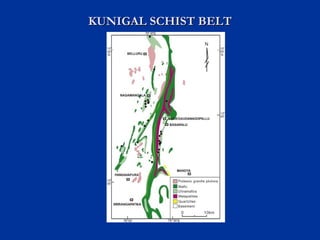
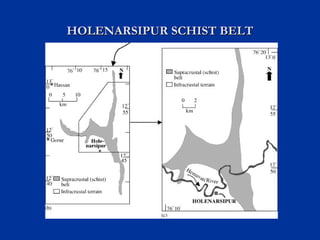
  • 140.
     The firstorganisms were membersThe first organisms were members  of the kingdom Moneraof the kingdom Monera  consisting of bacteria and archaea,consisting of bacteria and archaea,  both of which consist ofboth of which consist of prokaryotic cellsprokaryotic cells,,  cells that lack an internal, membrane-bounded nucleuscells that lack an internal, membrane-bounded nucleus and other structuresand other structures  Prior to the 1950s, scientists assumed that lifePrior to the 1950s, scientists assumed that life  must have had a long early historymust have had a long early history  but the fossil record offered little to support this ideabut the fossil record offered little to support this idea  The Precambrian, once calledThe Precambrian, once called AzoicAzoic  (“without life”), seemed devoid of life(“without life”), seemed devoid of life Oldest Known OrganismsOldest Known Organisms
  • 141.
     Charles Walcott(early 1900s) described structuresCharles Walcott (early 1900s) described structures  from the Paleoproterozoic Gunflint Iron Formation of Ontario,from the Paleoproterozoic Gunflint Iron Formation of Ontario, CanadaCanada  that he proposed represented reefs constructed bythat he proposed represented reefs constructed by algaealgae Oldest Know OrganismsOldest Know Organisms • Now called stromatolites, – not until 1954 were they shown – to be products of organic activity Present-day stromatolites (Shark Bay, Australia)
  • 142.
     Different typesof stromatolites includeDifferent types of stromatolites include  irregular mats, columns, and columns linked by matsirregular mats, columns, and columns linked by mats StromatolitesStromatolites
  • 143.
     Present-day stromatolitesform and growPresent-day stromatolites form and grow  as sediment grains are trappedas sediment grains are trapped  on sticky matson sticky mats  of photosynthesizing cyanobacteriaof photosynthesizing cyanobacteria  although now they are restrictedalthough now they are restricted  to environments where snails cannot liveto environments where snails cannot live  The oldest known undisputed stromatolitesThe oldest known undisputed stromatolites  are found in rocks in South Africaare found in rocks in South Africa  that are 3.0 billion years oldthat are 3.0 billion years old  but probable ones are also knownbut probable ones are also known  from the Warrawoona Group in Australiafrom the Warrawoona Group in Australia  which is 3.3 to 3.5 billion years oldwhich is 3.3 to 3.5 billion years old StromatolitesStromatolites
  • 144.
     Chemical evidencein rocks 3.85 billion years oldChemical evidence in rocks 3.85 billion years old  in Greenland indicate life was perhaps present thenin Greenland indicate life was perhaps present then  The oldest known cyanobacteriaThe oldest known cyanobacteria  were photosynthesizing organismswere photosynthesizing organisms  but photosynthesis is a complex metabolic processbut photosynthesis is a complex metabolic process  A simpler type of metabolismA simpler type of metabolism  must have preceded itmust have preceded it  No fossils are known of these earliest organismsNo fossils are known of these earliest organisms Other Evidence of Early LifeOther Evidence of Early Life
  • 145.
     The earliestorganisms must have resembledThe earliest organisms must have resembled  tinytiny anaerobicanaerobic bacteriabacteria  meaning they required no oxygenmeaning they required no oxygen  They must have totally dependedThey must have totally depended  on an external source of nutrientson an external source of nutrients  that is, they werethat is, they were heterotrophicheterotrophic  as opposed toas opposed to autotrophicautotrophic organismsorganisms  that make their own nutrients, as in photosynthesisthat make their own nutrients, as in photosynthesis  They all hadThey all had prokaryotic cellsprokaryotic cells Earliest OrganismsEarliest Organisms
  • 146.
     The earliestorganisms, then,The earliest organisms, then,  were anaerobic, heterotrophic prokaryoteswere anaerobic, heterotrophic prokaryotes  Their nutrient source was most likelyTheir nutrient source was most likely  adenosine triphosphate (ATP)adenosine triphosphate (ATP)  from their environmentfrom their environment  which was used to drivewhich was used to drive  the energy-requiring reactions in cellsthe energy-requiring reactions in cells  ATP can easily be synthesizedATP can easily be synthesized  from simple gases and phosphatefrom simple gases and phosphate  so it was availableso it was available  in the early Earth environmentin the early Earth environment Earliest OrganismsEarliest Organisms
  • 147.
    Proterozoic Fossil RecordProterozoicFossil Record  EukaryotesEukaryotes (large cells with nuclei and organelles)(large cells with nuclei and organelles) appeared by Mesoproterozoic time. Appeared byappeared by Mesoproterozoic time. Appeared by 1.6 by to 1.4 by. Increased in abundance about 1.41.6 by to 1.4 by. Increased in abundance about 1.4 by ago.by ago.  Potential for sexual reproduction and increasingPotential for sexual reproduction and increasing variation (evolution)variation (evolution)
  • 148.
     AcritarchsAcritarchs aresingle-celledare single-celled spherical, organic-walledspherical, organic-walled microfossils.microfossils.  Not known what sort ofNot known what sort of organism they were, but theyorganism they were, but they may have been phytoplankton.may have been phytoplankton. First appeared 1.6 by ago.First appeared 1.6 by ago. Maximum diversity andMaximum diversity and abundance 850 my ago. Theyabundance 850 my ago. They declined steadily during thedeclined steadily during the Neoproterozoic glaciation, andNeoproterozoic glaciation, and few remained by 675 my ago.few remained by 675 my ago. Useful for correlation inUseful for correlation in Proterozoic strata.Proterozoic strata. AcritarchsAcritarchs
  • 149.
    Origin of EukaryotesOriginof Eukaryotes EukaryotesEukaryotes are thought to have arisen from anare thought to have arisen from an originally endosymbiotic relationship between two ororiginally endosymbiotic relationship between two or more prokaryotic cells.more prokaryotic cells.  Symbiosis - two or more organisms living together,Symbiosis - two or more organisms living together, where each organism usually derives some benefitwhere each organism usually derives some benefit froom the relationship.froom the relationship.  Endosymbiosis - One organism lives inside the other,Endosymbiosis - One organism lives inside the other, e. g. bacteria in stomachs of cattle.e. g. bacteria in stomachs of cattle.
  • 150.
    Origin of EukaryotesOriginof Eukaryotes  Organelles (Mitochondria, plastids) were once free livingOrganelles (Mitochondria, plastids) were once free living bacteria, that entered or were engulfed by anotherbacteria, that entered or were engulfed by another prokaryote. Eventually, relationship became mutuallyprokaryote. Eventually, relationship became mutually beneficial.beneficial.  E. g. host cell provided proto-mitochondrion (primitiveE. g. host cell provided proto-mitochondrion (primitive oxidizing bacteria) with plenty of food, mitochondrionoxidizing bacteria) with plenty of food, mitochondrion performed oxidation and released energy for a bacterium thatperformed oxidation and released energy for a bacterium that previously could only ferment. Eventually proto-mitochondrionpreviously could only ferment. Eventually proto-mitochondrion gives up trying to reproduce.gives up trying to reproduce.  E.g. host cell waste products (carbon dioxide etc.) used by aE.g. host cell waste products (carbon dioxide etc.) used by a cyanobacterium (proto-plastid) to photosynthesize. Plastid leakscyanobacterium (proto-plastid) to photosynthesize. Plastid leaks energy to host cell. Eventually gives up reproducing on its own.energy to host cell. Eventually gives up reproducing on its own.
  • 151.
    Precambrian–CambrianPrecambrian–Cambrian boundaryboundary  The Precambrian–Cambrianboundary problemThe Precambrian–Cambrian boundary problem is being studied in an areno-argillaceousis being studied in an areno-argillaceous sequence in the Kashmir and Spiti Valley,sequence in the Kashmir and Spiti Valley, Northwest Himalaya, India. In Kashmir, a richNorthwest Himalaya, India. In Kashmir, a rich and diversified microbiota – cryptarchs andand diversified microbiota – cryptarchs and algae of the Late Precambrian, and low Loweralgae of the Late Precambrian, and low Lower Cambrian trace fossils are recorded. In the SpitiCambrian trace fossils are recorded. In the Spiti Valley, the yield of microbiota is poor and theValley, the yield of microbiota is poor and the trace fossils are late Lower Cambrian.trace fossils are late Lower Cambrian.
  • 152.
    Microfossils and Precambrian-CambrianboundaryMicrofossils and Precambrian-Cambrian boundary
  • 153.
    Precambrian–Cambrian boundary;Precambrian–Cambrian boundary; LesserHimalayaLesser Himalaya  The affinity of the Ediacaran fossil The affinity of the Ediacaran fossil Shaanxilithes ningqiangensisShaanxilithes ningqiangensis and putatively and putatively related forms has long been enigmatic; over the past few decades,related forms has long been enigmatic; over the past few decades, interpretations ranging from trace fossils to algae to metazoans of uncertaininterpretations ranging from trace fossils to algae to metazoans of uncertain phylogenetic placement have been proposed. Combined morphological andphylogenetic placement have been proposed. Combined morphological and geochemical evidence from a new occurrence of geochemical evidence from a new occurrence of SS.. ningqiangensis ningqiangensis in the Krol in the Krol and Tal groups of the Lesser Himalaya of India indicatesand Tal groups of the Lesser Himalaya of India indicates that that SS.. ningqiangensis ningqiangensis is not a trace fossil, but rather an organic-walled tubular is not a trace fossil, but rather an organic-walled tubular body fossil of unknown taxonomic affinity.body fossil of unknown taxonomic affinity.  Specimens consist of compressed organic cylindrical structures, characterizedSpecimens consist of compressed organic cylindrical structures, characterized by extended, overlapping or fragmented iterated units. Where specimensby extended, overlapping or fragmented iterated units. Where specimens intersect, overlapping rather than branching or intraplanar crossing isintersect, overlapping rather than branching or intraplanar crossing is observed. Lithologic comparisons and sequence stratigraphic data all suggestobserved. Lithologic comparisons and sequence stratigraphic data all suggest a late Ediacaran age for the uppermost Krol Group and basalmost Tal Groupa late Ediacaran age for the uppermost Krol Group and basalmost Tal Group
  • 154.
     Plate tectonicactivity has operatedPlate tectonic activity has operated  since the early Proterozoic (or perhaps late Archean)since the early Proterozoic (or perhaps late Archean)  Most geologists are convincedMost geologists are convinced  that some kind of plate tectonic activitythat some kind of plate tectonic activity  took place during the Archean as welltook place during the Archean as well  but it differed in detail from todaybut it differed in detail from today  Plates must have moved fasterPlates must have moved faster  with more residual heat from Earth’s originwith more residual heat from Earth’s origin  and more radiogenic heat,and more radiogenic heat,  and magma was generated more rapidlyand magma was generated more rapidly Archean Plate TectonicsArchean Plate Tectonics
  • 155.
     As aresult of the rapid movement of plates,As a result of the rapid movement of plates,  continents grew more rapidly along their marginscontinents grew more rapidly along their margins  a process called continental accretiona process called continental accretion  as plates collided with island arcs and other platesas plates collided with island arcs and other plates  Also, ultramafic extrusive igneous rocks,Also, ultramafic extrusive igneous rocks,  komitiites,komitiites,  were more commonwere more common Archean Plate TectonicsArchean Plate Tectonics
  • 156.
     The exposedpart of the craton in NorthThe exposed part of the craton in North America is theAmerica is the Canadian shieldCanadian shield  which occupies most of northeastern Canadawhich occupies most of northeastern Canada  a large part of Greenlanda large part of Greenland  parts of the Lake Superior regionparts of the Lake Superior region  in Minnesota, Wisconsin, and Michiganin Minnesota, Wisconsin, and Michigan  and the Adirondack Mountains of New Yorkand the Adirondack Mountains of New York  Its topography is subdued,Its topography is subdued,  with numerous lakes and exposed Archeanwith numerous lakes and exposed Archean  and Proterozoic rocks thinly coveredand Proterozoic rocks thinly covered  in places by Pleistocene glacial depositsin places by Pleistocene glacial deposits Canadian ShieldCanadian Shield
  • 157.
     Outcrop ofArchean gneiss in the CanadianOutcrop of Archean gneiss in the Canadian Shield in Ontario, CanadaShield in Ontario, Canada Canadian Shield RocksCanadian Shield Rocks
  • 158.
     Archean BrahmaSchist in the deeply erodedArchean Brahma Schist in the deeply eroded parts of the Grand Canyon, Arizonaparts of the Grand Canyon, Arizona Archean Rocks Beyond the ShieldArchean Rocks Beyond the Shield

Editor's Notes

  • #22 Image is from the following website: http://www.geology.ufl.edu/Biosphere.html Bio means “life”, so this is the sphere of life.
  • #34 76 M
  • #43 First, depend on summer temperature, T decreases with height. Tropics is warmer, thus snow line can only form at high altitude where temperature is near zero. Second, precipitation. More precipitation will increase accumulation rate, allowing glacier to exist at lower altitude.
  • #127 Geologic map of the Vindhyan basin, central India. After Azmi et al. (4), based on several sources. Localities mentioned in the present study are labeled in white letters on black.