1
Aim: How do we write the
chemical formula of an
ionic compound given
the chemical name
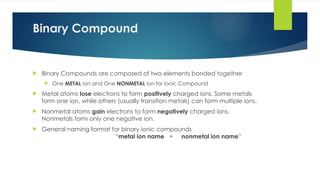
Binary Compound
 Binary Compounds are composed of two elements bonded together
 One METAL Ion and One NONMETAL Ion for Ionic Compound
 Metal atoms lose electrons to form positively charged ions. Some metals
form one ion, while others (usually transition metals) can form multiple ions.
 Nonmetal atoms gain electrons to form negatively charged ions.
Nonmetals form only one negative ion.
 General naming format for binary ionic compounds
“metal ion name + nonmetal ion name”
3
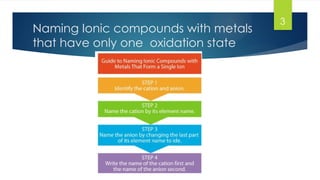
Naming Ionic compounds with metals
that have only one oxidation state
4
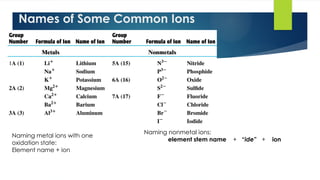
Names of Some Common Ions
Naming metal ions with one
oxidation state:
Element name + ion
Naming nonmetal ions:
element stem name + “ide” + ion
5
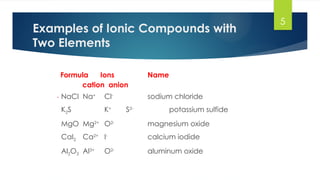
Formula Ions Name
cation anion
NaCl Na+
Cl-
sodium chloride
K2S K+
S2-
potassium sulfide
MgO Mg2+
O2-
magnesium oxide
CaI2 Ca2+
I-
calcium iodide
Al2O3 Al3+
O2-
aluminum oxide
Examples of Ionic Compounds with
Two Elements
6
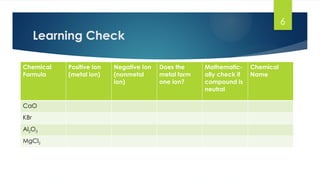
Learning Check
Chemical
Formula
Positive Ion
(metal ion)
Negative Ion
(nonmetal
ion)
Does the
metal form
one ion?
Mathematic-
ally check if
compound is
neutral
Chemical
Name
CaO
KBr
Al2O3
MgCl2
7
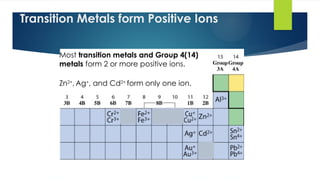
Transition Metals form Positive Ions
Most transition metals and Group 4(14)
metals form 2 or more positive ions.
Zn2+
, Ag+
, and Cd2+
form only one ion.
8
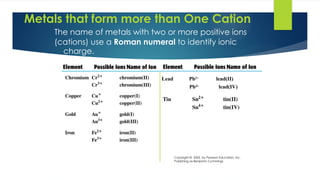
Metals that form more than One Cation
The name of metals with two or more positive ions
(cations) use a Roman numeral to identify ionic
charge.
Copyright © 2005 by Pearson Education, Inc.
Publishing as Benjamin Cummings
Lead Pb2+
lead(II)
Pb4+
lead(IV)
9
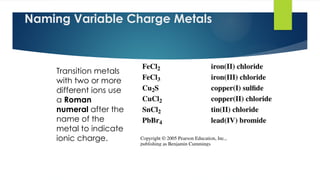
Naming Variable Charge Metals
Transition metals
with two or more
different ions use
a Roman
numeral after the
name of the
metal to indicate
ionic charge.
10
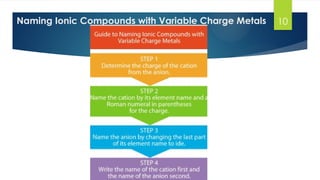
Naming Ionic Compounds with Variable Charge Metals
11
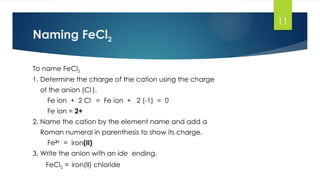
Naming FeCl2
To name FeCl2
1. Determine the charge of the cation using the charge
of the anion (Cl-
).
Fe ion + 2 Cl-
= Fe ion + 2 (-1) = 0
Fe ion = 2+
2. Name the cation by the element name and add a
Roman numeral in parenthesis to show its charge.
Fe2+
= iron(II)
3. Write the anion with an ide ending.
FeCl2 = iron(II) chloride
12
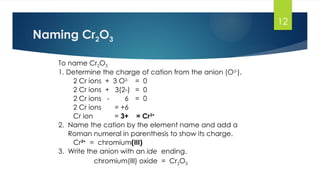
Naming Cr2O3
To name Cr2O3
1. Determine the charge of cation from the anion (O2-
).
2 Cr ions + 3 O2-
= 0
2 Cr ions + 3(2-) = 0
2 Cr ions - 6 = 0
2 Cr ions = +6
Cr ion = 3+ = Cr3+
2. Name the cation by the element name and add a
Roman numeral in parenthesis to show its charge.
Cr3+
= chromium(III)
3. Write the anion with an ide ending.
chromium(III) oxide = Cr2O3
13
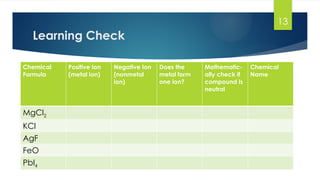
Learning Check
Chemical
Formula
Positive Ion
(metal ion)
Negative Ion
(nonmetal
ion)
Does the
metal form
one ion?
Mathematic-
ally check if
compound is
neutral
Chemical
Name
MgCl2
KCl
AgF
FeO
PbI4
14
1. Determine if the metal is a transition metal.
2. If Transition Metal, Determine the proper oxidation
number to use. (Use nonmetal to help you determine)
3. Write down the name of the metal. (use roman
numerals to show oxidation state for transition metals)
4. Write the name of the non-metal, changing the
ending to ide
Ex: Oxide, Fluoride, Bromide, Chloride, Nitride
Summary Steps to naming Binary Ionic
Compounds
writing ionic compounds in chemistry.pptx

  • 1.
    1 Aim: How dowe write the chemical formula of an ionic compound given the chemical name
  • 2.
    Binary Compound  BinaryCompounds are composed of two elements bonded together  One METAL Ion and One NONMETAL Ion for Ionic Compound  Metal atoms lose electrons to form positively charged ions. Some metals form one ion, while others (usually transition metals) can form multiple ions.  Nonmetal atoms gain electrons to form negatively charged ions. Nonmetals form only one negative ion.  General naming format for binary ionic compounds “metal ion name + nonmetal ion name”
  • 3.
    3 Naming Ionic compoundswith metals that have only one oxidation state
  • 4.
    4 Names of SomeCommon Ions Naming metal ions with one oxidation state: Element name + ion Naming nonmetal ions: element stem name + “ide” + ion
  • 5.
    5 Formula Ions Name cationanion NaCl Na+ Cl- sodium chloride K2S K+ S2- potassium sulfide MgO Mg2+ O2- magnesium oxide CaI2 Ca2+ I- calcium iodide Al2O3 Al3+ O2- aluminum oxide Examples of Ionic Compounds with Two Elements
  • 6.
    6 Learning Check Chemical Formula Positive Ion (metalion) Negative Ion (nonmetal ion) Does the metal form one ion? Mathematic- ally check if compound is neutral Chemical Name CaO KBr Al2O3 MgCl2
  • 7.
    7 Transition Metals formPositive Ions Most transition metals and Group 4(14) metals form 2 or more positive ions. Zn2+ , Ag+ , and Cd2+ form only one ion.
  • 8.
    8 Metals that formmore than One Cation The name of metals with two or more positive ions (cations) use a Roman numeral to identify ionic charge. Copyright © 2005 by Pearson Education, Inc. Publishing as Benjamin Cummings Lead Pb2+ lead(II) Pb4+ lead(IV)
  • 9.
    9 Naming Variable ChargeMetals Transition metals with two or more different ions use a Roman numeral after the name of the metal to indicate ionic charge.
  • 10.
    10 Naming Ionic Compoundswith Variable Charge Metals
  • 11.
    11 Naming FeCl2 To nameFeCl2 1. Determine the charge of the cation using the charge of the anion (Cl- ). Fe ion + 2 Cl- = Fe ion + 2 (-1) = 0 Fe ion = 2+ 2. Name the cation by the element name and add a Roman numeral in parenthesis to show its charge. Fe2+ = iron(II) 3. Write the anion with an ide ending. FeCl2 = iron(II) chloride
  • 12.
    12 Naming Cr2O3 To nameCr2O3 1. Determine the charge of cation from the anion (O2- ). 2 Cr ions + 3 O2- = 0 2 Cr ions + 3(2-) = 0 2 Cr ions - 6 = 0 2 Cr ions = +6 Cr ion = 3+ = Cr3+ 2. Name the cation by the element name and add a Roman numeral in parenthesis to show its charge. Cr3+ = chromium(III) 3. Write the anion with an ide ending. chromium(III) oxide = Cr2O3
  • 13.
    13 Learning Check Chemical Formula Positive Ion (metalion) Negative Ion (nonmetal ion) Does the metal form one ion? Mathematic- ally check if compound is neutral Chemical Name MgCl2 KCl AgF FeO PbI4
  • 14.
    14 1. Determine ifthe metal is a transition metal. 2. If Transition Metal, Determine the proper oxidation number to use. (Use nonmetal to help you determine) 3. Write down the name of the metal. (use roman numerals to show oxidation state for transition metals) 4. Write the name of the non-metal, changing the ending to ide Ex: Oxide, Fluoride, Bromide, Chloride, Nitride Summary Steps to naming Binary Ionic Compounds