Unit 3
The External Assessment
Source: David, Fred R. & David, Forest R, 16th. Edition (©2017)
Strategic Management. Pearson Education Inc., USA
Learning Objectives
3.1 Describe the nature and purpose of an external assessment in
formulating strategies.
3.2 Identify and discuss 10 external forces that impact organizations.
3.3 Explain Porter’s Five-Forces Model and its relevance in formulating
strategies.
3.4 Describe key sources of information for identifying opportunities
and threats.
3.5 Discuss forecasting tools and techniques.
3.6 Explain how to develop and use an External Factor Evaluation (EFE)
Matrix.
3.7 Explain how to develop and use a Competitive Profile Matrix (CPM)
Source: David, Fred R. & David, Forest R, 16th. Edition (©2017)
Strategic Management. Pearson Education Inc., USA 2
Figure 3.1 A Comprehensive
Strategic-Management Model
Source: Fred R. David, “How Companies Define Their Mission,”
Long Range Planning 22, no. 1 (February 1989): 91 3
External Audit
• External audit
• focuses on identifying and evaluating trends and
events beyond the control of a single firm
• reveals key opportunities and threats confronting an
organization so that managers can formulate
strategies to take advantage of the opportunities and
avoid or reduce the impact of threats
Source: David, Fred R. & David, Forest R, 16th. Edition (©2017)
Strategic Management. Pearson Education Inc., USA 4
The Purpose of an External Audit
• The external audit is aimed at identifying key variables
that offer actionable responses.
• Firms should be able to respond either offensively or
defensively to the factors by formulating strategies that
take advantage of external opportunities or that
minimize the impact of potential threats.
Source: David, Fred R. & David, Forest R, 16th. Edition (©2017)
Strategic Management. Pearson Education Inc., USA 5
Key External Forces
• External forces can be divided into five broad categories:
1. economic forces
2. social, cultural, demographic, and environmental (SCDE)
forces
3. political, governmental, and legal forces
4. technological forces
5. competitive forces
Source: David, Fred R. & David, Forest R, 16th. Edition (©2017)
Strategic Management. Pearson Education Inc., USA 6
Figure 3.2 Relationships Between Key
External Forces and an Organization
Source: David, Fred R. & David, Forest R, 16th. Edition (©2017)
Strategic Management. Pearson Education Inc., USA 7
Key External Forces
• When identifying and prioritizing key external factors in
strategic planning, the following factors are important:
• Actionable
• Quantitative
Source: David, Fred R. & David, Forest R, 16th. Edition (©2017)
Strategic Management. Pearson Education Inc., USA 8
Economic Forces
• Shift to service economy
• Availability of credit
• Level of disposable income
• Propensity of people to spend
• Interest rates
• Inflation rates
• GDP trends
• Consumption patterns
• Unemployment trends
• Value of the dollar
(Continued)
Source: David, Fred R. & David, Forest R, 16th. Edition (©2017)
Strategic Management. Pearson Education Inc., USA 9
Economic Forces
• Import/Export factors
• Demand shifts for different goods and services
• Income differences by region and consumer group
• Price fluctuations
• Foreign countries’ economic conditions
• Monetary and Fiscal policy
• Stock market trends
• Tax rate variation by country and state
• European Economic Community (EEC) policies
• Organization of Petroleum Exporting Countries (OPEC)
policies
Source: David, Fred R. & David, Forest R, 16th. Edition (©2017)
Strategic Management. Pearson Education Inc., USA 10
Social, Cultural, Demographic, and
Environmental (SCDE) Forces
• SCDE forces impact strategic decisions on virtually all
products, services, markets, and customers.
• These forces are shaping the way people live, work,
produce, and consume.
Source: David, Fred R. & David, Forest R, 16th. Edition (©2017)
Strategic Management. Pearson Education Inc., USA 11
Key SCDE Variables
• Population changes by race, age, and geographic area
• Regional changes in tastes and preferences
• Number of marriages
• Number of divorces
• Number of births
• Number of deaths
• Immigration and emigration rates
• Social Security programs
(Continued)
Source: David, Fred R. & David, Forest R, 16th. Edition (©2017)
Strategic Management. Pearson Education Inc., USA 12
Key SCDE Variables
• Life expectancy rates
• Per capita income
• Social media pervasiveness
• Attitudes toward retirement
• Attitudes toward product quality
• Attitudes toward customer service
• Pollution control
(Continued)
Source: David, Fred R. & David, Forest R, 16th. Edition (©2017)
Strategic Management. Pearson Education Inc., USA 13
Key SCDE Variables
• Attitudes toward foreign peoples
• Energy conservation
• Social programs
• Number of churches
• Number of church members
• Social responsibility issues
Source: David, Fred R. & David, Forest R, 16th. Edition (©2017)
Strategic Management. Pearson Education Inc., USA 14
Political, Governmental, and Legal Forces
• Local, state, and federal laws, as well as regulatory
agencies and special-interest groups, can have a major
impact on the strategies of small, large, for-profit, and
nonprofit organizations.
Source: David, Fred R. & David, Forest R, 16th. Edition (©2017)
Strategic Management. Pearson Education Inc., USA 15
Political, Government, and Legal Variables
• Natural environmental regulations
• Protectionist actions by countries
• Changes in patent laws
• Equal employment opportunity laws
• Level of defense expenditures
• Unionization trends
• Antitrust legislation
• USA versus other country relationships
• Political conditions in countries
(Continued)
Source: David, Fred R. & David, Forest R, 16th. Edition (©2017)
Strategic Management. Pearson Education Inc., USA 16
Political, Government, and Legal Variables
• Global price of oil changes
• Local, state, and federal laws
• Import-export regulations
• Tariffs, particularly on steel and aluminum
• Local, state, and national elections
Source: David, Fred R. & David, Forest R, 16th. Edition (©2017)
Strategic Management. Pearson Education Inc., USA 17
Technological Forces
• New technologies such as:
• the Internet of Things
• 3D printing
• the cloud
• mobile devices
• biotech
• analytics
• autotech
• robotics and
• artificial intelligence
Source: David, Fred R. & David, Forest R, 16th. Edition (©2017)
Strategic Management. Pearson Education Inc., USA 18
Technological Forces
• Many firms now have a Chief Information Officer (CIO)
and a Chief Technology Officer (CTO) who work together
to ensure that information needed to formulate,
implement, and evaluate strategies is available where and
when it is needed.
Source: David, Fred R. & David, Forest R, 16th. Edition (©2017)
Strategic Management. Pearson Education Inc., USA 19
Competitive Forces
• An important part of an external audit is identifying rival
firms and determining their strengths, weaknesses,
capabilities, opportunities, threats, objectives, and
strategies.
Source: David, Fred R. & David, Forest R, 16th. Edition (©2017)
Strategic Management. Pearson Education Inc., USA 20
Obtaining Competitive Intelligence
Legal and ethical ways to obtain competitive intelligence:
1. Reverse-engineer rival firms’ products.
2. Use surveys and interviews of customers, suppliers, and
distributors of rival firms.
3. Analyze rival firm’s Form 10-K.
4. Conduct fly-over and drive-by visits to rival firm
operations.
5. Search online databases.
6. Contact government agencies for public information
about rival firms.
(Continued)
Source: David, Fred R. & David, Forest R, 16th. Edition (©2017)
Strategic Management. Pearson Education Inc., USA 21
Obtaining Competitive Intelligence
7. Monitor relevant trade publications, magazines, and
newspapers.
8. Purchase social-media data about customers of all firms
in the industry.
9. Hire top executives from rival firms.
Source: David, Fred R. & David, Forest R, 16th. Edition (©2017)
Strategic Management. Pearson Education Inc., USA 22
Key Questions About Competitors
1. What are the strengths and weaknesses of our major
competitors?
2. What products and services do we offer that are unique
in the industry?
3. What are the objectives and strategies of our major
competitors?
4. How will our major competitors most likely respond to
current economic, SCDE, political, governmental, legal,
technological, and competitive trends affecting our
industry?
(Continued)
Source: David, Fred R. & David, Forest R, 16th. Edition (©2017)
Strategic Management. Pearson Education Inc., USA 23
Key Questions About Competitors
5. How vulnerable are the major competitors to our new
strategies, products, and services?
6. How vulnerable is our firm to successful counterattack by
our major competitors?
7. How does our firm compare to rivals in mastering the
social-media conversation in this industry?
8. To what extent are new firms entering and old firms
leaving this industry?
9. What key factors have resulted in our present competitive
position in this industry?
10. How are supplier and distributor relationships changing in
this industry?
Source: David, Fred R. & David, Forest R, 16th. Edition (©2017)
Strategic Management. Pearson Education Inc., USA 24
Competitive Intelligence Programs
• Competitive intelligence (CI)
• a systematic and ethical process for gathering and
analyzing information about the competition's
activities and general business trends to further a
business's own goals
Source: David, Fred R. & David, Forest R, 16th. Edition (©2017)
Strategic Management. Pearson Education Inc., USA 25
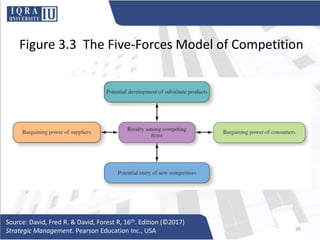
Figure 3.3 The Five-Forces Model of Competition
Source: David, Fred R. & David, Forest R, 16th. Edition (©2017)
Strategic Management. Pearson Education Inc., USA 26
The Five-Forces Model of Competition
1. Identify key aspects of each competitive force that impact
the firm.
2. Evaluate how strong and important each element is for
the firm.
3. Decide whether the collective strength of the elements is
worth the firm entering or staying in the industry.
Source: David, Fred R. & David, Forest R, 16th. Edition (©2017)
Strategic Management. Pearson Education Inc., USA 27
The Five-Forces Model of Competition
• Rivalry among competing firms
• Most powerful of the five forces
• Focus on competitive advantage of strategies over
other firms
Source: David, Fred R. & David, Forest R, 16th. Edition (©2017)
Strategic Management. Pearson Education Inc., USA 28
Table 3.5 The Five-Forces Model
1. When the number of competing firms is high
2. When competing firms are of similar size
3. When competing firms have similar capabilities
4. When demand for the industry’s products is changing rapidly
5. When price cuts are common in the industry
6. When consumers can switch brands easily
7. When barriers to leaving the market are high
8. When barriers to entering the market are low
9. When fixed costs are high among competing firms
10. When products are perishable or have short product life cycles
Conditions That Cause High Rivalry Among Competing Firms
Source: David, Fred R. & David, Forest R, 16th. Edition (©2017)
Strategic Management. Pearson Education Inc., USA
The Five-Forces Model
• Potential Entry of New Competitors
• Barriers to entry are important
• Quality, pricing, and marketing can overcome barriers
Source: David, Fred R. & David, Forest R, 16th. Edition (©2017)
Strategic Management. Pearson Education Inc., USA 30
Barriers to Entry
• Need to gain economies of scale quickly
• Need to gain technology and specialized know-how
• Lack of experience
• Strong customer loyalty
• Strong brand preferences
• Large capital requirements
• Lack of adequate distribution channels
• Government regulatory policies
• Tariffs
• Lack of access to raw materials
(Continued)
Source: David, Fred R. & David, Forest R, 16th. Edition (©2017)
Strategic Management. Pearson Education Inc., USA 31
Barriers to Entry
• Possession of patents
• Undesirable locations
• Counterattack by entrenched firms
• Potential saturation of the market
Source: David, Fred R. & David, Forest R, 16th. Edition (©2017)
Strategic Management. Pearson Education Inc., USA 32
The Five-Forces Model
• Potential development of substitute products
• Pressure increases when:
• Prices of substitutes decrease
• Consumers' switching costs decrease
Source: David, Fred R. & David, Forest R, 16th. Edition (©2017)
Strategic Management. Pearson Education Inc., USA 33
The Five-Forces Model
• Bargaining Power of Suppliers is increased when there
are:
• Few suppliers
• Few substitutes
• Costs of switching raw materials is high
• Backward integration is gaining control or ownership of
suppliers
Source: David, Fred R. & David, Forest R, 16th. Edition (©2017)
Strategic Management. Pearson Education Inc., USA 34
The Five-Forces Model
• Bargaining power of consumers
• Customers being concentrated or buying in volume
affects intensity of competition
• Consumer power is higher where products are
standard or undifferentiated
Source: David, Fred R. & David, Forest R, 16th. Edition (©2017)
Strategic Management. Pearson Education Inc., USA 35
Conditions Where Consumers
Gain Bargaining Power
1. If buyers can inexpensively switch
2. If buyers are particularly important
3. If sellers are struggling in the face of falling consumer
demand
4. If buyers are informed about sellers' products, prices,
and costs
5. If buyers have discretion in whether and when they
purchase the product
Source: David, Fred R. & David, Forest R, 16th. Edition (©2017)
Strategic Management. Pearson Education Inc., USA 36
Sources of External Information
• Unpublished sources include customer surveys, market
research, speeches at professional and shareholders'
meetings, television programs, interviews, and
conversations with stakeholders.
• Published sources of strategic information include
periodicals, journals, reports, government documents,
abstracts, books, directories, newspapers, and manuals.
Source: David, Fred R. & David, Forest R, 16th. Edition (©2017)
Strategic Management. Pearson Education Inc., USA 37
Forecasting Tools and Techniques
• Forecasts
• educated assumptions about future trends and events
• no forecast is perfect
Source: David, Fred R. & David, Forest R, 16th. Edition (©2017)
Strategic Management. Pearson Education Inc., USA 38
Making Assumptions
• Assumptions
• Best present estimates of the impact of major
external factors, over which the manager has little if
any control, but which may exert a significant impact
on performance or the ability to achieve desired
results
Source: David, Fred R. & David, Forest R, 16th. Edition (©2017)
Strategic Management. Pearson Education Inc., USA 39
Industry Analysis: The External
Factor Evaluation (EFE) Matrix
Summarize and evaluate these factors:
• Social
• Cultural
• Demographic
• Economic
• Environmental
• Political
• Governmental
• Legal
• Technological
• Competitive
Source: David, Fred R. & David, Forest R, 16th. Edition (©2017)
Strategic Management. Pearson Education Inc., USA
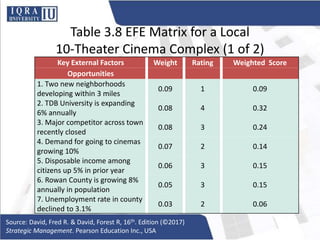
EFE Matrix Steps
1. List 20 key external factors
2. Weight from 0.0 to 1.0
3. Rate the effectiveness of current strategies from 1 - 4
4. Multiply weight * rating
5. Sum weighted scores
Source: David, Fred R. & David, Forest R, 16th. Edition (©2017)
Strategic Management. Pearson Education Inc., USA 41
Table 3.8 EFE Matrix for a Local
10-Theater Cinema Complex (1 of 2)
Key External Factors Weight Rating Weighted Score
Opportunities
1. Two new neighborhoods
developing within 3 miles
0.09 1 0.09
2. TDB University is expanding
6% annually
0.08 4 0.32
3. Major competitor across town
recently closed
0.08 3 0.24
4. Demand for going to cinemas
growing 10%
0.07 2 0.14
5. Disposable income among
citizens up 5% in prior year
0.06 3 0.15
6. Rowan County is growing 8%
annually in population
0.05 3 0.15
7. Unemployment rate in county
declined to 3.1%
0.03 2 0.06
Source: David, Fred R. & David, Forest R, 16th. Edition (©2017)
Strategic Management. Pearson Education Inc., USA
Table 3.8 EFE Matrix for a Local
10-Theater Cinema Complex (2 of 2)
Key External Factors Weight Rating Weighted Score
Threats
8. Trend toward healthy eating
eroding concession sales
0.12 4 0.48
9. Demand for online movies and
DVDs growing 10%
0.06 2 0.12
10. Commercial property adjacent to
cinemas for sale
0.06 3 0.18
11. TDB University installing an on-
campus movie theater
0.04 3 0.12
12. County and city property taxes
increasing 25%
0.08 2 0.6
13. Local religious groups object to R-
rated movies
0.04 3 0.12
14. Movies rented at local Red Box’s
up 12%
0.08 2 0.16
15. Movies rented last quarter from
Time Warner up 15%
0.06 1 0.06
Total 1.00 2.58
Industry Analysis: Competitive
Profile Matrix (CPM)
• Identifies firm's major competitors and their strengths
and weaknesses in relation to a sample firm's strategic
positions
• Critical success factors include internal and external
issues
Source: David, Fred R. & David, Forest R, 16th. Edition (©2017)
Strategic Management. Pearson Education Inc., USA 44
Table 3.10 An Example
Competitive Profile Matrix
• Note: The ratings values are as follows: 1 = response is poor, 2 = response is average, 3 = response is above average,
4 = response is superior. As indicated by the total weighted score of 2.20, Company 3 is performing worst. Only 8 critical
success factors are included for simplicity; in actuality, however, this is too few. The template asks that 12 factors be
included and to tailor factors to a given industry.
Source: David, Fred R. & David, Forest R, 16th. Edition (©2017)
Strategic Management. Pearson Education Inc., USA
Figure 3.4 How to Gain and
Sustain Competitive Advantages
Source: David, Fred R. & David, Forest R, 16th. Edition (©2017)
Strategic Management. Pearson Education Inc., USA 46
Session Ends
Disclaimer
The information provided in this module is derived from Pearson
Education Inc., USA, and other sources. All information is provided in
good faith for educational purposes only. Iqra University claims no
ownership of this information, and will not be liable for any claims
arising thereof, now or in the future.

Session 3 The External Assessment.pptx

  • 1.
    Unit 3 The ExternalAssessment Source: David, Fred R. & David, Forest R, 16th. Edition (©2017) Strategic Management. Pearson Education Inc., USA
  • 2.
    Learning Objectives 3.1 Describethe nature and purpose of an external assessment in formulating strategies. 3.2 Identify and discuss 10 external forces that impact organizations. 3.3 Explain Porter’s Five-Forces Model and its relevance in formulating strategies. 3.4 Describe key sources of information for identifying opportunities and threats. 3.5 Discuss forecasting tools and techniques. 3.6 Explain how to develop and use an External Factor Evaluation (EFE) Matrix. 3.7 Explain how to develop and use a Competitive Profile Matrix (CPM) Source: David, Fred R. & David, Forest R, 16th. Edition (©2017) Strategic Management. Pearson Education Inc., USA 2
  • 3.
    Figure 3.1 AComprehensive Strategic-Management Model Source: Fred R. David, “How Companies Define Their Mission,” Long Range Planning 22, no. 1 (February 1989): 91 3
  • 4.
    External Audit • Externalaudit • focuses on identifying and evaluating trends and events beyond the control of a single firm • reveals key opportunities and threats confronting an organization so that managers can formulate strategies to take advantage of the opportunities and avoid or reduce the impact of threats Source: David, Fred R. & David, Forest R, 16th. Edition (©2017) Strategic Management. Pearson Education Inc., USA 4
  • 5.
    The Purpose ofan External Audit • The external audit is aimed at identifying key variables that offer actionable responses. • Firms should be able to respond either offensively or defensively to the factors by formulating strategies that take advantage of external opportunities or that minimize the impact of potential threats. Source: David, Fred R. & David, Forest R, 16th. Edition (©2017) Strategic Management. Pearson Education Inc., USA 5
  • 6.
    Key External Forces •External forces can be divided into five broad categories: 1. economic forces 2. social, cultural, demographic, and environmental (SCDE) forces 3. political, governmental, and legal forces 4. technological forces 5. competitive forces Source: David, Fred R. & David, Forest R, 16th. Edition (©2017) Strategic Management. Pearson Education Inc., USA 6
  • 7.
    Figure 3.2 RelationshipsBetween Key External Forces and an Organization Source: David, Fred R. & David, Forest R, 16th. Edition (©2017) Strategic Management. Pearson Education Inc., USA 7
  • 8.
    Key External Forces •When identifying and prioritizing key external factors in strategic planning, the following factors are important: • Actionable • Quantitative Source: David, Fred R. & David, Forest R, 16th. Edition (©2017) Strategic Management. Pearson Education Inc., USA 8
  • 9.
    Economic Forces • Shiftto service economy • Availability of credit • Level of disposable income • Propensity of people to spend • Interest rates • Inflation rates • GDP trends • Consumption patterns • Unemployment trends • Value of the dollar (Continued) Source: David, Fred R. & David, Forest R, 16th. Edition (©2017) Strategic Management. Pearson Education Inc., USA 9
  • 10.
    Economic Forces • Import/Exportfactors • Demand shifts for different goods and services • Income differences by region and consumer group • Price fluctuations • Foreign countries’ economic conditions • Monetary and Fiscal policy • Stock market trends • Tax rate variation by country and state • European Economic Community (EEC) policies • Organization of Petroleum Exporting Countries (OPEC) policies Source: David, Fred R. & David, Forest R, 16th. Edition (©2017) Strategic Management. Pearson Education Inc., USA 10
  • 11.
    Social, Cultural, Demographic,and Environmental (SCDE) Forces • SCDE forces impact strategic decisions on virtually all products, services, markets, and customers. • These forces are shaping the way people live, work, produce, and consume. Source: David, Fred R. & David, Forest R, 16th. Edition (©2017) Strategic Management. Pearson Education Inc., USA 11
  • 12.
    Key SCDE Variables •Population changes by race, age, and geographic area • Regional changes in tastes and preferences • Number of marriages • Number of divorces • Number of births • Number of deaths • Immigration and emigration rates • Social Security programs (Continued) Source: David, Fred R. & David, Forest R, 16th. Edition (©2017) Strategic Management. Pearson Education Inc., USA 12
  • 13.
    Key SCDE Variables •Life expectancy rates • Per capita income • Social media pervasiveness • Attitudes toward retirement • Attitudes toward product quality • Attitudes toward customer service • Pollution control (Continued) Source: David, Fred R. & David, Forest R, 16th. Edition (©2017) Strategic Management. Pearson Education Inc., USA 13
  • 14.
    Key SCDE Variables •Attitudes toward foreign peoples • Energy conservation • Social programs • Number of churches • Number of church members • Social responsibility issues Source: David, Fred R. & David, Forest R, 16th. Edition (©2017) Strategic Management. Pearson Education Inc., USA 14
  • 15.
    Political, Governmental, andLegal Forces • Local, state, and federal laws, as well as regulatory agencies and special-interest groups, can have a major impact on the strategies of small, large, for-profit, and nonprofit organizations. Source: David, Fred R. & David, Forest R, 16th. Edition (©2017) Strategic Management. Pearson Education Inc., USA 15
  • 16.
    Political, Government, andLegal Variables • Natural environmental regulations • Protectionist actions by countries • Changes in patent laws • Equal employment opportunity laws • Level of defense expenditures • Unionization trends • Antitrust legislation • USA versus other country relationships • Political conditions in countries (Continued) Source: David, Fred R. & David, Forest R, 16th. Edition (©2017) Strategic Management. Pearson Education Inc., USA 16
  • 17.
    Political, Government, andLegal Variables • Global price of oil changes • Local, state, and federal laws • Import-export regulations • Tariffs, particularly on steel and aluminum • Local, state, and national elections Source: David, Fred R. & David, Forest R, 16th. Edition (©2017) Strategic Management. Pearson Education Inc., USA 17
  • 18.
    Technological Forces • Newtechnologies such as: • the Internet of Things • 3D printing • the cloud • mobile devices • biotech • analytics • autotech • robotics and • artificial intelligence Source: David, Fred R. & David, Forest R, 16th. Edition (©2017) Strategic Management. Pearson Education Inc., USA 18
  • 19.
    Technological Forces • Manyfirms now have a Chief Information Officer (CIO) and a Chief Technology Officer (CTO) who work together to ensure that information needed to formulate, implement, and evaluate strategies is available where and when it is needed. Source: David, Fred R. & David, Forest R, 16th. Edition (©2017) Strategic Management. Pearson Education Inc., USA 19
  • 20.
    Competitive Forces • Animportant part of an external audit is identifying rival firms and determining their strengths, weaknesses, capabilities, opportunities, threats, objectives, and strategies. Source: David, Fred R. & David, Forest R, 16th. Edition (©2017) Strategic Management. Pearson Education Inc., USA 20
  • 21.
    Obtaining Competitive Intelligence Legaland ethical ways to obtain competitive intelligence: 1. Reverse-engineer rival firms’ products. 2. Use surveys and interviews of customers, suppliers, and distributors of rival firms. 3. Analyze rival firm’s Form 10-K. 4. Conduct fly-over and drive-by visits to rival firm operations. 5. Search online databases. 6. Contact government agencies for public information about rival firms. (Continued) Source: David, Fred R. & David, Forest R, 16th. Edition (©2017) Strategic Management. Pearson Education Inc., USA 21
  • 22.
    Obtaining Competitive Intelligence 7.Monitor relevant trade publications, magazines, and newspapers. 8. Purchase social-media data about customers of all firms in the industry. 9. Hire top executives from rival firms. Source: David, Fred R. & David, Forest R, 16th. Edition (©2017) Strategic Management. Pearson Education Inc., USA 22
  • 23.
    Key Questions AboutCompetitors 1. What are the strengths and weaknesses of our major competitors? 2. What products and services do we offer that are unique in the industry? 3. What are the objectives and strategies of our major competitors? 4. How will our major competitors most likely respond to current economic, SCDE, political, governmental, legal, technological, and competitive trends affecting our industry? (Continued) Source: David, Fred R. & David, Forest R, 16th. Edition (©2017) Strategic Management. Pearson Education Inc., USA 23
  • 24.
    Key Questions AboutCompetitors 5. How vulnerable are the major competitors to our new strategies, products, and services? 6. How vulnerable is our firm to successful counterattack by our major competitors? 7. How does our firm compare to rivals in mastering the social-media conversation in this industry? 8. To what extent are new firms entering and old firms leaving this industry? 9. What key factors have resulted in our present competitive position in this industry? 10. How are supplier and distributor relationships changing in this industry? Source: David, Fred R. & David, Forest R, 16th. Edition (©2017) Strategic Management. Pearson Education Inc., USA 24
  • 25.
    Competitive Intelligence Programs •Competitive intelligence (CI) • a systematic and ethical process for gathering and analyzing information about the competition's activities and general business trends to further a business's own goals Source: David, Fred R. & David, Forest R, 16th. Edition (©2017) Strategic Management. Pearson Education Inc., USA 25
  • 26.
    Figure 3.3 TheFive-Forces Model of Competition Source: David, Fred R. & David, Forest R, 16th. Edition (©2017) Strategic Management. Pearson Education Inc., USA 26
  • 27.
    The Five-Forces Modelof Competition 1. Identify key aspects of each competitive force that impact the firm. 2. Evaluate how strong and important each element is for the firm. 3. Decide whether the collective strength of the elements is worth the firm entering or staying in the industry. Source: David, Fred R. & David, Forest R, 16th. Edition (©2017) Strategic Management. Pearson Education Inc., USA 27
  • 28.
    The Five-Forces Modelof Competition • Rivalry among competing firms • Most powerful of the five forces • Focus on competitive advantage of strategies over other firms Source: David, Fred R. & David, Forest R, 16th. Edition (©2017) Strategic Management. Pearson Education Inc., USA 28
  • 29.
    Table 3.5 TheFive-Forces Model 1. When the number of competing firms is high 2. When competing firms are of similar size 3. When competing firms have similar capabilities 4. When demand for the industry’s products is changing rapidly 5. When price cuts are common in the industry 6. When consumers can switch brands easily 7. When barriers to leaving the market are high 8. When barriers to entering the market are low 9. When fixed costs are high among competing firms 10. When products are perishable or have short product life cycles Conditions That Cause High Rivalry Among Competing Firms Source: David, Fred R. & David, Forest R, 16th. Edition (©2017) Strategic Management. Pearson Education Inc., USA
  • 30.
    The Five-Forces Model •Potential Entry of New Competitors • Barriers to entry are important • Quality, pricing, and marketing can overcome barriers Source: David, Fred R. & David, Forest R, 16th. Edition (©2017) Strategic Management. Pearson Education Inc., USA 30
  • 31.
    Barriers to Entry •Need to gain economies of scale quickly • Need to gain technology and specialized know-how • Lack of experience • Strong customer loyalty • Strong brand preferences • Large capital requirements • Lack of adequate distribution channels • Government regulatory policies • Tariffs • Lack of access to raw materials (Continued) Source: David, Fred R. & David, Forest R, 16th. Edition (©2017) Strategic Management. Pearson Education Inc., USA 31
  • 32.
    Barriers to Entry •Possession of patents • Undesirable locations • Counterattack by entrenched firms • Potential saturation of the market Source: David, Fred R. & David, Forest R, 16th. Edition (©2017) Strategic Management. Pearson Education Inc., USA 32
  • 33.
    The Five-Forces Model •Potential development of substitute products • Pressure increases when: • Prices of substitutes decrease • Consumers' switching costs decrease Source: David, Fred R. & David, Forest R, 16th. Edition (©2017) Strategic Management. Pearson Education Inc., USA 33
  • 34.
    The Five-Forces Model •Bargaining Power of Suppliers is increased when there are: • Few suppliers • Few substitutes • Costs of switching raw materials is high • Backward integration is gaining control or ownership of suppliers Source: David, Fred R. & David, Forest R, 16th. Edition (©2017) Strategic Management. Pearson Education Inc., USA 34
  • 35.
    The Five-Forces Model •Bargaining power of consumers • Customers being concentrated or buying in volume affects intensity of competition • Consumer power is higher where products are standard or undifferentiated Source: David, Fred R. & David, Forest R, 16th. Edition (©2017) Strategic Management. Pearson Education Inc., USA 35
  • 36.
    Conditions Where Consumers GainBargaining Power 1. If buyers can inexpensively switch 2. If buyers are particularly important 3. If sellers are struggling in the face of falling consumer demand 4. If buyers are informed about sellers' products, prices, and costs 5. If buyers have discretion in whether and when they purchase the product Source: David, Fred R. & David, Forest R, 16th. Edition (©2017) Strategic Management. Pearson Education Inc., USA 36
  • 37.
    Sources of ExternalInformation • Unpublished sources include customer surveys, market research, speeches at professional and shareholders' meetings, television programs, interviews, and conversations with stakeholders. • Published sources of strategic information include periodicals, journals, reports, government documents, abstracts, books, directories, newspapers, and manuals. Source: David, Fred R. & David, Forest R, 16th. Edition (©2017) Strategic Management. Pearson Education Inc., USA 37
  • 38.
    Forecasting Tools andTechniques • Forecasts • educated assumptions about future trends and events • no forecast is perfect Source: David, Fred R. & David, Forest R, 16th. Edition (©2017) Strategic Management. Pearson Education Inc., USA 38
  • 39.
    Making Assumptions • Assumptions •Best present estimates of the impact of major external factors, over which the manager has little if any control, but which may exert a significant impact on performance or the ability to achieve desired results Source: David, Fred R. & David, Forest R, 16th. Edition (©2017) Strategic Management. Pearson Education Inc., USA 39
  • 40.
    Industry Analysis: TheExternal Factor Evaluation (EFE) Matrix Summarize and evaluate these factors: • Social • Cultural • Demographic • Economic • Environmental • Political • Governmental • Legal • Technological • Competitive Source: David, Fred R. & David, Forest R, 16th. Edition (©2017) Strategic Management. Pearson Education Inc., USA
  • 41.
    EFE Matrix Steps 1.List 20 key external factors 2. Weight from 0.0 to 1.0 3. Rate the effectiveness of current strategies from 1 - 4 4. Multiply weight * rating 5. Sum weighted scores Source: David, Fred R. & David, Forest R, 16th. Edition (©2017) Strategic Management. Pearson Education Inc., USA 41
  • 42.
    Table 3.8 EFEMatrix for a Local 10-Theater Cinema Complex (1 of 2) Key External Factors Weight Rating Weighted Score Opportunities 1. Two new neighborhoods developing within 3 miles 0.09 1 0.09 2. TDB University is expanding 6% annually 0.08 4 0.32 3. Major competitor across town recently closed 0.08 3 0.24 4. Demand for going to cinemas growing 10% 0.07 2 0.14 5. Disposable income among citizens up 5% in prior year 0.06 3 0.15 6. Rowan County is growing 8% annually in population 0.05 3 0.15 7. Unemployment rate in county declined to 3.1% 0.03 2 0.06 Source: David, Fred R. & David, Forest R, 16th. Edition (©2017) Strategic Management. Pearson Education Inc., USA
  • 43.
    Table 3.8 EFEMatrix for a Local 10-Theater Cinema Complex (2 of 2) Key External Factors Weight Rating Weighted Score Threats 8. Trend toward healthy eating eroding concession sales 0.12 4 0.48 9. Demand for online movies and DVDs growing 10% 0.06 2 0.12 10. Commercial property adjacent to cinemas for sale 0.06 3 0.18 11. TDB University installing an on- campus movie theater 0.04 3 0.12 12. County and city property taxes increasing 25% 0.08 2 0.6 13. Local religious groups object to R- rated movies 0.04 3 0.12 14. Movies rented at local Red Box’s up 12% 0.08 2 0.16 15. Movies rented last quarter from Time Warner up 15% 0.06 1 0.06 Total 1.00 2.58
  • 44.
    Industry Analysis: Competitive ProfileMatrix (CPM) • Identifies firm's major competitors and their strengths and weaknesses in relation to a sample firm's strategic positions • Critical success factors include internal and external issues Source: David, Fred R. & David, Forest R, 16th. Edition (©2017) Strategic Management. Pearson Education Inc., USA 44
  • 45.
    Table 3.10 AnExample Competitive Profile Matrix • Note: The ratings values are as follows: 1 = response is poor, 2 = response is average, 3 = response is above average, 4 = response is superior. As indicated by the total weighted score of 2.20, Company 3 is performing worst. Only 8 critical success factors are included for simplicity; in actuality, however, this is too few. The template asks that 12 factors be included and to tailor factors to a given industry. Source: David, Fred R. & David, Forest R, 16th. Edition (©2017) Strategic Management. Pearson Education Inc., USA
  • 46.
    Figure 3.4 Howto Gain and Sustain Competitive Advantages Source: David, Fred R. & David, Forest R, 16th. Edition (©2017) Strategic Management. Pearson Education Inc., USA 46
  • 47.
  • 48.
    Disclaimer The information providedin this module is derived from Pearson Education Inc., USA, and other sources. All information is provided in good faith for educational purposes only. Iqra University claims no ownership of this information, and will not be liable for any claims arising thereof, now or in the future.

Editor's Notes

  • #30 This slide summarizes conditions that cause high rivalry among competing firms.
  • #41 An External Factor Evaluation (EFE) Matrix allows strategists to summarize and evaluate economic, social, cultural, demographic, environmental, political, governmental, legal, technological, and competitive information.
  • #44 The most important factor to being successful in this business is “Trend toward healthy eating eroding concession sales,” as indicated by the 0.12 weight. Also note that the local cinema is doing excellent in regard to handling two factors, “TDB University is expanding 6 percent annually” and “Trend toward healthy eating eroding concession sales.” Perhaps the cinema is placing flyers on campus and also adding yogurt and healthy drinks to its concession menu.