Strategic Management:
Concepts and Cases 9e
          Part II: Strategic Actions:
               Strategy Formulation
Chapter 6: Corporate-Level Strategy


         ©2011 Cengage Learning. All Rights Reserved. May not be scanned,
          copied or duplicated, or posted to a publicly accessible website, in
                                                             whole or in part.
Chapter 6: Corporate-Level Strategy

• Overview: Seven content areas
     – Define and discuss corporate-level strategy
     – Different levels of diversification
     – Three primary reasons firms diversify
     – Value creation: related diversification strategy
     – Value creation: unrelated diversification strategy
     – Incentives and resources encouraging value-neutral
       diversification
     – Management motives encouraging firm
       overdiversification


©2011 Cengage Learning. All Rights Reserved. May not be scanned, copied or duplicated, or posted to a publicly accessible website, in whole or in part.
Introduction

• Corporate-level strategy: Specifies actions a
  firm takes to gain a competitive advantage by
  selecting and managing a group of different
  businesses competing in different product markets
     – Expected to help firm earn above-average returns
     – Value ultimately determined by degree to which “the
       businesses in the portfolio are worth more under the
       management of the company then they would be under
       any other ownership
            • Product diversification (PD): primary form of corporate-
              level strategy


©2011 Cengage Learning. All Rights Reserved. May not be scanned, copied or duplicated, or posted to a publicly accessible website, in whole or in part.
Introduction

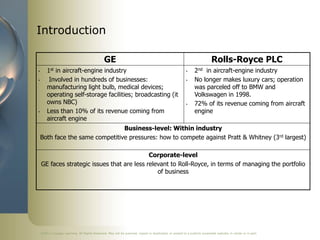
                                                GE                                                                        Rolls-Royce PLC
•       1st in aircraft-engine industry                                                                  •     2nd in aircraft-engine industry
•        Involved in hundreds of businesses:                                                             •     No longer makes luxury cars; operation
        manufacturing light bulb, medical devices;                                                             was parceled off to BMW and
        operating self-storage facilities; broadcasting (it                                                    Volkswagen in 1998.
        owns NBC)                                                                                        •     72% of its revenue coming from aircraft
•       Less than 10% of its revenue coming from                                                               engine
        aircraft engine
                                 Business-level: Within industry
    Both face the same competitive pressures: how to compete against Pratt & Whitney (3rd largest)

                                             Corporate-level
    GE faces strategic issues that are less relevant to Roll-Royce, in terms of managing the portfolio
                                                of business


    ©2011 Cengage Learning. All Rights Reserved. May not be scanned, copied or duplicated, or posted to a publicly accessible website, in whole or in part.
Levels of Diversification

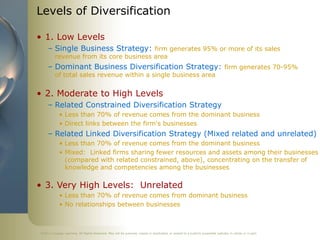
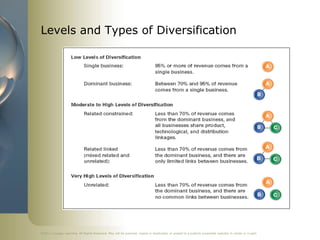
• 1. Low Levels
     – Single Business Strategy: firm generates 95% or more of its sales
         revenue from its core business area
     – Dominant Business Diversification Strategy: firm generates 70-95%
         of total sales revenue within a single business area


• 2. Moderate to High Levels
     – Related Constrained Diversification Strategy
            • Less than 70% of revenue comes from the dominant business
            • Direct links between the firm's businesses
     – Related Linked Diversification Strategy (Mixed related and unrelated)
            • Less than 70% of revenue comes from the dominant business
            • Mixed: Linked firms sharing fewer resources and assets among their businesses
              (compared with related constrained, above), concentrating on the transfer of
              knowledge and competencies among the businesses

• 3. Very High Levels: Unrelated
            • Less than 70% of revenue comes from dominant business
            • No relationships between businesses


©2011 Cengage Learning. All Rights Reserved. May not be scanned, copied or duplicated, or posted to a publicly accessible website, in whole or in part.
Levels and Types of Diversification


©2011 Cengage Learning. All Rights Reserved. May not be scanned, copied or duplicated, or posted to a publicly accessible website, in whole or in part.
Reasons for Diversification

• A number of reasons exist for diversification:

     – Value-creating

     – Value-neutral

     – Value-reducing


©2011 Cengage Learning. All Rights Reserved. May not be scanned, copied or duplicated, or posted to a publicly accessible website, in whole or in part.
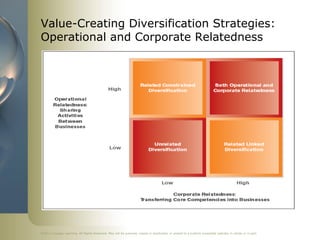
Value-Creating Diversification Strategies:
Operational and Corporate Relatedness


©2011 Cengage Learning. All Rights Reserved. May not be scanned, copied or duplicated, or posted to a publicly accessible website, in whole or in part.
Value-Creating Diversification (VCD): Related
Strategies

• Purpose: Gain market power relative to competitors
• Related diversification wants to develop and exploit
  economies of scope between its businesses
     – Economies of scope: Cost savings firm creates by successfully
       sharing some of its resources and capabilities or transferring one
       or more corporate-level core competencies that were developed in
       one of its businesses to another of its businesses
• VCD: Composed of ‘related’ diversification strategies
  including Operational and Corporate relatedness


©2011 Cengage Learning. All Rights Reserved. May not be scanned, copied or duplicated, or posted to a publicly accessible website, in whole or in part.
Value-Creating Diversification (VCD): Related
Strategies                              (Cont’d)


• 1. Operational Relatedness: Sharing activities
     –   Can gain economies of scope
     –   Share primary or support activities (in value chain)
     –   Related constrained share activities in order to create value
     –   Not easy, often synergies not realized as planned

• 2. Corporate Relatedness: Core competency transfer
     – Complex sets of resources and capabilities linking different
       businesses through managerial and technological knowledge,
       experience and expertise
     – Two sources of value creation
            • Expense incurred in first business and knowledge transfer reduces
              resource allocation for second business
            • Intangible resources difficult for competitors to understand and imitate
     – Use related-linked diversification strategy


©2011 Cengage Learning. All Rights Reserved. May not be scanned, copied or duplicated, or posted to a publicly accessible website, in whole or in part.
Value-Creating Diversification (VCD): Related
Strategies                              (Cont’d)


• Market Power
     – Exists when a firm is able to sell its products above the
       existing competitive level, to reduce costs of primary and
       support activities below the competitive level, or both.
     – Multimarket (or Multipoint) Competition
            • Exists when 2 or more diversified firms simultaneously compete
              in the same product or geographic markets.
     – Related diversification strategy may include
            • Vertical Integration
            • Virtual integration


©2011 Cengage Learning. All Rights Reserved. May not be scanned, copied or duplicated, or posted to a publicly accessible website, in whole or in part.
Value-Creating Diversification (VCD):
Unrelated Strategies

• Creates value through two types of financial
  economies
     – Cost savings realized through improved allocations of
       financial resources based on investments inside or
       outside firm
            • Efficient internal capital market allocation
     – Restructuring of acquired assets
            • Firm A buys firm B and restructures assets so it can operate
              more profitably, then A sells B for a profit in the external
              market


©2011 Cengage Learning. All Rights Reserved. May not be scanned, copied or duplicated, or posted to a publicly accessible website, in whole or in part.
Value-Neutral Diversification:
Incentives and Resources

• Incentives to Diversify
     – Antitrust Regulation and Tax Laws
     – Low Performance
     – Uncertain Future Cash Flows
     – Synergy and Firm Risk Reduction
     – Resources and Diversification


©2011 Cengage Learning. All Rights Reserved. May not be scanned, copied or duplicated, or posted to a publicly accessible website, in whole or in part.
Value-Reducing Diversification:
Managerial Motives to Diversify

• Top-level executives may diversify in order to
  diversity their own employment risk, as long as
  profitability does not suffer excessively
     – Diversification adds benefits to top-level managers but
       not shareholders
     – This strategy may be held in check by governance
       mechanisms or concerns for one’s reputation


©2011 Cengage Learning. All Rights Reserved. May not be scanned, copied or duplicated, or posted to a publicly accessible website, in whole or in part.
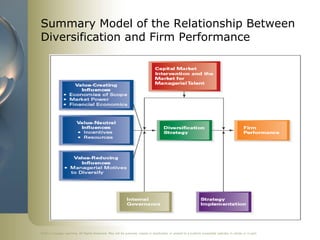
Summary Model of the Relationship Between
Diversification and Firm Performance


©2011 Cengage Learning. All Rights Reserved. May not be scanned, copied or duplicated, or posted to a publicly accessible website, in whole or in part.

Chapter 6 corporate-level strategy

  • 1.
    Strategic Management: Concepts andCases 9e Part II: Strategic Actions: Strategy Formulation Chapter 6: Corporate-Level Strategy ©2011 Cengage Learning. All Rights Reserved. May not be scanned, copied or duplicated, or posted to a publicly accessible website, in whole or in part.
  • 2.
    Chapter 6: Corporate-LevelStrategy • Overview: Seven content areas – Define and discuss corporate-level strategy – Different levels of diversification – Three primary reasons firms diversify – Value creation: related diversification strategy – Value creation: unrelated diversification strategy – Incentives and resources encouraging value-neutral diversification – Management motives encouraging firm overdiversification ©2011 Cengage Learning. All Rights Reserved. May not be scanned, copied or duplicated, or posted to a publicly accessible website, in whole or in part.
  • 3.
    Introduction • Corporate-level strategy:Specifies actions a firm takes to gain a competitive advantage by selecting and managing a group of different businesses competing in different product markets – Expected to help firm earn above-average returns – Value ultimately determined by degree to which “the businesses in the portfolio are worth more under the management of the company then they would be under any other ownership • Product diversification (PD): primary form of corporate- level strategy ©2011 Cengage Learning. All Rights Reserved. May not be scanned, copied or duplicated, or posted to a publicly accessible website, in whole or in part.
  • 4.
    Introduction GE Rolls-Royce PLC • 1st in aircraft-engine industry • 2nd in aircraft-engine industry • Involved in hundreds of businesses: • No longer makes luxury cars; operation manufacturing light bulb, medical devices; was parceled off to BMW and operating self-storage facilities; broadcasting (it Volkswagen in 1998. owns NBC) • 72% of its revenue coming from aircraft • Less than 10% of its revenue coming from engine aircraft engine Business-level: Within industry Both face the same competitive pressures: how to compete against Pratt & Whitney (3rd largest) Corporate-level GE faces strategic issues that are less relevant to Roll-Royce, in terms of managing the portfolio of business ©2011 Cengage Learning. All Rights Reserved. May not be scanned, copied or duplicated, or posted to a publicly accessible website, in whole or in part.
  • 5.
    Levels of Diversification •1. Low Levels – Single Business Strategy: firm generates 95% or more of its sales revenue from its core business area – Dominant Business Diversification Strategy: firm generates 70-95% of total sales revenue within a single business area • 2. Moderate to High Levels – Related Constrained Diversification Strategy • Less than 70% of revenue comes from the dominant business • Direct links between the firm's businesses – Related Linked Diversification Strategy (Mixed related and unrelated) • Less than 70% of revenue comes from the dominant business • Mixed: Linked firms sharing fewer resources and assets among their businesses (compared with related constrained, above), concentrating on the transfer of knowledge and competencies among the businesses • 3. Very High Levels: Unrelated • Less than 70% of revenue comes from dominant business • No relationships between businesses ©2011 Cengage Learning. All Rights Reserved. May not be scanned, copied or duplicated, or posted to a publicly accessible website, in whole or in part.
  • 6.
    Levels and Typesof Diversification ©2011 Cengage Learning. All Rights Reserved. May not be scanned, copied or duplicated, or posted to a publicly accessible website, in whole or in part.
  • 7.
    Reasons for Diversification •A number of reasons exist for diversification: – Value-creating – Value-neutral – Value-reducing ©2011 Cengage Learning. All Rights Reserved. May not be scanned, copied or duplicated, or posted to a publicly accessible website, in whole or in part.
  • 8.
    Value-Creating Diversification Strategies: Operationaland Corporate Relatedness ©2011 Cengage Learning. All Rights Reserved. May not be scanned, copied or duplicated, or posted to a publicly accessible website, in whole or in part.
  • 9.
    Value-Creating Diversification (VCD):Related Strategies • Purpose: Gain market power relative to competitors • Related diversification wants to develop and exploit economies of scope between its businesses – Economies of scope: Cost savings firm creates by successfully sharing some of its resources and capabilities or transferring one or more corporate-level core competencies that were developed in one of its businesses to another of its businesses • VCD: Composed of ‘related’ diversification strategies including Operational and Corporate relatedness ©2011 Cengage Learning. All Rights Reserved. May not be scanned, copied or duplicated, or posted to a publicly accessible website, in whole or in part.
  • 10.
    Value-Creating Diversification (VCD):Related Strategies (Cont’d) • 1. Operational Relatedness: Sharing activities – Can gain economies of scope – Share primary or support activities (in value chain) – Related constrained share activities in order to create value – Not easy, often synergies not realized as planned • 2. Corporate Relatedness: Core competency transfer – Complex sets of resources and capabilities linking different businesses through managerial and technological knowledge, experience and expertise – Two sources of value creation • Expense incurred in first business and knowledge transfer reduces resource allocation for second business • Intangible resources difficult for competitors to understand and imitate – Use related-linked diversification strategy ©2011 Cengage Learning. All Rights Reserved. May not be scanned, copied or duplicated, or posted to a publicly accessible website, in whole or in part.
  • 11.
    Value-Creating Diversification (VCD):Related Strategies (Cont’d) • Market Power – Exists when a firm is able to sell its products above the existing competitive level, to reduce costs of primary and support activities below the competitive level, or both. – Multimarket (or Multipoint) Competition • Exists when 2 or more diversified firms simultaneously compete in the same product or geographic markets. – Related diversification strategy may include • Vertical Integration • Virtual integration ©2011 Cengage Learning. All Rights Reserved. May not be scanned, copied or duplicated, or posted to a publicly accessible website, in whole or in part.
  • 12.
    Value-Creating Diversification (VCD): UnrelatedStrategies • Creates value through two types of financial economies – Cost savings realized through improved allocations of financial resources based on investments inside or outside firm • Efficient internal capital market allocation – Restructuring of acquired assets • Firm A buys firm B and restructures assets so it can operate more profitably, then A sells B for a profit in the external market ©2011 Cengage Learning. All Rights Reserved. May not be scanned, copied or duplicated, or posted to a publicly accessible website, in whole or in part.
  • 13.
    Value-Neutral Diversification: Incentives andResources • Incentives to Diversify – Antitrust Regulation and Tax Laws – Low Performance – Uncertain Future Cash Flows – Synergy and Firm Risk Reduction – Resources and Diversification ©2011 Cengage Learning. All Rights Reserved. May not be scanned, copied or duplicated, or posted to a publicly accessible website, in whole or in part.
  • 14.
    Value-Reducing Diversification: Managerial Motivesto Diversify • Top-level executives may diversify in order to diversity their own employment risk, as long as profitability does not suffer excessively – Diversification adds benefits to top-level managers but not shareholders – This strategy may be held in check by governance mechanisms or concerns for one’s reputation ©2011 Cengage Learning. All Rights Reserved. May not be scanned, copied or duplicated, or posted to a publicly accessible website, in whole or in part.
  • 15.
    Summary Model ofthe Relationship Between Diversification and Firm Performance ©2011 Cengage Learning. All Rights Reserved. May not be scanned, copied or duplicated, or posted to a publicly accessible website, in whole or in part.