SUBMITTED BY:
JASFIA KHANAM FAMA - 133200105
KARUNA KHANAM - 131200050
SYEDA SHAJIDA SHARMIN USHA -
132200018
MD. TORIQUL ISLAM - 122200053
MD.MAHADI HASAN ROBIN - 132200035
Presentation
on
Introduction to science
SUBMITTED TO:
NAHNEEN SULTANA
ASSISTANT
PROFESSOR, FBA
Presentation Topic:
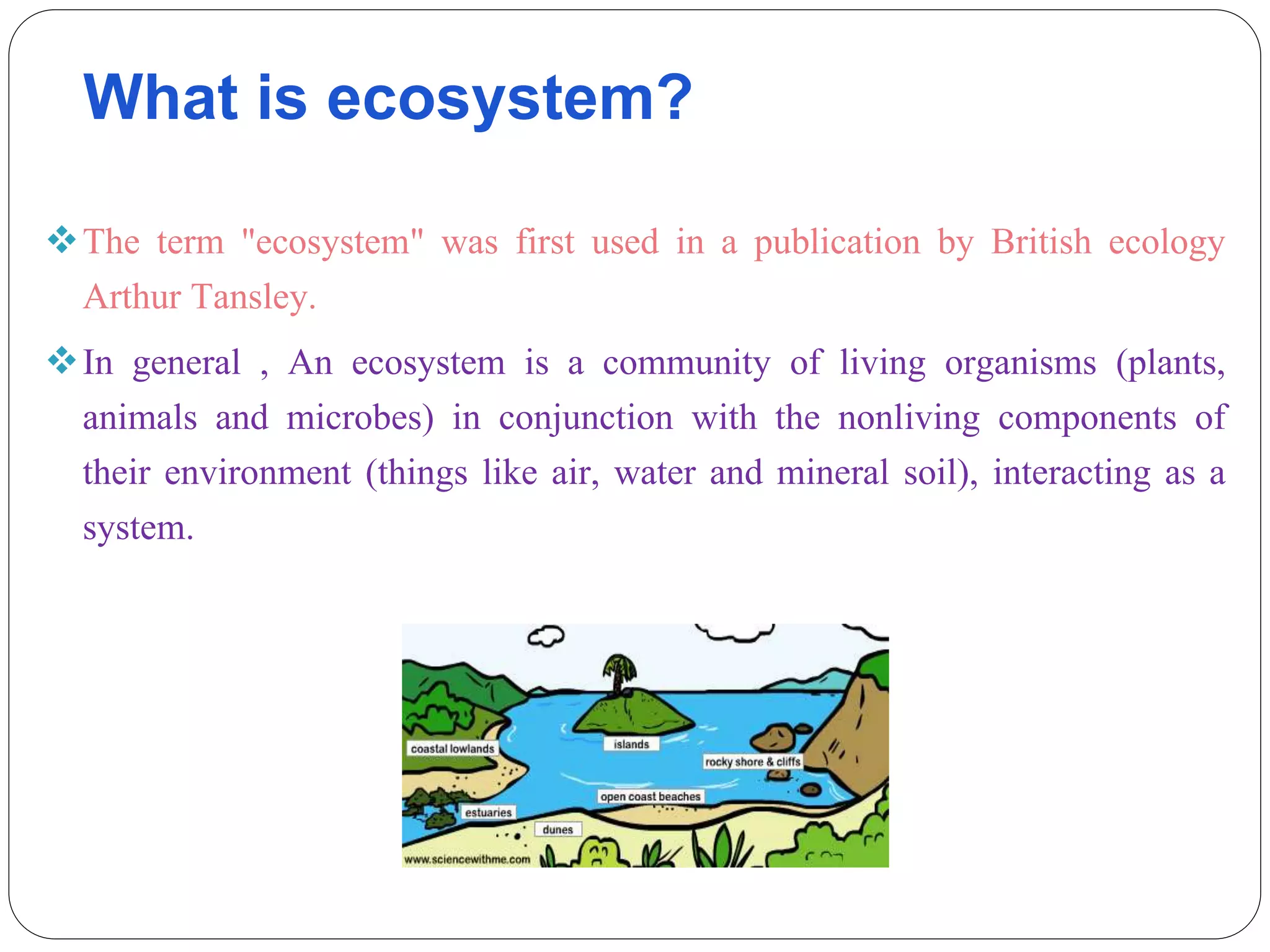
What is ecosystem?
The term "ecosystem" was first used in a publication by British ecology
Arthur Tansley.
In general , An ecosystem is a community of living organisms (plants,
animals and microbes) in conjunction with the nonliving components of
their environment (things like air, water and mineral soil), interacting as a
system.
The structure of a community
1. Producer Organism:
Green plants are the primary producer of the ecosystem.
2. Consumer organism:
Consumer organism are those cannot make their own food.
 1st order consumers-are the herbivores which feed directly on plants.
Example: cows, kangaroos, insects, zooplankton, rabbits, goats etc.
 2nd order consumers- The animals which feed on herbivores.
Example: birds, foxes, small fishes etc.
 3rd order consumers-are larger carnivores which feed on the 2nd order consumers,
Example: snakes and large fish.
 Scavengers- are animals that feed on any dead matter.
Example: mud crab, maggots etc.
3. Decomposer organisms
They break down foods and decomposes them to get energy.
Example: bacteria and fungi
Energy pyramid:
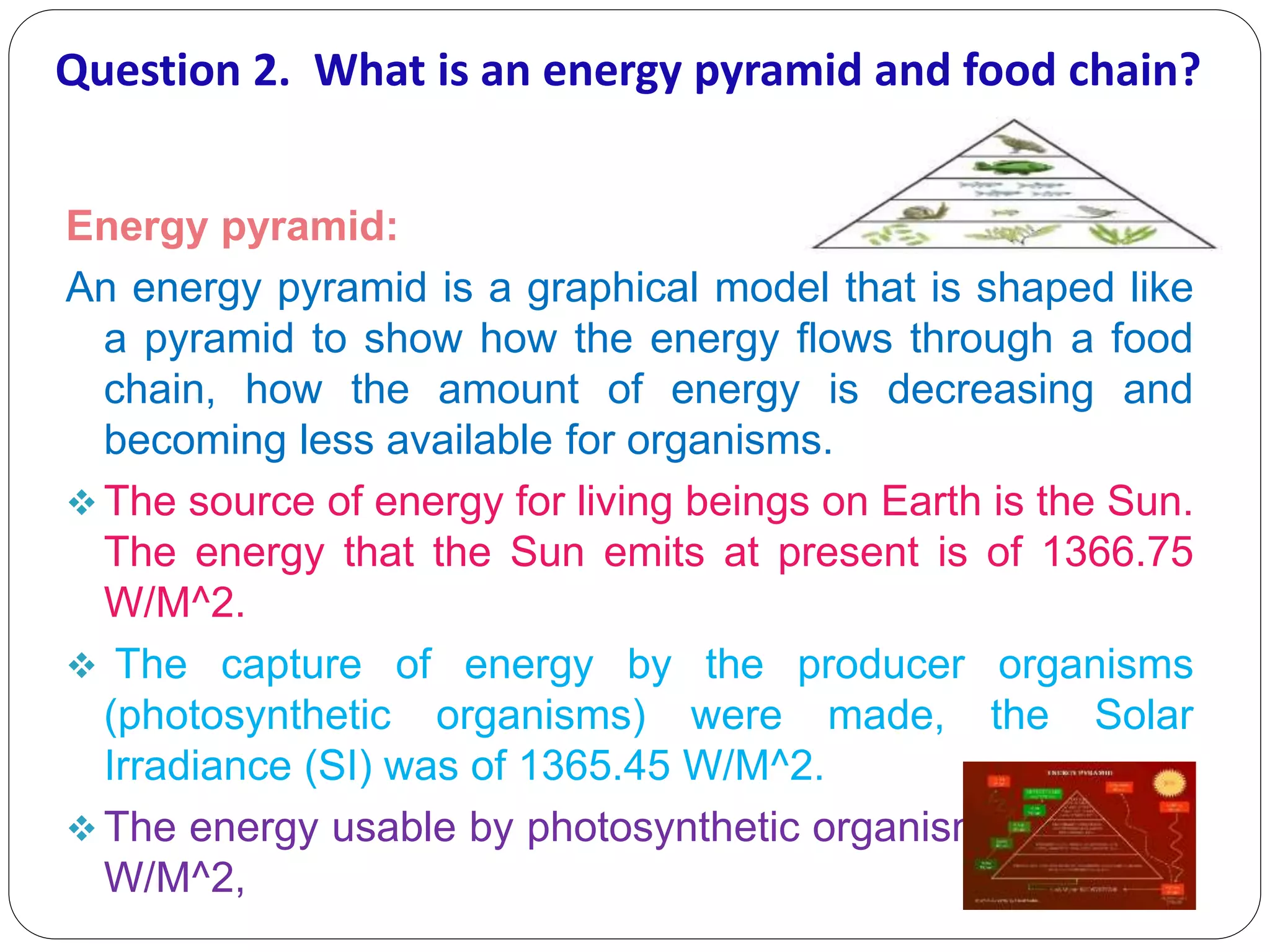
An energy pyramid is a graphical model that is shaped like
a pyramid to show how the energy flows through a food
chain, how the amount of energy is decreasing and
becoming less available for organisms.
 The source of energy for living beings on Earth is the Sun.
The energy that the Sun emits at present is of 1366.75
W/M^2.
 The capture of energy by the producer organisms
(photosynthetic organisms) were made, the Solar
Irradiance (SI) was of 1365.45 W/M^2.
 The energy usable by photosynthetic organisms is 697.04
W/M^2,
Question 2. What is an energy pyramid and food chain?
Food chain
 Food chains were first introduced by the African-Arab
scientist and philosopher Al-Jahiz in the 9th century .
 The food chain's length is a continuous variable that
provides a measure of the passage of energy and an
index of ecological structure that increases in value
counting progressively through the linkages in a linear
fashion from the lowest to the highest levels.
 Food chains vary in length from three to six or more
levels.
 Some animals eat plants and some animals eat other
animals.
 For example, a simple food chain links the trees &
shrubs, the giraffes (that eat trees & shrubs), and the
lions (that eat the giraffes). Each link in this chain is
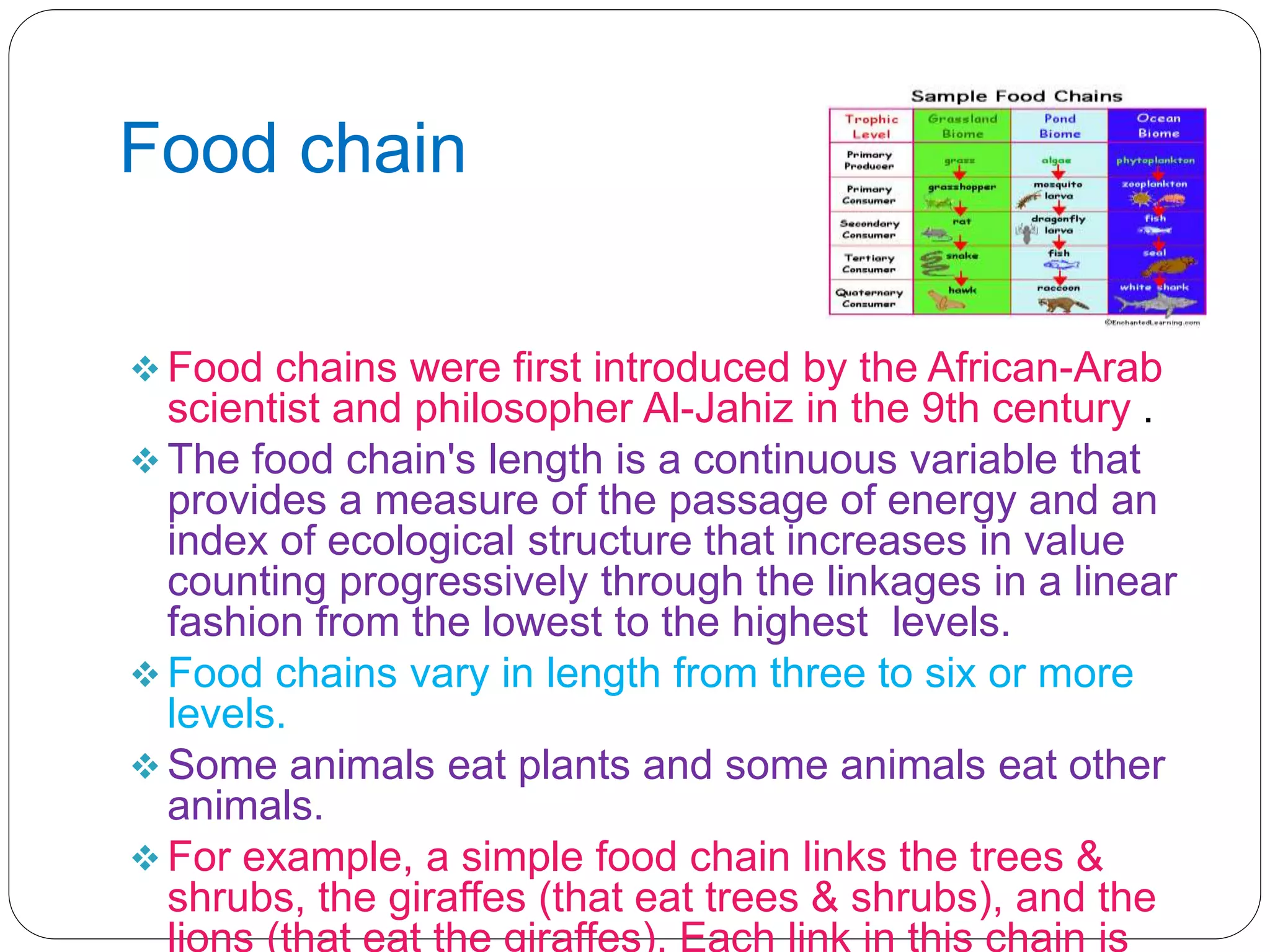
 A food chain consisting of a flower, a frog, a snake and an
owl consists of four levels;
 whereas a food chain consisting of grass, a grasshopper,
a rat, a snake and finally a hawk consists of five levels.
Question no 3: what are the different types of nutrient
cycling?
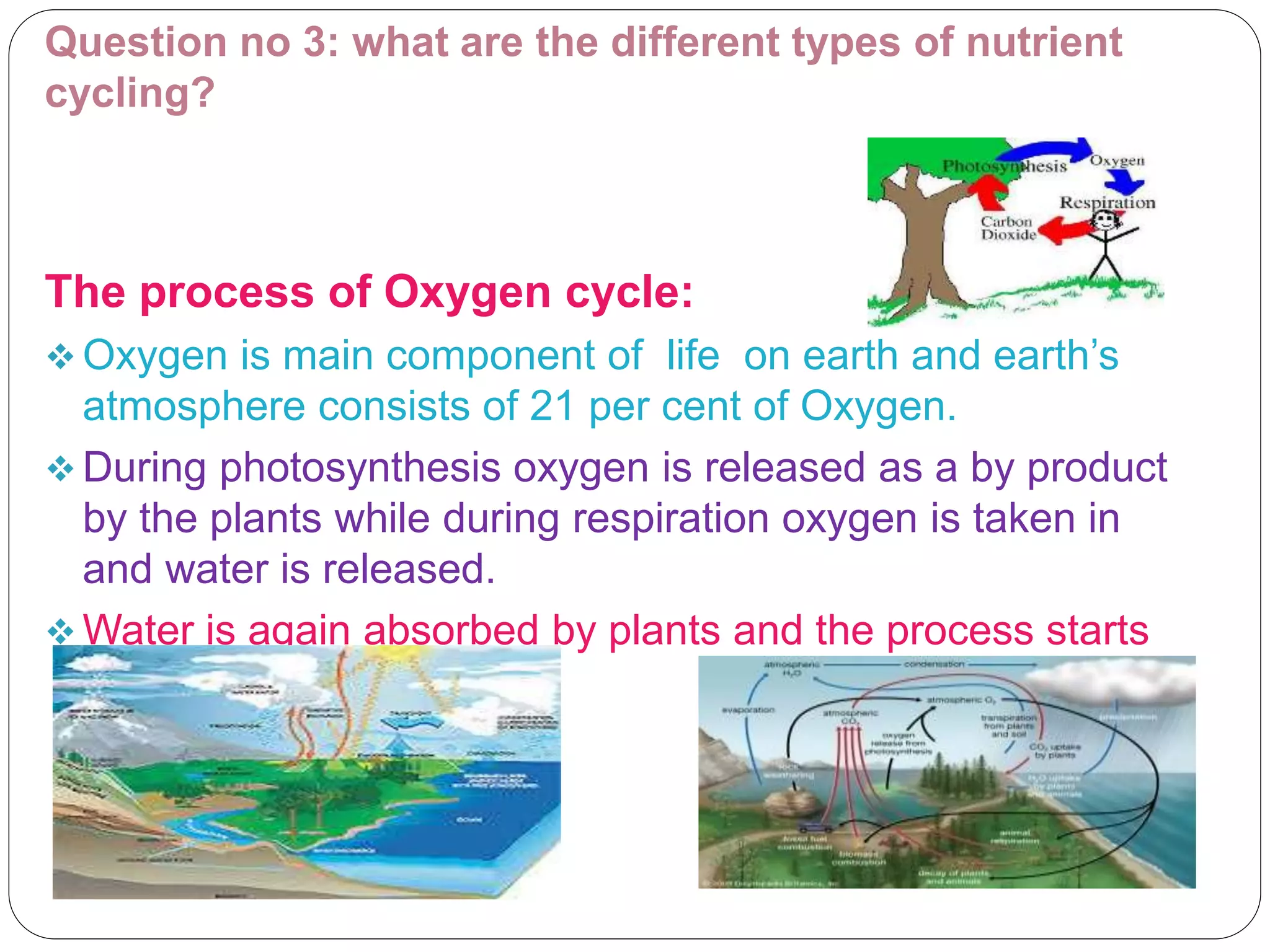
The process of Oxygen cycle:
 Oxygen is main component of life on earth and earth’s
atmosphere consists of 21 per cent of Oxygen.
 During photosynthesis oxygen is released as a by product
by the plants while during respiration oxygen is taken in
and water is released.
 Water is again absorbed by plants and the process starts
all over again.
Carbon cycle
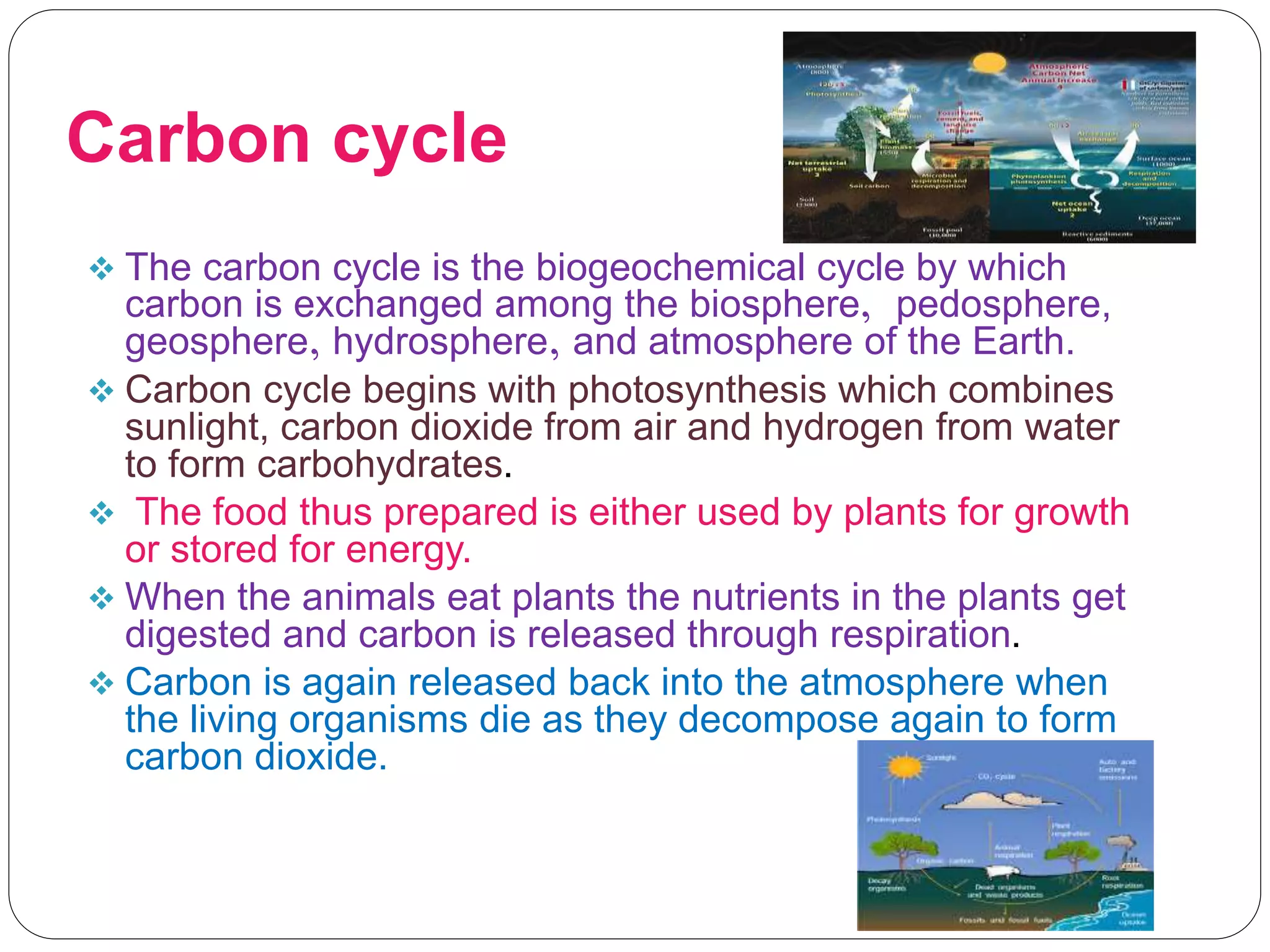
 The carbon cycle is the biogeochemical cycle by which
carbon is exchanged among the biosphere, pedosphere,
geosphere, hydrosphere, and atmosphere of the Earth.
 Carbon cycle begins with photosynthesis which combines
sunlight, carbon dioxide from air and hydrogen from water
to form carbohydrates.
 The food thus prepared is either used by plants for growth
or stored for energy.
 When the animals eat plants the nutrients in the plants get
digested and carbon is released through respiration.
 Carbon is again released back into the atmosphere when
the living organisms die as they decompose again to form
carbon dioxide.
Nitrogen cycle
 Nitrogen is an important element of ecosystem. But not very
organism can use nitrogen directly.
 This is where the nitrogen fixing bacteria help by converting
nitrogen into a usable form which can be absorbed by every
organism.
 When the nitrogen is fixed it is available in the form of nitrates,
nitrites and ammonia which can be easily absorbed by plants as
nutrients. Once it gets converted into food, it is eaten by animals
which are returned back to the soil in the form of feces and
decomposed bodies of animals and plants.
 Also there are denitrifying bacteria which balance the nitrogen
level in the soil and if found to be excess convert the nitrogen
compounds into nitrogen and release it back into the
atmosphere.
Question 4. Describe the ecosystem of
Bangladesh?
Ecosystems in Bangladesh:
Ecosystem of Bangladesh includes all living & non-
living things like people, animal, forest, land, river,
Bay of Bangle.
Different ecosystems of Bangladesh:
Ecosystem of Bangladesh can be divided into three
types. Three types of ecosystem are:
1. Aquatic Ecosystem
2. Soil Ecosystem
3. Forest Ecosystem
1. Aquatic Ecosystem:
 Bangladesh is a country of river. It has more than 300 rivers.
Again it’s located by the side of Bay of Bangle. That means
Bangladesh has a rich aquatic ecosystem.
 We can divide aquatic ecosystem of Bangladesh into two. They
are:
a)Freshwater ecosystem in Bangladesh:
Bangladesh has more than 300 rivers and lots of ponds. So it has a
large freshwater ecosystem. Freshwater ecosystem of
Bangladesh in three basic types:
 Lentic: slow-moving water, including pools, ponds and lakes.
 Lotic: rapidly-moving water, for example streams and rivers.
 Wetlands: areas where the soil is saturated or inundated for at
least part of the time.
b)Marine ecosystem of Bangladesh:
The coastline is 710 km long, composed of the
interface of various ecological and economic
systems, including mangroves, estuaries, islands,
accreted land, beaches, a peninsula, rural
settlements, urban and industrial areas, and ports.
2. Soil ecosystem in Bangladesh:
Soil ecosystem of Bangladesh refers to the micro
animals live in the soil and how they interact
themselves. In undisturbed soil, leaves and other
organic debris accumulate on the where they broken
down by the decomposers. Aerobic bacteria and
3. Forest ecosystem in Bangladesh:
A forest ecosystem is a natural unit consisting of
mostly plants, animals and micro-organisms in forest
area and functions together with all of non-living
physical factors of the environment. Among forest
ecosystems of Bangladesh, Sundarban is major.
The Sundarban is intersected by a complex network of
tidal waterways, mudflats and small islands of salt-
tolerant mangrove forests, and presents an excellent
example of ongoing ecological processes.
 The area is known for its wide range of flora and
fauna. The most famous are the Royal Bengal Tigers,
but numerous species of birds, spotted deer,
crocodiles and snakes also inhabit it.
Question 5.What are the problems of an ecosystem is
affected?
The Danger to Ecosystems:
 When we talking in terms of ecosystems, problems and
solutions, one does not realize how fragile ecosystems are
until we witness firsthand the devastation humans are having
on the environment.
 With the changing environmental shifts due to industry and
pollution, global warming and wanton abuse of resource
management, things have changed.
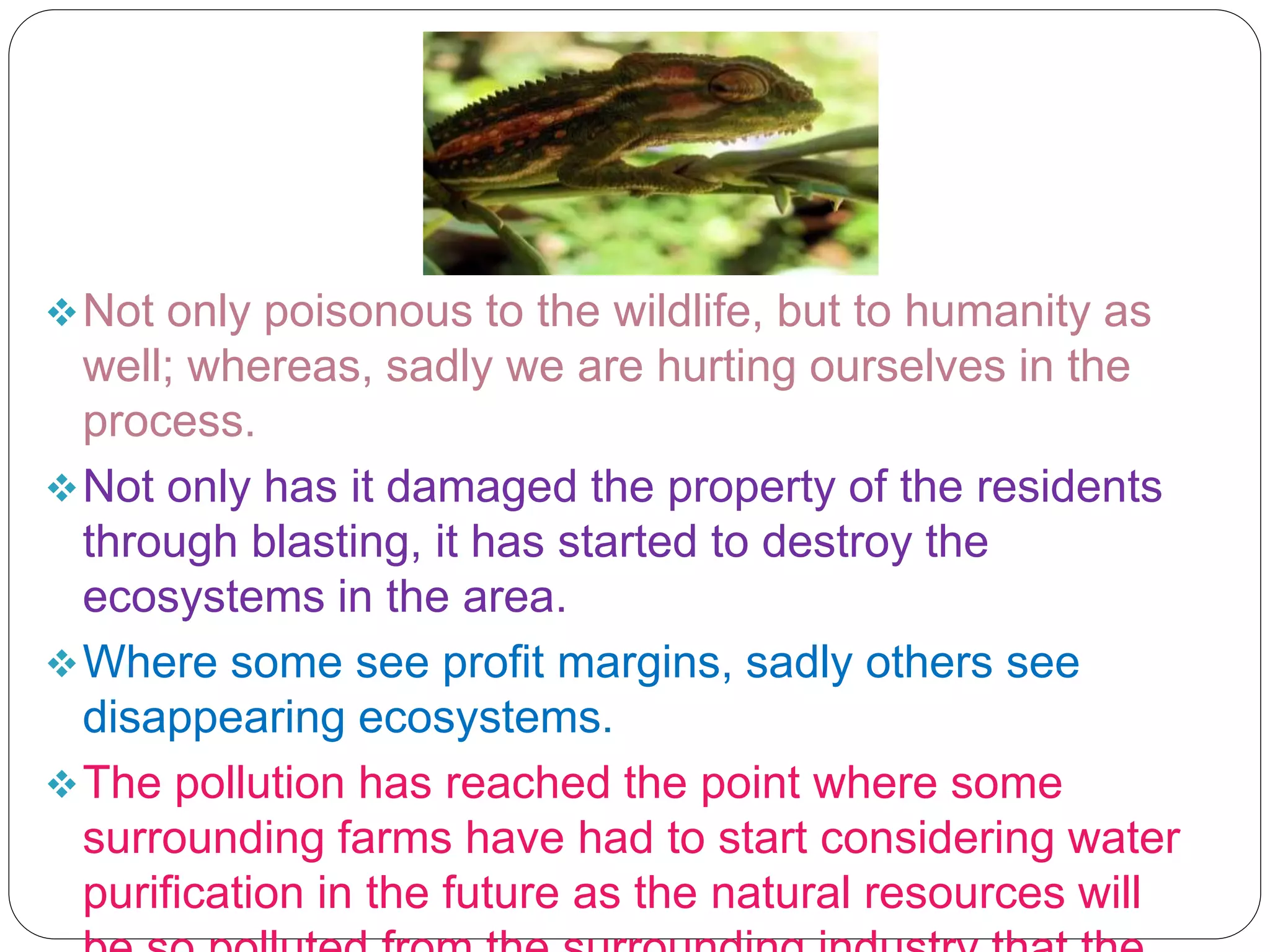
 The same small town which once harbored these little
creatures, in what we are slowly starting to realize as fragile
ecosystem environments, we now find an absence of
chameleons in the gardens.
 If one influences the smallest variable, then it changes the
whole. This is why global warming is such a big issue,
regardless of whether we created it or not.
 The problem is, where there was once a thriving ecosystem,
it has slowly been replaced by poisons to the natural
environment.
Not only poisonous to the wildlife, but to humanity as
well; whereas, sadly we are hurting ourselves in the
process.
Not only has it damaged the property of the residents
through blasting, it has started to destroy the
ecosystems in the area.
Where some see profit margins, sadly others see
disappearing ecosystems.
The pollution has reached the point where some
surrounding farms have had to start considering water
purification in the future as the natural resources will
Our Part in the Solution
In spite of these problems, there are a few things
that we can do to protect ecosystems.
The first step in the solution is to become aware.
The second step is analyzing how we can influence
the laws governing pollution and ungoverned
industrialization.
 We can make our self visible to society regarding
ecosystems.
 Small things like, reducing ones litter can also
influence the whole structure.
 Basically, reduce, recycle and reuse that which we
can. Cut down on carbon emissions wherever
possible.
The ecosystem

The ecosystem

  • 1.
    SUBMITTED BY: JASFIA KHANAMFAMA - 133200105 KARUNA KHANAM - 131200050 SYEDA SHAJIDA SHARMIN USHA - 132200018 MD. TORIQUL ISLAM - 122200053 MD.MAHADI HASAN ROBIN - 132200035 Presentation on Introduction to science SUBMITTED TO: NAHNEEN SULTANA ASSISTANT PROFESSOR, FBA
  • 2.
  • 3.
    What is ecosystem? Theterm "ecosystem" was first used in a publication by British ecology Arthur Tansley. In general , An ecosystem is a community of living organisms (plants, animals and microbes) in conjunction with the nonliving components of their environment (things like air, water and mineral soil), interacting as a system.
  • 4.
    The structure ofa community 1. Producer Organism: Green plants are the primary producer of the ecosystem. 2. Consumer organism: Consumer organism are those cannot make their own food.  1st order consumers-are the herbivores which feed directly on plants. Example: cows, kangaroos, insects, zooplankton, rabbits, goats etc.  2nd order consumers- The animals which feed on herbivores. Example: birds, foxes, small fishes etc.  3rd order consumers-are larger carnivores which feed on the 2nd order consumers, Example: snakes and large fish.  Scavengers- are animals that feed on any dead matter. Example: mud crab, maggots etc. 3. Decomposer organisms They break down foods and decomposes them to get energy. Example: bacteria and fungi
  • 5.
    Energy pyramid: An energypyramid is a graphical model that is shaped like a pyramid to show how the energy flows through a food chain, how the amount of energy is decreasing and becoming less available for organisms.  The source of energy for living beings on Earth is the Sun. The energy that the Sun emits at present is of 1366.75 W/M^2.  The capture of energy by the producer organisms (photosynthetic organisms) were made, the Solar Irradiance (SI) was of 1365.45 W/M^2.  The energy usable by photosynthetic organisms is 697.04 W/M^2, Question 2. What is an energy pyramid and food chain?
  • 6.
    Food chain  Foodchains were first introduced by the African-Arab scientist and philosopher Al-Jahiz in the 9th century .  The food chain's length is a continuous variable that provides a measure of the passage of energy and an index of ecological structure that increases in value counting progressively through the linkages in a linear fashion from the lowest to the highest levels.  Food chains vary in length from three to six or more levels.  Some animals eat plants and some animals eat other animals.  For example, a simple food chain links the trees & shrubs, the giraffes (that eat trees & shrubs), and the lions (that eat the giraffes). Each link in this chain is
  • 7.
     A foodchain consisting of a flower, a frog, a snake and an owl consists of four levels;  whereas a food chain consisting of grass, a grasshopper, a rat, a snake and finally a hawk consists of five levels.
  • 8.
    Question no 3:what are the different types of nutrient cycling? The process of Oxygen cycle:  Oxygen is main component of life on earth and earth’s atmosphere consists of 21 per cent of Oxygen.  During photosynthesis oxygen is released as a by product by the plants while during respiration oxygen is taken in and water is released.  Water is again absorbed by plants and the process starts all over again.
  • 9.
    Carbon cycle  Thecarbon cycle is the biogeochemical cycle by which carbon is exchanged among the biosphere, pedosphere, geosphere, hydrosphere, and atmosphere of the Earth.  Carbon cycle begins with photosynthesis which combines sunlight, carbon dioxide from air and hydrogen from water to form carbohydrates.  The food thus prepared is either used by plants for growth or stored for energy.  When the animals eat plants the nutrients in the plants get digested and carbon is released through respiration.  Carbon is again released back into the atmosphere when the living organisms die as they decompose again to form carbon dioxide.
  • 10.
    Nitrogen cycle  Nitrogenis an important element of ecosystem. But not very organism can use nitrogen directly.  This is where the nitrogen fixing bacteria help by converting nitrogen into a usable form which can be absorbed by every organism.  When the nitrogen is fixed it is available in the form of nitrates, nitrites and ammonia which can be easily absorbed by plants as nutrients. Once it gets converted into food, it is eaten by animals which are returned back to the soil in the form of feces and decomposed bodies of animals and plants.  Also there are denitrifying bacteria which balance the nitrogen level in the soil and if found to be excess convert the nitrogen compounds into nitrogen and release it back into the atmosphere.
  • 11.
    Question 4. Describethe ecosystem of Bangladesh? Ecosystems in Bangladesh: Ecosystem of Bangladesh includes all living & non- living things like people, animal, forest, land, river, Bay of Bangle. Different ecosystems of Bangladesh: Ecosystem of Bangladesh can be divided into three types. Three types of ecosystem are: 1. Aquatic Ecosystem 2. Soil Ecosystem 3. Forest Ecosystem
  • 12.
    1. Aquatic Ecosystem: Bangladesh is a country of river. It has more than 300 rivers. Again it’s located by the side of Bay of Bangle. That means Bangladesh has a rich aquatic ecosystem.  We can divide aquatic ecosystem of Bangladesh into two. They are: a)Freshwater ecosystem in Bangladesh: Bangladesh has more than 300 rivers and lots of ponds. So it has a large freshwater ecosystem. Freshwater ecosystem of Bangladesh in three basic types:  Lentic: slow-moving water, including pools, ponds and lakes.  Lotic: rapidly-moving water, for example streams and rivers.  Wetlands: areas where the soil is saturated or inundated for at least part of the time.
  • 13.
    b)Marine ecosystem ofBangladesh: The coastline is 710 km long, composed of the interface of various ecological and economic systems, including mangroves, estuaries, islands, accreted land, beaches, a peninsula, rural settlements, urban and industrial areas, and ports. 2. Soil ecosystem in Bangladesh: Soil ecosystem of Bangladesh refers to the micro animals live in the soil and how they interact themselves. In undisturbed soil, leaves and other organic debris accumulate on the where they broken down by the decomposers. Aerobic bacteria and
  • 14.
    3. Forest ecosystemin Bangladesh: A forest ecosystem is a natural unit consisting of mostly plants, animals and micro-organisms in forest area and functions together with all of non-living physical factors of the environment. Among forest ecosystems of Bangladesh, Sundarban is major. The Sundarban is intersected by a complex network of tidal waterways, mudflats and small islands of salt- tolerant mangrove forests, and presents an excellent example of ongoing ecological processes.  The area is known for its wide range of flora and fauna. The most famous are the Royal Bengal Tigers, but numerous species of birds, spotted deer, crocodiles and snakes also inhabit it.
  • 15.
    Question 5.What arethe problems of an ecosystem is affected? The Danger to Ecosystems:  When we talking in terms of ecosystems, problems and solutions, one does not realize how fragile ecosystems are until we witness firsthand the devastation humans are having on the environment.  With the changing environmental shifts due to industry and pollution, global warming and wanton abuse of resource management, things have changed.  The same small town which once harbored these little creatures, in what we are slowly starting to realize as fragile ecosystem environments, we now find an absence of chameleons in the gardens.  If one influences the smallest variable, then it changes the whole. This is why global warming is such a big issue, regardless of whether we created it or not.  The problem is, where there was once a thriving ecosystem, it has slowly been replaced by poisons to the natural environment.
  • 16.
    Not only poisonousto the wildlife, but to humanity as well; whereas, sadly we are hurting ourselves in the process. Not only has it damaged the property of the residents through blasting, it has started to destroy the ecosystems in the area. Where some see profit margins, sadly others see disappearing ecosystems. The pollution has reached the point where some surrounding farms have had to start considering water purification in the future as the natural resources will
  • 17.
    Our Part inthe Solution In spite of these problems, there are a few things that we can do to protect ecosystems. The first step in the solution is to become aware. The second step is analyzing how we can influence the laws governing pollution and ungoverned industrialization.  We can make our self visible to society regarding ecosystems.  Small things like, reducing ones litter can also influence the whole structure.  Basically, reduce, recycle and reuse that which we can. Cut down on carbon emissions wherever possible.