BACTERIAL GENETICS
DR.KAVYA.P
• DEFINITION
• CENTRAL DOGMA
• EXTRACHROMOSOMAL GENETIC ELEMENTS
• MUTATION
• TRANSMISSION OF GENETIC MATERIAL
26-06-2021 2
GENETICS……
defines & analyses heredity i.e., constancy and variation
in the physiologic functions, that form the properties of an organism.
The term was coined by British biologist William Bateson in 1906.
26-06-2021 3
UNDERSTANDING GENETICS
We resemble and differ because of Genetic configurations
Parents - Son - Daughter, how they resemble each other.
They breed true from Generation to Generation
But vary in small proportions in progeny.
Bacteria too obey the laws of Genetics
Gregor Mendel ….. Formulated the basic rules of heredity in 1865.
Thomas Morgan (1866-1945)… the founder of modern genetics, showed
chromosomes contain genes & won Nobel prize, 1933.
Watson - Crick
Discovery of DNA
Beginning of Bacterial Genetics
Since 1940s principles of genetics were applied to bacteria &
viruses.
Better understanding of genetic process has led to the birth of a
new branch of science, MOLECULAR BIOLOGY..
Central Dogma
of Molecular Genetics
DNA------- mRNA------ protein
transcription translation
Genetic Materials
DNA & RNA
DNA -deoxyribonucleic acid
RNA -ribonucleic acid
Nucleotides
◦ Phosphate group
◦ Pentose sugar
◦ Nitrogenous base
Structure of DNA
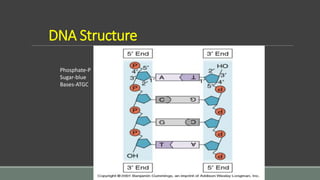
Double stranded (double helix)
Chains of nucleotides
5’ to 3’ (strands are anti-parallel)
Complimentary base pairing
◦ A-T
◦ G-C
DNA Structure
Phosphate-P
Sugar-blue
Bases-ATGC
DNA Structure
◦ The double stranded structure stabilized by hydrogen bonding b/n nitrogenous bases
of opposite strands.
◦ Purine bases are Adenine, Guanine
◦ Pyrimidine bases are Thymine, Cytosine.
◦ A+T/G+C ratio remains constant for each bacterial species.
26-06-2021 12
Bacterial Chromosome
Bacterial chromosome consists of a double stranded molecule of
DNA arranged in a circular form
1000µm in length
1kb=1000 base pairs
Bacterial DNA about 4000kb
Human genome about 3 million kb long
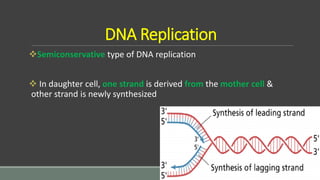
DNA Replication
Semiconservative type of DNA replication
 In daughter cell, one strand is derived from the mother cell &
other strand is newly synthesized
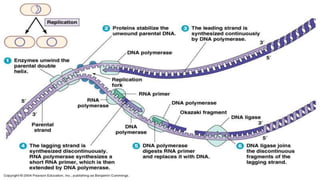
DNA Replication-occurs at the replication
fork
5’ to 3 ‘
DNA helicase-unzips + parental DNA strand that is used as a template
◦ Leading strand (5’ to 3’-continuous)
*DNA polymerase-joins growing DNA strand after nucleotides are aligned
(complimentary)
◦ Lagging strand (5’ to 3’-not continuous)
*RNA polymerase (makes short RNA primer)
*DNA polymerase (extends RNA primer then digests RNA primer and replaces it with DNA)
*DNA ligase (seals Okazaki fragments-the newly formed DNA fragments)
26-06-2021 17
 Replication of bacterial circular DS-DNA begins at the ori
locus
 Chromosome replication termination regions are called
ter.
 They are located at opposite points on the circular DNA
chromosome
RNA
Single stranded
It contains sugar Ribose
It contains the nitrogenous base Uracil in place of Thymine in
DNA
3 Types of RNA
1. mRNA (messenger RNA)
◦ Contains the codons
2. r RNA (ribosomal RNA)
◦ Ribosomes (70S)
3. t RNA (transfer RNA)
◦ Transfer amino acids to the ribosomes for protein synthesis
◦ Anti-codon
Template strand DNA strand which is transcribed to give rise to
m-RNA
Coding strand the opposite DNA strand which has the same
sequence of that of m-RNA
26-06-2021 22
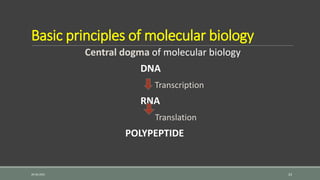
Basic principles of molecular biology
Central dogma of molecular biology
DNA
Transcription
RNA
Translation
POLYPEPTIDE
26-06-2021 23
The template strand of DNA is transcribed into a SS m-RNA by DNA
depended RNA polymerase
Steps
Initiation
Elongation
Termination
Post transcriptional modification
Transcription
26-06-2021 25
INITIATION
Promoter region : certain specific areas on the DNA to which RNAP
attaches.
Transcription unit : The region b/n promoter & terminator sites.
TATA Box : it act as the signal for the start region
Enhancers : increase the rate of transcription.
ELONGATION
The RNAP moves along the DNA template & new nucleotides are
incorporated in the nascent m-RNA.
Transcription bubble is formed by
RNAP, DNA & nascent RNA
TERMINATION
Rho dependent…when Rho
factor attaches to the RNA , the
RNAP cannot move further &
enzyme dissociates from DNA &
newly formed m-RNA is released
TERMINATION
Rho independent….it is an
interrupted invert repeat
DNA sequence &
is transcribed
The m-RNA produced will
form intrachain base pairing
to make a hairpin structure
this obstruct further movement of
RNAP
POST TRANSCRIPTIONAL MODIFICATION
In eukaryotes, the primary transcript undergoes extensive editing to become
mature m-RNA.
Poly A tailing, 5`capping, removal of introns & connection of exons.
In bacteria m-RNA is not changed & translation starts even before completion
of transcription.
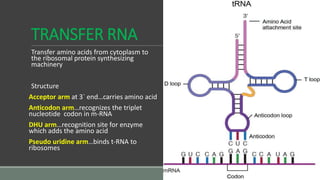
TRANSFER RNA
Transfer amino acids from cytoplasm to
the ribosomal protein synthesizing
machinery
Structure
Acceptor arm at 3` end…carries amino acid
Anticodon arm…recognizes the triplet
nucleotide codon in m-RNA
DHU arm…recognition site for enzyme
which adds the amino acid
Pseudo uridine arm…binds t-RNA to
ribosomes
RIBOSOMAL RNA
They are structural components of ribosomes
Ribosomal assembly is the protein synthesizing machinery
Bacteria has 70S ribosomes with 30S & 50S subunits
Bacterial ribosomes contain 3 types of r-RNA
What is a Gene
Gene is a sequence of DNA
carrying codons specifying for
particular polypeptide
DNA contains many Genes( A
combinations of hundreds and
thousands of Nucleotides )
GENETIC CODE
Genetic information in DNA is stored as a triplet code, which consists of 3
bases.
Each triplet code is transcribed to m-RNA & it has codons which specifies for a
single amino acid
Codon is degenerate…more than one codon may exist for same amino acid
Genetic Code is Universal…the codons are the same for the same amino acid in
all species
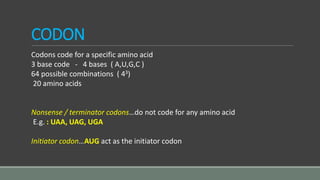
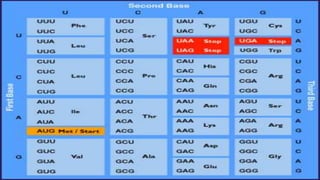
CODON
Codons code for a specific amino acid
3 base code - 4 bases ( A,U,G,C )
64 possible combinations ( 43)
20 amino acids
Nonsense / terminator codons…do not code for any amino acid
E.g. : UAA, UAG, UGA
Initiator codon…AUG act as the initiator codon
How bacterial Genome differs from Higher
forms of Life
Several stretches of DNA don't appear to function as codons, occurs between
the coding sequences of gene called as INTRONS
Coded are called as EXONS
In transcription introns are excised when form RNA before translated by
ribosomal proteins.
TRANSLATION
REGULATION OF GENE EXPRESSION
Synthesis of proteins under the influence of gene is called gene expression
All genes are not always being expressed
Genes turned on all the time - Constitutive
Enzymes are synthesized irrespective of
the conc. of the substrate
Other genes can be regulated by either induction / turned on or repression / turned off
LAC OPERON
Lac - Lactose (disaccharide)
◦ Glucose and Galactose
Operon - series of structural genes, all under the control of a Regulatory Gene
lac operon is normally turned off
lac operon is an Inducible operon
LAC OPERON
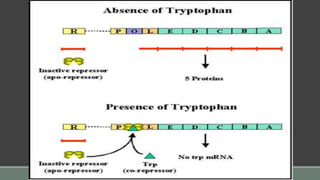
TRYPTOPHAN OPERON
Tryptophan - amino acid
Operon - series of structural genes, all under the control of a regulatory gene
Tryptophan operon is normally turned on
Tryptophan operon is a repressible operon
• DEFINITION
• CENTRAL DOGMA
• EXTRACHROMOSOMAL GENETIC ELEMENTS
• MUTATION
• GENE TRANSFER
EXTRACHROMOSOMAL GENETIC ELEMENTS
 Bacteria posses extra chromosomal genetic elements not essential
for survival of bacteria
But makes the bacteria resistant to antibiotics, and makes them
survive, able to produce toxins
PLASMIDS
They are circular DNA molecule in the cytoplasm of bacteria
Capable of autonomous replication (independent replicons)
Can transfer genes from one cell to other
act as vectors in genetic engineering
Can also be present in yeasts
PLASMIDS
Plasmid seem to be ubiquitous in bacteria, May encode genetic information for properties
Resistance to Antibiotics
Bacteriocin production
Enterotoxin production
Enhanced pathogenicity
Reduced sensitivity to mutagens
Degrade complex organic molecules
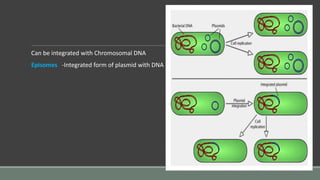
Can be integrated with Chromosomal DNA
Episomes -Integrated form of plasmid with DNA
CLASSIFICATION
Based on restriction endonuclease fingerprints from purified plasmid DNA
The pattern of fragments produced is dependent on the distribution of the
specific DNA sequences recognized by the enzyme
Closely related plasmids will produce same or very similar fingerprints
Unrelated plasmids will produce different fingerprints
By incompatibility testing
Based on the fact that, closely related plasmids are unable to coexist stably in the same
bacterial cell
Plasmids belonging to the same incompatibility group are closely related & interfere with one
another’s replication
Unrelated plasmids can coexist stably & belong to different incompatibility group
By using specific virulent bacteriophages
They will adhere only to the type of pilus produced by a particular group of
plasmids
Lysis by such a phage allows the identification of the group to which the
plasmid contained in the cell belongs
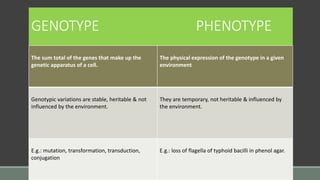
GENOTYPE PHENOTYPE
The sum total of the genes that make up the
genetic apparatus of a cell.
The physical expression of the genotype in a given
environment
Genotypic variations are stable, heritable & not
influenced by the environment.
They are temporary, not heritable & influenced by
the environment.
E.g.: mutation, transformation, transduction,
conjugation
E.g.: loss of flagella of typhoid bacilli in phenol agar.
• DEFINITION
• CENTRAL DOGMA
• EXTRACHROMOSOMAL GENETIC ELEMENTS
• MUTATION
• TRANSMISSION OF GENETIC MATERIAL
MUTATION
A random, undirected, heritable variation caused by an alteration in
the nucleotide sequence at some point of the DNA of the cell.
Macro lesions ( Multisite mutations) involve extensive
chromosomal rearrangements such as deletion, duplication,
inversion.
Micro lesions (Point mutations) affects one or very few nucleotides
POINT MUTATION
BASE PAIR SUBSTITUTION:
TRANSITION -- when a purine is replaced by another purine or a pyrimidine by another pyrimidine.
TRANSVERSION -- It is the substitution of a purine for a pyrimidine and vice versa in a base pairing
FRAMESHIFT MUTATION
Frame shift (deletion)
(leu) (ser) (arg)
Normal AAT AGT GCC
(leu) (val) (pro)
Mutant AAT AGT GCC A
Frame shift (insertion)
(leu) (ser) (arg)
Normal AAT AGT GCC
(leu) (glut) (cyst)
Mutant AAT CAGT GCC
MUTATIONS
Suppressor mutation: reversal of mutant phenotype by another mutation at
a position distinct from that of original position
Lethal mutation : involve vital functions & such mutants are nonviable
E.g.: a conditional lethal mutant—able to live under certain permissive
conditions like temp sensitive mutant
MUTAGENIC AGENTS
U V rays
Alkylating agents
Acridine dyes
5-bromouracil
2-aminopurine
• DEFINITION
• CENTRAL DOGMA
• EXTRACHROMASOMAL GENETIC ELEMENTS
• MUTATION
• GENE TRANSFER
GENE TRANSFER
Mechanisms of gene transfer
1.VERTICAL INHERITANCE
inheritance of parental genes
2. LATERAL (HORIZONTAL) gene transfer
DNA can be transferred from one organism to another & cause permanent
stable change in recipient’s genetic composition.
E.g.: Transformation, Transduction & Conjugation
TRANSFORMATION
The transfer of genetic information through the agency of free DNA
Cells that are able to take up DNA from their environment & incorporate it into
the genome are said to be competent
Competence involves the ability to bind DNA to the cell surface & then
transport it through the cell envelope into the cytoplasm prior to incorporation
into the genome
TRANSFORMATION
Cont.….
Natural competence  shown by
S . Pneumoniae , B .subtilis & H. influenzae
S . pneumoniae & B .subtilis take up heterospecific & homospecific bacterial DNA
H.influenzae & Neisseria gonorrhoea  homospecific (closely related) DNA only.
In systems that rely on natural competence, transformation with homospecific
chromosomal DNA is much more efficient
Cont.….
Artificial competence commonly seen in E.coli , P.aeruginosa, S.aureus
Induced by treatment of bacteria with calcium chloride at 0 degree C
Cell suspensions are mixed with free DNA and are subject to electrical discharge
through the suspension, termed Electroporation
Application in recombinant DNA technology
TRANSFORMATION
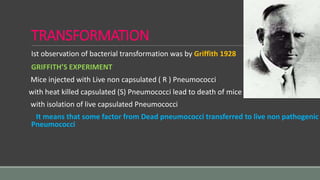
Ist observation of bacterial transformation was by Griffith 1928
GRIFFITH’S EXPERIMENT
Mice injected with Live non capsulated ( R ) Pneumococci
with heat killed capsulated (S) Pneumococci lead to death of mice
with isolation of live capsulated Pneumococci
It means that some factor from Dead pneumococci transferred to live non pathogenic
Pneumococci
TRANSFORMATION
The nature of the transforming principle was identified as DNA by
Avery, Macleod & McCarty in 1944
GRIFFITH’S EXPERIMENT
TRANSDUCTION
The transfer of a portion of the DNA from one bacterium to another by a bacteriophage
2 forms
Generalized …..any part of the donor genome can be transferred to a suitable recipient
Specialized…..specific sequences are transferred
RESTRICTED TRANSDUCTION
Lambda phage of E.coli
Prophage lambda inserts only b/n the genes determining
Galactose utilization (gal) & biotin synthesis (bio)
It transduces only either of these
BACTERIOPHAGE
A virus that parasitize bacteria
A nucleic acid core & a protein coat
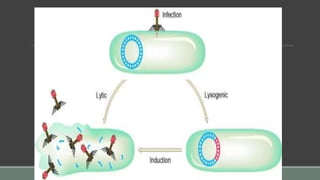
2 types of lifecycle
Virulent / lytic & Temperate / non lytic cycles
LYSOGENIC CONVERSION
Prophage…phage DNA integrated with bacterial chromosome
Lysogenic bacteria…bacteria harboring prophages
Lysogeny…process of prophage multiplying synchronously with the host DNA &
transferring to daughter cells
Phage conversion…the prophage DNA confers new genetic information to a bacterium
Cont.…
Episomes & plasmids may also be transduced
The plasmids determining penicillin resistance in Staphylococci are transferred by
transduction
Most widespread mechanism of gene transfer among prokaryotes
Transduction provides an excellent tool for the genetic engineering
CONJUGATION
The transfer of DNA directly from one bacterial cell to another by a mechanism that requires
cell-to-cell contact
Discovered by Lederberg and Tatum (1946)
in a strain of E . coli K 12
Plasmids are the genetic elements most frequently transferred
Self transmissible plasmids contain the tra gene which encodes
the genetic functions for cell contact & transfer
DNA transferred during conjugation through the plasmid
include
1.Fertility (F) factor
2.Colicinogenic (Col) factor
3.Resistance transfer factor (RTF)
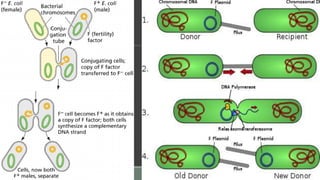
F factor
The maleness or donor status of a cell is indicated by a specialized fimbria (sex pili)
Sex pili act as conjugation tube
Retraction of pilus brings the cells into close contact & a pore forms in the adjoining cell
membrane
In plasmid DNA a single stranded nick occurs at oriT & the 5`end of a single strand is transferred
to the recipient
The F factor is actually an episome & in some cells they exist in the integrated state
They are Hfr cells
Have ability to transfer chromosomal genes to recipient cells with high frequency
Following conjugation with an Hfr cell, an F- only rarely becomes F+
This conversion of an F+ cell into the Hfr state is reversible
Hfr and F- bacterial conjugation
SEXDUCTION
When the F factor reverts from the integrated state to the free state; it may sometimes carry
some chromosomal genes from near its site of attachment
Such F factor is called F prime factor
The process of transfer of host genes through the F prime factor resembles transduction & so
named as sexduction
Col factor
Colicin production is determined by a plasmid called Col factor, which
resembles the F factor
Colicins…..Antibiotic like substances which are specifically & selectively
lethal to enterobacteriae
Similar substances are produced by bacteria other than coliforms also & so
collectively termed as Bacteriocin
RESISTANCE TRANSFER FACTOR
This plasmid leads to the spread of multiple drug resistance among bacteria
The plasmid R factor consists of 2 components
The RTF…..for conjugational transfer
Resistance determinant (r) ….for each of
the several drugs
RTF & the ‘r’ determinants may exist as separate plasmids
Then the drug resistance is not transferable
The host cell remains drug resistant
Transferable drug resistance is seen in…..Enterobacteriaceae, Vibrio, Pseudomonas, Pasteurella
The transfer of drug resistance is inhibited by…
1. Anaerobic conditions
2. bile salts
3. alkaline pH
4. the abundance of anaerobic Gram positive bacteria by minimizing
the contact b/n donor cells & recipient cells
MOBILE GENETIC ELEMENTS
Structurally & genetically discrete segments of DNA
They move around in a cut & paste manner b/n chromosomal &
extra chromosomal DNA molecules within cells
They are also called Jumping genes
Depend on chromosomal or plasmid DNA for replication
No genetic homology is needed for transfer of DNA molecule
by Transposition
Discovered by Barbara McClintock
A segment of DNA with one or more genes in the centre & the two ends with
inverted repeat sequences of nucleotides
2 types
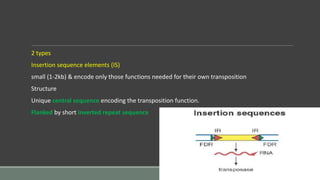
Insertion sequence elements (IS)
small (1-2kb) & encode only those functions needed for their own transposition
Structure
Unique central sequence encoding the transposition function.
Flanked by short inverted repeat sequence
Transposons
larger (4-25kb) & encode atleast one function unconnected to transposition, that alters
the cell phenotype
E.g.: antibiotic resistance…..
TEM-2- beta lactamases
2 types
Composite transposon
Complex transposon
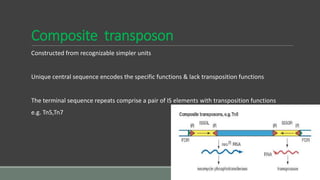
Composite transposon
Constructed from recognizable simpler units
Unique central sequence encodes the specific functions & lack transposition functions
The terminal sequence repeats comprise a pair of IS elements with transposition functions
e.g. Tn5,Tn7
Complex transposon
They do not have modular structures
Both transposition & non transposition functions are located in the bulk of the sequence
Flanked by short terminal inverted repeats
TnA or Tn1
Some transposons move by replicative manner
E.g. Tn1
Others non replicative (conservative) i.e. they move without making a copy of themselves
eg:Tn7
Integrons
A mobile DNA element
They can replicate & carry gene, particularly those responsible for antibiotic resistance by site
specific recombination
5` conserved region have a gene int encoding integrase, a site specific recombinase
attl site besides int is recognised & utilized by the integrase to capture gene cassettes
The antibiotic resistance genes that integron capture are located on gene cassettes
These gene cassettes exist as free circular DNA
A recombination event occurs, integrating the cassette into the integron
They are classified based on the integrase gene they contain
E.g.: most recently identified antibiotic resistance gene cassettes that encode the MBL
Bacterial genetics

Bacterial genetics

  • 1.
  • 2.
    • DEFINITION • CENTRALDOGMA • EXTRACHROMOSOMAL GENETIC ELEMENTS • MUTATION • TRANSMISSION OF GENETIC MATERIAL 26-06-2021 2
  • 3.
    GENETICS…… defines & analysesheredity i.e., constancy and variation in the physiologic functions, that form the properties of an organism. The term was coined by British biologist William Bateson in 1906. 26-06-2021 3
  • 4.
    UNDERSTANDING GENETICS We resembleand differ because of Genetic configurations Parents - Son - Daughter, how they resemble each other. They breed true from Generation to Generation But vary in small proportions in progeny. Bacteria too obey the laws of Genetics
  • 5.
    Gregor Mendel …..Formulated the basic rules of heredity in 1865. Thomas Morgan (1866-1945)… the founder of modern genetics, showed chromosomes contain genes & won Nobel prize, 1933.
  • 6.
  • 7.
    Beginning of BacterialGenetics Since 1940s principles of genetics were applied to bacteria & viruses. Better understanding of genetic process has led to the birth of a new branch of science, MOLECULAR BIOLOGY..
  • 8.
    Central Dogma of MolecularGenetics DNA------- mRNA------ protein transcription translation
  • 9.
    Genetic Materials DNA &RNA DNA -deoxyribonucleic acid RNA -ribonucleic acid Nucleotides ◦ Phosphate group ◦ Pentose sugar ◦ Nitrogenous base
  • 10.
    Structure of DNA Doublestranded (double helix) Chains of nucleotides 5’ to 3’ (strands are anti-parallel) Complimentary base pairing ◦ A-T ◦ G-C
  • 11.
  • 12.
    DNA Structure ◦ Thedouble stranded structure stabilized by hydrogen bonding b/n nitrogenous bases of opposite strands. ◦ Purine bases are Adenine, Guanine ◦ Pyrimidine bases are Thymine, Cytosine. ◦ A+T/G+C ratio remains constant for each bacterial species. 26-06-2021 12
  • 13.
    Bacterial Chromosome Bacterial chromosomeconsists of a double stranded molecule of DNA arranged in a circular form 1000µm in length 1kb=1000 base pairs Bacterial DNA about 4000kb Human genome about 3 million kb long
  • 14.
    DNA Replication Semiconservative typeof DNA replication  In daughter cell, one strand is derived from the mother cell & other strand is newly synthesized
  • 15.
    DNA Replication-occurs atthe replication fork 5’ to 3 ‘ DNA helicase-unzips + parental DNA strand that is used as a template ◦ Leading strand (5’ to 3’-continuous) *DNA polymerase-joins growing DNA strand after nucleotides are aligned (complimentary) ◦ Lagging strand (5’ to 3’-not continuous) *RNA polymerase (makes short RNA primer) *DNA polymerase (extends RNA primer then digests RNA primer and replaces it with DNA) *DNA ligase (seals Okazaki fragments-the newly formed DNA fragments)
  • 17.
  • 18.
     Replication ofbacterial circular DS-DNA begins at the ori locus  Chromosome replication termination regions are called ter.  They are located at opposite points on the circular DNA chromosome
  • 19.
    RNA Single stranded It containssugar Ribose It contains the nitrogenous base Uracil in place of Thymine in DNA
  • 21.
    3 Types ofRNA 1. mRNA (messenger RNA) ◦ Contains the codons 2. r RNA (ribosomal RNA) ◦ Ribosomes (70S) 3. t RNA (transfer RNA) ◦ Transfer amino acids to the ribosomes for protein synthesis ◦ Anti-codon
  • 22.
    Template strand DNAstrand which is transcribed to give rise to m-RNA Coding strand the opposite DNA strand which has the same sequence of that of m-RNA 26-06-2021 22
  • 23.
    Basic principles ofmolecular biology Central dogma of molecular biology DNA Transcription RNA Translation POLYPEPTIDE 26-06-2021 23
  • 24.
    The template strandof DNA is transcribed into a SS m-RNA by DNA depended RNA polymerase Steps Initiation Elongation Termination Post transcriptional modification
  • 25.
  • 26.
    INITIATION Promoter region :certain specific areas on the DNA to which RNAP attaches. Transcription unit : The region b/n promoter & terminator sites. TATA Box : it act as the signal for the start region Enhancers : increase the rate of transcription.
  • 27.
    ELONGATION The RNAP movesalong the DNA template & new nucleotides are incorporated in the nascent m-RNA. Transcription bubble is formed by RNAP, DNA & nascent RNA
  • 28.
    TERMINATION Rho dependent…when Rho factorattaches to the RNA , the RNAP cannot move further & enzyme dissociates from DNA & newly formed m-RNA is released
  • 29.
    TERMINATION Rho independent….it isan interrupted invert repeat DNA sequence & is transcribed The m-RNA produced will form intrachain base pairing to make a hairpin structure this obstruct further movement of RNAP
  • 30.
    POST TRANSCRIPTIONAL MODIFICATION Ineukaryotes, the primary transcript undergoes extensive editing to become mature m-RNA. Poly A tailing, 5`capping, removal of introns & connection of exons. In bacteria m-RNA is not changed & translation starts even before completion of transcription.
  • 32.
    TRANSFER RNA Transfer aminoacids from cytoplasm to the ribosomal protein synthesizing machinery Structure Acceptor arm at 3` end…carries amino acid Anticodon arm…recognizes the triplet nucleotide codon in m-RNA DHU arm…recognition site for enzyme which adds the amino acid Pseudo uridine arm…binds t-RNA to ribosomes
  • 33.
    RIBOSOMAL RNA They arestructural components of ribosomes Ribosomal assembly is the protein synthesizing machinery Bacteria has 70S ribosomes with 30S & 50S subunits Bacterial ribosomes contain 3 types of r-RNA
  • 34.
    What is aGene Gene is a sequence of DNA carrying codons specifying for particular polypeptide DNA contains many Genes( A combinations of hundreds and thousands of Nucleotides )
  • 36.
    GENETIC CODE Genetic informationin DNA is stored as a triplet code, which consists of 3 bases. Each triplet code is transcribed to m-RNA & it has codons which specifies for a single amino acid Codon is degenerate…more than one codon may exist for same amino acid Genetic Code is Universal…the codons are the same for the same amino acid in all species
  • 37.
    CODON Codons code fora specific amino acid 3 base code - 4 bases ( A,U,G,C ) 64 possible combinations ( 43) 20 amino acids Nonsense / terminator codons…do not code for any amino acid E.g. : UAA, UAG, UGA Initiator codon…AUG act as the initiator codon
  • 39.
    How bacterial Genomediffers from Higher forms of Life Several stretches of DNA don't appear to function as codons, occurs between the coding sequences of gene called as INTRONS Coded are called as EXONS In transcription introns are excised when form RNA before translated by ribosomal proteins.
  • 40.
  • 41.
    REGULATION OF GENEEXPRESSION Synthesis of proteins under the influence of gene is called gene expression All genes are not always being expressed Genes turned on all the time - Constitutive Enzymes are synthesized irrespective of the conc. of the substrate Other genes can be regulated by either induction / turned on or repression / turned off
  • 42.
    LAC OPERON Lac -Lactose (disaccharide) ◦ Glucose and Galactose Operon - series of structural genes, all under the control of a Regulatory Gene lac operon is normally turned off lac operon is an Inducible operon
  • 43.
  • 45.
    TRYPTOPHAN OPERON Tryptophan -amino acid Operon - series of structural genes, all under the control of a regulatory gene Tryptophan operon is normally turned on Tryptophan operon is a repressible operon
  • 48.
    • DEFINITION • CENTRALDOGMA • EXTRACHROMOSOMAL GENETIC ELEMENTS • MUTATION • GENE TRANSFER
  • 49.
    EXTRACHROMOSOMAL GENETIC ELEMENTS Bacteria posses extra chromosomal genetic elements not essential for survival of bacteria But makes the bacteria resistant to antibiotics, and makes them survive, able to produce toxins
  • 50.
    PLASMIDS They are circularDNA molecule in the cytoplasm of bacteria Capable of autonomous replication (independent replicons) Can transfer genes from one cell to other act as vectors in genetic engineering Can also be present in yeasts
  • 51.
    PLASMIDS Plasmid seem tobe ubiquitous in bacteria, May encode genetic information for properties Resistance to Antibiotics Bacteriocin production Enterotoxin production Enhanced pathogenicity Reduced sensitivity to mutagens Degrade complex organic molecules
  • 52.
    Can be integratedwith Chromosomal DNA Episomes -Integrated form of plasmid with DNA
  • 53.
    CLASSIFICATION Based on restrictionendonuclease fingerprints from purified plasmid DNA The pattern of fragments produced is dependent on the distribution of the specific DNA sequences recognized by the enzyme Closely related plasmids will produce same or very similar fingerprints Unrelated plasmids will produce different fingerprints
  • 54.
    By incompatibility testing Basedon the fact that, closely related plasmids are unable to coexist stably in the same bacterial cell Plasmids belonging to the same incompatibility group are closely related & interfere with one another’s replication Unrelated plasmids can coexist stably & belong to different incompatibility group
  • 55.
    By using specificvirulent bacteriophages They will adhere only to the type of pilus produced by a particular group of plasmids Lysis by such a phage allows the identification of the group to which the plasmid contained in the cell belongs
  • 56.
    GENOTYPE PHENOTYPE The sumtotal of the genes that make up the genetic apparatus of a cell. The physical expression of the genotype in a given environment Genotypic variations are stable, heritable & not influenced by the environment. They are temporary, not heritable & influenced by the environment. E.g.: mutation, transformation, transduction, conjugation E.g.: loss of flagella of typhoid bacilli in phenol agar.
  • 57.
    • DEFINITION • CENTRALDOGMA • EXTRACHROMOSOMAL GENETIC ELEMENTS • MUTATION • TRANSMISSION OF GENETIC MATERIAL
  • 58.
    MUTATION A random, undirected,heritable variation caused by an alteration in the nucleotide sequence at some point of the DNA of the cell. Macro lesions ( Multisite mutations) involve extensive chromosomal rearrangements such as deletion, duplication, inversion. Micro lesions (Point mutations) affects one or very few nucleotides
  • 59.
    POINT MUTATION BASE PAIRSUBSTITUTION: TRANSITION -- when a purine is replaced by another purine or a pyrimidine by another pyrimidine. TRANSVERSION -- It is the substitution of a purine for a pyrimidine and vice versa in a base pairing
  • 60.
    FRAMESHIFT MUTATION Frame shift(deletion) (leu) (ser) (arg) Normal AAT AGT GCC (leu) (val) (pro) Mutant AAT AGT GCC A Frame shift (insertion) (leu) (ser) (arg) Normal AAT AGT GCC (leu) (glut) (cyst) Mutant AAT CAGT GCC
  • 64.
    MUTATIONS Suppressor mutation: reversalof mutant phenotype by another mutation at a position distinct from that of original position Lethal mutation : involve vital functions & such mutants are nonviable E.g.: a conditional lethal mutant—able to live under certain permissive conditions like temp sensitive mutant
  • 65.
    MUTAGENIC AGENTS U Vrays Alkylating agents Acridine dyes 5-bromouracil 2-aminopurine
  • 66.
    • DEFINITION • CENTRALDOGMA • EXTRACHROMASOMAL GENETIC ELEMENTS • MUTATION • GENE TRANSFER
  • 67.
    GENE TRANSFER Mechanisms ofgene transfer 1.VERTICAL INHERITANCE inheritance of parental genes 2. LATERAL (HORIZONTAL) gene transfer DNA can be transferred from one organism to another & cause permanent stable change in recipient’s genetic composition. E.g.: Transformation, Transduction & Conjugation
  • 68.
    TRANSFORMATION The transfer ofgenetic information through the agency of free DNA Cells that are able to take up DNA from their environment & incorporate it into the genome are said to be competent Competence involves the ability to bind DNA to the cell surface & then transport it through the cell envelope into the cytoplasm prior to incorporation into the genome
  • 69.
  • 70.
    Cont.…. Natural competence shown by S . Pneumoniae , B .subtilis & H. influenzae S . pneumoniae & B .subtilis take up heterospecific & homospecific bacterial DNA H.influenzae & Neisseria gonorrhoea  homospecific (closely related) DNA only. In systems that rely on natural competence, transformation with homospecific chromosomal DNA is much more efficient
  • 71.
    Cont.…. Artificial competence commonlyseen in E.coli , P.aeruginosa, S.aureus Induced by treatment of bacteria with calcium chloride at 0 degree C Cell suspensions are mixed with free DNA and are subject to electrical discharge through the suspension, termed Electroporation Application in recombinant DNA technology
  • 72.
    TRANSFORMATION Ist observation ofbacterial transformation was by Griffith 1928 GRIFFITH’S EXPERIMENT Mice injected with Live non capsulated ( R ) Pneumococci with heat killed capsulated (S) Pneumococci lead to death of mice with isolation of live capsulated Pneumococci It means that some factor from Dead pneumococci transferred to live non pathogenic Pneumococci
  • 73.
    TRANSFORMATION The nature ofthe transforming principle was identified as DNA by Avery, Macleod & McCarty in 1944
  • 74.
  • 75.
    TRANSDUCTION The transfer ofa portion of the DNA from one bacterium to another by a bacteriophage 2 forms Generalized …..any part of the donor genome can be transferred to a suitable recipient Specialized…..specific sequences are transferred
  • 77.
    RESTRICTED TRANSDUCTION Lambda phageof E.coli Prophage lambda inserts only b/n the genes determining Galactose utilization (gal) & biotin synthesis (bio) It transduces only either of these
  • 78.
    BACTERIOPHAGE A virus thatparasitize bacteria A nucleic acid core & a protein coat 2 types of lifecycle Virulent / lytic & Temperate / non lytic cycles
  • 81.
    LYSOGENIC CONVERSION Prophage…phage DNAintegrated with bacterial chromosome Lysogenic bacteria…bacteria harboring prophages Lysogeny…process of prophage multiplying synchronously with the host DNA & transferring to daughter cells Phage conversion…the prophage DNA confers new genetic information to a bacterium
  • 82.
    Cont.… Episomes & plasmidsmay also be transduced The plasmids determining penicillin resistance in Staphylococci are transferred by transduction Most widespread mechanism of gene transfer among prokaryotes Transduction provides an excellent tool for the genetic engineering
  • 83.
    CONJUGATION The transfer ofDNA directly from one bacterial cell to another by a mechanism that requires cell-to-cell contact Discovered by Lederberg and Tatum (1946) in a strain of E . coli K 12 Plasmids are the genetic elements most frequently transferred
  • 84.
    Self transmissible plasmidscontain the tra gene which encodes the genetic functions for cell contact & transfer DNA transferred during conjugation through the plasmid include 1.Fertility (F) factor 2.Colicinogenic (Col) factor 3.Resistance transfer factor (RTF)
  • 85.
    F factor The malenessor donor status of a cell is indicated by a specialized fimbria (sex pili) Sex pili act as conjugation tube Retraction of pilus brings the cells into close contact & a pore forms in the adjoining cell membrane In plasmid DNA a single stranded nick occurs at oriT & the 5`end of a single strand is transferred to the recipient
  • 89.
    The F factoris actually an episome & in some cells they exist in the integrated state They are Hfr cells Have ability to transfer chromosomal genes to recipient cells with high frequency Following conjugation with an Hfr cell, an F- only rarely becomes F+ This conversion of an F+ cell into the Hfr state is reversible
  • 91.
    Hfr and F-bacterial conjugation
  • 92.
    SEXDUCTION When the Ffactor reverts from the integrated state to the free state; it may sometimes carry some chromosomal genes from near its site of attachment Such F factor is called F prime factor The process of transfer of host genes through the F prime factor resembles transduction & so named as sexduction
  • 93.
    Col factor Colicin productionis determined by a plasmid called Col factor, which resembles the F factor Colicins…..Antibiotic like substances which are specifically & selectively lethal to enterobacteriae Similar substances are produced by bacteria other than coliforms also & so collectively termed as Bacteriocin
  • 94.
    RESISTANCE TRANSFER FACTOR Thisplasmid leads to the spread of multiple drug resistance among bacteria The plasmid R factor consists of 2 components The RTF…..for conjugational transfer Resistance determinant (r) ….for each of the several drugs
  • 95.
    RTF & the‘r’ determinants may exist as separate plasmids Then the drug resistance is not transferable The host cell remains drug resistant Transferable drug resistance is seen in…..Enterobacteriaceae, Vibrio, Pseudomonas, Pasteurella
  • 96.
    The transfer ofdrug resistance is inhibited by… 1. Anaerobic conditions 2. bile salts 3. alkaline pH 4. the abundance of anaerobic Gram positive bacteria by minimizing the contact b/n donor cells & recipient cells
  • 97.
    MOBILE GENETIC ELEMENTS Structurally& genetically discrete segments of DNA They move around in a cut & paste manner b/n chromosomal & extra chromosomal DNA molecules within cells
  • 98.
    They are alsocalled Jumping genes Depend on chromosomal or plasmid DNA for replication No genetic homology is needed for transfer of DNA molecule by Transposition Discovered by Barbara McClintock
  • 99.
    A segment ofDNA with one or more genes in the centre & the two ends with inverted repeat sequences of nucleotides
  • 100.
    2 types Insertion sequenceelements (IS) small (1-2kb) & encode only those functions needed for their own transposition Structure Unique central sequence encoding the transposition function. Flanked by short inverted repeat sequence
  • 101.
    Transposons larger (4-25kb) &encode atleast one function unconnected to transposition, that alters the cell phenotype E.g.: antibiotic resistance….. TEM-2- beta lactamases 2 types Composite transposon Complex transposon
  • 102.
    Composite transposon Constructed fromrecognizable simpler units Unique central sequence encodes the specific functions & lack transposition functions The terminal sequence repeats comprise a pair of IS elements with transposition functions e.g. Tn5,Tn7
  • 103.
    Complex transposon They donot have modular structures Both transposition & non transposition functions are located in the bulk of the sequence Flanked by short terminal inverted repeats TnA or Tn1
  • 104.
    Some transposons moveby replicative manner E.g. Tn1 Others non replicative (conservative) i.e. they move without making a copy of themselves eg:Tn7
  • 105.
    Integrons A mobile DNAelement They can replicate & carry gene, particularly those responsible for antibiotic resistance by site specific recombination 5` conserved region have a gene int encoding integrase, a site specific recombinase attl site besides int is recognised & utilized by the integrase to capture gene cassettes
  • 106.
    The antibiotic resistancegenes that integron capture are located on gene cassettes These gene cassettes exist as free circular DNA A recombination event occurs, integrating the cassette into the integron They are classified based on the integrase gene they contain E.g.: most recently identified antibiotic resistance gene cassettes that encode the MBL