SLANG VERSUS JARGON
SLANG VERSUS JARGON


 Slang and Jargon together are parts of a colloquial
  vocabulary of English language. They both are very
  confusing processes in everyday vocabulary usage.
 So, first of all we will apply to a dictionary
  explanation in a way to understand the difference
  between these, too similar words.
SLANG (1)
Slang in Oxford dictionary is:
1) (n)a type of language consisting of words and
  phrases that are regarded as very informal, are
  more common in speech than writing, and are
  typically restricted to a particular context or group of
  people. For example in army slang ’’ the grass’’ is
  slang for marijuana.
2) Words and expressions that are informal and not
  standard English. Different social groups often use
  a special vocabulary. Sometimes this is fairly
  widespread and well understood. Some slang is
  confined to small tightly knit groups who can use it
  to exclude outsiders. Slang is also often sexual or
  scatological.
SLANG (2)
 In other words Slang is the use of informal words
  and expressions that are not considered standard
  in the speaker's language or dialect but are
  considered acceptable in certain social settings.
  And it is created by someone or a group of people
  have as shared expressions.. Slang expressions
  may act as euphemisms and may be used as a
  means of identifying with one's peers.
 They may be new words or old ones used with a
  new meaning. The desire to say old things in a new
  way leads to slang. When something becomes very
  common in our daily life, we are likely to make up
  new words for it. Slang is a part of every profession,
  trade, sport, school, and social group.
SLANG (3)
 Sometimes slang is used in a way that seems to be
  cruel or unkind, as when a person is called a jerk.
  Most slang is limited to certain areas.
 But some words, such as “okay,” are carried
  around the world by newspapers, radio, television,
  motion pictures, and tourists.
 Slang is popular because it is catchy and timely.
  Most slang has a very short life. It meets a
  momentary need or expresses a temporary opinion.
 Yet some words now considered standard began
  as slang. These include words such as taxi,
  flapjack, hoax, bogus, skyscraper, and fan (from
  fanatic).
SLANG (4)
 Slang often involves the creation of new meanings
  for existing words. It is common for such novel
  meanings to diverge significantly from the standard
  meaning. Thus, "cool" and "hot" can both mean
  "very good," "impressive," or "good-looking".
 Slang terms are often known only within a clique or
  ingroup. For example, Leet ("Leetspeak" or "1337")
  was originally popular only among certain Internet
  subcultures, such as crackers and online video
  gamers.
SLANG(5)
 During the 1990s, and into the early 21st
  century, however, Leet became increasingly more
  commonplace on the Internet, and it has spread
  outside Internet-based communication and into
  spoken languages.
 Other types of slang include SMS language used
  on mobile phones, and "chatspeak,"
  (e.g., "LOL", an acronym meaning "laughing out
  loud" or "laugh out loud" or ROFL, "rolling on the
  floor laughing"), which used to be widely used in
  instant messaging on the Internet in the early
  2000s.
SLANG (6)
 Slang is invented the same way formal language is.
  Its basis is usually metaphor. A metaphor is a word
  or phrase that ordinarily means one thing but is
  used for another thing to suggest a likeness
  between the two.
 Money, for example, is called
  bacon, loot, dough, bucks, and bread.
 One’s home is referred to as a
  pad, shack, dump, diggings, or hole in the wall.
 Failure is referred to as blowing it, hitting a foul
  ball, flunking, or running into a stone wall.
 To be discharged from a job is to be
  sacked, bounced, fired, or axed.
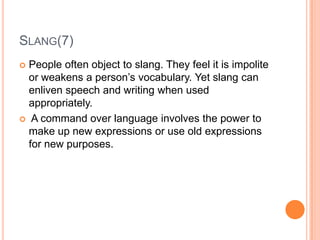
SLANG(7)
 People often object to slang. They feel it is impolite
  or weakens a person’s vocabulary. Yet slang can
  enliven speech and writing when used
  appropriately.
 A command over language involves the power to
  make up new expressions or use old expressions
  for new purposes.
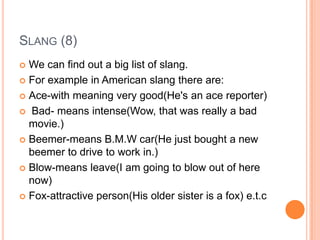
SLANG (8)
 We can find out a big list of slang.
 For example in American slang there are:

 Ace-with meaning very good(He's an ace reporter)

 Bad- means intense(Wow, that was really a bad
  movie.)
 Beemer-means B.M.W car(He just bought a new
  beemer to drive to work in.)
 Blow-means leave(I am going to blow out of here
  now)
 Fox-attractive person(His older sister is a fox) e.t.c
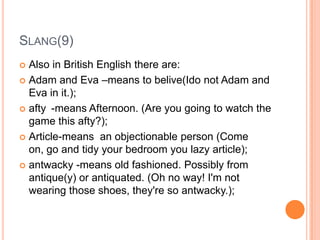
SLANG(9)
 Also in British English there are:
 Adam and Eva –means to belive(Ido not Adam and
  Eva in it.);
 afty -means Afternoon. (Are you going to watch the
  game this afty?);
 Article-means an objectionable person (Come
  on, go and tidy your bedroom you lazy article);
 antwacky -means old fashioned. Possibly from
  antique(y) or antiquated. (Oh no way! I'm not
  wearing those shoes, they're so antwacky.);
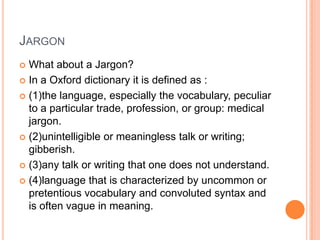
JARGON
 What about a Jargon?
 In a Oxford dictionary it is defined as :

 (1)the language, especially the vocabulary, peculiar
  to a particular trade, profession, or group: medical
  jargon.
 (2)unintelligible or meaningless talk or writing;
  gibberish.
 (3)any talk or writing that one does not understand.

 (4)language that is characterized by uncommon or
  pretentious vocabulary and convoluted syntax and
  is often vague in meaning.
JARGON (1)
 Jargon is a term that is used to describe a set of
  words that have a specific meaning in a specific
  context.
 Jargon, the terminology of a
  science, technology, art, profession, trade, or craft.
  The term has also come to mean the “officialese” of
  government.
 (Jargon is originally an Old French word meaning
  “warbling of birds.”)
JARGON (2)
  The philosophe Condillac observed in 1782 that:
"Every science requires a special language because
   every science has its own ideas."
    As a rationalist member of the Enlightenment he
   continued:
"It seems that one ought to begin by composing this
   language, but people begin by speaking and
   writing, and the language remains to be
   composed.’’
JARGON (3)
 In earlier times, the term jargon would refer to trade
  languages used by people who spoke different
  native tongues to communicate.
 In other words, the term covers the language used
  by people who work in a particular area or who
  have a common interest.
 Much like slang, it can develop as a kind of
  shorthand, to express ideas that are frequently
  discussed between members of a group, though it
  can also be developed deliberately using chosen
  terms.
 A standard term may be given a more precise or
  unique usage among practitioners of a field.
JARGON(4)
 In Britain, government jargon is called
  “Whitehallese”;
 in the United States, “Federal prose” or
  “gobbledygook” (from the gobbling noise of the
  turkey cock).
 Jargon may be defined as a cod within a code, that
  is special meanings of words that are imposed on
  the recognized code-the dictionary meaning of the
  words.
 The word grease means-money;a tiger hunter-is a
  gambler;a lexer is a student preparing for a law
  course;
JARGON(5)
Examples of Medical Jargon:
 Agonal - Term to signify a major, negative change in
  a patient’s condition
 BP - Medical shorthand for blood pressure

 FX - Medical jargon meaning bone fracture

 JT - A joint

 NPO - A patient should not take anything by mouth

 IM - Intramuscular

 K - The elemental symbol for potassium
JARGON(6)
Examples of Business Jargon:
 Bang for the buck - A term that means, to get the
  most for your money
 Due diligence - Putting effort into research before
  making a business decision
 Sweat equity - Getting a stake in the business
  instead of pay
 The 9-to-5 - Business jargon meaning a standard
  work day
 Chief cook and bottle-washer - A person who holds
  many responsibilities
JARGON(7)
Examples of Police Jargon:
 Suspect - A person whom the police think may have
  committed a crime
 10-4 - Radio jargon meaning Okay or I understand

 Code Eight - Term that means officer needs help
  immediately
 Code Eleven - A code that means the individual is
  at the scene of the crime
 FTP - The failure of an individual to pay a fine

 Assumed room temperature: An individual has died
JARGON(8)
Examples of Military Jargon:
 TD - Temporary duty

 AWOL - Absent without leave

 SQDN - A squadron

 SAM - Surface-to-Air missile

 PCS - A permanent change of station

 LES - Leave and earning statemen
JARGON(9)
Examples of Political Jargon:
 Left wing - Political jargon for liberal, progressive
  viewpoint
 Right wing - Jargon meaning a conservative
  viewpoint
 Getting on a soapbox - Making a speech in public

 POTUS - President of the United States

 SCOTUS - Supreme Court of the United States
JARGON (10)
Examples of Internet Jargon:
 BTW - By the way
 CYA - See you around
 FAQ - Frequently asked questions
 HTH - Hope this helps
 MOTD - Message of the day
 YMMV - Your mileage may vary
 IIRC - If I remember correctly
 IANAL - I am not a lawyer
 LOL - Laugh out loud
 BFF - Best friends forever
 TTYL - Talk to you later
SLANG VERSUS JARGON (END)
 In conclusion we can say that slang is used to
  escape the dull familiarity of standard words, it
  suggest to escape from the established routine of
  everyday life. Also people use slang in order to
  sound modern and up-to-date.
 But unfortunately jargon which is created to
  promote secrecy and keep outsiders in the dark it
  lost it’s special quality because it belongs to all
  social groups and it is easily understood by most of
  people.
END

   So it is hard to draw a line between slang and
    jargon because when jargons becomes common it
    has passed on a higher step on a ladder of word
    groups and becomes slang or colloquial. That is
    why a lot of words can be confused.

Slang versus jargon

  • 1.
  • 2.
    SLANG VERSUS JARGON Slang and Jargon together are parts of a colloquial vocabulary of English language. They both are very confusing processes in everyday vocabulary usage.  So, first of all we will apply to a dictionary explanation in a way to understand the difference between these, too similar words.
  • 3.
    SLANG (1) Slang inOxford dictionary is: 1) (n)a type of language consisting of words and phrases that are regarded as very informal, are more common in speech than writing, and are typically restricted to a particular context or group of people. For example in army slang ’’ the grass’’ is slang for marijuana. 2) Words and expressions that are informal and not standard English. Different social groups often use a special vocabulary. Sometimes this is fairly widespread and well understood. Some slang is confined to small tightly knit groups who can use it to exclude outsiders. Slang is also often sexual or scatological.
  • 4.
    SLANG (2)  Inother words Slang is the use of informal words and expressions that are not considered standard in the speaker's language or dialect but are considered acceptable in certain social settings. And it is created by someone or a group of people have as shared expressions.. Slang expressions may act as euphemisms and may be used as a means of identifying with one's peers.  They may be new words or old ones used with a new meaning. The desire to say old things in a new way leads to slang. When something becomes very common in our daily life, we are likely to make up new words for it. Slang is a part of every profession, trade, sport, school, and social group.
  • 5.
    SLANG (3)  Sometimesslang is used in a way that seems to be cruel or unkind, as when a person is called a jerk. Most slang is limited to certain areas.  But some words, such as “okay,” are carried around the world by newspapers, radio, television, motion pictures, and tourists.  Slang is popular because it is catchy and timely. Most slang has a very short life. It meets a momentary need or expresses a temporary opinion.  Yet some words now considered standard began as slang. These include words such as taxi, flapjack, hoax, bogus, skyscraper, and fan (from fanatic).
  • 6.
    SLANG (4)  Slangoften involves the creation of new meanings for existing words. It is common for such novel meanings to diverge significantly from the standard meaning. Thus, "cool" and "hot" can both mean "very good," "impressive," or "good-looking".  Slang terms are often known only within a clique or ingroup. For example, Leet ("Leetspeak" or "1337") was originally popular only among certain Internet subcultures, such as crackers and online video gamers.
  • 7.
    SLANG(5)  During the1990s, and into the early 21st century, however, Leet became increasingly more commonplace on the Internet, and it has spread outside Internet-based communication and into spoken languages.  Other types of slang include SMS language used on mobile phones, and "chatspeak," (e.g., "LOL", an acronym meaning "laughing out loud" or "laugh out loud" or ROFL, "rolling on the floor laughing"), which used to be widely used in instant messaging on the Internet in the early 2000s.
  • 8.
    SLANG (6)  Slangis invented the same way formal language is. Its basis is usually metaphor. A metaphor is a word or phrase that ordinarily means one thing but is used for another thing to suggest a likeness between the two.  Money, for example, is called bacon, loot, dough, bucks, and bread.  One’s home is referred to as a pad, shack, dump, diggings, or hole in the wall.  Failure is referred to as blowing it, hitting a foul ball, flunking, or running into a stone wall.  To be discharged from a job is to be sacked, bounced, fired, or axed.
  • 9.
    SLANG(7)  People oftenobject to slang. They feel it is impolite or weakens a person’s vocabulary. Yet slang can enliven speech and writing when used appropriately.  A command over language involves the power to make up new expressions or use old expressions for new purposes.
  • 10.
    SLANG (8)  Wecan find out a big list of slang.  For example in American slang there are:  Ace-with meaning very good(He's an ace reporter)  Bad- means intense(Wow, that was really a bad movie.)  Beemer-means B.M.W car(He just bought a new beemer to drive to work in.)  Blow-means leave(I am going to blow out of here now)  Fox-attractive person(His older sister is a fox) e.t.c
  • 11.
    SLANG(9)  Also inBritish English there are:  Adam and Eva –means to belive(Ido not Adam and Eva in it.);  afty -means Afternoon. (Are you going to watch the game this afty?);  Article-means an objectionable person (Come on, go and tidy your bedroom you lazy article);  antwacky -means old fashioned. Possibly from antique(y) or antiquated. (Oh no way! I'm not wearing those shoes, they're so antwacky.);
  • 12.
    JARGON  What abouta Jargon?  In a Oxford dictionary it is defined as :  (1)the language, especially the vocabulary, peculiar to a particular trade, profession, or group: medical jargon.  (2)unintelligible or meaningless talk or writing; gibberish.  (3)any talk or writing that one does not understand.  (4)language that is characterized by uncommon or pretentious vocabulary and convoluted syntax and is often vague in meaning.
  • 13.
    JARGON (1)  Jargonis a term that is used to describe a set of words that have a specific meaning in a specific context.  Jargon, the terminology of a science, technology, art, profession, trade, or craft. The term has also come to mean the “officialese” of government.  (Jargon is originally an Old French word meaning “warbling of birds.”)
  • 14.
    JARGON (2)  The philosophe Condillac observed in 1782 that: "Every science requires a special language because every science has its own ideas." As a rationalist member of the Enlightenment he continued: "It seems that one ought to begin by composing this language, but people begin by speaking and writing, and the language remains to be composed.’’
  • 15.
    JARGON (3)  Inearlier times, the term jargon would refer to trade languages used by people who spoke different native tongues to communicate.  In other words, the term covers the language used by people who work in a particular area or who have a common interest.  Much like slang, it can develop as a kind of shorthand, to express ideas that are frequently discussed between members of a group, though it can also be developed deliberately using chosen terms.  A standard term may be given a more precise or unique usage among practitioners of a field.
  • 16.
    JARGON(4)  In Britain,government jargon is called “Whitehallese”;  in the United States, “Federal prose” or “gobbledygook” (from the gobbling noise of the turkey cock).  Jargon may be defined as a cod within a code, that is special meanings of words that are imposed on the recognized code-the dictionary meaning of the words.  The word grease means-money;a tiger hunter-is a gambler;a lexer is a student preparing for a law course;
  • 17.
    JARGON(5) Examples of MedicalJargon:  Agonal - Term to signify a major, negative change in a patient’s condition  BP - Medical shorthand for blood pressure  FX - Medical jargon meaning bone fracture  JT - A joint  NPO - A patient should not take anything by mouth  IM - Intramuscular  K - The elemental symbol for potassium
  • 18.
    JARGON(6) Examples of BusinessJargon:  Bang for the buck - A term that means, to get the most for your money  Due diligence - Putting effort into research before making a business decision  Sweat equity - Getting a stake in the business instead of pay  The 9-to-5 - Business jargon meaning a standard work day  Chief cook and bottle-washer - A person who holds many responsibilities
  • 19.
    JARGON(7) Examples of PoliceJargon:  Suspect - A person whom the police think may have committed a crime  10-4 - Radio jargon meaning Okay or I understand  Code Eight - Term that means officer needs help immediately  Code Eleven - A code that means the individual is at the scene of the crime  FTP - The failure of an individual to pay a fine  Assumed room temperature: An individual has died
  • 20.
    JARGON(8) Examples of MilitaryJargon:  TD - Temporary duty  AWOL - Absent without leave  SQDN - A squadron  SAM - Surface-to-Air missile  PCS - A permanent change of station  LES - Leave and earning statemen
  • 21.
    JARGON(9) Examples of PoliticalJargon:  Left wing - Political jargon for liberal, progressive viewpoint  Right wing - Jargon meaning a conservative viewpoint  Getting on a soapbox - Making a speech in public  POTUS - President of the United States  SCOTUS - Supreme Court of the United States
  • 22.
    JARGON (10) Examples ofInternet Jargon:  BTW - By the way  CYA - See you around  FAQ - Frequently asked questions  HTH - Hope this helps  MOTD - Message of the day  YMMV - Your mileage may vary  IIRC - If I remember correctly  IANAL - I am not a lawyer  LOL - Laugh out loud  BFF - Best friends forever  TTYL - Talk to you later
  • 23.
    SLANG VERSUS JARGON(END)  In conclusion we can say that slang is used to escape the dull familiarity of standard words, it suggest to escape from the established routine of everyday life. Also people use slang in order to sound modern and up-to-date.  But unfortunately jargon which is created to promote secrecy and keep outsiders in the dark it lost it’s special quality because it belongs to all social groups and it is easily understood by most of people.
  • 24.
    END  So it is hard to draw a line between slang and jargon because when jargons becomes common it has passed on a higher step on a ladder of word groups and becomes slang or colloquial. That is why a lot of words can be confused.