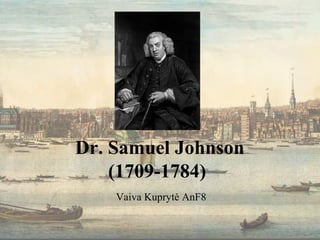
Dr. Samuel Johnson
(1709-1784)
Vaiva Kuprytė AnF8
Contents
• Brief biography of Dr. Samuel Johnson;
• Famous literary works;
• A Dictionary of the English Language
(1755);
• Examples;
• The Significance of The Dictionary.
• The Criticism of The Dictionary.
Brief Biography
• Born in Lichfield, Staffordshire, England, in
1709.
• In 1728 entered Oxford university but has not
finished.
• In 1735 married Mrs. Porter.
• In 1737 went to London.
• In 1755 published A Dictionary of the English
Language.
• Died in 1784.
Famous literary works
• London (1738)
• The Vanity of Human Wishes (1749)
• Irene (1749)
• A Dictionary of the English Language (1755)
• Idler (1758-60)
• Rasselas (1759)
• Lives of the Poets (1779-81)
• Journey to the Western Isles of Scotland (1775 )
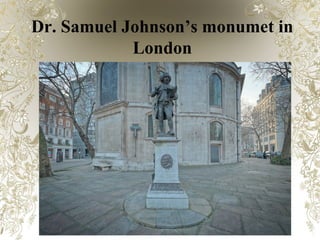
Dr. Samuel Johnson’s monumet in
London
A Dictionary of the English
Language (1755)
A Dictionary of the English Language
• Published in two folio volumes;
• Quotations from John Dryden,
William Shakespeare, John Milton
literary works;
• Over 42,000 words;
• A Plan of an English Dictionary
(1747);
• Accomplished in 9 years.
Etymology- n [etymologia, Latin]
1. The descent or deviation of a word from its original; the
deduction of formations from the radical word; the
analysis of compound words into primitives.
– Consumption is generally taken for any universal diminution and
colliquation of the body, which acception its etymology implies.
Harvey on Consumptions.
– When words are restrained, by common usage, to a particular
sense, to run up to etymology, and construe them by dictionary, it is
wretchedly ridiculous. Collier’s View of the Stage.
– Pelvis is used by comic writers for a good looking-glass, by which
means the etymology of the words is visible, and pelvidera will
signify a lady who looks in her glass. Addison’s Spectator.
– If the meaning of a word could be learned by its deviation or
etymology, yet the original deviation of words is oftentimes very
dark. Watt’s Logick.
1. The part of grammar which delivers the inflections of
nouns and verbs (Johnson).
• “Excise: a hateful tax levied upon commodities
and adjudged not by the common judges of
property but wretches hired by those to whom
excise is paid”;
• “Lexicographer: a writer of dictionaries; a
harmless drudge that busies himself in tracing the
original and detailing the signification of words”;
• “Oats: a grain which in England is generally given
to horses, but in Scotland supports the people”;
• “Patron: one who countenances, supports, or
protects. Commonly a wretch who supports with
insolence, and is repaid with flattery”.
• Opulence. Wealth; riches; affluence
“There in full opulence a banker dwelt,
Who all the joys and pangs of riches felt;
His sideboard glitter'd with imagin'd plate,
And his proud fancy held a vast estate” - Jonathan
Swift
• To fart. To break wind behind.
“As when we gun discharge,
Although the bore be ne're so large,
Before the flame from muzzle burst,
Just at the breech it flashes first;
So from my lord his passion broke,
He farted first, and then he spoke” - Jonathan Swift
The Significance of The Dictionary
• Johnson’s Dictionary is the work that defined the
English language.
• Witty definitions.
• Dictionary explicitly accomplished prescriptive
goals.
• Apt quotations.
• Johnson inserted dictionaries into literary culture.
The Criticism of The Dictionary
References
• http://classiclit.about.com/library/bl-etexts/jcou

Dr.samuel johnson

  • 1.
  • 2.
    Contents • Brief biographyof Dr. Samuel Johnson; • Famous literary works; • A Dictionary of the English Language (1755); • Examples; • The Significance of The Dictionary. • The Criticism of The Dictionary.
  • 3.
    Brief Biography • Bornin Lichfield, Staffordshire, England, in 1709. • In 1728 entered Oxford university but has not finished. • In 1735 married Mrs. Porter. • In 1737 went to London. • In 1755 published A Dictionary of the English Language. • Died in 1784.
  • 4.
    Famous literary works •London (1738) • The Vanity of Human Wishes (1749) • Irene (1749) • A Dictionary of the English Language (1755) • Idler (1758-60) • Rasselas (1759) • Lives of the Poets (1779-81) • Journey to the Western Isles of Scotland (1775 )
  • 5.
    Dr. Samuel Johnson’smonumet in London
  • 6.
    A Dictionary ofthe English Language (1755)
  • 7.
    A Dictionary ofthe English Language • Published in two folio volumes; • Quotations from John Dryden, William Shakespeare, John Milton literary works; • Over 42,000 words; • A Plan of an English Dictionary (1747); • Accomplished in 9 years.
  • 8.
    Etymology- n [etymologia,Latin] 1. The descent or deviation of a word from its original; the deduction of formations from the radical word; the analysis of compound words into primitives. – Consumption is generally taken for any universal diminution and colliquation of the body, which acception its etymology implies. Harvey on Consumptions. – When words are restrained, by common usage, to a particular sense, to run up to etymology, and construe them by dictionary, it is wretchedly ridiculous. Collier’s View of the Stage. – Pelvis is used by comic writers for a good looking-glass, by which means the etymology of the words is visible, and pelvidera will signify a lady who looks in her glass. Addison’s Spectator. – If the meaning of a word could be learned by its deviation or etymology, yet the original deviation of words is oftentimes very dark. Watt’s Logick. 1. The part of grammar which delivers the inflections of nouns and verbs (Johnson).
  • 9.
    • “Excise: ahateful tax levied upon commodities and adjudged not by the common judges of property but wretches hired by those to whom excise is paid”; • “Lexicographer: a writer of dictionaries; a harmless drudge that busies himself in tracing the original and detailing the signification of words”; • “Oats: a grain which in England is generally given to horses, but in Scotland supports the people”; • “Patron: one who countenances, supports, or protects. Commonly a wretch who supports with insolence, and is repaid with flattery”.
  • 10.
    • Opulence. Wealth;riches; affluence “There in full opulence a banker dwelt, Who all the joys and pangs of riches felt; His sideboard glitter'd with imagin'd plate, And his proud fancy held a vast estate” - Jonathan Swift • To fart. To break wind behind. “As when we gun discharge, Although the bore be ne're so large, Before the flame from muzzle burst, Just at the breech it flashes first; So from my lord his passion broke, He farted first, and then he spoke” - Jonathan Swift
  • 11.
    The Significance ofThe Dictionary • Johnson’s Dictionary is the work that defined the English language. • Witty definitions. • Dictionary explicitly accomplished prescriptive goals. • Apt quotations. • Johnson inserted dictionaries into literary culture.
  • 12.
    The Criticism ofThe Dictionary
  • 13.