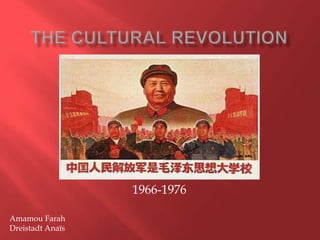
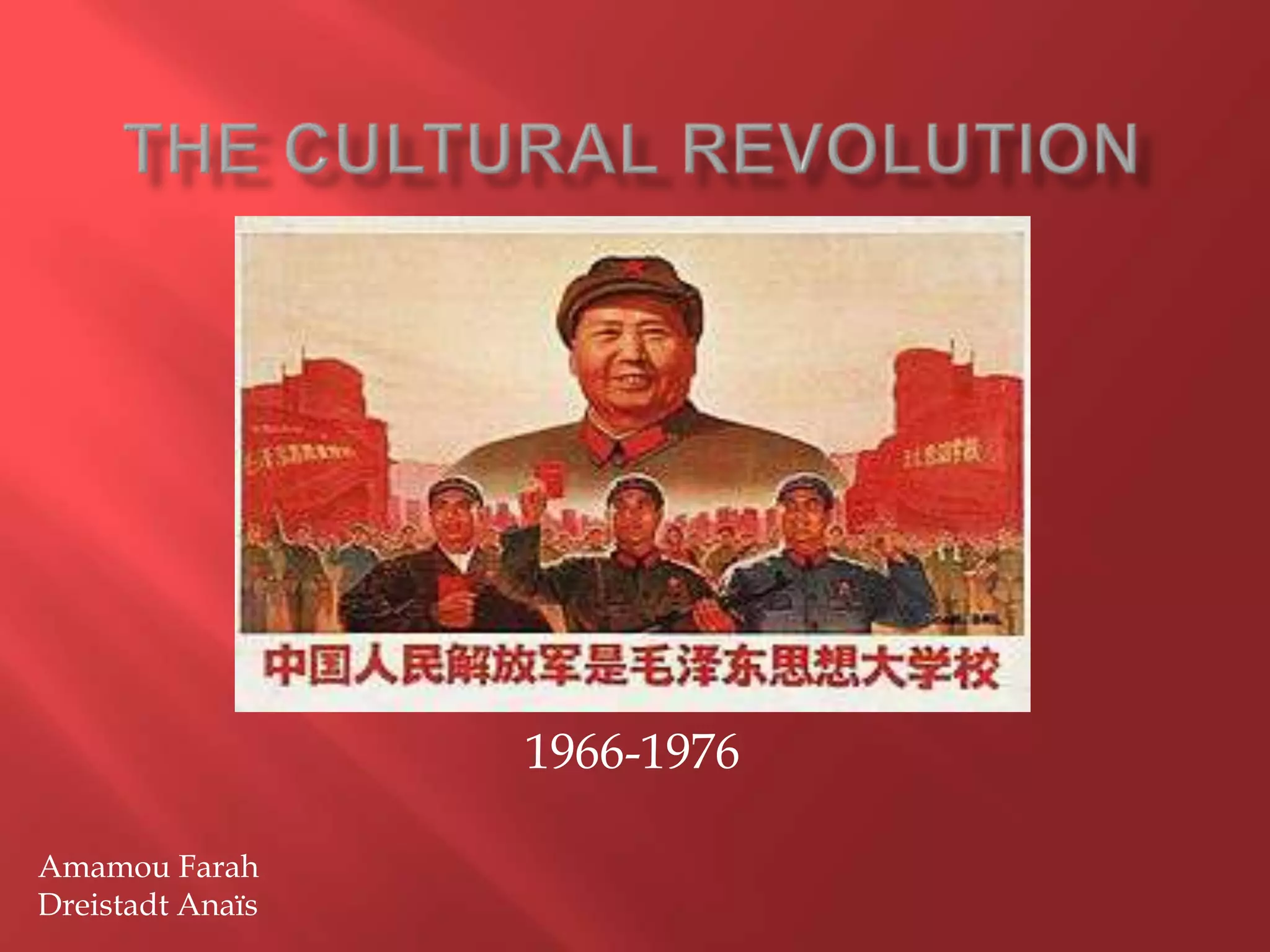
1966-1976

Amamou Farah
Dreistadt Anaïs
   Result of one and only person: Mao Zedong

   More and more inequality

“The CR was to provide a revolutionary commitment of an
older generation of party officials.” (MacFarqhar, p. 234)

   Political crisis

“The greatest danger to a successful socialist revolution is not
the threat of attacks from abroad, but rather the restoration of
capitalism at home” (MacFarqhar, p. 154)
   Necessity to intervene to restore the social order

   First phase: 3 steps in 3,5 years

   Mao‟s power base:

   PLA
   Radical intellectuals
   Mass base
   Red Guards

   Eradicate „the Four Olds‟


“The RG took the streets looking for evidence of bourgeois
culture” (MacFarqhar, p. 182)

Chairman Mao teaches us that revolution is not like going to
dinner […]. We can‟t be so tasteful and rafined. Revolution is
when one class overthrow another. Let‟s overhrow this
reactionary superstition!” (Gao,Yuan p. 91-92)


   Consequence: factionalism
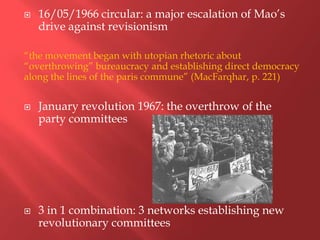
   16/05/1966 circular: a major escalation of Mao‟s
    drive against revisionism

“the movement began with utopian rhetoric about
“overthrowing” bureaucracy and establishing direct democracy
along the lines of the paris commune” (MacFarqhar, p. 221)


   January revolution 1967: the overthrow of the
    party committees


   3 in 1 combination: 3 networks establishing new
    revolutionary committees
   Reconstruction of political system: much more
    important role played by military officers

“purification of the ranks” of party members, expelling those
who had been shown to be revisionist, and absorbing “fresh
blood” from the activists of the CR. (MacFarqhar, p. 224)

“education serving proletarian politics and education being
combined with productive labour, so as to enable those
receiving an education to develop morraly, intellectually and
physically and to become labourers with social consciousness
and culture.” (Cheng & Letz, p. 429)
   Limited impact on agricultural and industrial
    production

   Factionalism until the eighties

   Crisis amoung the young people
   Why did Mao launch the Cultural Revolution ?
   What are the goals of the radicals intellectuals
    in the Cultural Revolution ?
   What are the consequences of the worker-
    peasant system on the rural population ?
   Why the bourgeoisie‟s youth had been the
    most active during the Red Guards „s
    movement ?
   How Mao did mobilize the mass base ?
   What was the role of the mass in the Centrale
    Case Examination Group ?
   What was the international reaction?

The cultural revolution ppt

  • 1.
  • 2.
    Result of one and only person: Mao Zedong  More and more inequality “The CR was to provide a revolutionary commitment of an older generation of party officials.” (MacFarqhar, p. 234)  Political crisis “The greatest danger to a successful socialist revolution is not the threat of attacks from abroad, but rather the restoration of capitalism at home” (MacFarqhar, p. 154)
  • 3.
    Necessity to intervene to restore the social order  First phase: 3 steps in 3,5 years  Mao‟s power base:  PLA  Radical intellectuals  Mass base
  • 4.
    Red Guards  Eradicate „the Four Olds‟ “The RG took the streets looking for evidence of bourgeois culture” (MacFarqhar, p. 182) Chairman Mao teaches us that revolution is not like going to dinner […]. We can‟t be so tasteful and rafined. Revolution is when one class overthrow another. Let‟s overhrow this reactionary superstition!” (Gao,Yuan p. 91-92)  Consequence: factionalism
  • 5.
    16/05/1966 circular: a major escalation of Mao‟s drive against revisionism “the movement began with utopian rhetoric about “overthrowing” bureaucracy and establishing direct democracy along the lines of the paris commune” (MacFarqhar, p. 221)  January revolution 1967: the overthrow of the party committees  3 in 1 combination: 3 networks establishing new revolutionary committees
  • 6.
    Reconstruction of political system: much more important role played by military officers “purification of the ranks” of party members, expelling those who had been shown to be revisionist, and absorbing “fresh blood” from the activists of the CR. (MacFarqhar, p. 224) “education serving proletarian politics and education being combined with productive labour, so as to enable those receiving an education to develop morraly, intellectually and physically and to become labourers with social consciousness and culture.” (Cheng & Letz, p. 429)
  • 7.
    Limited impact on agricultural and industrial production  Factionalism until the eighties  Crisis amoung the young people
  • 8.
    Why did Mao launch the Cultural Revolution ?  What are the goals of the radicals intellectuals in the Cultural Revolution ?  What are the consequences of the worker- peasant system on the rural population ?  Why the bourgeoisie‟s youth had been the most active during the Red Guards „s movement ?  How Mao did mobilize the mass base ?  What was the role of the mass in the Centrale Case Examination Group ?  What was the international reaction?