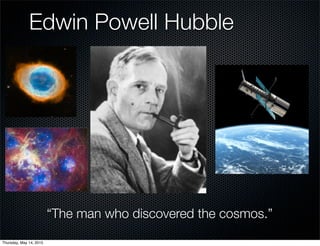
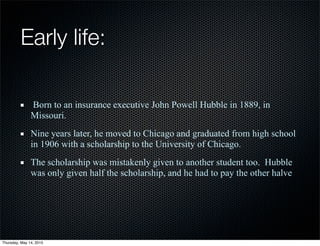
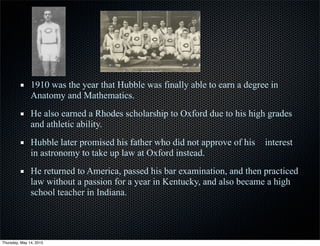
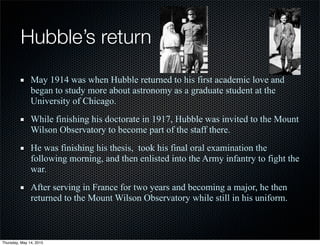
Edwin Powell Hubble
“The man who discovered the cosmos.”
Thursday, May 14, 2015
Early life:
Born to an insurance executive John Powell Hubble in 1889, in
Missouri.
Nine years later, he moved to Chicago and graduated from high school
in 1906 with a scholarship to the University of Chicago.
The scholarship was mistakenly given to another student too. Hubble
was only given half the scholarship, and he had to pay the other halve
Thursday, May 14, 2015
1910 was the year that Hubble was finally able to earn a degree in
Anatomy and Mathematics.
He also earned a Rhodes scholarship to Oxford due to his high grades
and athletic ability.
Hubble later promised his father who did not approve of his interest
in astronomy to take up law at Oxford instead.
He returned to America, passed his bar examination, and then practiced
law without a passion for a year in Kentucky, and also became a high
school teacher in Indiana.
Thursday, May 14, 2015
Hubble’s return
May 1914 was when Hubble returned to his first academic love and
began to study more about astronomy as a graduate student at the
University of Chicago.
While finishing his doctorate in 1917, Hubble was invited to the Mount
Wilson Observatory to become part of the staff there.
He was finishing his thesis, took his final oral examination the
following morning, and then enlisted into the Army infantry to fight the
war.
After serving in France for two years and becoming a major, he then
returned to the Mount Wilson Observatory while still in his uniform.
Thursday, May 14, 2015
Rivalry
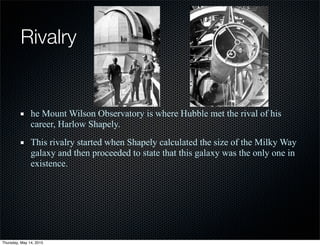
he Mount Wilson Observatory is where Hubble met the rival of his
career, Harlow Shapely.
This rivalry started when Shapely calculated the size of the Milky Way
galaxy and then proceeded to state that this galaxy was the only one in
existence.
Thursday, May 14, 2015
Competition
This bold assumption is what drove Hubble to work tirelessly to prove
him wrong.
In 1923, Hubble observed a star a flaring light in the distant sky using
the Observatory’s telescope and then used the calculations by the other
scientists and by Shapely himself. Hubble discovered that the star was
way outside of the Milky Way galaxy.
This is Hubble’s claim to fame, he changed history, and was able to
make the universe “expand” all within a matter of a day, Edwin Powell
Hubble had discovered the Cosmos!
Thursday, May 14, 2015
Hubble’s methods
Hubble used the same method as his rival to calculate the distance of
the star that made history on that day in 1923.
The method included using the standardized light variations from
cepheid (more luminous) stars to base and establish the distance of the
object in question.
Hubble also was able to develop other methods and diagrams to
classify the three different types of galaxies: ellipticals, spiral and
barred spirals, and irregulars.
These classifications also helped Hubble examine and study the
different galaxies and whether or not they are mobile or stationary.
Thursday, May 14, 2015
Influence
In the early 1900s, it was believed that there was only the Milky Way
galaxy that existed and just space dust floating around, yet we know
now that was incorrect.
After Hubble discovered the cosmos, it was like he took the blinds off
of every human being and literally introduced us to a brand new
universe with an uncountable amount of galaxies.
Hubble influenced the creation of new and improved telescopes that
could see what we were missing all these years, and ultimately 101
years after his birth, the Hubble Space telescope was named after him
in his honor.
Thursday, May 14, 2015
The discovery of the cosmos is still relevant today considering we still
get much of our information about other planets because they are too
far out of reach for man at the time.
The universe is infinite and the more we learn about it, the more we
can know and possibly make accurate predictions to what may be
coming in the future to planets or galaxies around us.
The Hubble space telescope also aids in attempting to find a planet like
our own, holds water, and even could possibly sustain life.
Thursday, May 14, 2015
Conclusion
We were given the life of a man who changed the world forever;
Hubble never gave up on his passion, even though he broke a promise,
I’m sure it was what he felt in his heart right.
The data we have been able to collect because of Hubble’s discovery is
priceless.
Hubble’s discovery was influential and still is to this day, and it is still
very relevant, because of him we are able to look up the beauty of the
heavens just at a click of a button and observe what the naked eye
could only fathom seeing on its’ own.
Thursday, May 14, 2015
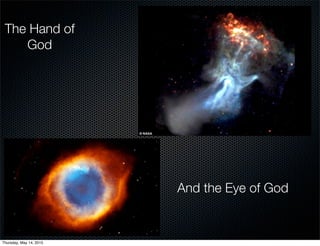
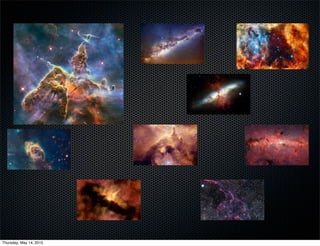
The Hand of
God
And the Eye of God
Thursday, May 14, 2015
Work Cited
Dunbar, Brian. "The Hubble Story." NASA. NASA, 26 Oct. 2006. Web. 12 May 2015.
<http://www.nasa.gov/mission_pages/hubble/story/the_story.html>.
"1929: Edwin Hubble Discovers the Universe Is Expanding." 1929: Edwin Hubble
Discovers the Universe Is Expanding. N.p., n.d. Web. 12 May 2015. <https://
cosmology.carnegiescience.edu/timeline/1929>
"Edwin Powell Hubble - The Man Who Discovered the Cosmos." Spacetelescope.org. N.p.,
n.d. Web. <https%3A%2F%2Fwww.spacetelescope.org%2Fabout%2Fhistory
%2Fthe_man_behind_the_name%2F>.
"The Legacy of Edwin Hubble." Hubblesite.org. N.p., n.d. Web. <http://hubblesite.org/
the_telescope/hubble_essentials/edwin_hubble.php>.
Thursday, May 14, 2015

Edwin hubble powerpoint 2

  • 1.
    Edwin Powell Hubble “Theman who discovered the cosmos.” Thursday, May 14, 2015
  • 2.
    Early life: Born toan insurance executive John Powell Hubble in 1889, in Missouri. Nine years later, he moved to Chicago and graduated from high school in 1906 with a scholarship to the University of Chicago. The scholarship was mistakenly given to another student too. Hubble was only given half the scholarship, and he had to pay the other halve Thursday, May 14, 2015
  • 3.
    1910 was theyear that Hubble was finally able to earn a degree in Anatomy and Mathematics. He also earned a Rhodes scholarship to Oxford due to his high grades and athletic ability. Hubble later promised his father who did not approve of his interest in astronomy to take up law at Oxford instead. He returned to America, passed his bar examination, and then practiced law without a passion for a year in Kentucky, and also became a high school teacher in Indiana. Thursday, May 14, 2015
  • 4.
    Hubble’s return May 1914was when Hubble returned to his first academic love and began to study more about astronomy as a graduate student at the University of Chicago. While finishing his doctorate in 1917, Hubble was invited to the Mount Wilson Observatory to become part of the staff there. He was finishing his thesis, took his final oral examination the following morning, and then enlisted into the Army infantry to fight the war. After serving in France for two years and becoming a major, he then returned to the Mount Wilson Observatory while still in his uniform. Thursday, May 14, 2015
  • 5.
    Rivalry he Mount WilsonObservatory is where Hubble met the rival of his career, Harlow Shapely. This rivalry started when Shapely calculated the size of the Milky Way galaxy and then proceeded to state that this galaxy was the only one in existence. Thursday, May 14, 2015
  • 6.
    Competition This bold assumptionis what drove Hubble to work tirelessly to prove him wrong. In 1923, Hubble observed a star a flaring light in the distant sky using the Observatory’s telescope and then used the calculations by the other scientists and by Shapely himself. Hubble discovered that the star was way outside of the Milky Way galaxy. This is Hubble’s claim to fame, he changed history, and was able to make the universe “expand” all within a matter of a day, Edwin Powell Hubble had discovered the Cosmos! Thursday, May 14, 2015
  • 7.
    Hubble’s methods Hubble usedthe same method as his rival to calculate the distance of the star that made history on that day in 1923. The method included using the standardized light variations from cepheid (more luminous) stars to base and establish the distance of the object in question. Hubble also was able to develop other methods and diagrams to classify the three different types of galaxies: ellipticals, spiral and barred spirals, and irregulars. These classifications also helped Hubble examine and study the different galaxies and whether or not they are mobile or stationary. Thursday, May 14, 2015
  • 8.
    Influence In the early1900s, it was believed that there was only the Milky Way galaxy that existed and just space dust floating around, yet we know now that was incorrect. After Hubble discovered the cosmos, it was like he took the blinds off of every human being and literally introduced us to a brand new universe with an uncountable amount of galaxies. Hubble influenced the creation of new and improved telescopes that could see what we were missing all these years, and ultimately 101 years after his birth, the Hubble Space telescope was named after him in his honor. Thursday, May 14, 2015
  • 9.
    The discovery ofthe cosmos is still relevant today considering we still get much of our information about other planets because they are too far out of reach for man at the time. The universe is infinite and the more we learn about it, the more we can know and possibly make accurate predictions to what may be coming in the future to planets or galaxies around us. The Hubble space telescope also aids in attempting to find a planet like our own, holds water, and even could possibly sustain life. Thursday, May 14, 2015
  • 10.
    Conclusion We were giventhe life of a man who changed the world forever; Hubble never gave up on his passion, even though he broke a promise, I’m sure it was what he felt in his heart right. The data we have been able to collect because of Hubble’s discovery is priceless. Hubble’s discovery was influential and still is to this day, and it is still very relevant, because of him we are able to look up the beauty of the heavens just at a click of a button and observe what the naked eye could only fathom seeing on its’ own. Thursday, May 14, 2015
  • 11.
  • 12.
    The Hand of God Andthe Eye of God Thursday, May 14, 2015
  • 13.
  • 14.
    Work Cited Dunbar, Brian."The Hubble Story." NASA. NASA, 26 Oct. 2006. Web. 12 May 2015. <http://www.nasa.gov/mission_pages/hubble/story/the_story.html>. "1929: Edwin Hubble Discovers the Universe Is Expanding." 1929: Edwin Hubble Discovers the Universe Is Expanding. N.p., n.d. Web. 12 May 2015. <https:// cosmology.carnegiescience.edu/timeline/1929> "Edwin Powell Hubble - The Man Who Discovered the Cosmos." Spacetelescope.org. N.p., n.d. Web. <https%3A%2F%2Fwww.spacetelescope.org%2Fabout%2Fhistory %2Fthe_man_behind_the_name%2F>. "The Legacy of Edwin Hubble." Hubblesite.org. N.p., n.d. Web. <http://hubblesite.org/ the_telescope/hubble_essentials/edwin_hubble.php>. Thursday, May 14, 2015