HISTORY AND DEVELOPMENT
 Astronomy and Physics have made many discoveries
which proves that the universe had a beginning.
Therefore, the big bang theory basically explains what
happened at the beginning of the universe.
 The theory suggests that the universe began by
expanding from a small volume with higher density and
temperature.
HISTORY
 The Big Bang theory developed from observations of
the structure of the universe and from theoretical
considerations.
 In 1912 Vesto Slipher measured the first Doppler shift
of a "spiral nebula" (spiral nebula is the obsolete term
for spiral galaxies), and soon discovered that almost all
such nebulae were receding from Earth. He did not
grasp the cosmological implications of this fact, and
indeed at the time it was highly controversial whether or
not these nebulae were "island universes" outside our
Milky Way
STRUCTURE FORMATION
 Over a long period of time, the slightly denser regions of the
nearly uniformly distributed matter gravitationally attracted
nearby matter and thus grew even denser, forming gas
clouds, stars, galaxies, and the other astronomical structures
observable today. The details of this process depend on the
amount and type of matter in the universe.
The four possible types of matter are:
1. cold dark matter
2. warm dark matter
3. hot dark matter
4. baryonic matter
BIG BANG THEORY - EVIDENCE FOR THE THEORY
WHAT ARE THE MAJOR EVIDENCES WHICH SUPPORT THE BIG BANG THEORY?
 First of all, we are reasonably certain that the universe had a beginning.
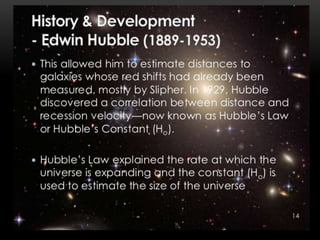
 Second, galaxies appear to be moving away from us at speeds proportional to
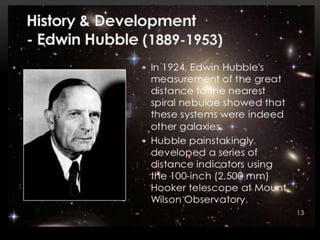
their distance. This is called "Hubble's Law," named after Edwin Hubble (1889-
1953) who discovered this phenomenon in 1929. This observation supports the
expansion of the universe and suggests that the universe was once
compacted.
 Third, if the universe was initially very, very hot as the Big Bang suggests, we
should be able to find some remnant of this heat. In 1965, Radioastronomers
Arno Penzias and Robert Wilson discovered a 2.725 degree Kelvin (-454.765
degree Fahrenheit, -270.425 degree Celsius) Cosmic Microwave Background
radiation (CMB) which pervades the observable universe. This is thought to be
the remnant which scientists were looking for. Penzias and Wilson shared in
the 1978 Nobel Prize for Physics for their discovery.
 Finally, the abundance of the "light elements" Hydrogen and Helium found in
the observable universe are thought to support the Big Bang model of origins.
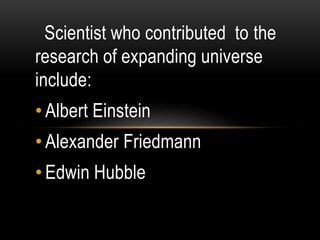
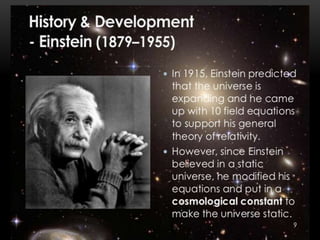
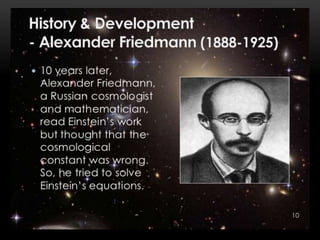
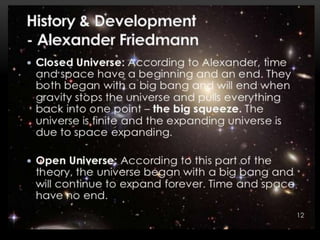
Scientist who contributed to the
research of expanding universe
include:
• Albert Einstein
• Alexander Friedmann
• Edwin Hubble
VIDEO PRESENTATION

The bigbang - theory!

  • 2.
    HISTORY AND DEVELOPMENT Astronomy and Physics have made many discoveries which proves that the universe had a beginning. Therefore, the big bang theory basically explains what happened at the beginning of the universe.  The theory suggests that the universe began by expanding from a small volume with higher density and temperature.
  • 3.
    HISTORY  The BigBang theory developed from observations of the structure of the universe and from theoretical considerations.  In 1912 Vesto Slipher measured the first Doppler shift of a "spiral nebula" (spiral nebula is the obsolete term for spiral galaxies), and soon discovered that almost all such nebulae were receding from Earth. He did not grasp the cosmological implications of this fact, and indeed at the time it was highly controversial whether or not these nebulae were "island universes" outside our Milky Way
  • 4.
    STRUCTURE FORMATION  Overa long period of time, the slightly denser regions of the nearly uniformly distributed matter gravitationally attracted nearby matter and thus grew even denser, forming gas clouds, stars, galaxies, and the other astronomical structures observable today. The details of this process depend on the amount and type of matter in the universe. The four possible types of matter are: 1. cold dark matter 2. warm dark matter 3. hot dark matter 4. baryonic matter
  • 5.
    BIG BANG THEORY- EVIDENCE FOR THE THEORY WHAT ARE THE MAJOR EVIDENCES WHICH SUPPORT THE BIG BANG THEORY?  First of all, we are reasonably certain that the universe had a beginning.  Second, galaxies appear to be moving away from us at speeds proportional to their distance. This is called "Hubble's Law," named after Edwin Hubble (1889- 1953) who discovered this phenomenon in 1929. This observation supports the expansion of the universe and suggests that the universe was once compacted.  Third, if the universe was initially very, very hot as the Big Bang suggests, we should be able to find some remnant of this heat. In 1965, Radioastronomers Arno Penzias and Robert Wilson discovered a 2.725 degree Kelvin (-454.765 degree Fahrenheit, -270.425 degree Celsius) Cosmic Microwave Background radiation (CMB) which pervades the observable universe. This is thought to be the remnant which scientists were looking for. Penzias and Wilson shared in the 1978 Nobel Prize for Physics for their discovery.  Finally, the abundance of the "light elements" Hydrogen and Helium found in the observable universe are thought to support the Big Bang model of origins.
  • 6.
    Scientist who contributedto the research of expanding universe include: • Albert Einstein • Alexander Friedmann • Edwin Hubble
  • 12.