The Barclays Data
Science Hackathon:
Building Retail Recommender
Systems based on Customer
Shopping Behavior
Gianmario	Spacagna	
@gm_spacagna	
Data	Science	Milan	meetup,	13	July	2016
The Barclays Data Science Team
•  Retail Business Banking division based in the HQ
(Canary Wharf, London)
•  Back in time (Dec 2015) was 6 members:
Head + mix of (engineering and machine learning) specialists
•  Goal: building data-driven applications such as:
–  Insights Engine for small businesses
–  Complaints NLP analytics
–  Mortgage predictive models
–  Pricing optimisation
–  Graph fraud detection
–  and so on...
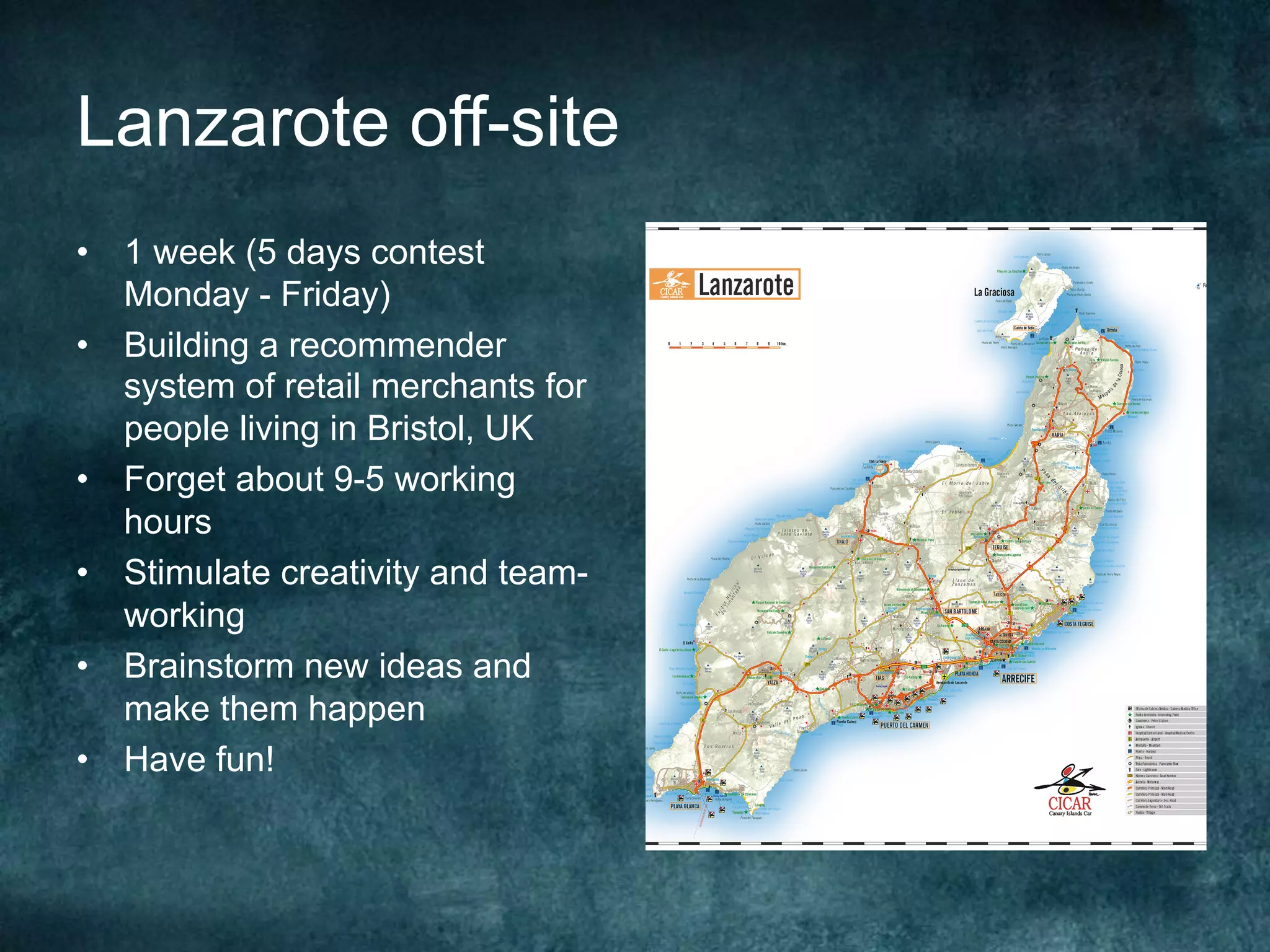
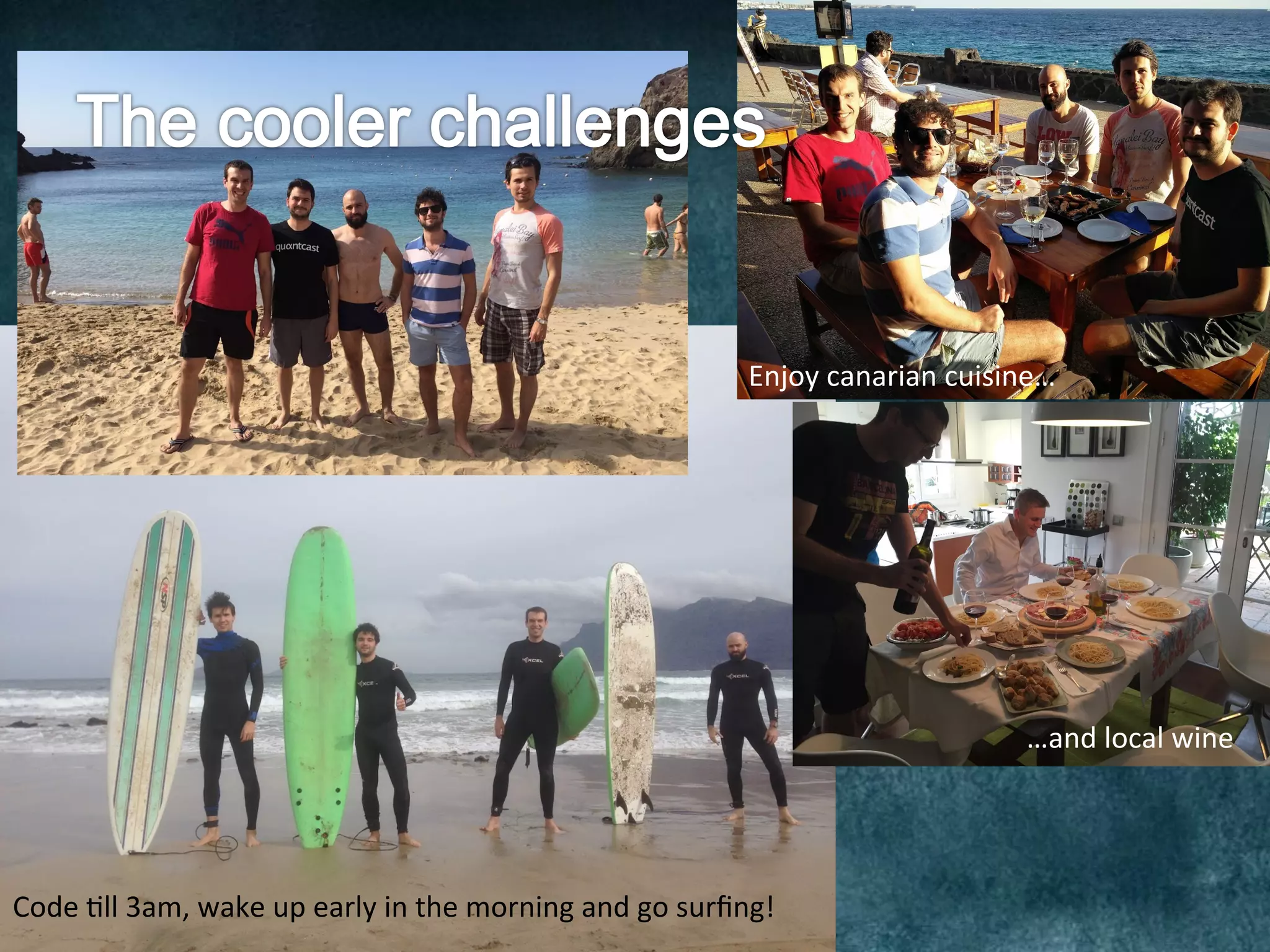
Lanzarote off-site
•  1 week (5 days contest
Monday - Friday)
•  Building a recommender
system of retail merchants for
people living in Bristol, UK
•  Forget about 9-5 working
hours
•  Stimulate creativity and team-
working
•  Brainstorm new ideas and
make them happen
•  Have fun!
The technical challenges
•  No infrastructure available, only laptops and a
1G WiFi shared Internet connection.
•  Build, test, and refactor quickly,
no time for long end-to-end evaluations.
•  Work with common structures without
constraining individual initiative and innovation.
•  Design for deployment to production on a multi-
tenant cluster.
Code	@ll	3am,	wake	up	early	in	the	morning	and	go	surfing!	
Enjoy	canarian	cuisine…	
…and	local	wine
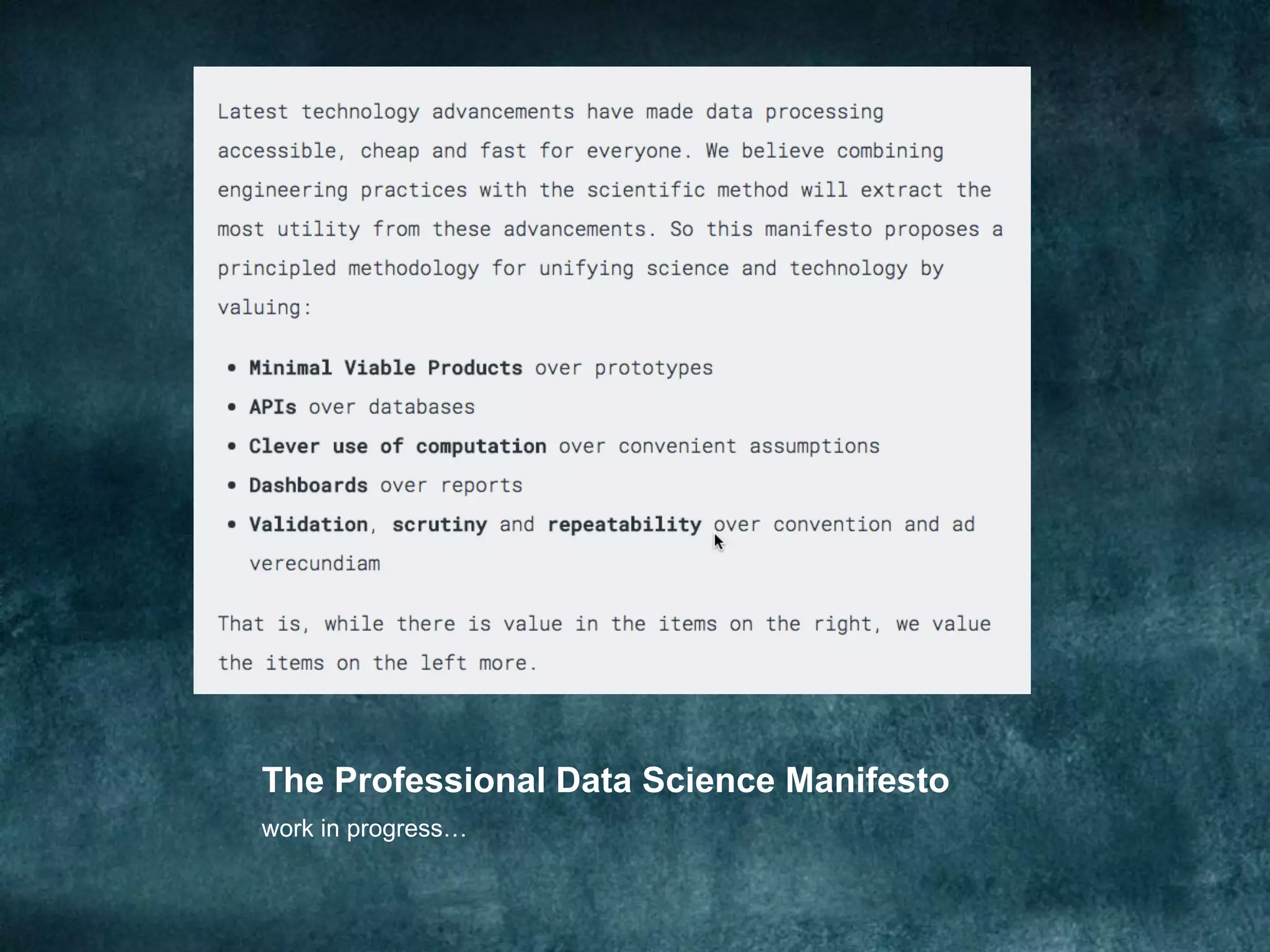
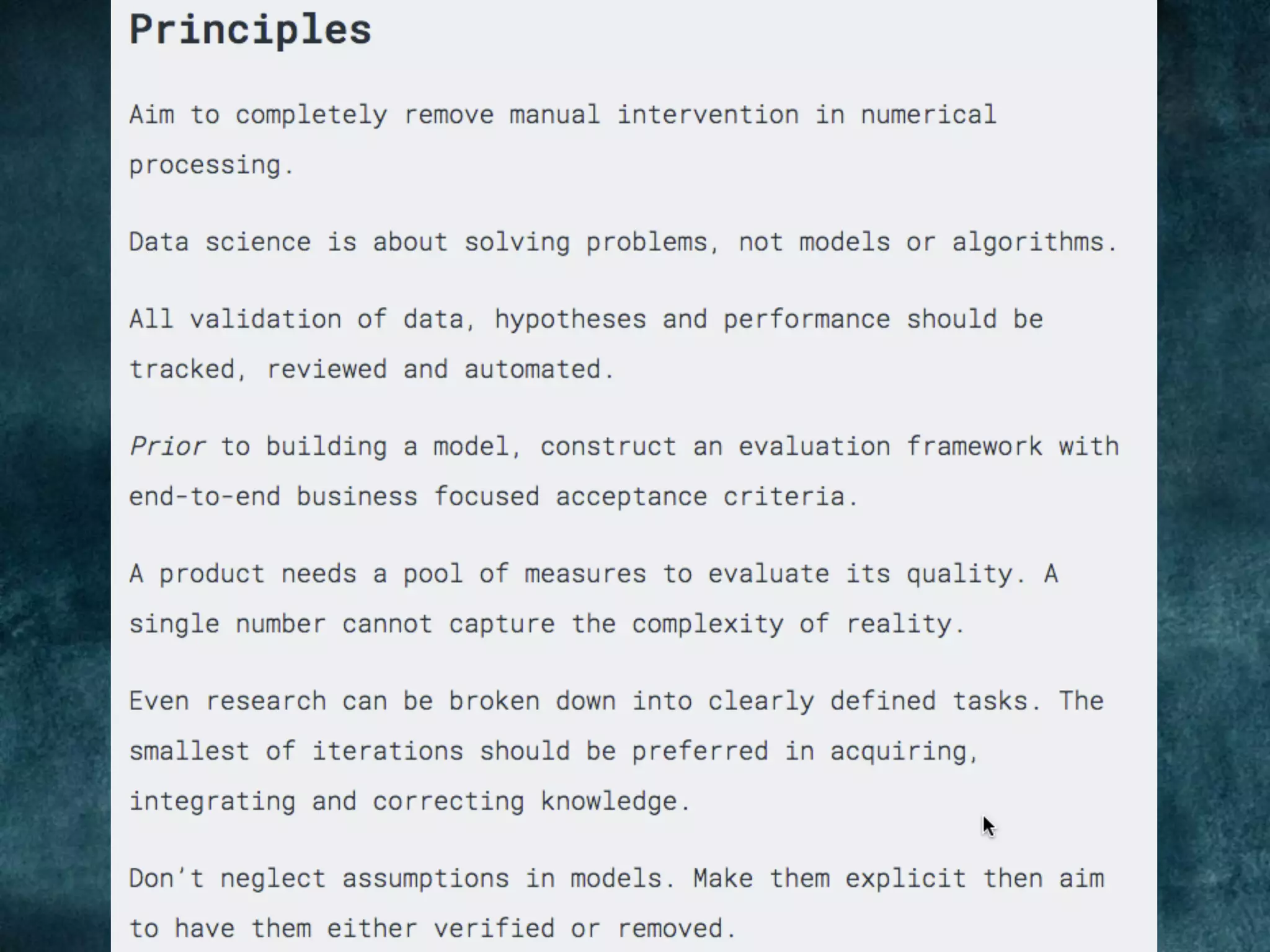
The Professional Data Science Manifesto
work in progress…
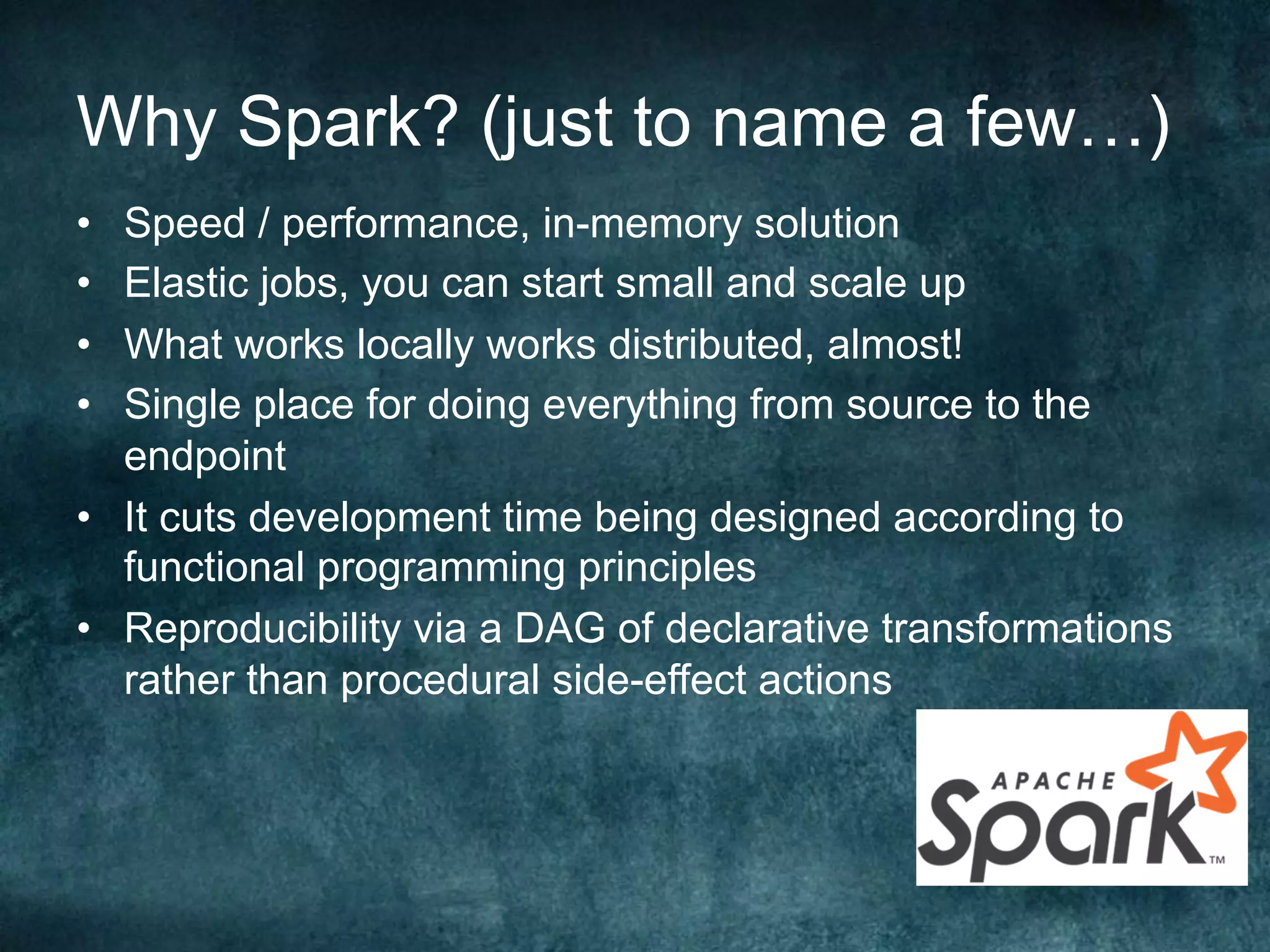
Why Spark? (just to name a few…)
•  Speed / performance, in-memory solution
•  Elastic jobs, you can start small and scale up
•  What works locally works distributed, almost!
•  Single place for doing everything from source to the
endpoint
•  It cuts development time being designed according to
functional programming principles
•  Reproducibility via a DAG of declarative transformations
rather than procedural side-effect actions
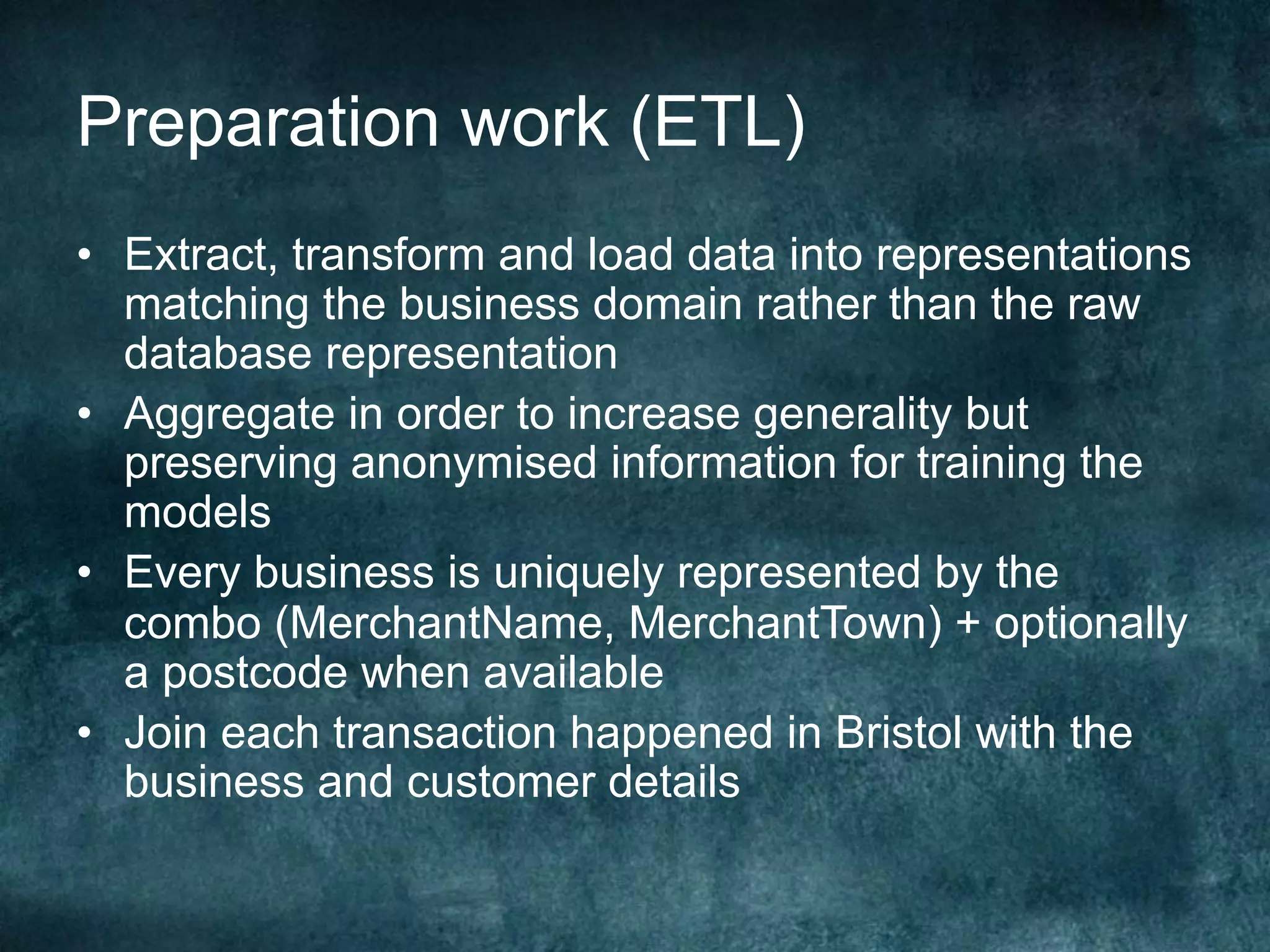
Preparation work (ETL)
•  Extract, transform and load data into representations
matching the business domain rather than the raw
database representation
•  Aggregate in order to increase generality but
preserving anonymised information for training the
models
•  Every business is uniquely represented by the
combo (MerchantName, MerchantTown) + optionally
a postcode when available
•  Join each transaction happened in Bristol with the
business and customer details
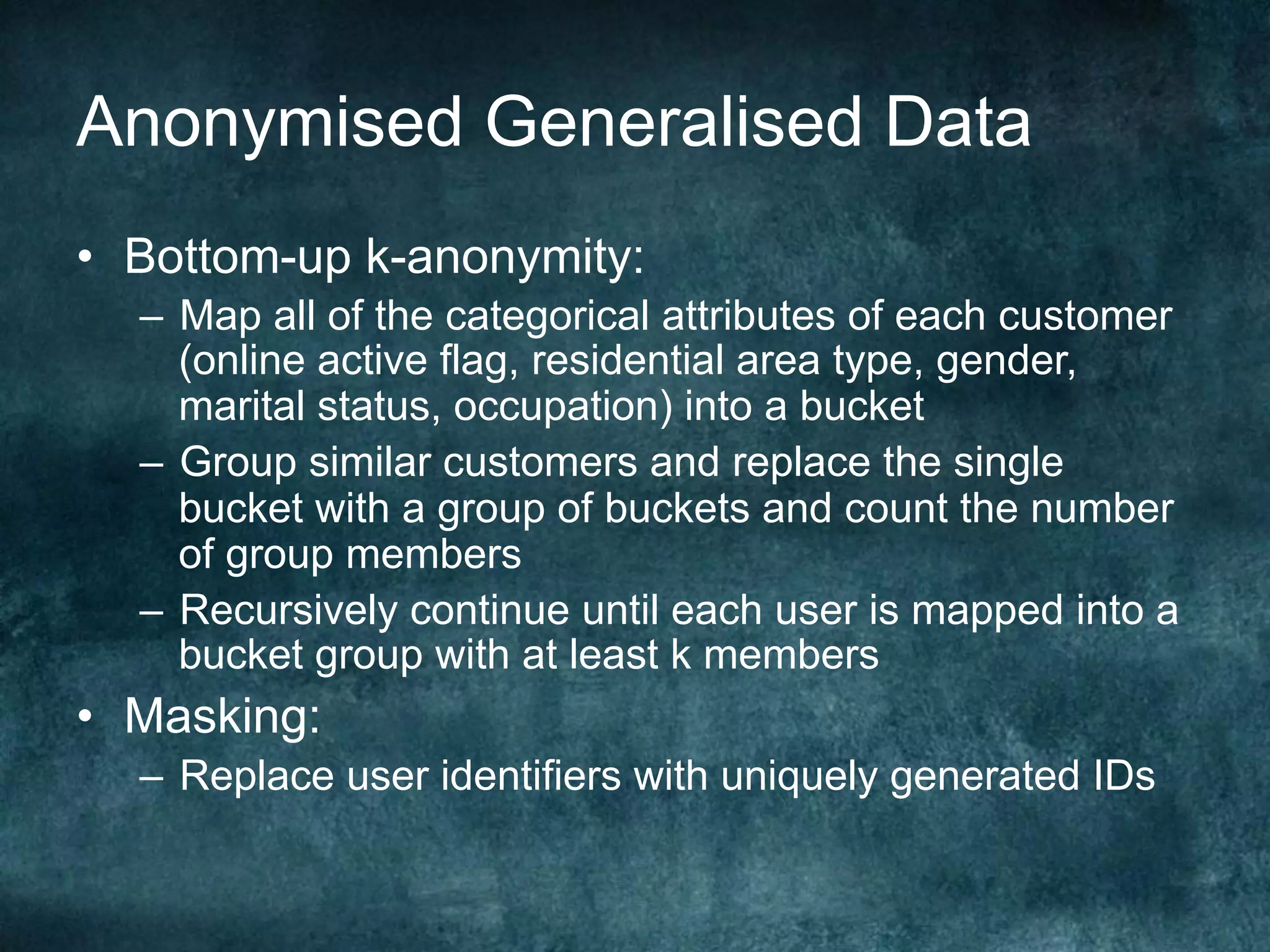
Anonymised Generalised Data
•  Bottom-up k-anonymity:
–  Map all of the categorical attributes of each customer
(online active flag, residential area type, gender,
marital status, occupation) into a bucket
–  Group similar customers and replace the single
bucket with a group of buckets and count the number
of group members
–  Recursively continue until each user is mapped into a
bucket group with at least k members
•  Masking:
–  Replace user identifiers with uniquely generated IDs
K-anonymity example
!mestamp	 customerId	 occupa!
on	
gender	 amount	 business	
2015-03-05	 9218324	 Engineer	 male	 58.42	 Waitrose	
2015-03-06	 324624	 Cook	 female	 118.90	 Waitrose	
2015-03-06	


324624	 Cook	 female	 5.99	 Abokado	
Categorical	bucket	 Day	of	
week	
custome
rId	
amount	 business	
engineer-male,		
student-male,	
cook-female	
Thursday	 00003	 [50-60]	 Waitrose	
Friday	 00012	 [100--1
20]	
Waitrose	
Friday	 00012	 [0-10]	 Abokado
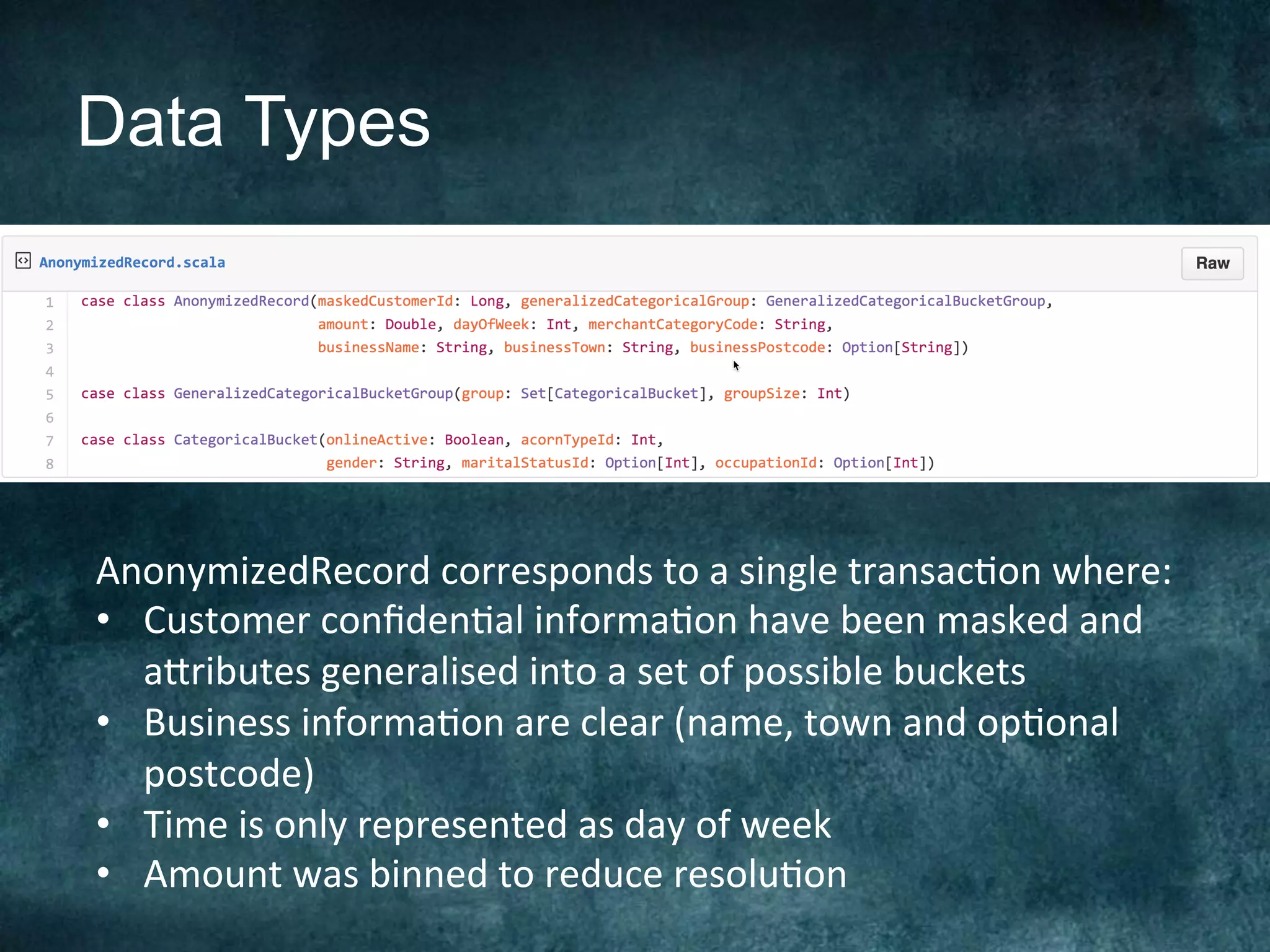
Data Types
AnonymizedRecord	corresponds	to	a	single	transac@on	where:	
•  Customer	confiden@al	informa@on	have	been	masked	and	
a[ributes	generalised	into	a	set	of	possible	buckets	
•  Business	informa@on	are	clear	(name,	town	and	op@onal	
postcode)	
•  Time	is	only	represented	as	day	of	week	
•  Amount	was	binned	to	reduce	resolu@on
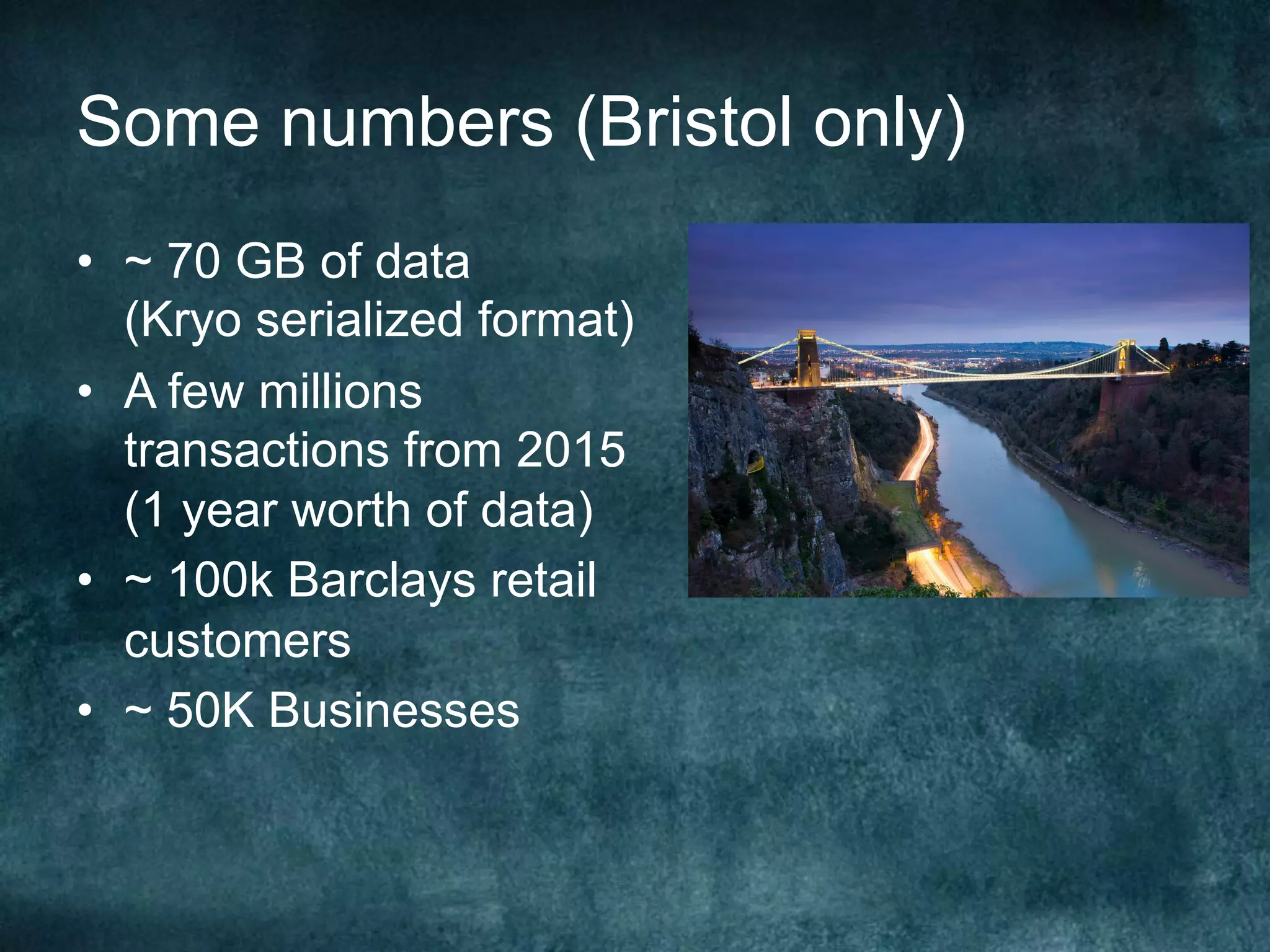
Some numbers (Bristol only)
•  ~ 70 GB of data
(Kryo serialized format)
•  A few millions
transactions from 2015
(1 year worth of data)
•  ~ 100k Barclays retail
customers
•  ~ 50K Businesses
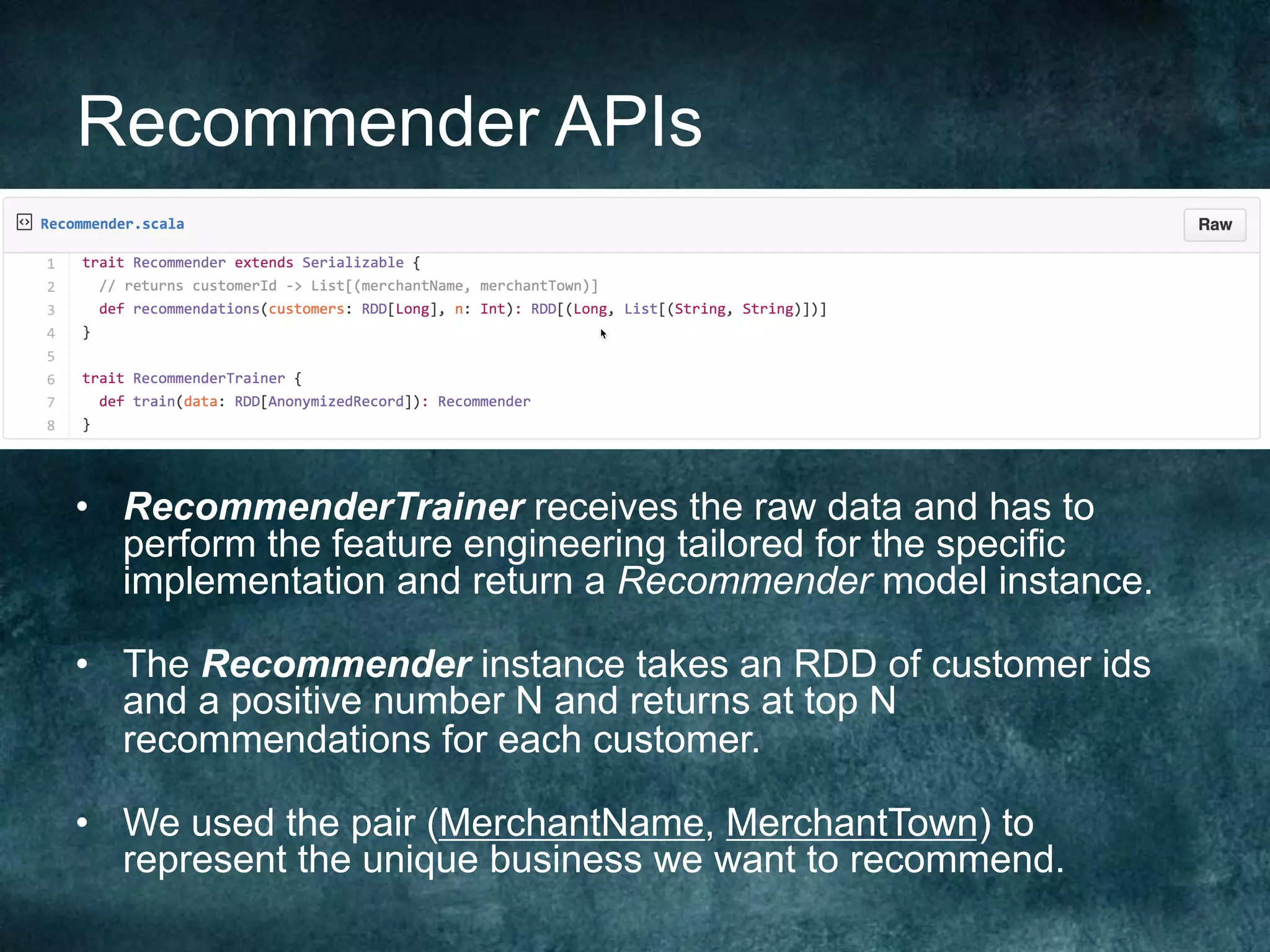
Recommender APIs
•  RecommenderTrainer receives the raw data and has to
perform the feature engineering tailored for the specific
implementation and return a Recommender model instance.
•  The Recommender instance takes an RDD of customer ids
and a positive number N and returns at top N
recommendations for each customer.
•  We used the pair (MerchantName, MerchantTown) to
represent the unique business we want to recommend.
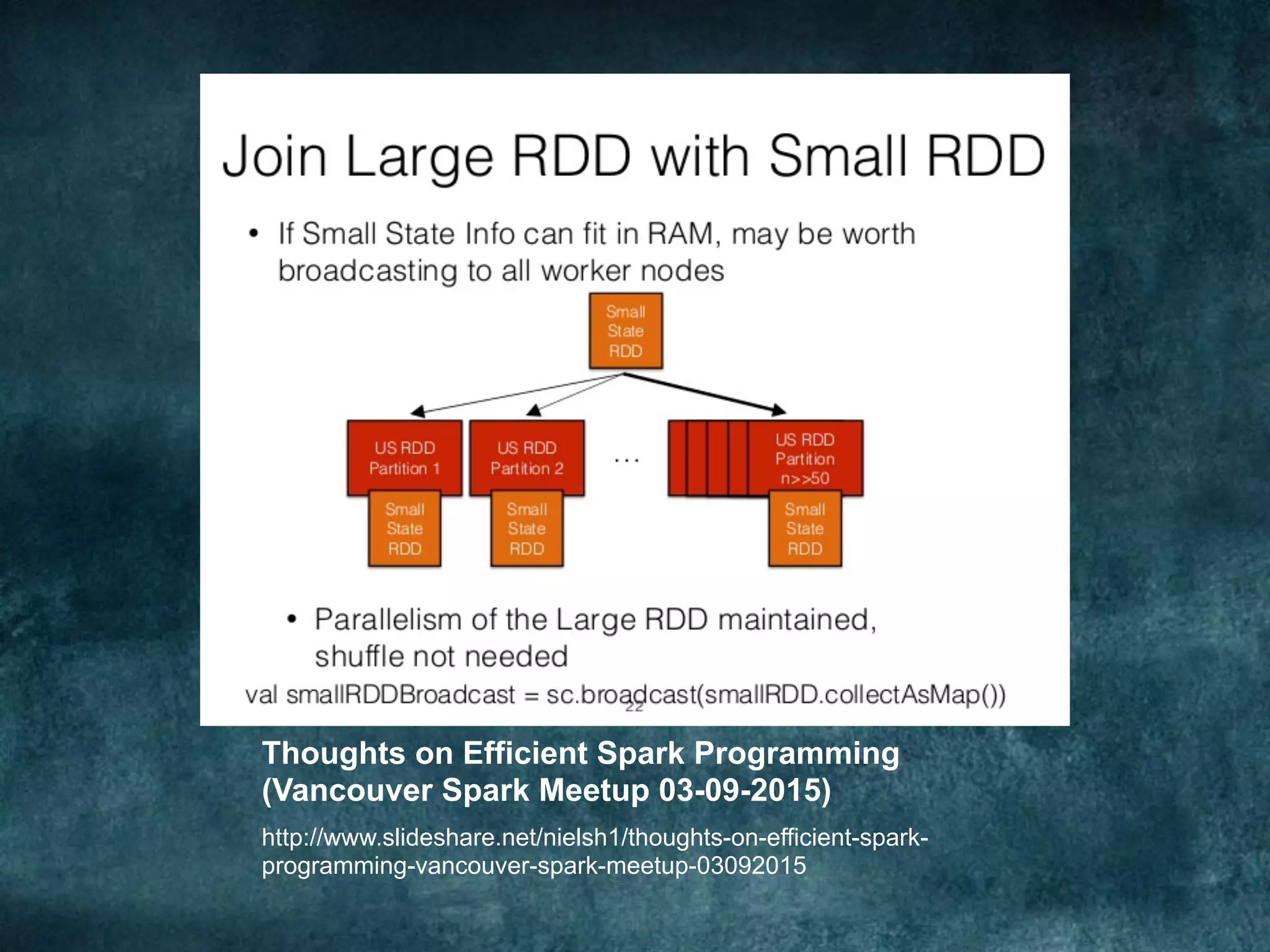
Thoughts on Efficient Spark Programming
(Vancouver Spark Meetup 03-09-2015)
http://www.slideshare.net/nielsh1/thoughts-on-efficient-spark-
programming-vancouver-spark-meetup-03092015
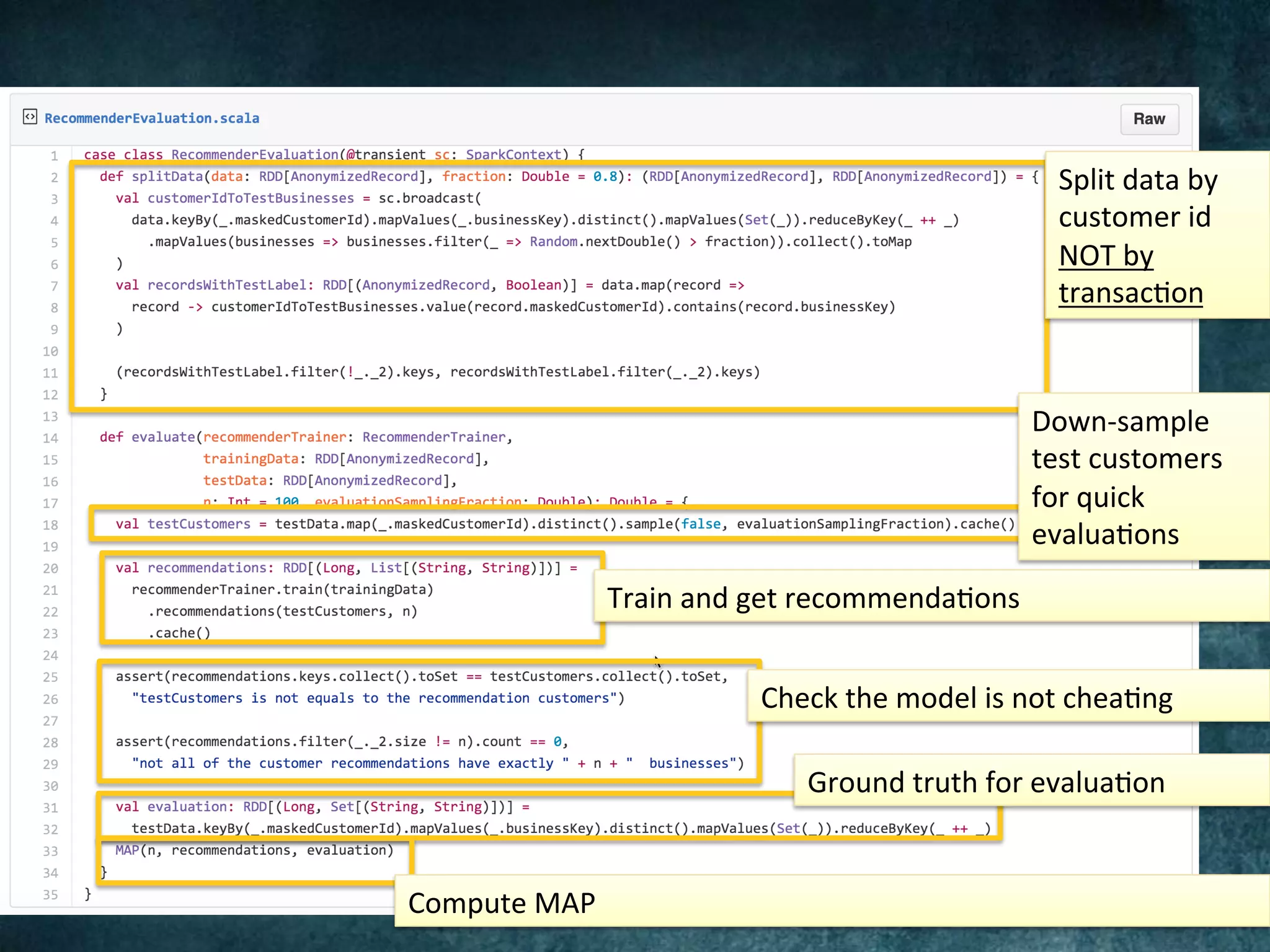
Split	data	by	
customer	id		
NOT	by	
transac@on	
Down-sample	
test	customers	
for	quick	
evalua@ons	
Train	and	get	recommenda@ons	
Check	the	model	is	not	chea@ng	
Ground	truth	for	evalua@on	
Compute	MAP
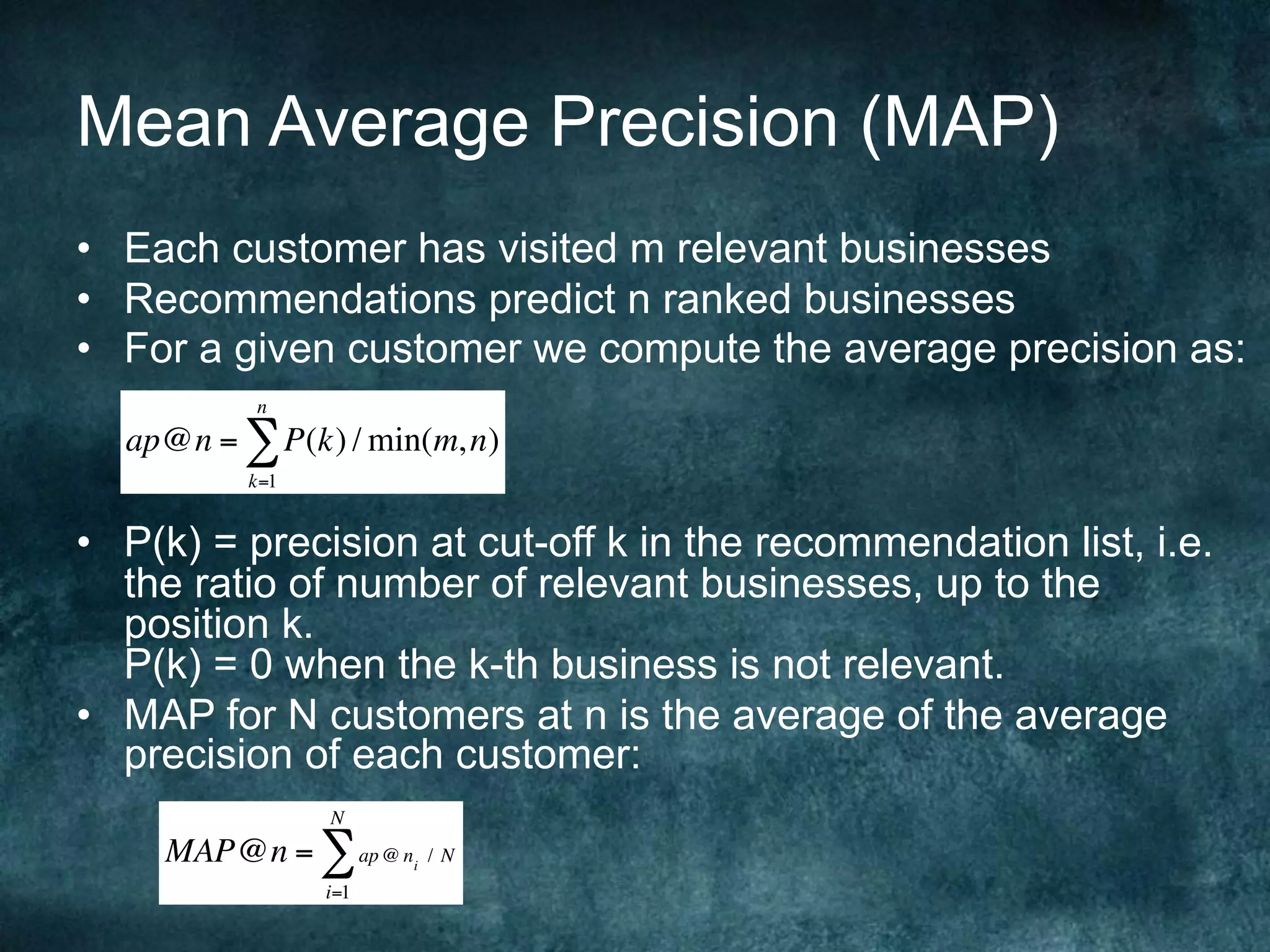
Mean Average Precision (MAP)
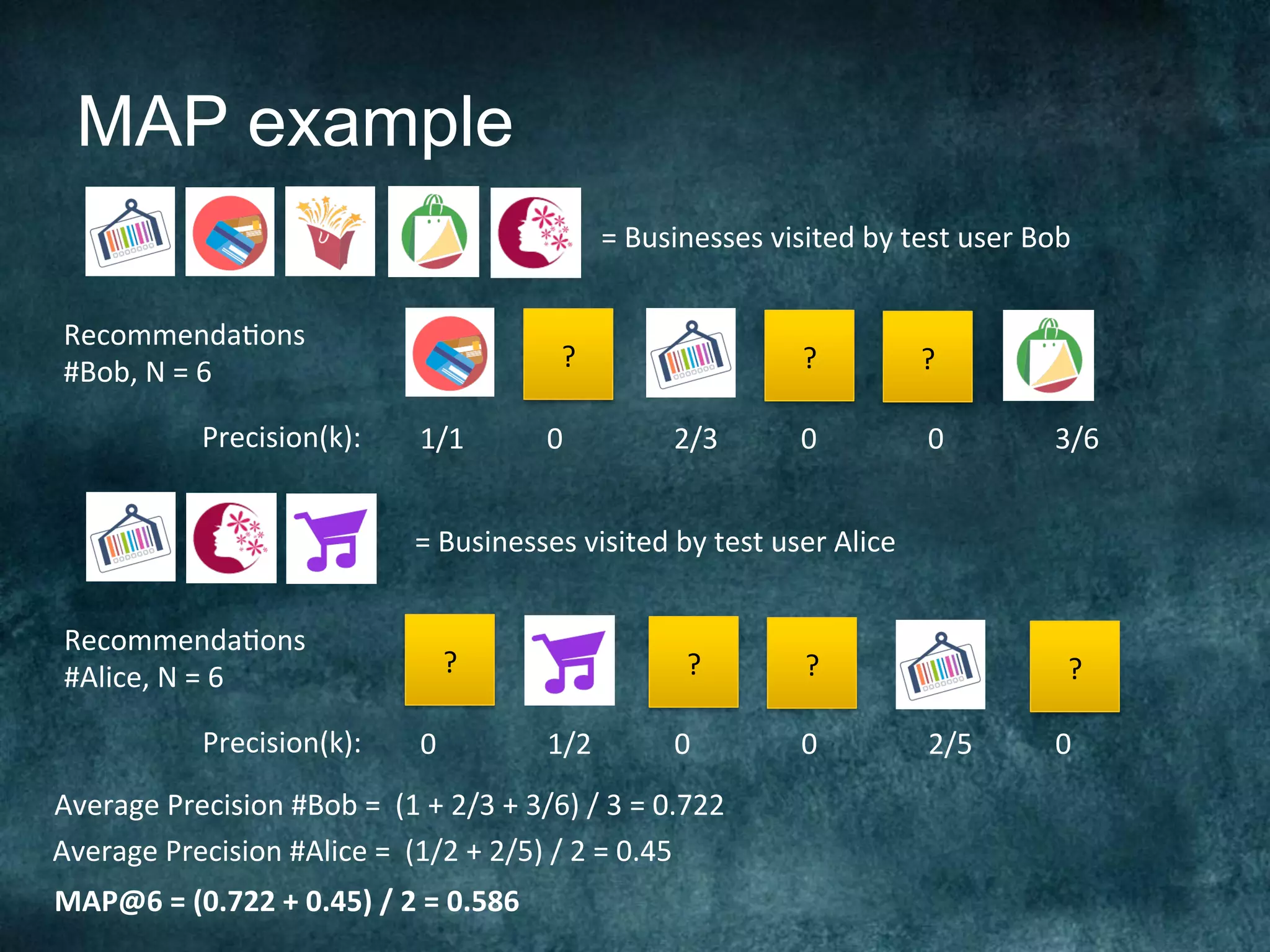
•  Each customer has visited m relevant businesses
•  Recommendations predict n ranked businesses
•  For a given customer we compute the average precision as:
•  P(k) = precision at cut-off k in the recommendation list, i.e.
the ratio of number of relevant businesses, up to the
position k.
P(k) = 0 when the k-th business is not relevant.
•  MAP for N customers at n is the average of the average
precision of each customer:
ap@n = P(k) / min(m,n)
k=1
n
∑
MAP@n = ap @ ni
/ N
i=1
N
∑
MAP example
=	Businesses	visited	by	test	user	Bob		
?	 ?	 ?	
Recommenda@ons	
#Bob,	N	=	6	
Precision(k):	 1/1 	0 	2/3 	0 	0 	3/6	
Average	Precision	#Bob	=		(1	+	2/3	+	3/6)	/	3	=	0.722		
Average	Precision	#Alice	=		(1/2	+	2/5)	/	2	=	0.45	
MAP@6	=	(0.722	+	0.45)	/	2	=	0.586		
=	Businesses	visited	by	test	user	Alice	
?	 ?	
Recommenda@ons	
#Alice,	N	=	6	
Precision(k):	 0 	1/2 	0 	0 	2/5 	0	
?	 ?
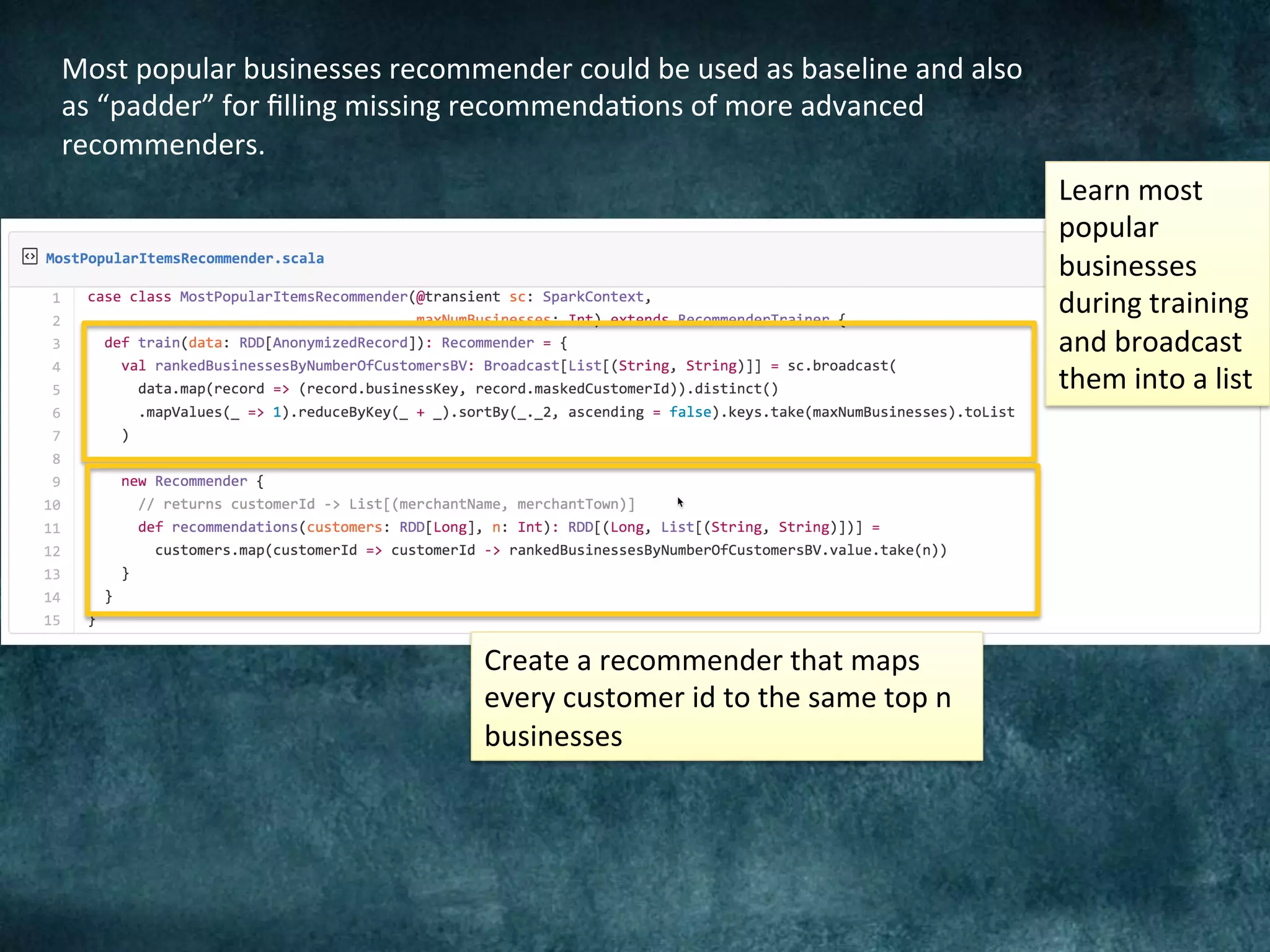
Most Popular Businesses
Learn	most	
popular	
businesses	
during	training	
and	broadcast	
them	into	a	list	
Create	a	recommender	that	maps	
every	customer	id	to	the	same	top	n	
businesses	
Most	popular	businesses	recommender	could	be	used	as	baseline	and	also	
as	“padder”	for	filling	missing	recommenda@ons	of	more	advanced	
recommenders.
CUSTOMER-TO-CUSTOMER
SIMILARITY MODELS
Each customer is represented in a sparse feature space
Must define a metric space that satisfies the triangle inequality
Similarity (or distance) based on:
Common behaviour (geographical and temporal shopping journeys)
Common demographic attributes (age, residential area, gender, job
position…)
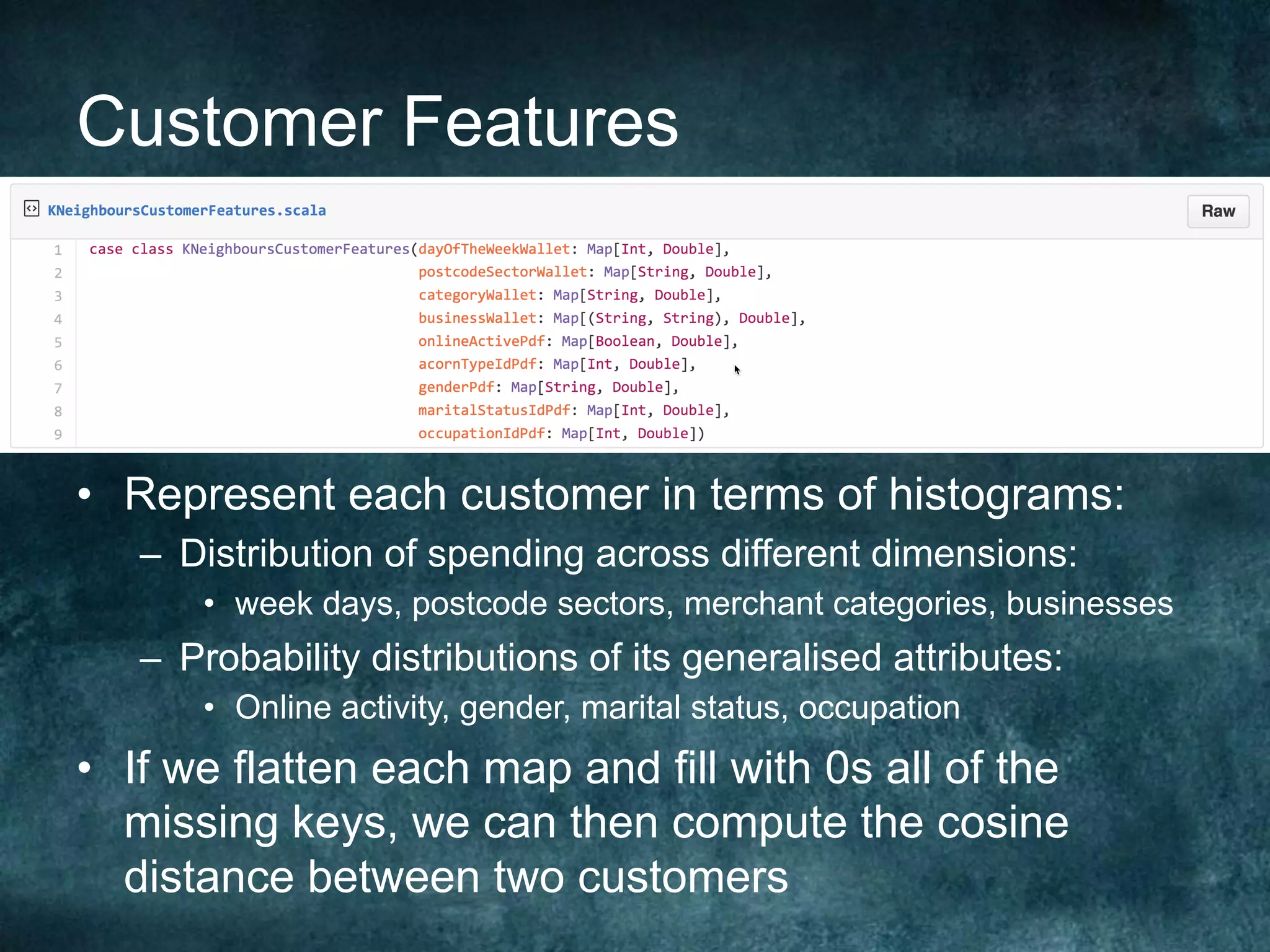
Customer Features
•  Represent each customer in terms of histograms:
–  Distribution of spending across different dimensions:
•  week days, postcode sectors, merchant categories, businesses
–  Probability distributions of its generalised attributes:
•  Online activity, gender, marital status, occupation
•  If we flatten each map and fill with 0s all of the
missing keys, we can then compute the cosine
distance between two customers
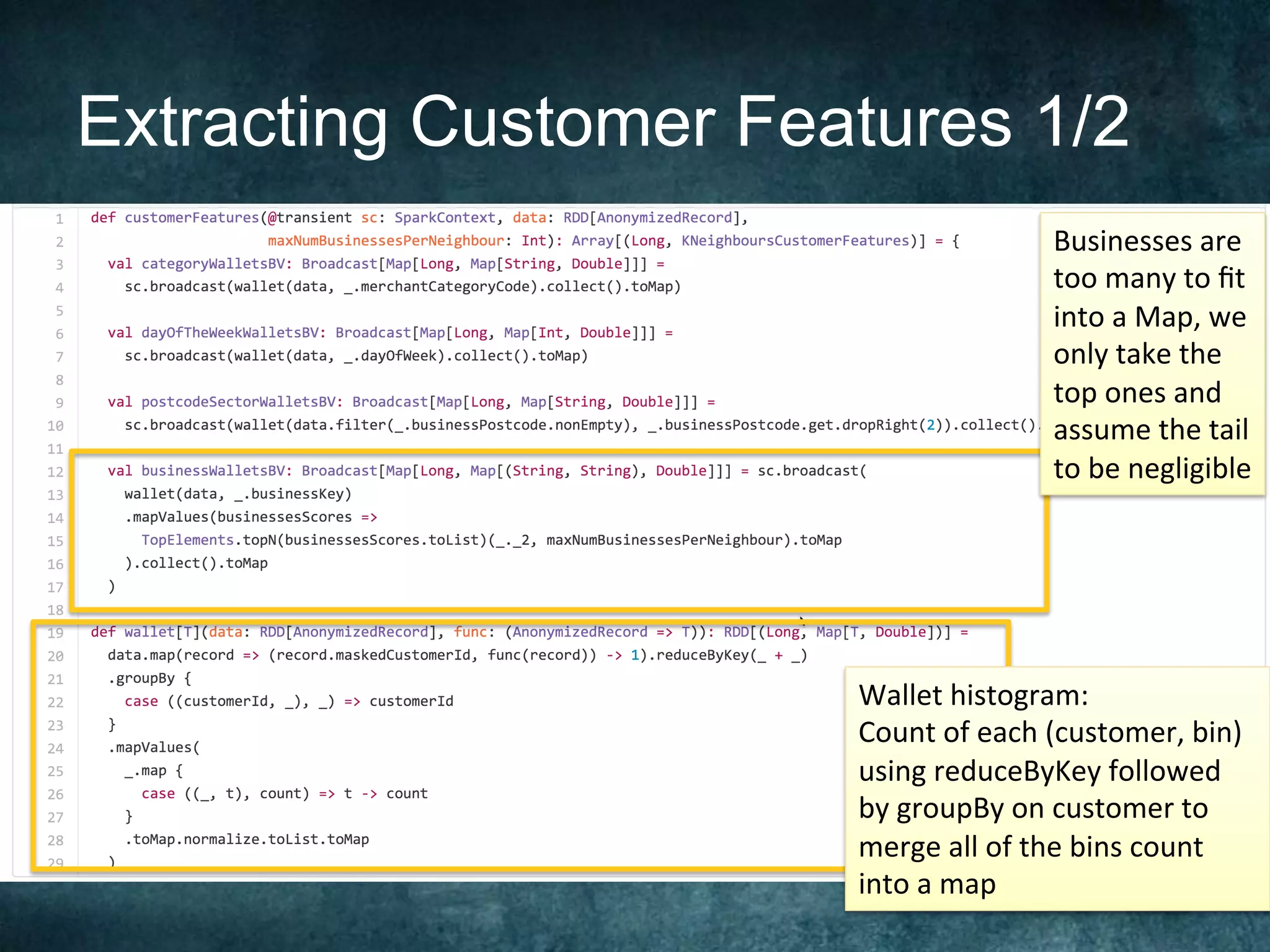
Extracting Customer Features 1/2
Businesses	are	
too	many	to	fit	
into	a	Map,	we	
only	take	the	
top	ones	and		
assume	the	tail	
to	be	negligible	
Wallet	histogram:	
Count	of	each	(customer,	bin)	
using	reduceByKey	followed	
by	groupBy	on	customer	to	
merge	all	of	the	bins	count	
into	a	map
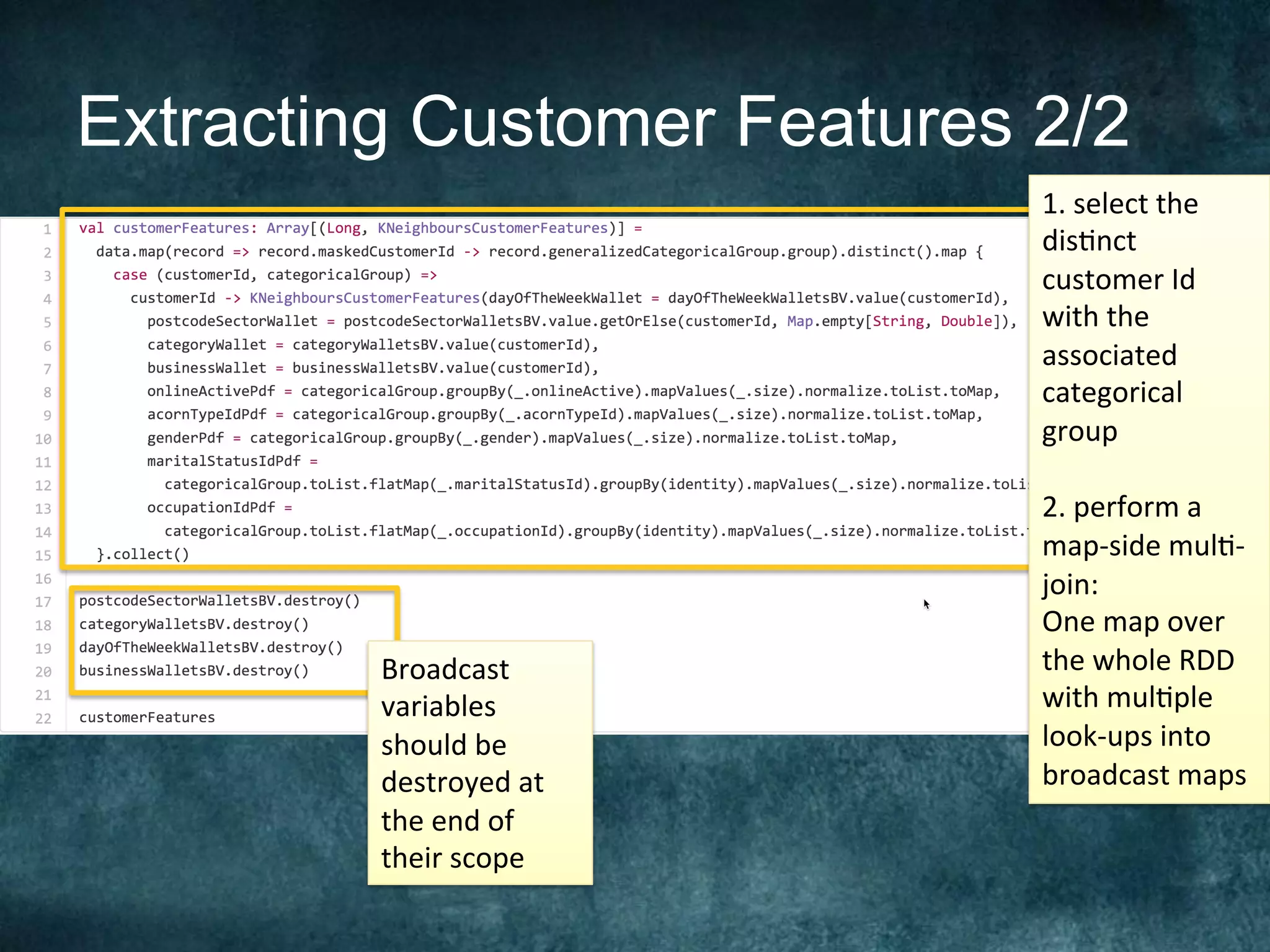
Extracting Customer Features 2/2
Broadcast	
variables	
should	be	
destroyed	at	
the	end	of	
their	scope	
1.	select	the	
dis@nct	
customer	Id	
with	the	
associated	
categorical	
group		
	
2.	perform	a	
map-side	mul@-
join:	
One	map	over	
the	whole	RDD	
with	mul@ple	
look-ups	into	
broadcast	maps
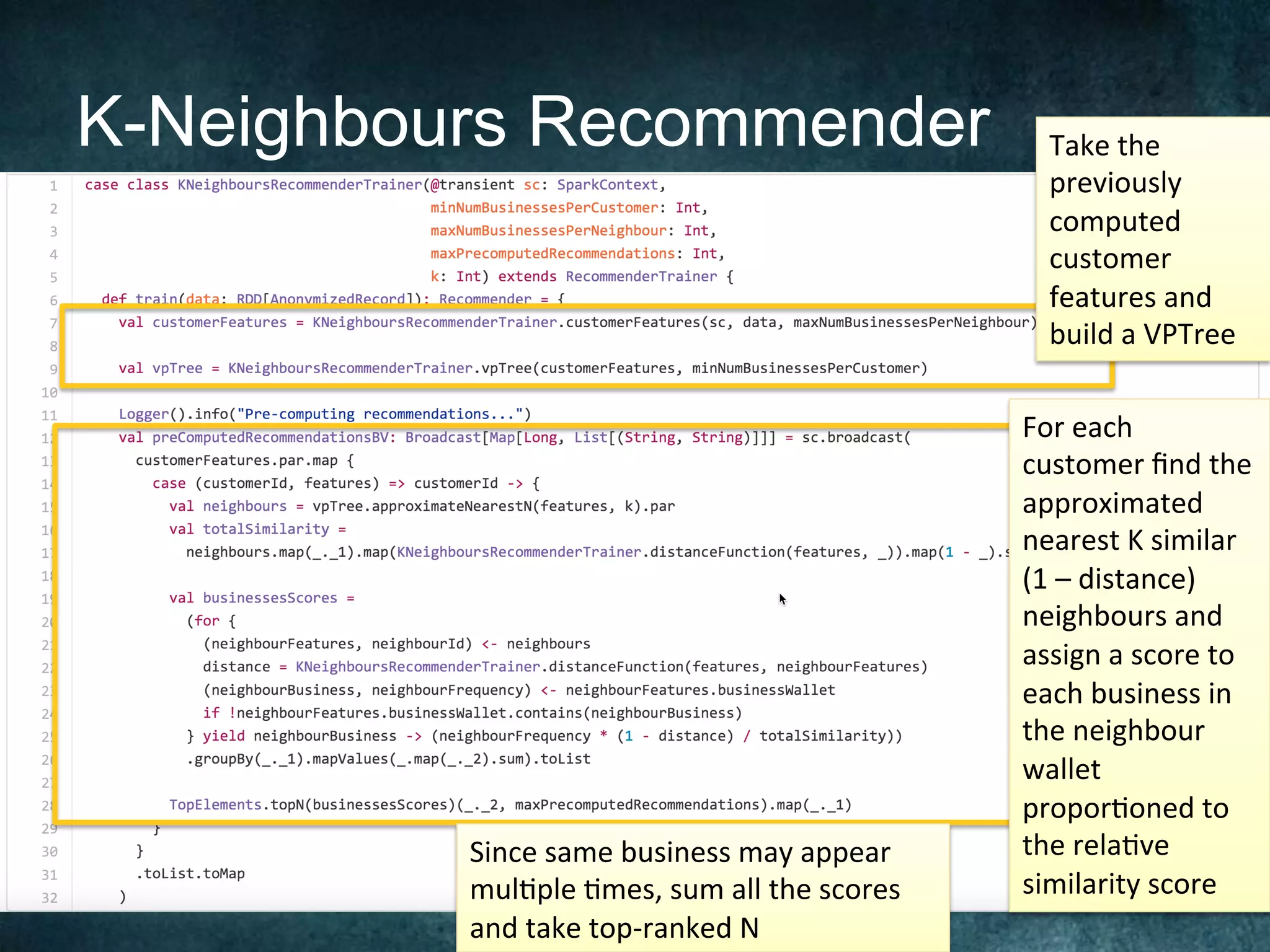
K-Neighbours Recommender Take	the	
previously	
computed	
customer	
features	and	
build	a	VPTree		
For	each	
customer	find	the	
approximated	
nearest	K	similar	
(1	–	distance)	
neighbours	and	
assign	a	score	to	
each	business	in	
the	neighbour	
wallet	
propor@oned	to	
the	rela@ve	
similarity	score	
Since	same	business	may	appear	
mul@ple	@mes,	sum	all	the	scores	
and	take	top-ranked	N
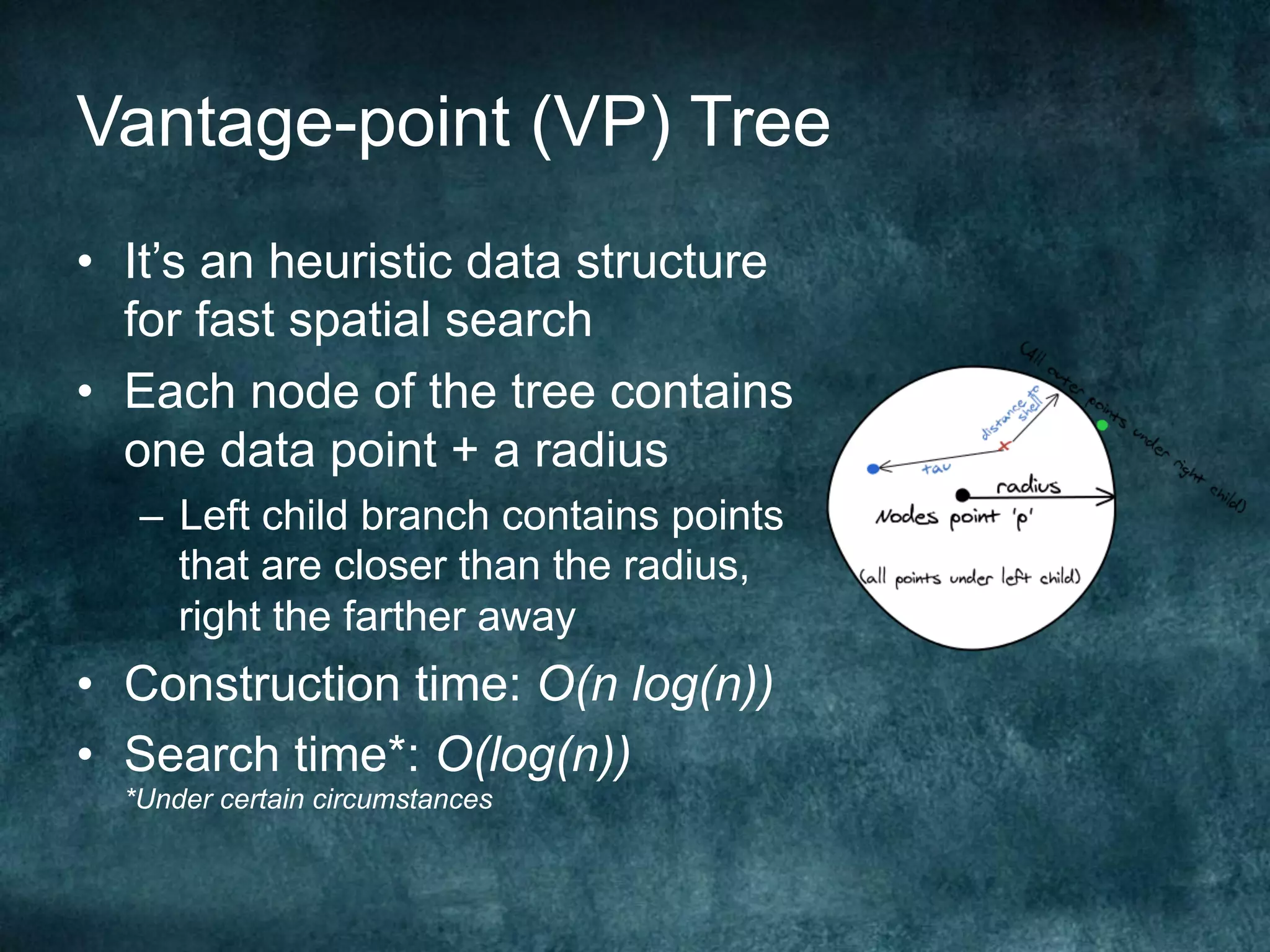
Vantage-point (VP) Tree
•  It’s an heuristic data structure
for fast spatial search
•  Each node of the tree contains
one data point + a radius
–  Left child branch contains points
that are closer than the radius,
right the farther away
•  Construction time: O(n log(n))
•  Search time*: O(log(n))
*Under certain circumstances
BUSINESS-TO-BUSINESS
SIMILARITY MODELS
Similarity metric based on the portion of
common customers
Conditional probability
Tanimoto Coefficient
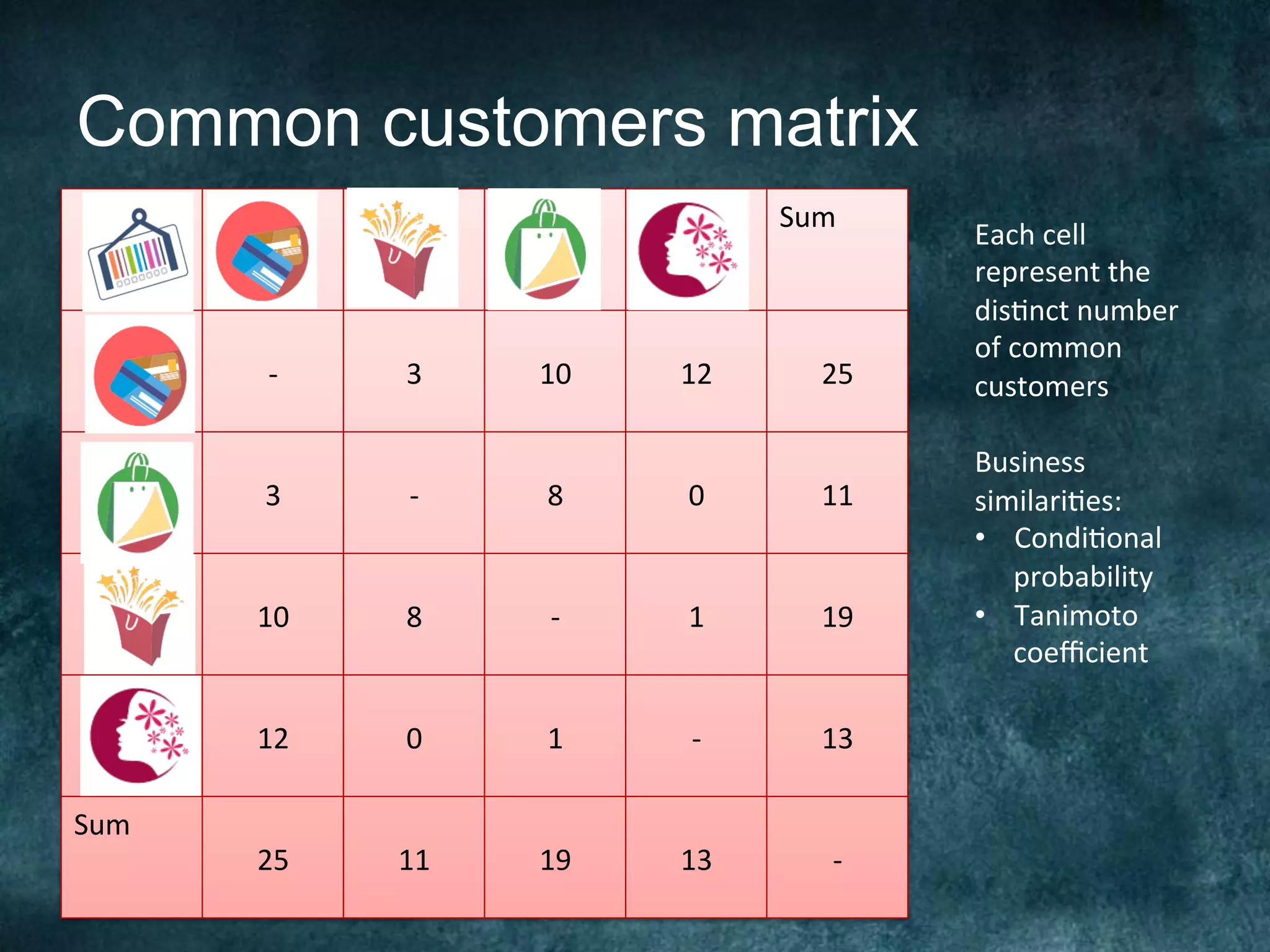
Common customers matrix
Sum	
-	 3	 10	 12	 25	
3	 -	 8	 0	 11	
10	 8	 -	 1	 19	
12	 0	 1	 -	 13	
Sum	
25	 11	 19	 13	 -	
Each	cell	
represent	the	
dis@nct	number	
of	common	
customers	
	
Business	
similari@es:	
•  Condi@onal	
probability	
•  Tanimoto	
coefficient
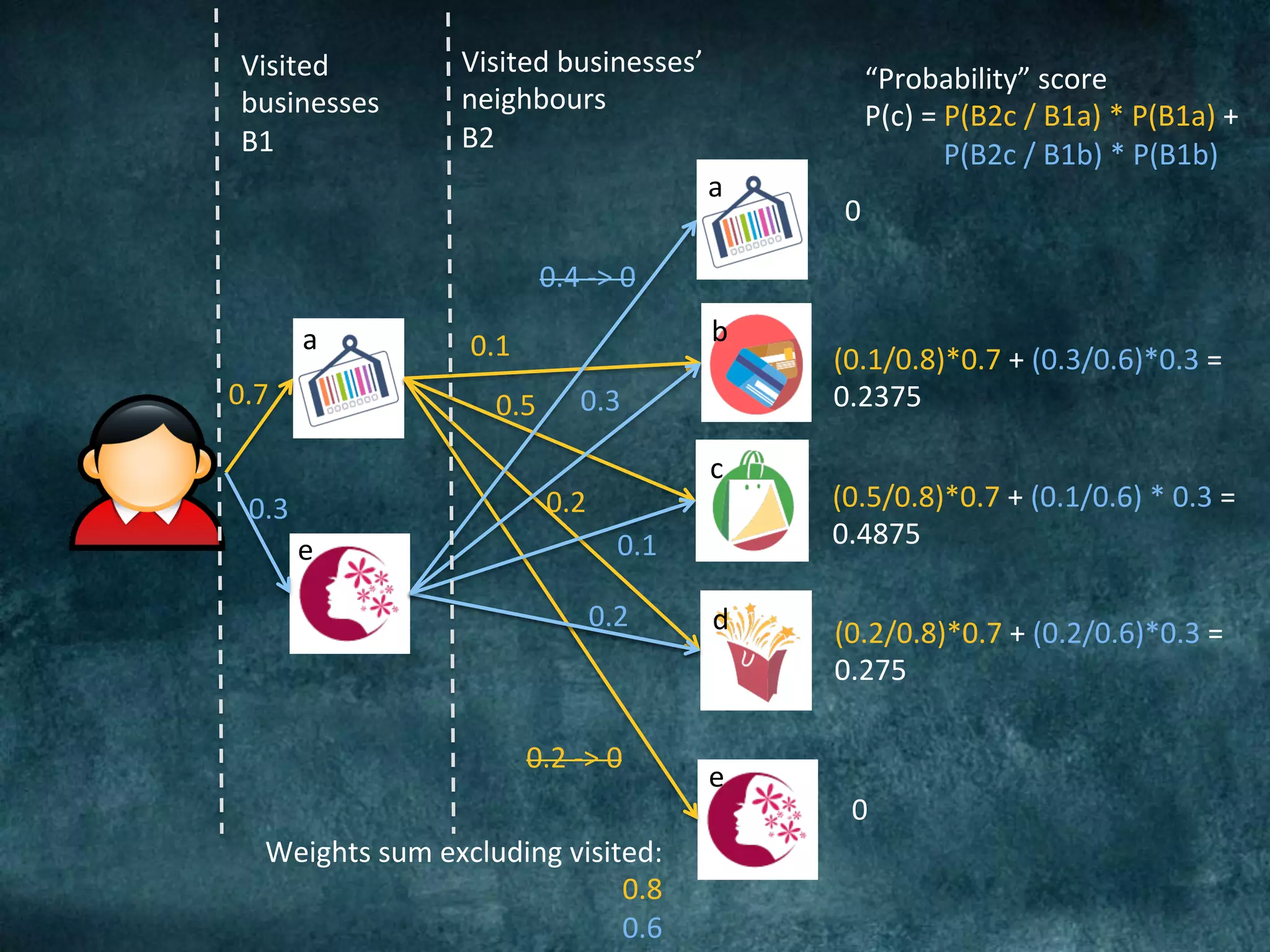
0.7	
0.3	
0.1	
0.5	
0.2	
0	
0.2	->	0	
0.4	->	0	
0.3	
0.1	
0.2	
Visited	
businesses	
B1	
Visited	businesses’	
neighbours	
B2	
Weights	sum	excluding	visited:	
0.8	
0.6	
“Probability”	score	
P(c)	=	P(B2c	/	B1a)	*	P(B1a)	+		
											P(B2c	/	B1b)	*	P(B1b)	
(0.1/0.8)*0.7	+	(0.3/0.6)*0.3	=	
0.2375	
(0.5/0.8)*0.7	+	(0.1/0.6)	*	0.3	=	
0.4875	
(0.2/0.8)*0.7	+	(0.2/0.6)*0.3	=	
0.275	
0	
a
a
b
c	
d
e
e
NEIGHBOUR-TO-BUSINESS
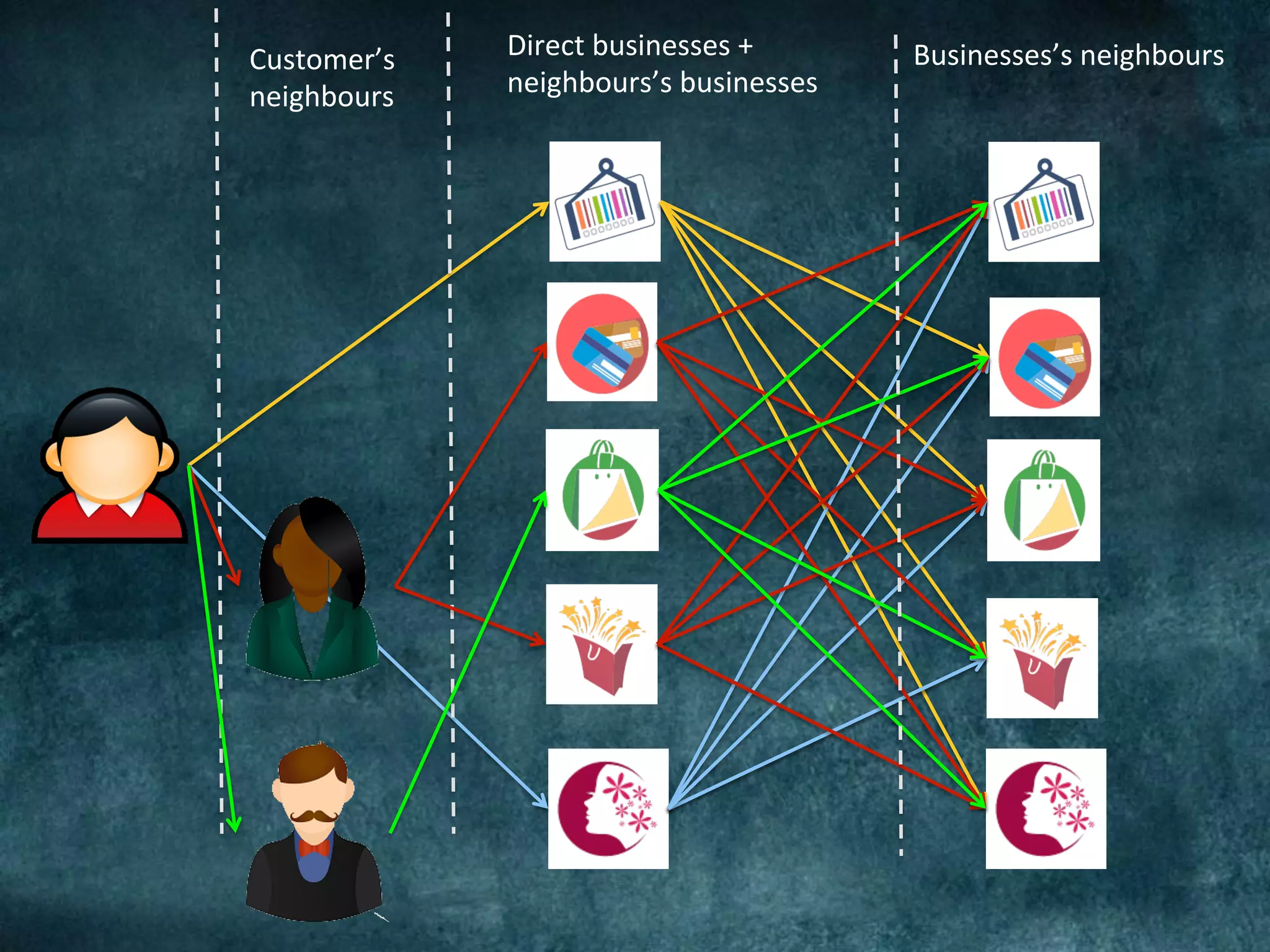
Hybrid approach of K-Neighbours combined with
Business-to-Business
3 levels: customer neighbours -> neighbour’s
businesses -> businesses’ neighbours
We named this model: Botticelli model
Customer’s	
neighbours	
Direct	businesses	+	
neighbours’s	businesses	
Businesses’s	neighbours
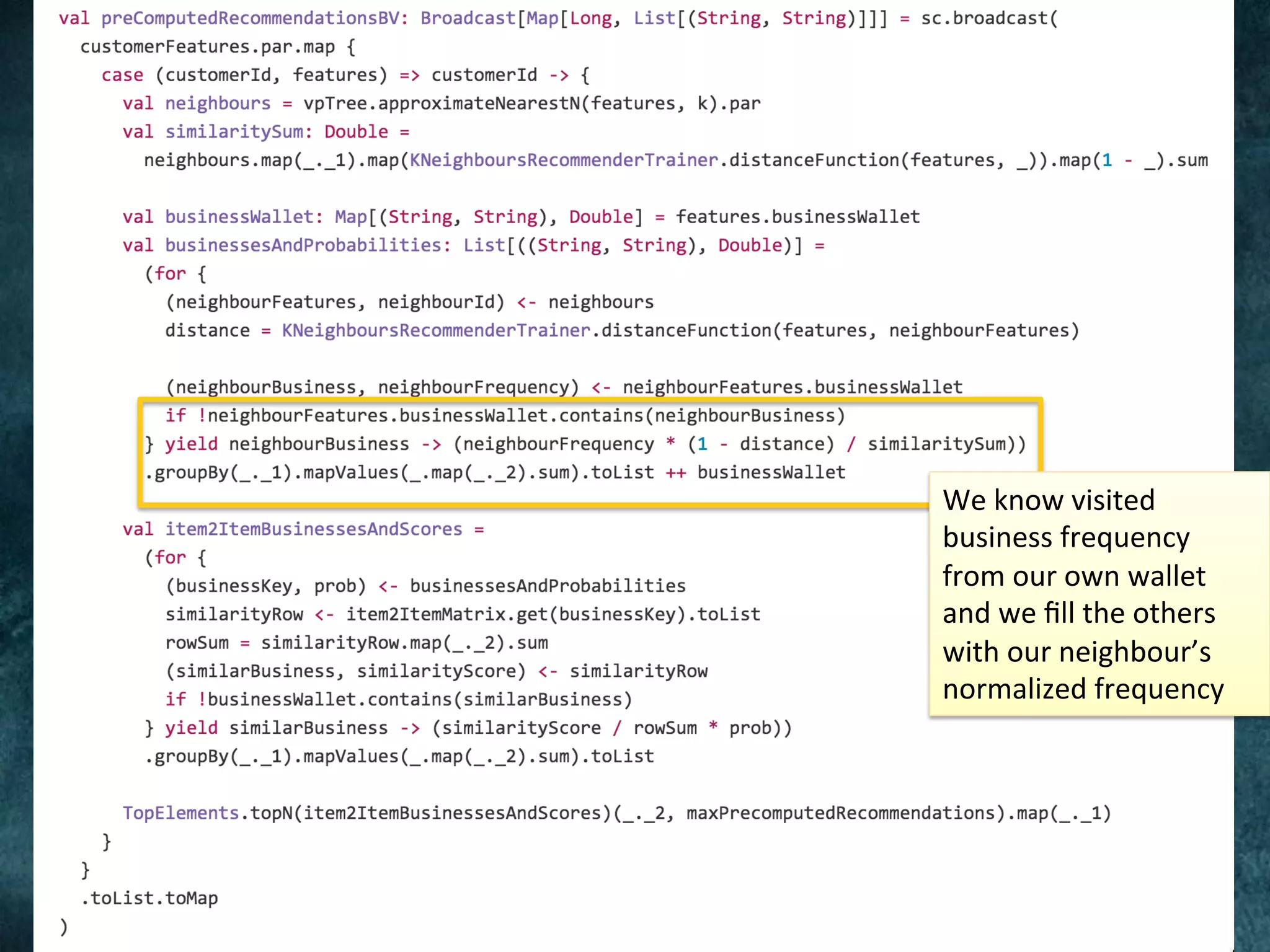
We	know	visited	
business	frequency	
from	our	own	wallet	
and	we	fill	the	others	
with	our	neighbour’s	
normalized	frequency
MATRIX FACTORIZATION
MODELS
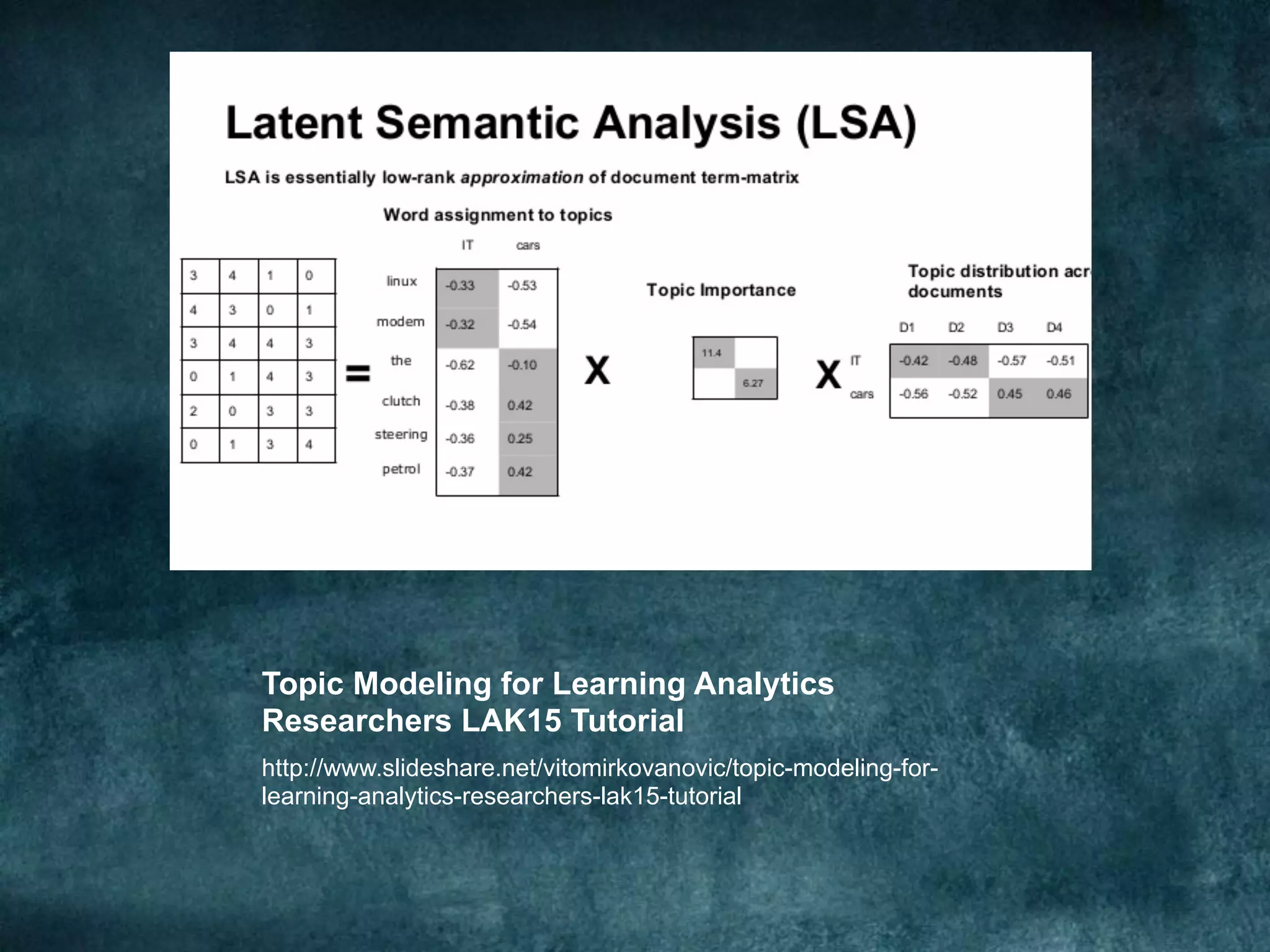
Factorize the transaction matrix of Customer-to-
Business into 2 matrices of Customer-to-Topic
and Topic-to-Business (e.g. LSA, SVD…)
Recommendations are done by applying linear
algebra
Topic Modeling for Learning Analytics
Researchers LAK15 Tutorial
http://www.slideshare.net/vitomirkovanovic/topic-modeling-for-
learning-analytics-researchers-lak15-tutorial
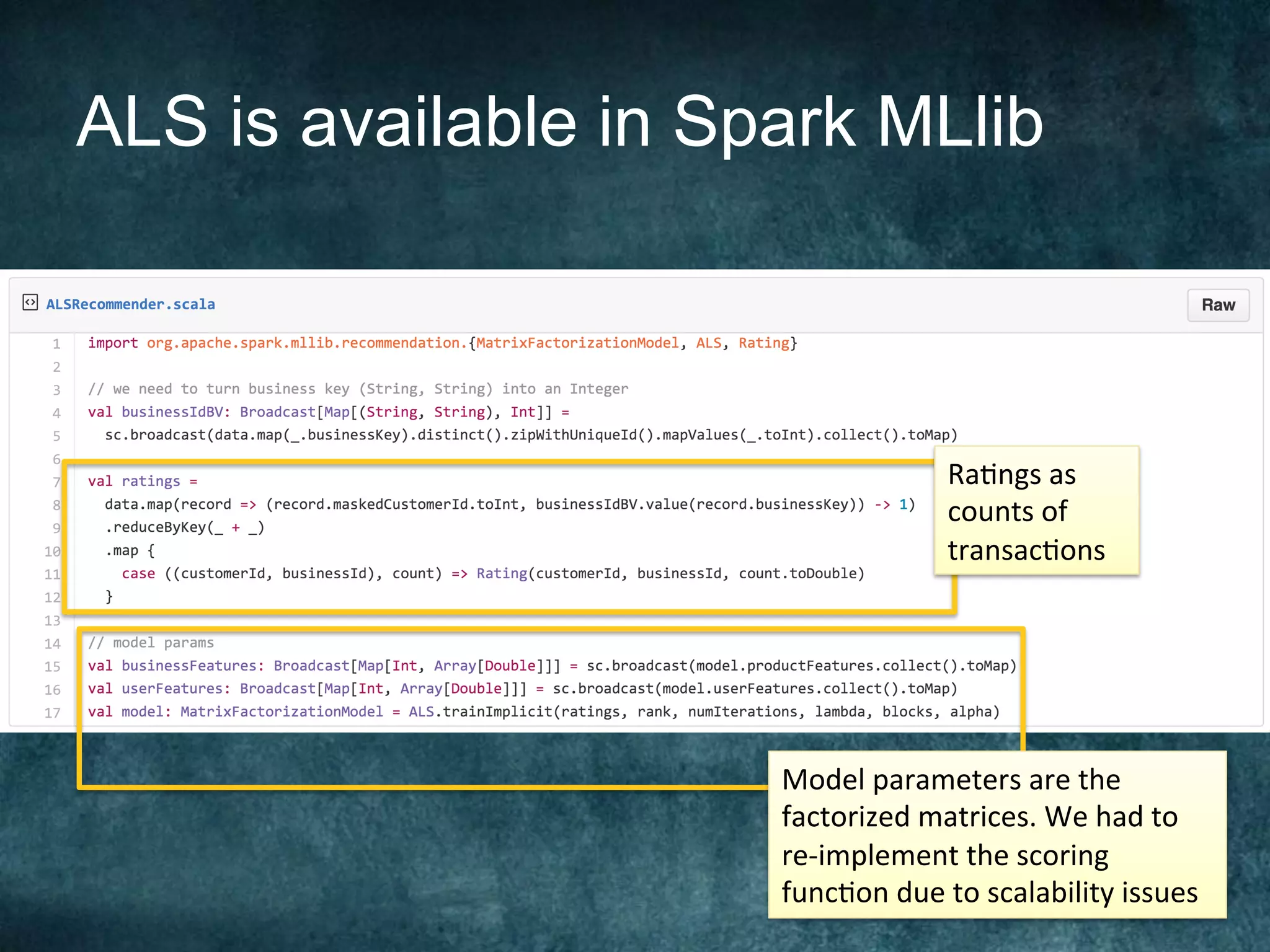
ALS is available in Spark MLlib
Ra@ngs	as	
counts	of	
transac@ons	
Model	parameters	are	the	
factorized	matrices.	We	had	to	
re-implement	the	scoring	
func@on	due	to	scalability	issues
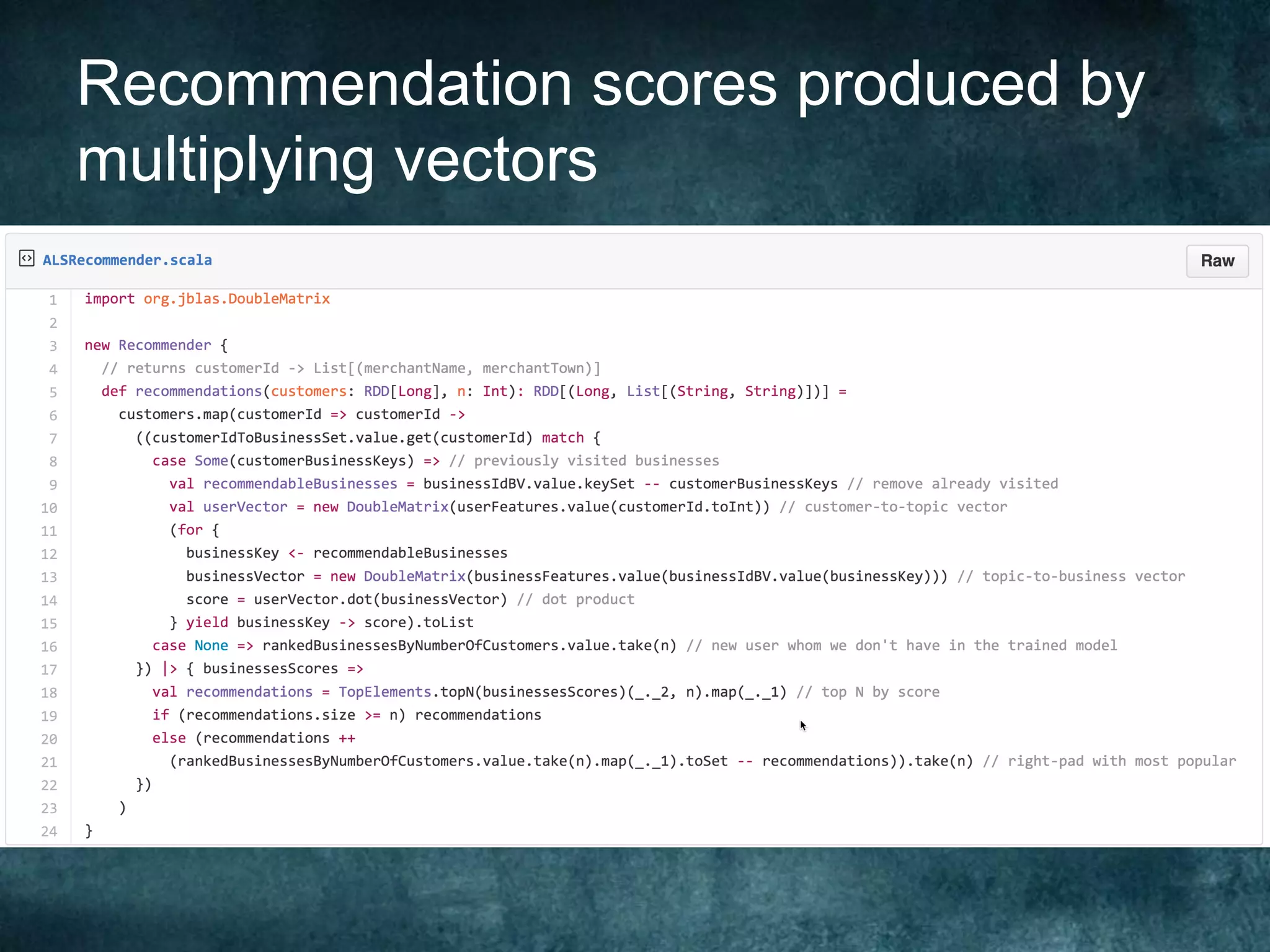
Recommendation scores produced by
multiplying vectors
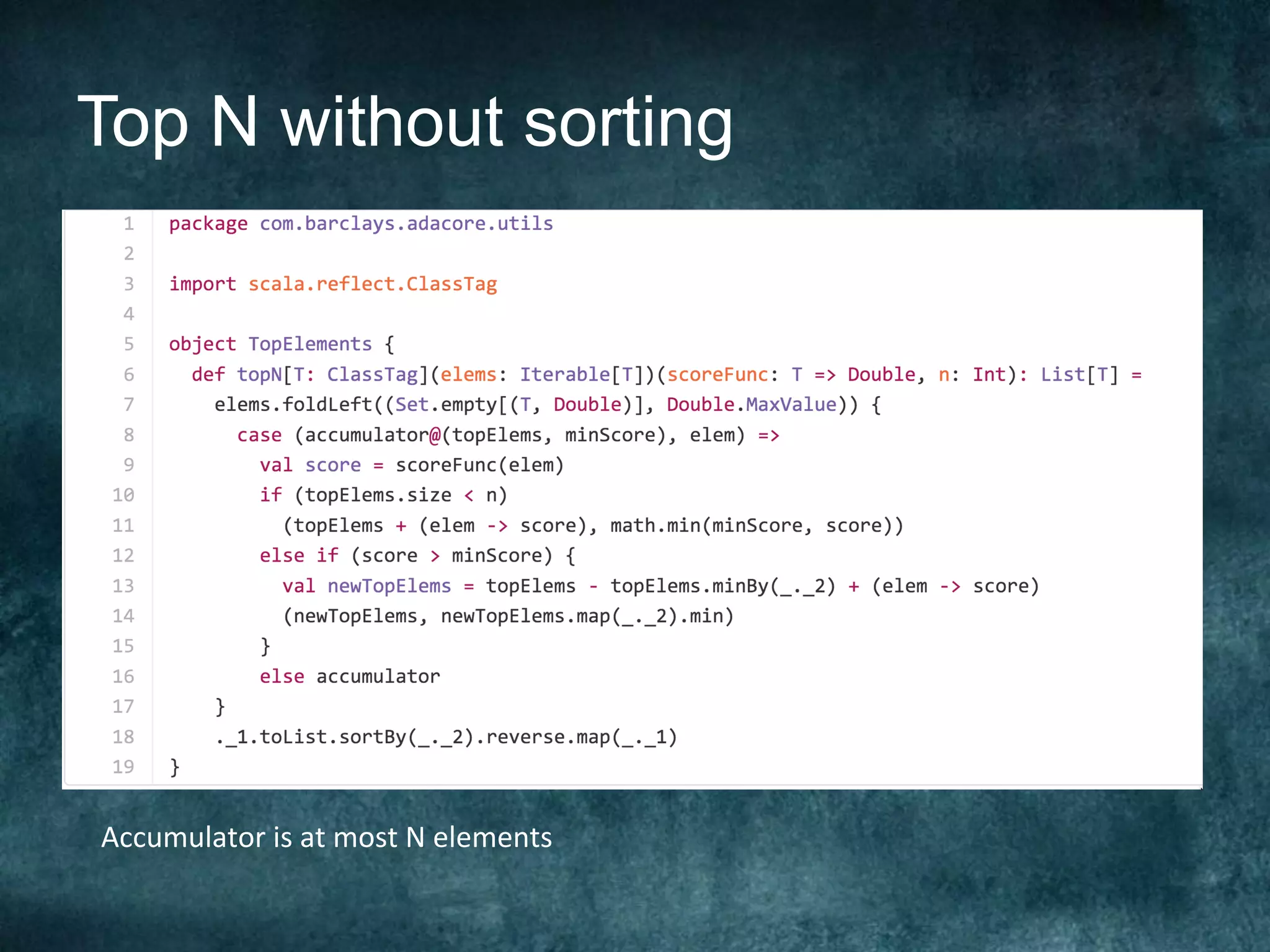
Top N without sorting
Accumulator	is	at	most	N	elements
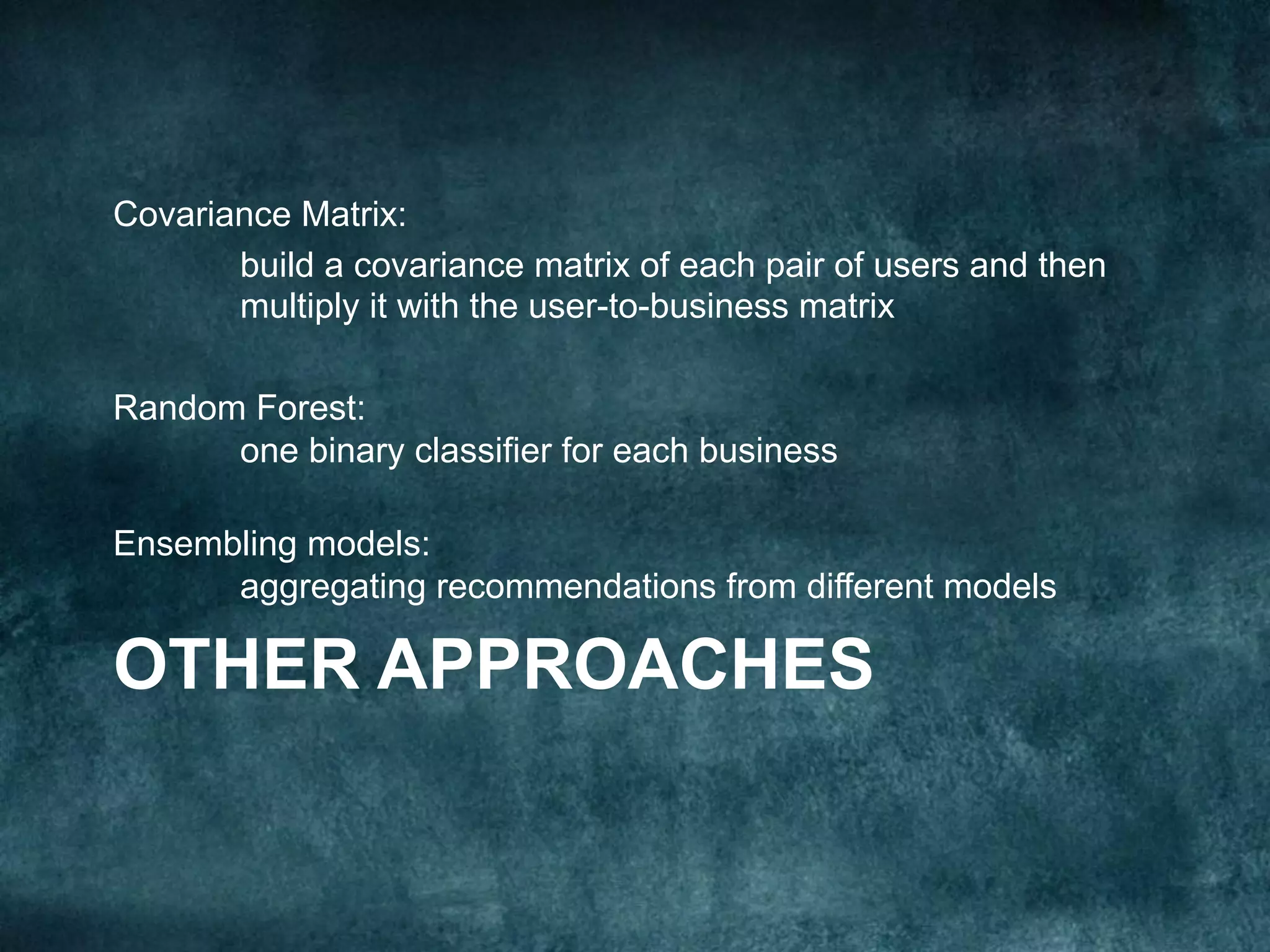
OTHER APPROACHES
Covariance Matrix:
build a covariance matrix of each pair of users and then
multiply it with the user-to-business matrix
Random Forest:
one binary classifier for each business
Ensembling models:
aggregating recommendations from different models
SUMMARY AND
CONCLUSIONS
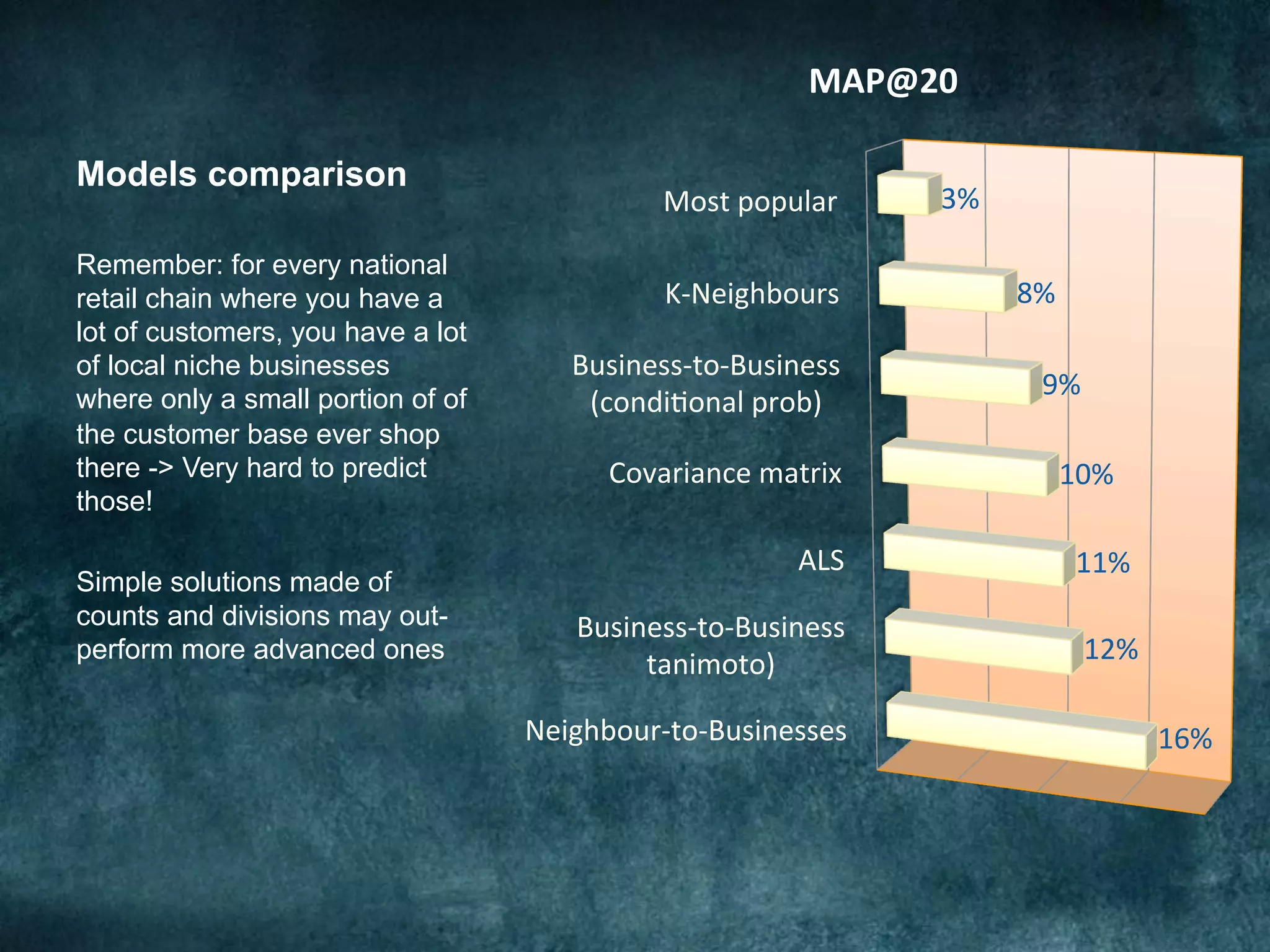
Models comparison
Neighbour-to-Businesses	
Business-to-Business	
tanimoto)	
ALS	
Covariance	matrix	
Business-to-Business	
(condi@onal	prob)	
K-Neighbours	
Most	popular	
16%	
12%	
11%	
10%	
9%	
8%	
3%	
MAP@20	
Remember: for every national
retail chain where you have a
lot of customers, you have a lot
of local niche businesses
where only a small portion of of
the customer base ever shop
there -> Very hard to predict
those!
Simple solutions made of
counts and divisions may out-
perform more advanced ones
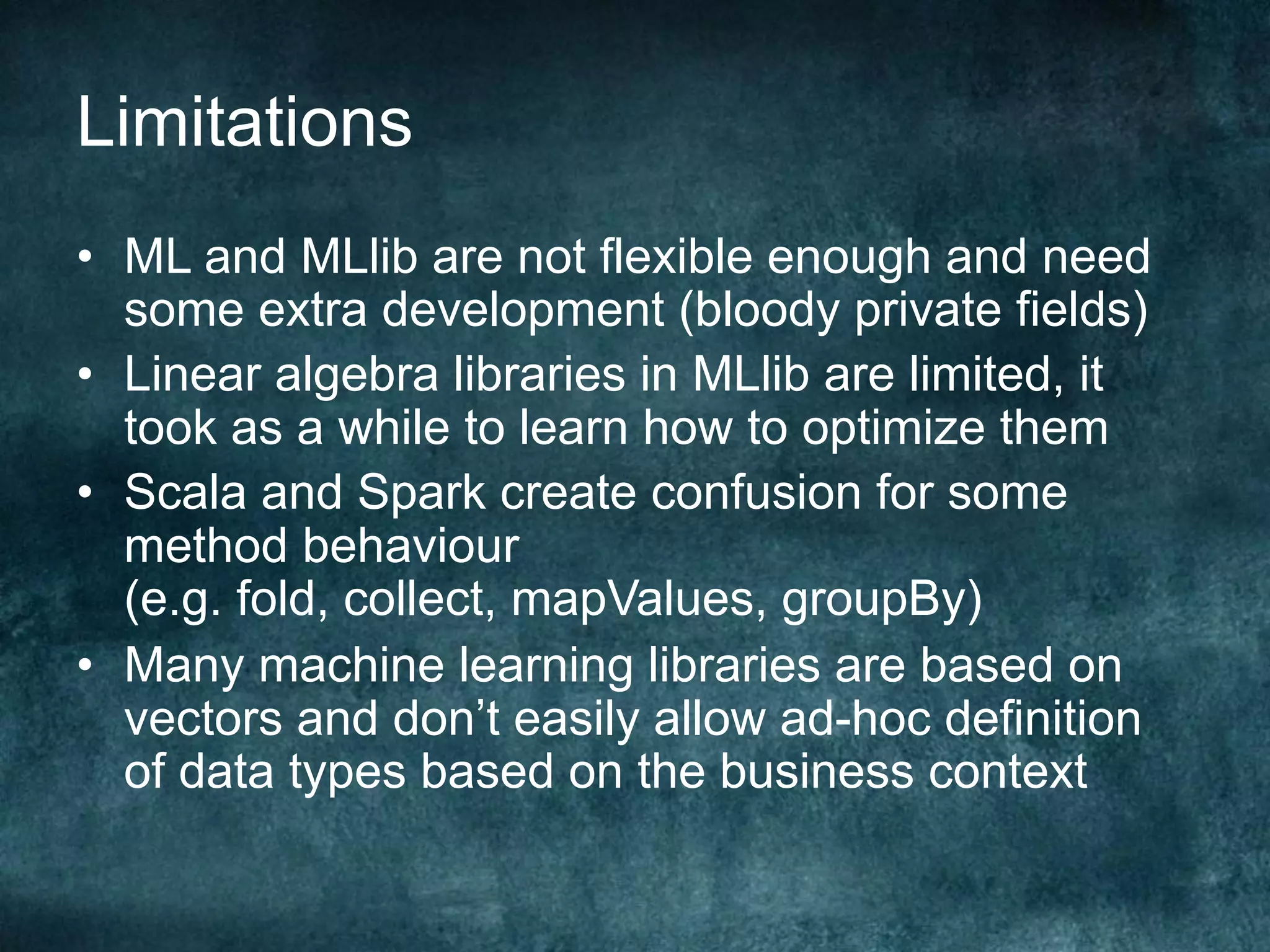
Limitations
•  ML and MLlib are not flexible enough and need
some extra development (bloody private fields)
•  Linear algebra libraries in MLlib are limited, it
took as a while to learn how to optimize them
•  Scala and Spark create confusion for some
method behaviour
(e.g. fold, collect, mapValues, groupBy)
•  Many machine learning libraries are based on
vectors and don’t easily allow ad-hoc definition
of data types based on the business context
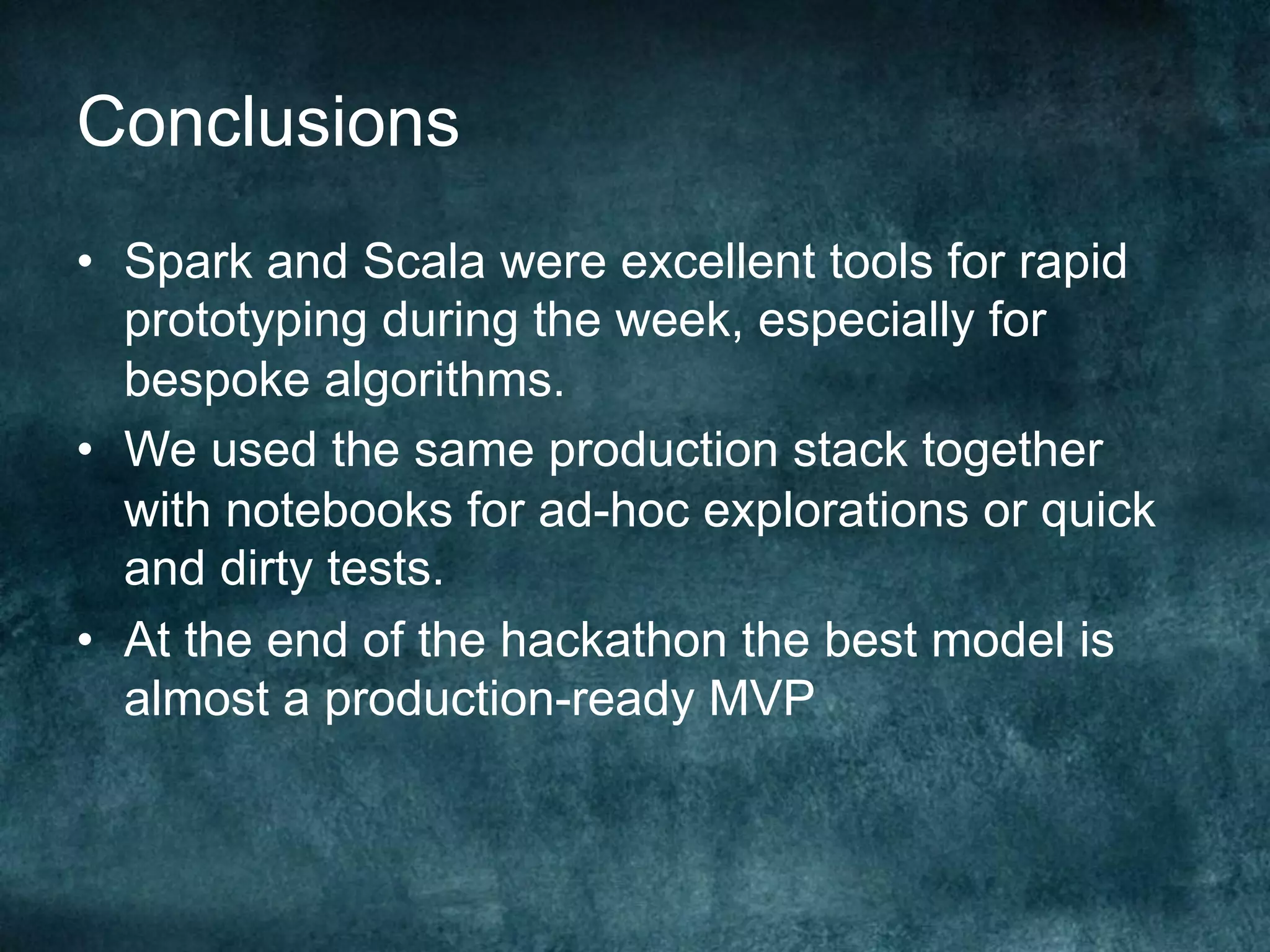
Conclusions
•  Spark and Scala were excellent tools for rapid
prototyping during the week, especially for
bespoke algorithms.
•  We used the same production stack together
with notebooks for ad-hoc explorations or quick
and dirty tests.
•  At the end of the hackathon the best model is
almost a production-ready MVP
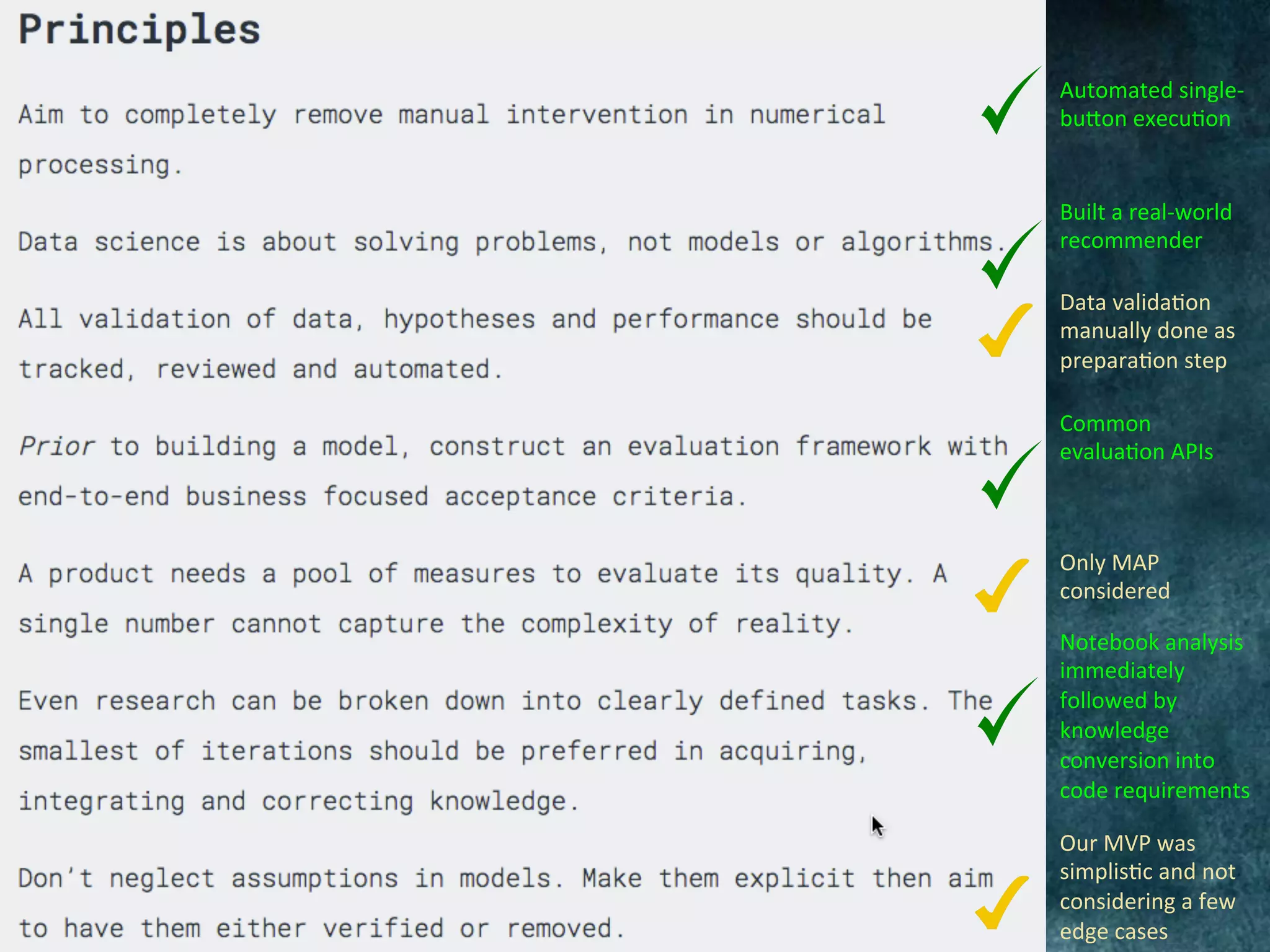
Automated	single-
bu[on	execu@on	
Built	a	real-world	
recommender	
Common	
evalua@on	APIs	
Data	valida@on	
manually	done	as	
prepara@on	step	
Only	MAP	
considered	
Notebook	analysis	
immediately	
followed	by	
knowledge	
conversion	into	
code	requirements	
Our	MVP	was	
simplis@c	and	not	
considering	a	few	
edge	cases
Off-site
•  Success of the hackathon was not solely down
to technology.
•  Innovation requires an environment where:
–  great people can connect
–  set clear ambitious goals
–  work together free of distractions
–  pressure of delivering comes from the group
–  Fail safely, go to sleep, wake up next day (go surfing)
and try again!
https://blog.cloudera.com/blog/2016/05/the-barclays-data-science-hackathon-using-apache-spark-and-scala-for-rapid-prototyping/
Original article on Cloudera Engineering Blog
https://github.com/gm-spacagna/lanzarote-awesomeness
GitHub code
Further Reading
A lot of references regarding Agile and Spark
http://datasciencevademecum.wordpress.com
Data Science Vademecum
The	Barclays	Data	Science	team	at	this	hackathon	was:		
Panos	Malliakas,	Victor	Paraschiv,	Harry	Powell,	Charis	
Sfyrakis,	Gianmario	Spacagna	and	Raffael	Strassnig	
http://www.datasciencemanifesto.org/
The Professional Data Science Manifesto

The Barclays Data Science Hackathon: Building Retail Recommender Systems based on Customer Shopping Behaviour - Gianmario Spacagna, Pirelli