Graph Recommendations
Harry Powell & Raffael Strassnig
Advanced Data Analytics - Barclays
Customer values and recommendation engines
Understanding customer values is a similar problem to recommendation
– How is Tesco similar to Asda?
– How is Tesco in Bristol similar to Asda in Bath?
– How is Tesco in Bristol similar to Bristol Angling Centre?
Assume that the similarity of two businesses can be inferred by the extent
to which they share customers
The data: Customer transactions
Timestam
p
Customer Business Amount (£)
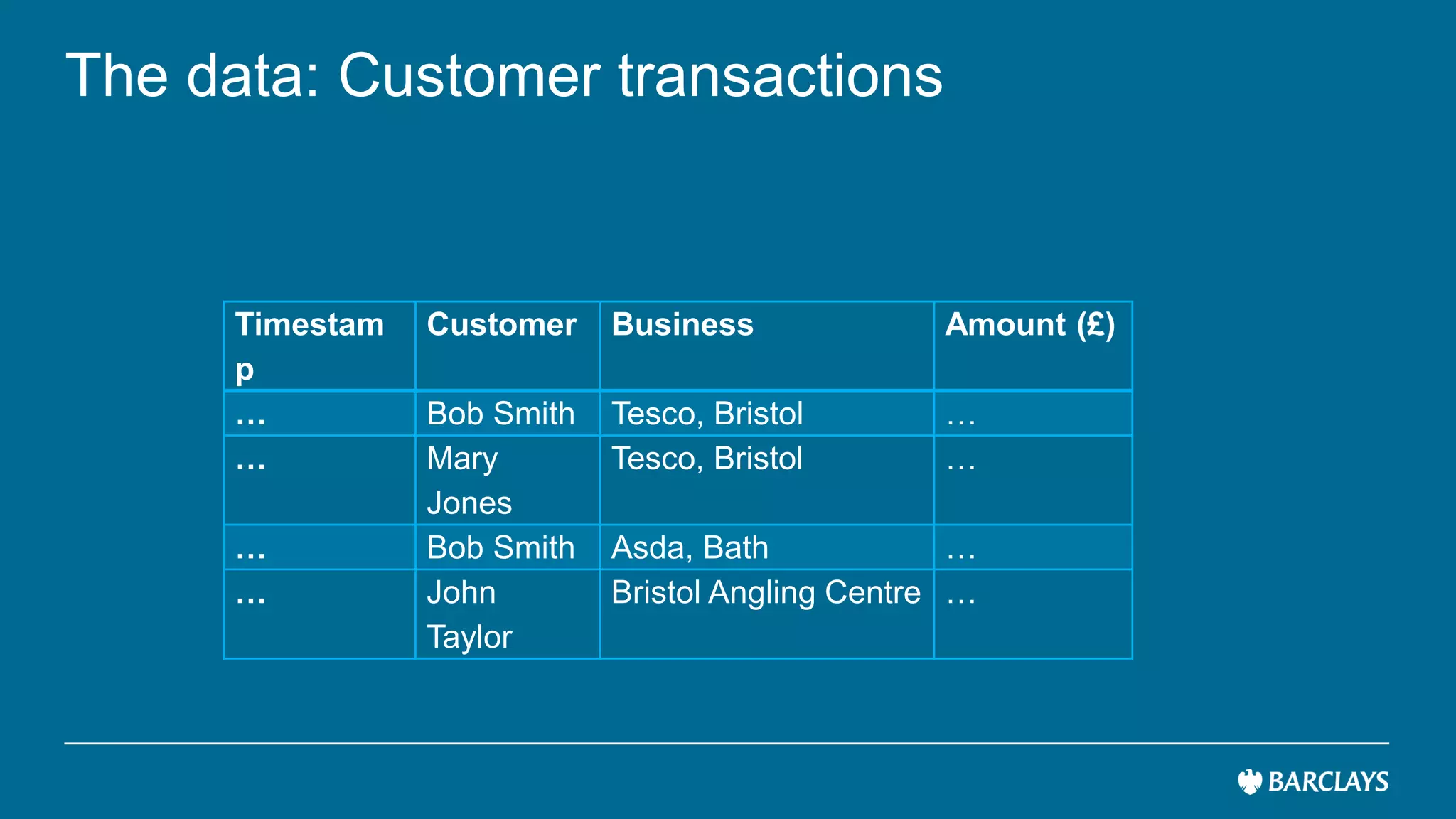
… Bob Smith Tesco, Bristol …
… Mary
Jones
Tesco, Bristol …
… Bob Smith Asda, Bath …
… John
Taylor
Bristol Angling Centre …
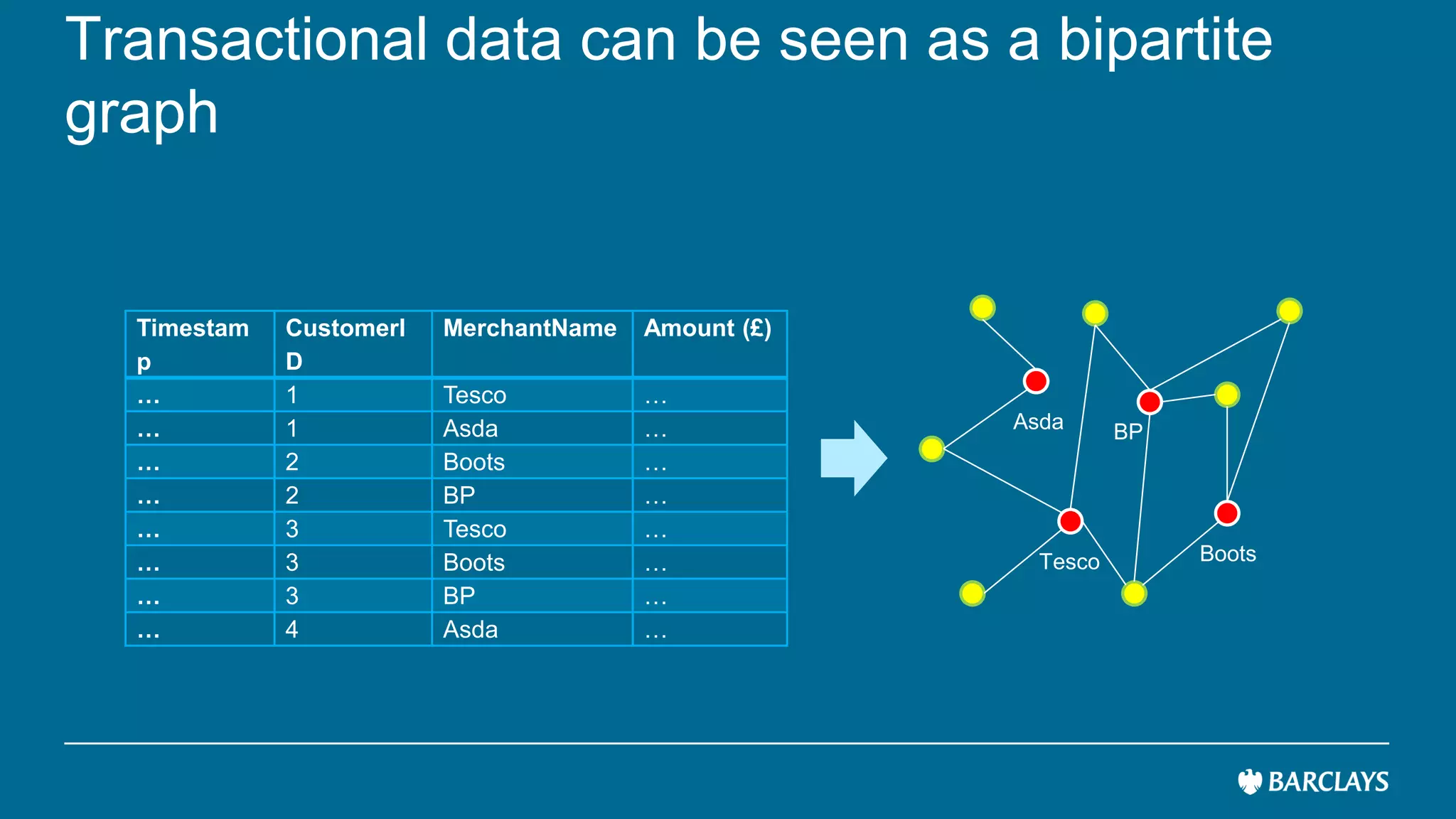
Transactional data can be seen as a bipartite
graph
Tesco
Asda BP
Boots
Timestam
p
CustomerI
D
MerchantName Amount (£)
… 1 Tesco …
… 1 Asda …
… 2 Boots …
… 2 BP …
… 3 Tesco …
… 3 Boots …
… 3 BP …
… 4 Asda …
Transactions imply customer preferences over
business values
Tesco

Price
Quality
Boots

Health
? Price ?
? Quality ?
Asda

Price
Customer
Business
Problems with conventional similarity metrics
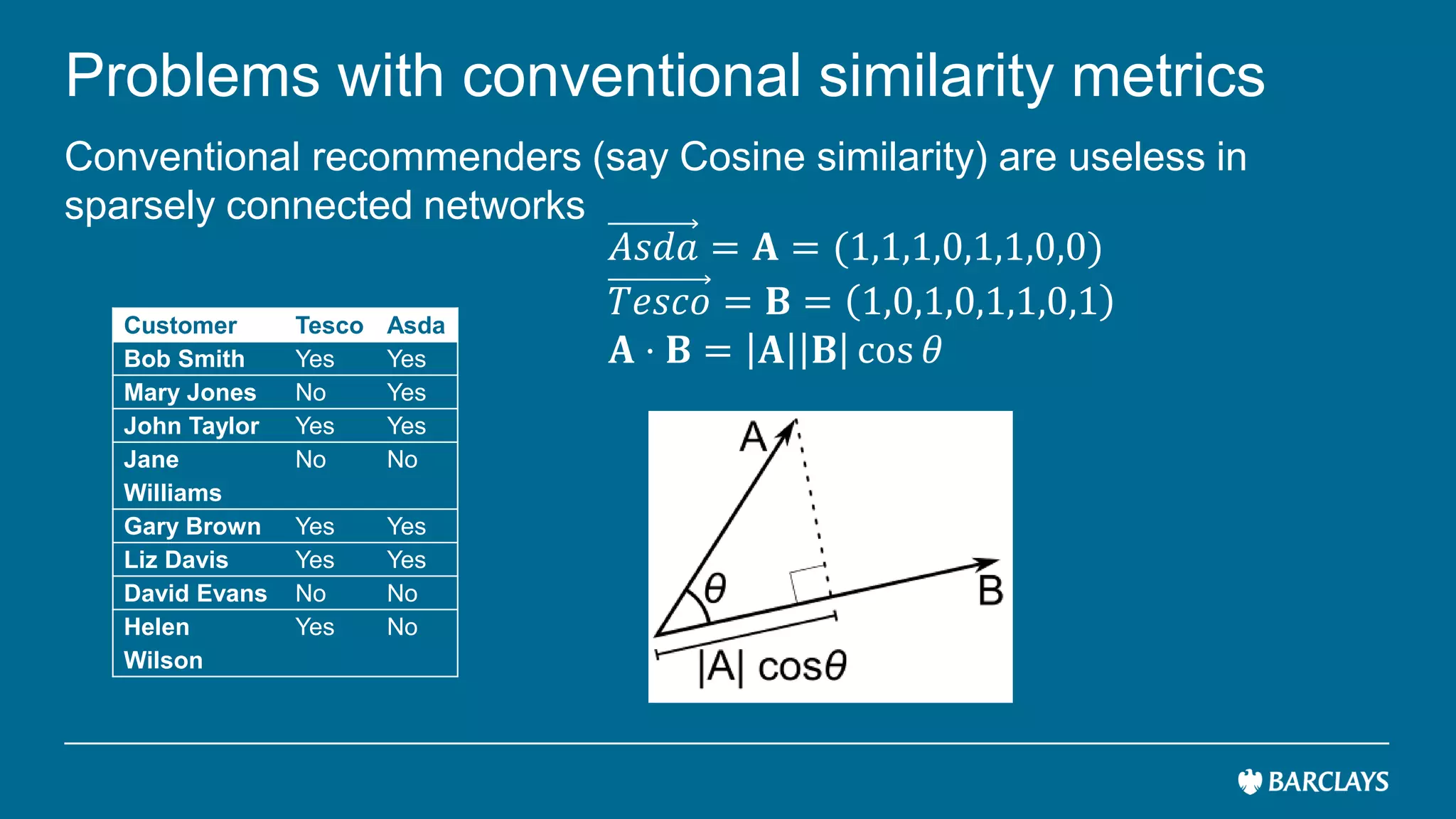
Conventional recommenders (say Cosine similarity) are useless in
sparsely connected networks
𝐴𝑠𝑑𝑎 = 𝐀 = (1,1,1,0,1,1,0,0)
𝑇𝑒𝑠𝑐𝑜 = 𝐁 = 1,0,1,0,1,1,0,1
𝐀 ⋅ 𝐁 = 𝐀 𝐁 cos 𝜃
Customer Tesco Asda
Bob Smith Yes Yes
Mary Jones No Yes
John Taylor Yes Yes
Jane
Williams
No No
Gary Brown Yes Yes
Liz Davis Yes Yes
David Evans No No
Helen
Wilson
Yes No
Problems with conventional graph metrics
Conventional graph metrics (say minimum distance) are useless in
networks with significant hubs.
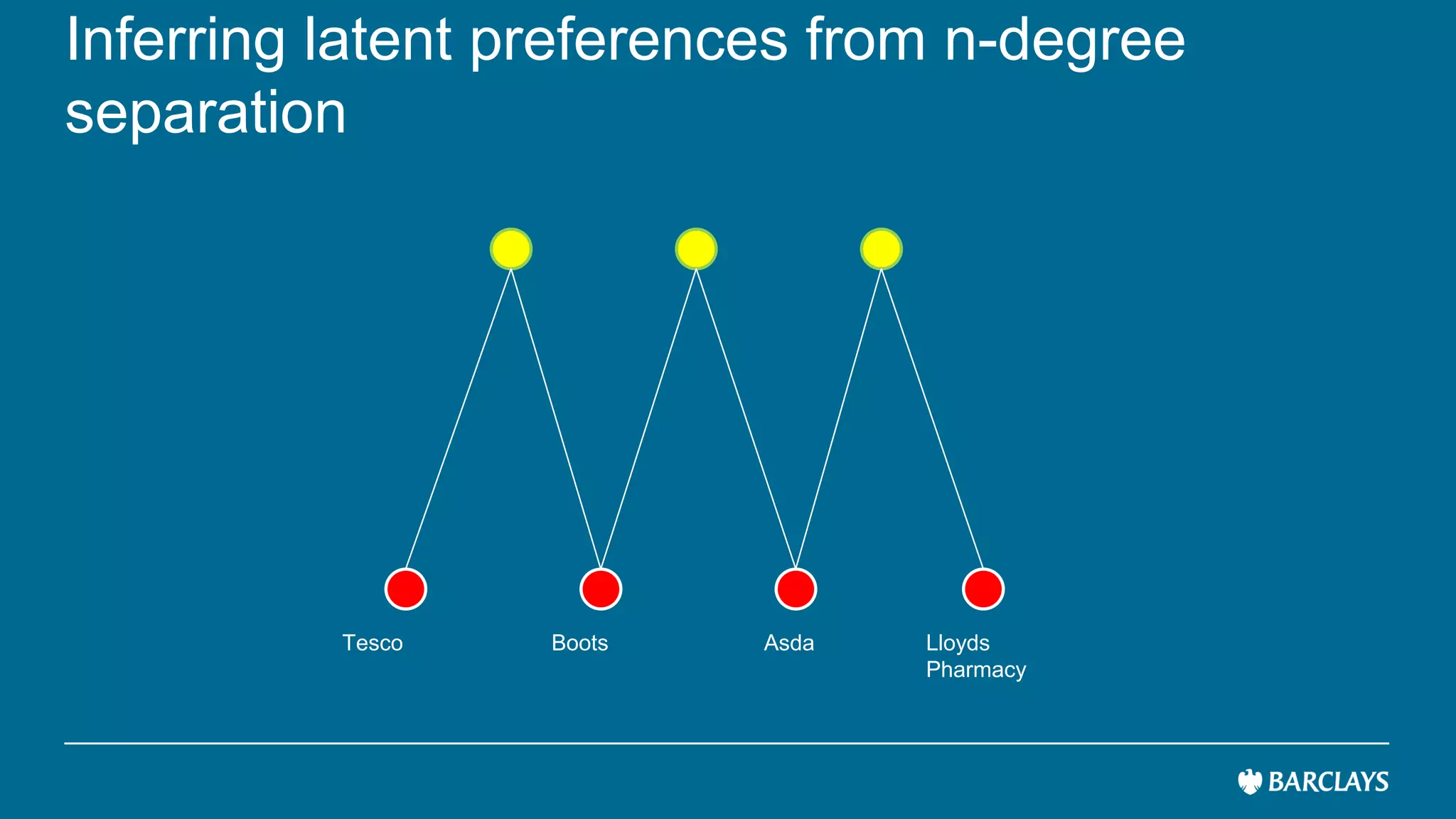
Inferring latent preferences from n-degree
separation
Tesco Boots Asda Lloyds
Pharmacy
Tesco
Asda
BP
Boots
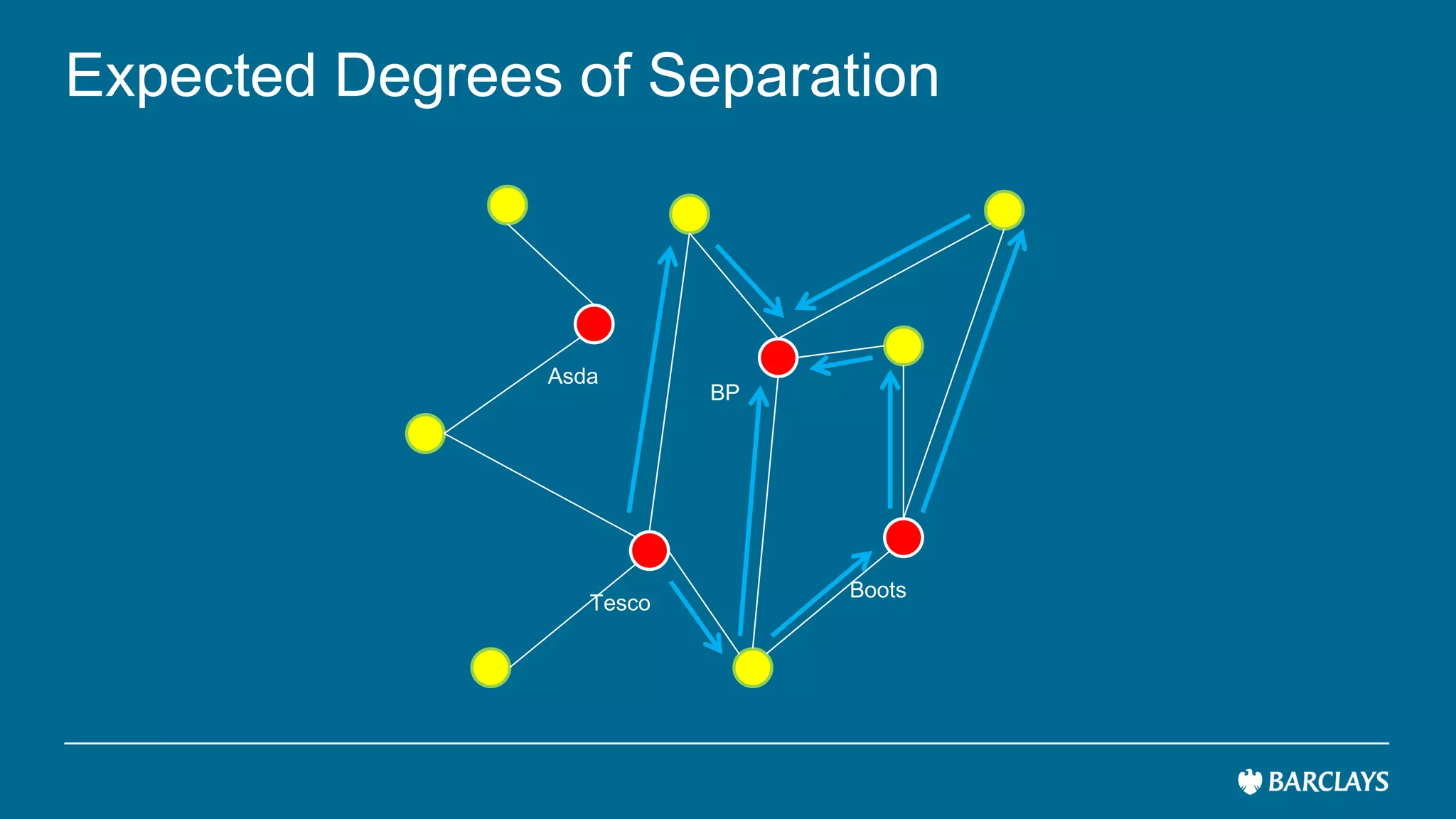
Expected Degrees of Separation
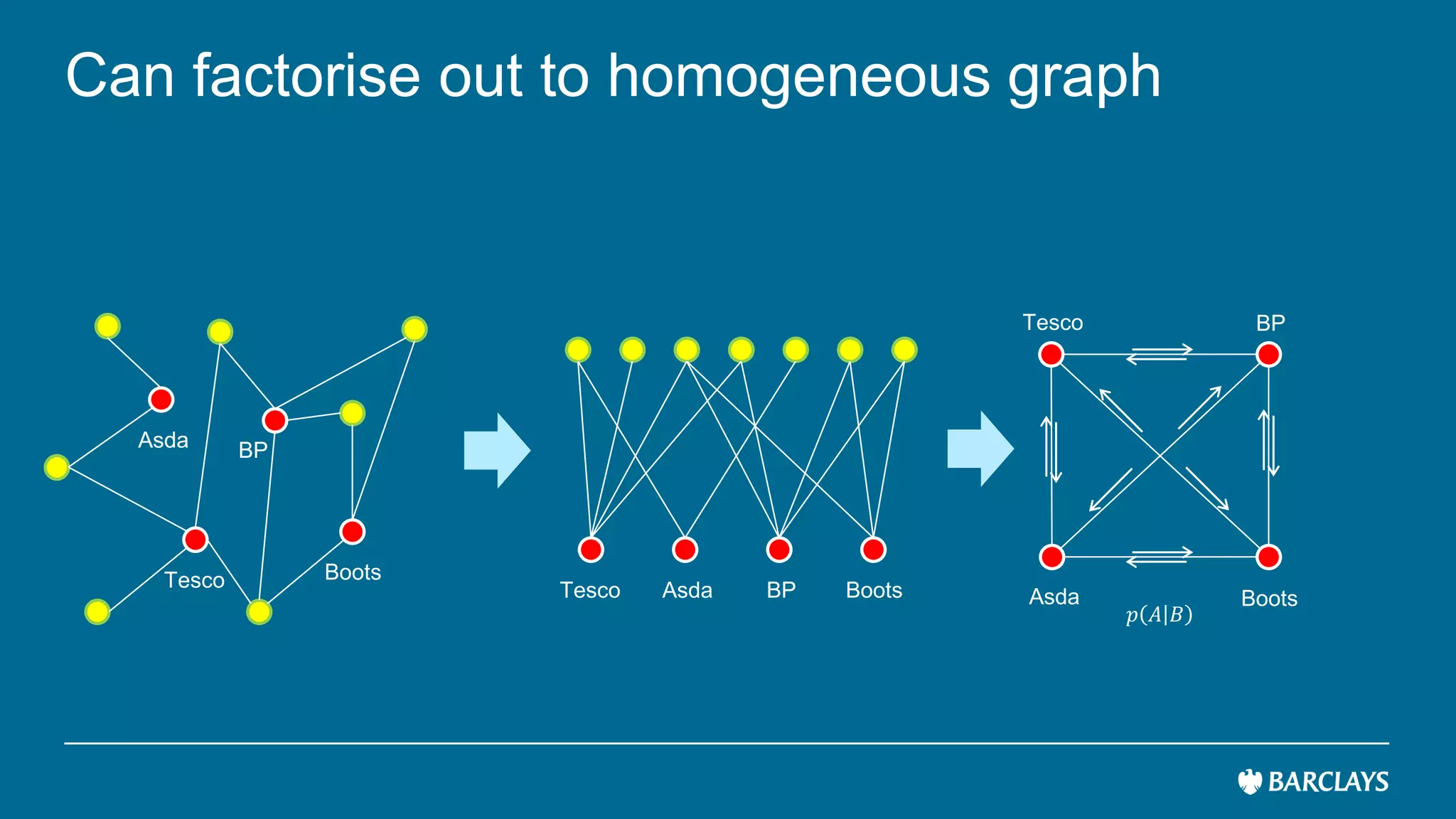
Can factorise out to homogeneous graph
Tesco Asda BP BootsTesco
Asda BP
Boots
Tesco
Asda
BP
Boots
𝑝 𝐴 𝐵
Large number of paths
Each node has a few
thousand outgoing
edges
Destination
Business
a
d
aa
b c
bc d d
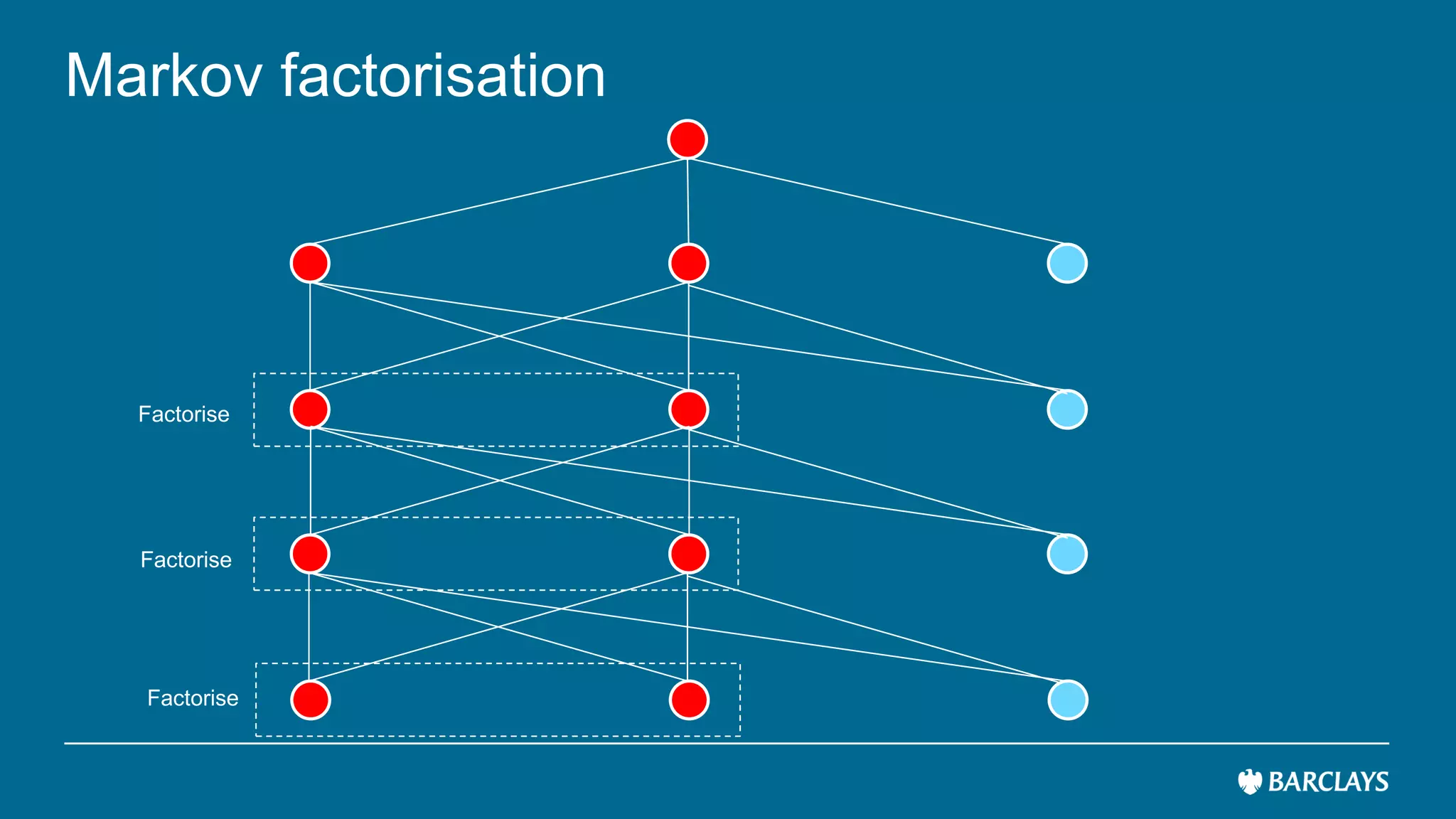
Markov factorisation
Factorise
Factorise
Factorise
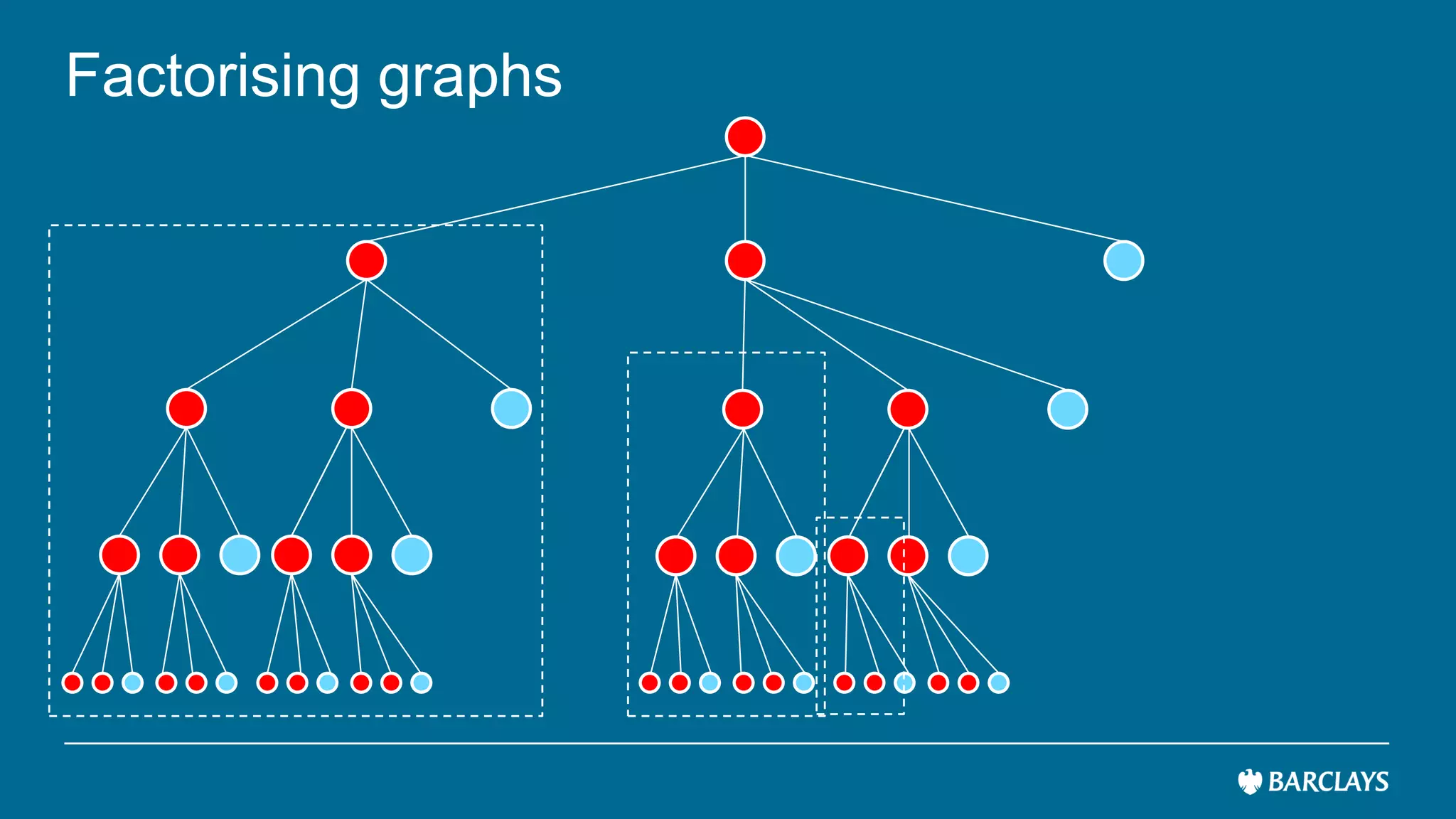
Factorising graphs
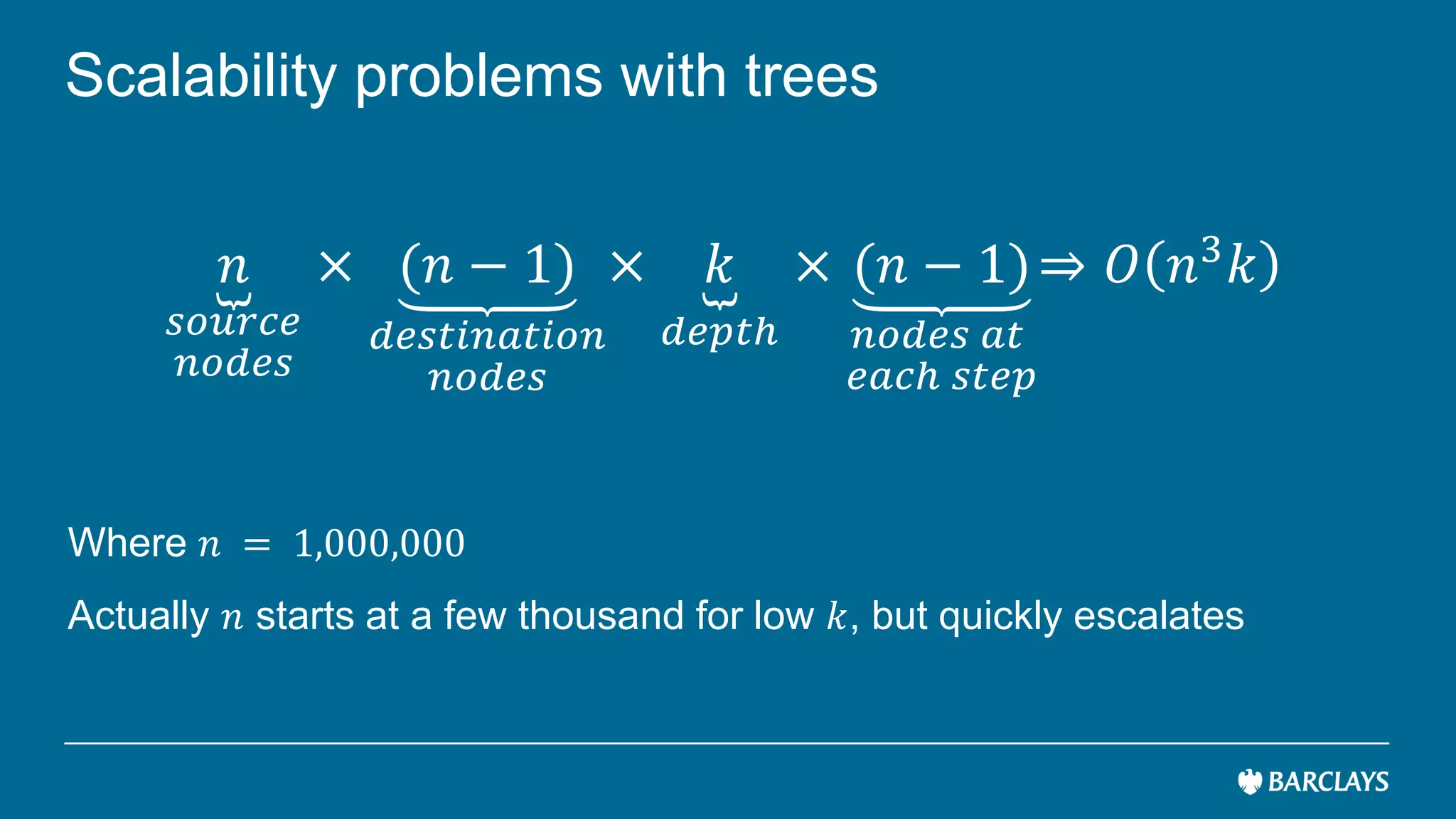
Scalability problems with trees
Where 𝑛 = 1,000,000
Actually 𝑛 starts at a few thousand for low 𝑘, but quickly escalates
𝑛
𝑠𝑜𝑢𝑟𝑐𝑒
𝑛𝑜𝑑𝑒𝑠
× (𝑛 − 1)
𝑑𝑒𝑠𝑡𝑖𝑛𝑎𝑡𝑖𝑜𝑛
𝑛𝑜𝑑𝑒𝑠
× 𝑘
𝑑𝑒𝑝𝑡ℎ
× (𝑛 − 1)
𝑛𝑜𝑑𝑒𝑠 𝑎𝑡
𝑒𝑎𝑐ℎ 𝑠𝑡𝑒𝑝
⇒ 𝑂 𝑛3 𝑘
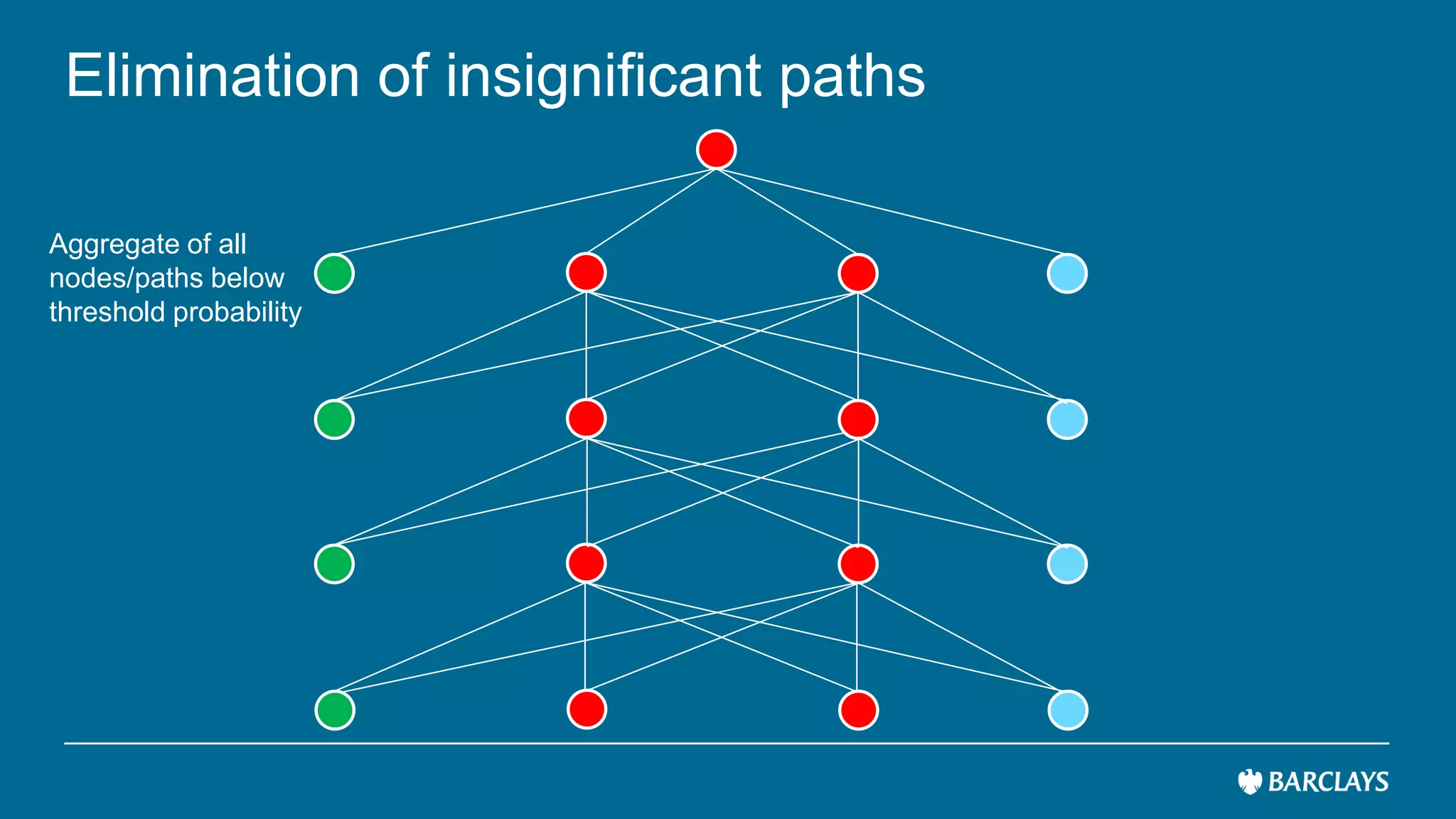
Elimination of insignificant paths
Aggregate of all
nodes/paths below
threshold probability
Comparing PageRank and Asymptotic EDS
PageRank: stationary distribution non-absorbing (eigenvector)
EDS: we would like to know how far we need to go (on average) to hit B
starting from A
Comment on ergodicity and teleporting
 Teleporting solely mechanism to get around non-ergodic graphs
 We assume a connected graph (eliminate graphs that only have
customers that solely shop with them) natural for retail not for websites.
Absorbing transition matrix
Discrete phase type distribution
– Computes EDS for all sources to single destination
– Gives exact results
𝑃 =
𝑇 𝑡
0 1
, 𝐸𝐷𝑆 = 𝐼 − 𝑇 −1
Spark implementation of Absorbing Transition
Matrix
[Spark code]
Has unacceptably high complexity (𝑂(𝑛4)) due to inverting large matrix
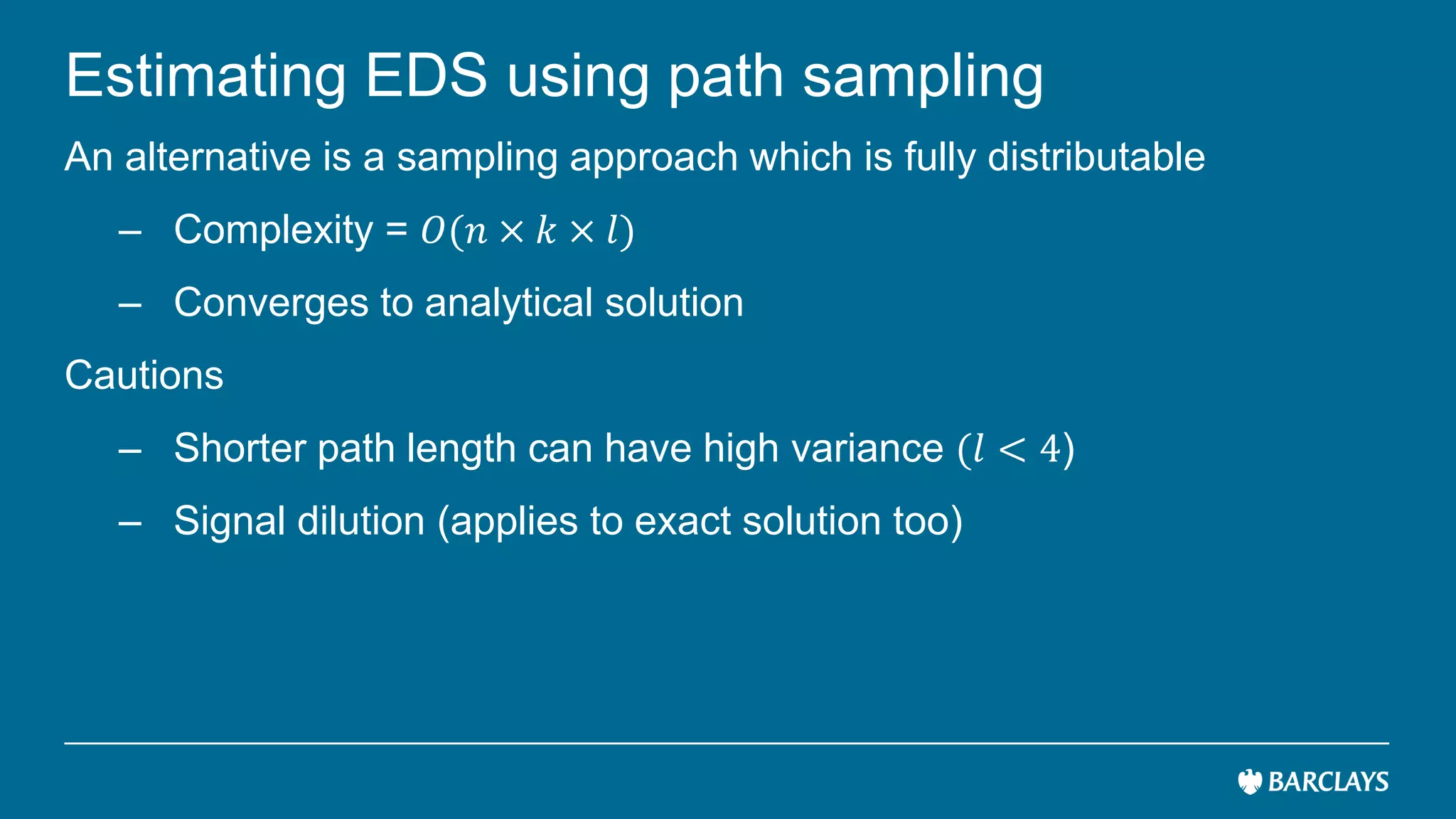
Estimating EDS using path sampling
An alternative is a sampling approach which is fully distributable
– Complexity = 𝑂(𝑛 × 𝑘 × 𝑙)
– Converges to analytical solution
Cautions
– Shorter path length can have high variance (𝑙 < 4)
– Signal dilution (applies to exact solution too)
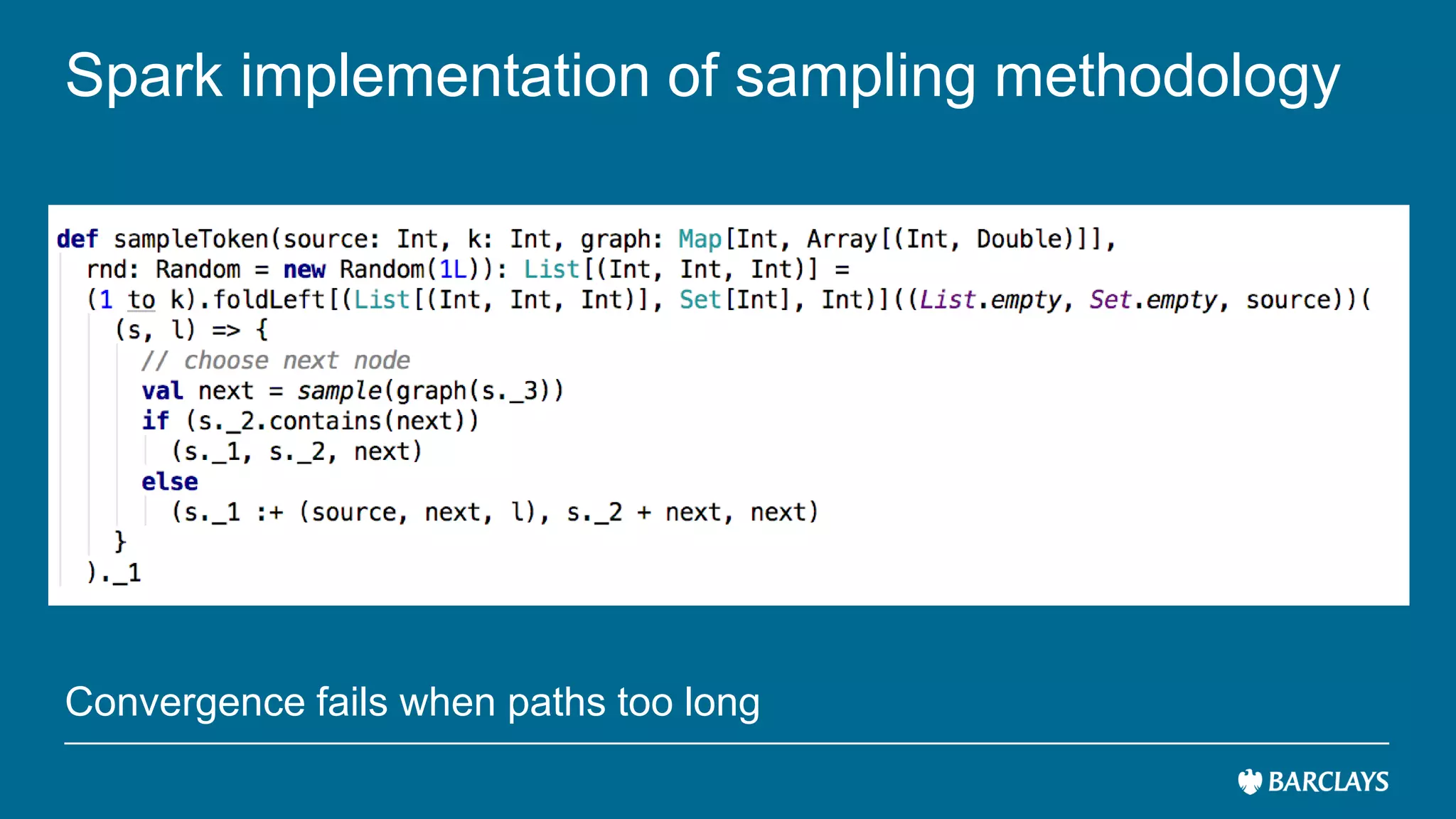
Spark implementation of sampling methodology
Convergence fails when paths too long
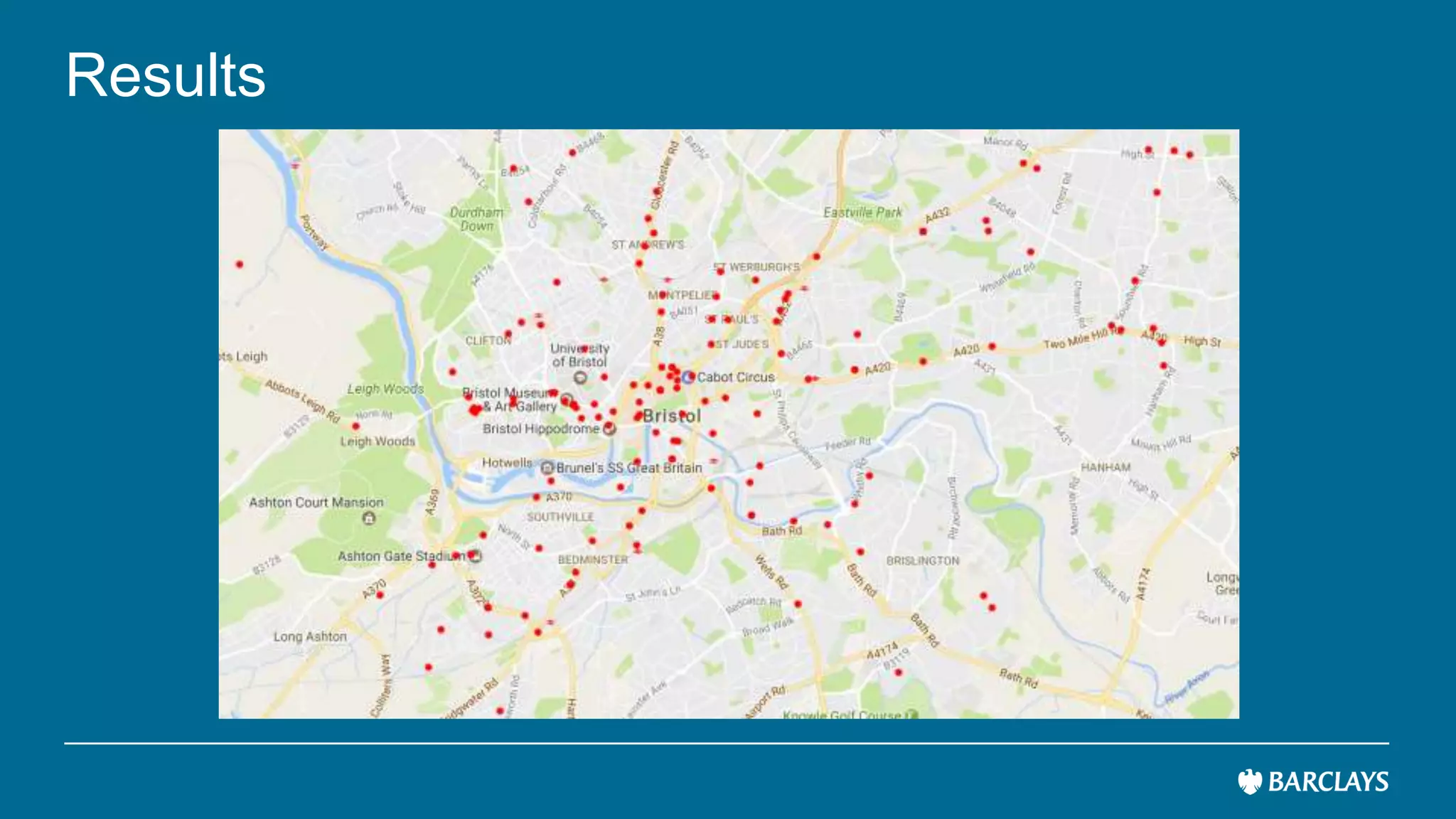
Results
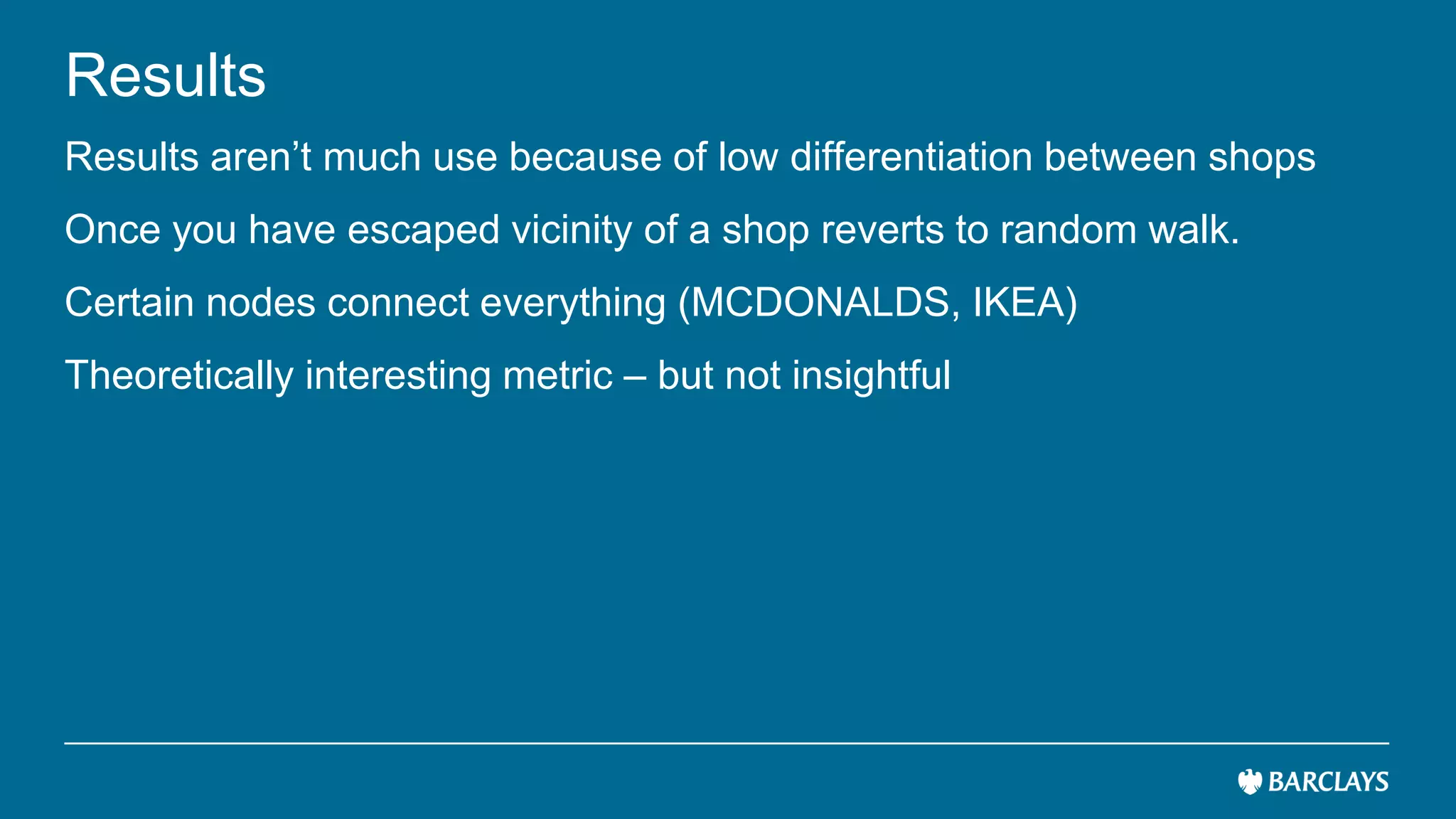
Results
MCDONALDS PRIMARK STORES LTD
PRIMARK STORES LTD 90.8 MCDONALDS 53.7
LIDL 105.3 LIDL 105.0
BOOTS 121.2 BOOTS 120.1
ALDI 123.2 ALDI 122.8
MARKS&SPENCER PLC 126.9 MARKS&SPENCER
PLC
126.2
POST OFFICE COUNTER 128.2 POST OFFICE
COUNTER
128.2
GREGGS PLC 154.1 GREGGS PLC 154.2
Results vs Pagerank
Pagerank EDS
SEVERN RIVER CROSSIN
PLC
MCDONALDS
MCDONALDS PRIMARK STORES LDT
POST OFFICE COUNTER LIDL
LIDL BOOTS
PRIMARK STORES ALDI
ALDI MARKS&SPENCER PLC
MARTIN MCCOLL POST OFFICE COUNTER
MARKS&SPENCER PLC GREGGS PLC
Results
Results aren’t much use because of low differentiation between shops
Once you have escaped vicinity of a shop reverts to random walk.
Certain nodes connect everything (MCDONALDS, IKEA)
Theoretically interesting metric – but not insightful
Localised EDS
Localised EDS
𝑃 =
𝑇 𝑡
0 1
We use that 𝑃 𝑘 which yields the results for the k-neighbourhood
Set k according to the problem at hand (eg. 5, 10, 20, …)
Spark implementation of Localised EDS
Brute force GPU implementation of Localised
EDS
Brute force matrix multiplication using GPUs
Parallelisation can be achieved by destination node
Sort-of scales (𝑂(𝑘 . 𝑛3
) ) as long as matrix fits into memory
Can be faster than Spark
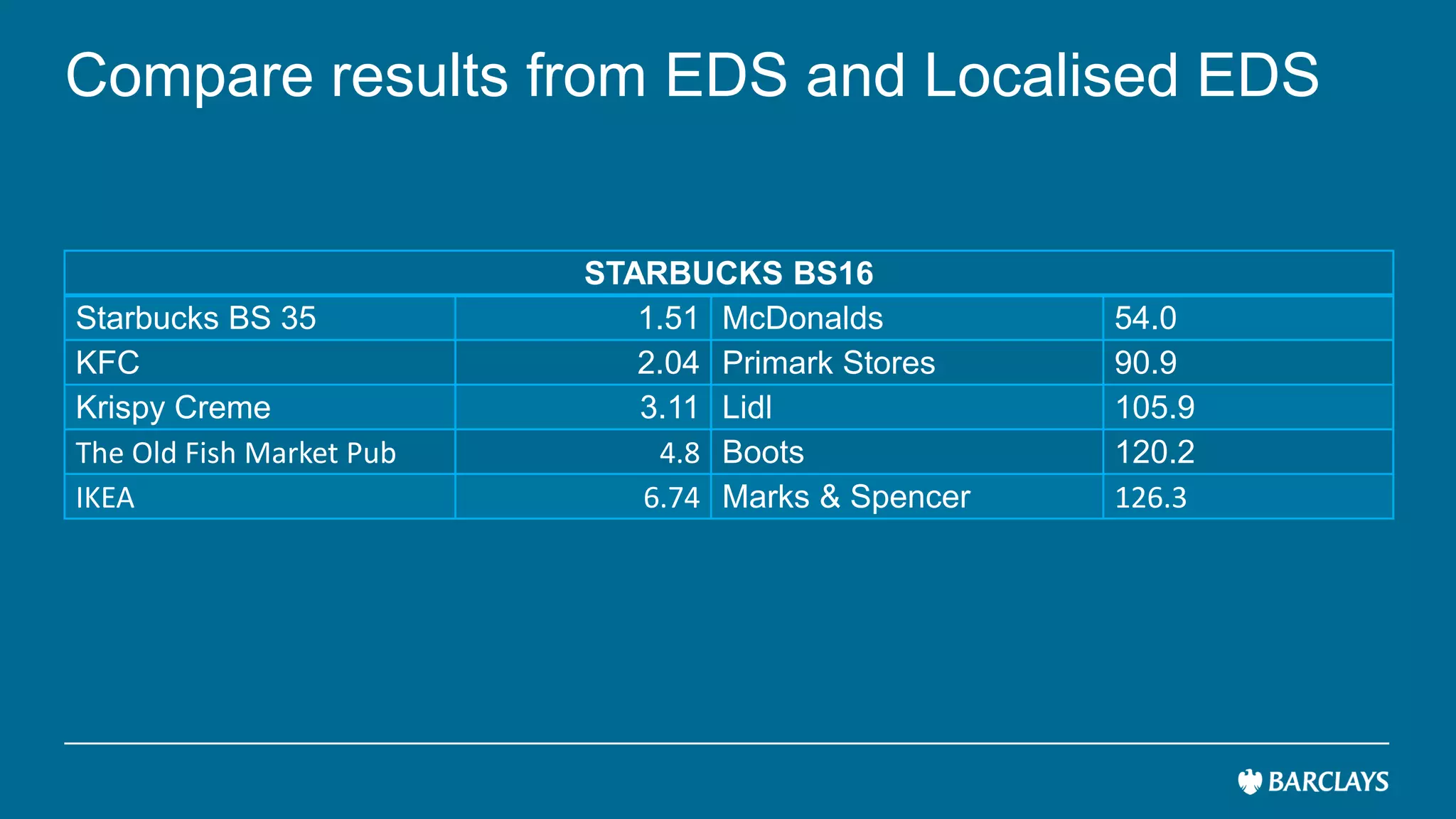
Compare results from EDS and Localised EDS
STARBUCKS BS16
Starbucks BS 35 1.51 McDonalds 54.0
KFC 2.04 Primark Stores 90.9
Krispy Creme 3.11 Lidl 105.9
The Old Fish Market Pub 4.8 Boots 120.2
IKEA 6.74 Marks & Spencer 126.3
Summary
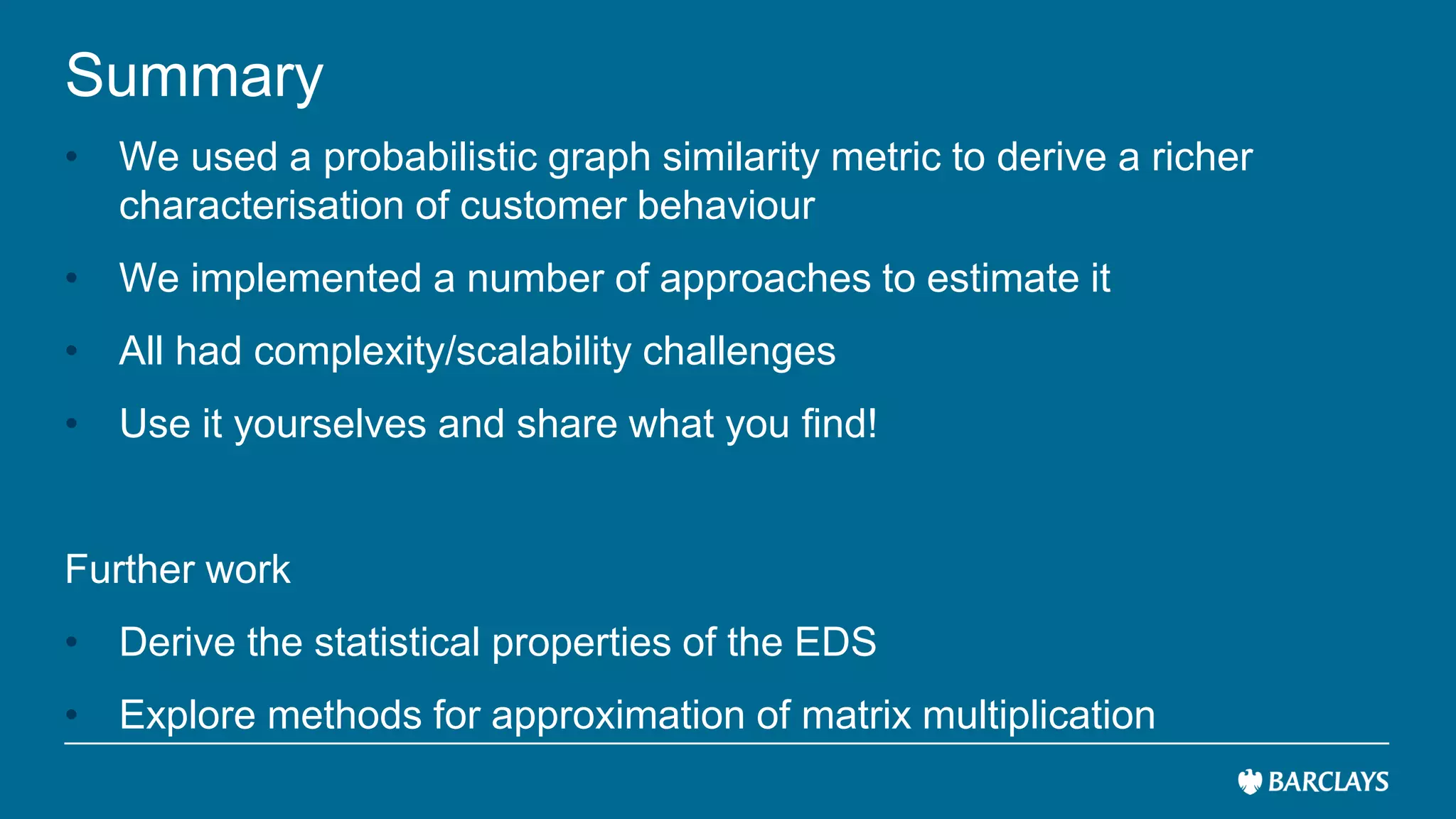
• We used a probabilistic graph similarity metric to derive a richer
characterisation of customer behaviour
• We implemented a number of approaches to estimate it
• All had complexity/scalability challenges
• Use it yourselves and share what you find!
Further work
• Derive the statistical properties of the EDS
• Explore methods for approximation of matrix multiplication
Data Science Section
….coming soon!

Graph Recommendations

  • 1.
    Graph Recommendations Harry Powell& Raffael Strassnig Advanced Data Analytics - Barclays
  • 2.
    Customer values andrecommendation engines Understanding customer values is a similar problem to recommendation – How is Tesco similar to Asda? – How is Tesco in Bristol similar to Asda in Bath? – How is Tesco in Bristol similar to Bristol Angling Centre? Assume that the similarity of two businesses can be inferred by the extent to which they share customers
  • 3.
    The data: Customertransactions Timestam p Customer Business Amount (£) … Bob Smith Tesco, Bristol … … Mary Jones Tesco, Bristol … … Bob Smith Asda, Bath … … John Taylor Bristol Angling Centre …
  • 4.
    Transactional data canbe seen as a bipartite graph Tesco Asda BP Boots Timestam p CustomerI D MerchantName Amount (£) … 1 Tesco … … 1 Asda … … 2 Boots … … 2 BP … … 3 Tesco … … 3 Boots … … 3 BP … … 4 Asda …
  • 5.
    Transactions imply customerpreferences over business values Tesco  Price Quality Boots  Health ? Price ? ? Quality ? Asda  Price Customer Business
  • 6.
    Problems with conventionalsimilarity metrics Conventional recommenders (say Cosine similarity) are useless in sparsely connected networks 𝐴𝑠𝑑𝑎 = 𝐀 = (1,1,1,0,1,1,0,0) 𝑇𝑒𝑠𝑐𝑜 = 𝐁 = 1,0,1,0,1,1,0,1 𝐀 ⋅ 𝐁 = 𝐀 𝐁 cos 𝜃 Customer Tesco Asda Bob Smith Yes Yes Mary Jones No Yes John Taylor Yes Yes Jane Williams No No Gary Brown Yes Yes Liz Davis Yes Yes David Evans No No Helen Wilson Yes No
  • 7.
    Problems with conventionalgraph metrics Conventional graph metrics (say minimum distance) are useless in networks with significant hubs.
  • 8.
    Inferring latent preferencesfrom n-degree separation Tesco Boots Asda Lloyds Pharmacy
  • 9.
  • 10.
    Can factorise outto homogeneous graph Tesco Asda BP BootsTesco Asda BP Boots Tesco Asda BP Boots 𝑝 𝐴 𝐵
  • 11.
    Large number ofpaths Each node has a few thousand outgoing edges Destination Business a d aa b c bc d d
  • 12.
  • 13.
  • 14.
    Scalability problems withtrees Where 𝑛 = 1,000,000 Actually 𝑛 starts at a few thousand for low 𝑘, but quickly escalates 𝑛 𝑠𝑜𝑢𝑟𝑐𝑒 𝑛𝑜𝑑𝑒𝑠 × (𝑛 − 1) 𝑑𝑒𝑠𝑡𝑖𝑛𝑎𝑡𝑖𝑜𝑛 𝑛𝑜𝑑𝑒𝑠 × 𝑘 𝑑𝑒𝑝𝑡ℎ × (𝑛 − 1) 𝑛𝑜𝑑𝑒𝑠 𝑎𝑡 𝑒𝑎𝑐ℎ 𝑠𝑡𝑒𝑝 ⇒ 𝑂 𝑛3 𝑘
  • 15.
    Elimination of insignificantpaths Aggregate of all nodes/paths below threshold probability
  • 16.
    Comparing PageRank andAsymptotic EDS PageRank: stationary distribution non-absorbing (eigenvector) EDS: we would like to know how far we need to go (on average) to hit B starting from A Comment on ergodicity and teleporting  Teleporting solely mechanism to get around non-ergodic graphs  We assume a connected graph (eliminate graphs that only have customers that solely shop with them) natural for retail not for websites.
  • 17.
    Absorbing transition matrix Discretephase type distribution – Computes EDS for all sources to single destination – Gives exact results 𝑃 = 𝑇 𝑡 0 1 , 𝐸𝐷𝑆 = 𝐼 − 𝑇 −1
  • 18.
    Spark implementation ofAbsorbing Transition Matrix [Spark code] Has unacceptably high complexity (𝑂(𝑛4)) due to inverting large matrix
  • 19.
    Estimating EDS usingpath sampling An alternative is a sampling approach which is fully distributable – Complexity = 𝑂(𝑛 × 𝑘 × 𝑙) – Converges to analytical solution Cautions – Shorter path length can have high variance (𝑙 < 4) – Signal dilution (applies to exact solution too)
  • 20.
    Spark implementation ofsampling methodology Convergence fails when paths too long
  • 21.
  • 22.
    Results MCDONALDS PRIMARK STORESLTD PRIMARK STORES LTD 90.8 MCDONALDS 53.7 LIDL 105.3 LIDL 105.0 BOOTS 121.2 BOOTS 120.1 ALDI 123.2 ALDI 122.8 MARKS&SPENCER PLC 126.9 MARKS&SPENCER PLC 126.2 POST OFFICE COUNTER 128.2 POST OFFICE COUNTER 128.2 GREGGS PLC 154.1 GREGGS PLC 154.2
  • 23.
    Results vs Pagerank PagerankEDS SEVERN RIVER CROSSIN PLC MCDONALDS MCDONALDS PRIMARK STORES LDT POST OFFICE COUNTER LIDL LIDL BOOTS PRIMARK STORES ALDI ALDI MARKS&SPENCER PLC MARTIN MCCOLL POST OFFICE COUNTER MARKS&SPENCER PLC GREGGS PLC
  • 24.
    Results Results aren’t muchuse because of low differentiation between shops Once you have escaped vicinity of a shop reverts to random walk. Certain nodes connect everything (MCDONALDS, IKEA) Theoretically interesting metric – but not insightful
  • 25.
  • 26.
    Localised EDS 𝑃 = 𝑇𝑡 0 1 We use that 𝑃 𝑘 which yields the results for the k-neighbourhood Set k according to the problem at hand (eg. 5, 10, 20, …)
  • 27.
  • 28.
    Brute force GPUimplementation of Localised EDS Brute force matrix multiplication using GPUs Parallelisation can be achieved by destination node Sort-of scales (𝑂(𝑘 . 𝑛3 ) ) as long as matrix fits into memory Can be faster than Spark
  • 29.
    Compare results fromEDS and Localised EDS STARBUCKS BS16 Starbucks BS 35 1.51 McDonalds 54.0 KFC 2.04 Primark Stores 90.9 Krispy Creme 3.11 Lidl 105.9 The Old Fish Market Pub 4.8 Boots 120.2 IKEA 6.74 Marks & Spencer 126.3
  • 30.
    Summary • We useda probabilistic graph similarity metric to derive a richer characterisation of customer behaviour • We implemented a number of approaches to estimate it • All had complexity/scalability challenges • Use it yourselves and share what you find! Further work • Derive the statistical properties of the EDS • Explore methods for approximation of matrix multiplication
  • 31.

Editor's Notes

  • #2 Introduction to Barclays Advanced Data Analytics (ADA) ADA is a data science team which innovates, designs and builds applications that deliver, direct to customers, relevant analytical content that will help them make smart decisions to improve their lives. We are aim to make applications that will revolutionise the way Barclays relates to our customers. The long term vision is to give each of our customers the same level of engagement and support in planning their finances and their lives as they would have if they were billionaires.