Milan – July 13 2016
Introduction to
Distributed Computing Engines for
Data Processing
Simone Robutti
Machine Learning Engineer at Radicalbit
@SimoneRobutti
What is a Distributed Computing System
It’s the solution to the problem where your
RAM is too small and your data are too big
and/or too CPU-intensive to be processed on
a single machine.
What is a Distributed Computing System
Solution: a huge, monolithic mainframe.
What is a Distributed Computing System
Solution: a huge, monolithic mainframe.
What is a Distributed Computing System
Solution: do your job on a cluster.
Distributed vs Parallel
Parallel: execute identical tasks (with different data
or parameters).
Parallel Distributed: do this on multiple machines.
Distributed: split a big task into smaller tasks and
execute them on multiple machines
What is a Distributed Computing System
Goal: the programmer should write its
programs easily and efficiently without caring
about distribution.
Issues: a cluster is complex and conceptually
very far from a local environment.
Hadoop
What: the first OSS distributed computing engine.
When: 2006 (work began).
Where: Google.
Why: Google had a lot of data (for that time) to process. They built
a solution. Eventually it became a series of papers and got
implemented as OSS.
How: HDFS (distributed file system), MapReduce (computational
abstraction), YARN (resource and cluster manager).
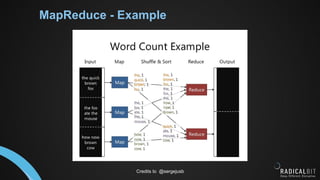
MapReduce - Example
Credits to @sergejusb
Hadoop Today
Common in many enterprise environments.
Still good enough for many batch processing use cases.
HDFS and Yarn widely used by other processing engines.
i.e.:
● Log analysis
● Clickstream analysis
● Text processing
Spark
What: a more generic distributed processing engine for batch and
streaming alike.
When: 2014 (1.0 Release).
Where: Berkeley + Databricks.
Why: They aimed for faster and more general processing with
better abstractions on top.
How: InMemory computing, DAG, RDD, polyglot functional API,
libraries out-of-the-box .
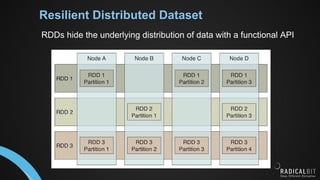
Resilient Distributed Dataset
RDDs hide the underlying distribution of data with a functional API
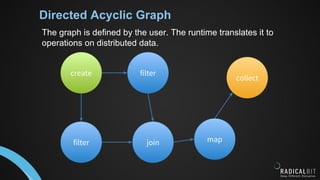
Directed Acyclic Graph
The graph is defined by the user. The runtime translates it to
operations on distributed data.
create filter
filter join
collect
map
Spark Today
The hot topic everyone talks about.
Just entered the phase of maturity, with an already huge and fast-
growing ecosystem of libraries, integrations and tools.
Widely used as the go-to solution for Big Data (and not-so-Big) use
cases.
I.e.:
● Recommending systems
● Fraud Detection
● Attack-Detection
● Near-Real time decision-heavy solutions
Flink
What: a streaming first (with batch on top), low latency distributed
processing engine.
When: 2016 (1.0 Release).
Where: German Research Foundation + dataArtisans.
Why: a faster and flexible computational model that could
guarantee low latency, high-throughput and fault-tolerance all at the
same time.
How: streaming-first approach, checkpointing, lazy symbolic
computation, powerful optimizations.
Flink Today
Perceived as an alternative to Spark. Gaining traction for specific
use-cases (real-time streaming) but performs well on most generic
uses cases.
Solid runtime and optimization; API and ecosystem still young.
Many big companies already adopted it for fast-data applications.
I.e.:
● Real-time precise analytics (counting)
● Real-time model evaluation
● Online Learning solutions
Alternative solutions
● Apache Storm/Heron
● Apache Samza
● Apache GearPump
● Apache Apex
Following next
"The Barclays Data Science Hackathon: Building
Retail Recommender Systems based on Customer
Shopping Behaviour" by Gianmario Spacagna, Senior Data
Scientist @ Pirelli
"Data intensive applications with Apache Flink" by
Simone Robutti, Machine Learning Engineer @ Radicalbit

Introduction to Distributed Computing Engines for Data Processing - Simone Robutti, Radicalbit

  • 1.
    Milan – July13 2016 Introduction to Distributed Computing Engines for Data Processing Simone Robutti Machine Learning Engineer at Radicalbit @SimoneRobutti
  • 2.
    What is aDistributed Computing System It’s the solution to the problem where your RAM is too small and your data are too big and/or too CPU-intensive to be processed on a single machine.
  • 3.
    What is aDistributed Computing System Solution: a huge, monolithic mainframe.
  • 4.
    What is aDistributed Computing System Solution: a huge, monolithic mainframe.
  • 5.
    What is aDistributed Computing System Solution: do your job on a cluster.
  • 6.
    Distributed vs Parallel Parallel:execute identical tasks (with different data or parameters). Parallel Distributed: do this on multiple machines. Distributed: split a big task into smaller tasks and execute them on multiple machines
  • 7.
    What is aDistributed Computing System Goal: the programmer should write its programs easily and efficiently without caring about distribution. Issues: a cluster is complex and conceptually very far from a local environment.
  • 8.
    Hadoop What: the firstOSS distributed computing engine. When: 2006 (work began). Where: Google. Why: Google had a lot of data (for that time) to process. They built a solution. Eventually it became a series of papers and got implemented as OSS. How: HDFS (distributed file system), MapReduce (computational abstraction), YARN (resource and cluster manager).
  • 9.
  • 10.
    Hadoop Today Common inmany enterprise environments. Still good enough for many batch processing use cases. HDFS and Yarn widely used by other processing engines. i.e.: ● Log analysis ● Clickstream analysis ● Text processing
  • 11.
    Spark What: a moregeneric distributed processing engine for batch and streaming alike. When: 2014 (1.0 Release). Where: Berkeley + Databricks. Why: They aimed for faster and more general processing with better abstractions on top. How: InMemory computing, DAG, RDD, polyglot functional API, libraries out-of-the-box .
  • 12.
    Resilient Distributed Dataset RDDshide the underlying distribution of data with a functional API
  • 13.
    Directed Acyclic Graph Thegraph is defined by the user. The runtime translates it to operations on distributed data. create filter filter join collect map
  • 14.
    Spark Today The hottopic everyone talks about. Just entered the phase of maturity, with an already huge and fast- growing ecosystem of libraries, integrations and tools. Widely used as the go-to solution for Big Data (and not-so-Big) use cases. I.e.: ● Recommending systems ● Fraud Detection ● Attack-Detection ● Near-Real time decision-heavy solutions
  • 15.
    Flink What: a streamingfirst (with batch on top), low latency distributed processing engine. When: 2016 (1.0 Release). Where: German Research Foundation + dataArtisans. Why: a faster and flexible computational model that could guarantee low latency, high-throughput and fault-tolerance all at the same time. How: streaming-first approach, checkpointing, lazy symbolic computation, powerful optimizations.
  • 16.
    Flink Today Perceived asan alternative to Spark. Gaining traction for specific use-cases (real-time streaming) but performs well on most generic uses cases. Solid runtime and optimization; API and ecosystem still young. Many big companies already adopted it for fast-data applications. I.e.: ● Real-time precise analytics (counting) ● Real-time model evaluation ● Online Learning solutions
  • 17.
    Alternative solutions ● ApacheStorm/Heron ● Apache Samza ● Apache GearPump ● Apache Apex
  • 18.
    Following next "The BarclaysData Science Hackathon: Building Retail Recommender Systems based on Customer Shopping Behaviour" by Gianmario Spacagna, Senior Data Scientist @ Pirelli "Data intensive applications with Apache Flink" by Simone Robutti, Machine Learning Engineer @ Radicalbit